- 1 hour 23 minutes2026 Hershey RV Show Rig and Gear Highlights (with Joshua Sheehan from RV Gear & Far)
Every year, America’s Largest RV Show in Hershey, Pennsylvania, offers an incredible opportunity to see what’s new in the RV industry. From lightweight campers and affordable travel trailers to luxurious fifth wheels and innovative camping accessories, the show provides a fascinating look at where RV design is headed.
But with hundreds of RVs on display, how do you separate genuinely useful innovations from features that simply look impressive on the showroom floor?
For this year’s Hershey RV Show recap, we welcomed Joshua Sheehan from RV Gear & Far back to The RV Atlas to share his favorite RVs, floor plans, and gear discoveries from the 2026 show.
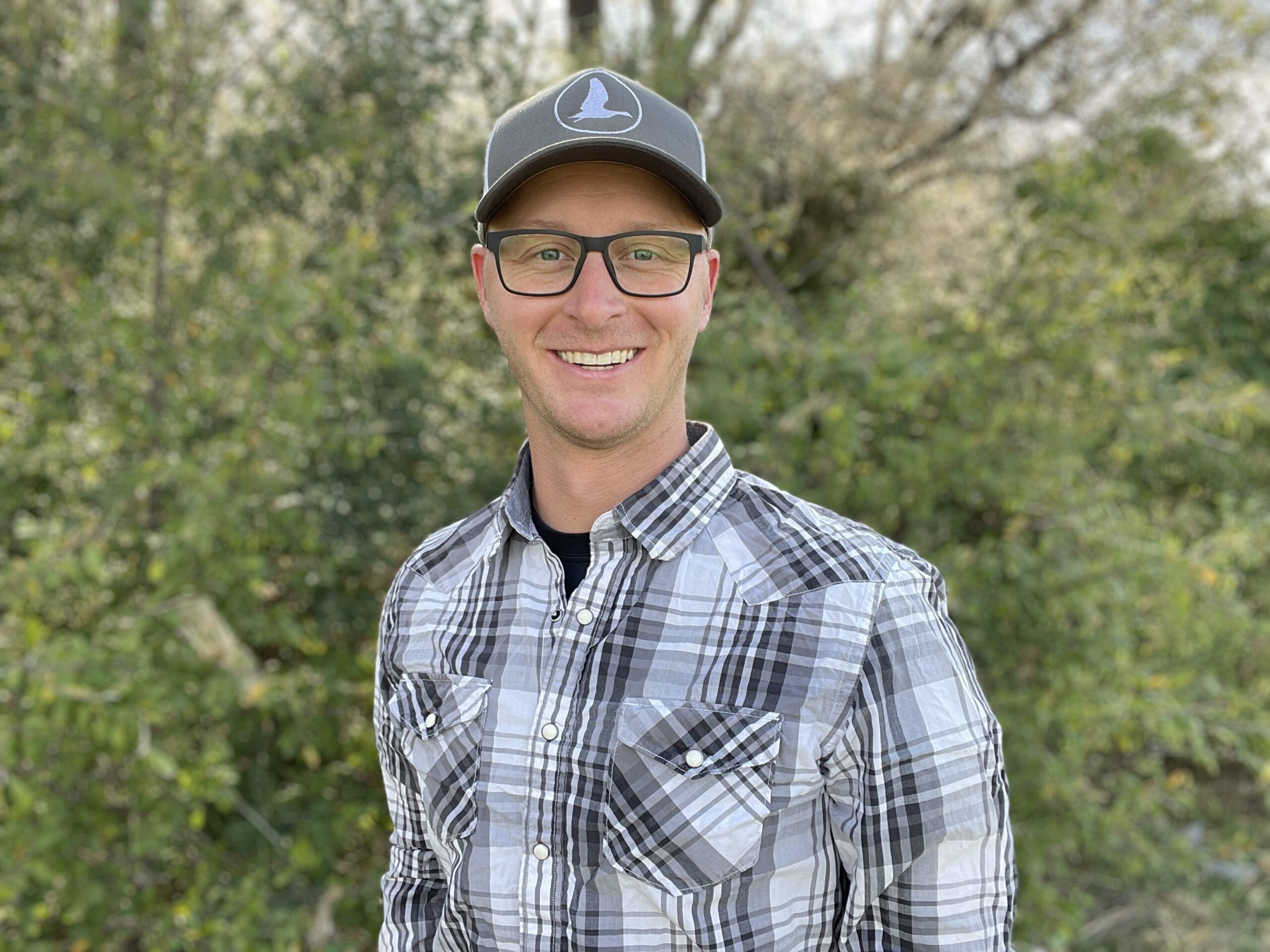
Joshua has been RVing for nearly eight years, starting with pop-up campers before moving into a 35-foot travel trailer. He and his wife spent more than two years traveling full-time with their twin boys before establishing a home base in the Midwest. Through his RV Gear &. Far YouTube channel, Joshua focuses on practical RV gear reviews, maintenance advice, and helping RV owners determine which products actually make sense for their needs.
That practical perspective is exactly what makes his Hershey picks so interesting. Rather than concentrating exclusively on the most expensive or luxurious RVs, Joshua selected models that solve real problems for campers.
His favorites range from compact Coleman travel trailers and lightweight Aliners to innovative Ember floor plans and premium fifth wheels from Keystone, Open Range, and Brinkley.
And after touring the RVs, he headed inside the Giant Center to find some interesting new gear and gadgets.
Here are Joshua’s favorite RVs and camping products from the 2026 Hershey RV Show, along with the features that made them stand out.
Listen to the complete episode of The RV Atlas below by clicking on the media player above or subscribing to the RV Atlas wherever you get your favorite shows!
Coleman 23TX: A Compact Toy Hauler with a Side-Entry Garage
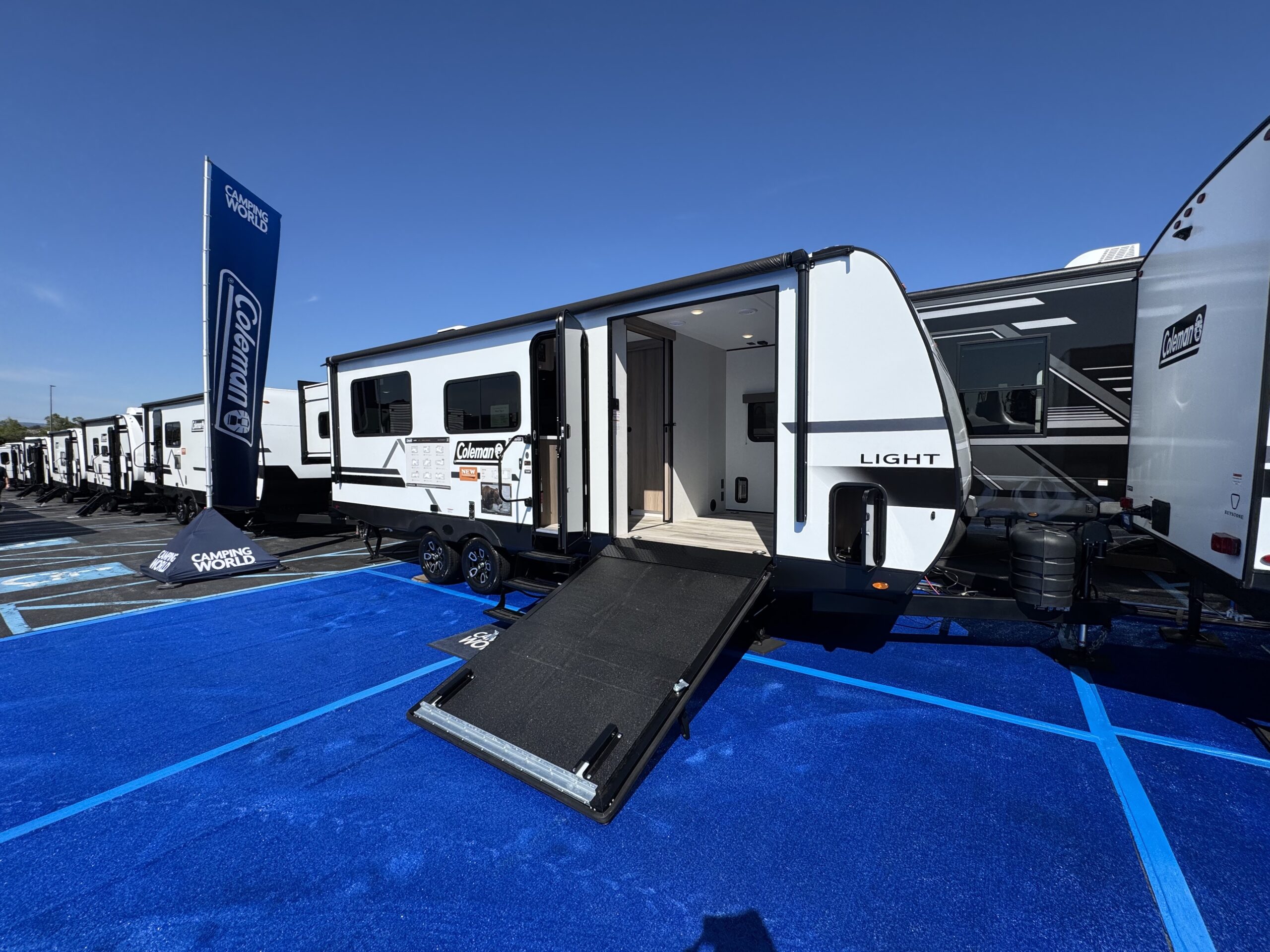
One of Joshua’s most interesting discoveries was the Coleman 23TX, a travel trailer that combines family-friendly sleeping accommodations with an unusually compact toy-hauler design.
Traditional toy haulers generally feature a large rear garage accessed through a ramp door. That works beautifully for campers transporting ATVs, motorcycles, or other large recreational vehicles, but not everyone needs an enormous garage.
For families transporting bicycles, smaller recreational equipment, or bulky camping supplies, all that garage space can be unnecessary.
The Coleman 23TX takes a different approach.
What Makes the Coleman 23TX Different?
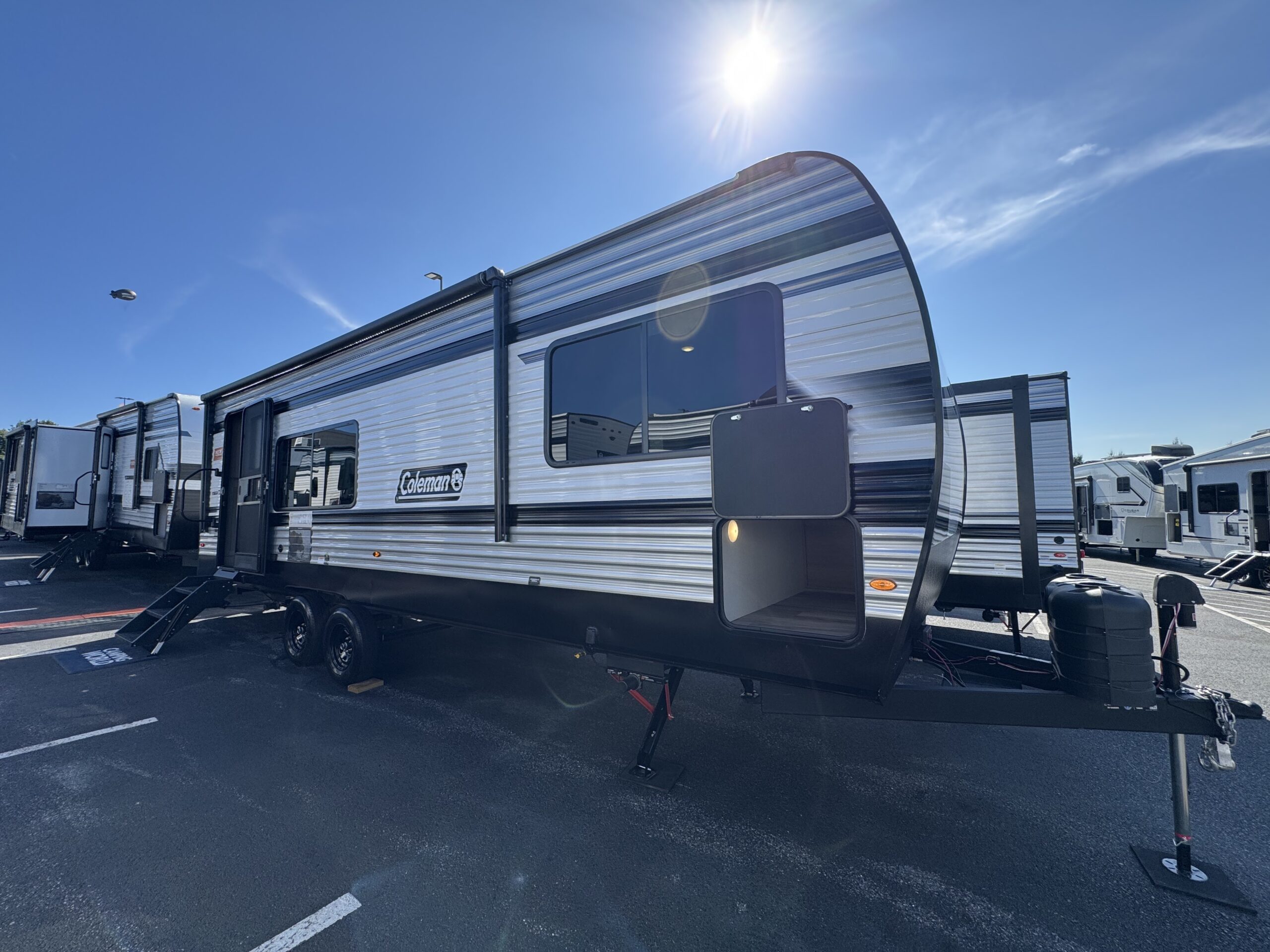
The 23TX is approximately 27 to 28 feet long, with a dry weight around 5,000 pounds. Its most distinctive feature is a side-entry garage located toward the front of the trailer.
Instead of opening from the rear, the ramp opens on the campsite side.
That might sound like a small change, but it’s surprisingly practical. Many campsites require RVers to back their trailers close to trees, landscaping, or the edge of the site. A traditional rear toy-hauler ramp may be difficult or impossible to lower after parking.
The side-entry design allows campers to access their equipment without worrying about clearance behind the RV.
The garage is large enough for bicycles, dirt bikes, and potentially a small four-wheeler, depending on the equipment’s dimensions and weight.
The front garage area also incorporates bunks, making the space multifunctional.
A Different Approach to the Main Bedroom
The Coleman 23TX uses another unusual feature to maximize interior space: a hard-sided rear bed slide.
Instead of dedicating the front of the trailer to a permanent queen bedroom, the main bed slides out from the rear of the RV, extending over the dinette area.
Joshua compared the concept to a hybrid camper, except that the slide-out is fully hard-sided.
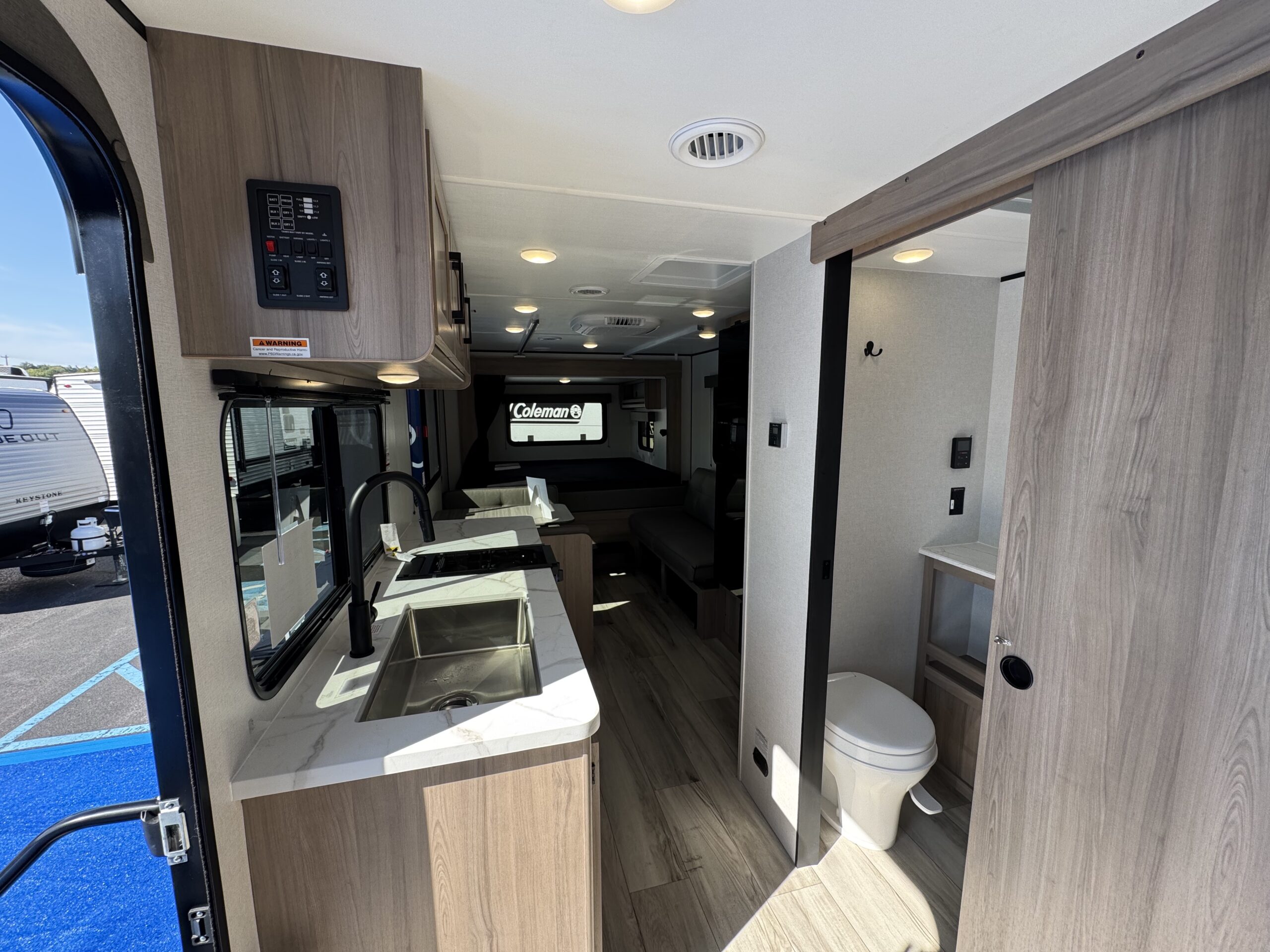
The main living area includes a kitchen, bathroom, and dinette.
The result is a compact travel trailer that offers sleeping accommodations for a family of four along with secure storage for outdoor equipment.
Who Is the Coleman 23TX Best For?
Joshua sees this floor plan working particularly well for active families with two children.
For families that regularly bring bicycles, outdoor gear, and other recreational equipment, having a dedicated enclosed storage area could eliminate many of the challenges associated with transporting equipment on exterior racks or in the tow vehicle.
We can certainly appreciate that advantage. When our family owned a toy hauler, we primarily used the garage for bicycles, kayaks, and camp cooking equipment rather than motorized recreational vehicles.
A smaller garage like this would have worked beautifully for much of our gear.
There are some compromises. Joshua pointed out that campers may need to unload equipment from the front garage before accessing the bunks. He also felt that the floor plan becomes less practical for families larger than four.
Jeremy found online prices in the upper $30,000 range, making the Coleman 23TX an intriguing option for buyers looking for a relatively affordable, compact toy hauler.
Coleman Lantern 25RK: Convertible Twin Beds or One King Bed
Joshua’s second Coleman pick wasn’t necessarily about an entirely new type of RV. Instead, it highlighted a simple floor-plan innovation that could make a travel trailer useful for a much wider variety of camping trips.
The Coleman Lantern 25RK features a convertible bedroom configuration that allows owners to choose between two twin beds and one large king-size sleeping area.
One Bedroom, Two Different Configurations
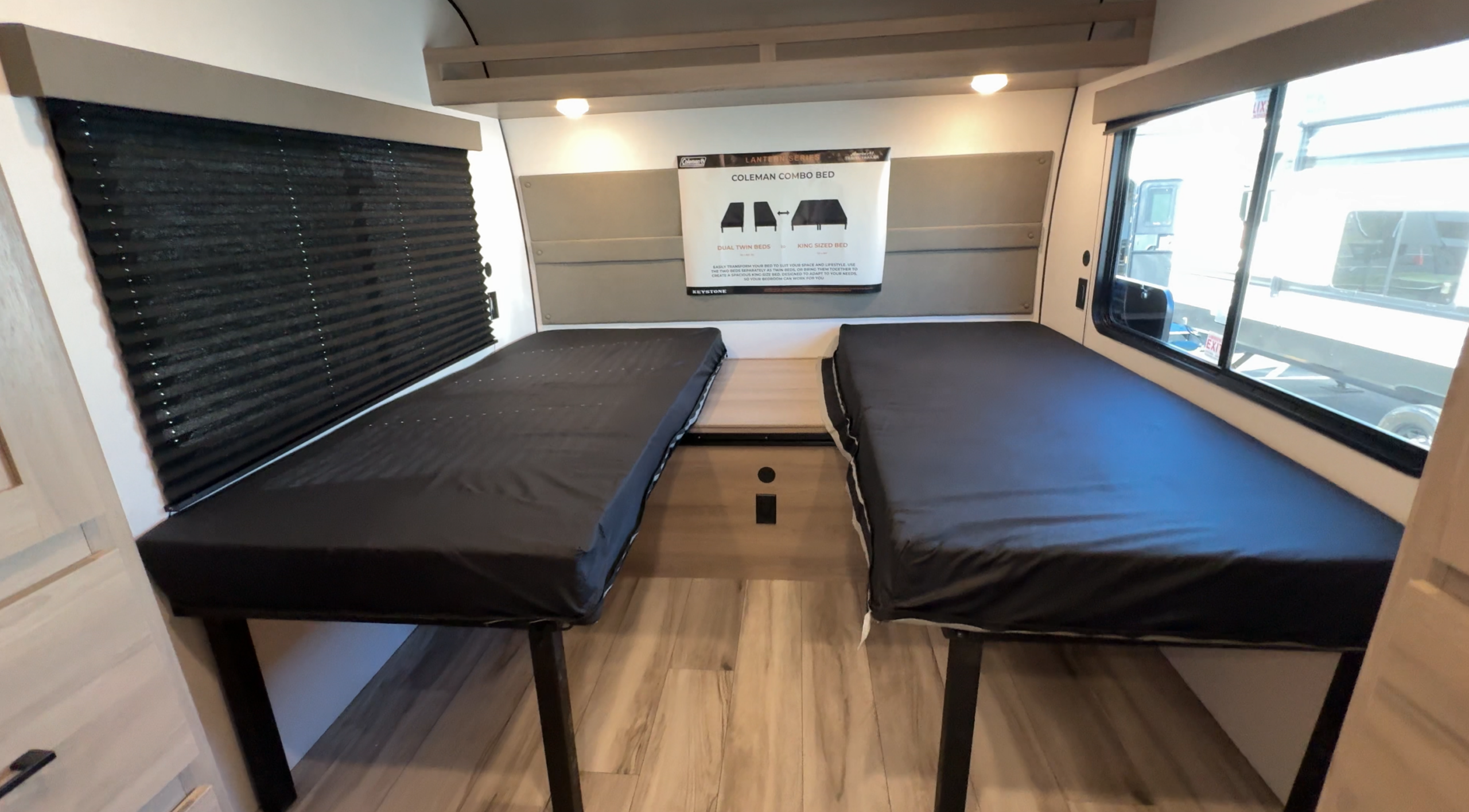
In a conventional travel trailer bedroom, the queen or king bed is usually permanently positioned in the center of the front bedroom.
The Coleman Lantern 25RK takes advantage of a platform extending over the front pass-through storage area, along with movable bed supports.
Owners can position the mattresses together to create a king-size bed or separate them into two twins with a walkway between them.
The conversion allows the same RV to accommodate different traveling companions without requiring anyone to sleep on a dinette or sofa.
For a couple taking a weekend trip, the king configuration makes perfect sense.
For a fishing trip with a friend, a father-and-son adventure, or a getaway with another family member, the twin-bed arrangement may be considerably more comfortable.
Why Flexible Bedrooms Are Becoming More Appealing
This is an innovation we’re increasingly seeing throughout the RV industry.
Jeremy mentioned similar convertible sleeping arrangements in newer nüCamp and inTech models.
The appeal is straightforward: one RV can accommodate several different styles of travel.
That flexibility becomes especially valuable as families change. Parents who initially purchase an RV for camping with young children may eventually find themselves taking more trips as a couple or traveling with friends.
The Coleman Lantern 25RK offers that adaptability in an entry-level travel trailer.
Joshua emphasized that the Coleman lineup remains relatively affordable, with traditional stick-and-tin construction. But entry-level pricing doesn’t mean manufacturers can’t introduce thoughtful, practical features.
Sometimes the most useful innovations are also the simplest.
Ember Touring 2850DBL: A Travel Trailer That Changes with Your Family
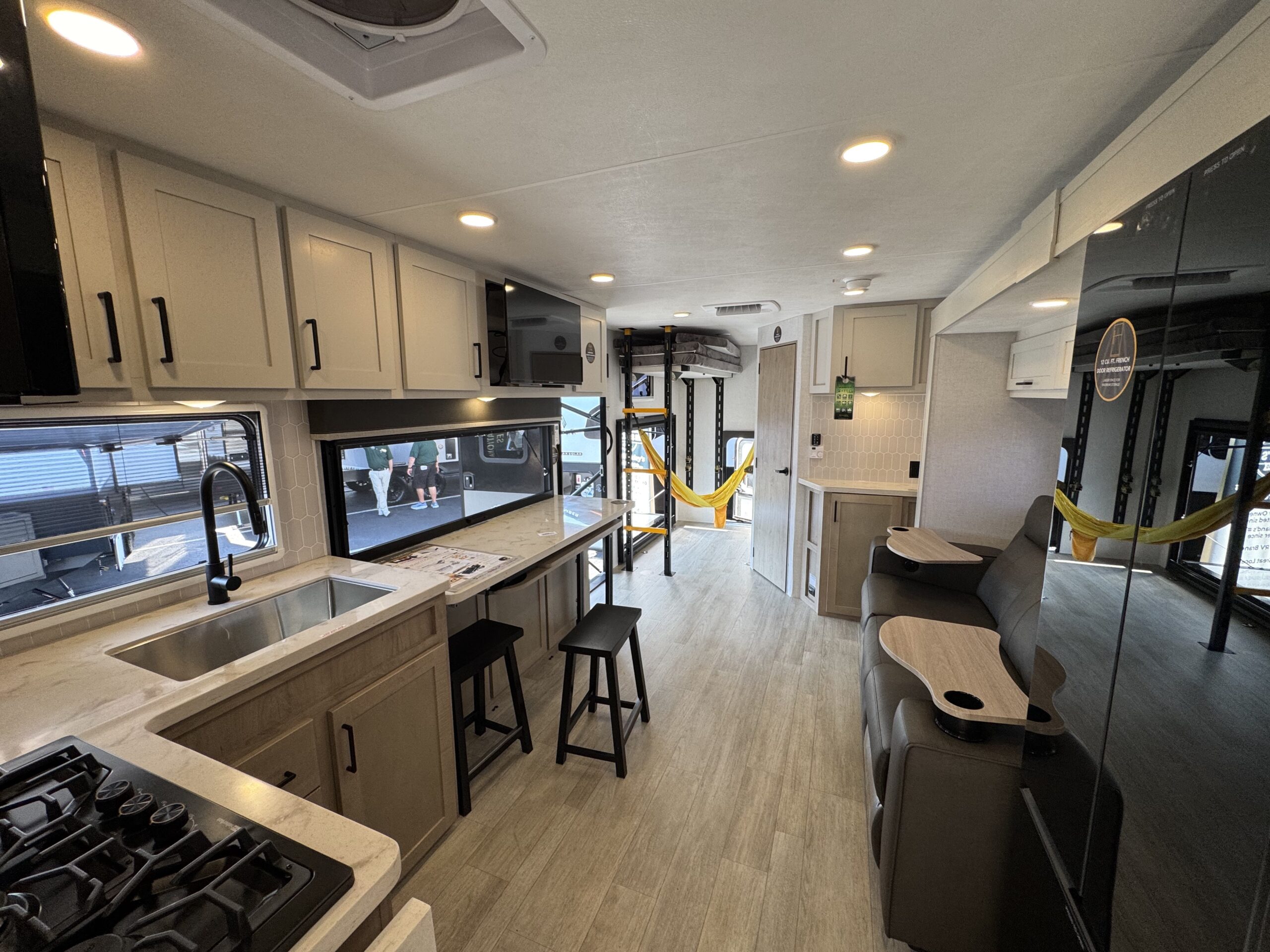

The Ember Touring 2850DBL was one of Joshua’s most enthusiastic picks from the entire show.
And by the end of the conversation, it was easy to understand why.
This travel trailer combines a dedicated primary bedroom with Ember’s innovative modular interior system, allowing owners to reconfigure the rear living space as their needs change.
Ember Touring 2850DBL Specifications

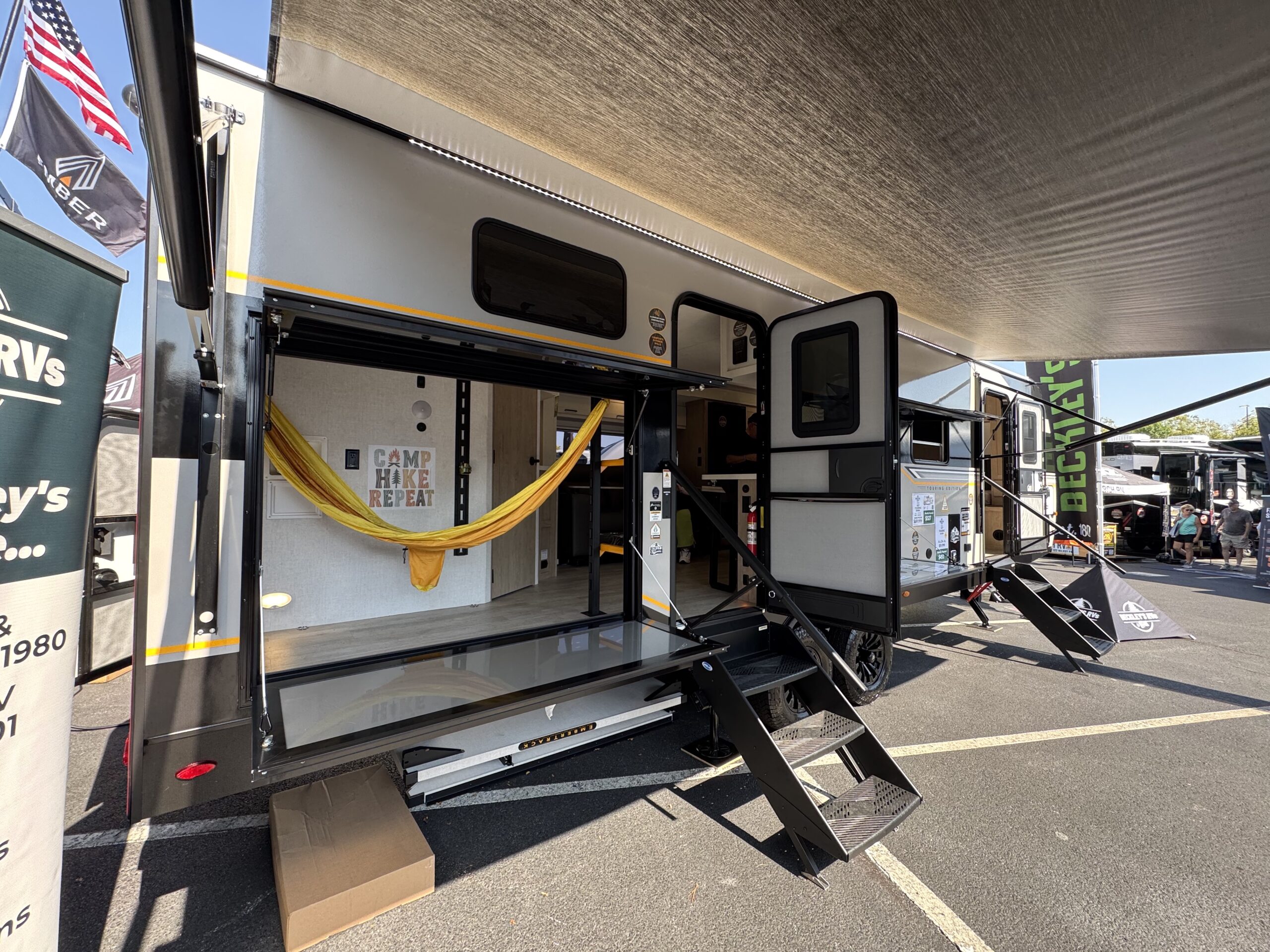
Joshua shared the following approximate specifications:
- Length: Just under 33 feet
- Dry weight: Approximately 7,300–7,400 pounds
- Freshwater capacity: Approximately 55 gallons
- Gray water capacity: Approximately 70 gallons
- Black water capacity: Approximately 35 gallons
- Pricing observed: Around $80,000
The Touring is a premium travel trailer designed for buyers looking for upgraded components, substantial amenities, and the ability to take longer trips.
Joshua highlighted Ember’s use of Furrion Chill Cube air conditioning systems and the CURT suspension system found on Touring models.
But the most compelling feature is the flexible rear living space.
The EmberTrack System
EmberTrack is a wall-mounted system that allows owners to reposition or replace furniture and accessories within designated areas of the RV.
Instead of permanently installing traditional bunk beds, Ember incorporates mounting tracks that can accommodate different configurations.
Owners can use the space for bunks, a desk, or additional storage.
The components can be repositioned as needed, and certain bunk configurations can be moved upward to open up the floor space.
Imagine purchasing an RV when your children are in elementary school.
During those early years, you might want traditional bunk beds.
As the kids become teenagers and start joining fewer family trips, you could convert part of that space into an office.
Later, when you’re primarily traveling as a couple, the same area could become storage for bicycles, hobbies, or other gear.
The ability to change the layout without replacing the RV is a major selling point.
A Dedicated Bedroom Makes the Difference
Ember has used modular interior concepts in other models, but Joshua particularly appreciated seeing the system incorporated into a larger travel trailer with a separate primary bedroom.
The Touring 2850DBL has a front bedroom with a closing door, providing privacy that isn’t always available in smaller, more flexible RV layouts.
There are also two exterior entry doors, a fold-down outdoor kitchen area, and a rear opening that can create a large window overlooking the campsite.
That rear space can be configured as an office with a view or even used as a screened area for pets.
Ember has demonstrated the concept as a catio, an enclosed outdoor-style space for cats.
It’s a great example of how one floor plan can serve very different kinds of campers.
Why This Floor Plan Could Save Families Money
The longer we RV, the more we appreciate floor plans that can evolve with our lives.
We’ve experienced firsthand how quickly family camping needs change.
When our boys were younger, dedicated bunks were essential. Now that they’re teenagers, not everyone joins every trip.
A traditional bunkhouse can eventually become an RV filled with beds that are rarely used.
The EmberTrack system addresses that problem directly.
And there’s a financial benefit.
Trading RVs frequently can be expensive, especially when depreciation and transaction costs are factored into the equation.
An RV that works for young children, teenagers, working adults, and eventually couples traveling alone could potentially remain useful for many more years.
That long-term adaptability is what makes the Ember Touring 2850DBL particularly exciting.
Keystone Montana 3600RO: A Fifth Wheel Designed for Working on the Road
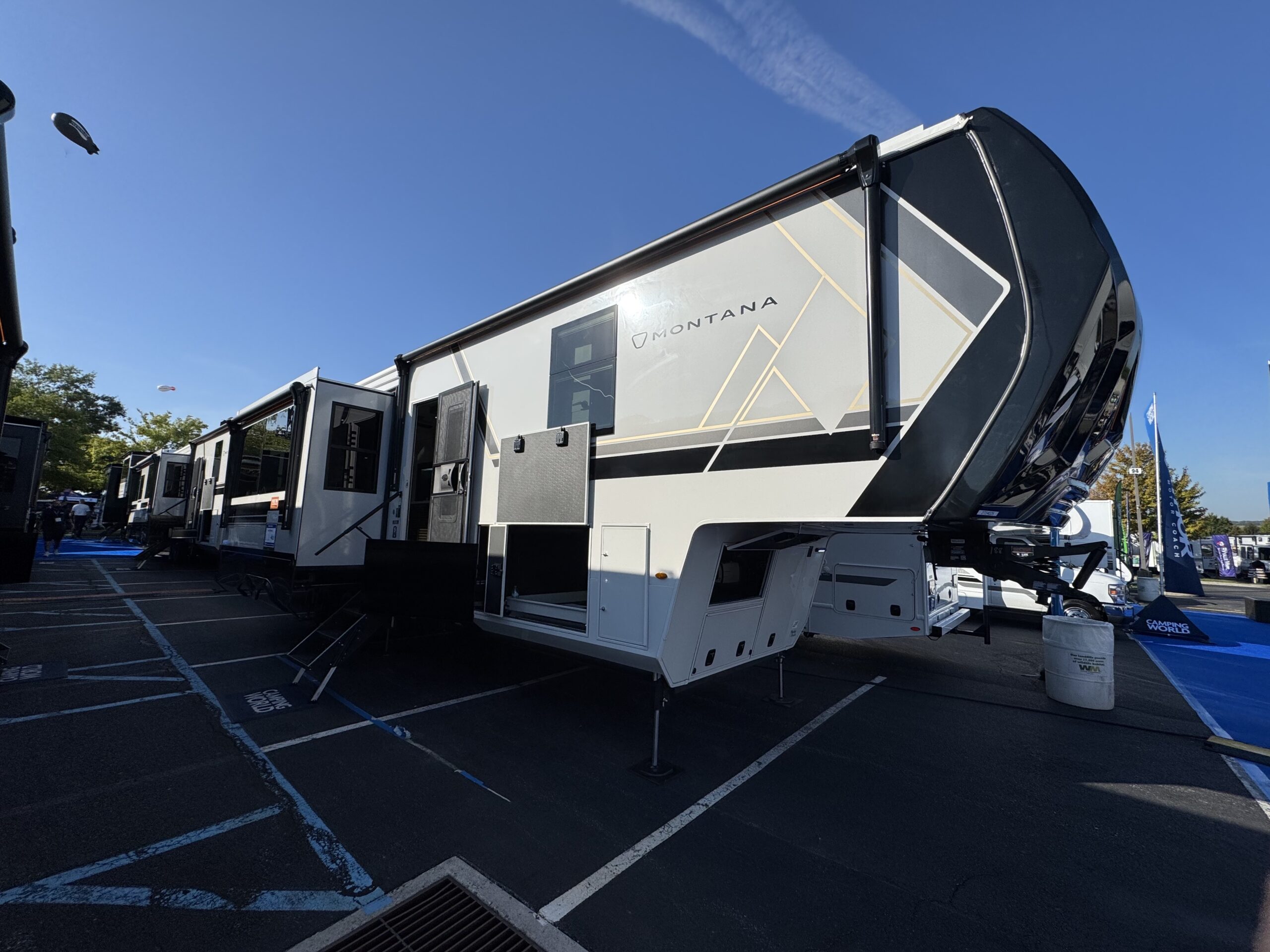
Remote work has become an important consideration for many RV buyers, and manufacturers have responded by incorporating dedicated office spaces into more floor plans.
The Keystone Montana 3600RO is a particularly interesting example.
This luxury fifth wheel includes a front bedroom, a spacious main living area, and a dedicated rear office.
While rear-office floor plans aren’t entirely new, Joshua appreciated several thoughtful details that make this one especially practical.
A Rear Office with a View
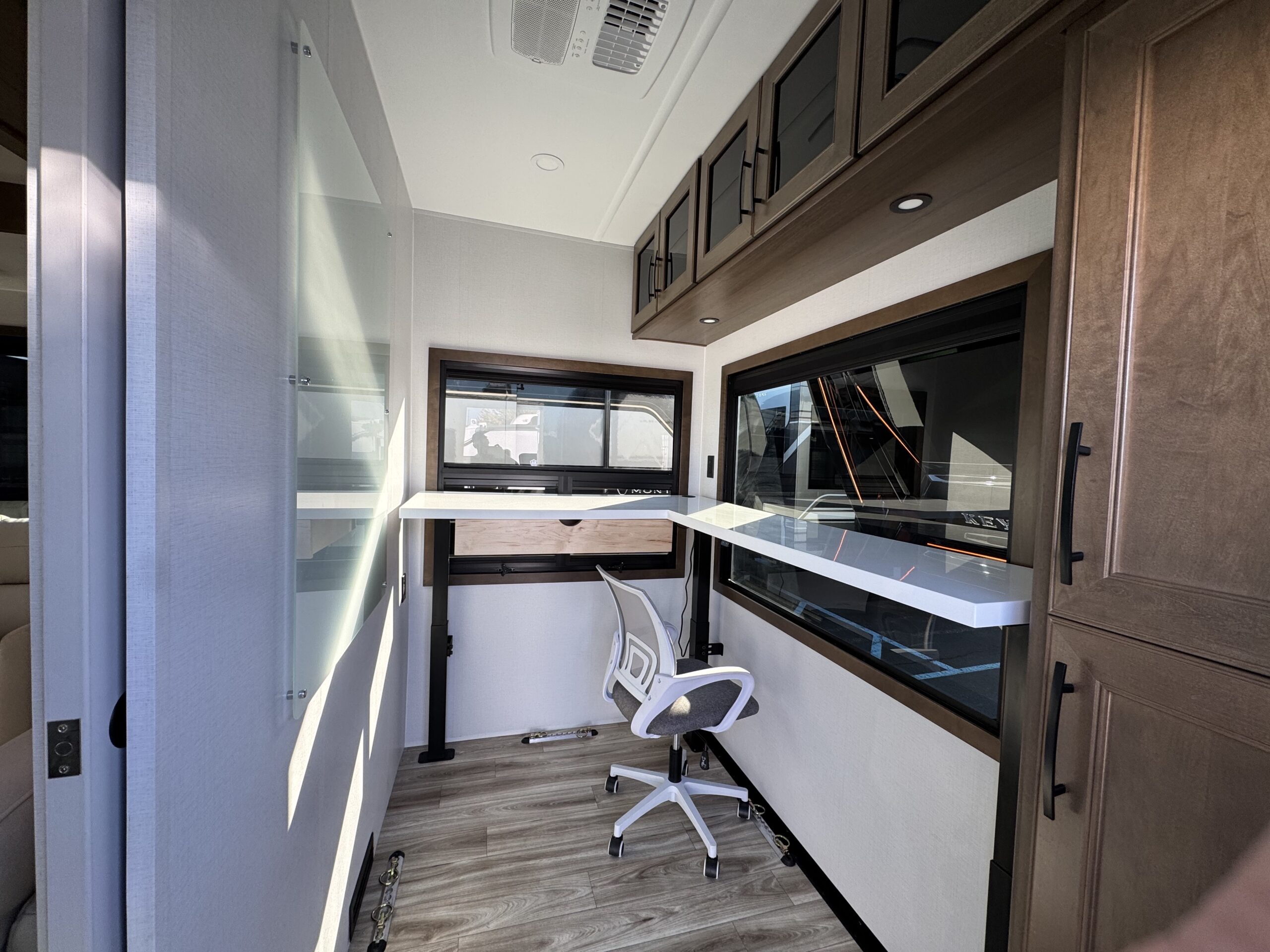
The rear office includes an L-shaped sit-stand desk positioned near large windows.
Rather than squeezing a small workspace into an awkward corner, Montana provides a dedicated room with generous headroom and views of the campsite.
For anyone spending several hours a day working remotely, that distinction matters.
The office also has its own exterior entrance on the service side of the fifth wheel.
That door allows owners to enter and exit the office without walking through the entire RV.
But Joshua noticed another potential advantage.
Secure Storage for Bicycles and Equipment
The office includes floor-mounted tie-down tracks that can be used to secure equipment.
For travelers who bring bicycles or other valuable gear, the exterior office entrance makes it possible to load equipment directly into the rear room.
The bikes can remain secured and out of sight during overnight stops without occupying the main living area.
It’s a clever combination of workspace and storage.
Dedicated Storage for Dirty Camping Gear
Joshua was equally impressed by another Montana feature: rear pull-out storage drawers located underneath the office floor.
These shallow drawers are designed for the equipment every RVer needs during campsite setup and breakdown.
Think sewer hoses, water hoses, electrical cords, leveling blocks, and wheel chocks.
The drawers are approximately eight inches deep, making them well suited to smaller equipment rather than bulky camping supplies.
That separation is particularly useful because much of this equipment becomes dirty during a camping trip.
Instead of mixing sewer accessories and muddy leveling gear with clean outdoor equipment in one enormous storage compartment, owners can keep everything organized in dedicated spaces.
Jeremy found prices around $115,000 for the Montana 3600RO, placing it firmly in the premium fifth-wheel category.
For full-time travelers or RVers who regularly work from the road, however, the combination of a dedicated office and thoughtful storage deserves serious consideration.
Aliner: Lightweight A-Frame Campers with Surprising Features
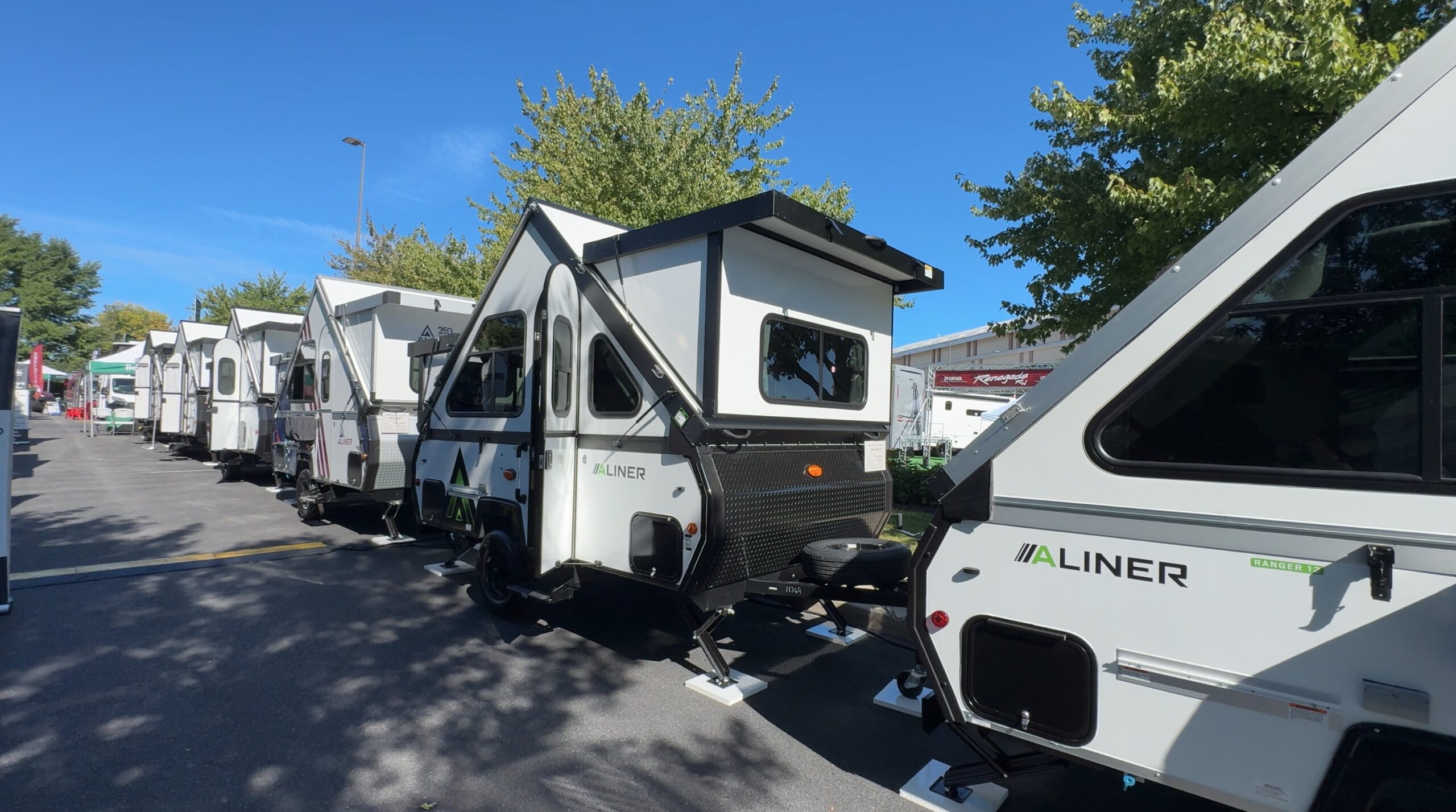
After exploring several larger travel trailers and fifth wheels, Joshua turned his attention to one of the most recognizable names in lightweight camping: Aliner.
Rather than selecting a single floor plan, he wanted to highlight the brand’s overall approach to compact RV design.
Both Joshua and Jeremy started their RV journeys in pop-up campers, and both still appreciate the simplicity and connection to the outdoors that those campers provide.
But anyone who has owned a traditional canvas pop-up also knows the challenges.
Wet canvas must be dried before storage. Setup and breakdown take time. And maintenance can become frustrating when camping trips end in bad weather.
Aliner’s hard-sided A-frame design offers a different compromise.
Why Aliners Are So Appealing
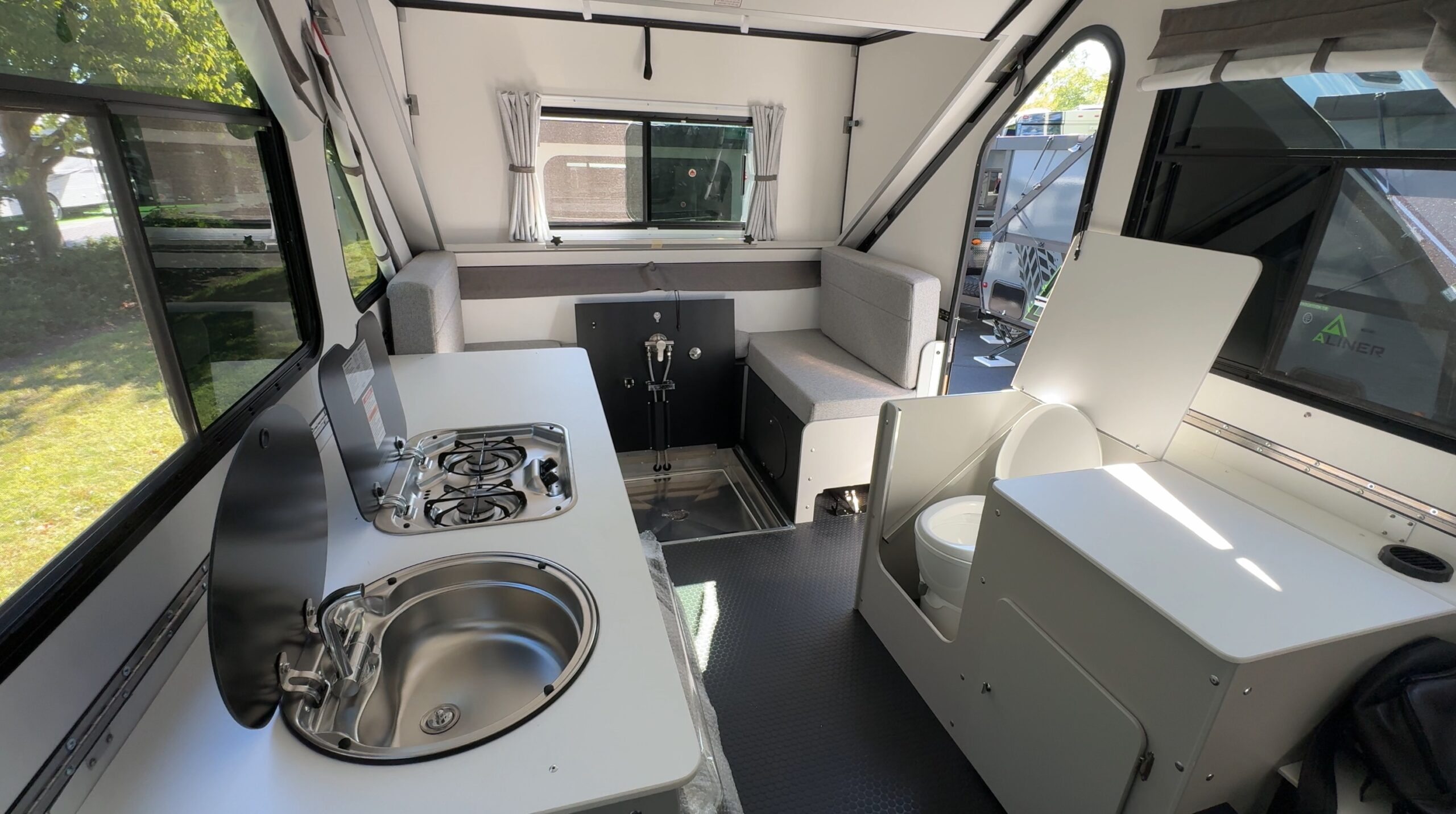
Aliners fold down into compact trailers that are relatively easy to tow and store.
Once at the campground, the hard-sided roof panels lift into place, creating the familiar A-frame shape.
Setup can take just a minute or two.
Joshua was particularly impressed by newer designs that incorporate expanding dormers and additional interior headroom.
Some models also include surprisingly sophisticated features for such small campers.
One example is an in-floor shower configuration that provides enough standing height for a six-foot-tall camper.
That’s a remarkable feature in a trailer weighing approximately 2,300 pounds dry.
The Bathroom Compromise
Of course, compact RV design always involves tradeoffs.
Some Aliners have portable or concealed toilets with limited privacy, while others don’t have a toilet at all.
These aren’t the spacious bathrooms found in a large travel trailer or fifth wheel.
For some campers, that’s an immediate dealbreaker.
For others, having a toilet available for a middle-of-the-night bathroom trip is more than enough.
Jeremy falls firmly into the second category. He appreciates having a basic bathroom option but is perfectly happy using campground bathhouses for most of his needs.
Joshua suggested that an Aliner might be the perfect type of camper to rent before purchasing.
That would allow prospective buyers to determine whether the advantages of lightweight towing and quick setup outweigh the compromises of compact living.
Easy Towing and Garage Storage
Another major advantage is that many Aliner models can fit inside a residential garage, depending on the garage’s dimensions.
Indoor storage can protect an RV from weather exposure and eliminate the need for a separate storage facility.
Joshua also noted that Aliner has been expanding beyond traditional A-frame trailers, including a folding truck camper design.
Jeremy found Aliner prices ranging from approximately $15,000 to $45,000, depending on the model and equipment.
For couples, solo travelers, and campers who prioritize simplicity, Aliner remains a brand worth exploring.
And as Jeremy likes to remind listeners, the best RV is often the one you’ll actually use the most.
Brinkley Model R 3710: Luxury, Cargo Capacity, and Innovative Engineering
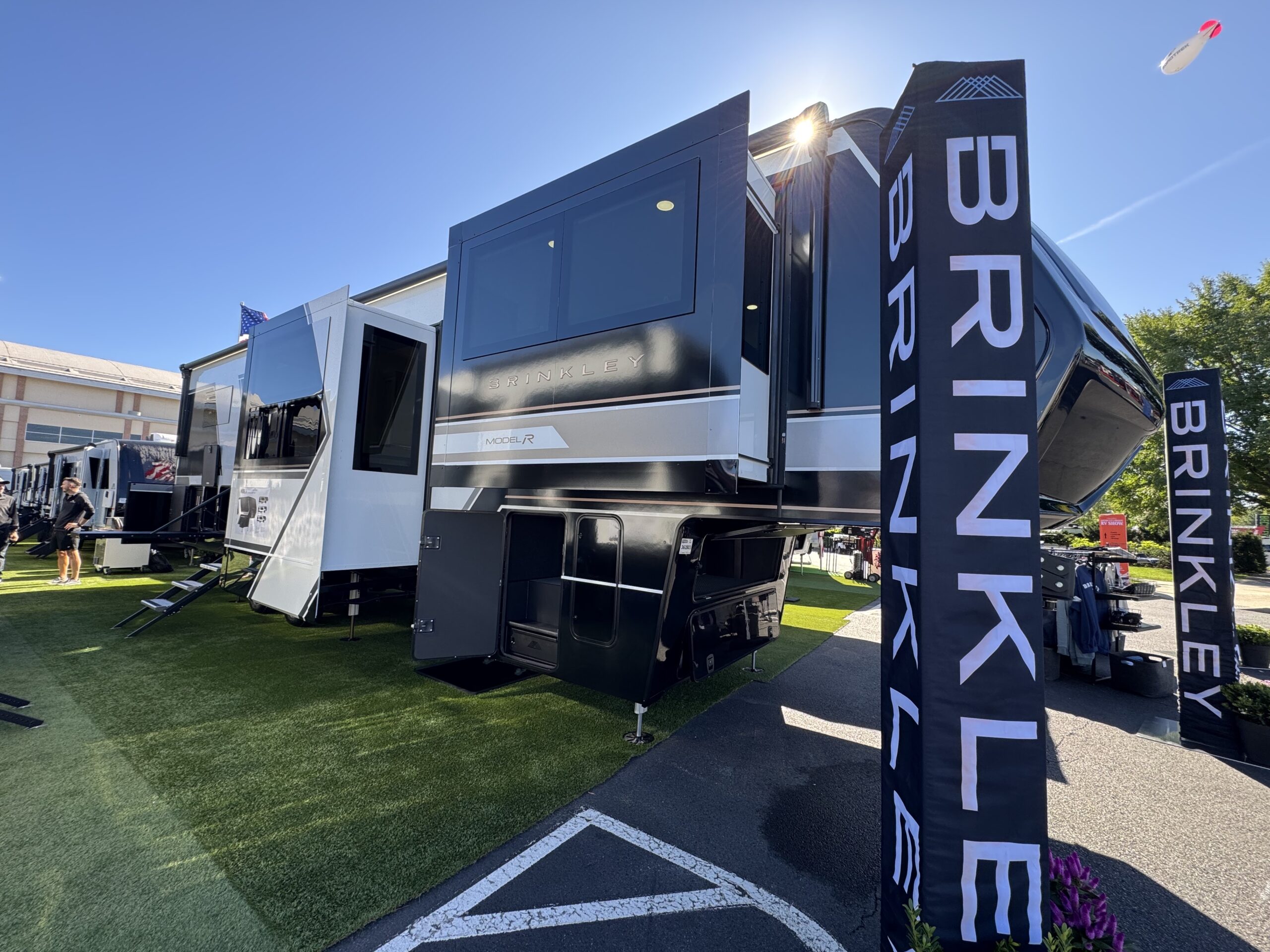
At the opposite end of the RV spectrum sits the Brinkley Model R 3710.
This enormous luxury fifth wheel was one of the most technically interesting RVs Joshua explored at Hershey.
With pricing above $200,000, it certainly isn’t an entry-level option.
But Joshua was impressed by how much thought Brinkley has put into its engineering, storage, and long-term usability.
Brinkley Model R 3710 Specifications
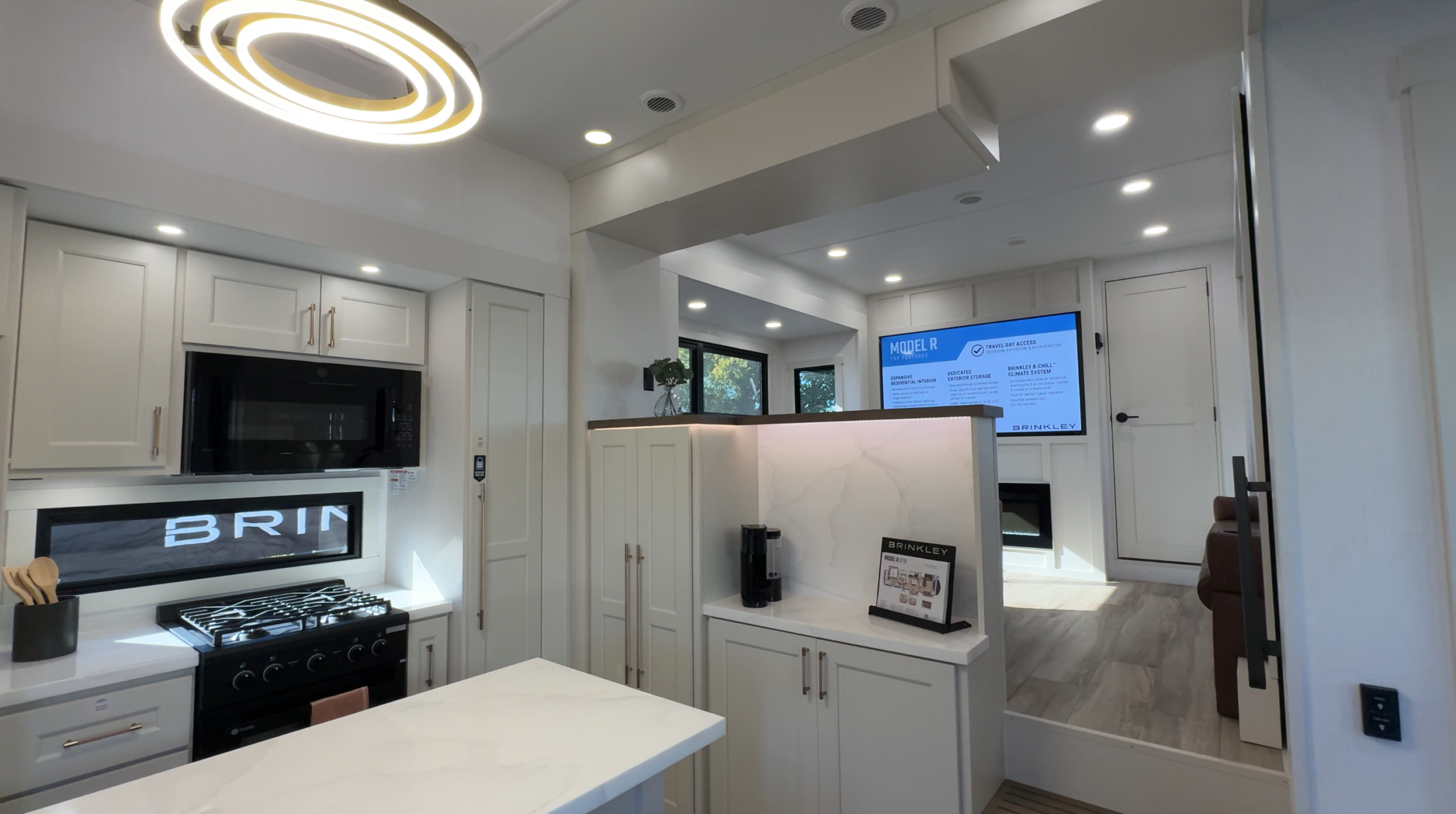
Joshua highlighted several impressive numbers:
- Length: Just over 41 feet
- Dry weight: Approximately 18,700 pounds
- Cargo carrying capacity: More than 4,500 pounds
- Gross vehicle weight rating: More than 23,000 pounds
- Suspension: MORryde independent suspension
- Axle configuration: Dual-axle setup
The cargo carrying capacity is especially noteworthy.
Storage Space Is Only Useful If You Can Carry the Weight
One of Joshua’s recurring concerns about RV design is the disconnect between available storage space and actual cargo carrying capacity.
Some large RVs have enormous storage compartments, multiple closets, and extensive cabinetry but surprisingly limited cargo capacity.
Owners can easily fill those spaces with equipment and belongings without realizing they’ve exceeded the RV’s weight limits.
The Brinkley Model R takes a different approach.
Its substantial cargo carrying capacity allows owners to make more practical use of the storage provided.
Joshua also appreciated the decision to use a heavy-duty independent suspension system with two axle positions rather than a traditional triple-axle arrangement.
The larger tires, brakes, and suspension components are designed to support the RV’s considerable weight.
Of course, this is a fifth wheel that requires a serious tow vehicle.
Joshua suggested buyers would likely be considering a one-ton dually or potentially an even larger truck, depending on the fully loaded trailer weight and actual pin weight.
This is not a fifth wheel for a half-ton pickup.
A Rear Garage and Built-In Outdoor Table
The Model R 3710 includes a rear storage compartment that Joshua estimated could accommodate two electric bicycles.
The compartment has a rear access door and additional storage extending forward.
But one of his favorite features was a large pull-out outdoor table.
Instead of carrying a separate folding table, owners can slide a substantial table directly out from underneath the exterior kitchen area.
There’s no need to unfold legs, find level ground, or rearrange the campsite.
The table remains integrated into the RV and can be ready to use in less than a minute.
It’s a simple feature that could make everything from campsite cooking to a quick roadside lunch more convenient.
Brinkley’s B Chill Air Conditioning System
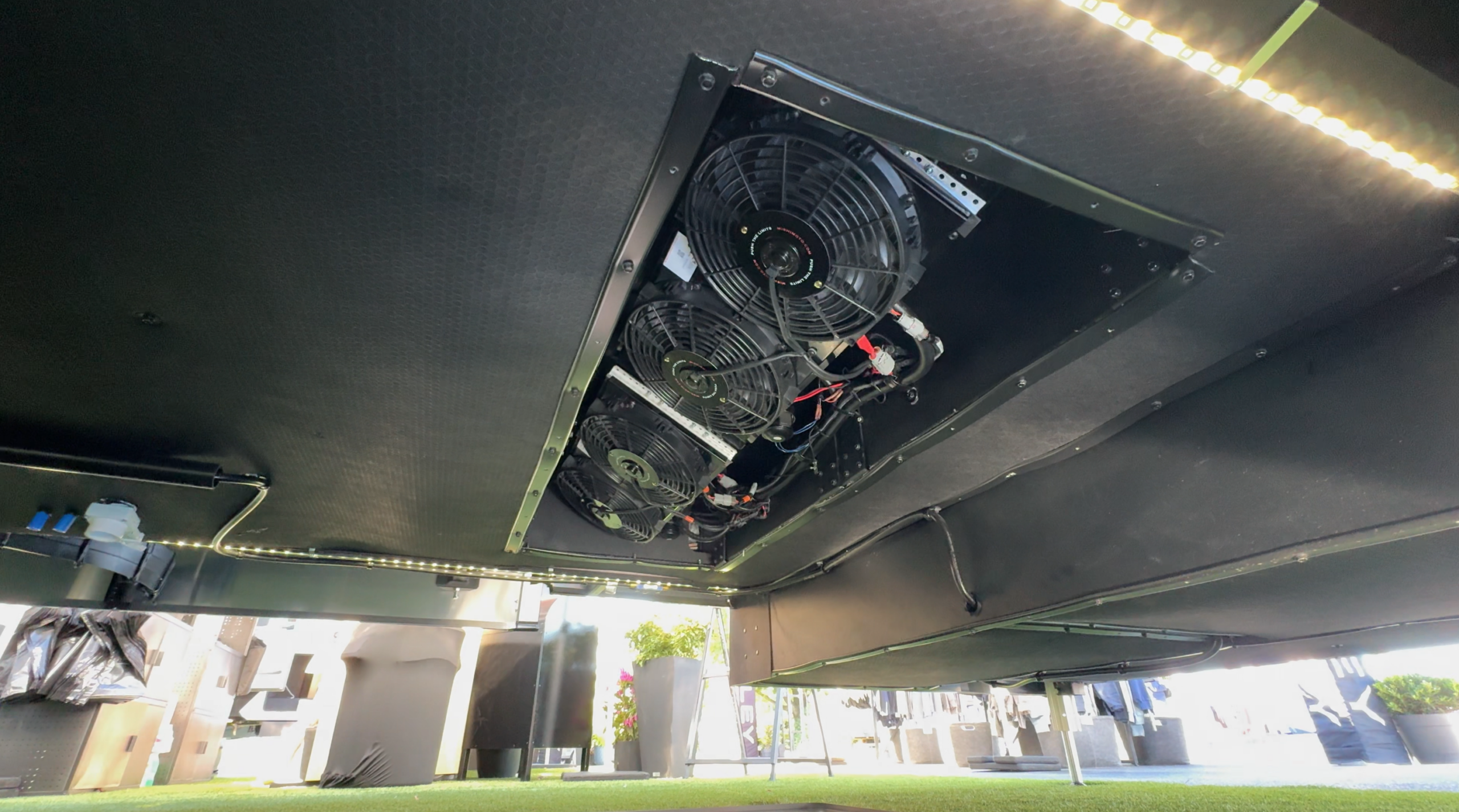
Perhaps the most innovative feature Joshua discussed was Brinkley’s B Chill air conditioning system.
Unlike traditional rooftop RV air conditioners, the B Chill design places major mechanical components underneath the RV.
The concept is similar in some respects to a residential split-system air conditioner.
By moving the equipment off the roof, Brinkley creates several potential advantages.
First, the roof can be designed without accommodating bulky rooftop air conditioning units.
That allows for additional interior ceiling height, particularly in areas of the fifth wheel where headroom is often limited.
Second, moving the noisy mechanical components away from the living space could create a quieter interior environment.
Third, Brinkley is designing the system with serviceability in mind.
Traditional RV rooftop air conditioners are often replaced as complete units when major components fail. The B Chill concept is intended to allow more conventional servicing and component replacement.
Joshua emphasized that this is an innovative system whose long-term performance will need to be demonstrated over time.
But the approach is exciting, particularly for buyers investing in an RV they hope to own for many years.
The Model R 3710 represents a very different kind of RV ownership than an Aliner or Coleman travel trailer.
For buyers who want residential-style comfort, substantial cargo capacity, and premium engineering, it’s an impressive example of how far fifth-wheel design has evolved.
Open Range 393TBR: A Three-Bedroom Fifth Wheel for Large Families

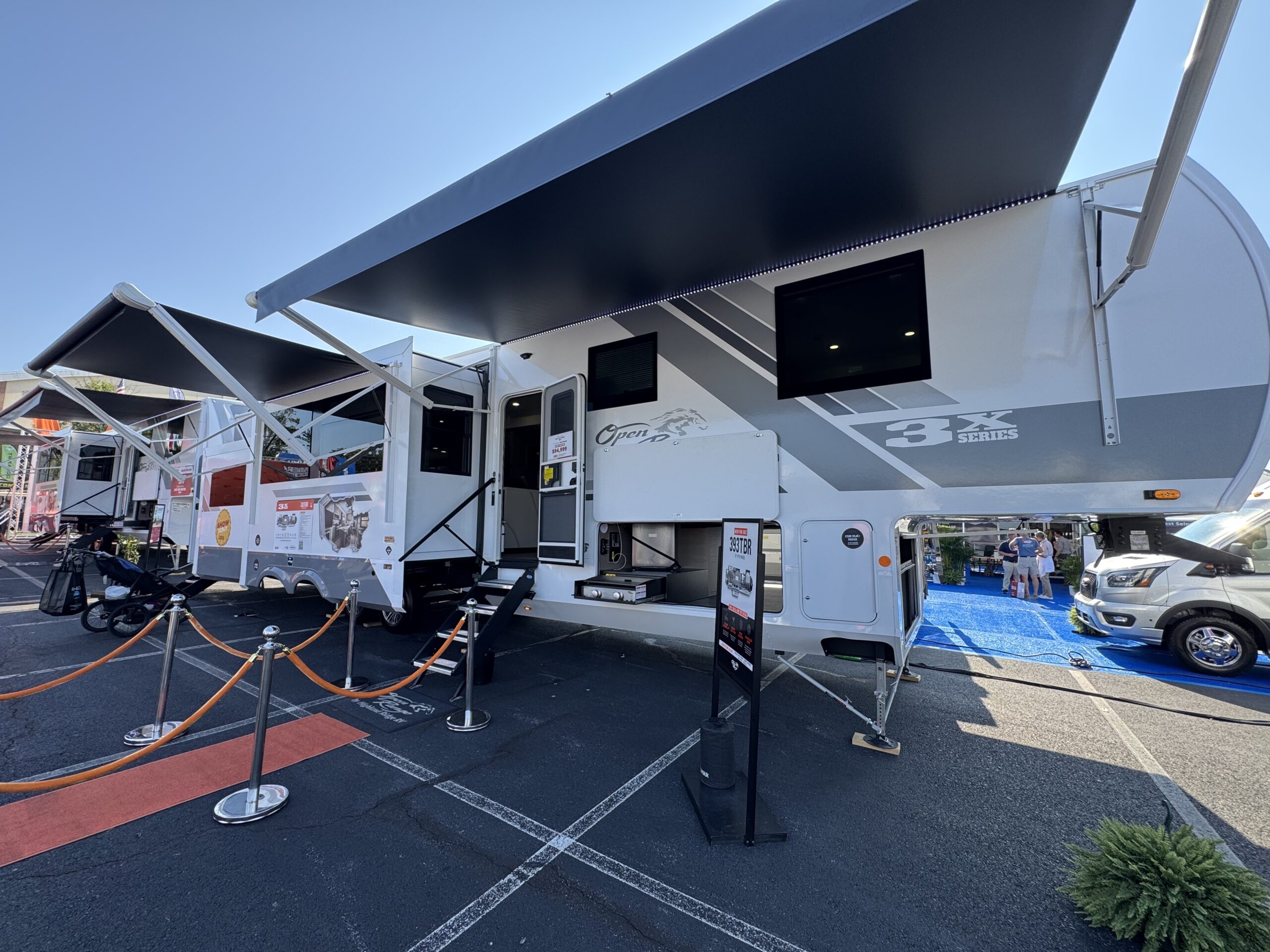
One of the most unusual floor plans Joshua discovered at Hershey was the Open Range 393TBR.
At approximately 43.5 feet long, this is another substantial fifth wheel.
But unlike the Brinkley Model R, its most interesting innovation isn’t hidden in the mechanical systems.
It’s the interior layout.
A Fifth Wheel with a Dedicated Kids’ Wing
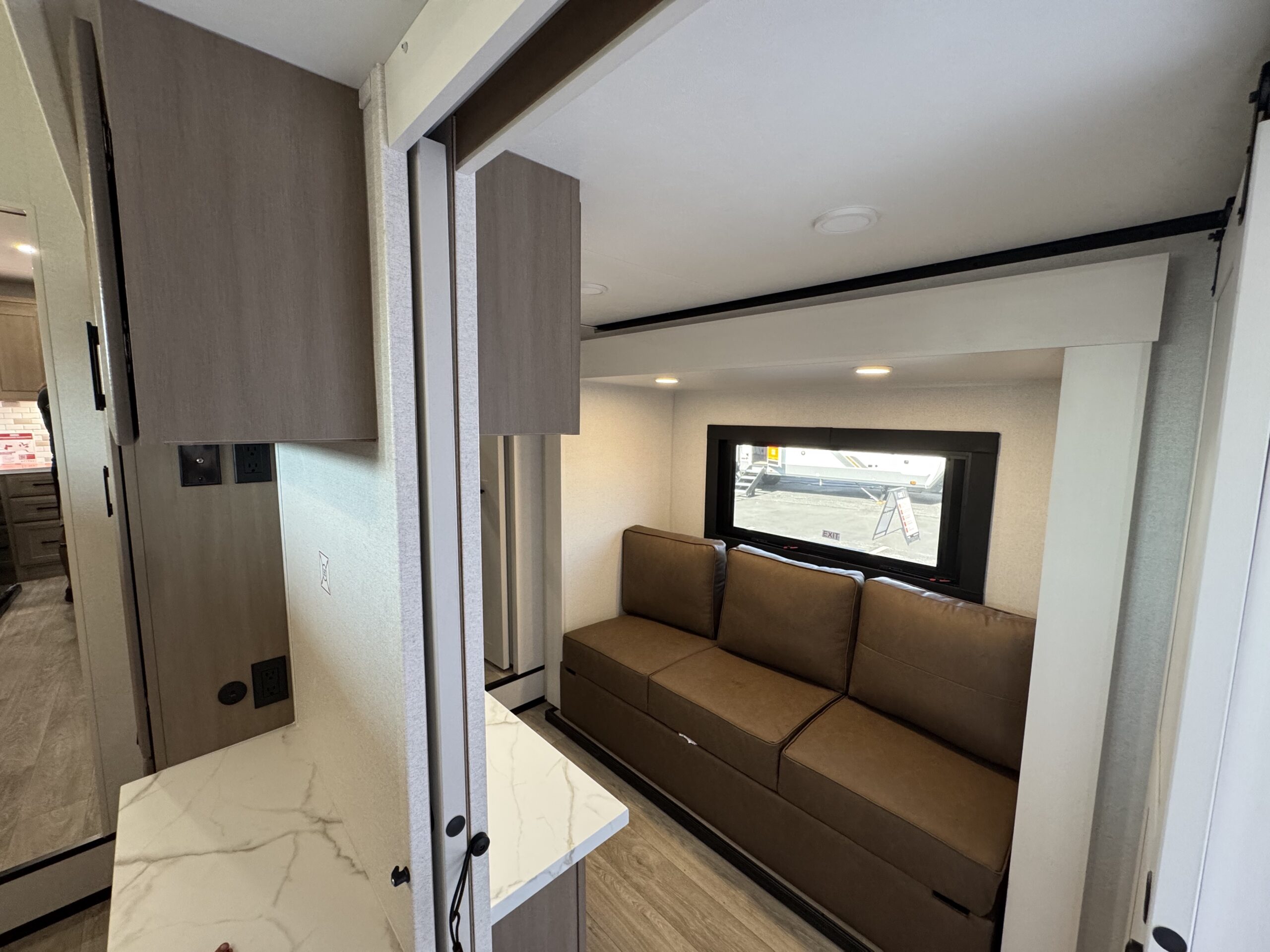
The Open Range 393TBR is marketed as a three-bedroom fifth wheel.
The primary bedroom is located at the front of the RV, with a bathroom nearby.
The main living space occupies the center.
At the rear, however, the floor plan becomes much more interesting.
A dividing wall separates two rear sleeping areas, each incorporating a slide-out.
Above those rooms is a loft.
There’s also a second bathroom at the back of the fifth wheel.
Joshua compared the arrangement to a dormitory, with two bedrooms sharing a bathroom and a loft above.
That description captures the concept perfectly.
Separate Sleeping and Hangout Spaces
The rear rooms incorporate convertible sleeping furniture, including fold-out seating.
When the beds aren’t in use, the rooms become places for children or teenagers to relax.
Instead of having every family member share one central living area, the Open Range provides separate spaces where kids can hang out, watch television, or enjoy some privacy.
For families with multiple children, that’s a significant advantage.
And for full-time RV families, it could be even more important.
Designed for Families Who Spend More Time Inside
Joshua believes this floor plan is particularly well suited to families living in their RV full-time.
Weekend campers may spend most of their waking hours outside, exploring destinations and enjoying the campground.
Full-time families have different needs.
Children may need space for schoolwork, privacy, hobbies, or simply spending time apart from siblings.
The Open Range 393TBR offers a layout that acknowledges those needs.
Its rear drop-frame design also creates additional space for the loft, making more effective use of the RV’s interior volume.
Joshua noted that the fifth wheel has a gross vehicle weight rating approaching 18,000 pounds, with pricing around $100,000.
That puts it at a very different price point from the Brinkley while still offering a substantial residential-style floor plan.
For a family with several children, this could be one of those RVs that creates an immediate aha moment during a showroom walkthrough.
Favorite RV Gear and Gadgets from the 2026 Hershey RV Show
The RVs weren’t the only things that caught Joshua’s attention.
Inside the Giant Center, he found several products and services that could make RV ownership easier, safer, or more comfortable.
Some are brand-new concepts, while others represent thoughtful improvements to products RVers already use.
Yellow Pages RV: A Directory for RV Services
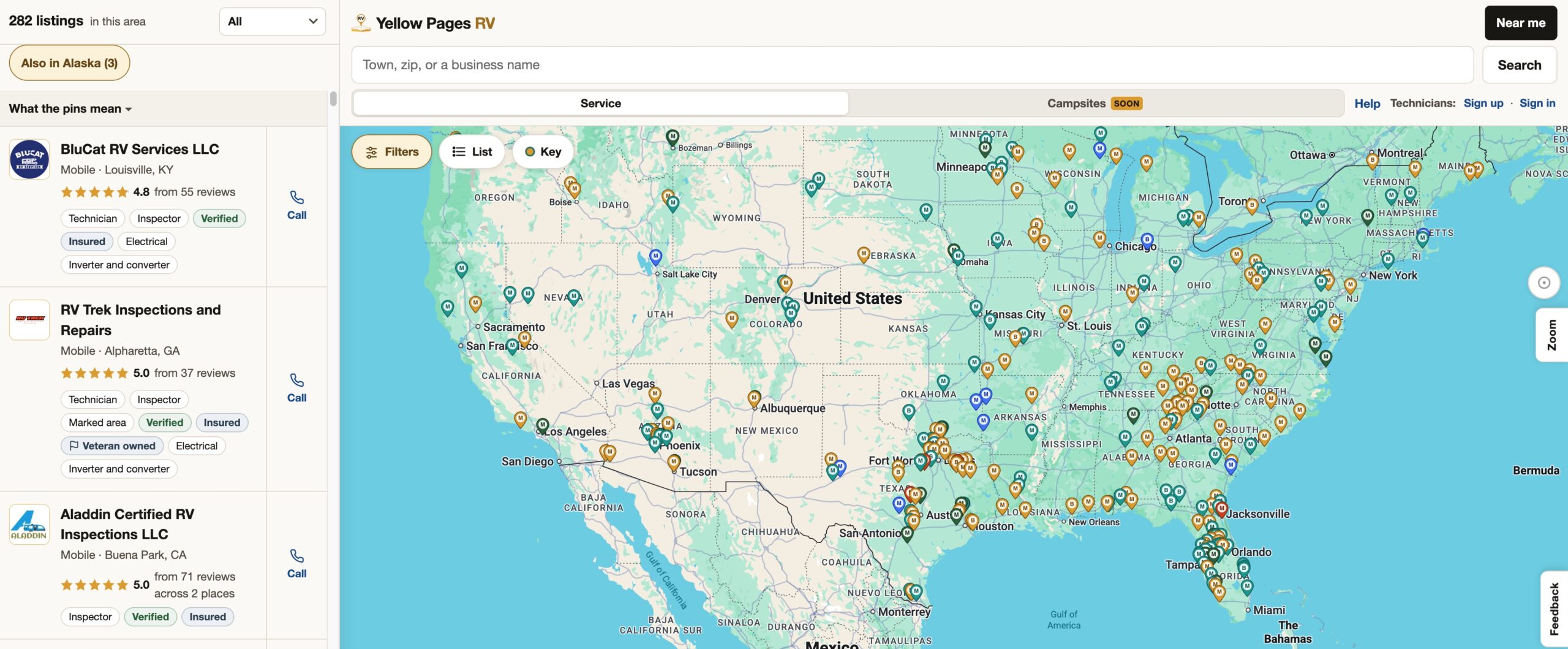
Finding reliable RV service providers can be surprisingly difficult, particularly when you’re traveling far from home.
Yellow Pages RV is a website designed to simplify that process.
The concept is straightforward: create a searchable directory of businesses and individuals who provide RV-specific services.
That includes mobile RV technicians, inspectors, detailers, and specialists who work on particular types of RVs.
Unlike larger RV support platforms that incorporate maintenance reminders, troubleshooting services, and other features, Yellow Pages RV focuses on helping owners find service providers.
Joshua met the founder while walking around the Hershey show.
The service doesn’t have a dedicated mobile app, but its website is designed for use on phones, tablets, and computers.
For RVers who need help finding a technician or specialist while traveling, another centralized resource could be extremely useful.
Hüga Heated Cushions: Portable Warmth for Cold-Weather Camping
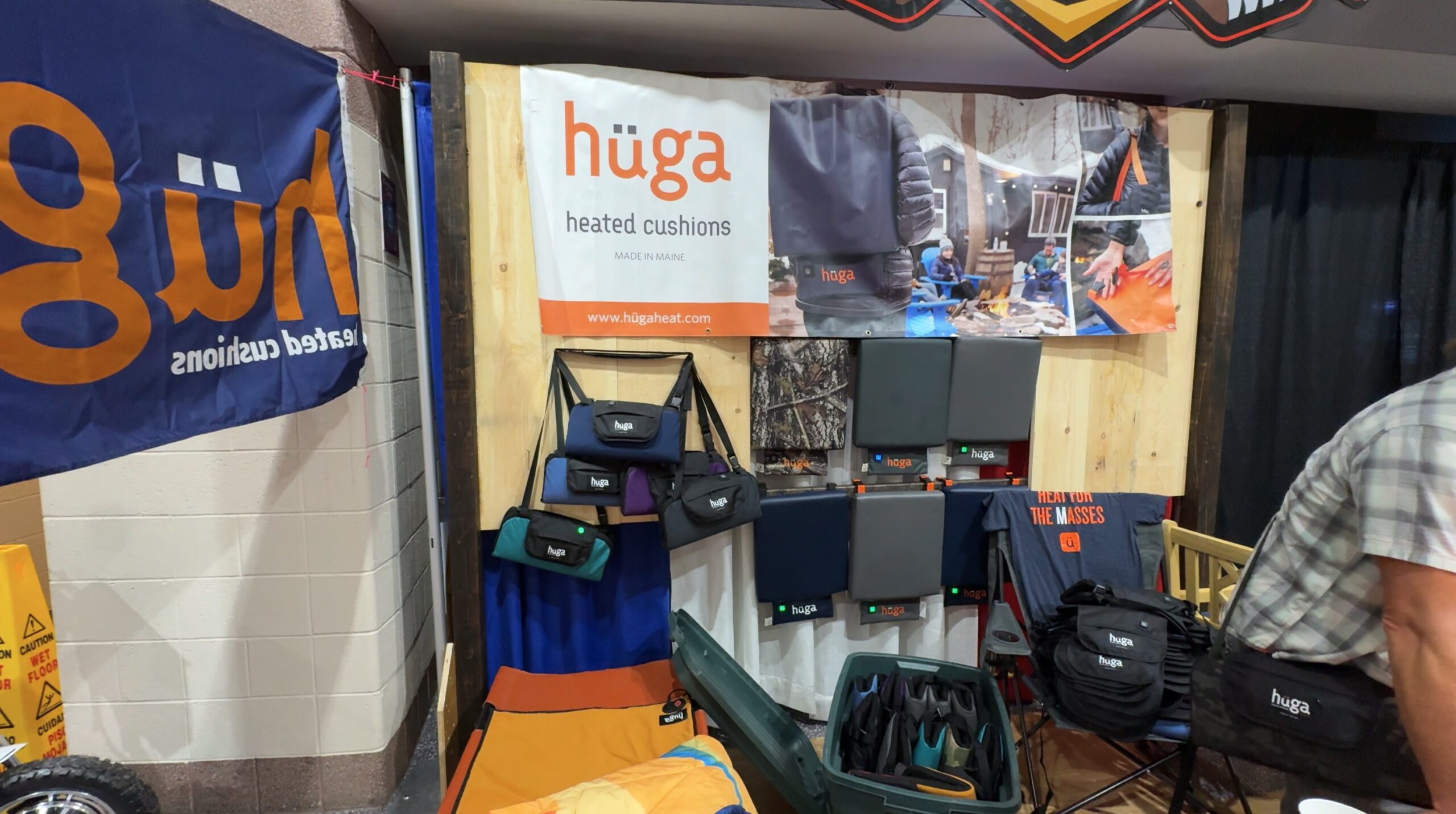
This might be the coziest product Joshua discovered at Hershey.
Hüga Heated Cushions are battery-powered heated seat cushions designed to add warmth to ordinary chairs and seating surfaces.
Depending on the model and battery capacity, Joshua described operating times of approximately three to six hours.
The cushions can be used at the campsite, around the campfire, at a picnic table, or while attending outdoor sporting events.
Some models fold for easier transport.
Joshua was particularly intrigued by a version called the Go, which folds into a wearable hand-warming accessory with a shoulder strap.
Instead of simply sitting on the cushion, users can carry it and warm their hands while walking.
Is this an essential camping accessory?
Absolutely not.
But it’s exactly the kind of small luxury that can make fall and shoulder-season camping more enjoyable.
And anyone who knows Jeremy’s enthusiasm for cold-weather camping gear can probably guess how quickly this product landed on his wish list.
SmartPlug: A Better Connection for RV Shore Power
RV electrical connections are something most campers don’t think much about until a problem occurs.
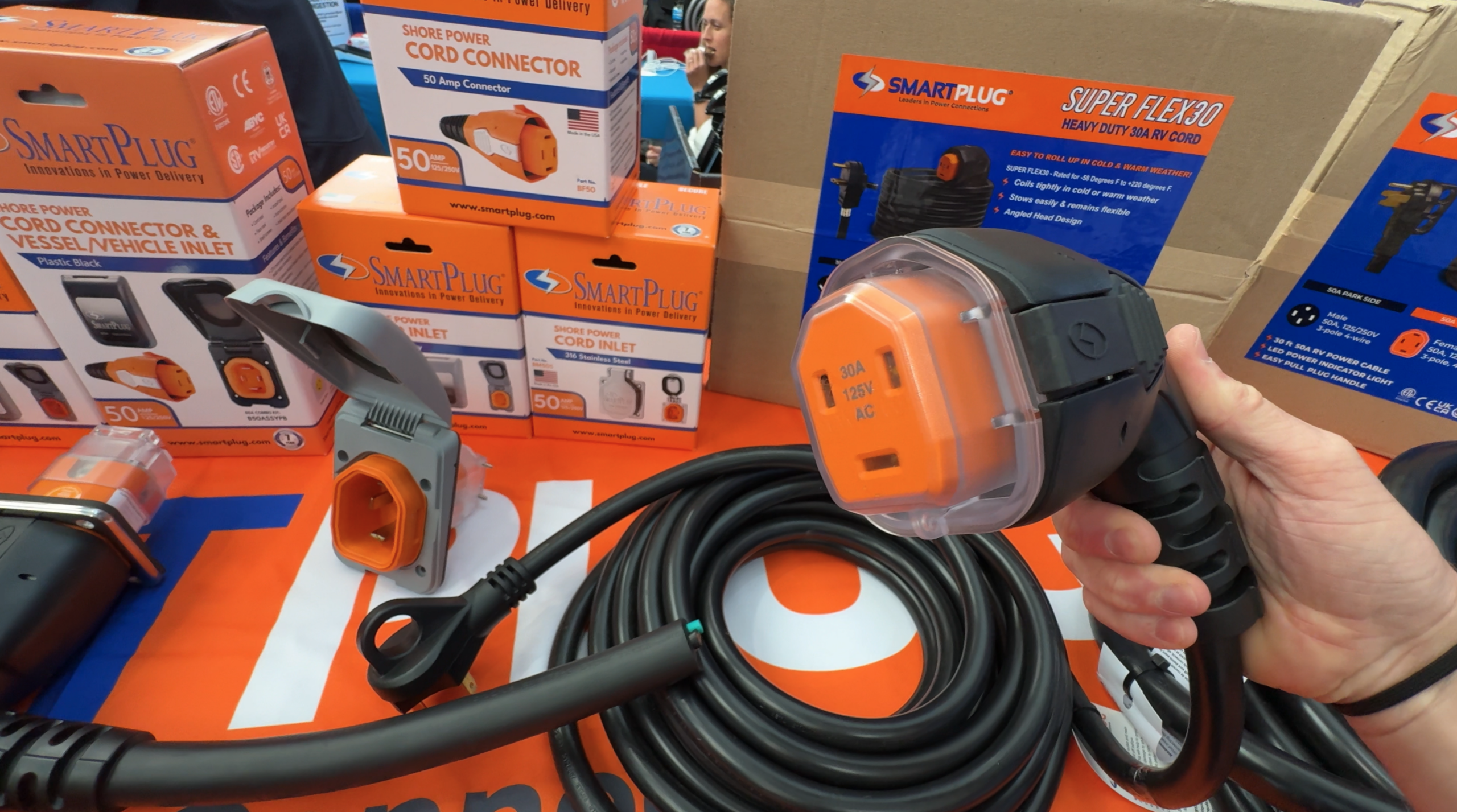
SmartPlug offers an alternative to the traditional twist-lock shore power connection found on many RVs.
The system uses larger electrical contact points and a secure locking mechanism designed to provide a more reliable connection between the power cord and the RV.
Joshua has noticed more RV manufacturers incorporating SmartPlug connections directly into their products.
Aftermarket conversion components are also available.
Why does this matter?
Poor electrical connections can create resistance and heat, potentially damaging plugs, cords, and receptacles.
A secure, properly installed connection is an important part of RV electrical safety.
Jeremy shared a firsthand example of how vulnerable traditional shore power connections can be.
While his nüCamp TAB 320 was plugged into a 30-amp connection at home, one of the boys accidentally caught the cord while riding a bicycle down the driveway.
The resulting pull damaged the RV’s electrical connection.
That experience made Joshua’s discussion of stronger, more secure shore power connections particularly relevant.
SmartPlug is worth researching for RVers interested in upgrading their electrical equipment. Any installation or conversion should follow the manufacturer’s specifications and applicable electrical safety requirements.
Armis Wheel Defenders: Additional Protection Against Tire Blowout Damage
A trailer tire blowout can cause far more damage than simply destroying a tire.
When tread separates from a tire, it can strike the underside of the RV with tremendous force.
The resulting damage may include torn body panels, damaged wiring, broken plumbing, and even compromised propane lines.
Joshua knows this firsthand.
His family lost a pop-up camper following a tire blowout, so products designed to reduce this type of damage immediately caught his attention.
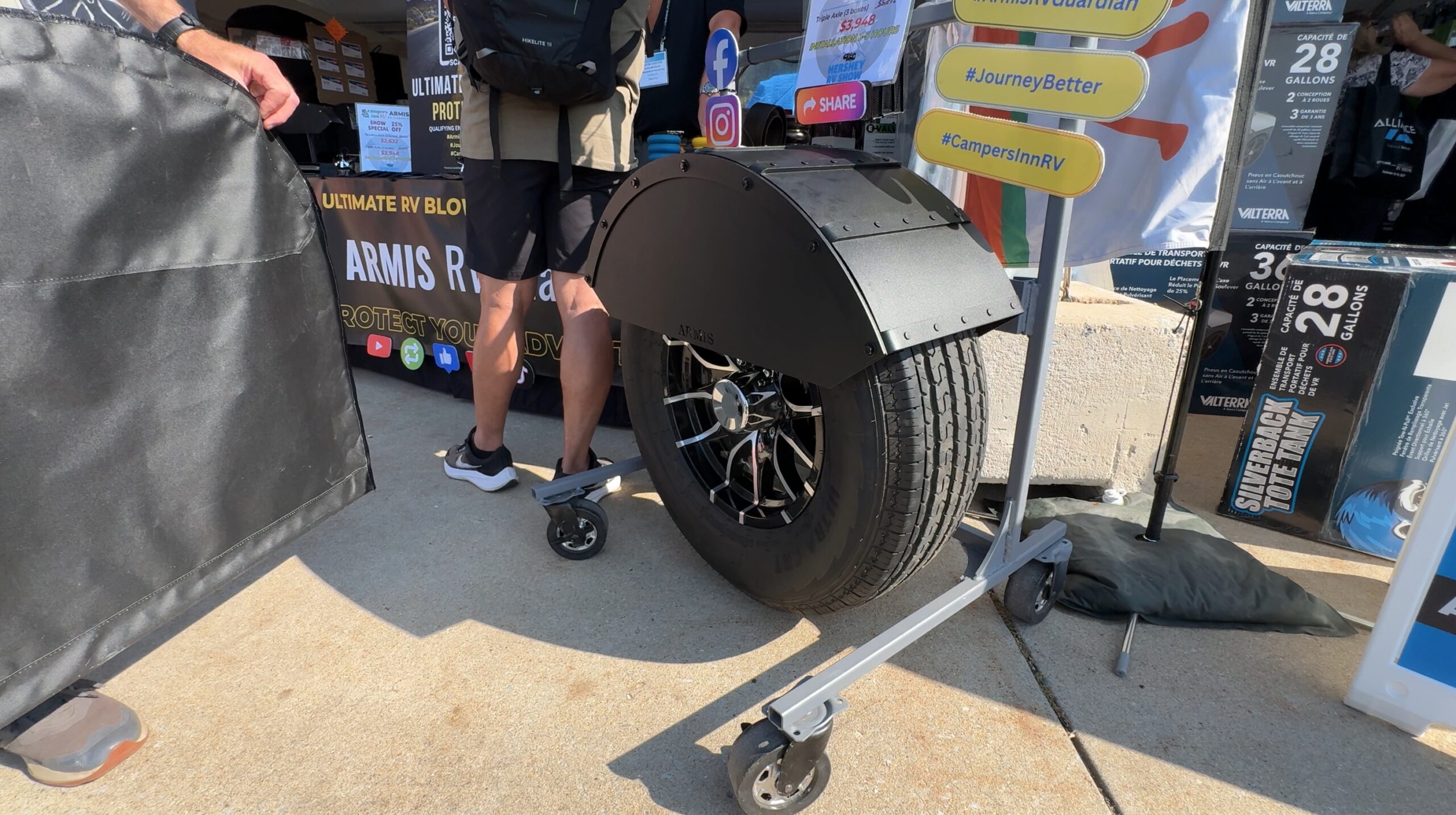
Armis Wheel Defenders are heavy-duty steel protective structures installed around the RV’s wheel wells.
The idea is to create a barrier between a failing tire and vulnerable RV components.
Joshua was impressed by the concept but noted that the product requires installation through authorized installers rather than being offered as a standard DIY project.
He estimated that the product and installation could cost a couple thousand dollars.
That’s a substantial investment, but repairing major damage after a tire blowout can also be extremely expensive.
Wheel defenders won’t prevent a blowout or guarantee that damage won’t occur, but they are intended to reduce the consequences.
For owners of expensive travel trailers and fifth wheels, additional protection could be worth considering.
Prime RV Gravity Sewer Hose: A More Subtle Approach to Essential Gear
Not every innovation needs to reinvent an entire product category.
Sometimes an improvement can be as simple as better materials, a more practical design, or even a more appealing appearance.
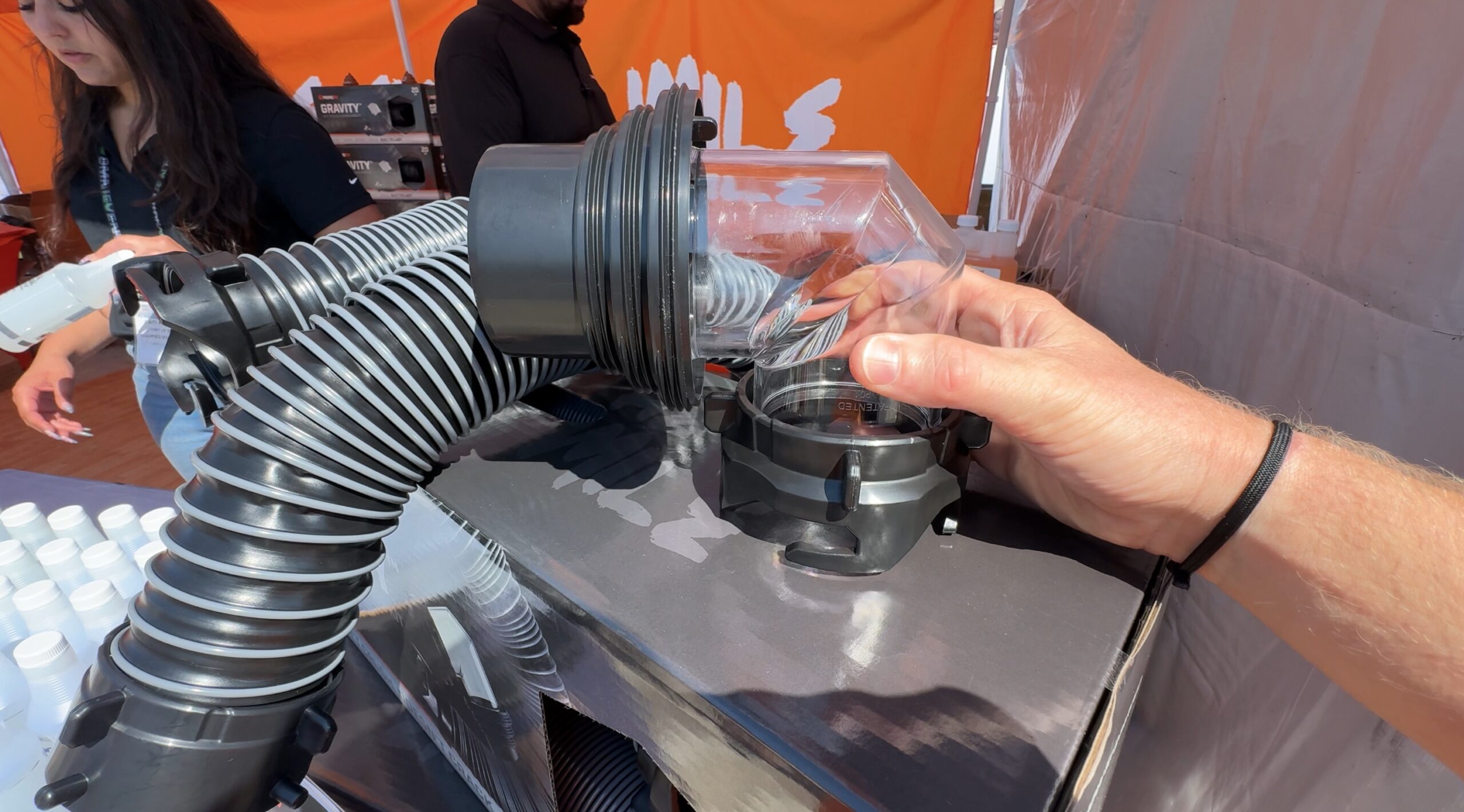
Joshua highlighted the Gravity sewer hose from Prime RV, a company associated with Matt’s RV Reviews and the Liquified and LiquiShine product lines.
The Gravity hose features heavy-duty 24-mil construction and a clear connection elbow.
But one of the first things Joshua noticed was the color.
Instead of the bright orange, yellow, or red commonly found on RV sewer accessories, the Gravity hose uses a subdued black-and-gray design.
Joshua appreciates a campsite that looks organized and visually appealing, and he finds the mismatched bright colors of many RV accessories distracting.
Jeremy agreed completely.
While appearance certainly isn’t the most important factor when choosing a sewer hose, it’s nice to see manufacturers paying attention to the details that affect the overall camping experience.
Valterra Silverback Portable Wastewater Tote: Small Changes That Matter
Portable wastewater totes are essential equipment for RVers who regularly camp at state parks, county parks, and other campgrounds without sewer hookups.
Instead of breaking camp and towing the entire RV to the dump station, owners can transfer wastewater into a portable tank and transport it separately.
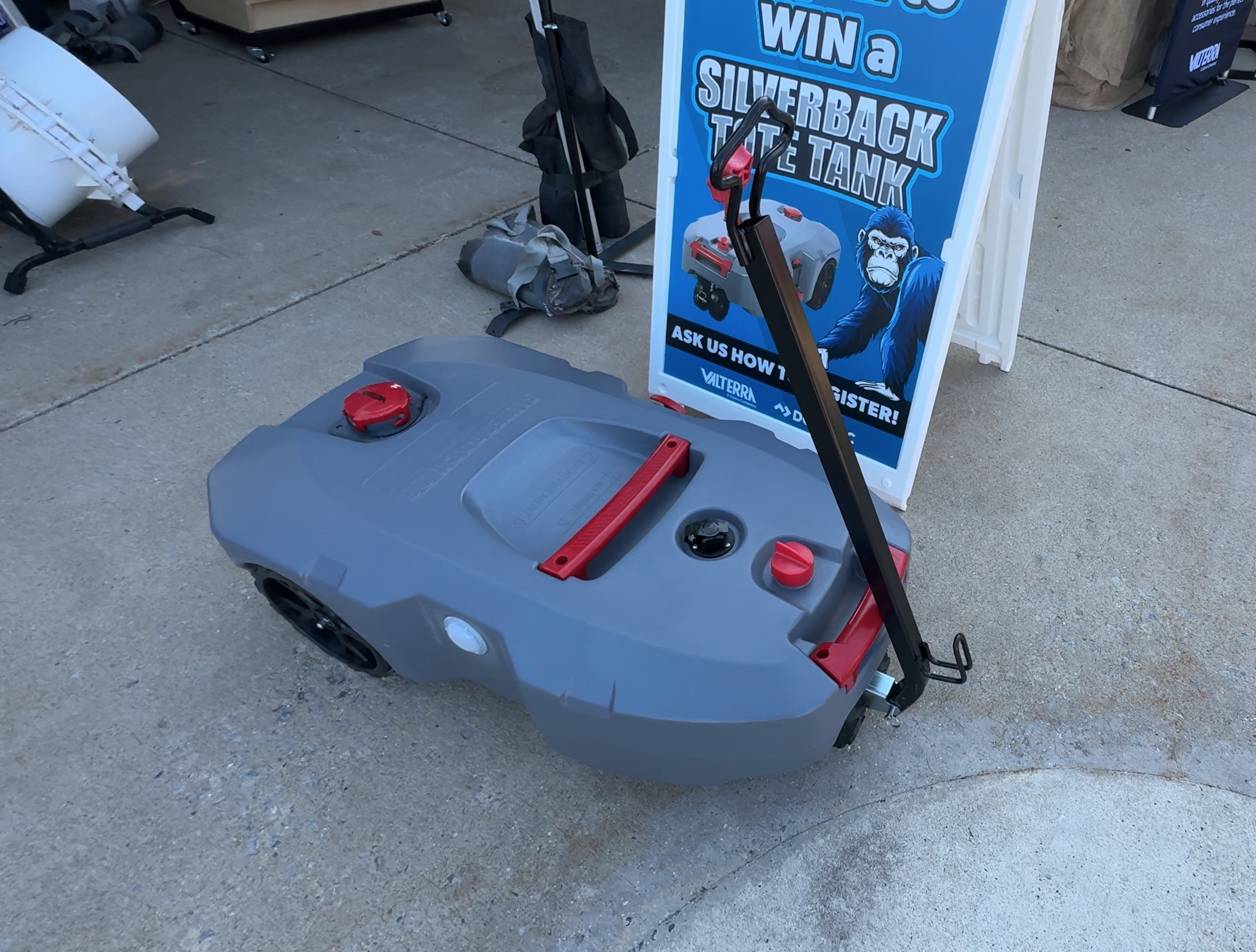
Joshua was impressed by several details on Valterra’s Silverback portable wastewater tote.
A More Comfortable Handle
Many wastewater totes use a circular towing attachment designed to connect to a vehicle’s hitch ball.
Unfortunately, those circular handles aren’t particularly comfortable when pulling the tank by hand.
Valterra incorporates a horizontal handle design that Joshua found much more ergonomic.
It’s a small change, but anyone who has dragged a heavy wastewater tote across a campground can appreciate the difference.
Thoughtful Discharge Placement
Joshua also liked the positioning of the tank’s discharge connection.
The location of a wastewater tote’s outlet can determine how easily owners maneuver it at a dump station.
A better placement can eliminate awkward positioning or the need to disconnect and reposition the tank.
These aren’t glamorous innovations, but they make a familiar camping chore a little easier.
For campers who regularly stay at water-and-electric sites without sewer connections, a well-designed portable wastewater tote can significantly extend the length of a stay.
Joshua’s Best RV and Gear Picks from Hershey
After reviewing such a wide variety of RVs and products, Jeremy asked Joshua to choose his absolute favorites.
Favorite RV: Ember Touring 2850DBL
Joshua’s top RV pick was the Ember Touring 2850DBL.
The deciding factor was the flexibility of the EmberTrack system.
With his twin boys approaching their teenage years, Joshua appreciates the ability to reconfigure the RV as his family’s needs change.
He could use the rear space as a bunkroom during family trips, convert it into an office when traveling alone, or adapt it for storage and other activities.
The dedicated primary bedroom makes that flexibility even more appealing.
For families hoping to keep an RV through several different stages of life, the Ember Touring offers a compelling approach.
Favorite Gear: Hygge Heated Cushions
Joshua’s favorite gear discovery was the Hygge heated cushion.
It’s a relatively simple product, but it supports something he loves about RVing: spending more time outdoors.
A heated seat cushion might allow campers to enjoy the campfire a little longer on a chilly evening or extend their camping season by a few extra weekends.
Sometimes the best gear isn’t about adding more technology or complexity.
It’s about making the experiences we already love a little more comfortable.
What the 2026 Hershey RV Show Reveals About RV Design
Looking across Joshua’s picks, several important trends emerge.
Flexible floor plans are becoming increasingly valuable. Whether it’s the convertible twin beds in the Coleman Lantern or the modular EmberTrack system, manufacturers are recognizing that RV owners don’t always travel with the same people or use their campers in the same ways.
Thoughtful storage matters as much as storage volume. The Montana’s dedicated utility drawers and Brinkley’s substantial cargo capacity show how useful it can be when manufacturers design storage around the realities of RV ownership.
RV offices are becoming more sophisticated. Instead of squeezing a desk into an existing living area, manufacturers are creating dedicated workspaces with natural light, privacy, and flexible storage.
Premium RV engineering continues to evolve. Brinkley’s B Chill air conditioning system and heavy-duty suspension demonstrate how manufacturers are thinking about long-term serviceability and performance.
Small improvements can make a big difference. From ergonomic wastewater tote handles to more secure electrical connections and heated seat cushions, RV gear manufacturers continue to find ways to improve familiar products.
And perhaps most importantly, the show demonstrated that there isn’t one perfect RV for everyone.
The camper who loves the simplicity of an Aliner has very different needs from the family considering a three-bedroom Open Range fifth wheel.
Both can find exactly what they’re looking for.
That’s what makes exploring an RV show so much fun.
Finding the Right RV for the Way You Camp
One of Joshua’s guiding principles at RV Gear and Far is that the most expensive or heavily marketed product isn’t automatically the best choice.
The right RV or camping accessory depends on how you actually travel.
A family taking weekend trips may prioritize quick setup, manageable towing, and easy access to outdoor equipment.
A full-time family may need private sleeping areas, dedicated workspaces, and substantial cargo capacity.
A couple traveling without children may want something compact, simple, and easy to store.
And the right answer can change over time.
That’s why we love seeing manufacturers experiment with new floor plans and flexible designs. Every innovative feature creates another possibility for someone trying to find the perfect RV.
A big thank-you to Joshua Sheehan for sharing his favorite discoveries from the 2026 Hershey RV Show.
You can find Joshua’s RV gear reviews, product comparisons, maintenance tutorials, and other RV content through RV Gear and Far on YouTube and social media, or visit RVGearAndFar.com.
And if you’re considering a new RV, remember to think beyond the showroom. Consider how you’ll use the camper today, what your needs might look like several years from now, and whether the floor plan will continue to work as your life changes.
The best RV isn’t necessarily the biggest, the most luxurious, or the most expensive.
It’s the one that helps you get out camping more often.
We’ll see you at the campground.
The post 2026 Hershey RV Show Rig and Gear Highlights (with Joshua Sheehan from RV Gear & Far) appeared first on The RV Atlas.
21 October 2026, 6:49 pm - 1 hour 3 minutesA Haunted RV Roadtrip to America’s National Parks: With Shannon Minner
America’s national parks are filled with breathtaking scenery, incredible wildlife, and fascinating history. But some of these beautiful destinations also have a darker side. From Civil War battlefields where visitors report seeing ghostly soldiers to abandoned mining towns, mysterious mountain forests, and historic lodges with unexplained footsteps, there are plenty of places where an ordinary national park adventure can take a spooky turn.
Just in time for Halloween, we’re welcoming Shannon Minner back to The RV Atlas for the fourth installment of our annual Haunted RV Road Trip series. Shannon is a school librarian, longtime RVer, and paranormal enthusiast who has spent 20 years working with a local ghost-hunting team. She knows a thing or two about tracking down a good ghost story, and this year she’s taking us to five of America’s most intriguing haunted national park destinations.
We’re exploring Gettysburg National Military Park, Death Valley National Park, New River Gorge National Park and Preserve, Great Smoky Mountains National Park, and Crater Lake National Park. Along the way, Shannon shares the legends surrounding each destination, specific places to explore, campground recommendations, and important safety tips for visitors.
Whether you’re a dedicated believer in the paranormal, a skeptic who loves a good ghost story, or simply an RVer looking for a different kind of national park adventure, these destinations offer plenty of reasons to plan a trip.
Listen to the complete episode of The RV Atlas podcast in the media player above–or wherever you get your favorite shows!
Gettysburg National Military Park, Pennsylvania: Ghosts of the Civil War
Gettysburg is one of the most historically significant destinations in the United States, and it’s also widely considered one of the country’s most haunted places.
The three-day Battle of Gettysburg in July 1863 resulted in an estimated 46,000 to 51,000 casualties, including soldiers killed, wounded, captured, or missing. With that much suffering concentrated in such a small area, it’s easy to understand why Gettysburg has inspired generations of ghost stories.
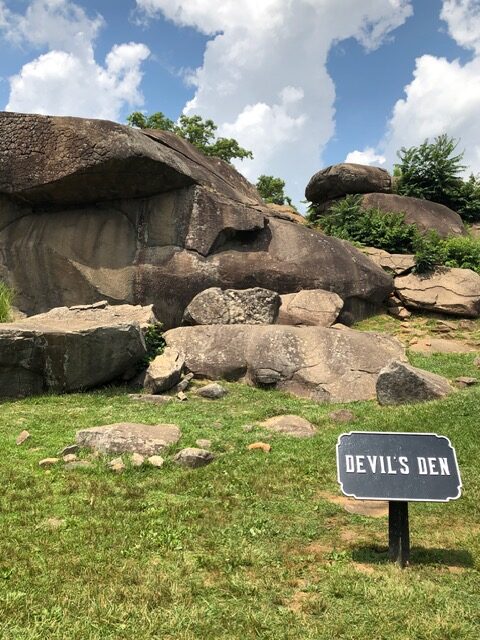
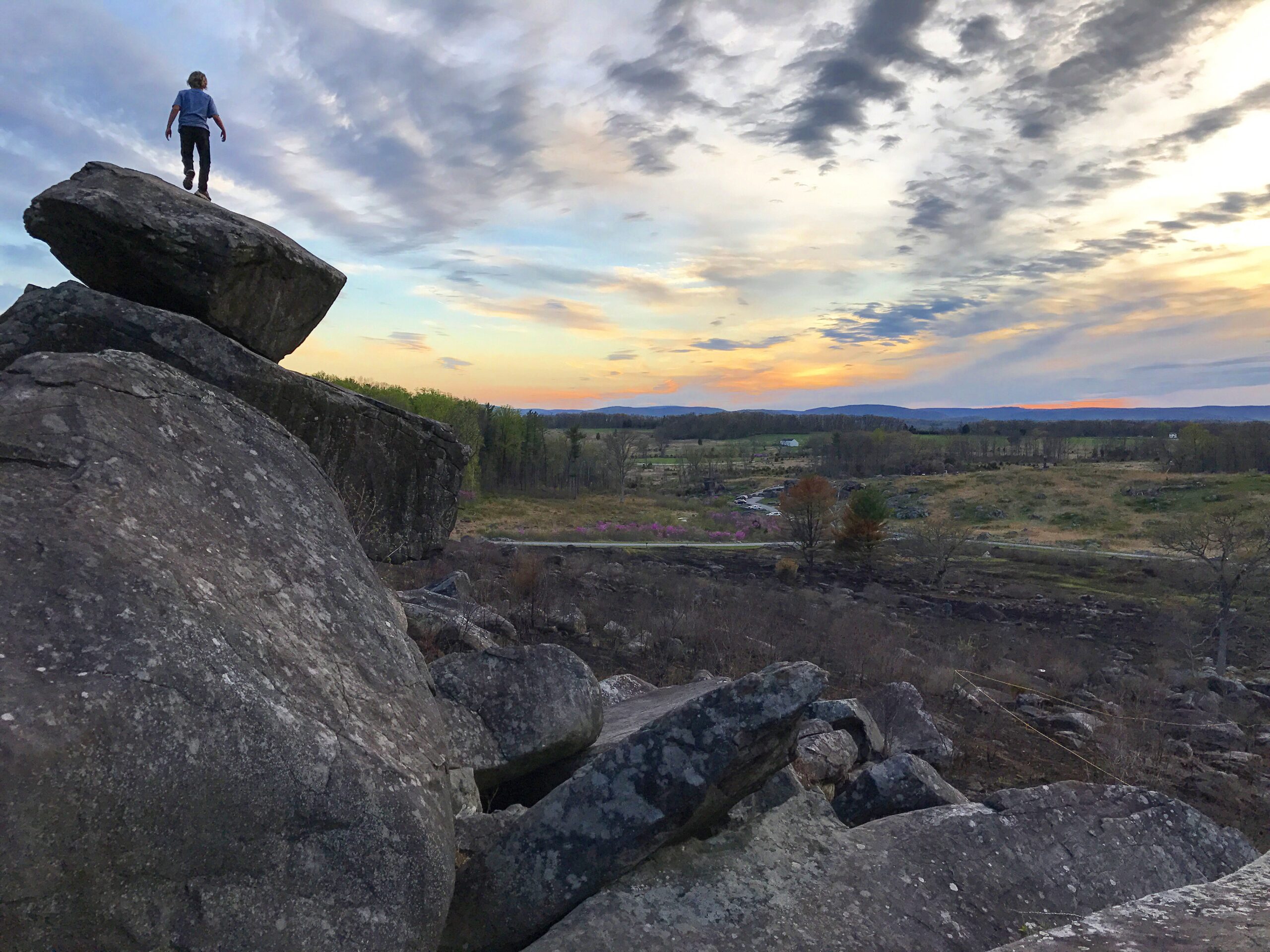
Jeremy and Stephanie visited Gettysburg with their boys when they were young and remembers feeling the emotional weight of the battlefield. At Devil’s Den, the kids happily scrambled over the enormous boulders while the adults reflected on the terrible events that had unfolded there. That contrast between a beautiful place to explore and its tragic history can feel unsettling, even in broad daylight.
Haunted Places to Visit in Gettysburg
Devil’s Den
Devil’s Den is a dramatic collection of massive boulders that played an important role during the second day of the Battle of Gettysburg. The area witnessed intense fighting and enormous loss of life.
Many soldiers who died during the battle were initially buried where they fell or in temporary graves. According to paranormal lore, the violent deaths and unsettled circumstances surrounding these burials may help explain the battlefield’s reputation for hauntings.
Even without a ghost sighting, Devil’s Den is a memorable stop for visitors interested in Civil War history.
Sachs Covered Bridge
Located a short drive from the main battlefield, Sachs Covered Bridge is another popular destination for paranormal enthusiasts.
Local ghost stories tell of Confederate soldiers who were allegedly executed at the bridge after attempting to pass themselves off as Union soldiers. Visitors have reported seeing apparitions of soldiers around the structure.
The bridge is worth visiting for its historic architecture and scenic setting, regardless of whether you encounter anything supernatural.
Jennie Wade House
The Jennie Wade House tells one of Gettysburg’s most tragic civilian stories.
Jennie Wade was a 20-year-old seamstress who was helping her sister care for a newborn when fighting broke out in Gettysburg. While preparing bread, she was struck and killed by a bullet that passed through two doors.
She is remembered as the only civilian killed directly by gunfire during the battle.
Today, visitors to the house have reported unexplained sensations, including feeling pushed, scratched, or pinched by something they cannot see. The historic house is a popular stop for both history enthusiasts and ghost hunters.
Gettysburg National Cemetery
Gettysburg National Cemetery is the final resting place of thousands of Union soldiers and the location where Abraham Lincoln delivered the Gettysburg Address.
It’s an important place for reflection and remembrance. Visitors should be particularly respectful of cemetery regulations and visiting hours.
Ghost Tours in Gettysburg
One of the best things about Gettysburg is the variety of organized ghost tours available.
Visitors can choose from family-friendly walking tours, paranormal investigations using ghost-hunting equipment, haunted pub crawls, and even carriage tours.
Shannon has participated in paranormal investigation tours and appreciates the opportunity to explore historic locations with knowledgeable guides. Organized tours are also a sensible way to enjoy the spooky side of Gettysburg without trespassing on private property or entering restricted areas.
Where to Camp Near Gettysburg
Gettysburg Battlefield KOA
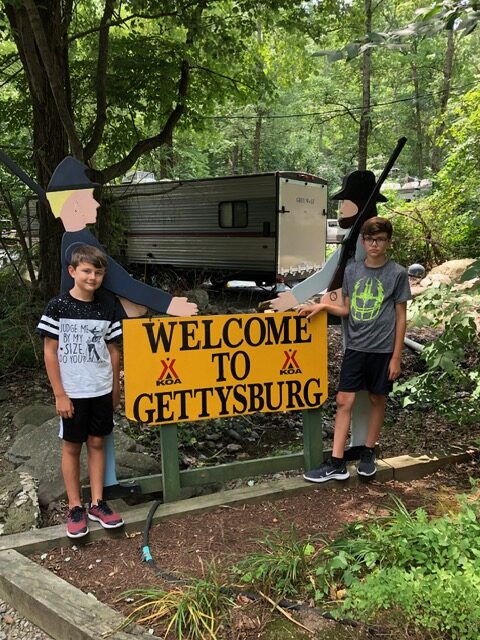
Gettysburg Battlefield KOA is one of Shannon’s personal favorites, and Jeremy agrees. In fact, he considers it one of the top KOA campgrounds we’ve visited over the years.
Shannon particularly loved the heavily shaded campsites. The campground also offers a swimming pool, miniature golf, a dog park, and family activities.
During Shannon’s 2019 visit, the campground organized a Gettysburg photo hunt that encouraged families to explore the campground and battlefield while completing challenges.
With RV sites, tent camping, and cabin accommodations, this KOA works well for different kinds of travelers.
Artillery Ridge Campground
Artillery Ridge is another popular option among members of our RV Atlas community.
The campground is conveniently located near battlefield trails, museums, and monuments. Shannon also discovered that the campground has advertised a complimentary historical ghost walk on select weekends.
For visitors planning a haunted Gettysburg getaway, that combination of campground convenience and ghost-themed activities makes Artillery Ridge particularly appealing.
Death Valley National Park, California: Ghost Towns and Mysterious Apparitions
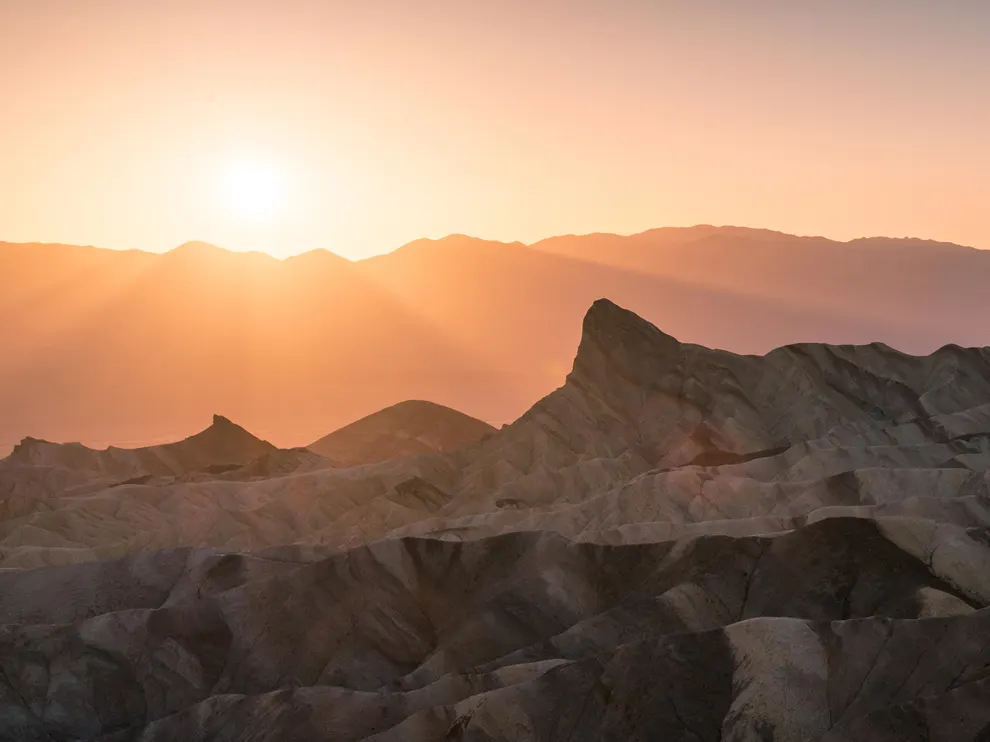
With a name like Death Valley, it’s no surprise that this national park has its share of eerie legends.
Death Valley is famous for its extreme temperatures, remote desert landscapes, and abandoned mining communities. While the park’s natural beauty is extraordinary, the combination of isolation and remnants of long-forgotten settlements creates an atmosphere that can feel genuinely unsettling.
Shannon recommends several historic destinations for visitors interested in exploring the paranormal side of Death Valley.
Haunted Places to Explore Near Death Valley
Rhyolite Ghost Town
Rhyolite is an abandoned mining town located outside the national park boundary near Beatty, Nevada.
During the early 1900s, Rhyolite was a thriving community with hotels, stores, schools, an ice plant, and electrical facilities. But the boom was short-lived, and the community was largely abandoned by 1916.
Today, the ruins provide a fascinating glimpse into the region’s mining history.
According to local ghost stories, visitors have reported seeing a mysterious figure known as the Brown Shadow Man. The apparition is described as wearing a long duster coat and a wide-brimmed hat.
Whether or not you believe those stories, walking through an abandoned desert town surrounded by deteriorating buildings and wide-open wilderness is certainly an atmospheric experience.
Leadfield Ghost Town
Leadfield was another mining settlement, this one dating to the 1920s.
Unlike some Western boomtowns that flourished for years, Leadfield’s mining operation was remarkably short-lived. The settlement declined after the ore proved disappointing.
Remnants of the town include foundations, wooden structures, and sealed mine tunnels.
Leadfield is listed on the National Register of Historic Places and offers another opportunity to explore the history of Death Valley’s mining era.
Because reaching remote historic sites can involve difficult roads and terrain, visitors should research access conditions before attempting the trip.
Amargosa Opera House and Hotel
Located in Death Valley Junction, the Amargosa Opera House has one of the most unusual stories on Shannon’s list.
In the 1960s, New York dancer Marta Becket discovered the abandoned theater while traveling through the desert with her husband. Captivated by the building, she eventually moved to the area and restored it.
When audiences were small, Becket painted an elaborate audience on the theater walls so she would never have to perform to an empty house.
The opera house became her artistic home for decades.
Today, the property is associated with stories of unexplained activity, including claims that Becket’s spirit remains connected to the theater.
Historic theaters already have a naturally mysterious atmosphere, and the Amargosa Opera House’s extraordinary history makes it an especially interesting stop.
Where to Camp in Death Valley
Furnace Creek Campground
Furnace Creek Campground is conveniently located near the Furnace Creek Visitor Center.
The campground offers a combination of RV sites, tent sites, and group camping areas, with some sites providing hookups.
Reservations are available during designated periods, and the campground can be popular during the cooler months.
Visitors should not expect extensive resort amenities. Shannon notes that cell service and internet access can be unreliable or nonexistent, and the campground does not provide showers or laundry facilities. Flush toilets are available.
Stovepipe Wells RV Park
Stovepipe Wells is another option for RVers who want to stay within the Death Valley area.
Shannon highlights its relatively small number of full-hookup RV sites and access to nearby trails, sand dunes, and other park attractions.
The Stovepipe Wells area also offers access to services and a swimming pool associated with the resort property.
Important Safety Tips for Death Valley
Death Valley demands serious preparation, whether you’re searching for ghosts or simply sightseeing.
Make sure your vehicle is in good working condition, fill your fuel tank before entering remote areas, and carry plenty of drinking water.
Cellular service is limited throughout much of the park, so download maps that work offline and never assume you’ll be able to call for help.
Flash flooding is another important concern. Desert storms can create dangerous conditions with very little warning, so always check weather forecasts and follow National Park Service alerts.
Most importantly, do not allow the excitement of visiting a ghost town to override common sense about extreme heat, road conditions, or restricted areas.
New River Gorge National Park and Preserve, West Virginia: Ghostly Railroad Legends
West Virginia is filled with mountain scenery, historic coal towns, and generations of Appalachian folklore.
New River Gorge National Park and Preserve is best known for its spectacular bridge, whitewater rafting, and rugged landscape. But the region’s industrial history also provides plenty of material for ghost stories.
Shannon discovered one of the park’s most interesting historic communities almost by accident during a family trip.
Thurmond: A Historic Railroad Ghost Town
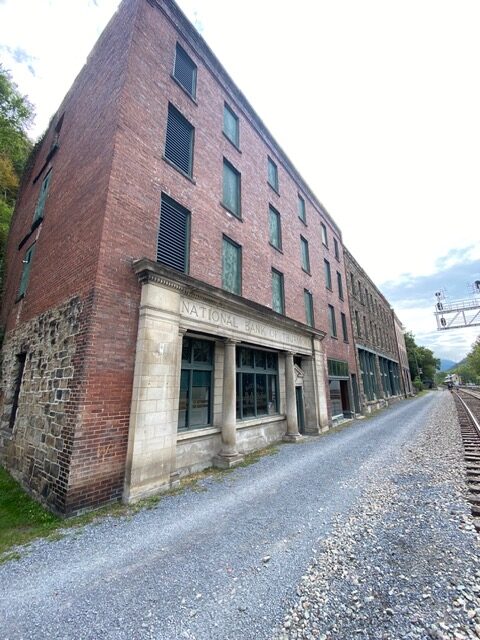
While attempting to find the New River Gorge Bridge, Shannon’s family followed their GPS and ended up in Thurmond.
The unexpected detour turned into a memorable experience.
During the early 1900s, Thurmond was a bustling railroad community where coal shipments and passenger trains supported a thriving local economy. Hotels, boarding houses, and businesses served railroad workers and visitors.
The town’s banks were once among the wealthiest in West Virginia.
But changes in railroad technology, declining mining activity, and the Great Depression contributed to Thurmond’s eventual decline.
Today, visitors can explore the preserved historic community. The National Park Service maintains a number of buildings, and the historic Thurmond Depot serves as a seasonal visitor center.
A working railroad still passes through town, adding to the atmosphere.
According to local paranormal stories, visitors have reported unexplained voices, shadowy figures, and the sensation of being watched.
Two particularly memorable legends involve a headless railroad conductor carrying a lantern and a phantom hitchhiker who supposedly appears along remote roads before mysteriously disappearing.
Jeremy was fascinated by both stories, although he made it very clear that he has absolutely no intention of picking up a phantom hitchhiker or boarding a train with a headless conductor.
One important planning note: The roads into Thurmond are narrow and winding. The National Park Service discourages bringing large vehicles or towing campers into the historic town. Leave your RV at the campground and explore in a smaller vehicle.
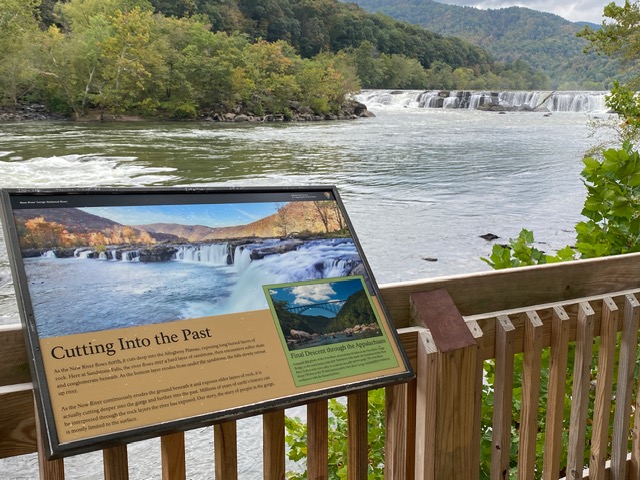
Sandstone Falls
Sandstone Falls is another beautiful destination with a spooky reputation.
A boardwalk provides access to views of the impressive waterfalls and surrounding landscape.
Visitors have reported hearing unexplained whispers, experiencing sudden drops in temperature, and seeing apparitions near the falls.
Of course, the natural scenery alone makes Sandstone Falls worth visiting. The paranormal stories simply add another layer of intrigue.
Where to Camp at New River Gorge
Adventures on the Gorge
Adventures on the Gorge offers a wide variety of accommodations, including RV camping, traditional campsites, glamping tents, cabins, and vacation homes.
The property also features recreational amenities such as a swimming pool, disc golf, and scenic overlooks.
One of the biggest advantages is the opportunity to book guided outdoor adventures, including whitewater rafting.
You can spend the day experiencing the thrills of the New River and then enjoy a ghost story around the campfire at night.
National Park Service Campgrounds
New River Gorge National Park and Preserve also offers several primitive camping areas.
These campgrounds provide a more rustic experience than a developed private campground. Many sites are first-come, first-served, with limited facilities and no hookups.
Access roads may be gravel or dirt, and not every campsite is suitable for an RV.
Campers should carefully review the specific campground’s access requirements, vehicle restrictions, and available amenities before arriving.
Safety Tips for New River Gorge
The New River is beautiful, but it can also be dangerous.
Strong currents, rocky banks, and sudden underwater drop-offs make swimming hazardous in many areas.
Visitors planning overnight boating or backpacking trips should consult park rangers and obtain appropriate trail and river maps.
Primitive campers should bring sufficient food, water, and supplies rather than assuming services will be available nearby.
Great Smoky Mountains National Park: Appalachian Ghost Stories and Unspoken Rules
Great Smoky Mountains National Park is one of America’s most beloved outdoor destinations. But the misty forests, historic settlements, and deep Appalachian storytelling traditions also make it one of the country’s most atmospheric places for ghost stories.
Jeremy has always felt that certain areas of the Smokies have an unusually mysterious quality, particularly Cades Cove.
Even during the daytime, fog drifting through the mountains and abandoned historic buildings can create an eerie feeling.
Shannon agrees, and she believes the Smokies are among the best destinations in the country for visitors interested in paranormal folklore.
The Unspoken Rules of Appalachian Folklore
Before sharing her favorite haunted locations, Shannon introduces several traditional warnings associated with Appalachian folklore.
These are regional legends and superstitions rather than established wilderness safety rules, but they certainly make for entertaining campfire conversation.
Never answer a familiar voice calling from the woods. According to folklore, a spirit or supernatural trickster may imitate someone you know in an attempt to lure you away from safety.
Don’t whistle at night. Some traditions warn that whistling after dark attracts the attention of unwanted spirits.
Pay attention when the forest suddenly becomes silent. Folklore interprets an abrupt absence of natural sounds as a warning that something unusual may be nearby.
Avoid wandering into the woods after dark. In these stories, nighttime belongs to the creatures and spirits that inhabit the forest.
Be cautious about unexplained screams. Appalachian legends sometimes associate strange cries with supernatural beings, although real wildlife can also make surprisingly human-sounding noises.
These traditions are part of a larger body of Appalachian folklore that includes mysterious creatures known as cryptids, such as Mothman, the Wampus Cat, and the Not Deer.
Whatever you believe about the supernatural, staying together, respecting wildlife, and avoiding unnecessary nighttime wandering are sensible precautions when camping in remote areas.
And if you’re tent camping deep in the Smokies, you may find that these stories sound considerably more frightening after the sun goes down.
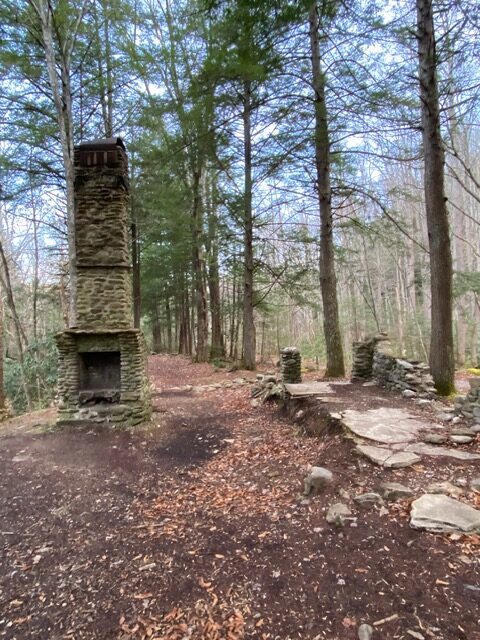
Elkmont and Daisy Town
One of Shannon’s favorite historic locations in Great Smoky Mountains National Park is Elkmont.
The community began developing during the region’s logging era. In the early 1900s, wealthy families from Knoxville also began using the area as a mountain retreat, establishing vacation homes and social clubs.
When Great Smoky Mountains National Park was created, some property owners retained leases that allowed them to continue using their homes for a period of time.
Eventually, the buildings reverted to National Park Service ownership, leaving behind a collection of historic structures.
Today, the Daisy Town area offers visitors a chance to explore part of this former vacation community.
Shannon visited with a friend and remembers walking through historic houses where remnants of flooring and wallpaper were still visible.
With very few other visitors around, the experience was surprisingly eerie. Open doors moved in the breeze, and the abandoned buildings seemed to hold traces of the people who had once spent their summers there.
Levi Trentham Cemetery
Near Daisy Town, visitors can find the historic Levi Trentham Cemetery.
This small cemetery offers another reminder of the people who lived and worked in the Elkmont area before it became part of the national park.
Visitors should approach the cemetery respectfully and remain on permitted paths.
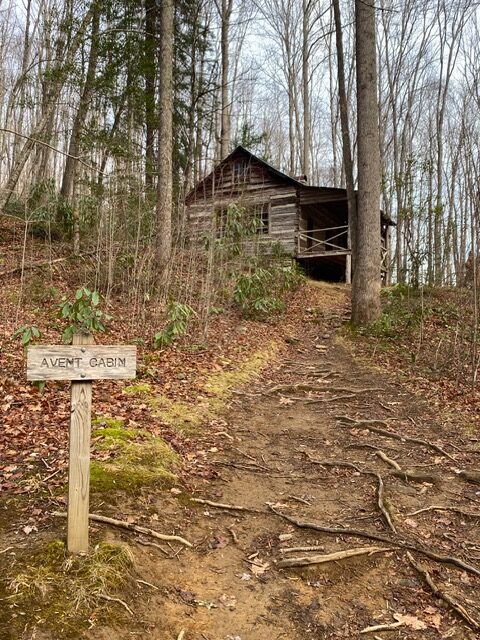
Avent Cabin and Jakes Creek Trail
Shannon also recommends exploring Jakes Creek Trail, which provides access to the historic Avent Cabin.
The cabin was associated with artist Mayna Treanor Avent and remains an interesting piece of the area’s cultural history.
Shannon and her friend hiked to the cabin, crossing a wooden bridge that she remembers as one of the more intimidating parts of the adventure.
Visitors have reported strange sounds and unexplained voices around the cabin, adding to its paranormal reputation.
Even without those stories, the combination of forest scenery, historic architecture, and quiet mountain surroundings makes this a fascinating area to explore.
Where to Camp in Great Smoky Mountains National Park
Elkmont Campground
Elkmont Campground is the most convenient choice for visitors who want to explore Daisy Town and the surrounding historic sites.
The campground offers RV and tent sites, drinking water, and flush toilets.
There are no RV hookups or showers, and cellular service can be unreliable.
Reservations are available through Recreation.gov.
For campers who enjoy a traditional national park experience and don’t mind disconnecting from modern conveniences, Elkmont is an excellent base camp.
Little Arrow Outdoor Resort
Little Arrow Outdoor Resort offers a very different camping experience.
Located in Townsend, Tennessee, this upscale campground is one of our personal favorites in the Smokies.
The property offers RV sites along with glamping tents, tiny homes, cabins, and Airstream accommodations.
There are also organized activities and events throughout the year.
Little Arrow provides a comfortable place to return after a day of exploring historic sites and spooky mountain legends.
For travelers who prefer a little luxury after their ghost hunting, it’s hard to beat.
Crater Lake National Park, Oregon: Mysterious Lights and a Haunted Lodge
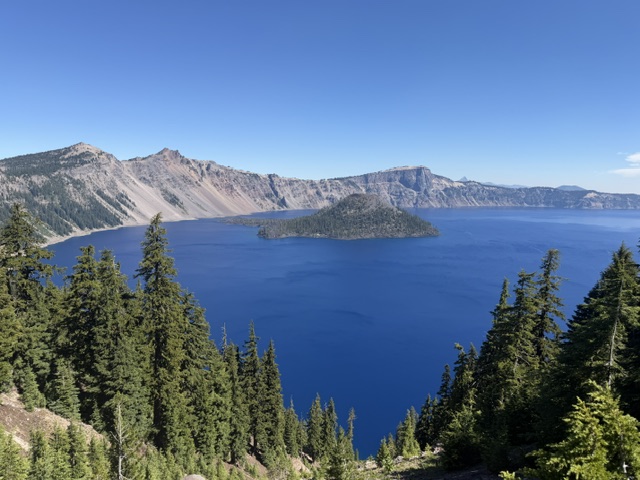
Crater Lake National Park might not immediately come to mind when thinking about haunted national parks, but its remote location and mysterious landscape make it a natural fit for Shannon’s list.
Shannon visited the park with her family during the summer and researched its paranormal stories before the trip.
Crater Lake was formed when Mount Mazama collapsed following a massive volcanic eruption thousands of years ago. The resulting caldera eventually filled with rainwater and snowmelt, creating the deepest lake in the United States.
At approximately 1,943 feet deep, the lake is famous for its extraordinary blue water and dramatic cliffs.
But the same isolation and depth that make Crater Lake beautiful also inspire stories about what might be lurking beneath the surface.
Wizard Island and Mysterious Campfires
Wizard Island is a volcanic island rising from Crater Lake.
According to local legends, visitors have reported seeing mysterious campfires glowing on the island even though campfires are prohibited there.
Shannon describes stories of park rangers investigating these reports without finding evidence of an actual fire.
The region also has a strong tradition of Bigfoot stories, and Crater Lake has inspired occasional tales of a mysterious lake creature.
Shannon notes that while her primary interest is ghosts, these stories fall within the broader world of paranormal folklore.
During her family’s visit, boat trips to Wizard Island were not operating. Visitors interested in reaching the island should check the current status of boat tours before planning their trip.
Crater Lake Lodge
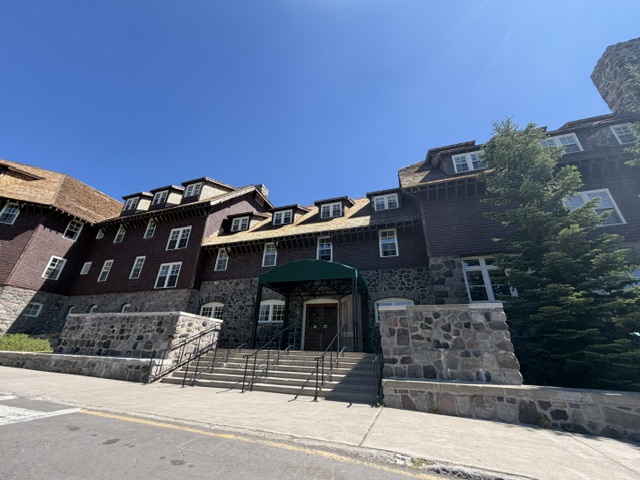
Historic national park lodges are some of the most atmospheric buildings in the country, and Crater Lake Lodge is no exception.
The lodge offers beautiful views of the lake, a dramatic great hall, a fireplace, and guest rooms overlooking the surrounding landscape.
But the historic property also has a reputation for unexplained activity.
Visitors have reported hearing footsteps in the second- and third-floor hallways, only to discover that nobody is there.
Others describe shadowy figures appearing in the great hall.
One of the lodge’s most memorable legends involves a mysterious chambermaid. According to the story, staff members have reported seeing a woman dressed in period clothing walking through the hallways while carrying keys that jingle as she moves.
For anyone who loves historic architecture and ghost stories, spending a night at Crater Lake Lodge could be an especially memorable experience.
Where to Camp Near Crater Lake
Mazama Campground
Mazama Campground is the primary developed campground within Crater Lake National Park.
It accommodates RVs and travel trailers, making it a convenient option for visitors who want to stay close to the park’s major attractions.
Reservations are strongly recommended, and campers should check seasonal operating dates and current campground availability.
Shannon also points out that there are many additional camping options outside the park. Because Crater Lake can be approached from different directions, it’s important to choose a campground that makes sense for your overall route.
Visitors should not plan to spend the night in an RV at a scenic overlook or ordinary parking area. Overnight camping is restricted to designated locations.
Safety Tips for Crater Lake
Crater Lake’s dramatic scenery comes with significant hazards.
Many overlooks and trails are located near steep drop-offs, so proper footwear and careful attention to trail conditions are essential.
Large RVs and trailers can be difficult to maneuver on narrow, winding roads, and some parking areas have limited space or no convenient turnaround.
Shannon recommends unhitching your tow vehicle before exploring the park whenever possible.
Visitors should also arrive with adequate fuel, food, and water. Services are limited, and meals inside the park can be expensive.
Weather is another major consideration. Crater Lake receives enormous amounts of snowfall, and snow can remain on the ground well into summer.
Even during July, road access and trail conditions can vary dramatically from year to year.
Which Haunted National Park Should You Visit First?
After exploring all five destinations, Jeremy asked Shannon which park she would recommend for someone hoping to have a paranormal experience.
Her first choice was Gettysburg.
The relatively concentrated battlefield area, extensive history of Civil War casualties, and abundance of reported hauntings make Gettysburg her top recommendation.
Great Smoky Mountains National Park came in second.
For Shannon, the Smokies combine historic settlements, deep forests, Appalachian folklore, and an extraordinary atmosphere.
Jeremy agreed that Gettysburg deserves a spot near the top, but he also considers the Smokies one of the eeriest national parks he has ever visited.
There’s something about the fog, the dense forests, the historic cabins, and the long tradition of Southern storytelling that makes the Smokies feel mysterious even during the day.
Of course, Death Valley’s abandoned mining towns, New River Gorge’s railroad legends, and Crater Lake’s historic lodge all offer compelling reasons to plan a spooky adventure of your own.
Planning a Safe Haunted National Park RV Trip
One of the most important themes throughout Shannon’s recommendations is that ghost hunting should never come at the expense of personal safety.
National parks contain real hazards, including extreme temperatures, dangerous water conditions, wildlife, steep terrain, limited cellular service, and remote roads.
A successful haunted RV road trip starts with the same preparation required for any other outdoor adventure.
Research park access and seasonal conditions before arriving. Carry adequate food, water, fuel, and emergency supplies. Download offline maps when traveling through areas with limited cellular coverage.
Pay particular attention to RV length restrictions and road conditions. A destination that is easy to reach in a passenger vehicle may be completely unsuitable for a large motorhome or a truck towing a travel trailer.
And always respect park hours, closed areas, historic structures, cemeteries, and private property.
If you want to experience a historic location after dark, look for an authorized ranger program or organized ghost tour rather than attempting to explore restricted areas on your own.
You can enjoy a wonderfully spooky adventure without creating an actual emergency.
More Haunted RV Road Trips with Shannon Minner
This episode marks Shannon’s fourth annual Halloween visit to The RV Atlas, and her haunted road trip series has become one of our favorite October traditions.
Previous episodes have explored ghost-hunting tours and tips, haunted destinations paired with books, and haunted bars and restaurants near camping locations.
The combination of RV travel, history, folklore, and practical campground recommendations makes these episodes fun for believers and skeptics alike.
Shannon is already thinking about future paranormal adventures, including historic national park lodges and other famously haunted destinations.
If you have your own ghost story from a national park or campground, you can connect with Shannon on Instagram at @thecampinglibrarian. She loves hearing about unusual experiences and seeing photographs from fellow travelers.
Whether you’re planning a Halloween getaway or simply want to add a little mystery to your next national park adventure, these five destinations offer fascinating history, memorable scenery, and plenty of stories to share around the campfire.
Just remember to bring your flashlight, check the weather, and maybe think twice before answering that mysterious voice calling your name from the woods.
We’ll see you at the campground.
The post A Haunted RV Roadtrip to America’s National Parks: With Shannon Minner appeared first on The RV Atlas.
14 October 2026, 1:15 am - 1 hour 4 minutesA Solo Campervan Trip to Mueller State Park in Colorado with Kerri Cox from Travels with Birdy
Ponderosa pines, Rocky Mountain peaks, gorgeous campsites…Colorado’s Mueller State Park just might be one of the nation’s prettiest campgrounds. It is classic camping at its best. Our longtime correspondent Kerri Cox is with us to share a campground review of Mueller State Park, which has become a favorite home away from home for her over the years. And, she selected this familiar favorite for her very first solo van trip.
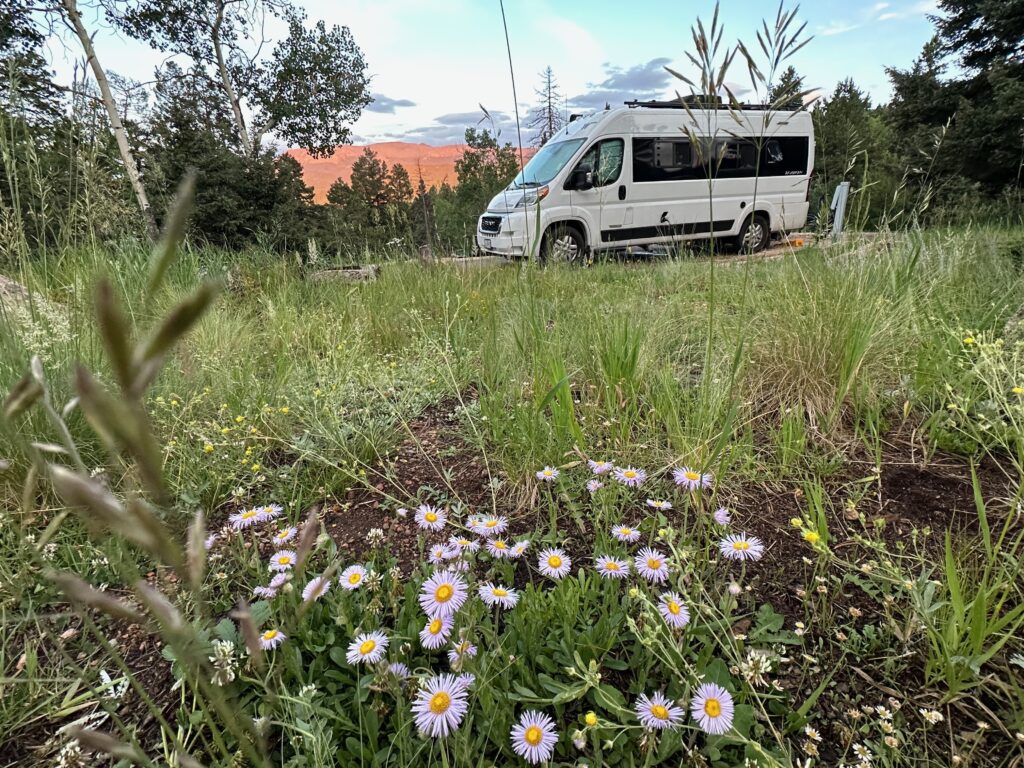
Here’s a guest post from Kerri. To hear our full conversation, including Kerri’s top campsite picks, click play on the media player above or look for The RV Atlas on your favorite podcast app.
Though I don’t live in Colorado, it’s become my favorite place to visit due to the easy drive to the mountains from my home in Missouri. You might have heard me talk about it again and again and again on the podcast over the years. I first fell in love with Mueller State Park nearly 10 years ago and have returned five or six times as a place to enjoy nature and relaxation. I consider it my annual “reset” before the school year begins.
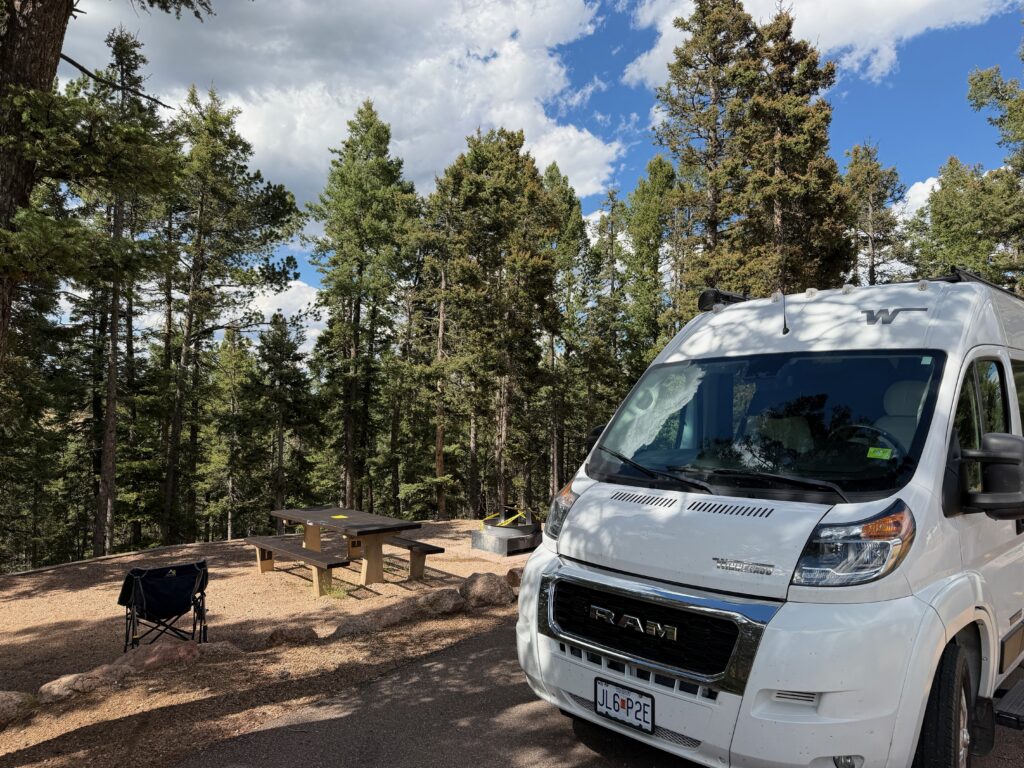
Since Russell and I didn’t have a good chance for a getaway together this summer, when he was heading off to a game convention in Indianapolis, I decided it would be the perfect time for my first solo van trip in my beloved Class B van, AKA “Birdy.” It was a familiar place to practice the unfamiliar experience of a big solo drive and full setup. Since I booked late, I ended up with a different campsite for each night, giving me even more of an opportunity to explore the park.
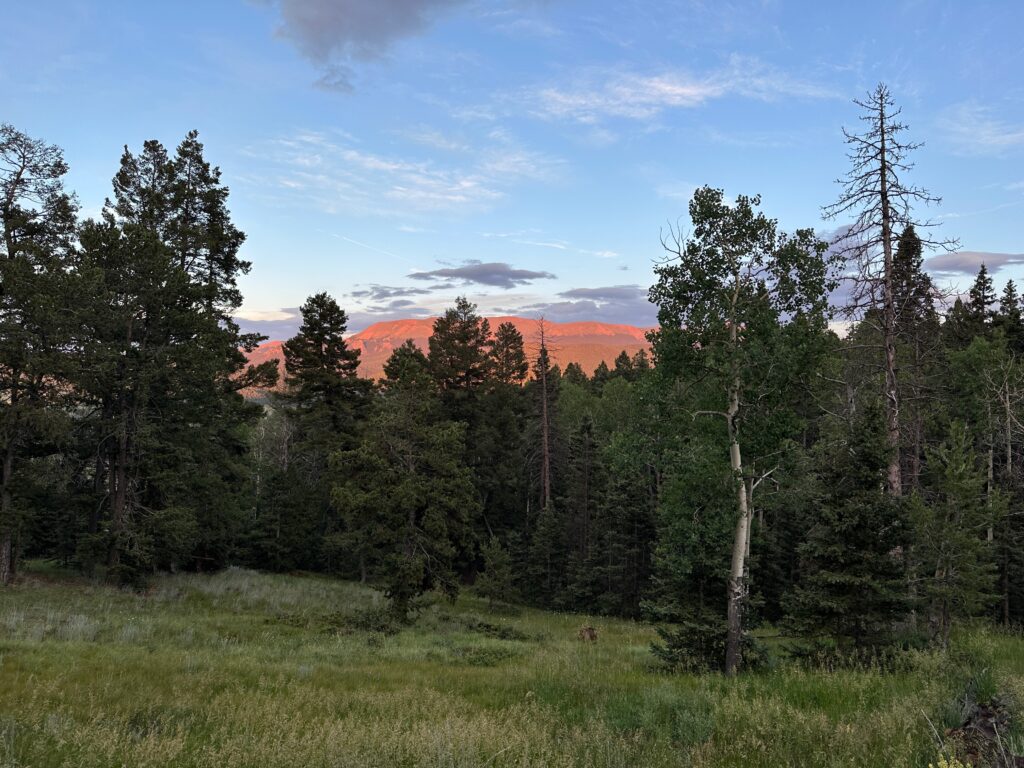
First, here are 5 things make Mueller State Park especially special:
-
- Amazing panoramic views of Pikes Peak and surrounding mountains
- Elevation is truly IN the mountains
- Large campsites with some privacy
- Surrounded by pines, aspens, and wildlife
- True classic camping experience!
Where is Mueller State Park?
Some campgrounds work best as basecamps you use to explore other destinations, but Mueller State Park is a campground I go to just to stay in the campground. It encompasses all of the mountain vibes without requiring driving on mountainous roadway (when coming in from Colorado Springs).
Mueller State Park is located approximately 45 minutes west of Colorado Springs, making it close enough for a day trip but a little too far away to drive in and grab a meal. The drive “up” Highway 24 from Colorado Springs is pretty interesting, passing by some of the city’s iconic red rocks and a few small mountain towns.
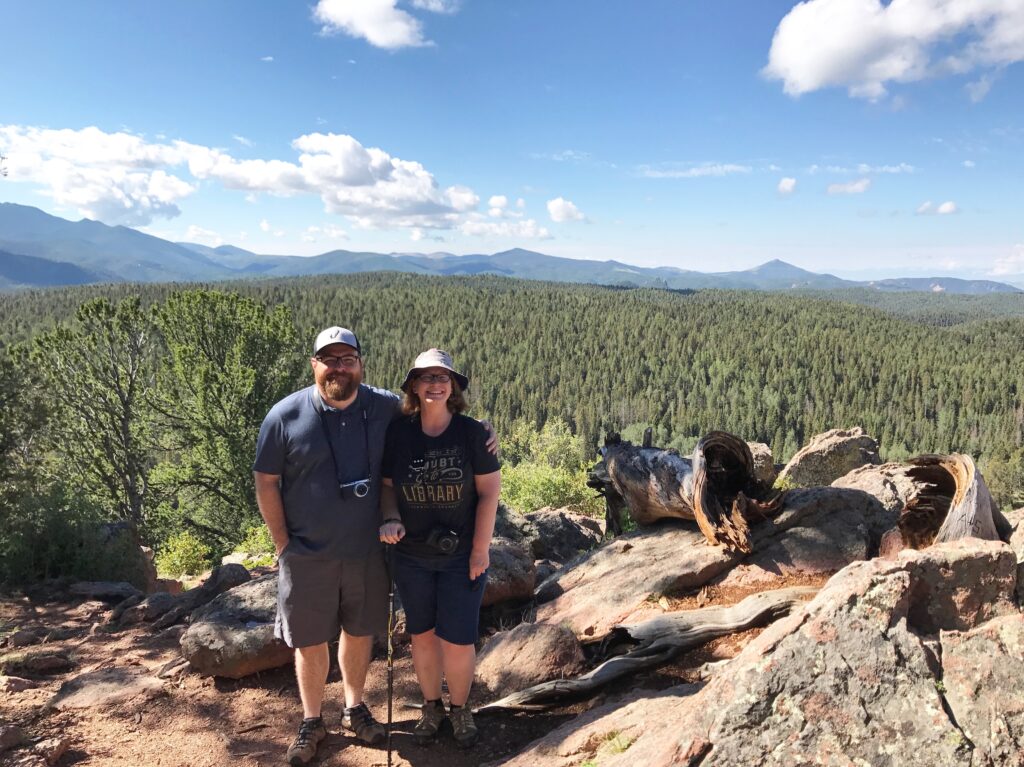
The main reason I go to Mueller State Park has less to do with its geographic location and more to do with its elevation. The park is located at app. 9,500 feet in elevation (pro tip: it’s not advisable to go directly to the park from the flatlands if you aren’t used to elevation; consider a stay in Colorado Springs for a night before continuing on).
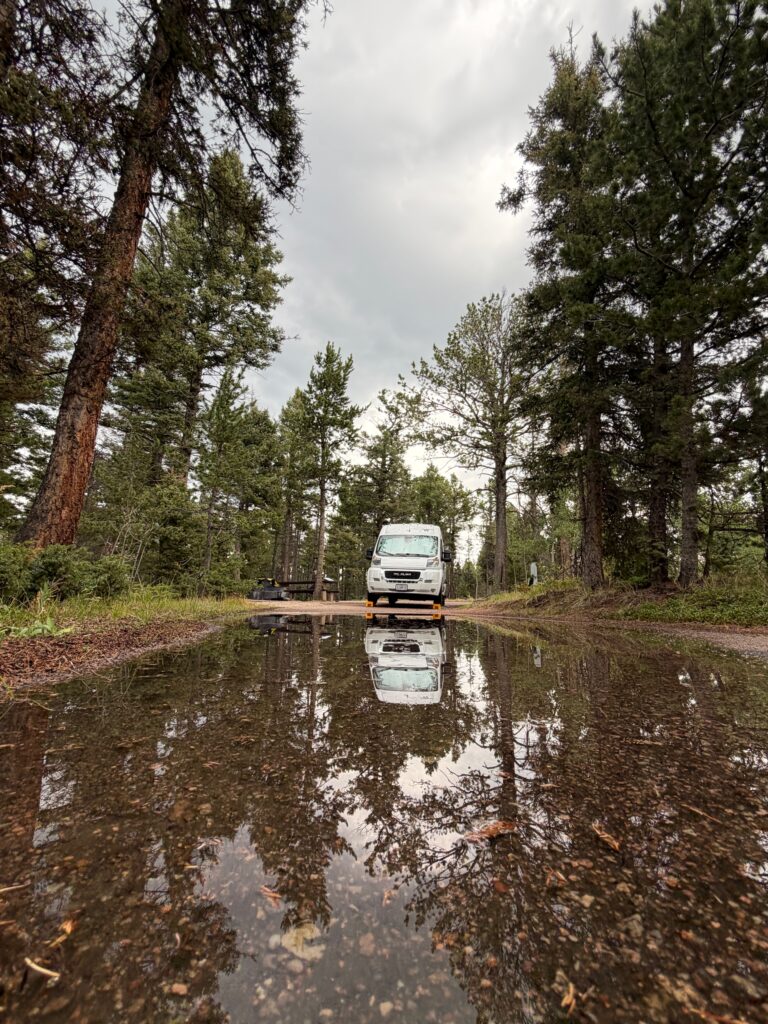
Because of the elevation, the weather is much cooler in the summer, with highs in the 70s and low 80s. Monsoon rains hit daily in July and August but rarely wash out an entire day. Mueller is a great spot to experience Colorado’s golden aspens in the fall (with trees changing in September), and it offers camping and activities even in the snowy winter.
What Amenities Does Mueller State Park Offer?
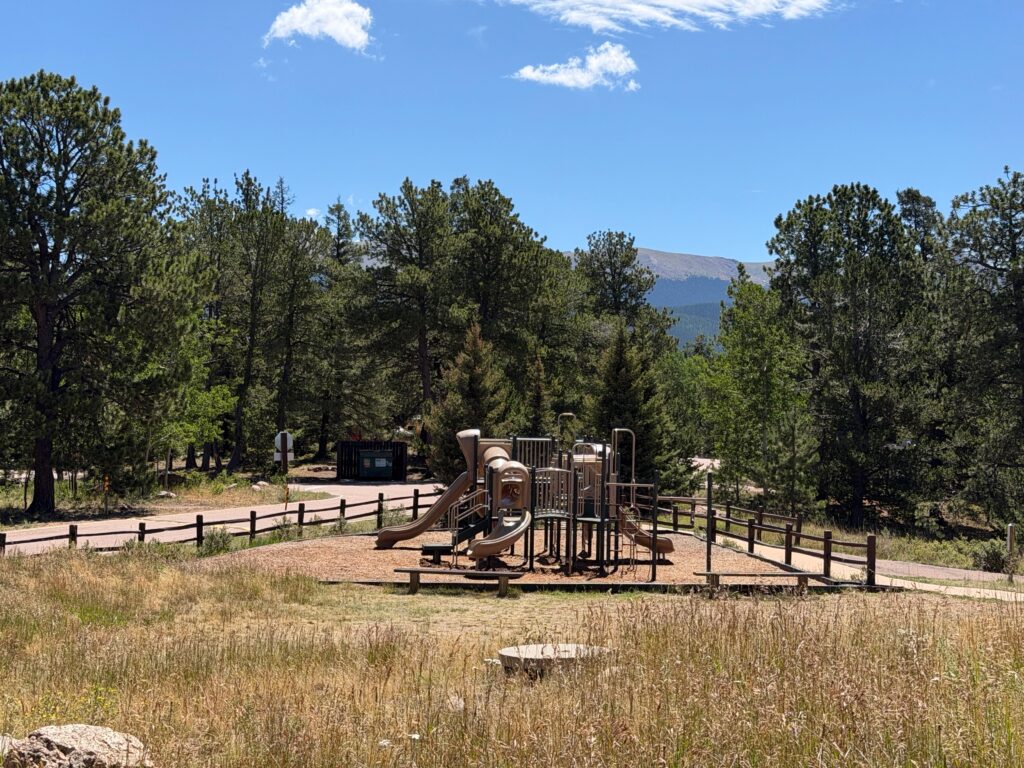
- The Visitor Center shares details about the local wildlife, geology, and park amenties
- A large camper services station offers a playground, a laundry room, and showers. All are well maintained. There are picnic tables inside and out, providing a nice place to rest while waiting, and the outside seats offer good views of the park.
- 2 important things to note about the comfort stations:
- You may have to walk quite a ways uphill to reach them if you aren’t driving
- The showers require quarters!
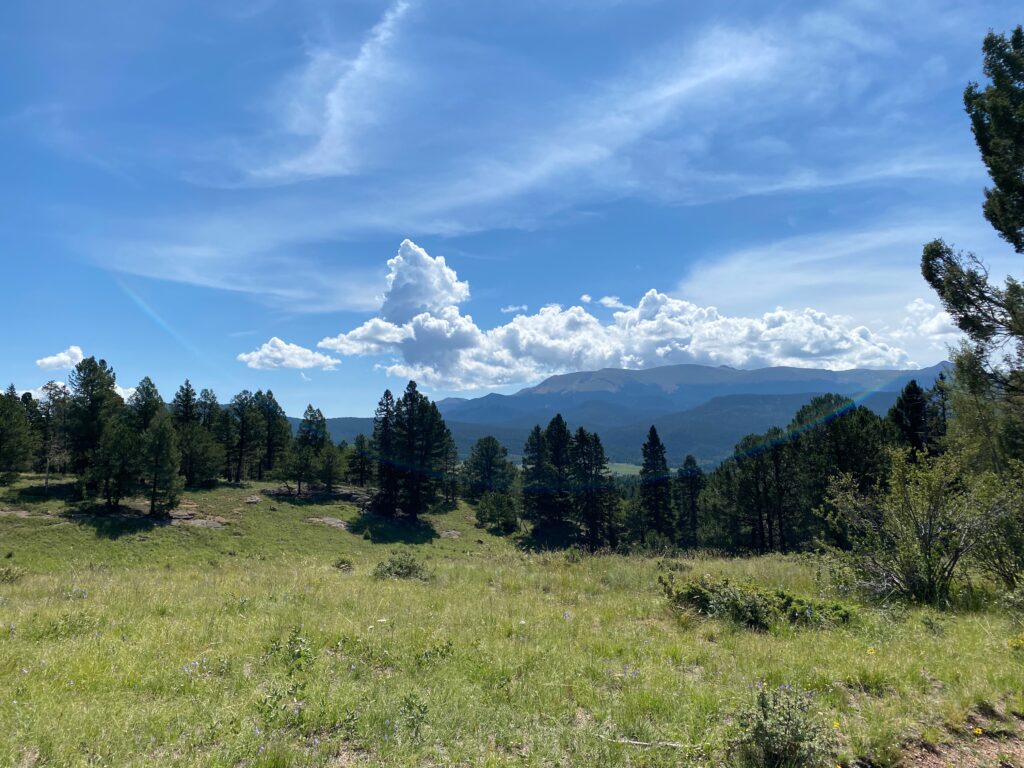
- The park has nearly 50 miles of trails with varying degrees of difficulty (this website has good trail details with personal descriptions and lots of photos). The trails are mostly open to mountain biking and horseback riding but not to dogs.
- My favorite is Grouse Mountain Trail, which is a mile out and back and takes you up to an overlook where you feel like you are at a mountain peak, with panoramic views of a swath of evergreens, Pikes Peak, and the Sangre de Cristo mountains.
- Other activities include fishing (kids’ pond and backcountry fishing), lots of wildlife watching, snowshoeing, sledding, and more.
- Note about phone and data signals: No public wifi is available. Due to the trees and mountains, cell signals, especially for data, can be very spotty. Sites that open toward meadows and have higher elevations have better signal. If you can’t get a signal at your site, go to the visitor center or camper services building for your best chance.
Camping in Mueller State Park
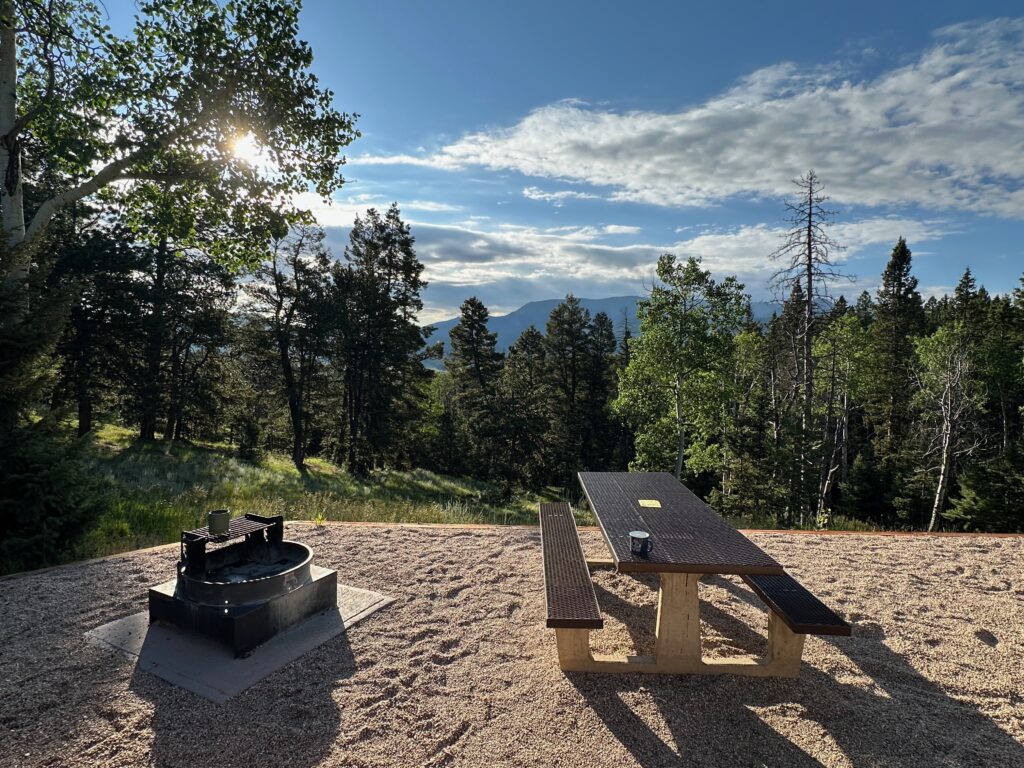
Important details about the campsites:
- 136 campsites, including spots for RVs, tents, and groups
- Walk-in tent sites are especially nice, with pushcarts for hauling your supplies.
- Cabins and a background yurt are also available
- Basic or Electric campsites only (no full hookups)
- Potable water spigots and a dump station available
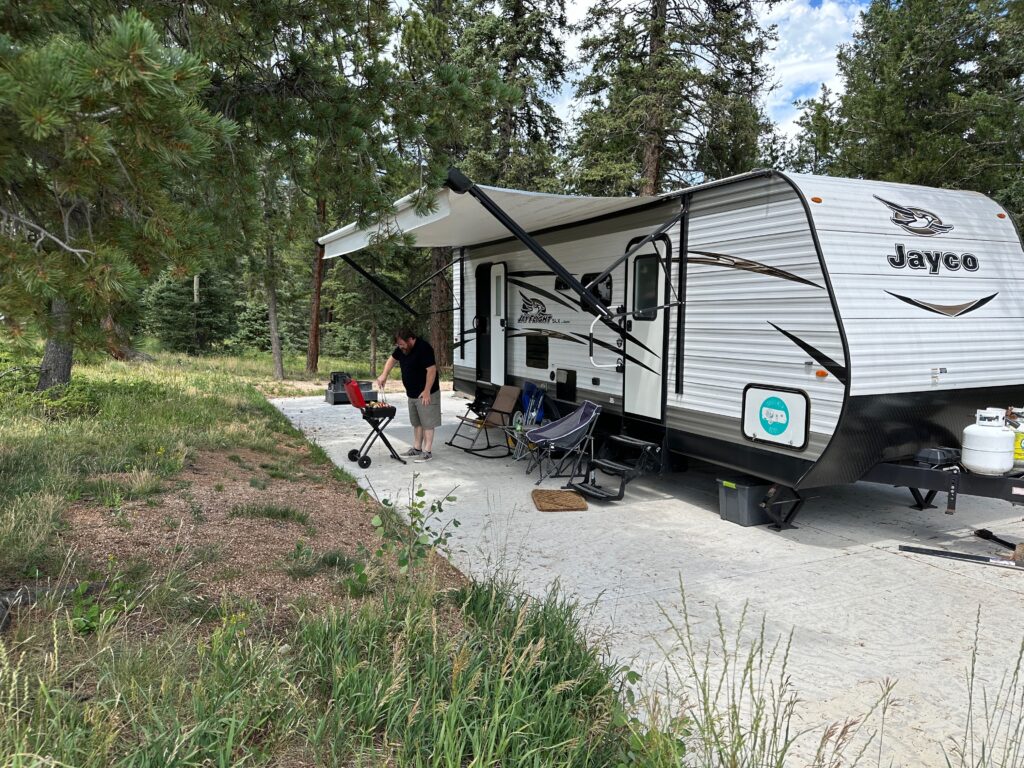
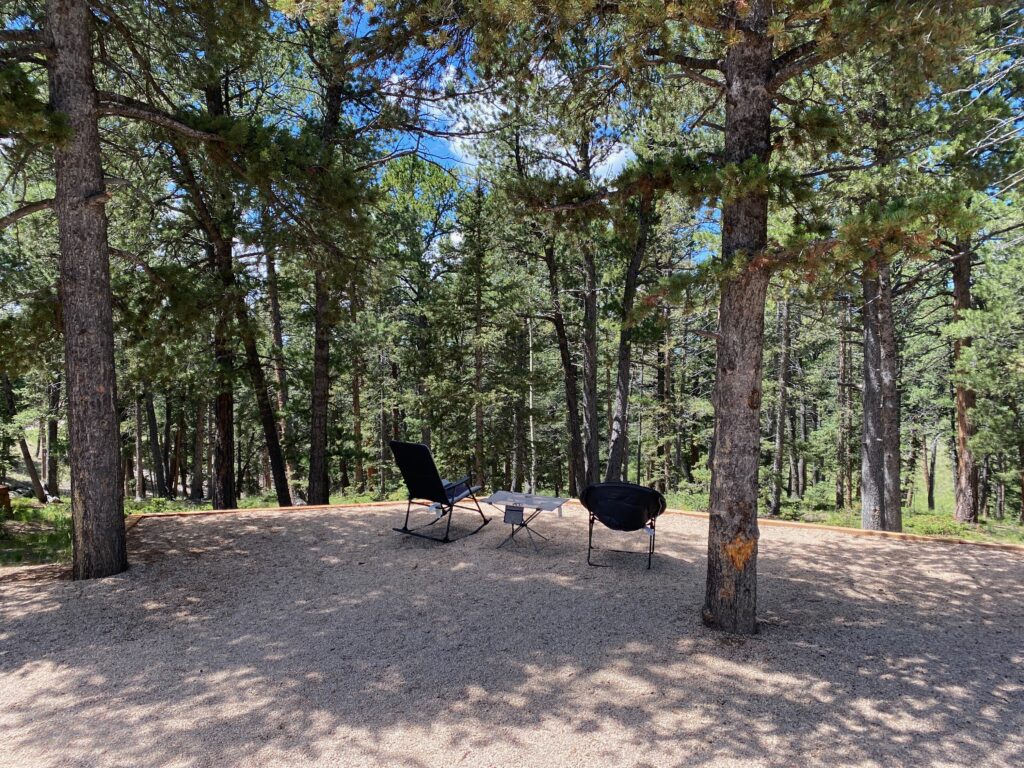
- Sites are very spacious, with concrete parking pads, large gravel patios, a picnic table and a fire ring. Additional space is usually available for a tent
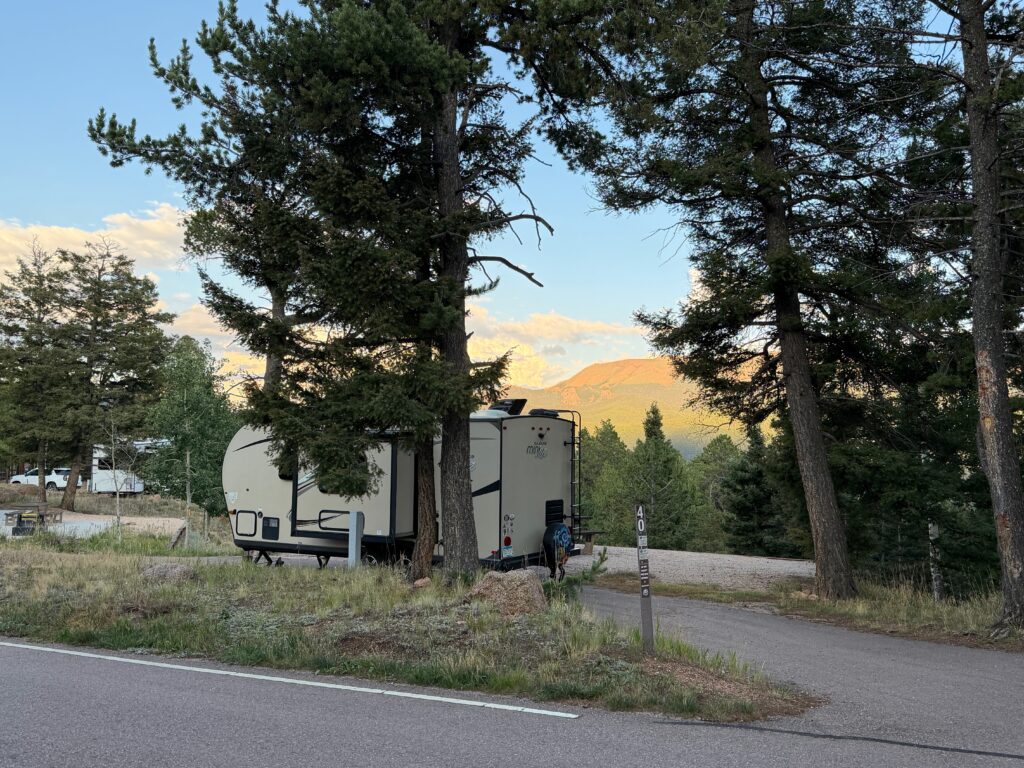
Tips for booking at Mueller State Park:
- It is open year round, though you will need to be mindful of roadways during the snowy winters
- Booking well in advance is advised, especially if you’ll want to stay on a weekend and don’t have flexible plans
- Bookable 6 months in advance
- Later bookings are possible if you split your stay across sites, don’t stay on the weekend, or sign up for alerts about cancellations (pro tip: if you book on a computer instead of a phone, you can click on a calendar icon to see every site’s availability per night, allowing you to patch together different sites if you can easily move)
- RV sites are $36 a night, but you must also pay $10 Colorado State Park entry fee per day per car upon arrival
- For an excellent drive-through of the park’s campsite, check out this video.
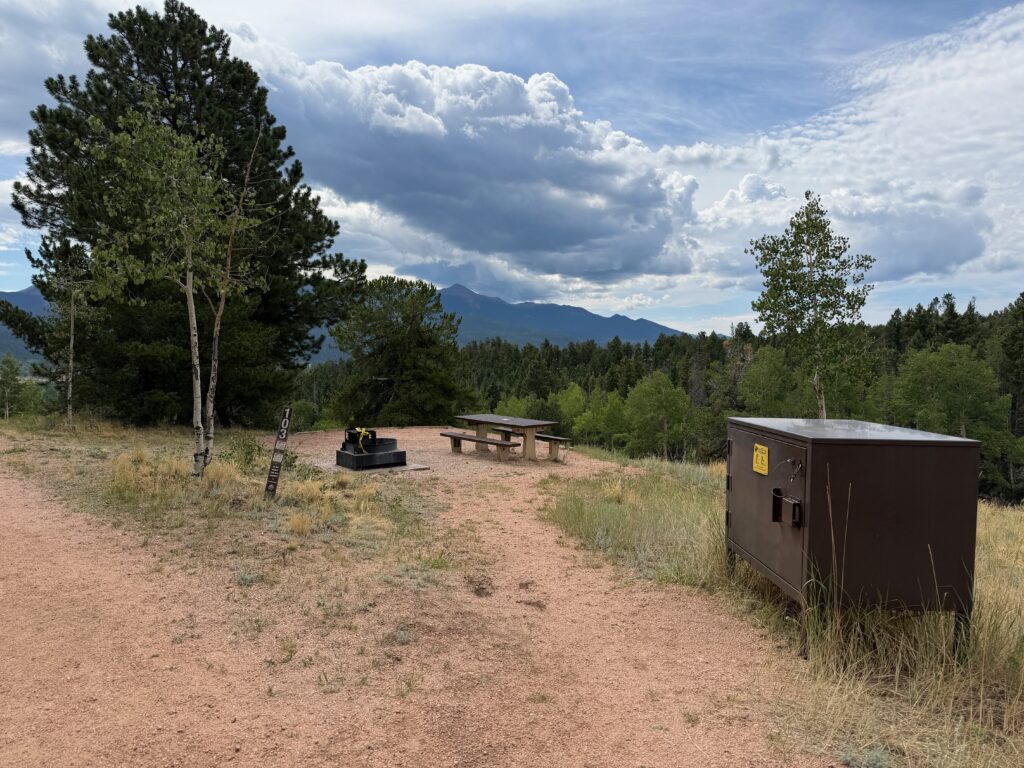
Camping loops at Mueller State Park:
- Peak View – This is one of my favorite loops. It is the smallest and has back-in sites with views of Pikes Peak from front of site. There is a trailhead here and a nice meadow with a pond.
- Revenues Ridge – This includes mostly pull-through sites on the sides of the main road. These are not traditional pull-throughs and are shaped like the letter D, with pull-offs from the road and a curved driveway. These have the most road noise, but I like that the front of your campsite faces the trees instead of the road, giving you a lot more privacy than you would expect.
- Conifer Ridge – This loop offers a mix of sites facing Pikes Peak and woodlands.
- Grouse Mountain – This loop has the highest elevation, and similar views to Conifer Ridge in some spots. It has a mix of sites, including some with big boulders.
If you want to hear the full campground review of Mueller State Park, including some favorite campsites and some to avoid, click play on the media player above or look for The RV Atlas on your podcast app.
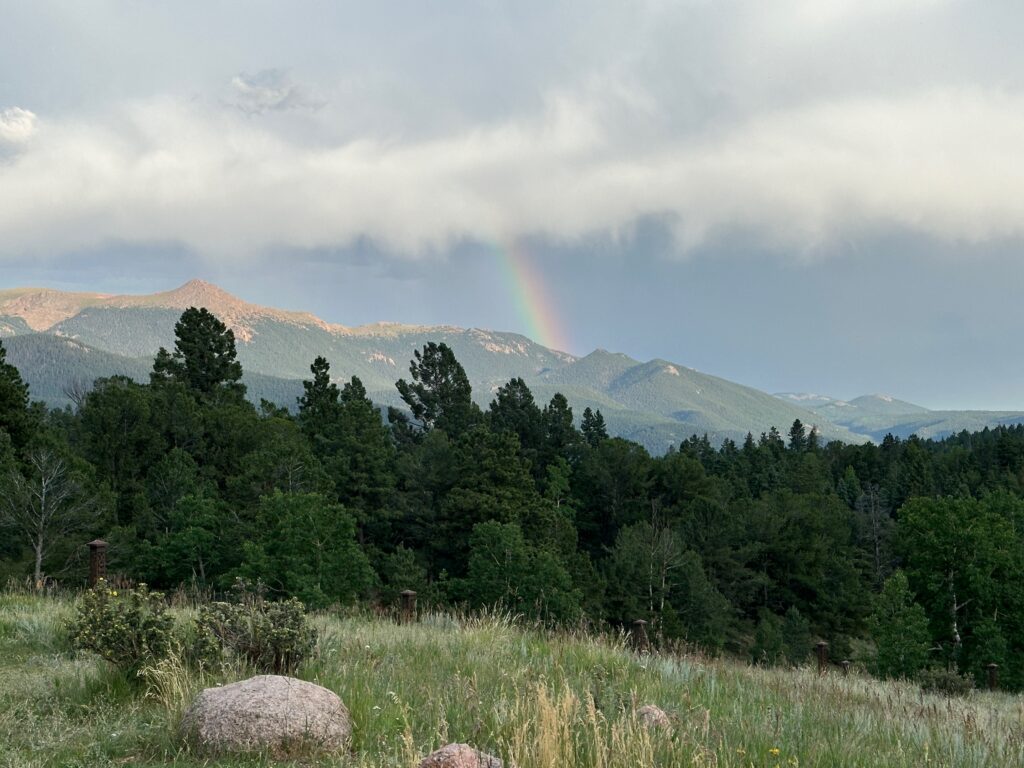
Venturing Outside of Mueller State Park
While you can totally stay inside Mueller and relax and cook your own food, I enjoy driving around and doing some simple exploration.
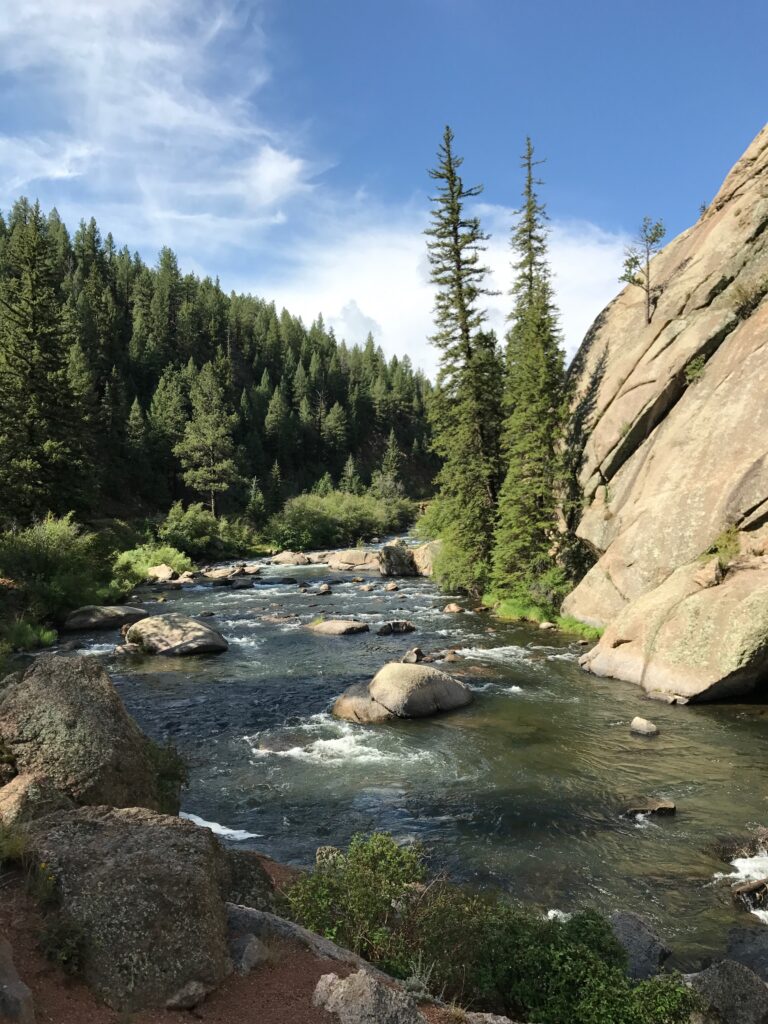
- Eleven Mile Canyon Recreation Area (not to be confused with Eleven Mile State Park): This spot has all the beauty of Rocky Mountain National Park without the crowds. You can go fishing, play in the water, or just sightsee along the beautiful drive.
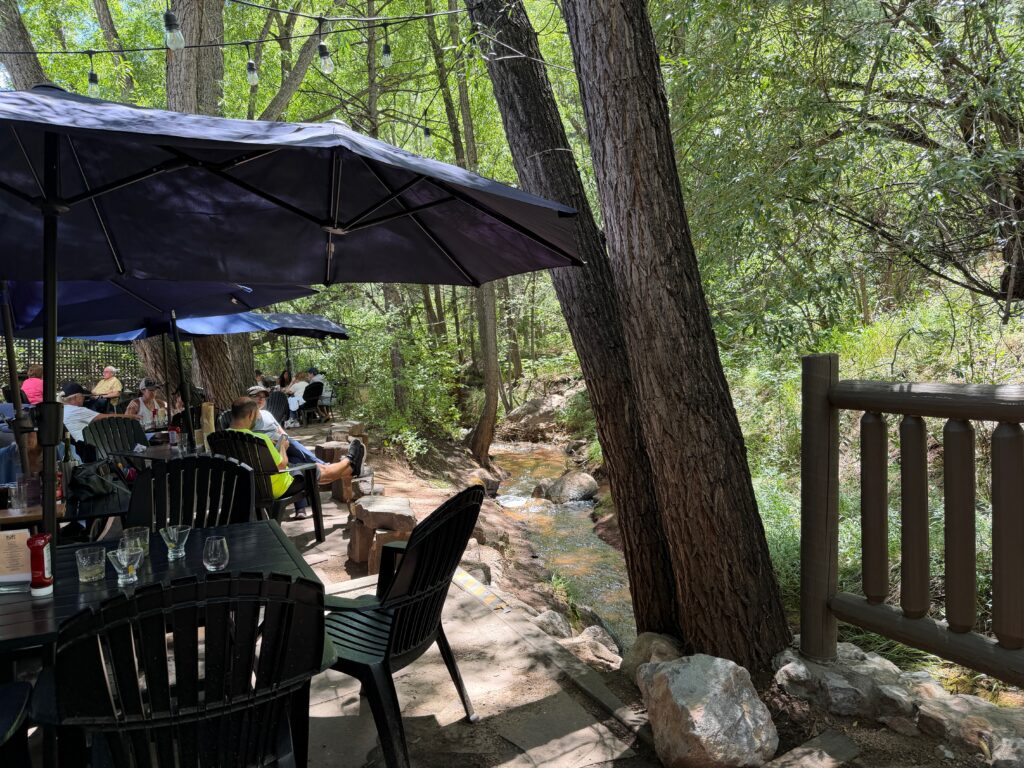
- The towns of Cascade and Green Mountain are between Mueller and Colorado Springs. Cascade is home to my favorite restaurant, Wines of Colorado, which has a lovely patio along a creek and excellent food. Stop in Green Mountain to check out the cool, colorful “Skynet” art installation suspended above a pond.
- Since it is just 15-20 minutes away, Woodland Park is great for dining, shopping, and exploring while staying at Mueller State Park. It’s probably what Estes Park was like 30 years ago or more.
- Cafe Leo: Cute coffee shop with not-to-be-missed Norwegian Sweet Buns
- Woodland Social: Cute dining spot along the main street
- Divide is just 10 minutes from the park and has a small grocery store, a handful of local restaurants, and some other essentials. Two restaurants I’ve enjoyed here are McGinty’s Wood Oven Pub and Russ’s Place.
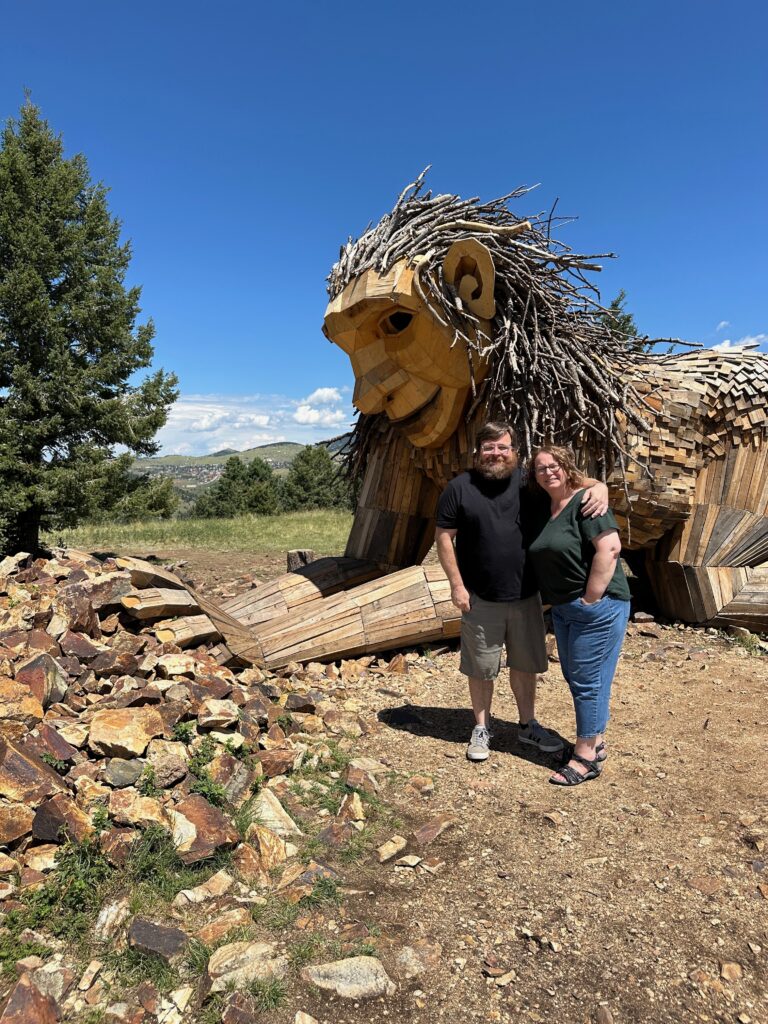
- Though a bit of a further drive, Cripple Creek and Victor make for a fun day trip. They showcase mining history, roaming burros, and a giant troll statue by artist Thomas Dambo. Rita the Rock Planter is so cool to visit!
Final Thoughts
I hope this campground review of Mueller State Park helped inspire you to visit…although, I may regret sharing this special under-the-radar campground. Ultimately, I consider Mueller State Park “old reliable.” I know what to expect, and I love what I know! It was the perfect spot for my first solo van trip.
The post A Solo Campervan Trip to Mueller State Park in Colorado with Kerri Cox from Travels with Birdy appeared first on The RV Atlas.
3 October 2026, 10:17 pm -
- 50 minutes 36 secondsAn Epic RV Trip to Western Canada and the Canadian Rockies PT. 3 (Vancouver)
An epic RV trip through Western Canada doesn’t have to be all mountains, lakes, and national parks. After exploring Calgary, Banff, then Jasper, the Icefields Parkway, and several other spectacular destinations in the Canadian Rockies, Gretchen Holcombe and her family headed west toward Vancouver for the final leg of their adventure.
This stop offered a completely different experience from the first two parts of the trip. Instead of filling every day with mountain hikes and scenic drives, the family mixed outdoor adventures with great coffee shops, historic sites, museums, restaurants, and some of Vancouver’s most popular attractions.
They also discovered an excellent campground in the charming community of Fort Langley, found a workable strategy for getting into Vancouver, biked and drove through Stanley Park, crossed the famous Capilano Suspension Bridge, solved a murder mystery in Gastown, and finished their Vancouver adventures with a rainforest hike filled with waterfalls—and a surprising number of banana slugs.
Here’s how to plan the Vancouver portion of an epic Western Canada RV trip.
Driving from the Canadian Rockies to Vancouver
Before arriving in Vancouver, Gretchen’s family spent a couple of days in Revelstoke, a mountain town that didn’t make it into the previous episodes simply because there was already so much ground to cover.
Revelstoke is smaller and less touristy than Banff and Jasper, but it still makes a worthwhile stop on a Western Canada itinerary. The town is best known as a ski destination, but there is plenty to enjoy during the summer as well.
The drive from the mountains toward Vancouver was also an experience in itself. Over roughly six hours, the scenery changed dramatically. The route moved from the mountains through a surprisingly dry, high-desert landscape before eventually entering the lush Pacific Northwest.
It felt a little like compressing the geography of the western United States into a single day of driving.
Where to Camp Near Vancouver
Choosing a campground for a Vancouver RV trip presents an interesting dilemma. RVers can stay close to the city and sacrifice some campsite space, or camp farther outside Vancouver and enjoy a more traditional campground experience.
Gretchen considered both approaches.
Capilano River RV Park
For RVers who want to prioritize easy access to Vancouver, Capilano River RV Park has an impressive location.
The campground is just minutes from Stanley Park, making it an excellent base camp for exploring the city. Reviews of the campground frequently mention tight sites, which initially made Gretchen hesitant to book there.
After visiting Vancouver and realizing just how convenient the location is, however, she reconsidered that decision. For a future visit, she might be willing to trade a little campsite space for such easy access to the city.
Fort Camping in Fort Langley
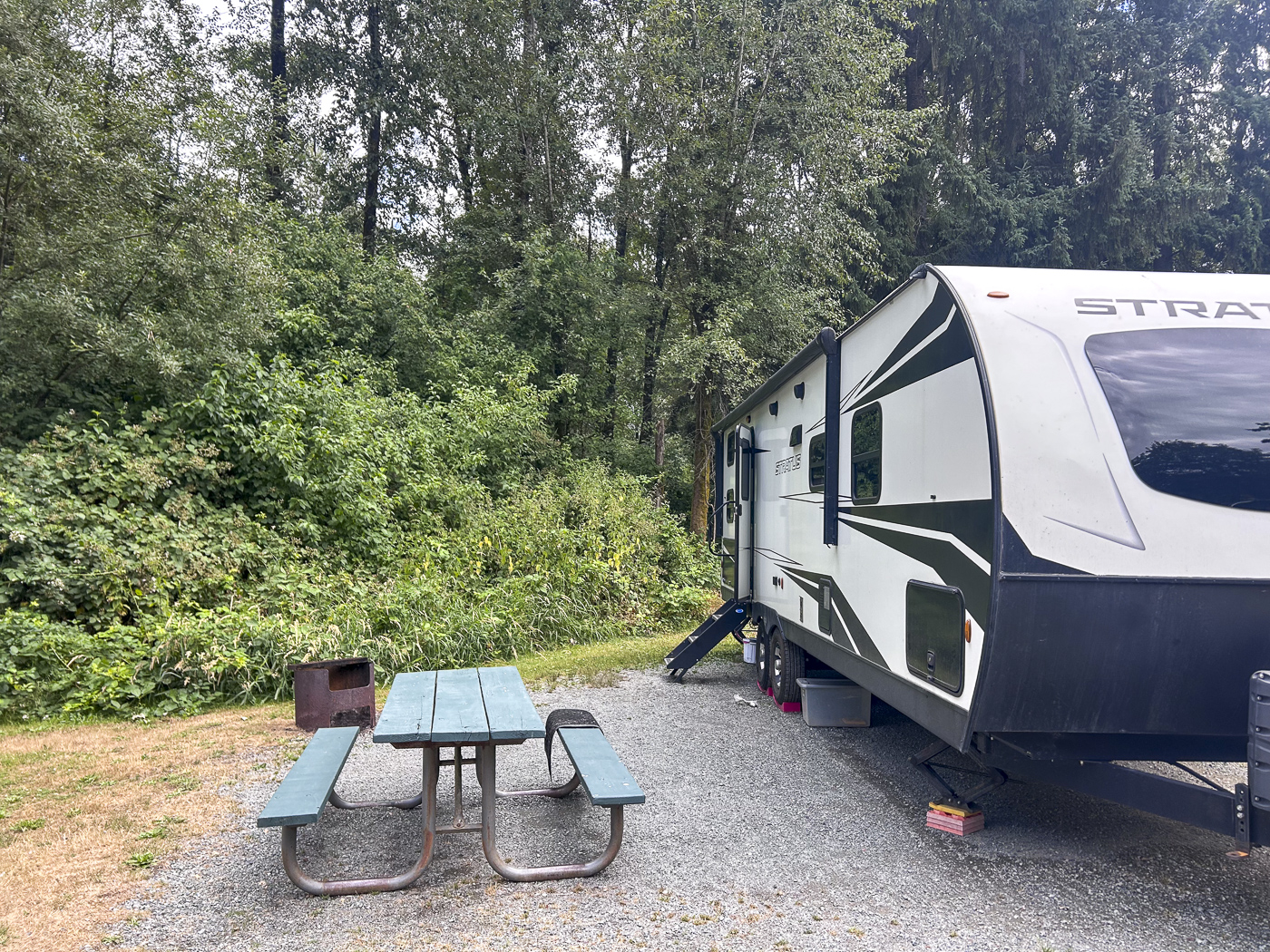
For this trip, the family chose Fort Camping in Fort Langley, about 45 minutes east of Vancouver when traffic cooperates.
That meant a longer trip into the city, but the campground itself became one of the pleasures of the Vancouver stay.
Fort Camping is located directly across the bridge from downtown Fort Langley. From the campground entrance, visitors can reach restaurants, coffee shops, stores, and attractions within minutes on foot.
For RVers who love campgrounds that allow them to park the truck and walk into town, this is a terrific option.
Most campsites are long, back-in gravel sites, although some pull-throughs are available. There isn’t a tremendous amount of privacy between sites, but there is landscaping, along with enough outdoor space for a picnic table and fire pit.
During Gretchen’s stay, full-hookup sites were around $60 Canadian per night, making the campground feel like a particularly good value after accounting for the exchange rate.
Amenities are fairly simple. There are laundry facilities, a small playground, and a seasonal camp store, but no swimming pool or extensive resort-style recreation.
Showers are coin operated, so make sure you have some Canadian currency handy. A loonie is the Canadian one-dollar coin, while a toonie is the two-dollar coin.
The campground also sits alongside a popular walking and biking path that can be followed toward town or farther along the river.
But the biggest amenity here is really Fort Langley itself.
Exploring Fort Langley
Fort Langley is small, charming, and surprisingly packed with things to do.
The family made it a goal to try a different coffee shop nearly every morning, which turned out to be a pretty great way to explore town.
Republica Coffee Roasters
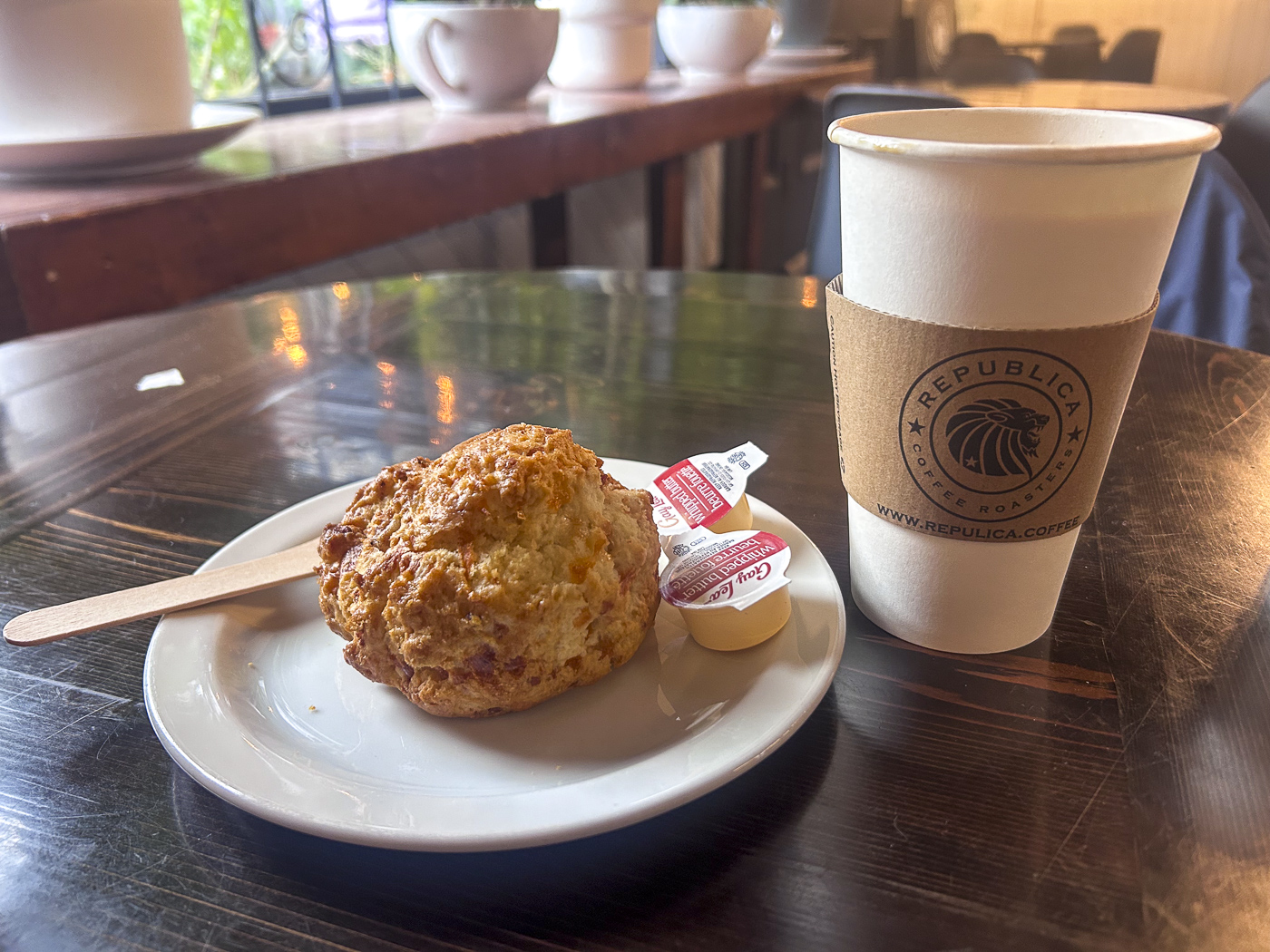
Republica Coffee Roasters was one of Gretchen’s favorite coffee stops. In addition to drinks and a small selection of baked goods, it was a good place to buy coffee to take along for the next leg of the trip.
Blacksmith Bakery
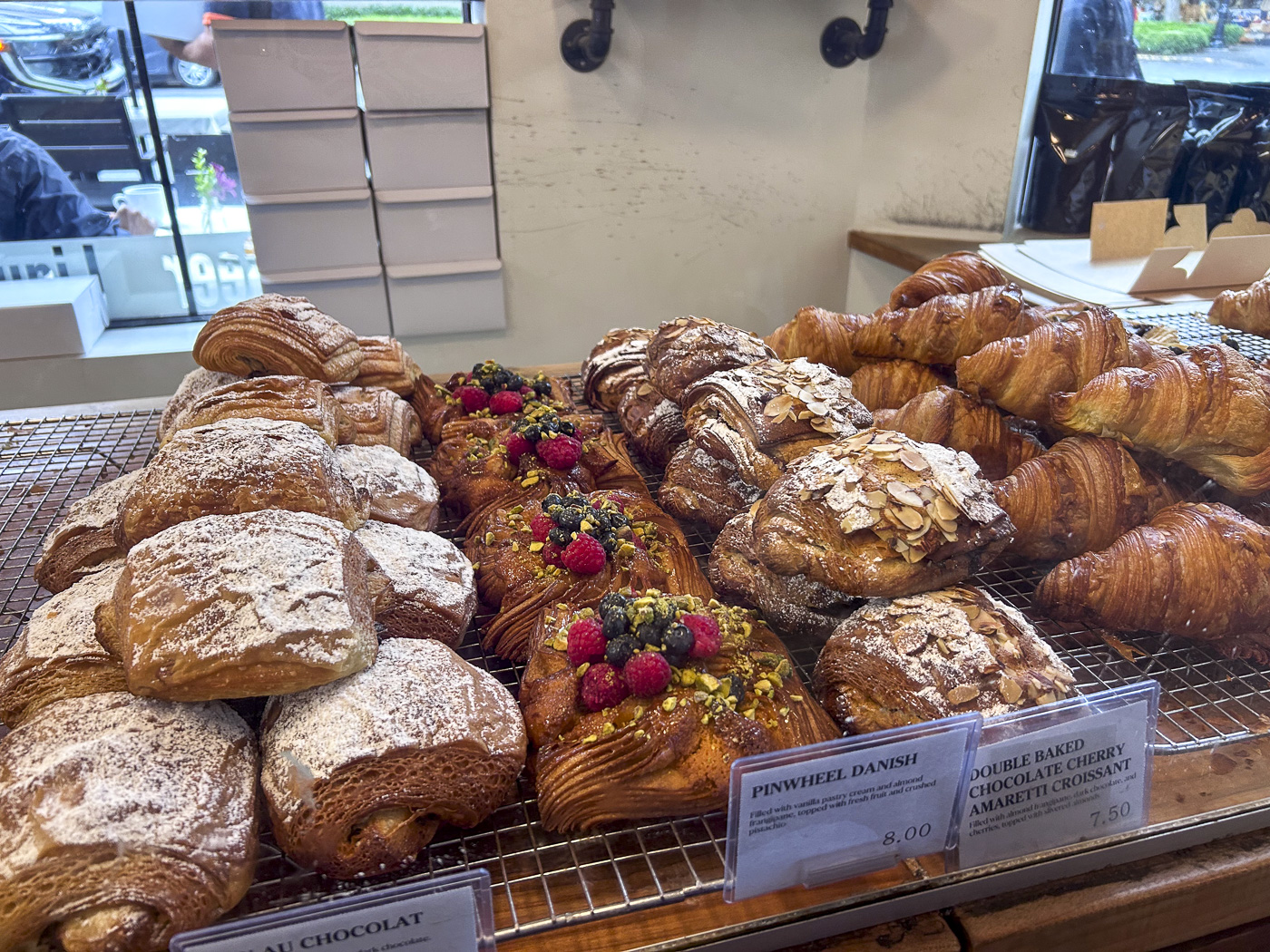
Blacksmith Bakery paired excellent coffee with beautiful pastries and was good enough to warrant more than one visit.
Wendel’s Bookstore & Cafe
Wendel’s combines several of the RV Atlas’s favorite things: books, coffee, and breakfast.
Unlike a simple coffee shop, Wendel’s has a full breakfast menu, and the family enjoyed breakfast outside on the patio one morning.
Trading Post Eatery
For a meal in town, Gretchen recommends Trading Post Eatery. The brewery is based in nearby Langley and has an eatery in Fort Langley with a lovely outdoor patio.
There are plenty of other restaurants around town that Gretchen would like to try on another visit, but trips into Vancouver meant there were only so many meals available for exploring the local dining scene.
Visit Fort Langley National Historic Site
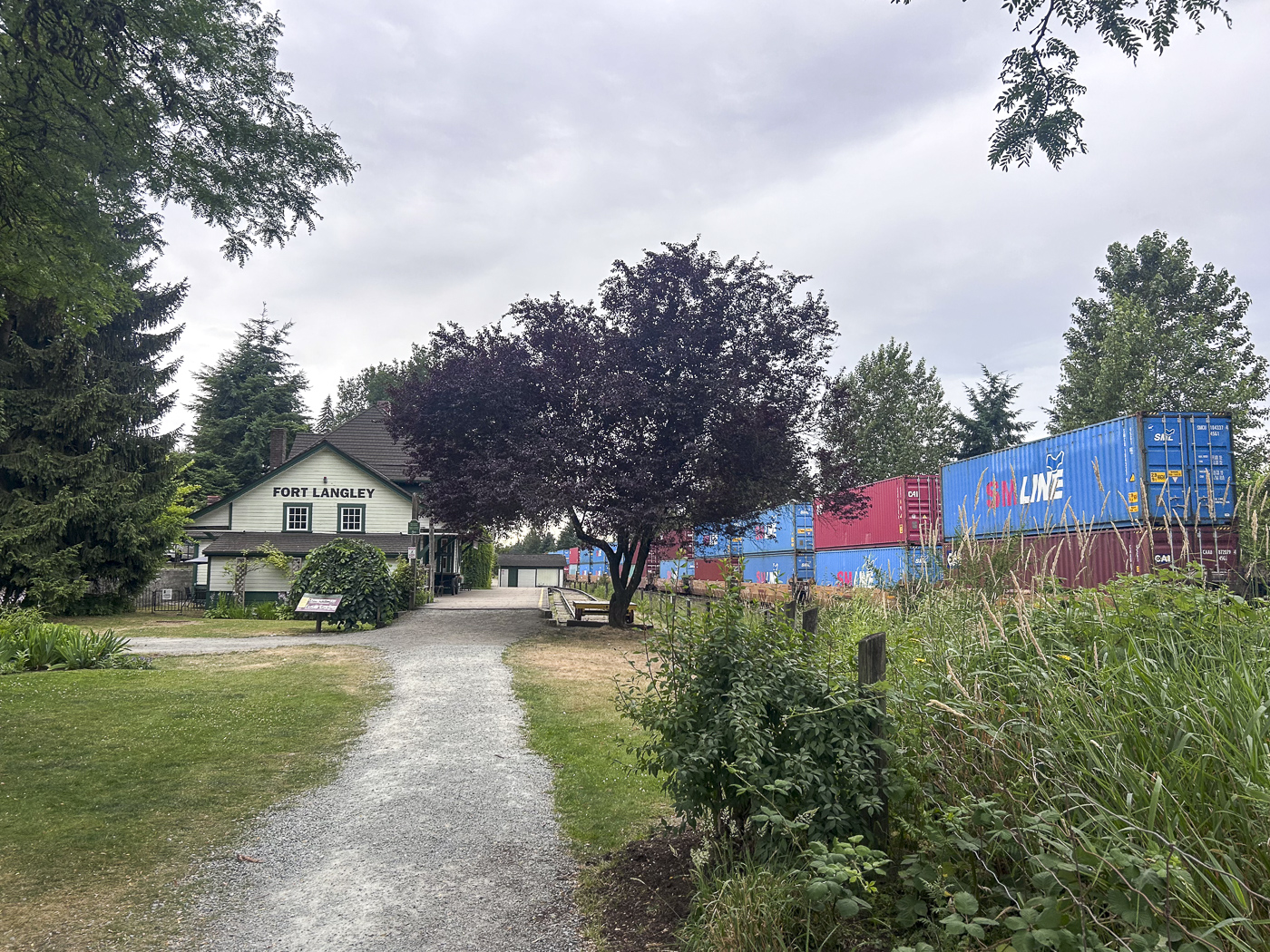
The actual Fort Langley is also within walking distance of the campground.
Fort Langley National Historic Site is a Parks Canada site centered around a 19th-century fur trading post. Visitors can explore historic buildings, visit the blacksmith shop, interact with interpreters, and learn about life at the fort.
Families should look for the kids’ activities available at Parks Canada sites. Children can complete activities and earn an explorer badge, similar in spirit to the Junior Ranger programs at U.S. national parks.
Plan on spending a couple of hours here before wandering back into town—or simply walking back to the campground.
Getting from Fort Langley into Vancouver
The downside of staying in Fort Langley is obvious: you aren’t actually camping in Vancouver.
Gretchen researched public transportation before the trip and hoped there might be an easy way to leave the truck behind at the campground. Unfortunately, getting from Fort Langley to Vancouver entirely by public transit required multiple connections.
Vancouver itself has an excellent rapid-transit system, the SkyTrain, but it doesn’t currently extend to Fort Langley.
The family experimented with two approaches during their three trips into Vancouver.
For one visit, they drove approximately 30–35 minutes to the Scott Road Park & Ride. This worked particularly well because the station had a large surface parking lot, an important consideration for anyone driving a large tow vehicle that doesn’t fit comfortably in parking garages.
From there, they took the SkyTrain approximately 35 minutes to Waterfront Station in downtown Vancouver.
The elevated ride provided views of the water and city skyline and eliminated the hassle of downtown parking. However, the entire process took longer than simply driving.
For the other two visits, they drove into Vancouver.
The lesson? Match your transportation strategy to your plans for the day. The SkyTrain makes sense when you’re heading directly downtown and don’t want to deal with parking. Driving can be more efficient when you’re exploring attractions outside the city center.
And regardless of which option you choose, try to avoid rush hour.
Spend a Day at Stanley Park
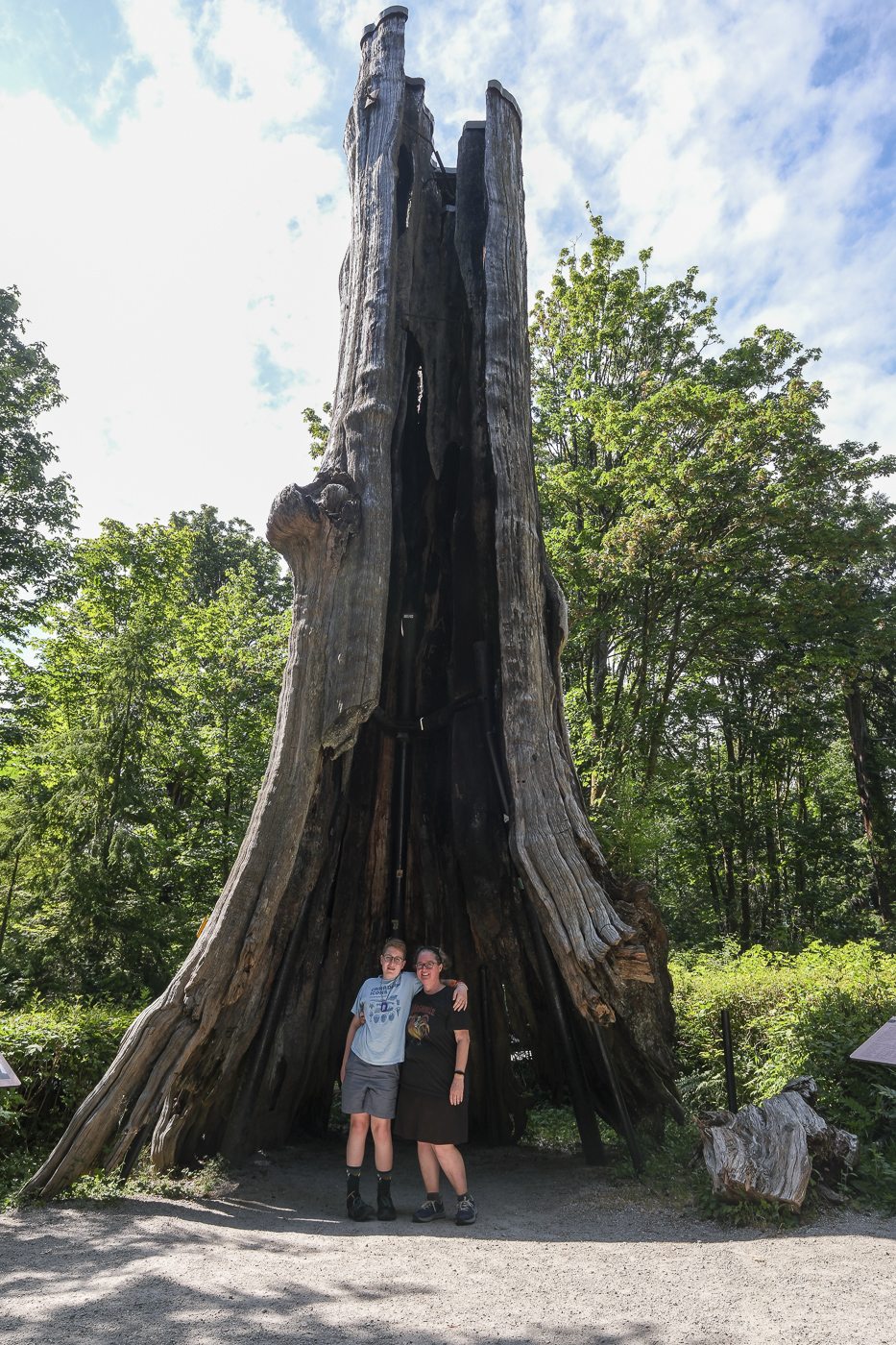
If Gretchen had to choose one Vancouver highlight, it would be Stanley Park.
This enormous waterfront urban park combines rainforest, shoreline, trails, gardens, attractions, and the famous seawall into a destination that could easily fill an entire day.
Gretchen’s oldest son Ari and his girlfriend Abby rented bikes and rode around the park, while the rest of the family explored by vehicle.
The complete loop is roughly seven miles, making biking an excellent option for visitors who want to experience the park at a leisurely pace. Driving works well too, particularly if you want to stop at viewpoints and explore different areas along the way.
For the driving tour, Gretchen recommends the GuideAlong app. The narrated tour points out worthwhile stops and also helps visitors decide what they can skip when time is limited.
Stanley Park was one of those places where the family wished they had scheduled even more time. The combination of water, rainforest, and city views makes it feel surprisingly removed from an urban environment.
After exploring, they regrouped at Stanley Park Brewing for pizza and beer.
Gretchen would happily return and devote an entire day to Stanley Park. The Vancouver Aquarium, which they didn’t have time to visit, is already on her list for a future trip.
Pair Stanley Park with Capilano Suspension Bridge Park
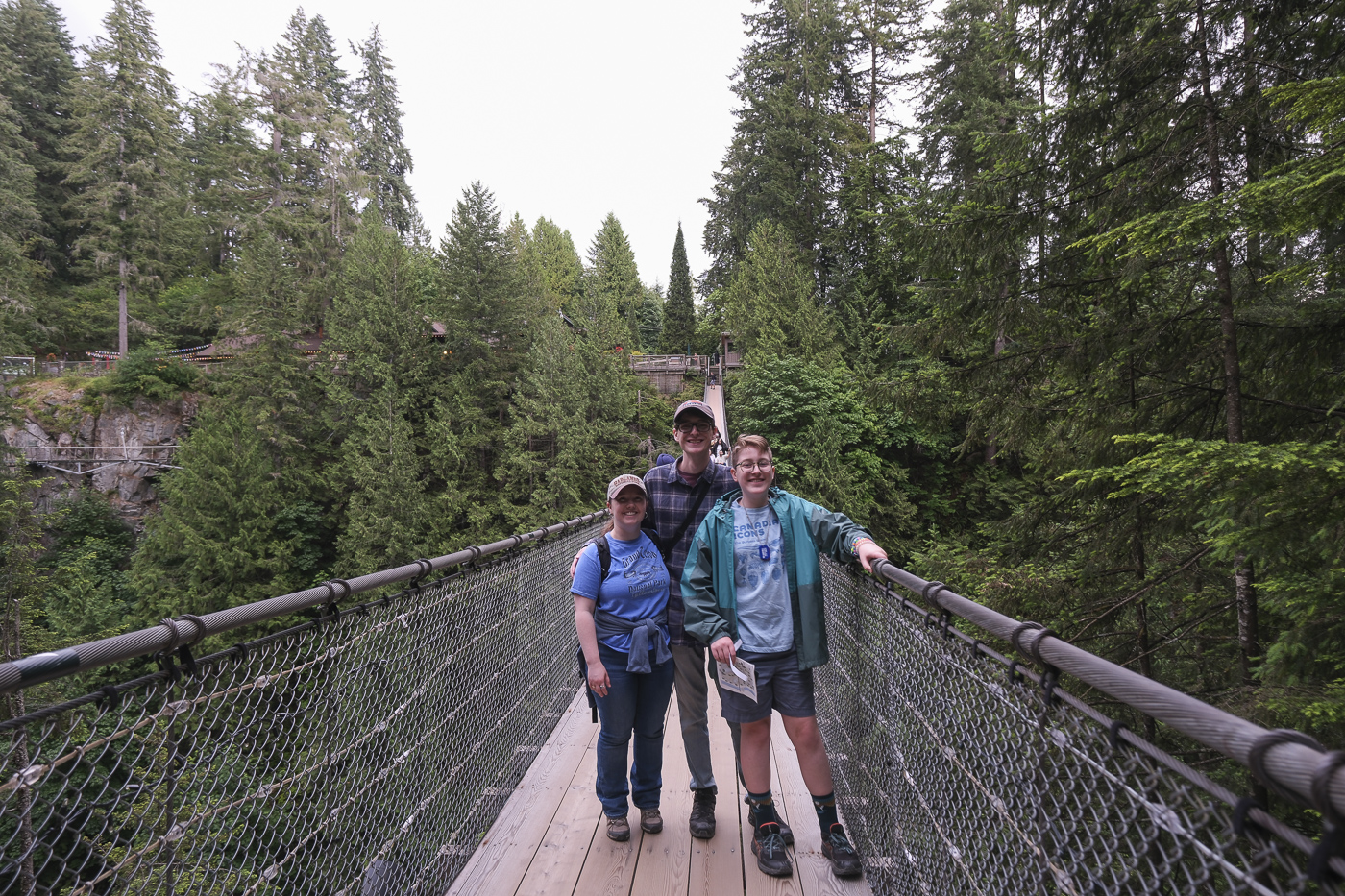
One of Gretchen’s best Vancouver planning strategies was pairing Stanley Park with Capilano Suspension Bridge Park.
Capilano is located just across the iconic Lions Gate Bridge and less than a 10-minute drive from Stanley Park. The family spent the afternoon exploring Stanley Park, ate dinner, and then headed to Capilano after 5 p.m.
That timing had two major advantages.
First, summer visitors arriving after 5 p.m. could take advantage of a 25-percent twilight discount during their visit.
Second—and perhaps even better—the crowds had largely disappeared.
The family could see the ropes and queue areas designed to handle daytime crowds, but during their evening visit there was hardly anyone waiting for the bridge.
The famous suspension bridge stretches about 450 feet across the gorge, roughly 230 feet above the Capilano River. Gretchen found the amount of sway slightly more adventurous than she expected.
But the suspension bridge isn’t the only attraction.
Visitors can also explore elevated walkways through the trees and the Cliffwalk, a series of narrow walkways suspended along granite cliffs above the river.
Allow a couple of hours to explore the property at a relaxed pace. Gretchen felt the experience was worth the admission price—particularly with the twilight discount and significantly smaller evening crowds.
Solve a Mystery in Gastown
Gastown is one of Vancouver’s most recognizable tourist districts, with cobblestone streets, Victorian-style architecture, shops, restaurants, and its famous steam clock.
But Gretchen sometimes finds that simply walking through a tourist district can feel a little directionless. Once you’ve admired the buildings and watched the clock, what do you actually do?
Her solution was Vancouver Mysteries.
Instead of an app-based scavenger hunt, participants meet a costumed character at a physical location and receive a kit for solving a mystery. Gretchen’s family tackled a murder mystery that sent them around Gastown solving puzzles and looking for clues.
The activity gave the family a reason to explore the neighborhood more carefully while keeping everyone engaged.
And yes, they solved the mystery.
Even better, they were told they had earned the highest score of the day.
For families with older kids or teens who aren’t necessarily thrilled by the prospect of simply wandering through another historic district, experiences like this can be a great travel tool.
Eat at the Old Spaghetti Factory
After solving their Gastown mystery, the family headed to the Old Spaghetti Factory.
This isn’t a recommendation for travelers looking for Vancouver’s most sophisticated culinary experience. It’s a recommendation for people who appreciate a little kitsch.
The restaurant features over-the-top nostalgic decor, including a full-size trolley car inside the Vancouver location. The menu is classic Americanized Italian food, with meals offering multiple courses at a relatively affordable price for a major tourist district.
For visitors from parts of the country without an Old Spaghetti Factory, it can be a fun taste of Pacific Northwest nostalgia—and an entertaining family meal after a day of sightseeing.
Museum of Anthropology at the University of British Columbia
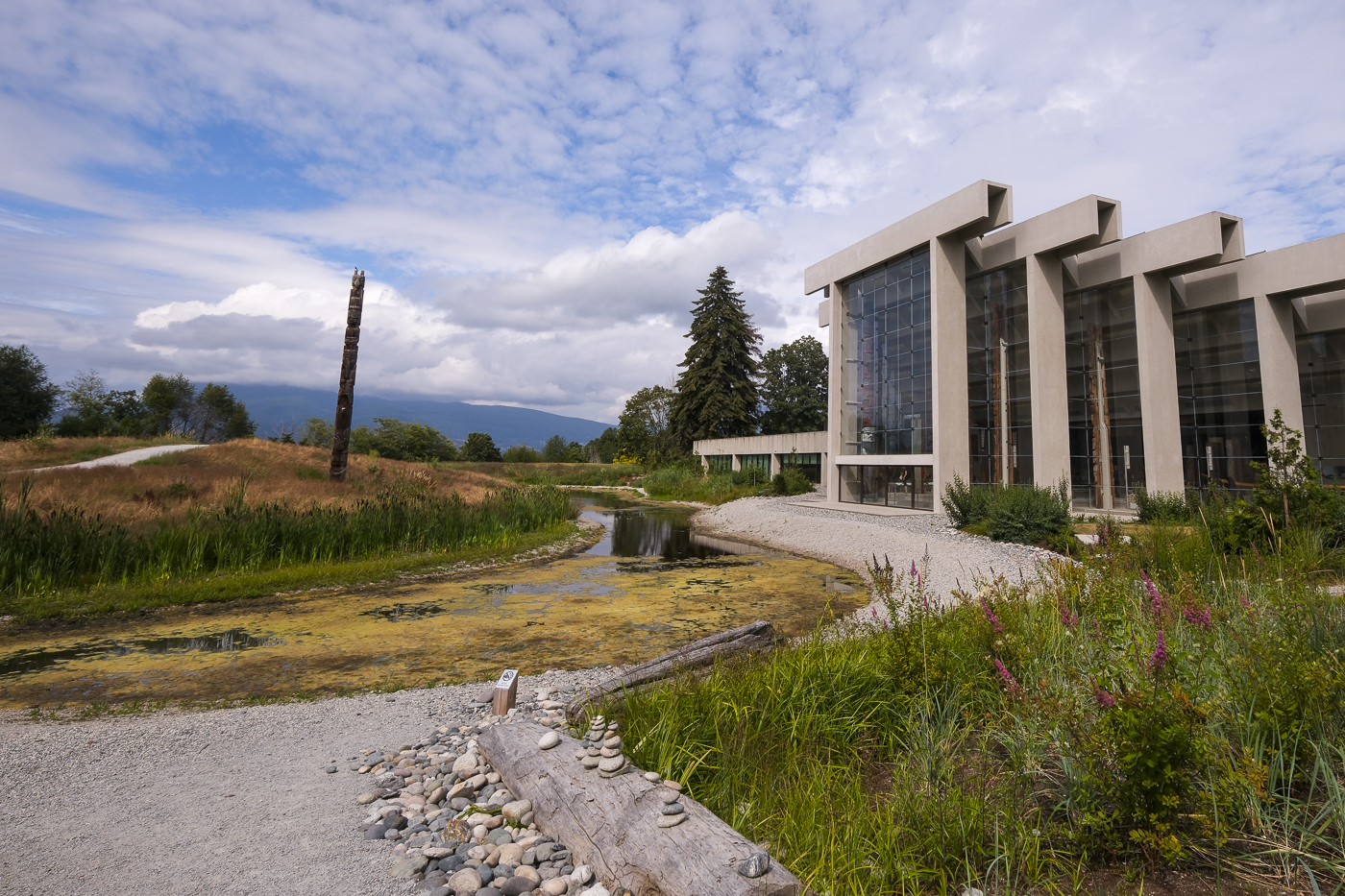
The Museum of Anthropology on the University of British Columbia campus was another standout.
The museum has an enormous collection of anthropological objects from around the world, but the Pacific Northwest collection makes an immediate impression. Large-scale works, including totem poles and other pieces created by Indigenous peoples of the region, are displayed in a dramatic gallery with a wall of glass.
What Gretchen particularly appreciated was the organization of the enormous collection.
Large collections can quickly become overwhelming, but the museum uses regions, themes, and smaller exhibits to give visitors a framework for understanding what they’re seeing. Some interactive elements also work particularly well for families.
This is a museum where visitors could easily spend several hours.
Nitobe Memorial Garden
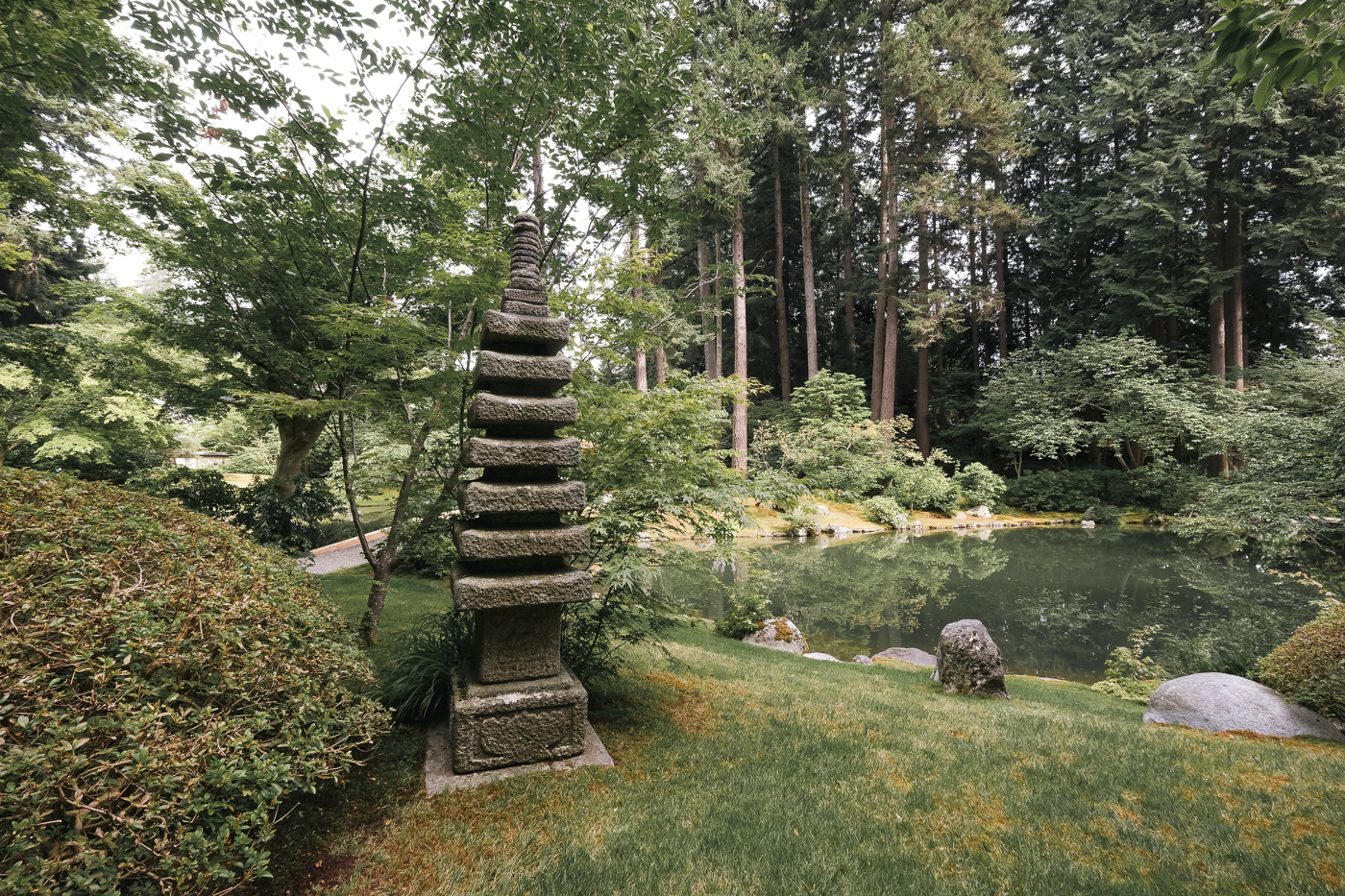
After spending a few hours indoors at the Museum of Anthropology, walk over to nearby Nitobe Memorial Garden.
The small Japanese garden is also located on the University of British Columbia campus and is within walking distance of the museum.
The garden features waterfalls, carefully designed landscaping, and peaceful pathways. It doesn’t require a major time commitment—the family spent roughly half an hour there—but that’s part of its appeal.
After several hours inside a museum, it’s a lovely place to stretch your legs and slow down for a bit.
Take a Day Trip to Golden Ears Provincial Park

For one final dose of Pacific Northwest wilderness, head to Golden Ears Provincial Park.
The park was about a 40-minute drive from Fort Langley and offered one of the family’s favorite hikes of the entire summer.
Abby researched hiking options and chose the Lower Gold Creek Falls Trail, an approximately 3.5-mile out-and-back hike.
The trail travels through towering rainforest alongside the water, with opportunities to walk down to pebble beaches and catch mountain views in the distance. The turnaround point features a double waterfall.
But the waterfall wasn’t what captured most of the family’s attention.
It was the banana slugs.
Dozens and dozens of them.
These enormous yellow slugs were scattered along the trail, along with darker slugs, and the family eventually started counting. Gretchen estimates they spotted at least 90.
The banana slugs might have stolen the show, but the hike itself was beautiful, with rainforest, river scenery, mountain views, and the waterfall making it worthwhile even for visitors who are considerably less enthusiastic about giant slugs.
The family also stopped at a pretty mountain lake on the return trip and briefly considered having a picnic—until they encountered some extremely bold geese who seemed quite interested in sharing lunch.
Why Vancouver Works So Well on a Canadian Rockies RV Trip
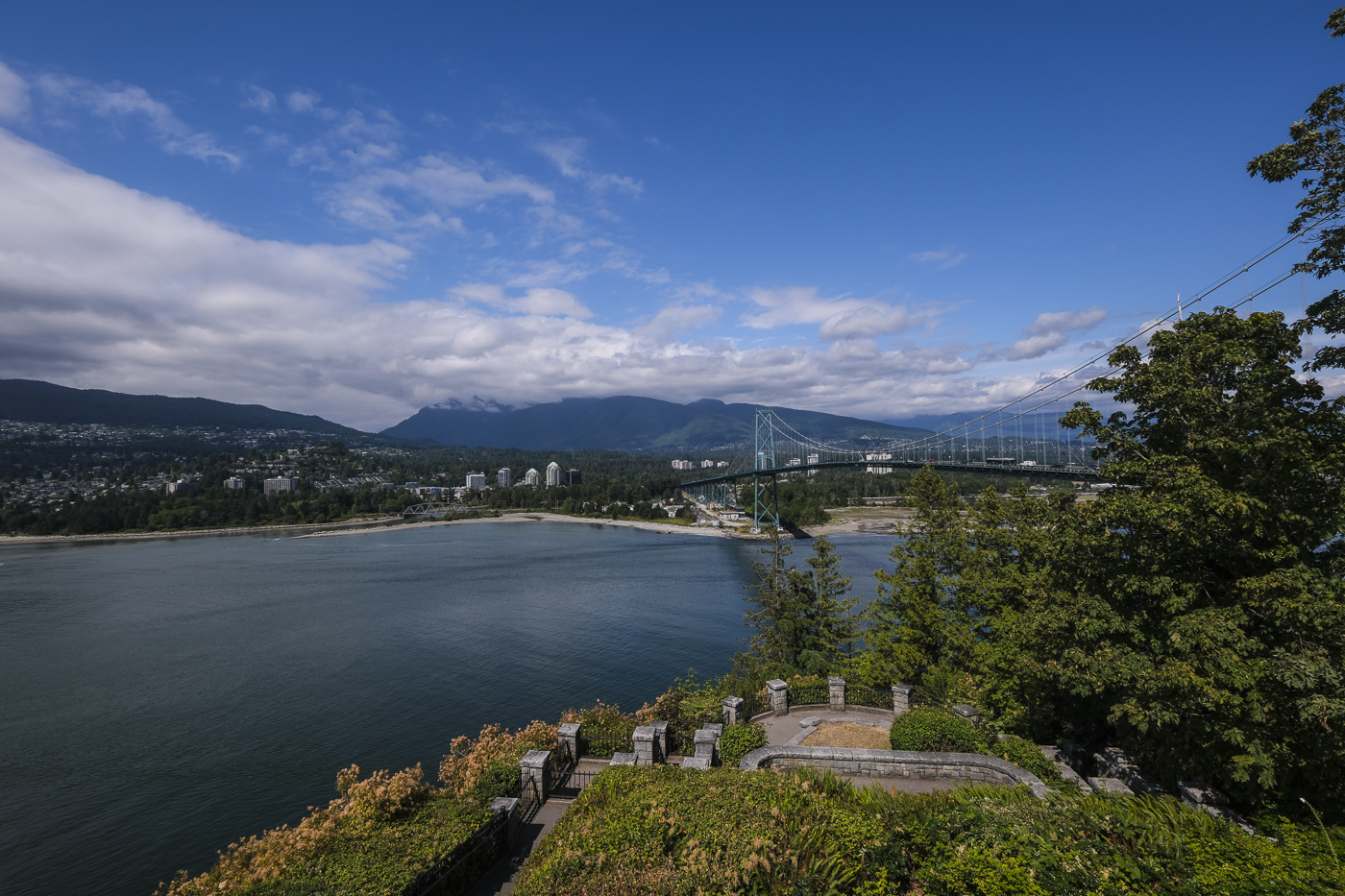
One of the biggest lessons from this three-part adventure is the value of variety on a long RV trip.
It can sound ridiculous to imagine getting tired of stunning alpine lakes and mountain views in Banff and Jasper. But on a long family trip, even extraordinary scenery can eventually start to blend together.
Combining national parks and wilderness destinations with cities can reset the rhythm of a trip.
Spend one day hiking beside a glacier and another wandering through a museum. Follow several days of mountain scenery with coffee shops and restaurants. Give older kids and teens a chance to shop, bike through a city park, solve a murder mystery, or eat dinner somewhere fun.
Gretchen admits that this isn’t just a strategy for keeping the kids happy. She enjoys the variety too.
And Vancouver delivered plenty of it.
Looking Back at an Epic Western Canada RV Trip
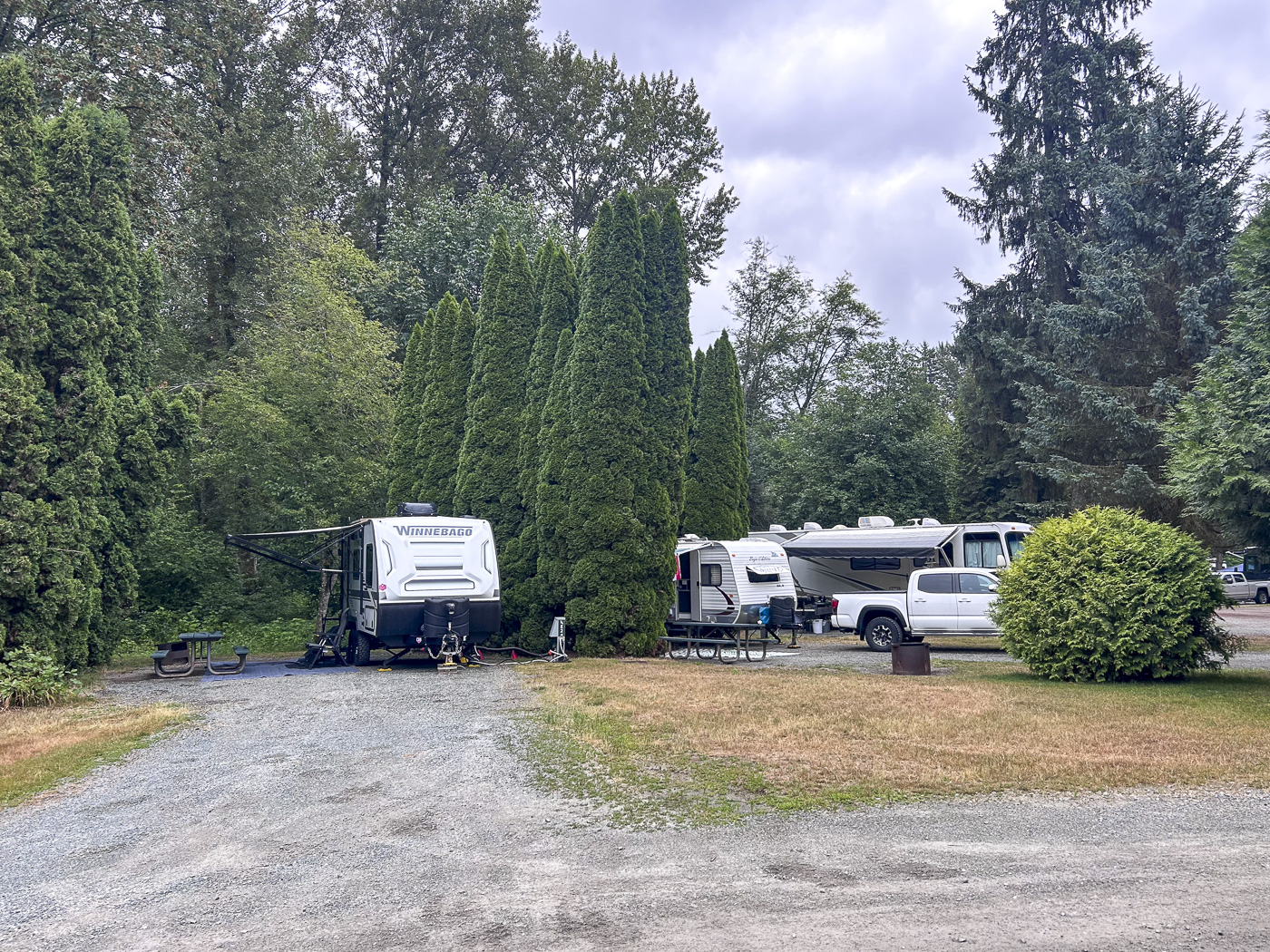
Asked to choose her favorite Vancouver experience, Gretchen picked Stanley Park. She would happily return and devote an entire day to exploring the park, including the aquarium they missed on this trip.
Looking back across the entire three-part Western Canada adventure, a few other experiences rose to the top.
The Banff Gondola remained one of Gretchen’s favorite ticketed attractions of the trip, thanks largely to the spectacular views. In Jasper, she particularly loved the Valley of the Five Lakes Trail and the From Jasper With Love comedy show.
When asked to choose a favorite campground from the five campgrounds covered during this portion of the larger trip, Jasper took the top spot. Gretchen appreciated the scenery, thoughtful campground layout, newer bathhouse, and convenient location for both exploring town and heading out to area attractions.
There was one experience she wished the family could have tackled: the Plain of Six Glaciers Tea House hike near Lake Louise. Snowpack and avalanche risk made the trail impractical during their visit, but the open views and glacier scenery have put it firmly on the list for a future trip.
And because a great RV trip inevitably leads to planning the next one, Gretchen already knows where her family hopes to head next summer: a Lake Superior circle tour through Michigan’s Upper Peninsula, Wisconsin, Minnesota’s North Shore, and Ontario.
After three episodes covering Calgary, Banff, Kootenay, Jasper, the Icefields Parkway, Lake Louise, Yoho, Revelstoke, Fort Langley, Vancouver, and more, one thing is clear: Western Canada deserves a place near the top of any RVer’s road-trip bucket list.
To hear Gretchen’s complete Vancouver trip report—and all of the stories and planning advice that go along with it—listen to this episode of The RV Atlas. And make sure to check out Parts One and Two of this Western Canada series for everything you need to start planning your own epic Canadian Rockies RV adventure.
The post An Epic RV Trip to Western Canada and the Canadian Rockies PT. 3 (Vancouver) appeared first on The RV Atlas.
27 September 2026, 2:56 pm - 34 minutes 38 secondsThe Complete Guide to America’s Largest RV Show in Hershey, PennsylvaniaIf you’ve ever wondered what it would be like to see almost everything in the RV world in one place, the Hershey RV Show—officially known as America’s Largest RV Show—is your answer. Every September, this five-day event transforms the Giant Center in Hershey, Pennsylvania into a massive celebration of RV life. We’ve been attending for more than a decade, and we can tell you: this show isn’t just for people shopping for a new rig. It’s for anyone who loves RVing. Whether you’re a first-time buyer, a full-timer looking for the latest accessories, or a camping enthusiast who wants to see what’s new, this event has something for you. To listen to our interview with Heather Leach, the Executive Director of the PRVCA, click on the media player above–or subscribe to the RV Atlas podcast wherever you get your favorite shows.
Show Overview
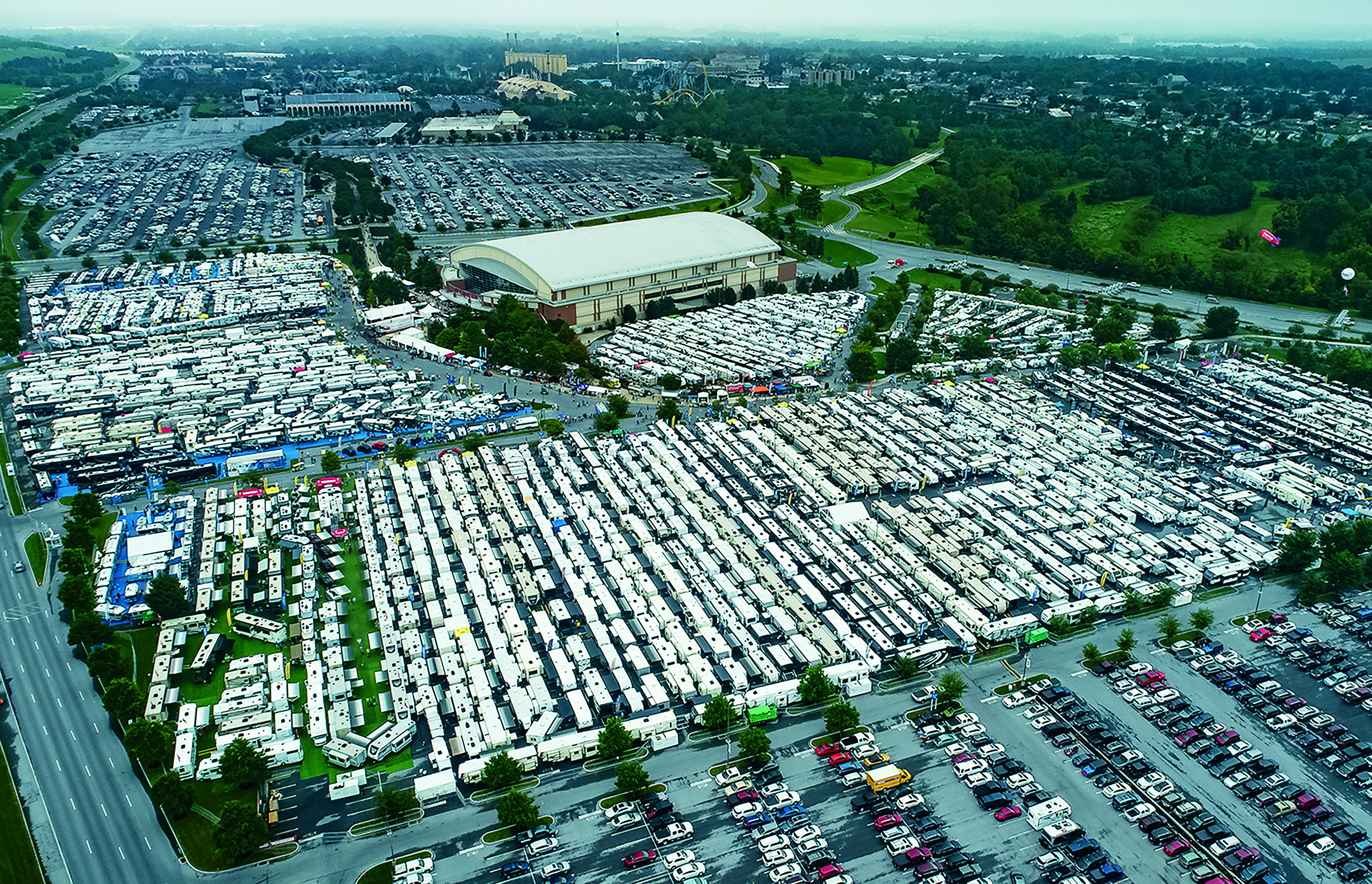
- Dates: September 16-20th, 2026
- Location: Giant Center, Hershey, Pennsylvania — right next to Hersheypark
- Public Hours: Wed–Sat 9:00 AM–7:00 PM; Sun 9:00 AM–5:00 PM
- Tickets & Info: largestrvshow.com (advance purchase saves money)
- Official App: Search America’s Largest RV Show in your app store for maps, exhibitors, seminars, and more.
This is the show’s 57th year, with the Giant Center serving as its home base since 2005.
What Makes This Show Unique?
Unlike many regional RV shows, Hershey is organized by manufacturers rather than dealers. That makes shopping and comparing much more efficient:
- Brands are grouped together so you can head straight to the ones you’re interested in.
- You can compare different models from the same manufacturer side by side.
- Less bouncing between mixed-brand dealer areas; more focused time evaluating rigs.
You’ll find 1,400–1,500 RVs across every category—pop-ups, hybrids, travel trailers, fifth wheels, toy haulers, camper vans, Class C’s, and luxury Class A’s. See the up-to-date manufacturer list here: Manufacturers on Display.
Plan Your Route: Maps, Layout & Strategy
The fastest way to beat getting overwhelmed is to arrive with a plan. Start by reviewing the Show Layout & Maps and building a route that clusters your must-see brands together. Grab a printed map at the entrance and keep the show app open on your phone for quick reference.Pro Navigation Tip: The outdoor map includes numbered light pole indicators. If you lose your bearings, find the nearest light pole, match its number to the map, and you’ll instantly know where you are.
The Giant Center: A Show Within the Show

Outside is all about RVs. Inside the Giant Center, you’ll find more than 200 booth vendors covering the rest of your RV life—gear, services, and destinations. Expect:
- Campground and destination reps
- RV accessories, parts, and maintenance products
- Insurance providers, hitch/sway systems, and more
- A downstairs “store” area similar to a dealership parts department
Even if you’re not buying a rig this year, you can happily spend hours exploring gadgets and talking upcoming trips. For the evolving 2026 list, check Booth Vendors.
Educational Seminars (Included with Your Ticket)
Seminars run hourly inside the Giant Center and are included in your admission. Topics range from beginner basics to advanced skills:
- How to choose the right RV
- Maintenance and safety must-knows
- Full-time RVing, work-on-the-road, and logistics (like mail and domicile)
Industry experts present throughout the week. See the current schedules here: Seminars & Presenters.
Influencer Meet & Greets
Meet popular RV creators in the dedicated Influencer Tent by the West/Orange Gate. The lineup typically includes creators like Campin’ Erin, Half Fast Travelers, and more. Check times and additions here: Influencer Meet & Greets.
Food & Entertainment
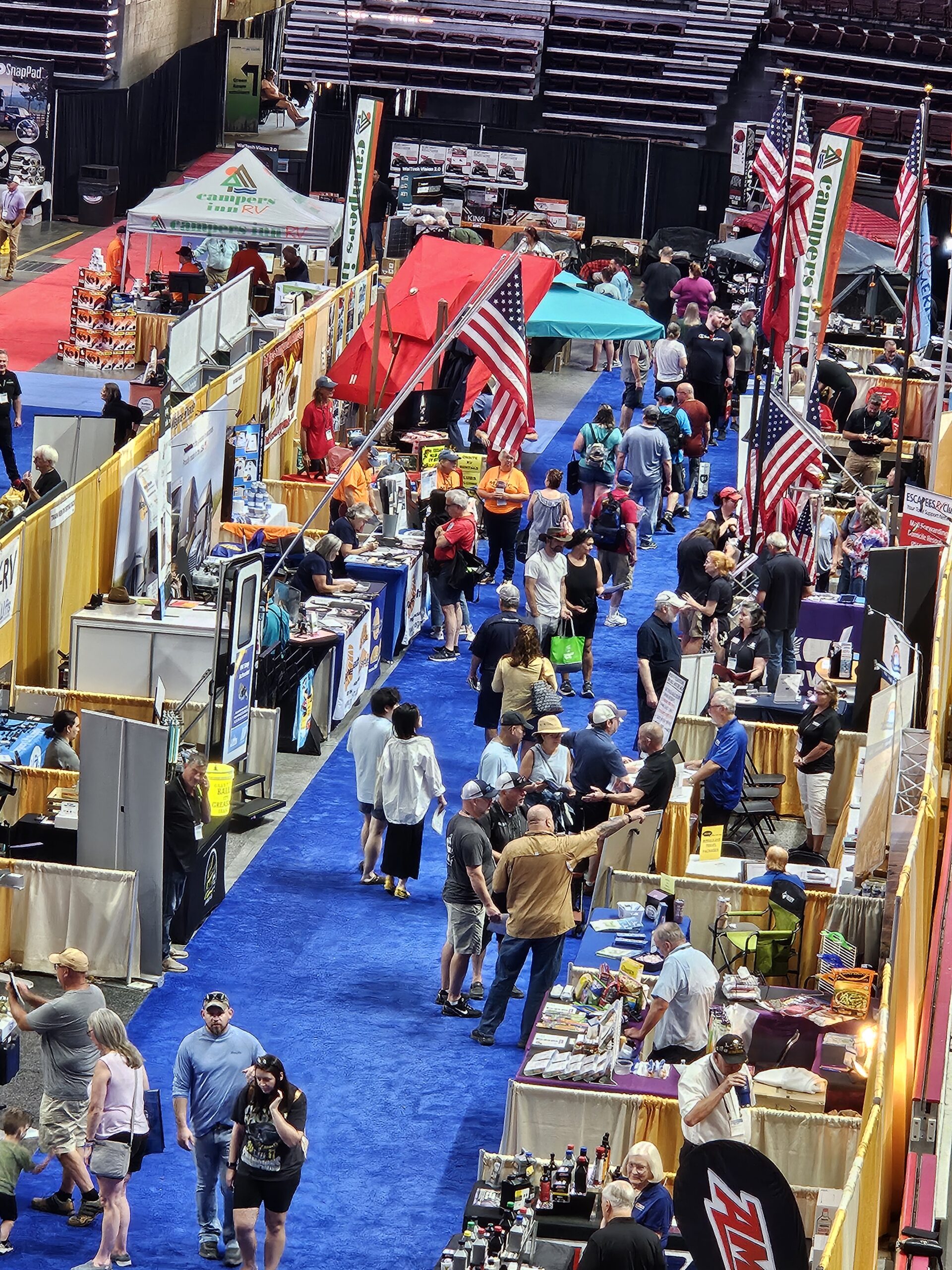
- Indoor concessions (plus AC and seating) inside the Giant Center
- Food trucks along the front of the building
- New West Gate food court near the park model village with picnic tables
- Roaming entertainment including a live band and a bike-borne ice cream themed comedy show
Where to Stay: Dry Camping, Campgrounds & Hotels
On-Site Dry Camping
- First-come, first-served (no hookups)
- Shuttle service runs between dry camping and the show
- Historically plenty of space, but arrive early for convenience
Nearby Hotels & Campgrounds
Hershey has plenty of lodging thanks to Hersheypark. Book early. For official listings and distances, see Accommodations.
Smart Shopping at a Manufacturer-Organized Show
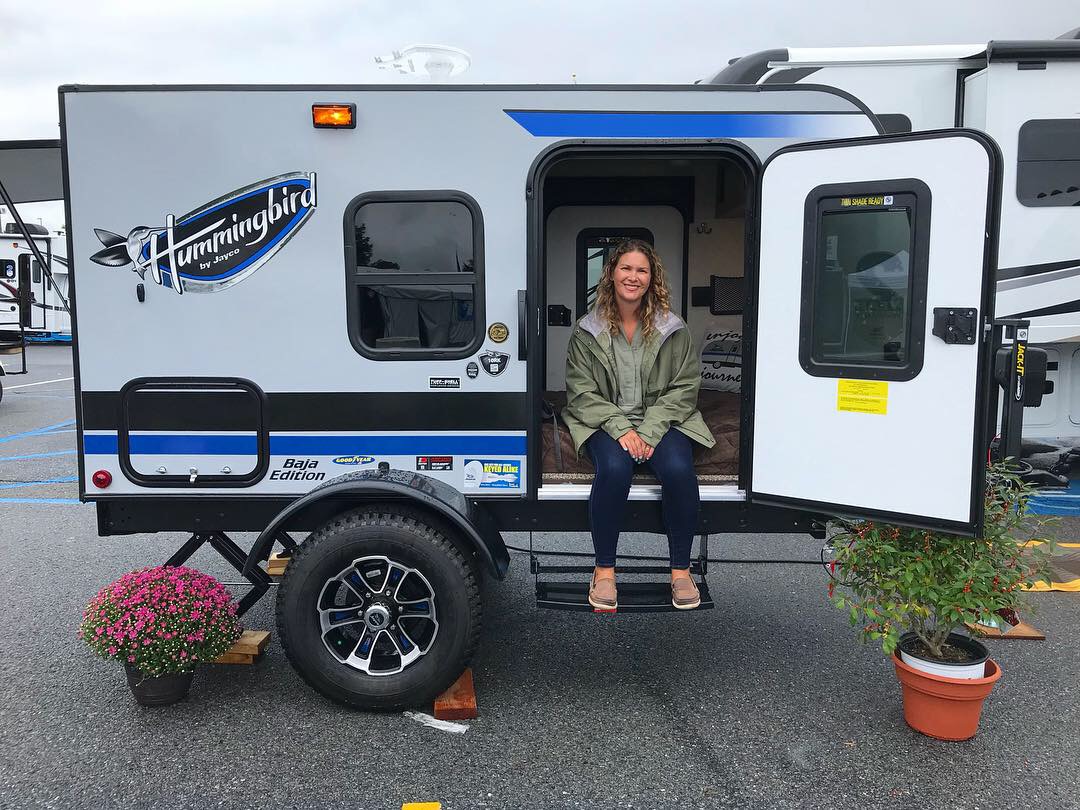
- Define your category first. Are you comparing fifth wheels? Toy haulers? Class B vans? Focus your day on one or two segments.
- Use your camera. After 30+ walkthroughs, rigs blur together. Snap exterior shots and key interior features (plus the spec sheet) to review later.
- Note model names and lengths. That makes apples-to-apples comparisons easier when you get home.
- Plan for a second day if you can. Between outdoor displays, the Giant Center, and seminars, two days is ideal.
Our Personal Tips for Enjoying the Hershey RV Show
- Wear comfortable shoes. This is a big walking show—save the fashion shoes for dinner.
- Start with a plan. Use the map and app to cluster must-see brands.
- Hydrate & pace yourself. September is usually pleasant, but it can get warm.
- Use the light-pole hack. Match the nearest pole number to your map to re-orient fast.
- Build in Giant Center time. Gear, gadgets, campground reps—plus AC and lots of seating.
- Seminars are included. They’re a huge value add—pick two or three that match your goals.
For more quick-hit advice from years past, see our earlier post: 6 Quick Tips for Enjoying America’s Largest RV Show in Hershey, PA.
FAQs
Where is the show and what are the hours? At the Giant Center in Hershey, PA. Public hours are Wed–Sat 9:00 AM–7:00 PM and Sun 9:00 AM–5:00 PM. Are seminars included with admission? Yes. They run hourly inside the Giant Center. See the current schedules here: Seminars. Is buying tickets in advance cheaper? Yes—purchase via largestrvshow.com for a discount compared to day-of pricing. Is there on-site camping? Yes—dry camping is available on a first-come, first-served basis, with shuttle service to the show. Where can I see who’s exhibiting? Check the evolving lists for manufacturers and booth vendors. Also review the show layout & maps. Where do influencer meet & greets happen? At the Influencer Tent by the West/Orange Gate. See the schedule here: Meet & Greets.Where to Camp Near the Hershey RV Show
If you prefer hookups over dry camping, these three campgrounds are great bases for the show:
Hersheypark Camping Resort
This campground is the closest option to the show. It offers RV sites with hookups, cabin rentals, and convenient access to Hershey attractions (including park shuttles in season). Expect a resort-style vibe and easy logistics.
Elizabethtown / Hershey KOA
This KOA is a short drive away with spacious sites, a pool, camp store, and family-friendly amenities. It’s a reliable basecamp with the classic KOA convenience factor.
Jellystone Park Quarryville
A bit farther than the other two but packed with activities—pools, water features, and theme-weekend fun for kids. This is a great choice if you’re turning the show into a family getaway.
Final Thoughts
The Hershey RV Show isn’t just a sales event—it’s a community gathering for everyone who loves RVing. Visitors come from all over the country, often turning the trip into a mini-vacation. Whether you’re here to buy, learn, shop, or simply soak up the RV lifestyle, you’ll find unmatched opportunities to connect with manufacturers, experts, influencers, and fellow RVers—all in one place.
We’ll be there again this year inside the Giant Center—come say hello at our table inside the Giant Center and grab some “Where Should We Camp Next? books!
The post The Complete Guide to America’s Largest RV Show in Hershey, Pennsylvania appeared first on The RV Atlas.
13 September 2026, 9:00 pm - 1 hour 23 minutesLetchworth State Park: A Guide to “the Grand Canyon of the East” with Casita Dean May
There are some state parks that feel almost too grand to be state parks. They have the scenery, recreation, history, and sheer scale that we usually associate with our national parks.
Letchworth State Park in Western New York is one of those places.
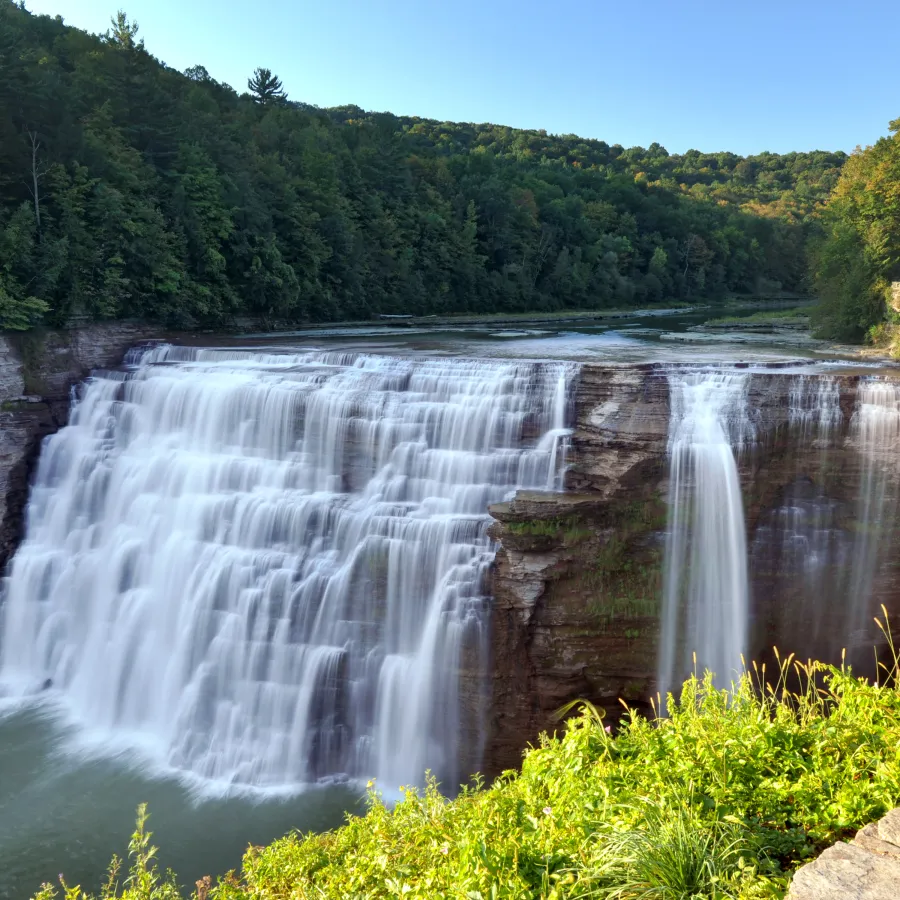
Known as the “Grand Canyon of the East,” Letchworth stretches for roughly 17 miles along the Genesee River, where three major waterfalls tumble through a dramatic gorge surrounded by forested cliffs. There are miles and miles of hiking trails, historic sites, overlooks, a swimming pool, rafting, kayaking, interpretive programs, and enough attractions to fill several days without ever leaving the park.
On this week’s episode of The RV Atlas podcast, our longtime correspondent Casita Dean May returns with an incredibly detailed review of Letchworth State Park. Dean and his wife Laura spent six nights camping here as the final stop on a 21-day summer road trip that also included Geneva State Park in Ohio and Watkins Glen State Park in New York. After nearly 600 nights of camping in 18 states—primarily at state parks—Dean ranks Letchworth among his top three state parks and says it might even take the number-one spot.
That is high praise from someone who has done a whole lot of state park camping.
To listen to our interview with Casita Dean May about Letchworth State Park please click on the media player above or subscribe to the RV Atlas wherever you get your favorite shows!
Where Is Letchworth State Park?
Letchworth State Park is located in rural Western New York, about 45 miles south of Rochester and roughly 60 miles southeast of Buffalo.
Dean and Laura arrived after spending a week at Watkins Glen State Park, which is only about 80 to 90 miles away. That makes these two legendary New York state parks an excellent pairing for a longer RV trip.
One of the first things that surprised Dean and Laura was just how rural this part of New York is.
We remember having exactly the same reaction when we traveled through Western New York with our boys years ago. Once you get away from the major population centers, you’ll find rolling hills, farms, cornfields, forests, and beautiful little villages. It can feel worlds away from the image many travelers have of New York.
And Letchworth itself is enormous.
The park is approximately 17 miles long, so don’t expect to park the truck at the campground and walk everywhere. Depending on where you’re headed, you may drive 20 or 25 minutes from the campground to reach a trailhead, overlook, or attraction.
Dean and Laura spent three fairly committed days just exploring the park.
That’s an important planning note. Letchworth isn’t a place where we’d recommend booking two nights and assuming you’ve seen it.
Camping at Letchworth State Park
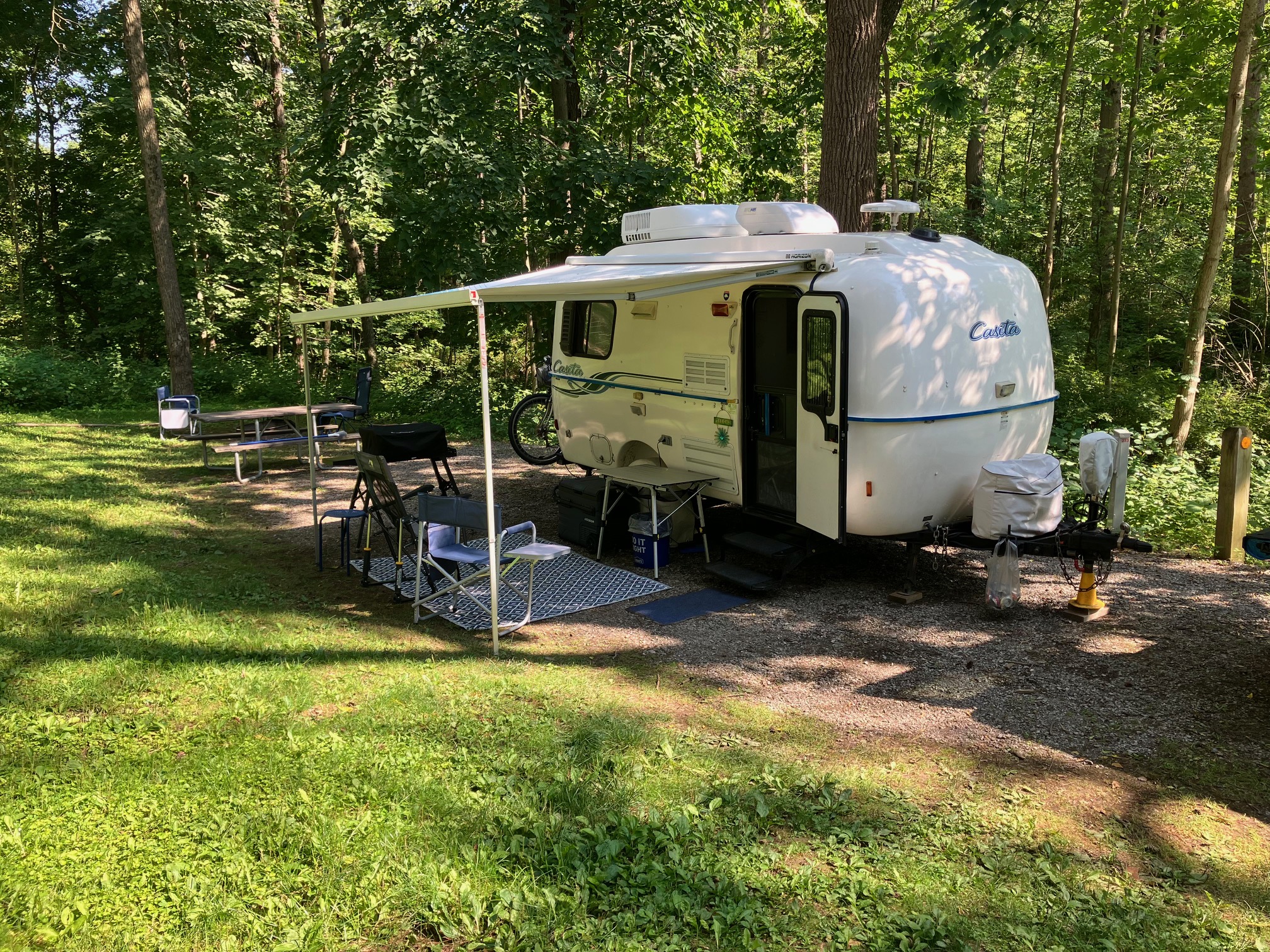
Letchworth has a large, classic state park campground divided into eight loops. Dean describes the camping area as beautiful, wooded, and somewhat nostalgic.
The campground has 257 campsites, along with an unusually large selection of cabins and other lodging options. Sites offer either 30-amp or 50-amp electric service, but there are no water hookups at individual campsites. Instead, each loop has several shared water spigots.
Each loop also has restroom and shower facilities.
Most campsites are gravel, and you’ll find everything from partial shade to deeply wooded sites.
This is an older campground, so RVers should research individual sites before booking. Some sites can be uneven, and site lengths vary.
Dean and Laura travel with a 17-foot Casita and had no trouble finding a suitable campsite. They also saw more large fifth wheels and motorhomes than they expected, so Letchworth certainly isn’t off-limits to big rigs.
However, if you’re traveling with a larger RV, Dean recommends booking early and researching the individual site carefully.
This is one of those campgrounds where experienced repeat visitors probably know exactly which sites work for their rigs.
A Note About Campground Renovations
One of Dean’s few criticisms of Letchworth involved the age of some campground facilities.
This is something we’ve noticed at other New York state park campgrounds as well. The parks themselves are spectacular, and the campgrounds often occupy incredible locations, but some of the older bathhouses and infrastructure can feel dated.
There is almost a charming nostalgia to it.
Almost.
We love campground nostalgia as much as anyone, but we’d also like a nice shower.
The good news is that Letchworth is in the midst of significant bathhouse improvements. The park is replacing several campground shower buildings, and construction is affecting campsite availability during the 2026 season, with work extending into spring 2027.
So if you’re planning an upcoming stay, pay particularly close attention to which loops are open when you make your reservation.
Camping With Pets at Letchworth State Park
Pet owners also need to be careful when selecting a loop.
When Dean booked his trip, he specifically chose a pet-friendly loop because their beloved dog Gibbs was still traveling with them at the time. Sadly, Gibbs passed away before this trip.
Not every camping loop at Letchworth allows pets, so don’t assume that simply selecting an available campsite means your dog can join you there.
The park currently allows pets in designated camping loops and limits campers to two pets, with additional leash and vaccination requirements.
This is definitely something to verify before clicking that reservation button.
How Much Does It Cost to Camp at Letchworth?
One of the best things about Letchworth is the price.
Dean found the campsites remarkably affordable considering the quality of the destination.
Current campsite rates are $30 to $32 per night, with an additional $5-per-night fee for out-of-state residents.
That’s a tremendous value for a campground inside one of the most spectacular state parks in the country.
During the episode, we couldn’t help noticing the tension between those incredibly low prices and the need for infrastructure improvements.
We’re certainly not advocating for unnecessarily expensive state park camping. Affordable public campgrounds are incredibly important. But we’d also gladly pay a few more dollars per night if that money were dedicated to preserving and improving these extraordinary parks for future generations.
Cabins, Cottages, and the Glen Iris Inn
Letchworth also stands out for the sheer variety of accommodations available to non-RVers.
The park has 81 cabins, ranging from rustic options to more developed accommodations, along with two impressive cottages: Maplewood Lodge and Parker’s Hideaway.
Then there is an entirely different collection of accommodations associated with the historic Glen Iris Inn, including rooms at the inn itself as well as Pinewood Lodge, Pinewood Lofts, Caroline’s Cottage, the Stone House, and Chalet House.
The Glen Iris Inn is particularly special because it overlooks Middle Falls.
Dean joked that if someone told him he had to pick one place to live for the rest of his life—as long as he could escape during the harshest part of winter—the Glen Iris Inn overlooking Middle Falls wouldn’t be a bad choice.
We can’t really argue with that.
These lodging options also make Letchworth an excellent choice for a multigenerational camping trip or a vacation with friends who don’t own RVs.
Don’t Expect Great Wi-Fi or Cell Service
If you need to work from the campground, plan ahead.
Dean and Laura found no campground Wi-Fi and struggled with cell service, frequently getting only one or two bars.
Their solution was simple: embrace it.
Dean is retired, so as he reminded us during the episode, “work” is a four-letter word.
They downloaded entertainment to an iPad ahead of time and enjoyed being disconnected.
We have to admit that when we pull into a campground and discover the Wi-Fi isn’t very good, there is sometimes a small sense of relief. It removes the temptation to check email and gives us permission to actually disconnect.
But if you truly need connectivity during your stay, don’t assume you’ll be able to rely on your phone.
What Makes Letchworth the “Grand Canyon of the East”?
The Genesee River runs through the heart of Letchworth, cutting a dramatic gorge through the landscape.
Cliffs rise as high as 600 feet, and the river passes over three major waterfalls: Lower Falls, Middle Falls, and Upper Falls.
Surrounding everything is dense forest.
The park offers approximately 66 miles of hiking trails, plus opportunities for biking, horseback riding, whitewater rafting, kayaking, swimming, snowmobiling, cross-country skiing, and other recreation. There are also nature programs, guided walks, historical interpretation, and even hot-air ballooning.
This is why Letchworth feels more like a national park than a typical state park.
There is simply an enormous amount to do.
Hiking the Gorge Trail
If you only have time for one hiking experience, Dean recommends focusing on the Gorge Trail.
The trail runs roughly seven miles along the western side of the gorge and provides access to many of the park’s most famous views, including all three major waterfalls.
You don’t have to hike the entire thing.
In fact, most visitors probably shouldn’t.
Because Letchworth is long and narrow, hiking the whole trail out and back would turn it into roughly a 14-mile day.
Instead, Park Road parallels much of the gorge and provides numerous parking areas and access points.
That allows you to create your own hiking itinerary.
Drive to a parking area, hike a section of the Gorge Trail, return to your vehicle, continue down Park Road, and then access another section.
For most visitors, that’s probably the best way to experience Letchworth.
Serious Hikers Can Tackle the Finger Lakes Trail
If seven miles doesn’t sound like nearly enough hiking, Letchworth has you covered.
The Finger Lakes Trail travels along the more rugged eastern side of the park.
Dean describes this side as considerably less developed, making it appealing to hikers looking for a more substantial backcountry experience.
The trail through Letchworth also connects to the much larger Finger Lakes Trail system, opening up enormous possibilities for serious hikers.
You could easily use Letchworth as a hiking base camp and never come close to running out of trail.
The Autism Nature Trail
One of the most unique recreational resources at Letchworth is the Autism Nature Trail, commonly called the ANT.
Located near the Humphrey Nature Center, this approximately one-mile accessible trail was specifically designed to provide an inclusive nature experience for visitors with autism and other developmental disabilities.
It features eight sensory stations that encourage visitors to experience and interact with nature in different ways.
Dean and Laura walked the trail while exploring the nature center area and came away impressed.
This is the kind of thoughtful park resource that makes us fall in love with the New York State Park system all over again.
Explore the Mount Morris Dam
The northern end of Letchworth offers an attraction that surprised Dean: the Mount Morris Dam.
At first glance, he couldn’t figure out where the reservoir was.
That’s because this isn’t a traditional dam creating a permanent lake.
It is a dry dam designed for flood control.
The Genesee River normally flows through it, while the area behind the dam can temporarily hold floodwater during periods of excessive rain or snowmelt.
Dean was fascinated by the engineering and particularly enjoyed the interpretive signage explaining how the system works.
There is also a visitor center in this area.
For travelers who enjoy engineering, history, or simply learning how the places they visit actually work, it’s well worth heading to the northern end of the park instead of spending your entire trip around the waterfalls.
Take Advantage of Letchworth’s Concessions
For such a large park, Letchworth does a good job of providing places to grab a snack, drink, or meal while you’re exploring.
The campground has a well-stocked camp store, along with another area selling local products such as honey, baked goods, and other treats.
Elsewhere in the park you’ll find additional concessions.
Near the dam, for example, Dean found the Dam Overlook Cafe and Gifts.
The southern section has still more options, including concessions near the waterfalls.
That matters more than you might expect.
When you’re spending an entire day driving, hiking, and sightseeing through a 17-mile-long park, being able to grab a cold drink or lunch without leaving the park is incredibly convenient.
Swimming at Letchworth State Park
Letchworth also has a large swimming complex, which Dean describes as essentially an Olympic-sized pool accompanied by another substantial pool.
Swimming is a great option for families who need a break from hiking and sightseeing.
It’s also a reminder that these New York state parks aren’t just tourist attractions. They serve as important recreational spaces for surrounding communities.
You could easily imagine local families spending summer days at Letchworth just to swim, picnic, and enjoy the park.
Spend Time at the Humphrey Nature Center
On the southern end of the park, make time for the Humphrey Nature Center.
Unlike some of the campground facilities that show their age, Dean found the nature center modern, contemporary, and packed with information.
Interactive exhibits explore the park’s geology, wildlife, plants, and river ecology, and trails from the nature center lead to destinations including Trout Pond and Inspiration Point.
For families, we’d put this fairly high on the itinerary.
It’s a great place to give kids some context for everything they’re seeing outside—and it works especially well if the weather isn’t cooperating with your hiking plans.
Inspiration Point and the Council Grounds
The southern portion of Letchworth also contains some of the park’s most interesting historical attractions.
Dean recommends stopping at Inspiration Point, as well as exploring the Council Grounds and park museum.
The history of this landscape extends far beyond its creation as a state park, and Dean was particularly interested in learning more about the Seneca people who lived here.
The park preserves and interprets several sites connected to that history, including the story of Mary Jemison, who became closely connected with the Seneca community after being captured as a child and later played an important role in the history of the Genesee Valley.
That history adds an entirely different layer to a Letchworth visit.
You can come here for waterfalls.
But you shouldn’t leave without learning something about the people who lived on this land long before it became a recreational destination.
The Civilian Conservation Corps at Letchworth
Another important chapter of Letchworth’s history came during the Great Depression.
Between 1933 and 1941, four Civilian Conservation Corps camps operated at Letchworth, with approximately 3,000 men helping develop the park’s infrastructure.
Dean has joined us on The RV Atlas before for an entire episode about the Civilian Conservation Corps, and his enthusiasm for the CCC came roaring back at Letchworth.
The work these young men performed during the Depression helped create the parks Americans continue enjoying generations later.
It’s also worth remembering when we look at aging infrastructure in our public parks.
These places were created through enormous investments by previous generations.
Maintaining them requires investment from ours.
Lower Falls
Of course, for many visitors, Letchworth is ultimately about the waterfalls.
Start with Lower Falls, which Dean describes as approximately 70 feet tall.
Reaching the best views requires descending more than 100 stairs from the Gorge Trail.
One of the highlights here is the beautiful stone footbridge built by the Civilian Conservation Corps.
Walk onto the bridge, turn toward the river, and Lower Falls appears upstream.
It’s one of those classic Letchworth views that demonstrates how beautifully the park’s historic infrastructure works with the surrounding landscape.
Middle Falls
Middle Falls is the largest of Letchworth’s three major waterfalls.
Dean describes it as approximately 107 feet tall and 285 feet wide.
It’s also the waterfall most closely associated with the Glen Iris Inn.
Walk outside the inn, take a few steps, and there it is.
Once you see the view, it becomes pretty easy to understand why William Pryor Letchworth chose this particular spot for his home.
Middle Falls is also a good reminder to keep your phone handy.
Dean joked that he would take what seemed like the perfect waterfall photo, walk another 20 or 30 feet, discover an even better view, and immediately take another.
We remember doing exactly the same thing.
Upper Falls and the Genesee Arch Bridge
Upper Falls is approximately 70 feet tall and has a distinctive horseshoe shape.
But the waterfall is only part of the scene.
Towering above it is the Genesee Arch Bridge, creating one of Letchworth’s most recognizable views.
The combination of waterfall, gorge, forest, and massive railroad bridge is spectacular.
Even though it has been more than a decade since our own visit, we can still remember standing in these spots.
That’s the kind of impression Letchworth makes.
Who Was William Pryor Letchworth?
The park bears the name of William Pryor Letchworth, a Buffalo businessman, Quaker, and social reformer who became captivated by this landscape.
He eventually purchased approximately 1,000 acres surrounding the Upper and Middle Falls and established his home at Glen Iris.
Before his death in 1910, he arranged for his estate to be given to New York State so the landscape could be preserved.
What began with Letchworth’s property eventually grew into today’s massive state park.
Dean, a retired social work professor, was particularly interested in Letchworth’s commitment to social reform and preservation.
Learning his story at the park museum helps explain how this extraordinary place became public land rather than disappearing behind private gates.
How Many Days Do You Need at Letchworth State Park?
Dean and Laura camped at Letchworth for six nights, giving them five full days once travel days were factored in.
They spent three of those days primarily exploring the park.
That feels about right to us.
You could certainly see the biggest attractions during a shorter visit, but Letchworth rewards time.
For a first trip, we’d recommend at least three full days, especially if you want to hike, explore both ends of the park, visit the historical attractions, and spend time around all three waterfalls.
With five days, you can slow down and also explore some of the delightful small communities surrounding the park.
And those communities turned out to be one of Dean and Laura’s biggest surprises.
Visit the Village of Perry
The village of Perry makes an excellent excursion from Letchworth.
Dean describes it as a quaint small town with a charming downtown, but his biggest recommendation sits just outside town.
The Charcoal Corral
The Charcoal Corral is a glorious throwback.
It has not one but two drive-in movie screens.
It has pizza.
It has ice cream.
It has miniature golf.
It has an arcade.
It has inflatables for kids.
And depending on when you visit, there may be classic car cruise nights, line dancing, trivia, concerts, or other events.
Dean initially wondered how good the pizza could possibly be at a place that felt this touristy.
He was wrong to worry.
He and Laura loved it.
The whole place has a nostalgic 1960s-and-1970s family-fun vibe that fits perfectly with a summer camping trip.
Act 4 Books
Dean is also one of our most reliable traveling bookstore correspondents.
His recommendation in Perry is Act 4 Books.
This isn’t simply a bookstore. It also incorporates coffee, games, toys, and community events.
What impressed Dean most was the personal connection. The staff could actually talk books, make recommendations, and clearly cared about being part of the community.
If your ideal small-town afternoon involves browsing bookstores, grabbing coffee, and wandering through antique and thrift shops, Perry deserves some time on your itinerary.
Take a Quick Trip to Silver Lake
Near Perry you’ll also find Silver Lake.
Silver Lake State Park is a day-use destination, and there are other public access points around the lake.
Dean doesn’t suggest making it the centerpiece of your trip—Letchworth certainly provides enough to do—but it makes a pleasant hour-or-two excursion.
It’s also sometimes casually described as the westernmost Finger Lake, although Dean notes that geologically it isn’t officially considered part of the Finger Lakes.
Explore Mount Morris
At the northern end of Letchworth, the village of Mount Morris is another easy side trip.
Dean and Laura enjoyed simply parking and walking through town, something they routinely do when they discover communities with interesting historic architecture.
Their memorable food stop here was Susie’s Gluten Free Bakery.
Dean didn’t seek it out because he eats gluten-free.
He went for the coffee.
He ended up having what he called the best Americano he’d ever tasted—and liked the first one enough to immediately order a second.
The breakfast sandwiches and pastries were also excellent.
But the real attraction may have been Susie herself.
Dean describes her as intense, opinionated, funny, and extremely concerned about making sure her customers make the right choices.
She even managed to talk him out of putting his preferred sweetener into his coffee.
Rather than being annoyed, Dean kept finding reasons to talk to her because she reminded him of his Aunt Betty from Phoenicia, New York.
Sometimes the people you meet while traveling become as memorable as the places.
Grab Breakfast in Castile
Castile is smaller than Perry or Mount Morris, but its location makes it particularly convenient for exploring the southern section of Letchworth.
Dean and Laura stopped at the Parkside Diner for breakfast before heading back into the park for a full sightseeing day.
It’s a straightforward local diner serving breakfast, lunch, dinner, burgers, and other classics.
Sometimes that’s exactly what you need before several hours of hiking waterfalls.
Save Room for a Burger at Wolf Creek Deli
Dean also recommends Wolf Creek Deli in Castile.
He loves burgers but tries not to order them constantly, so he tends to save his burger calories for one that seems especially promising.
This one passed the test.
Beyond burgers, Wolf Creek Deli serves wings, pizza, pressed sandwiches, and other casual fare.
These Castile restaurants work especially well because you can leave the park, grab a meal, and quickly get back to sightseeing.
Spend an Afternoon in Geneseo
A little farther north is Geneseo, and Dean thinks it’s absolutely worth the extra drive.
This was the most developed of the surrounding villages they explored.
The presence of SUNY Geneseo gives the town a college-town energy, while the historic district provides plenty to explore on foot.
Dean and Laura originally landed here because they needed groceries.
And then Dean discovered Wegmans.
Those of us who already know Wegmans understand.
Dean now understands too.
Crickets Coffee Kitchen and Cocktails
Dean recommends Crickets Coffee Kitchen and Cocktails for coffee and brunch.
One detail particularly charmed him: the shop offered an honor-system option for grab-and-go coffee.
Put the money in, pour yourself a cup, and head out.
It was a small detail, but exactly the sort of thing that made him enjoy Geneseo.
The Not Dot Shop
Laura particularly enjoyed The Not Dot Shop, which brings together work and merchandise from numerous individual vendors and makers under one roof.
Dean and Laura enjoy thrifting and browsing even when they aren’t necessarily looking to buy something, and Geneseo turned out to be an excellent place for that kind of wandering.
Dean recommends giving the town an afternoon rather than treating it as nothing more than a grocery stop.
Sometimes Getting Lost Is the Best Part
One of our favorite stories from this episode wasn’t planned at all.
Dean and Laura were driving along the eastern side of Letchworth, got a little turned around, and eventually found themselves in Nunda.
There they discovered the Kishwaukee Creamery and Coffee House.
Laura ordered ice cream.
Dean ordered coffee.
So far, perfectly on brand.
The shop also had an antique-parlor-style seating area where they could relax.
While sitting there, they struck up a conversation with a 14-year-old employee who was taking his lunch break.
He was a military kid whose retired father had eventually brought the family to Nunda, and he spent his break happily chatting with Dean and Laura about his life.
It was a simple interaction.
But it became one of those little travel memories that sticks.
You can’t put it on an itinerary.
You can’t reserve it online.
You just have to leave enough space in a trip for unexpected things to happen.
Letchworth or Watkins Glen?
Dean’s 21-day trip included three state parks, and when we put him on the spot about his favorite, he chose Letchworth.
But there is some nuance.
The Gorge Trail at Watkins Glen State Park, with 19 waterfalls packed into roughly a mile and a half, remains one of the most spectacular individual hikes Dean has experienced.
And Watkins Glen’s location in the heart of the Finger Lakes puts you close to wineries, breweries, lakes, and an enormous range of day trips.
So here’s how we’d frame the choice:
Letchworth is the grander state park. Watkins Glen is surrounded by more tourist attractions.
Thankfully, you don’t really have to choose.
They are close enough to combine into one outstanding Western New York RV trip.
Is Letchworth State Park Worth the Trip?
Absolutely.
Dean and Laura have camped nearly 600 nights in 18 states, and they overwhelmingly prefer public parks.
Letchworth still landed in their top three state parks—and potentially at number one.
That tells you something.
The campground itself isn’t luxurious. Some of the infrastructure is old. Cell service isn’t great. Larger RVs need to choose sites carefully.
But none of those things define the experience.
What defines Letchworth is waking up in a deeply wooded campground and having an entire day ahead of you filled with waterfalls, gorge overlooks, hiking trails, history, museums, rafting, swimming, nature programs, and scenic drives.
It’s looking at Middle Falls and understanding instantly why William Pryor Letchworth wanted to protect this land.
It’s walking another 30 feet after taking what you thought was the perfect picture—and realizing the view just got even better.
And it’s discovering that one of the most magnificent outdoor destinations in the Northeast is surrounded by little villages where you can find a great burger, an old-school drive-in, an independent bookstore, a memorable cup of coffee, or an unexpected conversation with a stranger.
Dean said that sometimes Letchworth was so beautiful he couldn’t walk 10 or 20 feet without pulling out his phone for another photograph.
We know exactly what he means.
New York State is one of the most underrated camping destinations in the country, and Letchworth State Park is one of the very best reasons why.
We’ll see you at the campground.
The post Letchworth State Park: A Guide to “the Grand Canyon of the East” with Casita Dean May appeared first on The RV Atlas.
13 September 2026, 6:20 pm - 1 hour 7 minutesAn Epic RV Trip to Western Canada and the Canadian Rockies PT. 2 (Jasper, Icefields Parkway)
Some RV trips are about the destination. Others are about the drive. And then there are those rare adventures where every single part of the journey feels like the destination. That is exactly what happened during the second leg of Gretchen Holcombe’s epic Western Canada RV trip.
In Part One of this three-part series, we followed Gretchen and her family through Calgary and Banff National Park. This week, the adventure continues north along the Icefields Parkway to Jasper National Park, then back south to the Lake Louise area of Banff National Park, with an unforgettable side trip into Yoho National Park.
This is the kind of RV trip that belongs on a bucket list. There are glacier-fed lakes, waterfalls, wildlife encounters, mountain hikes, incredible campgrounds, surprisingly good food, and some very important lessons about towing an RV through the Canadian Rockies.
And while Banff may get more attention, Gretchen surprised us by admitting that if she could return to only one of the two parks, she might choose Jasper. It felt more relaxed, more rugged, and less crowded—and she left feeling like there was still plenty she hadn’t had time to see.
To listen to our interview with Gretchen please click on the media player above or subscribe to the RV Atlas podcast wherever you get your favorite shows!
Driving the Icefields Parkway With an RV
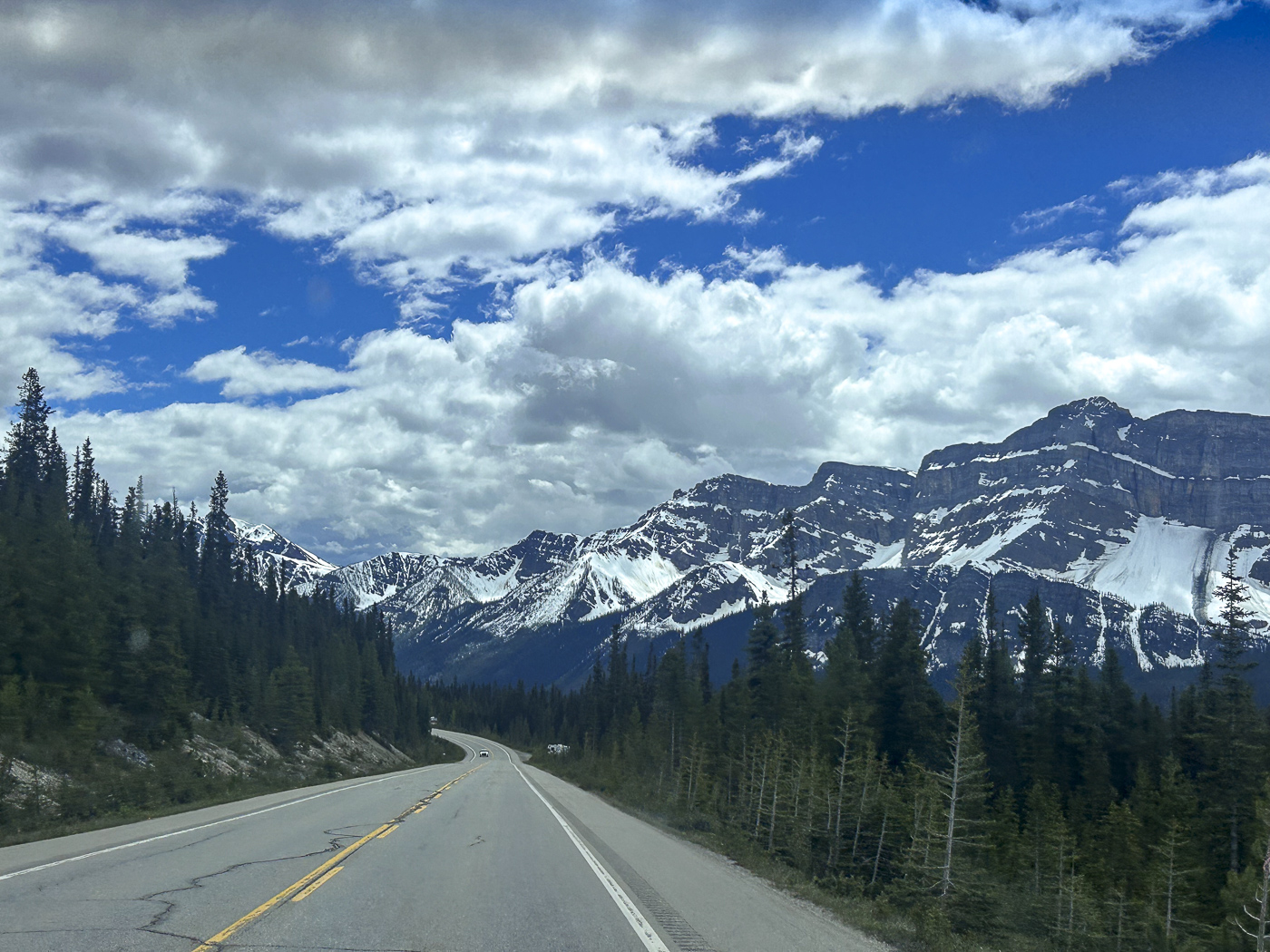
The Icefields Parkway connects the Lake Louise area of Banff National Park with Jasper National Park.
The drive is about 144 miles, but this is absolutely not a road you should think of simply as transportation between two destinations.
The Icefields Parkway is an attraction all its own. Towering mountains surround the road almost continuously. There are glacier views, waterfalls, alpine lakes, hiking trails, and scenic overlooks scattered along the route.
Gretchen’s best advice is simple:
Do not rush it.
Many travelers devote an entire day to the drive, stopping frequently for scenery and short hikes along the way.
The Challenge of Scenic Pullouts With a Larger RV
There is one significant downside if you’re towing a bigger travel trailer or driving a large motorhome.
Not every scenic pullout is particularly RV friendly.
Gretchen and her husband frequently found themselves looking at a turnout and debating whether they could safely fit.
Sometimes they decided to keep driving.
A Class B van or smaller RV will give you much more flexibility along this route. If you’re traveling with a bigger setup, be prepared to pass some of the smaller overlooks and concentrate on the larger stops.
One of the easiest major stops is the Columbia Icefield Discovery Centre, which has a large parking area with dedicated RV parking.
The family stopped there for lunch and enjoyed views of the Athabasca Glacier from the visitor complex. It’s also the departure point for the popular glacier tours that carry visitors onto the ice.
Don’t Underestimate the Mountain Driving
Here is one piece of advice Gretchen wished she had heard more clearly before the trip:
The Icefields Parkway is still mountain driving.
The road is well maintained and large RVs travel it every day, but there are substantial grades.
Gretchen had actually worried more about other mountain passes later in their Western Canada journey. Instead, one long grade just past the Columbia Icefield Discovery Centre caught her off guard.
She estimated that portions reached around a 12% grade.
Their 2003 van handled the route, but they manually downshifted and found themselves using the brakes more than they normally would on mountain roads.
Her advice for other RVers is not to avoid the Icefields Parkway. Quite the opposite.
Just arrive prepared.
Know how your tow vehicle performs on steep grades, understand how to downshift appropriately, and don’t assume that beautiful scenery means an effortless drive.
Jasper National Park Feels Different From Banff
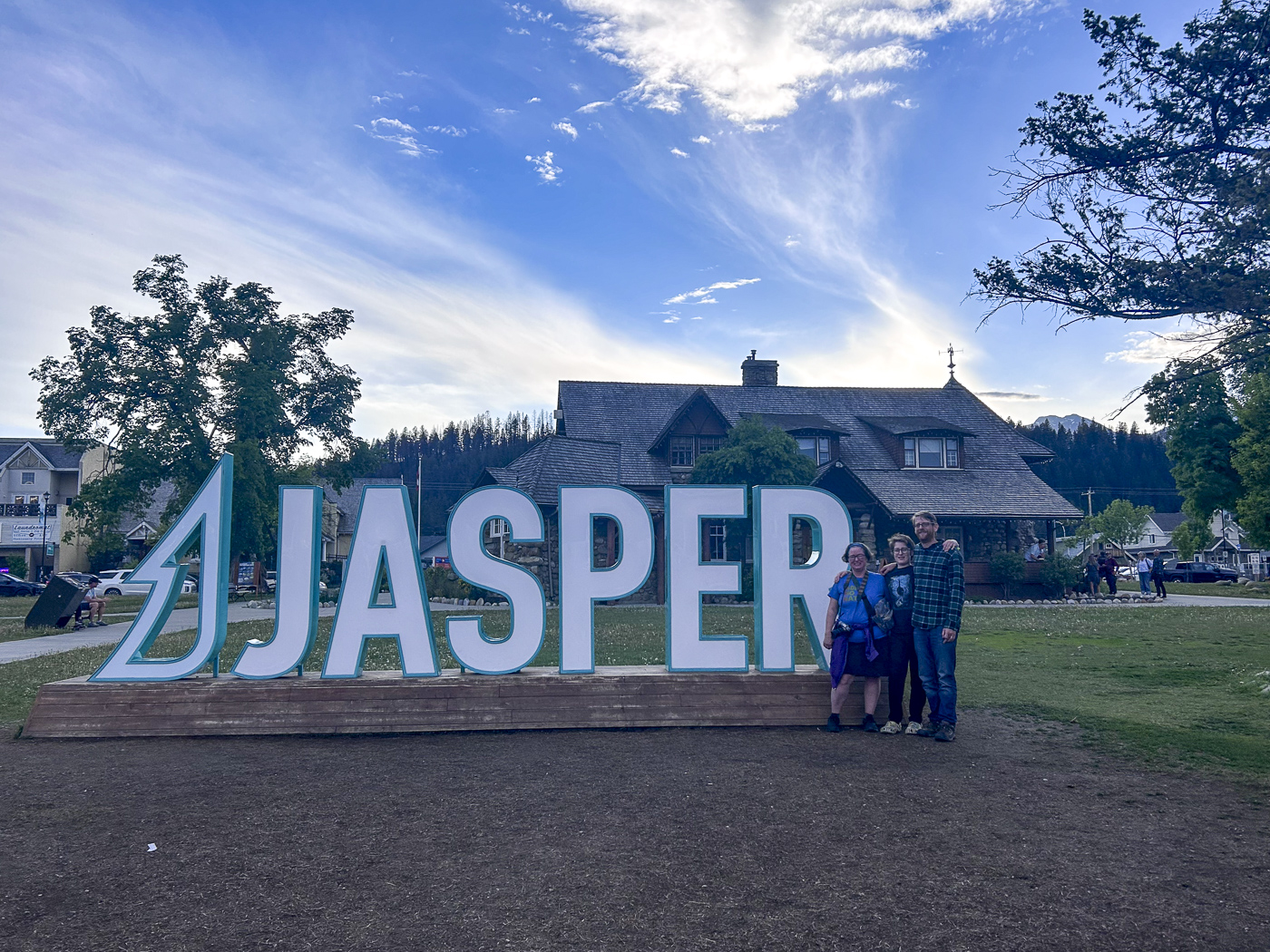
Both Banff and Jasper showcase the spectacular scenery of the Canadian Rockies, but they have very different personalities.
Banff is easier to access from Calgary and receives considerably more visitors. Jasper is more remote.
That extra distance means fewer crowds and a noticeably different atmosphere.
Gretchen found Jasper more relaxed and rugged. The town felt less touristy, and the logistics of their stay were easier because they were camping just outside downtown.
Both parks are absolutely worth visiting.
But when Jeremy asked Gretchen which one she would choose if she could only return to one, she picked Jasper.
Camping at Whistlers Campground in Jasper National Park
One of the biggest victories of this leg of the trip was getting a reservation at Whistlers Campground.
After missing out on a national park campsite in Banff, Gretchen was able to reserve three nights at Whistlers, located only about five minutes outside the town of Jasper.
And it became one of the family’s favorite campgrounds of the trip.
Whistlers is enormous, with roughly 780 campsites, but it doesn’t necessarily feel that large because the campground is divided into smaller loops.
Some loops offer full hookups, and Gretchen recommends being online as soon as reservations open if those sites are important to you.
Their pull-through site was spacious and comfortable, and the campground’s mountain setting made a huge impression.
Every direction seemed to offer another mountain view.
Surprisingly Nice Bathhouses
The bathhouses were another pleasant surprise.
They appeared very new, were extremely clean, featured murals inside, and offered free showers.
That last detail was especially noteworthy because free campground showers were not common during this portion of the trip.
One amenity Whistlers did not have was laundry.
Gretchen found campground laundry facilities surprisingly difficult to come by throughout the Canadian Rockies, so travelers planning a longer itinerary may want to think ahead about where they’ll handle that chore.
Coffee at the Campground
Another unexpected perk?
A local coffee shop operated a small trailer at Whistlers where campers could buy coffee, tea, and pastries.
It’s a simple amenity, but there is something especially wonderful about waking up in a national park campground surrounded by the Canadian Rockies and being able to walk over for a fresh cup of coffee.
Wildlife Is Not Just a Possibility at Whistlers
Wildlife sightings weren’t something Gretchen’s family had to go looking for.
The wildlife came to them.
They visited during elk calving season, when female elk can be especially protective.
Campground staff gave plenty of warnings about keeping a safe distance.
And those warnings were not theoretical.
Elk regularly wandered right through the campground. One evening, Gretchen had to quickly bring the dog inside after he noticed an elk standing very close to their campsite.
Then things got even more interesting.
One morning, a neighboring campground loop was evacuated after a grizzly bear wandered through the area and spent some time investigating picnic tables.
Food Storage Matters
Campers were allowed to cook and eat outside, but food and cooking equipment could not simply be left unattended.
Gretchen’s family would cook on the Blackstone, eat outside, and then immediately pack everything away into the RV or vehicle.
In a place like Jasper, wildlife safety needs to become part of your normal camping routine.
You don’t leave the grill sitting outside because you’ll “come back to it later.”
You clean up.
You store food properly.
And you pay attention.
Exploring Downtown Jasper
Whistlers Campground’s location makes downtown Jasper incredibly easy to visit.
Gretchen estimates the drive at roughly five minutes, and there’s also a bike path connecting the campground with town.
They enjoyed wandering downtown, browsing shops, and eating at Jasper Brewing Company, where they sat outside and watched people pass by.
One practical tip: extremely long freight trains regularly pass through Jasper.
The family quickly learned to use an alternate route into town that avoided crossing the tracks whenever possible.
Don’t Miss From Jasper With Love

One of the most unexpected recommendations from the entire episode is a show called From Jasper With Love.
Gretchen booked tickets on a rainy day without expecting too much.
It became a surprise highlight.
The two-man sketch comedy show is built around life in Jasper, poking fun at the town, the wildlife, and the experience of visiting the Canadian Rockies.
One recurring character is Eddie the Elk, who is hilariously offended that bears and moose get all the attention while elk barely make it onto the souvenirs.
The show is family friendly and worked especially well with Gretchen’s 13-year-old.
If rain interrupts your hiking plans—or if you simply need a break from nonstop outdoor sightseeing—this is exactly the kind of quirky local experience that can make a trip more memorable.
Valley of the Five Lakes Trail
If Gretchen had to choose one personal highlight from Jasper, she picked the Valley of the Five Lakes Trail.
The trail had been closed due to wildfire damage but reopened after extensive work, including reconstructed boardwalks.
The family completed a roughly 3.5-mile loop with moderate elevation changes.
The trail passes a series of colorful mountain lakes and areas where the landscape is already beginning to recover from wildfire.
This is one of those hikes where the combination of scenery and variety keeps things interesting without demanding an all-day commitment.
A Quick Shout-Out to Canadian National Park Bathrooms
This may be the first RV Atlas article where we’ve enthusiastically recommended pit toilets.
But here we are.
Gretchen repeatedly noticed how clean and well maintained the facilities were throughout the Canadian national parks.
Even pit toilets were surprisingly impressive.
She saw maintenance crews regularly servicing and cleaning them, and the overall experience stood out enough that it became a legitimate topic of conversation during the episode.
It might sound like a small thing.
But clean restrooms, maintained trails, and visible staff presence can dramatically improve the visitor experience.
And Gretchen felt Canadian national parks were doing an excellent job in that regard.
Athabasca Falls
Another easy Jasper-area recommendation is Athabasca Falls.
The falls are accessible through a system of boardwalks and short trails that showcase not only the waterfall itself but also the canyons and rock formations carved by the water.
You can make this a very quick roadside stop or spend around half an hour exploring the network of paths.
For Gretchen’s family, it was absolutely worth the short detour back down the Icefields Parkway.
Pyramid Island
For something slower and easier, consider Pyramid Island.
A bridge connects the mainland with the small island, where short trails provide views of Pyramid Mountain.
The stop was particularly nice for Gretchen’s older dogs because it offered an easy outing without a demanding hike.
It also makes a great photography stop, especially in the evening.
Maligne Lake
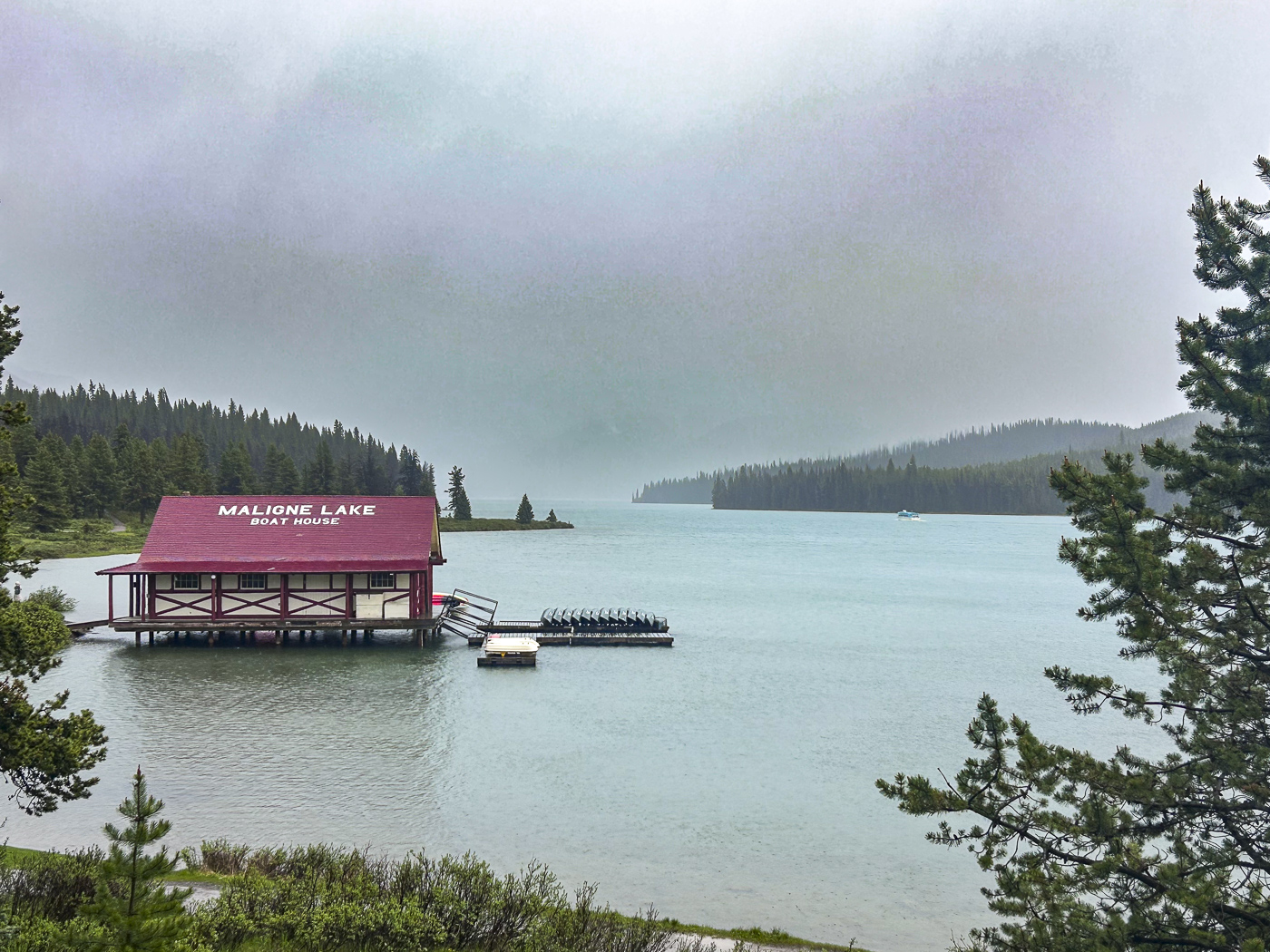
Maligne Lake is one of Jasper’s marquee attractions.
The famous boat tour travels to Spirit Island and gets rave reviews from many visitors.
Gretchen’s family ultimately skipped it.
The cost would have been roughly $100 per person, and they had already spent quite a bit on the Banff Gondola earlier in the trip.
They decided to visit the lake and hike instead.
Then the weather intervened.
By the time they arrived, steady rain had settled in, so they snapped a few photos, escaped into the gift shop and café for hot chocolate, and eventually headed back toward Jasper.
Interestingly, Gretchen’s aunt and uncle happened to visit the area about a week later, took the boat tour, and loved it.
Choose Expensive Activities Carefully
This led to an important family travel discussion.
When you’re traveling with several people, ticketed attractions add up quickly.
A scenic hike might cost nothing.
A waterfall might cost nothing.
A family boat tour can suddenly add hundreds of dollars to your day.
That doesn’t mean you should skip paid experiences.
The Banff Gondola, for example, became one of Gretchen’s favorite memories from the earlier portion of the trip.
But choosing the right splurges for your particular family can help keep a long RV vacation financially manageable.
How Long Should You Stay in Jasper?
Gretchen’s family spent three nights at Whistlers Campground.
Was that enough?
Mostly.
They packed an impressive amount into those three nights, although rain interrupted some plans.
Gretchen felt they easily could have filled another day, but for a larger itinerary covering Banff, Jasper, Lake Louise, Yoho, and eventually Vancouver, three nights felt reasonable.
If Jasper is a major focus of your trip, we’d certainly consider adding another night.
But three nights gives you enough time for a substantial introduction.
Returning to the Lake Louise Area
After Jasper, the family headed back down the Icefields Parkway toward Banff National Park.
Yes, that meant backtracking.
But there are worse roads to drive twice.
Seeing the Icefields Parkway in the opposite direction simply offered another perspective on one of the most spectacular drives in North America.
Their next base camp was the Lake Louise hard-sided campground.
Hard-Sided Versus Soft-Sided Camping at Lake Louise
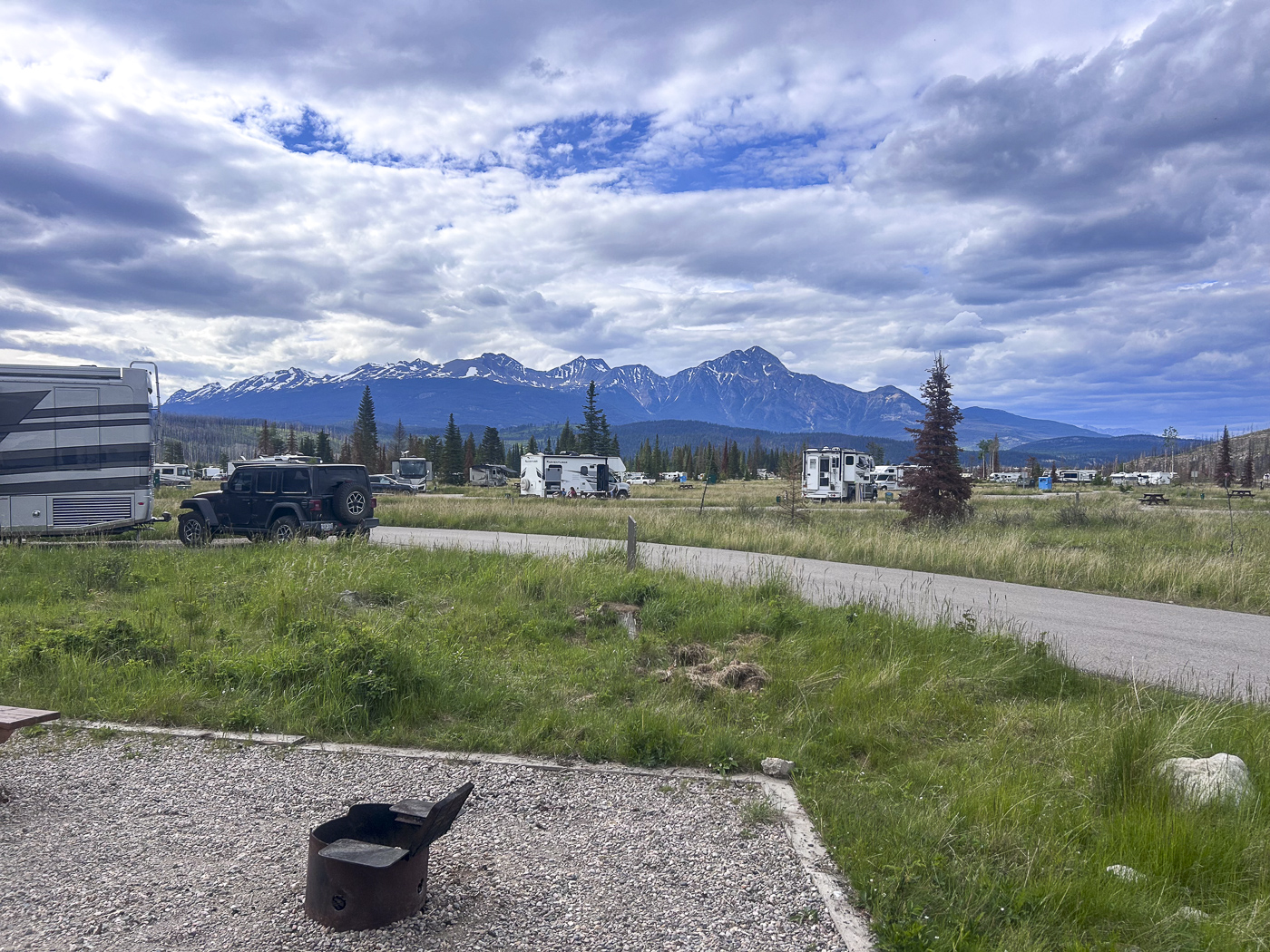
Lake Louise has neighboring campground areas designated for hard-sided and soft-sided camping.
The distinction exists because of bear activity.
Tent campers, pop-ups, and other soft-sided accommodations use the soft-sided campground, which is surrounded by an electric fence.
The soft-sided campground is more wooded and offers greater privacy, but it is generally better suited to smaller rigs.
Gretchen’s family stayed in the hard-sided campground.
One unusual feature is that many campsites use long pull-through driveways shared by two RVs.
It sounds odd on paper, but Gretchen didn’t find it particularly bothersome.
Most campers position their RVs so their non-door sides face one another, leaving the outdoor living areas pointed toward the woods.
The only minor inconvenience is that you may need to run your electrical cord underneath the camper to reach the pedestal.
Be Prepared for Trains and Weak Cell Service
There are two practical drawbacks worth knowing before booking.
Cell service is extremely limited.
You may be able to find a signal by walking around, and there is Wi-Fi available in places such as the visitor center.
The second issue is noise.
Freight trains run extremely close to the campground at all hours.
Gretchen could see the tracks from their campsite.
If you’re a light sleeper, bring earplugs.
Fortunately, the campground also offers easy access to beautiful walking trails along the Bow River.
A Surprisingly Fun Bear Safety Program
The adjacent soft-sided campground has an amphitheater where park staff offer interpretive programs.
Gretchen’s family attended a bear safety presentation expecting a fairly traditional ranger talk.
Instead, it included games, team competitions, drawing activities, and stories about individual bears that live in the park.
They even learned about a well-known local bear nicknamed The Boss.
It was educational, funny, and especially well suited to families with kids.
Visiting the Lake Louise Village
The small commercial area near the campground includes shops, restaurants, and a visitor center.
“Village” might be a slightly generous term.
But it provides useful services, Wi-Fi, and trip-planning information.
The visitor center even tipped Gretchen’s family off to a geocaching adventure in the campground, which became another fun activity for their son.
For a meal, they recommend Bill Peyto’s, located at a nearby hostel.
They enjoyed the food, local beers, and—very importantly during a trip where connectivity was often limited—the comfortable upstairs seating area with Wi-Fi.
You Need a Plan for Moraine Lake
Two of the biggest attractions in this region are Lake Louise and Moraine Lake.
You absolutely should try to see both.
But don’t assume you can simply drive to Moraine Lake.
Private vehicles are no longer permitted.
Visitors need to use a shuttle.
And those shuttle tickets can be extremely difficult to get.
Gretchen had four nights in the Lake Louise area and several possible days available, yet she was only able to secure one late-afternoon shuttle reservation.
Alternative private shuttles are available, including some that permit dogs, but they can become expensive.
Book Shuttle Reservations Early
Parks Canada releases some reservations when the season opens and another portion shortly before travel dates.
That second release sounds helpful until you realize you may be sitting in a national park campground with weak Wi-Fi trying to compete for tickets.
Gretchen recommends thinking about Moraine Lake transportation at roughly the same time you’re making campground reservations.
The more flexible your itinerary, the better your chances of finding a workable time.
The Advantage of a Late Moraine Lake Shuttle
Their late-afternoon shuttle actually turned into a blessing.
Crowds were lighter.
At Moraine Lake, they first tackled the short, steep Rockpile Trail, which leads to the iconic elevated view over the lake.
Even later in the day, they shared the viewpoint with plenty of other visitors.
Then they did something we highly recommend.
They kept walking.
The Lakeshore Trail follows the edge of Moraine Lake, and the crowds disappeared almost immediately once they moved beyond the busiest area.
They followed the lake toward a waterfall where glacier and snowmelt feed the water.
It was a perfect example of how you can be standing among hundreds of tourists one minute and feel completely alone in the Canadian wilderness ten minutes later.
Carry Bear Spray—Even Around Busy Attractions
That ability to escape the crowds comes with another reminder.
Carry your bear spray.
Even at extremely popular destinations, you can turn onto a trail and quickly find yourself alone.
Jeremy compared it to hiking in Glacier National Park, where crowds can disappear surprisingly quickly once you move beyond a major viewpoint.
As he joked during the episode, suddenly you’re thinking:
“I’m really glad I have my bear spray…because I’m the only snack here.”
Funny?
Yes.
But also true.
Visiting Lake Louise
Unlike Moraine Lake, you can still drive your own vehicle to Lake Louise.
Parking is limited and expensive.
Gretchen’s family arrived around 6:45 a.m. in June and still found plenty of spaces.
Staying at the nearby campground made that early start much easier than it would have been if they were driving from Banff.
Hiking to the Lake Agnes Tea House
Their main goal at Lake Louise was the Lake Agnes Tea House Trail.
This popular hike is approximately 4.5 miles round trip and climbs around 1,300 feet.
It is a workout.
Gretchen’s 13-year-old made his feelings about the uphill slog quite clear.
But there’s an excellent reward at the top.
The trail ends at Lake Agnes, where a mountain tea house serves tea, coffee, soups, sandwiches, biscuits, cake, and other food.
There is no electricity at the tea house.
Supplies must be brought up the mountain, making the experience feel even more special.
If you’ve ever wanted to finish a mountain hike in the Canadian Rockies with tea and chocolate cake, this is your moment.
Keep Going to Little Beehive
One of Gretchen’s biggest pieces of advice is don’t stop at the tea house.
Continue another kilometer toward Little Beehive.
Lake Agnes is lovely, but the additional climb offers much better elevated views back toward Lake Louise.
If you’ve already done the hard work of climbing to the tea house, that extra push is worth it.
Another Tea House Option: Plain of Six Glaciers
The family had also considered the Plain of Six Glaciers trail.
It’s longer than the Lake Agnes hike and leads to another tea house.
Gretchen liked the idea because it reportedly offers more views throughout the hike.
However, they were visiting early enough in the season that lingering snow made the trail less appropriate without specialized hiking gear.
If you visit later in the summer, it may be worth comparing the two tea house hikes and choosing whichever best matches your interests and abilities.
Take a Side Trip to Yoho National Park
Lake Louise is also an excellent base camp for visiting Yoho National Park.
Yoho sits only about 20 minutes away along the Trans-Canada Highway.
You can easily spend a day here—or even just an afternoon or evening.
Gretchen’s family squeezed it into the same day as their Lake Agnes hike.
That’s an ambitious itinerary.
But they’re professionals at packing a lot into a travel day.
Stop at the Spiral Tunnels
One unusual Yoho attraction is the Spiral Tunnels.
The tunnels were engineered to reduce the steep railway grade through Kicking Horse Pass.
A roadside viewpoint provides interpretive signs explaining the construction and allows visitors to watch trains navigate the tunnels.
If you’re lucky, a train will appear while you’re there.
Gretchen’s family waited roughly ten minutes.
No train.
After seeing approximately a million trains elsewhere on this trip, they decided they had experienced enough railroad excitement and moved along.
Eat at Truffle Pigs Bistro in Field
The tiny town of Field is home to one of the more unexpected dining recommendations from this trip.
Truffle Pigs Bistro offers a much more interesting menu than you might expect from a small mountain town with relatively few restaurants.
Gretchen’s family enjoyed local beer and creative dishes, making it a worthy food stop during a Yoho day trip.
Emerald Lake Without the Lake Louise Crowds
If Lake Louise and Moraine Lake start to feel overwhelmingly busy, head to Emerald Lake.
You still get brilliant blue mountain water.
You still get spectacular scenery.
But the atmosphere can feel far more relaxed.
Visitors can hike, rent canoes, or simply walk along the shoreline.
Gretchen’s family only made a quick stop, but she noted that you could easily make Emerald Lake the centerpiece of an entire day if you wanted more time in nature and less time navigating crowds.
Avoiding “Another Beautiful Lake” Fatigue
There is such a thing as too much spectacular scenery.
At least if you’re 13.
During a long Canadian Rockies trip, Gretchen’s son occasionally reached the point of:
“Oh look…another beautiful lake.”
It’s a useful reminder for family travelers.
Adults might happily stare at glacier-fed lakes for two straight weeks.
Kids may appreciate some variety.
Gretchen’s family mixed hiking and scenery with things like comedy shows, gondola rides, audio tours, restaurants, geocaching, and interpretive programs.
The GuideAlong app was particularly helpful because the narrated stories gave their drives more structure and kept their son engaged.
The goal is not to make every moment educational or expensive.
Just mix things up enough that everyone still enjoys the trip.
Takakkaw Falls
The final big Yoho stop was Takakkaw Falls.
The waterfall is roughly 800 feet tall and incredibly dramatic.
Getting there requires driving a road with some tight hairpin turns.
Even Gretchen’s approximately 18-foot van required a multipoint turn at one of the switchbacks.
Once you arrive, however, access is easy.
A short paved trail leads toward the base of the waterfall.
As you get closer, the roar grows louder and the scale becomes increasingly impressive.
The Bear Encounter They’ll Never Forget
Then things got interesting.
After visiting the falls around 9 p.m., Gretchen’s family turned around to walk back toward their vehicle.
A bear was standing on the trail between them and the parking lot.
They believed it was a black bear.
And they did not have their bear spray.
They had assumed this short, paved, popular attraction didn’t really require it.
But by that time of evening, the crowds were gone.
Another small group was still near the waterfall, so Gretchen’s family warned them and suggested everyone walk back together.
The bear disappeared.
Then reappeared.
Then disappeared again.
They spotted it several more times while carefully keeping their distance.
Eventually, both groups made it safely back to their vehicles.
The bear never showed aggression or much interest in them.
But the experience reinforced one of the biggest lessons of this entire trip:
Wildlife precautions aren’t only for remote backcountry hikes.
Busy places become quiet.
Popular trails empty out.
And wildlife does not care that you’re only half a mile from your car.
Their son later insisted that they call the wildlife reporting line to report the bear.
Which they did.
Then they went back to the campground and went to bed.
Just another peaceful night in the Canadian Rockies.
Final Thoughts on Jasper, Lake Louise, and Yoho
This portion of Gretchen’s Western Canada RV trip demonstrates exactly why the Canadian Rockies belong on so many RVers’ bucket lists.
The scenery is spectacular.
But the real magic is in the variety.
You can drive one of the world’s most beautiful highways in the morning, hike past turquoise lakes in the afternoon, eat dinner in a tiny railroad town, watch elk wander through your campground, climb to a mountain tea house, and end the evening standing beneath an 800-foot waterfall.
Then a bear might appear.
Because apparently the Canadian Rockies don’t believe in boring vacations.
Our biggest takeaway from this episode is that planning matters, but flexibility matters just as much.
Reserve campgrounds as early as possible.
Think ahead about Moraine Lake shuttles.
Prepare for real mountain driving.
Carry bear spray.
Choose your expensive ticketed experiences carefully.
And give yourself enough time to occasionally abandon the plan and follow something interesting.
Gretchen’s trip continues west from here, eventually reaching Fort Langley and Vancouver, and we’ll cover that final chapter in Part Three.
We’ll see you at the campground.
Meta Description
Plan an epic Jasper National Park RV trip with stops along the Icefields Parkway, Whistlers Campground, Lake Louise, Moraine Lake, Yoho National Park, Emerald Lake, and Takakkaw Falls.
The post An Epic RV Trip to Western Canada and the Canadian Rockies PT. 2 (Jasper, Icefields Parkway) appeared first on The RV Atlas.
5 September 2026, 5:02 pm - 1 hour 16 minutesThe Best Appliances for the Best RVs: An Interview with Mark Howlett from TrumaOver roughly the last decade, we have used the Truma AquaGo in several travel trailers, the Truma Combi in our Ember, and the Alde hydronic heating system in our nüCamp TAB 320 CSS. More recently, we have also been spending time in a TAB 360 CS equipped with both Alde heat and the Truma Saphir air-conditioning system.
After all of these experiences with Truma products, one thing has become very clear: their appliances can dramatically change how an RV feels at the campground when it comes to comfort and convenience.
On this week’s episode of The RV Atlas Podcast, Jeremy sits down with Mark Howlett, President and CEO of Truma North America, for a deep dive into the company’s history, the differences between European and North American RV design, and the major Truma products available to RV owners today.
To listen to our interview with Mark, click on the media player above or subscribe to the RV Atlas podcast wherever you get your favorite shows.
Why We Pay Attention to the Appliances Inside an RV
When people shop for an RV, it’s easy to focus almost entirely on the floor plan.
Where is the bed? How big is the refrigerator? Does the dinette convert into a sleeping space? How much storage is there?
Those things absolutely matter. But after years of RV ownership, we’ve learned to pay close attention to the components a manufacturer chooses as well.
What furnace is installed? What water heater? What air conditioner? What suspension? What solar products are being used?
Those choices can tell you quite a bit about what kind of ownership experience the manufacturer is trying to create.
That is why Jeremy believes that when an RV manufacturer chooses Truma products they are making a statement about the quality of their RVs.
That doesn’t mean every RV with a Truma appliance will automatically be perfect.
But after using these products ourselves, we understand why so many premium manufacturers select them.
Truma’s History Starts With Harry S. Truman
One of the most surprising parts of our conversation with Mark was learning the history behind the Truma name.
The company was founded in Germany in 1949 by Philipp Kreis, and the name was inspired by President Harry S. Truman.
After World War II, Kreis benefited from the Marshall Plan as Germany rebuilt. He later wrote to Truman to thank him for that support and asked to name the company in his honor—dropping the final “n” to create Truma.
The original signed correspondence with Truman is still preserved at Truma’s facility near Munich.
Even more surprising is how the company actually started.
Kreis began repairing and selling gas lanterns in postwar Munich, where street lighting was still badly damaged. By the 1960s, Truma had moved into RV heating systems that allowed European caravan owners to extend their travel season and even take their rigs on winter ski trips.
Today, Truma has operations across Europe, North America, Australia, and Asia.
Why European RV Design Matters in North America
To understand Truma products, it helps to understand the RVs they were originally designed for.
European caravans and motorhomes are generally smaller than the massive travel trailers, fifth wheels, and Class A motorhomes many Americans picture when they hear the word RV.
Roads are narrower in Europe.
Campsites can be tighter.
Weight restrictions are often stricter.
Fuel efficiency matters.
Space matters.
And noise really matters.
Those constraints have encouraged European manufacturers to become extremely thoughtful about compact appliances.
The Truma Combi is a great example. It combines the furnace and water heater into a single appliance roughly the size of a slightly oversized carry-on suitcase.
Instead of dedicating separate spaces to a furnace and a water heater, one compact unit performs both jobs.
That kind of engineering becomes especially valuable in the small-RV categories that continue to grow in North America: Class B vans, teardrops, truck campers, and overlanding rigs.
The Hidden Luxury of a Quiet RV
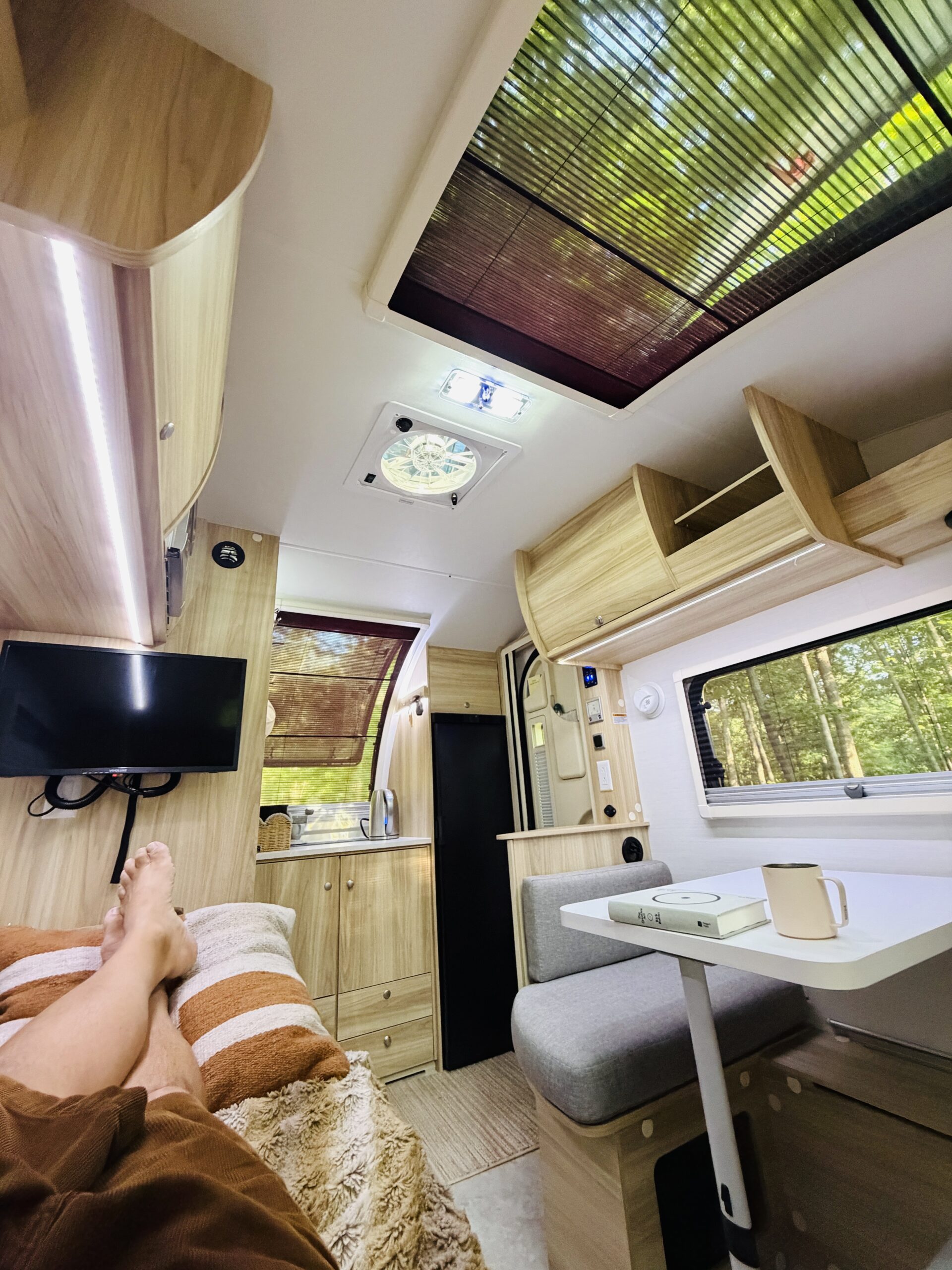
One of the themes that kept surfacing throughout our conversation was noise.
Most RV shoppers do not walk through a dealership thinking, “How loud will this furnace be at 2:00 a.m.?”
But they probably should.
We’ve owned RVs where the furnace kicking on in the middle of the night would wake us up every time.
We’ve used air conditioners so loud that once they were running, there was almost no point trying to watch television.
Once you experience a quieter system, you realize how much those sounds affect the camping experience.
Mark shared a great story from Truma’s early years in North America.
The company had installed a Combi in a North American travel trailer and brought the RV to an OEM during a cold February visit. The engineering team stepped inside and immediately noticed that the trailer was warm.
But they couldn’t hear the furnace.
They asked whether it was actually running.
Mark told them it was.
Then he pointed out that they were literally sitting on top of it.
The furnace was operating directly beneath them, and they still could barely hear it.
That story perfectly captures something we’ve noticed ourselves.
Sometimes you don’t realize how disruptive a traditional RV appliance is until you experience an alternative.
Truma AquaGo: Continuous Hot Water Perfect for Family RVers
The Truma AquaGo was our introduction to the brand, and it remains one of our favorite RV appliances.
Traditional RV water heaters commonly use a six- or ten-gallon tank.
That can work perfectly well—until several people need hot water in a row.
When our boys were young, Stephanie would sometimes bathe all three kids and discover there was very little hot water left afterward for her to take a shower.
The AquaGo completely changed that experience.
With an on-demand system, we no longer had to carefully schedule showers or wonder who was going to get stuck with cold water.
Everybody could get cleaned up, and Mom and Dad could still take a hot shower afterward.
For a family of five, that felt luxurious.
What Makes the AquaGo Different?
One interesting detail Mark explained is that the AquaGo is not simply a traditional tankless heater.
It includes a small temperature-stabilizing tank.
That tank helps smooth out the temperature fluctuations that can occur when water pressure changes.
Anyone who has camped at a busy campground has probably experienced that moment in the evening when everyone suddenly starts washing dishes and taking showers.
Water pressure drops.
With some on-demand heaters, the lower flow rate can make it difficult for the burner to operate consistently.
Truma designed the AquaGo to function at very low flow rates—Mark said the system has been tested down to approximately 0.25 gallons per minute. The small internal tank also buffers temperature changes so you don’t suddenly get blasted with extremely hot or cold water when pressure fluctuates.
AquaGo Maintenance
Like other on-demand water heaters, the AquaGo does require maintenance.
Hard water can create mineral buildup over time. Truma recommends annual decalcification as preventative maintenance and offers tablets designed for the cleaning process. Mark compared it to cleaning a coffee maker.
That might sound like one more thing to add to your RV maintenance list, but it also helps explain why some AquaGo units installed more than a decade ago are still operating today.
Can You Add a Truma AquaGo to an Existing RV?
Yes.
This is one of the most important distinctions in the Truma lineup.
The AquaGo was designed with replacement installations in mind.
It can generally replace common six- or ten-gallon RV water heaters, and Truma offers adapter solutions for larger existing openings.
Installation should be handled through Truma or one of its trained authorized dealers.
That approach is intentional. Truma wants the entire system—not just the appliance itself—to be installed correctly.
For RV owners who love their existing rig but want a significantly better hot-water experience, the AquaGo is one of the most realistic Truma upgrades to consider.
Truma Combi: Furnace and Water Heater in One Compact Package
If the AquaGo is about maximizing the hot-water experience, the Truma Combi is about making extremely efficient use of space.
The Combi combines:
- A furnace
- A water heater
- Variable-speed heating
- Multiple fuel options depending on the application
All in one compact appliance.
It can operate on propane, and depending on the model and vehicle, Truma also offers diesel and gasoline configurations.
Unlike the AquaGo, however, the Combi uses a tanked water-heating system.
That means owners should not assume that every appliance with the Truma name automatically provides endless hot water.
The Combi experience is closer to a traditional tanked water heater—but with the furnace and water heater packaged together in one highly engineered system.
Why Manufacturers Like the Combi
Space savings are only part of the appeal.
Truma works extensively with manufacturers to test how the heating system performs throughout an RV.
At its Elkhart facility, Truma uses a climate chamber to evaluate many RVs before they go into production.
Engineers can look at how warm air moves from front to back and side to side, then make recommendations about duct placement and overall system performance.
That matters because a furnace isn’t very useful if one end of the RV is roasting while the bedroom stays cold.
The goal is to create a more consistent interior temperature with less noise and fewer dramatic cycles.
Truma’s Strong Presence in Class B Vans
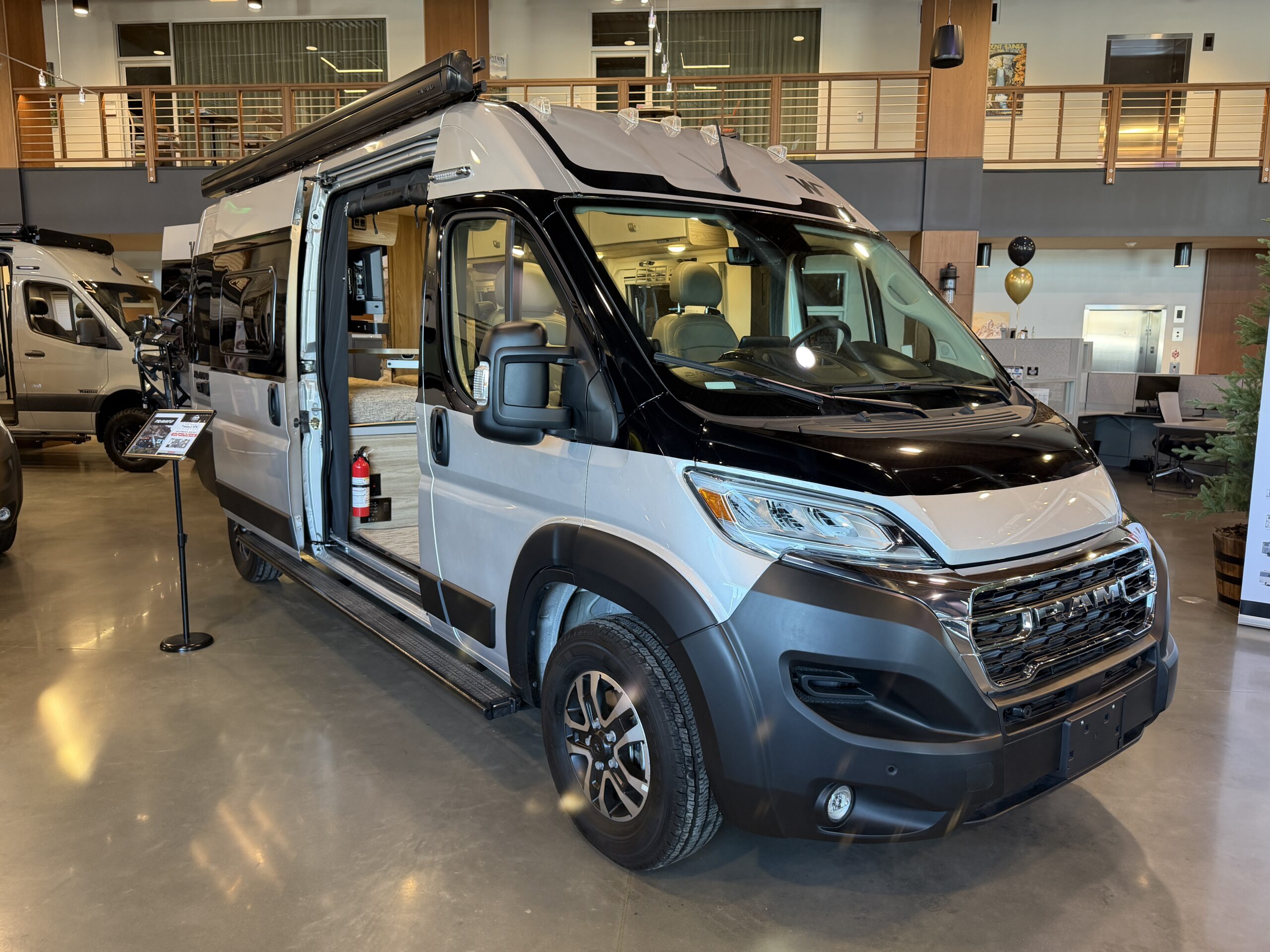
The Combi was an especially natural fit as Truma entered the North American market.
Class B vans have limited interior space, so combining two appliances into one compact unit makes tremendous sense.
One of Truma’s early North American partners was Winnebago, particularly with the Travato.
Mark estimates that more than half of the Class B vans built in North America now typically use a Truma Combi system.
That’s a remarkable shift for a company that officially established its North American operation only 13 years ago.
VarioHeat: A Small Furnace for Small RVs
Not every camper needs the combined furnace-and-water-heater setup of a Combi.
That is where Truma VarioHeat comes in.
The VarioHeat is a compact standalone furnace designed for small RV applications.
Mark offered perhaps the best size comparison possible: he wears a size 14 shoe, and the furnace is roughly comparable to the box those shoes come in.
That compact footprint gives manufacturers much more flexibility when designing truck campers, teardrops, small travel trailers, and overland rigs.
VarioHeat also offers the same emphasis on low noise and efficiency that characterizes the broader Truma lineup.
For certain direct-discharge furnace applications, Truma is also exploring VarioHeat as a retrofit option.
Alde Hydronic Heat: A Completely Different Heating Experience
Of all the systems we’ve used recently, Alde may provide the most distinctive experience.
Unlike a forced-air furnace, Alde uses hydronic heating.
A glycol solution circulates through the system and heats radiators located around the RV.
Instead of blasting hot air through ducts, the system creates convection currents that gradually and evenly warm the interior.
The result is an entirely different kind of heat.
It feels more even.
It feels less dry.
It is incredibly quiet.
And there is no traditional furnace blowing dust, pet hair, or other particles around the RV.
After using Alde in our nüCamp TAB campers, we understand why European RV owners have embraced this type of system for years.
Why We Love Having the Alde in Our TAB
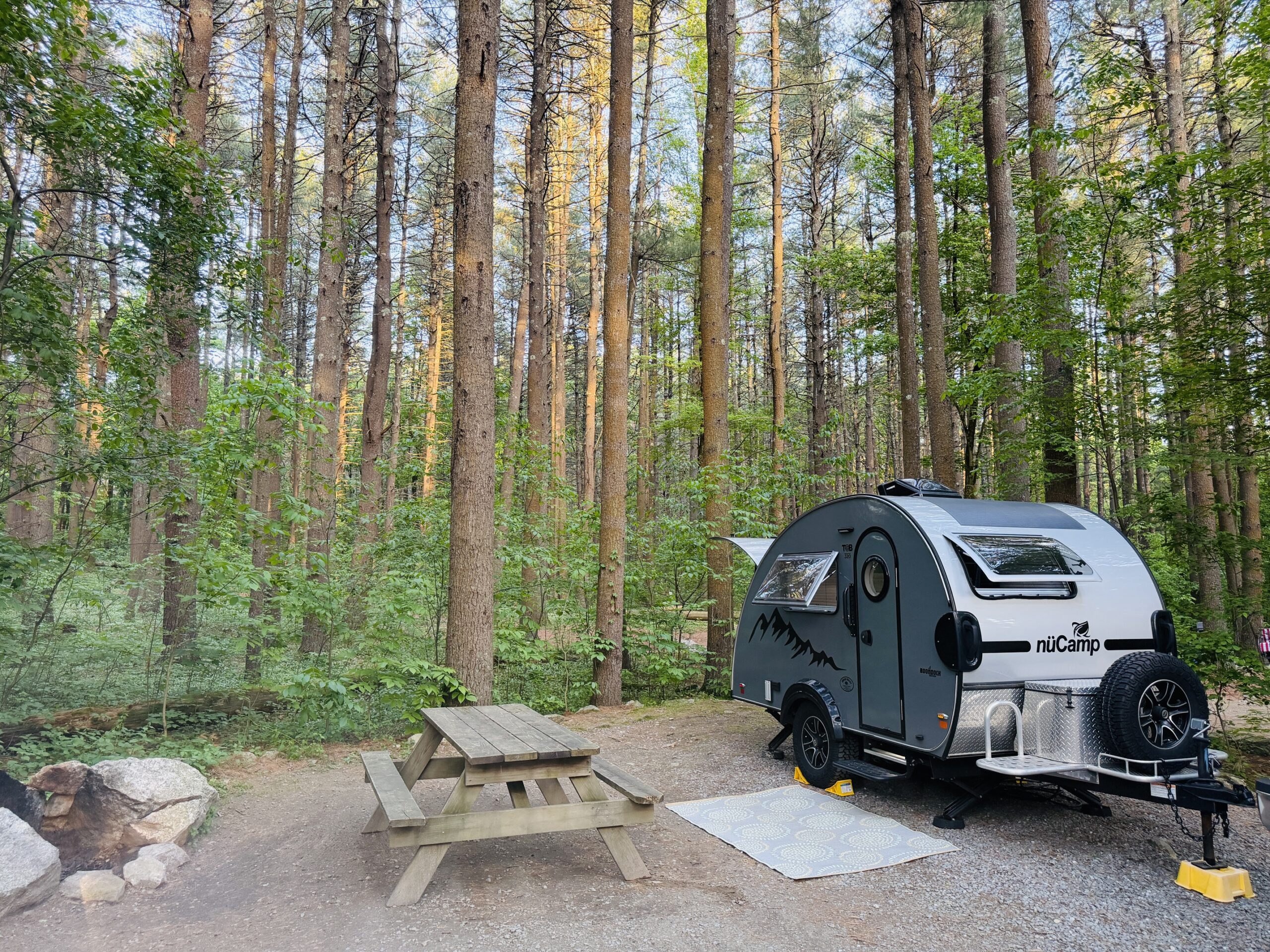
Jeremy describes the Alde almost like a little magic machine.
The first time you turn it on, you may find yourself wondering whether anything is happening.
There’s no loud furnace roar.
There’s no sudden rush of air.
Then several minutes later, you realize the entire interior is becoming warm.
Another benefit we appreciate is the ability to use electric heat at a campground with hookups.
That means we can maintain the interior temperature without burning through propane.
The latest Alde 3030 Plus can also incorporate a continuous hot-water feature through a plate heat exchanger.
For cold-weather campers, it is an exceptionally comfortable system.
Truma Aventa: Quiet Rooftop Air Conditioning

Heating isn’t the only place where Truma focuses on noise.
The company currently offers the Aventa rooftop air conditioner in North America.
It is available in both 13,500 BTU and 15,000 BTU versions, and newer models incorporate heat-pump functionality.
The Aventa is designed to be:
- Low profile
- Energy efficient
- Quiet inside the RV
- Remarkably quiet outside the RV
That last point is especially interesting.
European campsites tend to place RVs closer together, so engineers think not only about what an appliance sounds like inside your camper but also about what your neighbor hears outside.
That cultural difference influenced the product design.
And once you start noticing noisy campground air conditioners, it’s difficult to stop noticing them.
Truma Saphir: Moving the Air Conditioner Off the Roof
The Truma Saphir takes an entirely different approach to air conditioning.
Instead of mounting the AC on the roof, the Saphir is installed inside the RV, typically beneath a bed, dinette, bench, or floor area.
Ductwork then distributes the conditioned air throughout the camper.
That offers several advantages.
For a teardrop like a TAB, putting a bulky air conditioner on the curved roof can be awkward.
An interior-mounted system preserves the exterior profile.
It can also free up valuable roof space for solar panels.
And as more people begin towing with EVs or looking for better aerodynamics, keeping equipment off the roof may become even more valuable.
The Saphir also provides heat-pump functionality in addition to air conditioning.
Jeremy has been using the Saphir this summer in the TAB 360 CS and has been extremely impressed with its performance.
Which Truma Products Can Be Retrofitted?
This was one of the most practical parts of our conversation with Mark.
Not every Truma product can simply replace an appliance in your existing RV.
Here is the basic breakdown:
- AquaGo: Yes. Specifically designed to replace many standard RV water heaters.
- Aventa: Sometimes. Roof dimensions, vents, solar panels, and other equipment have to be evaluated first.
- VarioHeat: Possible in certain applications, particularly direct-discharge furnace installations.
- Combi: Generally OEM installation only.
- Alde: OEM installation only.
- Saphir: Generally not offered as a retrofit because of the extensive interior ducting required.
The Combi and Alde systems integrate multiple utilities and components throughout the RV, which makes retrofitting them far more complicated than replacing a single water heater.
Why Small RVs and Overlanding Are Such a Natural Fit
Truma’s European heritage increasingly looks like an advantage in the North American market.
Class B vans continue to be popular.
Truck campers are attracting new attention.
Overlanding companies continue to introduce smaller, more rugged campers.
Many of those customers want exactly what Truma has spent decades designing:
- Compact equipment
- Low fuel consumption
- Low electrical demand
- Quiet operation
- Strong reliability
- Equipment capable of handling extended time away from hookups
Mark said truck campers have become one of Truma’s growing segments.
Overland manufacturers are also increasingly incorporating Truma systems as they move from small garage operations into larger-scale production.
The “Truma On Board” Symbol Is Worth Noticing
We spend a lot of time telling RV shoppers not to judge a camper solely by what they can see during a 15-minute walkthrough.
The shiny countertops and big television are easy to notice.
The quality of the hidden systems is harder to evaluate.
That is why we think there is real value in looking at the brands a manufacturer chooses for those systems.
Mark mentioned the Truma On Board symbol, which indicates that a manufacturer is using Truma equipment.
For us, that badge is worth noticing.
When a manufacturer spends more money on a furnace, water heater, or air-conditioning system because it wants a quieter, more efficient, and more reliable experience, that tells us something about its priorities.
Reliability Matters Because Vacation Time Matters
One of Mark’s comments near the end of the conversation really stuck with us. Many North American RV owners have limited vacation time.Maybe you have one major two-week trip with your family every summer. The last thing you want during that trip is a furnace that won’t heat the RV or a water heater that stops working.
We sometimes talk about RV quality as though it’s purely a technical issue. But ultimately, quality is about protecting the experience. The hot water should work when you come back muddy from a hike. The furnace should work when the temperature drops. The air conditioner should cool the RV without making everyone miserable from the noise. When appliances quietly do their jobs, you almost forget they’re there.
And that might be the best compliment we can give them.
Final Thoughts
We have used Truma products long enough that our enthusiasm is based on far more than a showroom demonstration.
We’ve bathed three little kids with the AquaGo. We’ve slept through cold nights with a Combi that didn’t wake us up every time the furnace cycled. We’ve experienced the remarkably even hydronic heat of the Alde. And we’ve enjoyed how quiet and unobtrusive the Saphir air conditioning can be inside a small teardrop trailer.
Those experiences have changed what we notice when we walk through a new RV.
A premium RV isn’t just about beautiful cabinetry or attractive upholstery.
Sometimes the most important upgrades are the ones hidden underneath a bench, tucked behind a cabinet, or mounted where you barely notice them.
When they’re engineered well, they don’t demand your attention. They simply make camping more comfortable.
And that’s exactly what great RV equipment should do.
We’ll see you at the campground.
The post The Best Appliances for the Best RVs: An Interview with Mark Howlett from Truma appeared first on The RV Atlas.
30 August 2026, 2:02 pm - 1 hour 12 minutesAn Epic RV Trip to Western Canada and the Canadian Rockies PT. 1 (Calgary and Banff)
This is a guest post by Gretchen Holcombe from Boxy Colonial on the Road. It is part one of a three-part series of podcasts about her family’s epic RV trip to Western Canada and the Canadian Rockies. In this first entry Gretchen take a close look at Calgary and Banff.
Our family had been dreaming of a Canadian Rockies RV road trip for years. But we’d done several great trips to Rocky Mountain destinations in the US—Grand Teton, Glacier National Park, Rocky Mountain National Park—and we wondered if the Canadian side of things would just feel like more of the same. After spending a couple of weeks exploring the region over the summer, we can definitively say that the Canadian Rockies are at least as impressive as their counterparts to the south and that they show off in completely different ways and are well worth the trip no matter how many gorgeous mountains you’ve been lucky enough to visit in the past.
Our Canadian Rockies adventure took us to four different national parks and included stays in four different campgrounds. In this post I’m talking about our first two stops: at the Okotoks Lions Campground outside of Calgary and at Bow Valley Provincial Park in Canmore, a few minutes away from Banff National Park.
Calgary
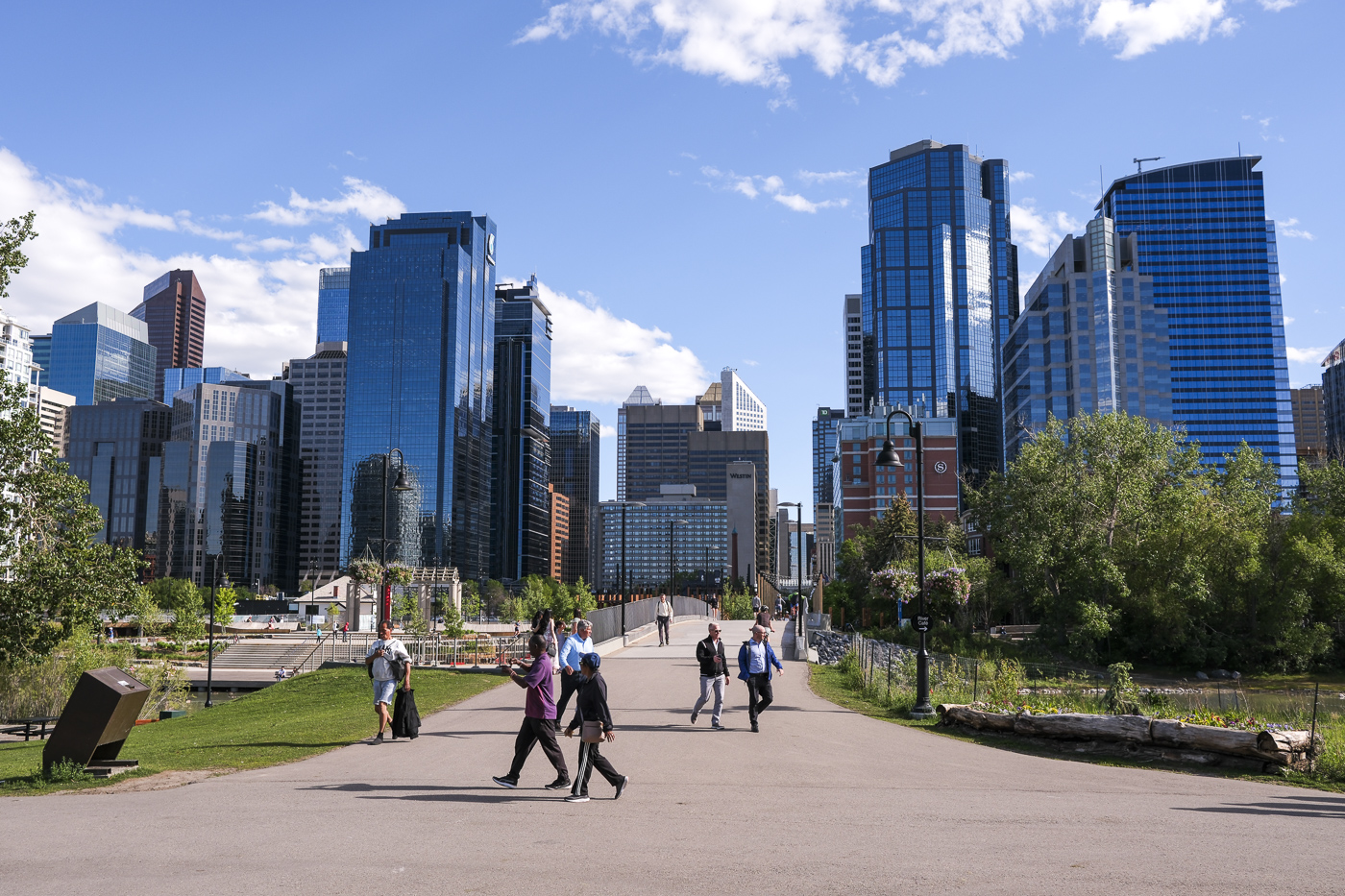
Calgary, Alberta is an easy 80 mile drive from Banff and home to the closest major airport, so it’s a very common first and last stop for people who fly in to visit the Rockies. But it’s also a vibrant city in its own right with a ton to offer, so I recommend spending some time exploring here before rushing off to the mountains if you can.
Okotoks Lions Campground
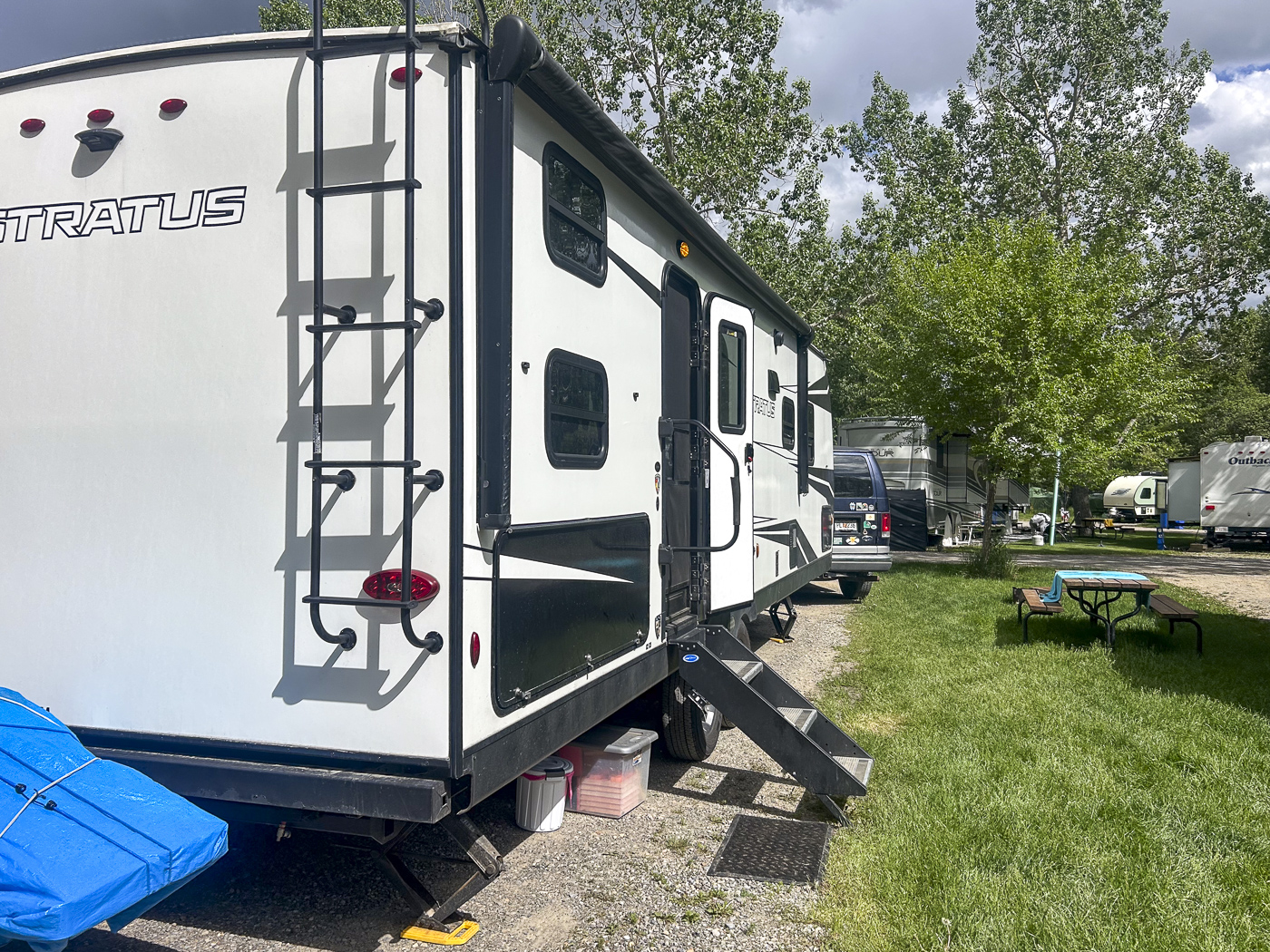
The Okotoks Lions Campground was our base camp for exploring the city. We were pleasantly surprised by how much we enjoyed spending time in the small suburban city of Okotoks as well; the campground is right on the Sheep River and is an easy pleasant walk along a paved path from the charming downtown area with shopping and restaurants. Everything else you might need as far as groceries and other services is a short drive away. The campground offers 55 spacious, well-maintained full hook-up sites for only $50 Canadian/night. There’s a small camp store, a clean and modern bathhouse (with pay showers), and a huge community playground right at the entrance to the campground. Wi-fi is available for a small daily fee, and we found it very speedy and reliable.
Downtown Okotoks is packed with adorable coffee shops, bakeries, breweries, and shops. A couple of our favorites were 94 Take the Cake, with its quirky black and white decor and beautifully decorated baked goods, and Brew and Scoop Co. ice cream and coffee shop, with a great outdoor seating area in the heart of town.
Things to do in Calgary
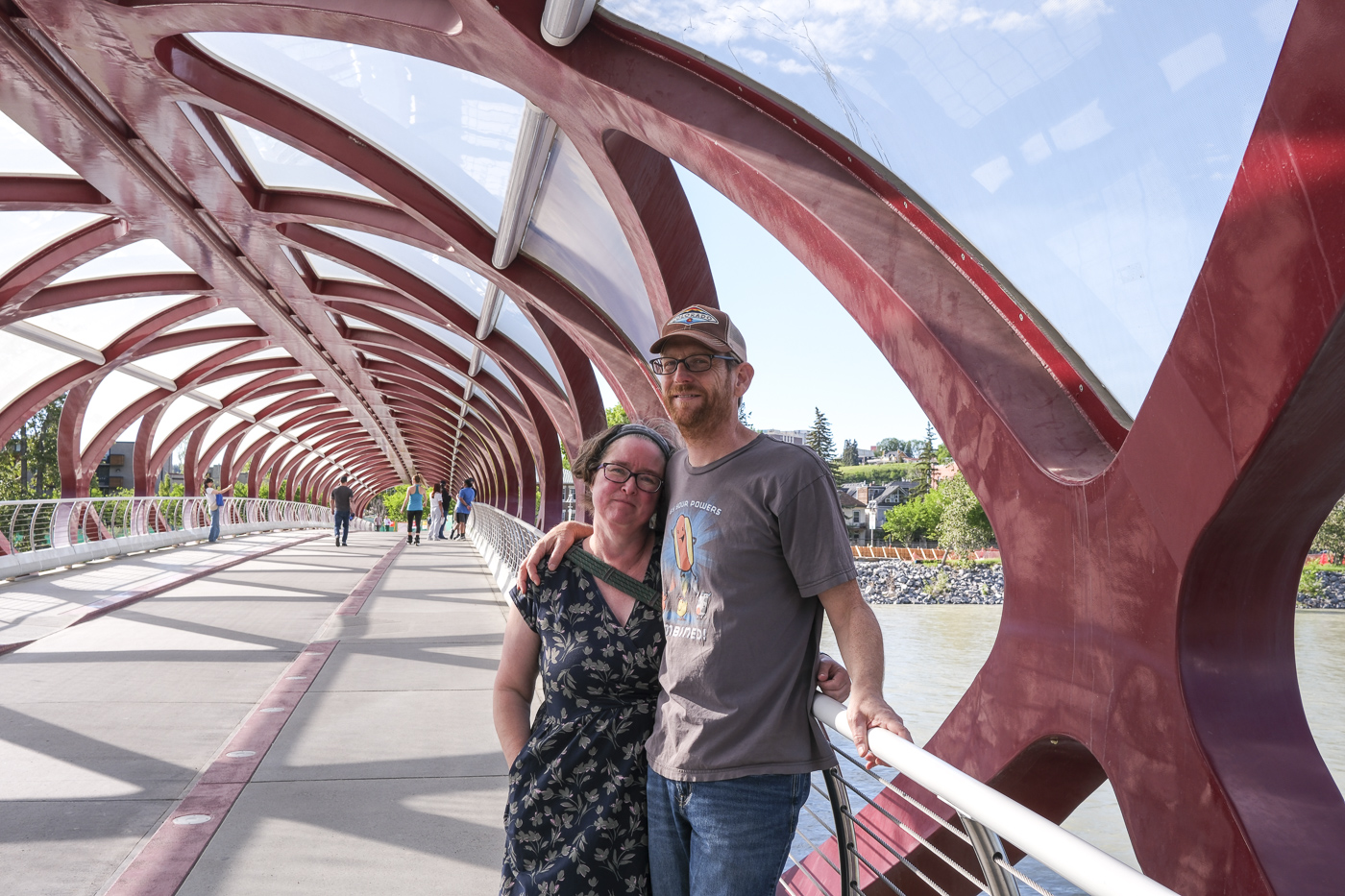
The Wilder Institute’s Calgary Zoo might be our favorite zoo we’ve ever visited, largely on the strength of its very playful polar bears. It’s Canada’s most visited zoo and has over 1000 animal residents; in addition to the polar bears, we were especially fond of the penguin and grizzly bear habitats. If you happen to be there on a Sunday, the Sunday Safari buffet brunch is an excellent value; my husband and son still reminisce fondly about the chocolate fountain.
I came across a self-guided walking tour on the Fearless Female Travel blog, and we used this as our guide to exploring some of Calgary on foot. The tour took us through the stunning public library, past some fun public art, and finally to the lovely urban oasis of Prince’s Island Park and the iconic Peace Bridge. From there we made our way to the hip neighborhood of Kensington and stopped in for snacks and games at the Hexagon Board Game Cafe.
Canmore and Banff National Park
Bow River Campground
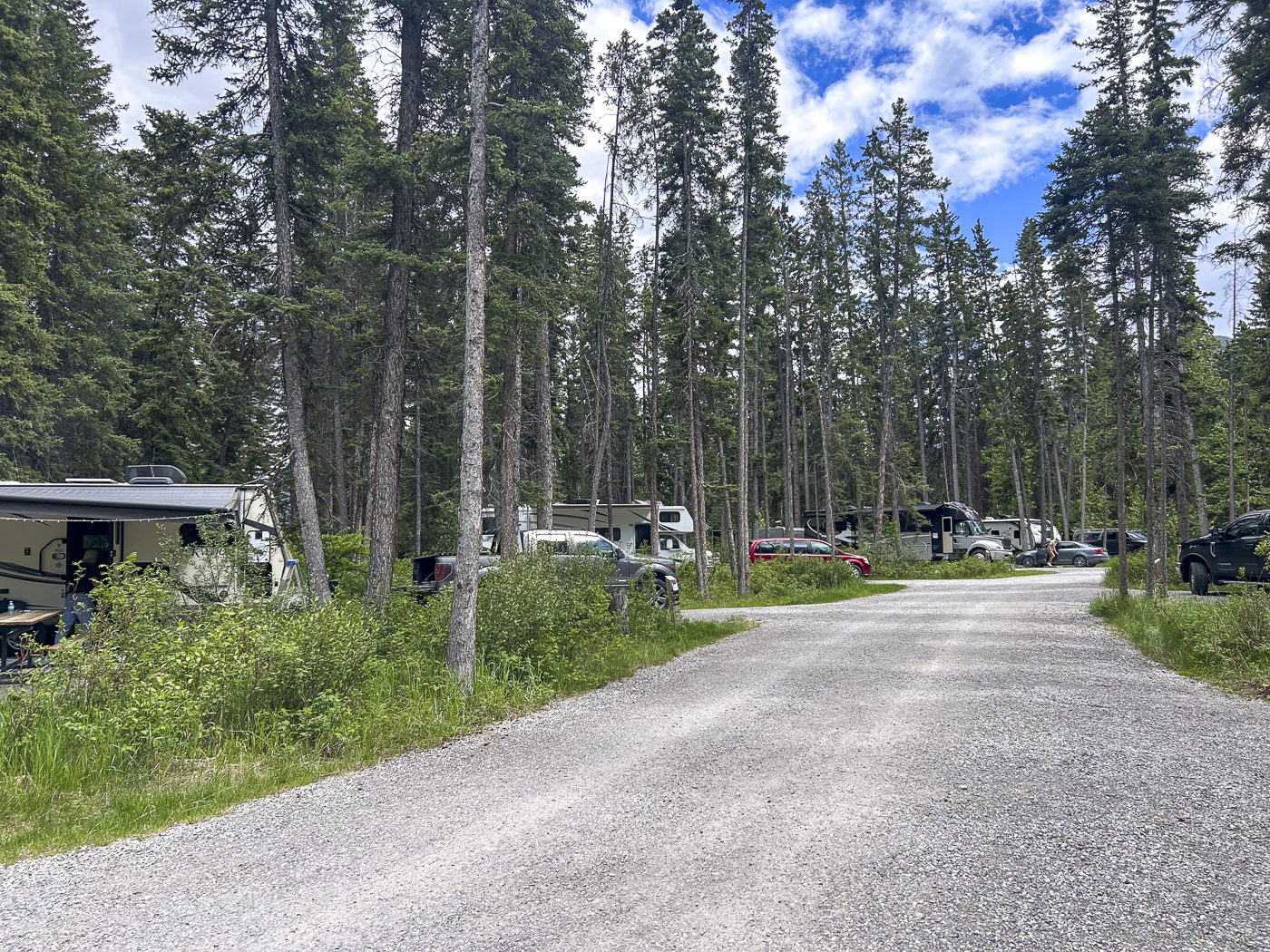
To be honest, Bow River Campground was not our first choice for this leg of our trip. We’d planned to stay at Tunnel Mountain Trailer Court right near the town of Banff. However, reservations proved even more competitive than I had anticipated, and we found ourselves shut out even though I was online the second reservations opened up. Luckily, Bow River is a terrific alternative just down the road in Canmore. A lot of people actually prefer staying in Canmore when visiting Banff National Park because it’s a little more laid back and less congested.
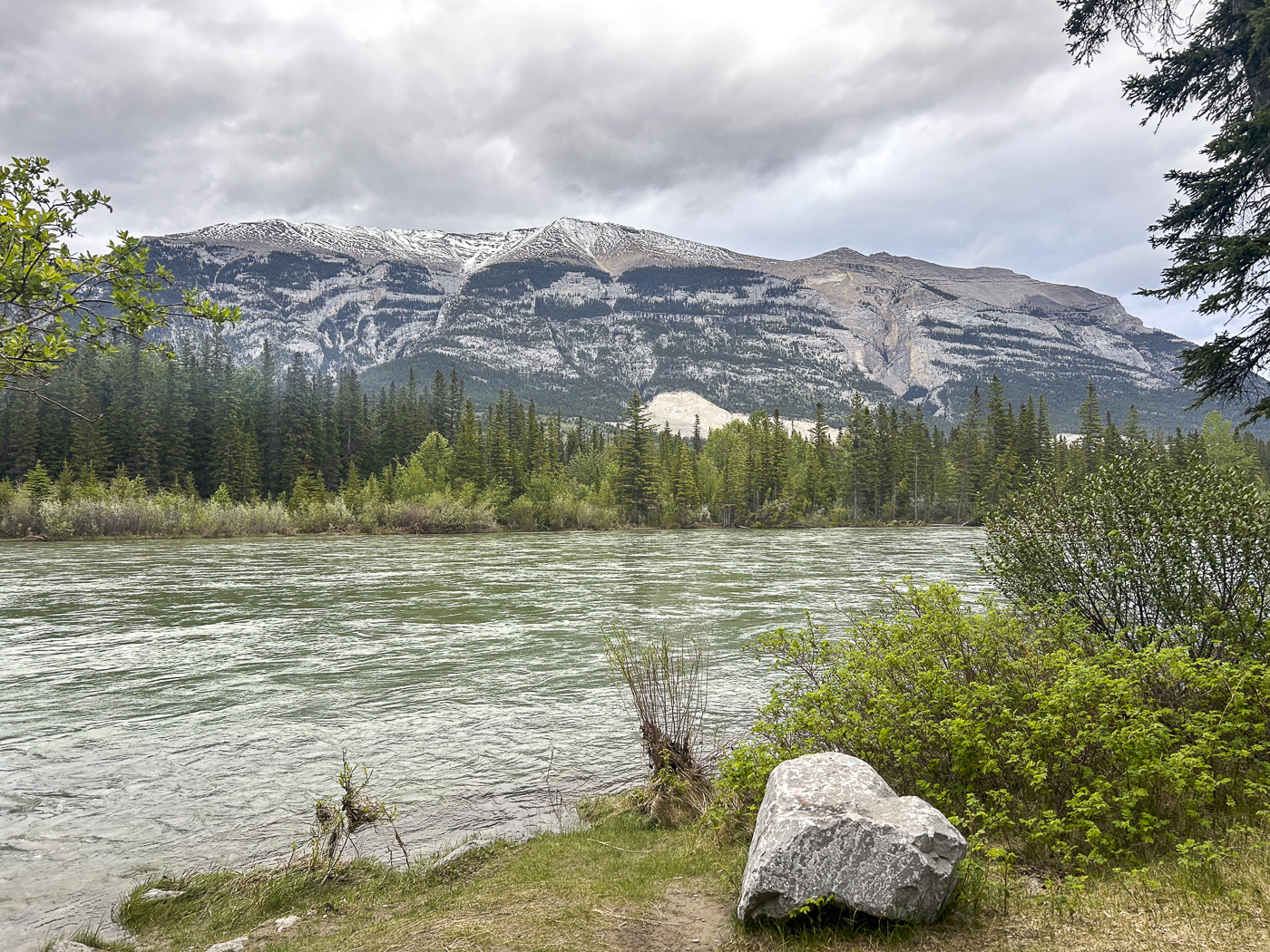
As the name suggests, Bow River Campground is right along the Bow River and about a 10 minute drive from Canmore or a 25 minute drive from Banff. There are 56 water/electric sites here for $47 CAD/night. The sites are wooded and private. A number of them back right up to the river. There’s one bathhouse at the entrance to the campground with pay showers, along with vault toilets inside the camping loops. Roads here are fairly narrow and might be tight for larger rigs, although we did see a number of larger motorhomes and fifth wheels that managed okay. Note that you’re very much in bear country here and need to maintain a clean campsite (no food left out; put all cooking equipment away in a vehicle when you’re not using it).
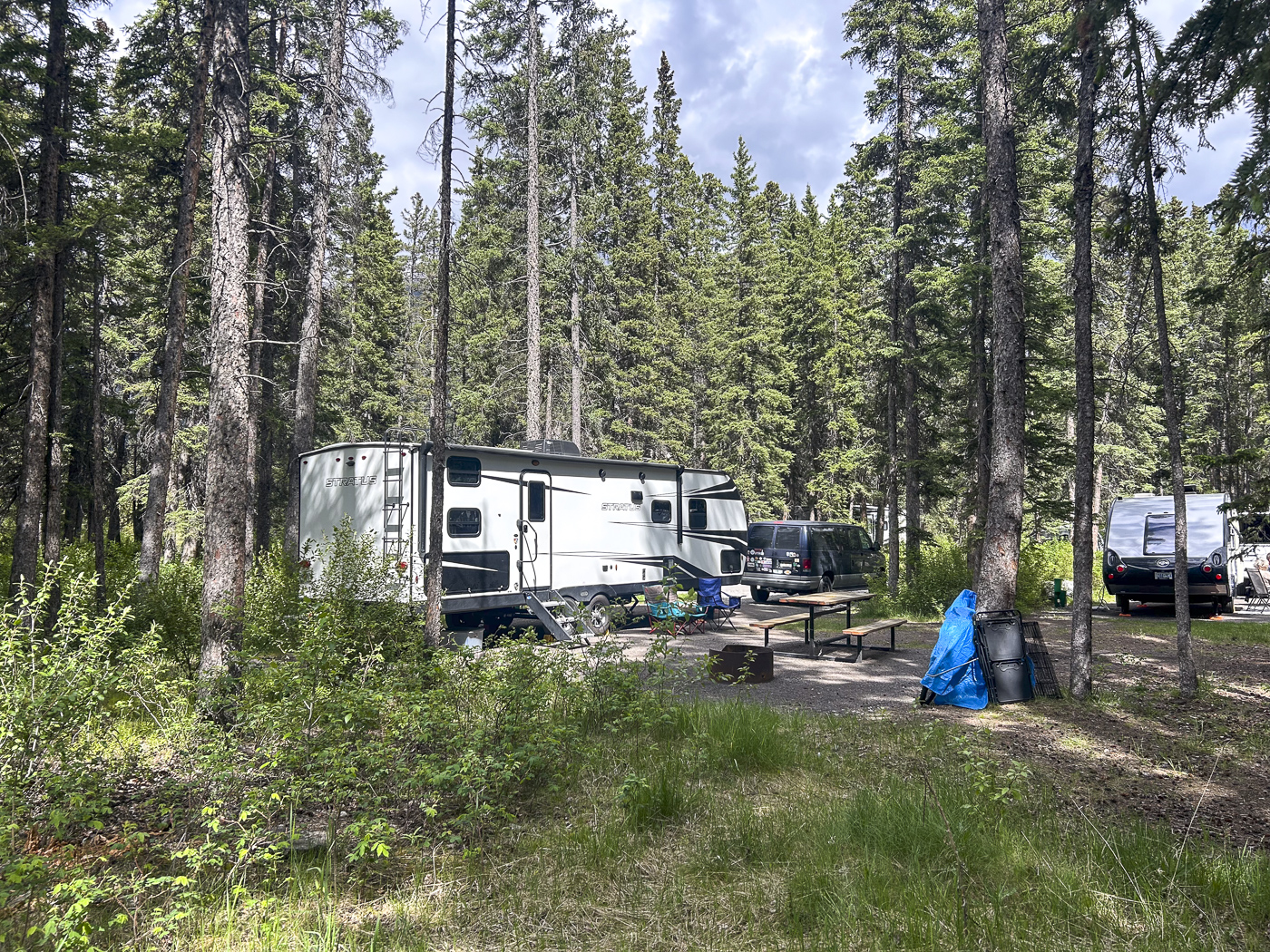
One inconvenient quirk here is that there’s no on-site dump station. There’s one in the provincial park’s other campground, Bow Valley, but that’s 20 minutes down the road to the east. We were heading west when we left, so we used the public dump station in the town of Banff instead. Also note that you’ll need to pay for a Kananaskis Conservation Pass in addition to (and separate from) the camping fees. It’s $15/day or $90/year, so do some math and figure out which makes sense based on how long you’re staying. You can buy the pass online, but cell service is spotty in the campground so it’s probably best to do it before you get there.
Canmore
Canmore is a great little mountain town with a downtown full of shopping and restaurants and amazing views in every direction. We enjoyed dinner and local beers at the Grizzly Paw Pub and then took an after dinner stroll along the Policeman’s Creek Boardwalk. This is an easy walk right in town and served as a great introduction to the kind of stunning mountain scenery we were going to be immersed in for the next couple of weeks.
Banff National Park
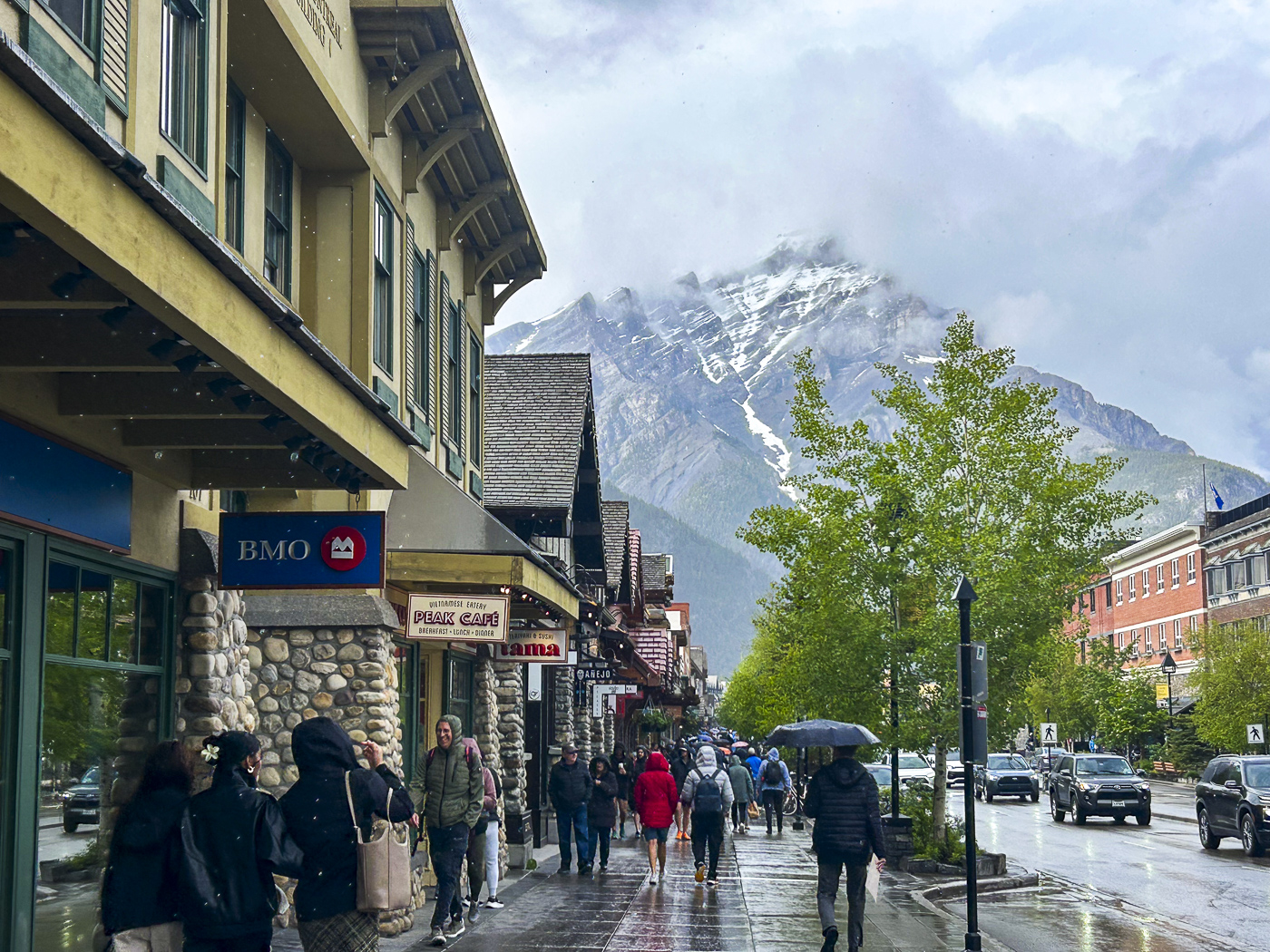
Town of Banff: This is where you go for all your souvenir shopping and for great restaurant options, but be prepared to fight the crowds! Parking can be tough and expensive, but if you’re able to walk a few blocks you can park for free in the large lot at the train station at the edge of town. We were very impressed with the pizza and beer as well as the atmosphere at Three Bears Brewery and Restaurant. The Cascade of Time Garden is a lovely little spot right at the end of the main strip. And just outside of town (a nice walk or a quick drive) you can visit the Bow Falls viewpoint for views of both the waterfall and the Fairmont Banff Springs hotel.
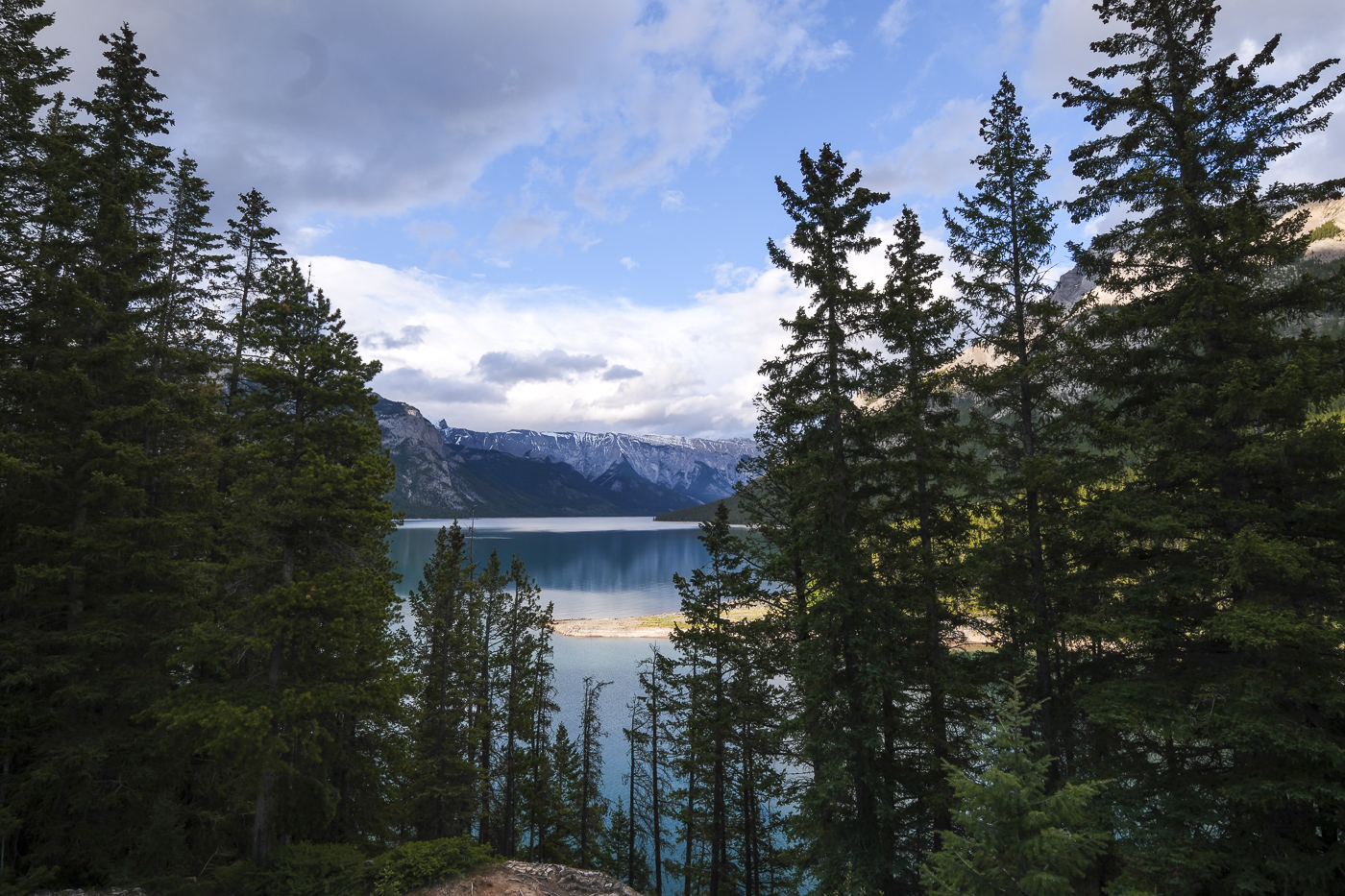
Lake Minnewanka Loop: definitely take some time to complete this scenic drive right near the townsite. It’s just 24 km and offers tons of great stops at beautiful mountain lakes, hikes, and opportunities for wildlife spotting. We stopped to hike the 3 km Johnson Lake Trail and then checked out Two Jack Lake and Lake Minnewanka itself.
Banff Gondola: the Banff Gondola ride up to the top of Sulphur Mountain is one of those super expensive, super touristy things where you wonder if it can possibly worth what you have to spend to do it. We reluctantly shelled out the money (they use dynamic pricing, but expect to pay around $90-100 CAD/adult) and…we loved it! We spent a lot of time looking at mountains from below during our time in the Rockies, so this was a great chance to get up high for some different perspectives.
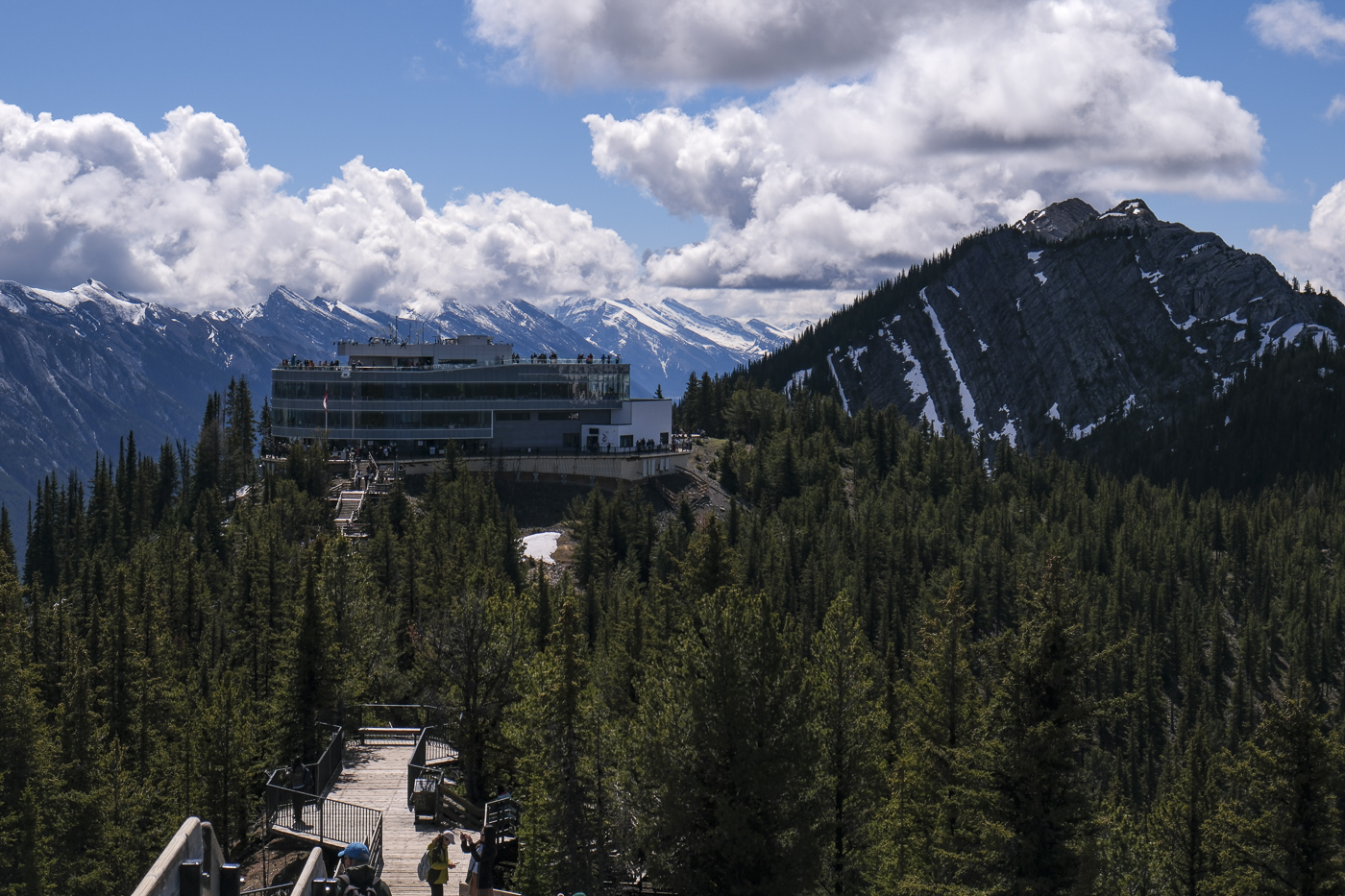
We saved a bit of money by doing the “Family Experience” which allows kids to go up for free during the first two hours that they’re open. You have to reserve both the time to go up and to come back down when you buy your tickets; I’d recommend leaving yourself plenty of time up at the top to feel like you’re getting the full experience. There’s an interpretive center with restaurants, a gift shop, a movie, and exhibit areas to check out. And you want to make sure you have time to take the boardwalk trail from the visitor center to the old weather station at Sanson’s Peak. And, of course, you’ll want plenty of time to take too many pictures of the mountain and town site views.
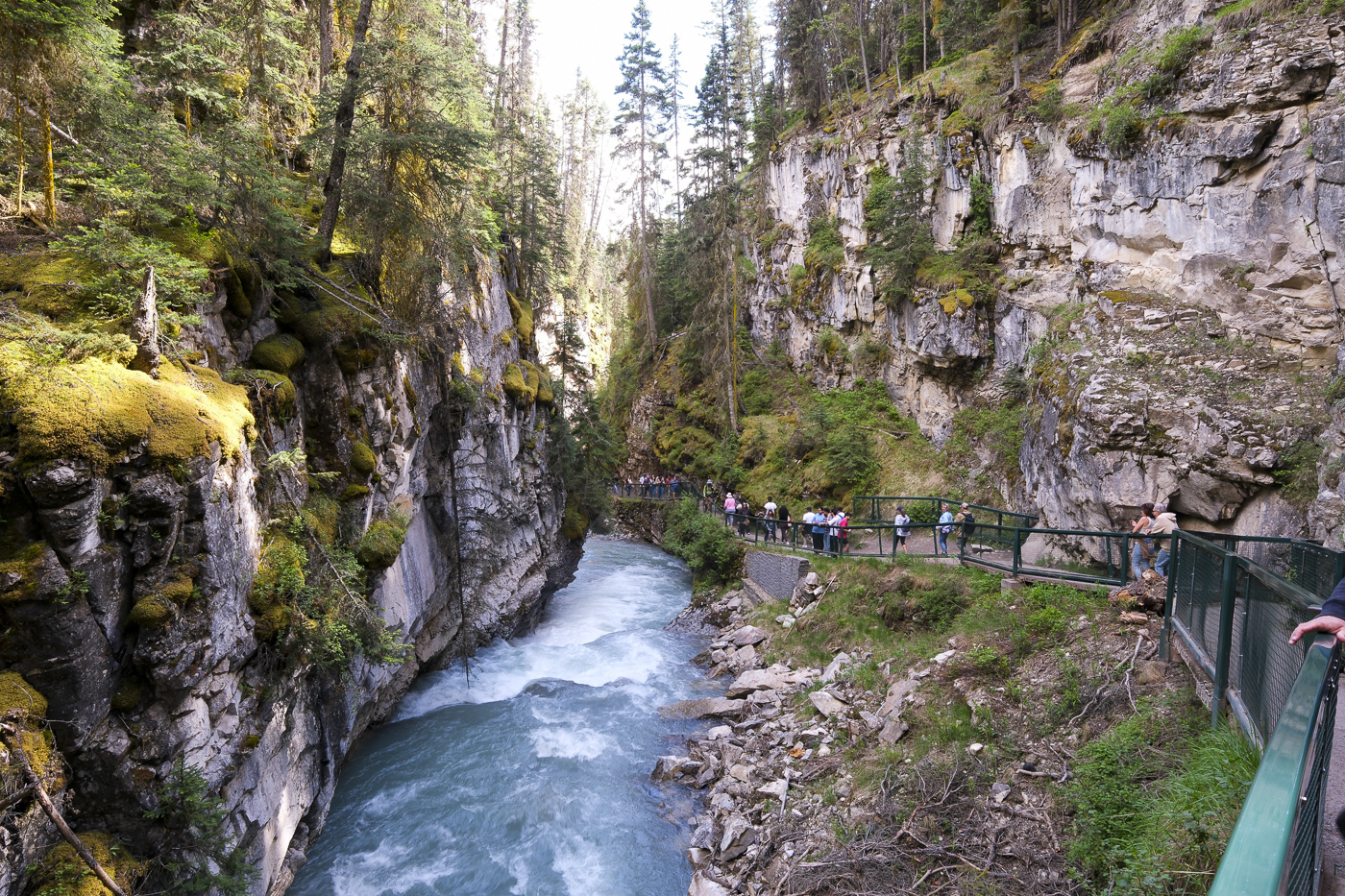
Johnston Canyon: A system of suspended pathways and trails takes you through this rocky canyon over stunning blue water and past several waterfalls. We decided to hit Johnston Canyon later in the afternoon (around 3 or 4), in hopes of missing the midday crowds. This strategy worked for finding parking easily, but the trails themselves were still packed with people. For the best experience, try to get here very early in the morning or later on in the evening.
Kootenay National Park
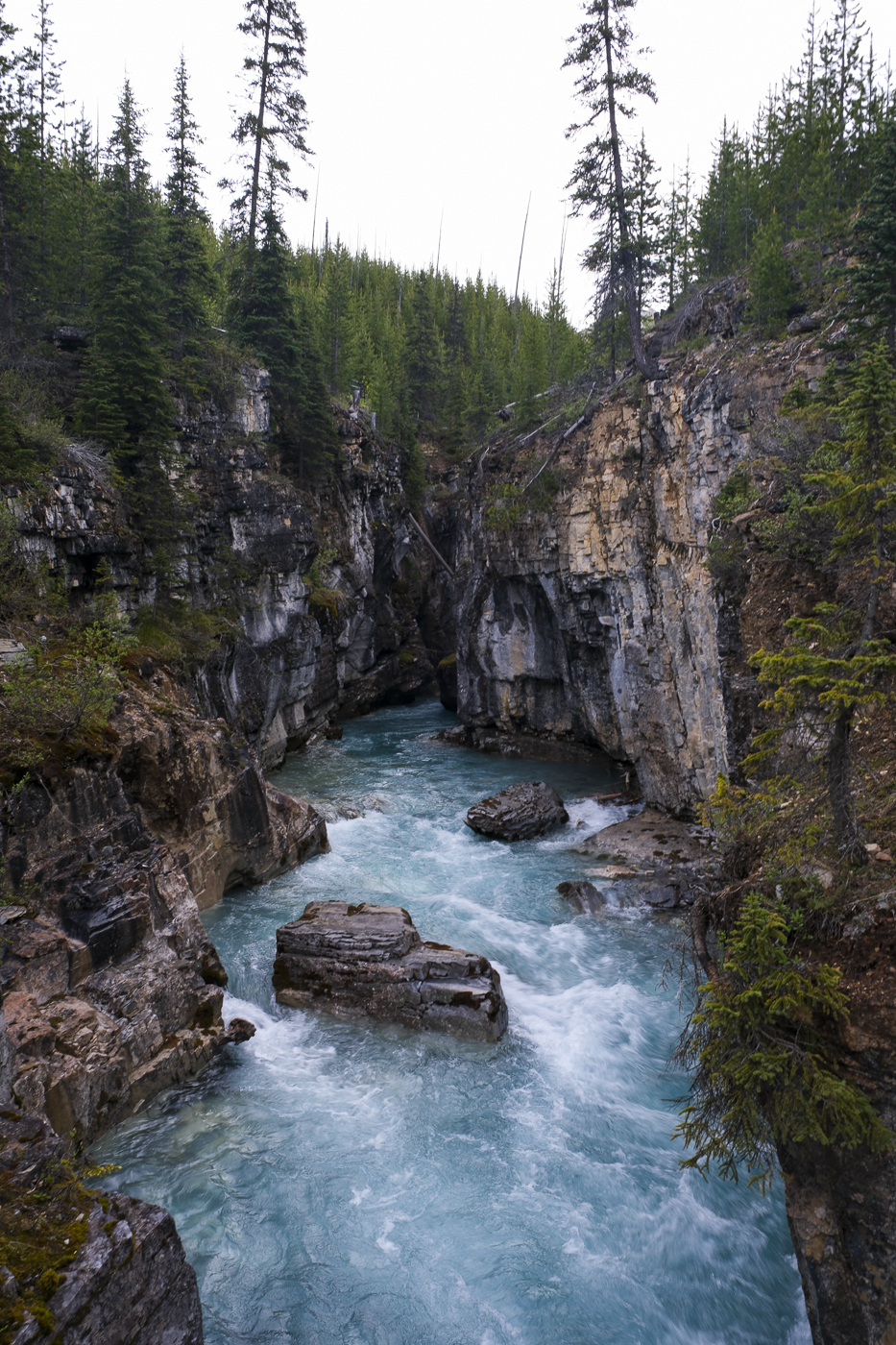
When we were planning our trip, I was surprised to learn just how many national parks there are in the Canadian Rockies and that often where one ends another one begins. Banff, Jasper, Kootenay, and Yoho are all clustered together, with Glacier (the Canadian one), Mount Revelstoke, and Waterton Lakes not far away. Banff and Jasper tend to steal the spotlight, but the smaller parks have tons worth seeing, too, and very often can offer lower crowds just a short drive from the big name sites. We made the short and scenic drive to Kootenay one day to see Marble Canyon and the Paint Pots. Marble Canyon is just half an hour from the town of Banff, and it’s often billed as a less congested alternative to Johnston Canyon. It features the same deep rocky canyon and impossibly blue water, but the trail takes you uphill to take it in from several viewpoints instead of letting you walk in the canyon itself.
A bit farther down the road is the Paint Pots trail. To be honest, while the trail itself is lovely, the paint pots were a little lackluster and resembled mud puddles more than an artist’s palette. Still, it’s a short, easy trail and worth a stop if you’re in the area for Marble Canyon. We didn’t make it any further into the park, but if you keep driving another hour you’ll hit the Radium Hot Springs, Kootenay’s big claim to fame.
Planning a Trip to the Canadian Rockies
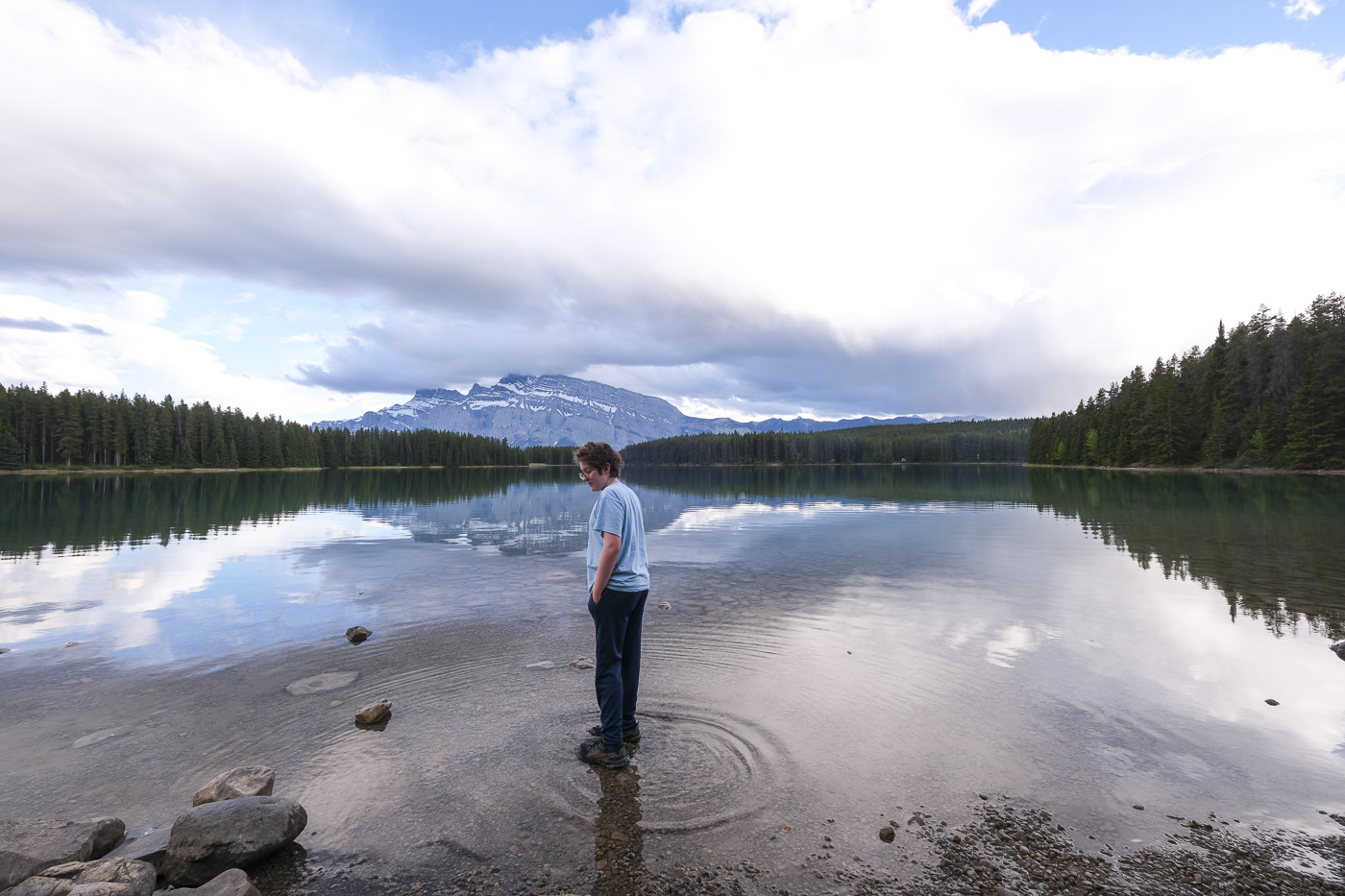
If you’ve made it this far you’ve probably already picked up on the idea that the Canadian Rockies are busy. We were there in early-mid June, so not even the height of the season, and we already needed to plan carefully to avoid the worst of the crowds. This isn’t the kind of trip that invites spontaneity; you’ll need to book accommodations well in advance and be ready to arrive at major trails and attractions early in the morning or later in the evening before parking lots fill up and crowds build. At the national park campgrounds, reservations for the entire season open up on the same morning, and Parks Canada uses a queuing system for booking. There are lots of good blog posts and YouTube videos out there explaining the system; make sure you learn about it ahead of time and are ready to go as soon as reservations open up in late winter.
After reading a lot of rave reviews online, we bought the Guide Along audio guide for the Canadian Rockies, and it was an awesome addition to our trip. You install the app on your phone, and it uses a GPS signal to trigger audio commentary as you drive. The narrator is wonderful and shares all kinds of information about the history, science, and culture of different sites. He also tells you which places are must stops and which are okay to skip if you don’t have time. We ended up buying more tours for every destination where one was available on our summer trip and we’ll be looking for more for future trips.
The post An Epic RV Trip to Western Canada and the Canadian Rockies PT. 1 (Calgary and Banff) appeared first on The RV Atlas.
20 August 2026, 7:12 pm - 57 minutes 4 secondsHow We Use Solar in the Northeast + Go Power! Celebrates 30 Years of Off-Grid Adventures
For a long time, RV solar felt like something designed primarily for hardcore boondockers heading deep into the desert or spending weeks on public land out West. That has never really described the way we camp. We live in the Northeast. We still love campgrounds with full hookups. We stay at KOAs and Jellystone Parks. We don’t regularly disappear onto BLM land for two weeks at a time. And yet, after roughly a decade of camping with solar, we now consider having a solar system an absolute necessity. Using Solar in the Northeast used to be rare–but everything is changing and changing fast.
Solar hasn’t fundamentally changed why we camp. Instead, it has given us more choices about where we can stay, how comfortably we can travel, and how dependent we need to be on hookups. It has opened up a world of options for us–even though we lack BLM land in our part of the country.
On this week’s episode of The RV Atlas Podcast, we look back at the many ways solar has changed our own camping life. Then Jeremy talks with Jake Erwin from Go Power!, which is celebrating its 30th anniversary, about where RV solar technology is heading next—including smarter integrated systems, new Shade Tech panels, common solar misconceptions, and what RVers should know before building their first system.
To listen to our interview with Jake please click on the media player above or subscribe to the RV Atlas wherever you get your favorite shows!
Why We Got Serious About RV Solar
When we first started RVing with our boys, we were not trying to rough it.
We had twins who started camping before they were a year old, and Wes began camping when he was only about six weeks old. For several years, we had three very young boys along for every camping trip. Creature comforts were part of what made RV travel work for our family.
We liked having electricity. We liked using the appliances. We liked staying at places where we could plug in, turn everything on, and concentrate on enjoying the trip instead of rationing every bit of power.
But as the boys got older, we started noticing something.
Many of the places where we really wanted to camp didn’t necessarily have hookups.
Assateague State Park was a perfect example. Electric campsites were limited and incredibly competitive, while many more beautiful campsites were available if we were willing to dry camp.
We weren’t looking to give up our comfortable style of RVing. We wanted to expand our options without sacrificing the things we enjoyed about having an RV. That was where solar entered the picture.
Our first major system with Go Power! was installed on our toy hauler about a decade ago. At the time, it was a substantial setup with six AGM batteries, and installations like that were far less common than they are today. Even our RV dealer was learning through the process because it was their first installation of that scale.
Stephanie even had one particularly ambitious request: she wanted to be able to run the convection oven without plugging into shore power.
Did we absolutely need a convection oven while dry camping?
Probably not.
But that was our use case at the time, and it illustrates one of the most important lessons we’ve learned about solar:
Build the system around the way you actually camp.
Here are six ways that we use solar in the Northeast — and why we can’t live without it!
1. Having Power in the RV at Home
One of the first benefits of solar surprised us because it had nothing to do with camping.
Our RV was always powered in the driveway.
At that time, we didn’t have a dedicated 30- or 50-amp RV connection at home. But with the solar panels continually maintaining the batteries, we could walk into the RV and use it.
Over the years, our RV has served as:
- An office
- A filming space
- Extra space when friends visited
- A place to wrap Christmas presents
- An extension of our house when we simply needed another room
It sounds small, but having an RV that is always functional rather than essentially dormant between camping trips makes the investment feel more useful.
Today we have 50-amp service at home, but that wasn’t always the case—and solar filled that gap beautifully.
2. Making Overnight Stops Much More Comfortable
Another revelation came during long travel days.
Before solar, we’d occasionally attempted overnight stops in parking lots and found the experience uncomfortable enough that we’d rather pay for a campground along the highway.
That changed dramatically once we had dependable battery power and inverted outlets.
On a trip to Nova Scotia, we spent the night at a Cabela’s.
The refrigerator stayed cold. The lights worked. The outlets worked.
And the next morning, we made coffee right there in the parking lot.
That cup of coffee was a surprisingly important moment.
Jeremy remembers thinking that from that point forward, he always wanted solar and inverted outlets on the RV. Being able to wake up during a travel overnight and use the RV normally made stopping at places like Cabela’s, Walmart, or Cracker Barrel feel entirely different.
Solar didn’t turn a parking lot into a campground.
It simply made an overnight stop comfortable enough that it became a practical option.
3. Moochdocking at Friends’ and Family Members’ Homes
Solar also made visiting people much easier.
Over the years, friends would often tell us:
“You’re driving right past our house. Why don’t you stop?”
The problem was that most people don’t have a 30- or 50-amp RV hookup sitting next to their driveway.
With a capable solar and battery system, that no longer mattered nearly as much.
We could pull into someone’s driveway, spend the night in our own RV, make coffee in the morning, keep the refrigerator operating, and enjoy our own space without asking our hosts to somehow provide campground-level electrical service.
Especially in the Northeast, where friends may live in smaller towns with limited campground options nearby, this can open up some fantastic weekend possibilities.
4. Making Harvest Hosts Even Better
Our Harvest Hosts membership has become another major reason we value RV solar.
Most Harvest Hosts locations are dry camping experiences. Some hosts are beginning to offer hookups, but we have generally approached Harvest Hosts stays assuming we’re going to be self-contained.
Solar makes that easy.
We can spend the night at wineries, farms, breweries, and other unique destinations without worrying much about where the electricity is coming from.
One of our earliest memories of seeing this lifestyle in action actually happened before we were regularly using Harvest Hosts ourselves.
While driving toward South Dakota, we stopped at an outdoor sculpture installation and saw a massive fifth wheel parked nearby. The owners explained that they had spent the night there through Harvest Hosts.
Their RV was fully operational, and seeing what they were able to do without hookups planted a seed.
This was an entirely different way of traveling.
Today, Harvest Hosts and solar feel like a natural pairing.
You don’t necessarily need an enormous solar system for a single overnight stay. But having enough battery capacity and solar charging to comfortably operate the basics makes those experiences far easier.
5. Opening Up More State Park Campsites
For us, this is probably the biggest benefit. Solar changed where we could camp.
Once we installed our first major system, one of our first trips was to Assateague State Park.
We spent several days without hookups and still had the electricity we needed for lights, refrigeration, outlets, and normal daily life inside the RV. We weren’t running air conditioning, and the weather was cool enough that we didn’t need it. The experience felt incredibly comfortable.
That trip changed our direction as RV travelers.
We never stopped staying at private campgrounds. We still love KOAs, Jellystone Parks, and full-hookup sites. But we began adding far more state park camping because electricity no longer determined which campsites we could book.That’s an especially important advantage in regions where only a handful of campsites offer electric hookups.
Sometimes the best campsite in the campground has no hookups at all.
Sometimes the only campsite you can actually reserve has no hookups.
Solar gives you more freedom to say yes to both.
6. Using the RV During Power Outages
There’s one final benefit we don’t hear discussed nearly enough.
Your RV can become a backup resource during a power outage.
We live in a coastal area where storms and outages happen. A whole-house generator can be a significant investment, and not every family needs or wants one.
But as campers, we already own a mobile living space.
If our house loses power, we know we can go outside to the RV, charge devices, use electricity, access stored food, and have another functional space available.
Solar doesn’t replace every emergency preparedness solution.
But it adds another layer of resilience to equipment RV owners already have sitting in their driveway.
The Biggest Solar Lesson: Know What You Want to Power
One reason solar can feel intimidating is that there is no single correct system.
One camper may want enough power to keep a refrigerator cold and charge phones during a Harvest Hosts overnight.
Another may want to dry camp at state parks for four or five days.
Another may want to run an air conditioner in the desert.
Those are completely different power requirements.
The best place to start is not by asking:
How much solar should I buy?
Instead ask:
What do I want my RV to be able to do when I’m not plugged in?
That one question should drive everything that comes afterward.
Go Power! Celebrates 30 Years of Off-Grid Adventures
default
Go Power! traces its history back to 1996, when the business began as Soltek Power and worked in a much smaller mobile-power market.
Back then, many systems were primarily intended to maintain batteries and support relatively modest electrical loads.
Thirty years later, customer expectations are dramatically different.
RVers increasingly want enough power to operate refrigerators, microwaves, sophisticated electronics, and—in some situations—even air conditioning while remaining off-grid.
Jake explained that the industry has also moved toward fully integrated power systems. Batteries, inverter chargers, solar controllers, and other RV systems increasingly communicate with one another rather than functioning as separate islands of technology.
Go Power!’s 30,000-Tree Anniversary Initiative
Go Power! is marking its 30th anniversary with something more meaningful than a simple celebration.
The company is partnering with Veritree to plant 30,000 trees.
Jake explained that environmental restoration felt like a natural way to celebrate because Go Power!’s products are designed to help people spend more time outdoors while using renewable energy.
The program also allows the company to recognize partners by planting trees on their behalf and providing visibility into where those trees are being planted.
ShadeTech Solar Panels Solve a Very Real Camping Problem
One of the most interesting new products Jake discussed is Go Power!’s ShadeTech solar panel.
This development caught our attention immediately because shade is a huge issue for campers in the Northeast.
Out West, it’s relatively common to see RVs sitting beneath completely open skies.
In eastern state parks, you’re often tucked underneath a beautiful canopy of trees.
That’s wonderful for camping.
It’s not always wonderful for solar production.
ShadeTech panels use bypass diodes designed to reduce the dramatic efficiency loss that can occur when one portion of a traditional panel becomes shaded.
They’re also smaller and lighter than their predecessors.
The new 200-watt panels are approximately six inches shorter while maintaining the same width, making them interchangeable with previous models. They’re also about four pounds lighter per panel. That may not sound significant until you multiply it across an entire roof.
On a 1,200-watt system using six panels, that’s roughly 24 pounds of weight savings.
For RV owners carefully managing cargo carrying capacity, those incremental savings matter.
PowerTrak Makes RV Solar Easier to Understand
The other major trend Jake emphasized is simplification.
Years ago, advanced RV solar could feel like a foreign language.
You might have separate displays and controls for batteries, solar controllers, inverters, and other components.
Go Power!’s PowerTrak ecosystem is designed to bring compatible components together.
MPPT solar controllers, lithium batteries, inverter chargers, standard inverters, and other connected products communicate through a single system and can be monitored from one touchscreen interface.
PowerTrak can also help with error reporting, giving the RV owner a clearer indication of where a problem is occurring.
The technology underneath these systems is becoming more sophisticated.
The goal, however, is for the actual camping experience to become simpler.
Solar Myth: “I Want to Run My Air Conditioner”
If Jake could choose one expectation that RVers most need to understand, air conditioning would probably be near the top of the list.
Can solar help run an RV air conditioner?
Yes.
But that’s very different from asking whether a modest solar installation can operate your air conditioner indefinitely.
Air conditioning requires enormous amounts of power.
Once AC enters the equation, you’re generally talking about substantial lithium battery capacity, a large solar array, significant roof space, and enough cargo carrying capacity to support all that equipment.
The industry is moving quickly.
Solar panels are becoming more efficient.
Air conditioners are becoming more efficient.
Battery technology continues to improve.
Jake believes that over the next several years, running RV air conditioning from solar will become increasingly feasible.
The important question is shifting from:
Can we run the AC?
to:
How long can we run the AC?
Don’t Forget About the 12-Volt Refrigerator
Air conditioners aren’t the only significant electrical load.
The widespread move toward 12-volt refrigerators has changed RV power planning as well.
These refrigerators rely entirely on electricity instead of switching to propane the way many older absorption refrigerators could.
Jake offered a helpful general rule of thumb: around 400 watts of solar can often offset the needs of a single 12-volt refrigerator under typical circumstances.
That’s roughly two 200-watt panels.
Add another panel, and you begin creating more capacity for lights and other everyday electrical demands.
It’s a great example of why understanding individual loads is more useful than simply asking how many solar panels an RV “needs.”
Build Your First Solar System With Expansion in Mind
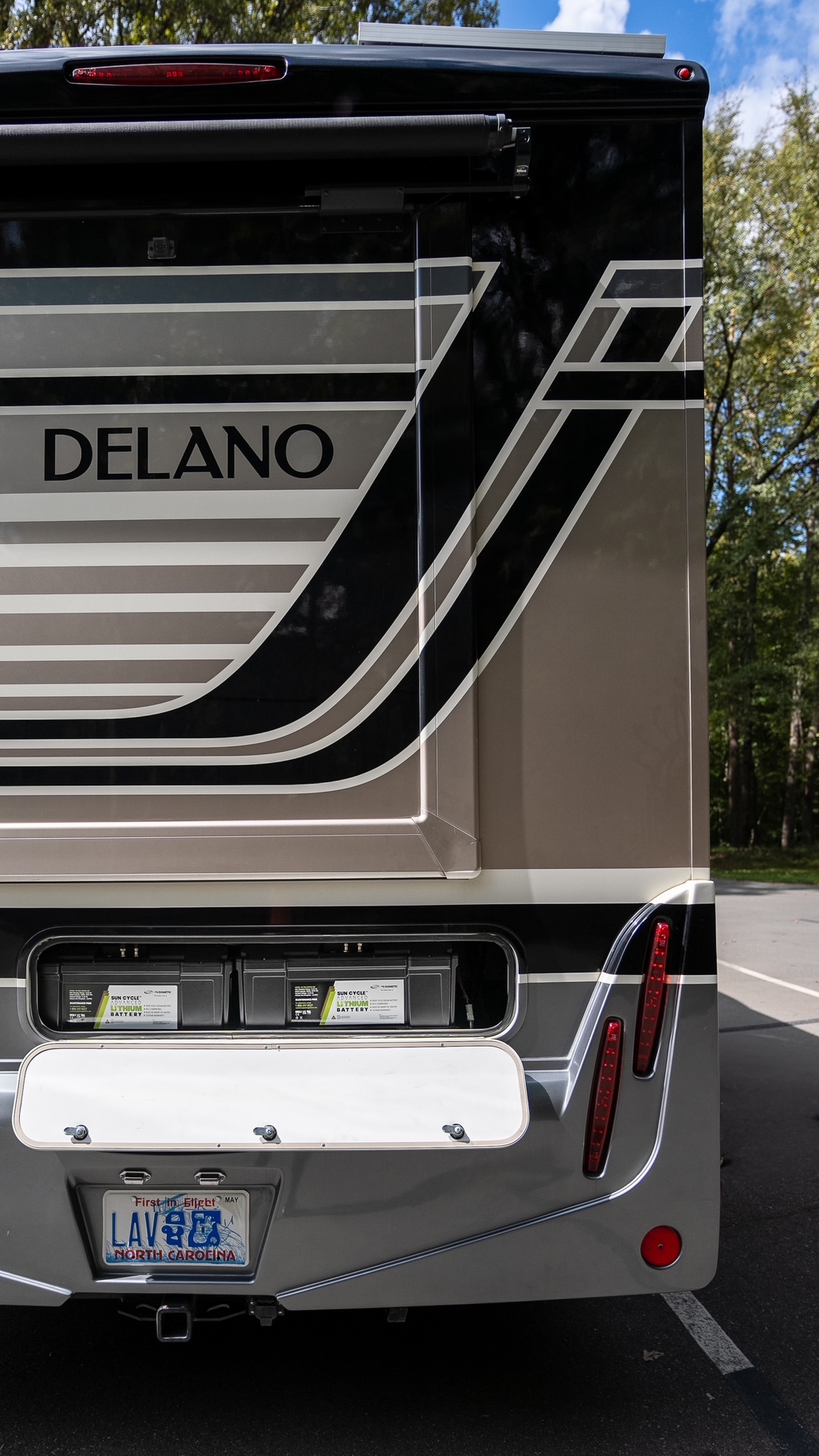
Jake’s best advice for new RV owners is refreshingly simple:
Plan to expand.
You may begin by wanting enough solar for a two-night state park trip.
Then you discover Harvest Hosts.
Then you want to stay at Assateague for a week.
Then you want more battery capacity.
If you’re starting from scratch, size the wiring and underlying infrastructure so the system can grow later.
You don’t necessarily need to buy everything on day one.
But making smart decisions during the initial installation can prevent you from having to replace major components when your camping style evolves.
How Big Can RV Solar Get?
If you want to see what’s possible at the extreme end, Jake shared one memorable project built with Drive the Globe.
The massive Unimog overland vehicle used approximately:
- 2,000 watts of rooftop solar
- Five solar controllers
- A huge lithium battery bank
- A large inverter charger
- Starlink
- Refrigeration
- Electric coolers
- 12-volt air conditioning
The system was designed to support essentially the entire rig electrically while traveling and camping in remote environments.
Most RVers don’t need anything remotely that large.
But projects like this demonstrate what’s becoming possible as mobile-power technology improves.
Where RV Solar Goes Next
Jake believes the RV industry is moving steadily toward greater electrification.
We’re already seeing more all-electric RVs, larger lithium battery systems, smarter energy management, more efficient appliances, and solar becoming standard equipment rather than a niche aftermarket upgrade.
For Go Power!, that’s an exciting place to be.
For RV owners, it means systems that were complicated and unusual ten years ago are increasingly becoming approachable and mainstream.
And that may ultimately be the biggest change we’ve witnessed ourselves.
A decade ago, installing a large solar system on our toy hauler felt experimental.
Today, we don’t really want an RV without one.
Not because we’re hardcore boondockers.
Not because we’ve given up campgrounds with hookups.
And definitely not because we’re ready to abandon creature comforts.
It’s exactly the opposite.
Solar has allowed us to keep the parts of RVing we love while removing one more limitation from where we can camp.
For us, that’s the real promise of RV solar.
More choices. More flexibility. And more places to camp.
We’ll see you at the campground.
The post How We Use Solar in the Northeast + Go Power! Celebrates 30 Years of Off-Grid Adventures appeared first on The RV Atlas.
15 August 2026, 5:41 pm - 14 minutes 11 seconds5 Quick Tips for Towing Safely: A Mini Podcast for RV NewbiesTowing your first RV to the campground does not have to be a stressful experience. Most RV newbies worry too much about towing–and some folks that are “RV curious” even let those worries get the best of them and decide to stay on the sidelines and not buy an RV at all.
This is not to say that towing an RV should be taken lightly. You need to be prepared and you need to know your equipment (and have the right equipment!) and have a strategy for getting from point A to point B. But once you are prepared and have developed a checklist and a strategy for towing–the experience can become part of the fun. Seriously.
I enjoy towing my RV now and feel relaxed the second I pull out of the driveway.
This mini RV Atlas podcast episode goes over 5 quick tips for towing safely that are perfect for RV newbies to implement. The episode is brought to you exclusively by our friends at the Original Equal-i-zer Sway Control Hitch. We have used the Equal-i-zer system on four of our RV’s over the course of the last 15 years and we have NEVER had a sway event happen to us while towing–and we have towed from Nova Scotia to Florida and as far west as South Dakota.
We trust the Equal-i-zer Sway Control Hitch to keep our family safe wherever we may tow!
We hope you check out this podcast for our quick tips and we hope to see all of you at the campground!
The post 5 Quick Tips for Towing Safely: A Mini Podcast for RV Newbies appeared first on The RV Atlas.
9 August 2026, 2:13 pm - More Episodes? Get the App