- 31 minutes 2 secondsGA 649 | Accountability Starts in the Mirror with Michael Caito
Most organizations have a strategy. Far fewer can actually execute one. Michael Caito built and sold a food delivery business decades before DoorDash existed, then spent years helping other companies close the gap between where leaders want to go and where they actually end up. His diagnosis is consistent: the gap is almost always an accountability problem, and accountability is almost always the leader’s problem first. The conversation with Ron covers what CEOs truly own, how to know whether you have a strategy issue or an execution issue, and why the cadence of your team meetings matters more than most leaders want to admit.
In this episode you’ll learn:
- How focusing on what is vital applies the Pareto principle to business (2:24)
- Why the strategy-execution gap exists in most organizations (9:29)
- What five things a CEO truly owns in any business (10:55)
- When to make a people change and how to know you have waited too long (13:34)
- How an operating rhythm makes performance visible across the organization (15:34)
- Why monthly goal reviews beat quarterly check-ins for compounding results (17:28)
- The difference between leading indicators and result-based measurements (20:00)
- How to tell whether you have a strategy problem or an execution problem (22:44)
- What a struggling leader should do first before choosing a system or hiring a coach (26:39)
“Performance is visible and the person that’s not performing or hitting their goals, they’re not gonna be comfortable working there.” – Michael Caito
Keep Learning
If Michael’s point about building a real management cadence around goal-setting and performance visibility resonated, the School of Leadership offers structured ways to develop exactly those skills across your organization.
Learn More About School of Leadership at gembaacademy.com/leadershipPodcast Resources
Get All the Latest News from Gemba Academy
Stay current on new courses, podcast episodes, and continuous improvement resources. Sign up for the Gemba Academy newsletter at gembaacademy.com/news
What Do You Think?
When was the last time your team reviewed goals together in a structured monthly meeting, and what got in the way of making that a non-negotiable rhythm?
10 September 2026, 10:00 am - 37 minutes 11 secondsGA 648 | Discovering Lean in High School with Ted Pendergrass
Most lean practitioners spend their careers trying to change the minds of adults who have been doing things the same way for decades. Ted Pendergrass decided to start earlier. Over 20 years coordinating a career technical education program at a California high school, he brought 5S, practical problem-solving, and Yellow Belt certification to students who had never heard of lean. The conversation covers what actually stuck, what surprised him, and what the rest of the lean community could do to help.
In this episode you’ll learn:
- How a cabinet maker’s instinct for efficiency led to lean teaching (4:57)
- What happens when high schoolers 5S their Google Drives (6:57)
- Why practical problem solving opens students’ eyes more than any other unit (9:06)
- How student tours reveal whether lean is actually taking root (12:22)
- Why education is not the most lean process and what chunking has to do with it (13:34)
- How to teach students to use AI as a tool rather than a crutch (15:53)
- Why CTE programs are the right entry point for spreading lean (19:46)
- What a Yellow Belt certification does for a student in a job interview (21:51)
- How the California Partnership Academy model keeps students engaged and career-ready (24:18)
- Why getting companies inside schools changes what students believe is possible (29:00)
- What practitioners outside education can do to plant lean seeds in their communities (30:49)
“If you have to ask if it’s good enough, it probably isn’t.” – Ted Pendergrass
Keep Learning
Ted’s seniors earned Yellow Belt certification as a capstone to a three-year lean program. If that kind of structured progression interests you for your own team or organization, the certification path is worth a close look.
Learn More About Certifications at https://www.gembaacademy.com/solutions/certificationsGet All the Latest News from Gemba Academy
Stay current on new courses, podcast episodes, and continuous improvement resources. Sign up for the Gemba Academy newsletter at gembaacademy.com/news
What Do You Think?
If you had two hours with a classroom of high school students, which lean concept would you start with and why?
3 September 2026, 10:00 am - 39 minutes 20 secondsGA 647 | Making Sleep a Priority with Tim Thomas
Most organizations measure productivity, absenteeism, and safety incidents without ever asking what all three have in common. Tim Thomas, a former Australian Special Forces soldier turned sleep specialist, argues the answer is sitting in plain sight at the bottom of every performance pyramid. The conversation moves from combat deployments in Afghanistan to corporate boardrooms, and the through line is the same: fatigue is an enemy that most leaders never name.
In this episode you’ll learn:
- How the opposite of fear works and what that means for taking action (3:22)
- What Special Forces, veteran recovery, and corporate leadership have in common under pressure (9:36)
- Why leaders in a state of fatigue lose the bandwidth to lead well (10:29)
- How to build practical sleep habits that improve everything else (13:59)
- Why breathwork is not meditation and why that distinction matters (16:29)
- How the first five minutes of your morning shape the rest of your day (21:42)
- Why resilience lives in recovery rather than in relentless output (22:45)
- How measuring sleep quality could change the way companies define success (28:14)
- What a near-fatal ambush revealed about connection, intelligence, and not dying with a full magazine (31:23)
“If you want to cut the amount of sick days you have in half, improve the quality sleep of the people that work there.” – Tim Thomas
Keep Learning
Tim’s performance pyramid puts rest and recovery at the foundation of everything else, and that same principle applies to the people leading improvement work on your floor or in your office.
Learn More About School of Leadership at https://www.gembaacademy.com/leadershipPodcast Resources
Get All the Latest News from Gemba Academy
Stay current on new courses, podcast episodes, and continuous improvement resources. Sign up for the Gemba Academy newsletter at gembaacademy.com/news
What Do You Think?
If sleep quality were a visible metric in your organization, what would it reveal about how your team is actually performing?
27 August 2026, 10:00 am - 35 minutes 25 secondsGA 646 | Connect Before You Correct with Royden Johnson and Luc van Merrienboer
 Culture shapes how people receive change, and nowhere is that clearer than on a shop floor where history, language, and moral authority all sit alongside the 5S board. Royden Johnson and Luc van Merrienboer bring two distinct lenses to that tension: Royden from years of leading continuous improvement in South Africa, and Luc from rolling out digital transformation across Asia and now the African continent. Their conversation with Ron covers resistance, influence, and what it actually takes to bring people along rather than drag them forward.
In this episode you’ll learn:
- The cultural context of 5S in Asia and Africa (5:01)
- How 5S connects to every performance pillar in a manufacturing operation (9:43)
- What digital transformation actually looks like on a shop floor (13:04)
- Where their passion for continuous improvement comes from (15:42)
- How to use personal, social, and structural influencing strategies together (17:18)
- How to handle CAVE people without losing the rest of the team (19:29)
- Why unemployment history in South Africa shaped resistance to continuous improvement (25:32)
- What happened when a leader stopped pushing and started listening (27:28)
- How to speak, listen, and lead while keeping everyone’s dignity intact (31:50)
Keep Learning
If the discussion about moral authority, influencing strategies, and leading change on a diverse shop floor resonated with you, the School of Leadership offers structured ways to develop those same skills in your own context.
Learn More About School of Leadership at gembaacademy.com/leadershipPodcast Resources
Get All the Latest News from Gemba Academy
Stay current on new courses, podcast episodes, and continuous improvement resources. Sign up for the Gemba Academy newsletter at gembaacademy.com/news
What Do You Think?
When you have encountered a CAVE person in your organization, what shifted the dynamic?
20 August 2026, 10:00 am - 24 minutes 18 secondsGA 645 | Why Leadership Is Failing with Keith Wyche
Trust in leadership has been declining for decades, and Keith Wyche has the research to prove it. A 40-year veteran of AT&T, IBM, and Walmart, Keith opened up to us about a few mistakes he’s made in his career. The real conversation here is what changed him, and what he thinks it will take to reverse the broader collapse.
In this episode you’ll learn:
- How a career spanning AT&T, IBM, and Walmart shapes a leadership philosophy (2:26)
- Why a 15-year-old’s question became the catalyst for serious research (4:05)
- How the thirst for power quietly replaced the calling to serve (6:08)
- What happens when results become the only measure that matters (7:27)
- Why vulnerability is harder for leaders than it looks (10:42)
- How admitting a mistake in front of 30,000 employees built more trust than any win (11:08)
- How to rebuild trust one promise at a time (16:48)
- The difference between listening to defend and listening to understand (18:53)
- Why people never forget how a leader made them feel (20:42)
“My successes may have inspired me, but my failures taught me.” – Keith Wyche
Keep Learning
If Keith’s point about creating followership through trust, listening, and character resonated with you, the School of Leadership is a practical place to build those same skills in yourself and your team.
Learn More About School of Leadership at https://www.gembaacademy.com/leadershipPodcast Resources
Get All the Latest News from Gemba Academy
Stay current on new courses, podcast episodes, and continuous improvement resources. Sign up for the Gemba Academy newsletter at gembaacademy.com/news
What Do You Think?
When you listen in a conversation, are you listening to understand the other person, or are you already forming your response?
13 August 2026, 10:00 am - 44 minutes 1 secondGA 644 | Defining Propaganda with Owen Fitzpatrick
Most leaders assume that the right argument, delivered clearly, will change minds. Owen Fitzpatrick has spent 30 years studying why that assumption is wrong. A psychologist who has worked inside some of the world’s most extreme propaganda environments, from North Korea to Rwanda to his own teenage years, Owen brings a framework to this conversation that reframes how belief actually changes. The implications for anyone trying to lead a continuous improvement effort are hard to ignore.
In this episode you’ll learn:
- What the purpose of life being “defeated by greater things” reveals about continuous improvement (3:37)
- How a single question changed the trajectory of Owen’s life and work (5:00)
- Why the inner critic is the wrong label for what actually holds people back (9:18)
- How propaganda works in three parts and why it mirrors what happens inside our own minds (14:35)
- Why naive realism is the single biggest obstacle to influencing anyone (22:43)
- How recognizing inner propaganda as propaganda changes the way your brain processes it (28:55)
- Why logic comes last when beliefs actually change (33:40)
- How the three conditions of belief change explain why great arguments still fail (35:12)
“Being right is not enough. Having the facts, having the data, having the information, table stakes, you need to have that. But it’s not enough to be persuasive.” – Owen Fitzpatrick
Keep Learning
If Owen’s point that buy-in requires more than logic resonates with how you lead change, the School of Leadership builds the skills that close that gap.
Learn More About School of Leadership at https://www.gembaacademy.com/leadershipPodcast Resources
Get All the Latest News from Gemba Academy
Stay current on new courses, podcast episodes, and continuous improvement resources. Sign up for the Gemba Academy newsletter at gembaacademy.com/news
What Do You Think?
How do you define propaganda?
6 August 2026, 10:00 am - 36 minutes 53 secondsGA 643 | Asking Better Questions with Kabrina Ashley
Most organizations say they want high performers, yet quietly punish them for being too valuable to lose. Kabrina Ashley, a coach and behavioral science practitioner based in Nashville, makes the case that the real barriers to change, growth, and improvement are not strategic, they’re neurological. The conversation covers why good intentions still produce bad outcomes, and what leaders can do differently once they understand what is actually happening inside their employees’ heads.
In this episode you’ll learn:
- How inertia shapes the way people respond to change (8:57)
- What the high performers paradox costs organizations over time (10:57)
- Why personality frameworks can mislead leaders who rely on them too heavily (14:51)
- How asking better questions changes what people believe is possible (18:47)
- Why most corporate training fails to produce lasting retention (22:57)
- What running old code means and where it comes from (26:49)
- How the habit loop connects to the rewards we give ourselves at work (30:56)
- Why the quality of your questions determines the quality of your results (35:10)
“The quality of your life is determined by the quality of questions that you ask.” – Kabrina Ashley
Keep Learning
If the conversation about habit change, running old code, and why training rarely sticks resonated with you, the School of Leadership covers the human side of building organizations that actually improve.
Learn More About School of Leadership at https://www.gembaacademy.com/leadershipPodcast Resources
Get All the Latest News from Gemba Academy
Stay current on new courses, podcast episodes, and continuous improvement resources. Sign up for the Gemba Academy newsletter at gembaacademy.com/news
What Do You Think?
When you look at your highest performers right now, are they growing toward their potential or quietly being held in place by how much you need them where they are?
30 July 2026, 10:00 am - 32 minutes 54 secondsGA 642 | The Future of Work with Jonathan David Lewis
Something fundamental has shifted in how people relate to work, and most leaders are still operating from a story that the workforce has already left behind. Jonathan David Lewis, president of brand strategy firm McKee Wallwork and author of The Rebuilders, makes the case that the old shared narrative of careers, retirement, and institutional trust has fractured. What comes next depends entirely on whether leaders choose to rebuild it.
In this episode you’ll learn:
- What forgetting obvious things costs a leader over time (2:34)
- Why Jonathan wrote a daily reader instead of a conventional leadership book (5:05)
- How the shared story of work collapsed and what replaced it (8:14)
- What TFS reveals about the current workforce’s relationship to the future (11:41)
- Why counter-trends in the trades and faith communities signal a rebuilding moment (16:29)
- How the shift from print-first to digital-first thinking is reshaping the workforce (19:30)
- What inside-out leadership means when the burden gets heavy (24:41)
- Whether optimism is a feeling or a daily choice (28:30)
- Why the era of postmodernism is over and what younger generations are seeking instead (30:41)
“When you see the crack, look for the light that’s being let in.” – Jonathan David Lewis
Keep Learning
If Jonathan’s argument about inside-out leadership resonated, the School of Leadership offers a structured way to develop the character and practices that sustain that kind of work over time.
Learn More About School of Leadership at https://www.gembaacademy.com/leadershipPodcast Resources
Get All the Latest News from Gemba Academy
Stay current on new courses, podcast episodes, and continuous improvement resources. Sign up for the Gemba Academy newsletter at gembaacademy.com/news
What Do You Think?
In your organization, which part of the old story of work is your team still holding onto, and what would it look like to rebuild something more honest in its place?
23 July 2026, 10:00 am - 35 minutes 33 secondsGA 641 | What Makes a Good Teammate with Eric Reveno
Most organizations spend enormous energy developing leaders and almost none developing teammates. Stanford Associate Head Men’s Basketball Coach Eric Reveno has spent 30 years watching what actually determines whether a team wins or collapses, and his answer is not the coach. The conversation moves from college basketball to NIL compensation to Michael Jordan to what you should do first when you walk into a struggling team. The thread running through all of it is the same uncomfortable idea: the people in the room are more responsible for the culture than anyone standing at the front of it.
In this episode you’ll learn:
- The quote that reframes what culture actually is (3:19)
- Why leadership is overtaught and teammate behavior is undertaught (6:07)
- What NIL is and why it changed the dynamics of building a team (13:52)
- What showing up as a great teammate actually looks like day to day (18:35)
- Whether a player like Michael Jordan was truly a good teammate (21:55)
- Why talent alone does not produce connection on a team (27:24)
- How to identify and address the real problems when a team is struggling (30:15)
- Why every person’s ability to change their future depends on being a great teammate (33:49)
“Everyone’s true agency and true ability to change their future and create the world they want, it lies in their ability to be a great teammate.” – Eric Reveno
Keep Learning
If Eric’s point about teammate behavior being undertaught resonated, the School of Leadership is a direct next step for practitioners who want to build the kind of team culture he describes rather than just study it.
Learn More About School of Leadership at https://www.gembaacademy.com/leadershipPodcast Resources
Get All the Latest News from Gemba Academy
Stay current on new courses, podcast episodes, and continuous improvement resources. Sign up for the Gemba Academy newsletter at gembaacademy.com/news
What Do You Think?
In your organization, who carries more responsibility for the team’s culture: the leader at the front of the room, or the teammates deciding what they will and will not tolerate?
16 July 2026, 10:00 am - 33 minutes 11 secondsGA 640 | Optimistic Fear with Cornelia Choe
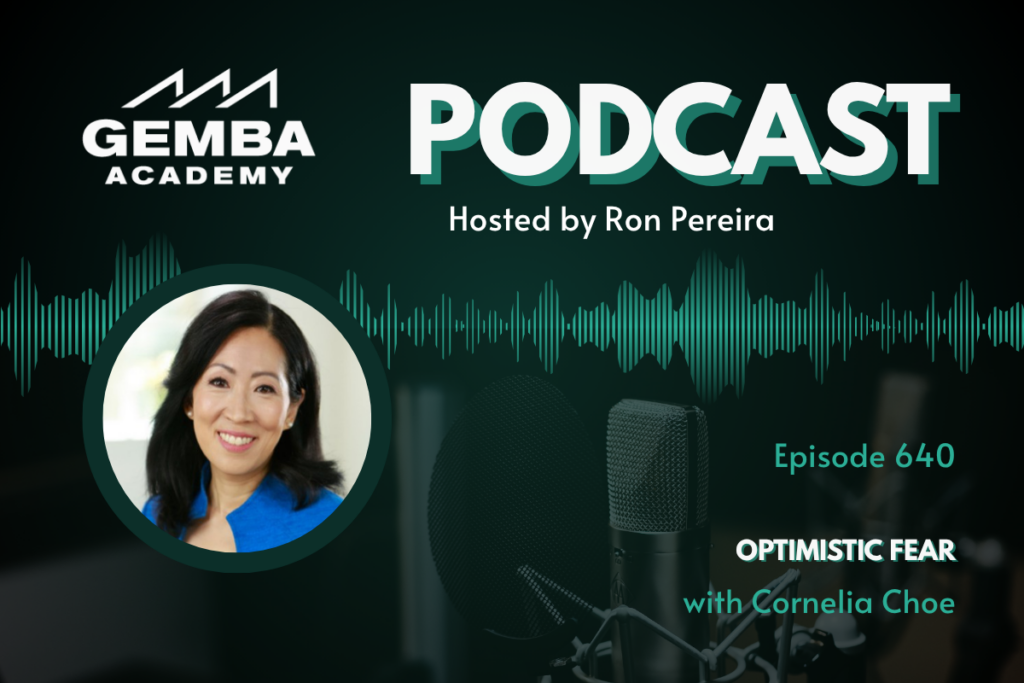
Most leaders think their biggest risk is making the wrong call. Cornelia Choe argues the real danger comes earlier, when a leader stops questioning the mental map they’re using to make calls in the first place. In her book The Panoramic Leader, co-authored with Marshall Goldsmith, Cornelia builds a case that continuous change has made the old leadership playbook obsolete. The world stopped being a predictable highway, and too many leaders are still staring at the rearview mirror.
In this episode you’ll learn:
- What the quote “Achievement is all about me, but leadership is all about them” really means (3:33)
- Why continuous change broke the old model of leadership (6:49)
- How the GEM method helps leaders navigate constant change (9:52)
- Why G must come before E in the GEM sequence (11:31)
- How panoramic leadership builds on go-and-see (13:15)
- What mapping your evolving perspective actually looks like in practice (17:44)
- Why success is the most dangerous place to stop learning (23:25)
- What optimistic fear is and why courage alone is not enough (26:25)
- Three questions that pull leaders out of autopilot (29:40)
“One of the greatest dangers we can have is to stop mapping.” – Cornelia Choe
Keep Learning
If Cornelia’s point about seeing the system from multiple angles resonated, the School of Leadership can help you build the habits that turn that awareness into consistent practice.
Learn More About School of Leadership at https://www.gembaacademy.com/leadershipPodcast Resources
Get All the Latest News from Gemba Academy
Stay current on new courses, podcast episodes, and continuous improvement resources. Sign up for the Gemba Academy newsletter at gembaacademy.com/news
What Do You Think?
When did you last seriously question whether the mental map guiding your decisions still reflects the reality around you?
9 July 2026, 10:00 am - 31 minutes 30 secondsGA 639 | Putting the Customer First with Slaytor BaldwinA suppressor manufacturer in Utah started its lean transformation about a year ago. Twelve months later, inventory turns had doubled, changeover time dropped from 3.5 hours to 9 minutes, and a rollout planned for a year got compressed to three months. Slaytor Baldwin, Director of Operations at SilencerCo, joined Ron Pereira to walk through exactly how that happened, including the five years of failed starts that preceded it and what finally changed. In this episode you'll learn: How a single cell pilot compressed a year-long rollout into three months (0:00) What starting a career inside a lean company teaches you without knowing it (3:17) Why measuring resource utilization instead of customer demand creates invisible dysfunction (6:04) How one leadership change unlocked five years of stalled momentum (10:08) What the first two moves of a real lean commitment look like in practice (12:46) Why starting with your hardest product family creates conviction no training can replicate (14:51) What happened to inventory turns when the entire factory went cellular (17:43) Why lean is not an operations game and what that costs you when you treat it like one (19:59) Why picking the right first project matters more than having the right toolkit (24:22) How failure functions as data when you build a learning culture around it (28:43) Why most transformation decisions are a two-way door and what changes when leaders believe that (29:17) "Lean is not a template. It is a culture." - Slaytor Baldwin Keep Learning If the shift from departmental batch production to cellular flow described in this episode has you thinking about your own factory layout, the School of Lean covers value stream design, SMED, and cellular manufacturing in depth. Learn More About School of Lean at https://www.gembaacademy.com/school-of-lean Podcast Resources Slaytor on LinkedIn Get All the Latest News from Gemba Academy Stay current on new courses, podcast episodes, and continuous improvement resources. Sign up for the Gemba Academy newsletter at gembaacademy.com/news What Do You Think? When you look at your own organization, is the resistance to lean transformation coming from the shop floor or from the layer above it?2 July 2026, 10:00 am
- More Episodes? Get the App