- Clearest image ever of Betelgeuse’s companion | ESO News
 Astronomers have finally obtained firm evidence that Betelgeuse, a famous star in the Orion constellation, is not alone. Using ESO’s Very Large Telescope (VLT) they have obtained the clearest image ever of what likely is Betelgeuse B, a star orbiting Betelgeuse and which could explain some of its brightness variations. This video summarises the discovery.28 July 2026, 12:00 pm
 - New 'exomoon' detection challenges cosmic labels | ESO News

 Using ESO's Very Large Telescope (VLT), astronomers have found an object in another planetary system that challenges astronomical labels. The object resembles a moon in that it orbits another object which in turn orbits a star. But the newly found ‘moon’ is itself as massive as a planet, and the object it orbits is neither a planet nor a star. This video summarises the discovery.22 July 2026, 3:00 pm
 - New exoplanet had been hiding for more than 10 years | ESO News
 Astronomers have discovered a third planet orbiting the star Beta Pictoris using ESO’s Very Large Telescope (VLT). The new planet, Beta Pictoris d, is among the lightest exoplanets ever to be imaged from the ground. After the initial discovery, the team found it had been hiding in archive observations spanning more than a decade. This video summarises the study.15 July 2026, 12:00 pm
 - 3I/ATLAS likely formed in the outskirts of an old star system | ESO News
 Using ESO’s Very Large Telescope (VLT), astronomers have studied the relative abundances of carbon and nitrogen in 3I/ATLAS, the third interstellar comet discovered so far. Their findings suggest that the comet likely formed in the outskirts of the disc around a star older than the Sun. This video summarises the discovery.6 July 2026, 9:00 am
 - Strange winds reveal magnetic exoplanets | ESO News

 Astronomers have found the strongest evidence yet that some planets outside our Solar System may have magnetic fields. Using ESO’s Very Large Telescope and the Gemini North telescope, the researchers measured wind speeds on seven very hot, Jupiter-like exoplanets.2 June 2026, 9:00 am
 - Two planets spotted forming around a young star | ESO News
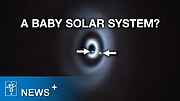
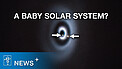 Using ESO’s Very Large Telescope (VLT), astronomers have observed two exoplanets forming around the young star WISPIT 2. Both planets are gas giants, more massive than Jupiter, and are carving out gaps in the disc of gas and dust around their host star. The WISPIT 2 system could therefore resemble a young Solar System. This video summarises the discovery.24 March 2026, 1:00 pm
 - An unexpected shock wave | ESO News
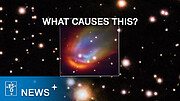
 Astronomers are surprised by a mysterious shock wave around the dead star RXJ0528+2838, studied with ESO’s Very Large Telescope. The dead star moves through space creating a so-called bow shock, as the surrounding material is pushed away. Structures like this one are typically caused by a strong outflow from the star. However, in the case of RXJ0528+2838, no known mechanism could be causing the outflow. A hidden energy source, perhaps magnetic fields, might be the answer to this mystery.12 January 2026, 10:00 am
 - What’s the true shape of a supernova? | ESO News
 Astronomers have observed a supernova just a day after it was first detected. In the early stages of the blast, the explosion has not yet interacted with the material around the star, retaining its true shape. This initial shape has now been revealed for the first time. This video summarises the discovery.12 November 2025, 7:00 pm
 - Rogue planet found growing at record rate | ESO News

 Astronomers have found an intense ‘growth spurt’ in a rogue planet –– a planet that doesn’t orbit a star. Observations with ESO’s Very Large Telescope (VLT) reveal that this free-floating planet is eating up gas and dust from its surroundings at a rate of six billion tonnes a second, the strongest ever found for a planet of any kind. This video summarises the discovery.2 October 2025, 12:00 pm
 - Hayabusa2’s next target is smaller and faster than we thought | ESO News

 Astronomers have discovered that the next target for Japan’s Hayabusa2 spacecraft, the asteroid 1998 KY26, is almost three times smaller than previously thought, and spinning much faster than expected. This study was conducted using ESO’s Very Large Telescope, and its results offer important new information for the upcoming mission, just six years out from the spacecraft’s encounter with this tiny asteroid.18 September 2025, 9:00 am
 - Look into the stunning RCW 38 star cluster

 What lies behind this chaotic extravaganza? This video takes you on a journey across the star cluster RCW 38, located 5500 light-years from us.13 February 2025, 1:00 pm
 - More Episodes? Get the App