- Lawsuit on "Anchoring" StrokesDear Folks,
The question of a possible lawsuit filed to defeat either the ban on "anchoring" clubs when making a stroke or against any outright ban on belly and long putters doubtless is provoking a lot of nonsense presently from uneducated golfers nonetheless motivated to spout opinions. So, mostly as an antidote to confusion and gross stupidity in golf, and also because the issue has intrinsic interest, I offer the following educated analysis for the benefit of visitors to this PuttingZone Blog.
[Disclaimer: The opinions expressed in this article are not legal advice but reporting and discussing issues of concern to golfers generally, and anyone considering a specific legal situation or taking legal action should consult a licensed attorney for advice.]
There are two possible lawsuits: one by a player, and one by a maker / seller of belly or long putters.
Player Suit
1. The federal law, the Americans with Disabilities Act of 1990 (ADA), 42 U.S.C. § 12101 et seq., requires an entity operating public accommodations to make reasonable modifications in its policies when necessary to afford such accommodations to individuals with disabilities, unless the entity can demonstrate that making such modifications would fundamentally alter the nature of such accommodations, §12182(b)(2)(A)(ii). The ADA mandates that "[n]o individual shall be discriminated against on the basis of a disability in the full and equal enjoyment of the privileges of any place of public accommodation." §12182(a).
2. In the case of PGA Tour, Inc. v. Martin, 532 U.S. 661 (2001), the United States Supreme Court held the ADA prevented the Tour from applying a Rule prohibiting use of carts at Q School's final stage against Casey Martin; specifically ruling against the PGA Tour on four points, the Court held (1) that the Tour events including Q-School take place on places that are "public accommodations" and (2) that Casey Martin's leg problem preventing him from walking 18 holes was a "disability" and (3) that his request to be allowed to use a cart in the final stage of Q-School when others were not allowed was "a reasonable accommodation" the Tour was required to make and (4) that the use by Martin of a cart in the final stage of Q-School would not "fundamentally alter" the nature of" the Tour's "public accommodation" event.
3. In the case of the potential claim of a player to be allowed to use a belly putter or a long putter or to "anchor" the stroke, the same four elements would have to be established to win the ADA claim.
4. But the player would not be requesting this of the PGA Tour. He would be asking that the Rules of Golf not be applied as written against him only, and he would be suing the USGA (or the R&A) or whoever is operating the golf event.
5. The USGA is not subject to the ADA as an organization, but only to the extent it operates a golf event that takes place on a place as a "public accommodation" under the ADA. The Tour made two arguments that its events were not "public accommodations" under the ADA, and both were rejected. First, the Tour claimed it was a private club. Title 42 U. S. C. §12187 provides: "The provisions of this subchapter shall not apply to private clubs or establishments exempted from coverage under Title II of the Civil Rights Act of 1964 (42 U. S. C. §2000a(e)) or to religious organizations or entities controlled by religious organizations, including places of worship." Second, the Tour argued that even if the event is held to be a "public accommodation", the only area that is public is "outside the ropes" and "inside the ropes" where Casey Martin would be is not a "public accommodation." The District Court ruled against the Tour on both arguments, holding that a "golf course" is named specifically in the ADA as a place of "public accommodation" and that the Tour in holding events is "a commercial enterprise operating in the entertainment industry for the economic benefit of its members rather than as a private club." The District Court rejected the second argument as an attempt to create enclaves in "public accommodations" where the ADA would not reach. The Tour gave up on the "private club" argument in higher appeals, but persisted in the "enclave" argument. The Tour lost its appeal to the 9th Circuit Court of Appeals, and then the case went to the Supreme Court.
6. In a related case at about the same time, the 7th Circuit Court of Appeals ruled against a player requesting to be allowed to use a cart in the U.S. Open, ruling in favor of the USGA on the ground that allowing one player to use a cart and compete with less fatigue than the other competitors would "fundamentally alter" the nature of the competition. Olinger v. United States Golf Assn., 205 F. 3d 1001 (7th Cir. 2000). In Martin's case, the USGA had allowed him a waiver in events that it sponsors, including the U.S. Open, but had denied Orlinger's request. The Supreme Court resolved the issues in both the Martin case and the Orlinger case by its decision in Martin.
7. In the Supreme Court the Tour switched up its argument from asserting that it was a "private enclave" to asserting that the Tour was an "entertainment or exhibition" to the public but that players were like actors and employees of the exhibition, and the ADA only protects the consuming public, not employees in this sense. The Supreme Court viewed the Tour events as both entertainment for the public and as competitions in which the players were public consumers since they were paying entry fees and competing for money, and so rejected the argument and held the Tour events were "public accommodations".
8. The USGA as the ruling authority for golf is not by that alone a "public accommodation". "No individual shall be discriminated against on the basis of disability in the full and equal enjoyment of the goods, services, facilities, privileges, advantages, or accommodations of any place of public accommodation by any person who owns, leases (or leases to), or operates a place of public accommodation." 42 U. S. C. §12182(a). The twelve categories of places deemed "public accommodations" includes "golf courses" but do not include organizations per se, only public places like restaurants, bars, museums, stadiums, bowling alleys, and the like. The USGA is not a "place" but the ruling organization. It is only when the USGA operates a public golf event at a "place" that the ADA applies to the USGA, so that includes all the Opens and amateur championships. But when an amateur is suing the USGA to be allowed to play in a stipulated round on a golf course somewhere but the USGA does not specifically "own, lease (or lease to), or operate a place of public accommodation" for that golf event, the suing player has no claim.
9. The player might have a claim against a golf course or tournament sponsor who applies the USGA Rules (and in certain events that would be the USGA), since then the course owner or event operator would likely be deemed operating a "public accommodation", provided the public generally is entitled to access and the event is truly not a "private club" event.
10. 42 U. S. C. §12102 provides, in part: "The term disability means, with respect to an individual (A) a physical or mental impairment that substantially limits one or more of the major life activities of such individual . . . ." Clearly, there was no dispute that a person who cannot walk 18 holes and who is a professional golfer is someone with a physical limitation that limits one of his major life activities. Can the same be said about a person claiming a "need" to use a belly putter or a long putter, on the one hand, or to "anchor" any club, on the other hand? That depends on the "physical or mental impairment" the player says requires use of the putters or the anchoring. Presumably, the player could claim he suffers from the "yips" and the yips are either a mental or physical impairment. That claim is medically substantiated. Another possible claim is some sort of orthopedic inability to bend over at address on the green. But he would also have to sustain the argument that the impairment limits one of his major life activities, and that would seem to be "playing USGA-Rules golf events at public accommodations." (Golfers with the yips, according to the medical literature, never complain about the problem except on the course, and never experience the problem in connection with off-course movements.) Is that one of his "major life activities"? For a typical amateur, that claim does not necessarily take wing -- playing the casual round of golf 2-3 times a month, as most amateurs do, and then playing in a tournament 2-3 times a year, with the amateur-staus restriction against acceptance of event money, substantially undercuts the claim that playing in such an amateur event is a "major life activity" for that typical amateur. The case would be stronger for an avid golfer playing 2-3 times weekly and entering 6-7 amateur tournaments annually, but even then there is a major issue whether the impairment limits the player in "one of his major life activities". A professional playing in U.S. Open competition (for men, women, or seniors) paying entry fees and playing for money would not have difficulty with this aspect of the ADA case.
11. Assuming that the player's case of the yips or other impairment amounts to a "disability" in the limiting sense, the player next would have to sustain the claim that not being exempted from the ban on belly or long putters or the ban on "anchoring" amounts to "discrimination" against him. "Discrimination" is defined in the ADA to mean "a failure to make reasonable modifications in policies, practices, or procedures, when such modifications are necessary to afford such goods, services, facilities, privileges, advantages, or accommodations to individuals with disabilities, unless the entity can demonstrate that making such modifications would fundamentally alter the nature of such goods, services, facilities, privileges, advantages, or accommodations." §12182(b)(2)(A)(ii). In plain terms, this means that discrimination occurs unless the player is exempted from the ban by a "modification" of the rule or policy, that the modification is "necessary" to give the player full access to the event, and that the exemption does not "fundamentally alter" the nature of the golf event. Exemption from the Rule is not hard, but there is the subtle question of whether exemption actually helps the player overcome the impairment. The statute provides that the "modification" sought has to be "necessary" to afford the player full access to the event. In Martin's case, there was no question that riding in the cart overcame his inability to walk 18 holes and was therefore "necessary". Not only was the cart effective in making Martin able to play the 18 holes, but it was also the ONLY way he could have his impairment addressed, and so the cart was "necessary" in both senses as effective and as the only option. But does use of a belly or long putter or anchoring actually alleviate the impairment of the yips (or other impairment) such that the "modification" is "necessary" in either of the two senses? That would require proof.
12. Does use of a belly or long putter or anchoring the stroke overcome or substantially reduce the impairment caused by the yips in playing golf? The conventional wisdom is that players most often opt for the long or belly putter or anchoring not because of the yips, but because of problems making a conventional stroke with conventional and traditional clubs. Those players have no ADA case because they have no "disability" the ADA recognizes. But as to yips-afflicted golfers, even then the conventional wisdom is that it is not the club per se that addresses the yips but the change in the body action from the specific movement the yips afflict to another form of movement. The use of a belly or long putter MAY shift the movement to a new movement pattern, and thus help, but not necessarily. The anchoring is more often thought to address the afflicted movement, provided what gets anchored is not the club but the limb or body part that is afflicted. That also is not necessarily the case for anyone using these putters or anchoring. So there is a gap in the proof that needs filling with medical evidence to show that the belly or long putter or anchoring is necessary and effective to alleviate the impairment, since otherwise it is not any "accommodation" for the player at all. To date, there is no systematic study of this issue, and only anecdotal evidence from this or that individual without any clear establishment of the use of the special putters or anchoring actually causing alleviation of the yips. Even if there is proof that the modification sought by the player is effective to alleviate the yips, it is not necessarily the only option. Is it not possible that the player's yips can be alleviated in a manner that leaves the player using a conforming, conventional putter or a conforming, non-anchored stroke? In effect, the player might be required to prove that there is NO intervention for the yips OTHER THAN the use of a belly or long putter or an anchored stroke that alleviates his yips. It is possible that such a player with such a specific form of yips might make this case, but there are also abundant claims by others to "cure the yips" with interventions having nothing to do with the club or anchoring. One such is hypnotherapy; another is Emotional Freedom Technique (EFT); others include acupuncture, Botulinum injection, changing a right-hand grip of a right-hand yips golfer to left-hand-low grip, using a heavy putter, using a "claw" grip to tame the right hand out of the stroke, doing deep breathing exercises, taking rehabilitative training, and more. None of these require the long or belly putter or anchoring as the exclusive remedial modification. And with respect to a claimed impairment like a "back problem," this actually is advanced only in connection with "practicing putting for a lengthy period of time", and is almost never advanced as a problem making one or two putts per hole while playing a round. Afterall, the "back problem" doesn't seem to be serious enough to interfere with the 40-50 or more full swings taken in a typical round of 18 holes. So this "back problem" is not likely to be accepted as a serious "impairment" requiring use of a long or belly putter (and in any event has nothing to do with "anchoring").
13. The more weighty question is whether allowing one player to use a putter design that others cannot use or a grip form that others cannot use would fundamentally alter the competition. The Supreme Court in the Martin case identified two ways exemption from a Rule of the game might "fundamentally alter" the nature of the event: "In theory, a modification of petitioners golf tournaments might constitute a fundamental alteration in two different ways. It might alter such an essential aspect of the game of golf that it would be unacceptable even if it affected all competitors equally; changing the diameter of the hole from three to six inches might be such a modification. Alternatively, a less significant change that has only a peripheral impact on the game itself might nevertheless give a disabled player, in addition to access to the competition as required by Title III, an advantage over others and, for that reason, fundamentally alter the character of the competition."
14. First, does allowing use of a non-traditional putter design concern such an essential aspect of the game as to be unacceptable to call it golf when a player used such a putter or anchoring? At first blush, that's doubtful, so the player would appear likely to win that argument -- NOT a fundamental alteration to allow the non-traditional putter or anchoring. However, it is possible that the Court could say otherwise, and many golfers would indeed share the opinion, so one never knows how the argument would be received. There is, however, a stronger form of this argument. Unlike the Martin case, where use of carts was widespread in golf generally, and the Tour was simply arguing its authority to ban them in Q-School and in PGA Tour events, while allowing them in Senior Tour and Nike Tour events and in early stages of Q-School, the issue here is really about the authority of the Rules authority to specify what equipment is allowed for actually playing golf in the making of strokes. In other words, once the Rules authorities says that in ALL competitions everywhere and always, NO player can use a belly or long putter and must use only clubs that conform to the specifications it has set, and cannot use anchoring, but must only make strokes that conform to the Rules that apply equally always to everyone, and there are never any exceptions, may a player with a physical impairment that would be alleviated by use of the non-conforming belly or long putter or non-conforming anchoring have the right under the ADA to compel the Rules authority to allow him to use a non-conforming club or non-conforming stroke? Does allowing that "fundamentally alter" the nature of golf? There is a strong argument that it does, simply because what the impaired golfer is asking to be allowed to play just is not "golf." The Rules define the nature of the game in the equipment specifications and in the allowable stroke rules. This defines "golf". Exempting any player from those rules, for any reason, means the player would not be playing "golf". In this sense, the allowance of non-conforming clubs or non-conforming strokes is the equivalent of changing the size of the hole by judicial fiat. Yes, that fundamentally alters the nature of the game, because the game is "essentially" defined by these Rules of equipment and strokes. In the Martin case, the Court rejected the argument that "fatigue" was an essential aspect of golf. Here, the question is whether using allowable clubs and strokes is part of the essence of the game. That question seems more likely to be answered in the affirmative than the one posed in the Martin case.
15. Second, if allowing one player with the yips or other impairment to use a non-traditional design or stroke is deemed not to be an essential change, does it nonetheless give that player "an advantage over others" that fundamentally alters the competition? If the player has difficulty documenting that the long or belly putter or anchoring actually alleviates the impairment, the Rules authority will surely have a steeper hill to climb proving that the use affords that player "an advantage over others." The player is likely to prevail on this argument that use of the special putter or anchoring does NOT fundamentally alter the nature of the competition. Everyone who espouses the idea that belly and long putters and anchoring don't help that much are making the argument that helps a lawsuit to stop the Rule from applying to a player with the yips. In the Martin case, the Tour argued that exempting Martin from the fatigue of walking 18 holes that all other competitors had to endure gave him an unfair advantage, but the Court held that the "fatigue" the Tour claimed was proved by physiologists to be insignificant. So the claimed advantage in a suit about the putter or anchoring will likely be shot down immediately simply by quoting the widely held belief in golf that "It's not the arrow, but the Indian" to the effect that putters don't give significant advantages. (Obviously, putter makers don't want to admit this, but they don't have any proof to the contrary, and the only scientific study of the claimed benefits of putter designs says the manufacturers' claims of benefit are utterly insignificant and don't matter to score (Werner and Grieg, How Golf Clubs Really Work and How to Optimize Their Design.)) Moreover, no company making and selling belly or long putters (such as SeeMore) has ever claimed any expertise about the yips or about what putter designs might have to offer to address the yips phenomenon. These companies simply follow a transitory trend in golf following a noted success of some player using a belly putter or long putter and the ensuing media puffing that makes the belly or long putter a trendy, popular item. The companies follow the wind, wherever the market interest blows them, and certainly are not conducting medically-relevant R&D simply to help a few golfers suffering the yips. So no manufacturer can credibly claim that its long or belly putter design evolved in response to medical expertise to address and alleviate the yips and therefore has proof that the design gives any advantage. Likewise, there is not any scientific evidence that anchoring alleviates the yips. The well-known example of Bernard Langer clasping his right hand against his left forearm, also pinning the putter handle against his forearm (i.e., "anchoring"), appears to have served him well in "controlling" his specific form of the yips, but there was never any scientific probing of his yips and his mechanical prevention of the movement disorder disrupting his stroke. And there is clearly no proof he thereby gained a superior level of performance over other competitors. The Decisions under the Rules already prohibit any "artificial device" being use as a mechanical control of the stroke, such as strapping the putter handle to the forearm underneath a watch band. Anchoring the handle or hand against the body is mainly to "eliminate a degree of freedom" for any golfer making a stroke and therefore make good strokes easier for players struggling with conventional putting. The usual claim is that "anchoring" benefits any golfer precisely because it "eliminates a degree of freedom" from the conventional style, but there is never any accompanying proof that this "eliminating a degree of freedom" causes better results and lower scores compared to what other competitors can accomplish without this. So, the player would not lose on the ground that any putter design or anchoring gives the player an advantage.
Club Maker / Seller Suit
16. These lawsuits against the USGA never end in victory for the club maker, since courts recognize the authority of a sport to establish it own terms for equipment specifications. The only case that ever came close was the claim of Ping about the u-groove clubs that once were not illegal and then were allowed to be made and sold but then were ruled illegal. In that case, an out-of-court settlement ended the case with a grandfathering in of the existing u-groove clubs already made but future clubs to be made only with v-grooves, and Ping agreeing not to make any more u-groove clubs. But that small scent of club-maker positive outcome has unduly encouraged other club makes to have hope where on the merits of the claim, there really is not much hope.
17. The maker /seller of long or belly putters would most likely not be allowed to stand in the shoes of a yips-afflicted golfer and assert that players' claim under the ADA, but would have to assert some independent claim on its own behalf.
18. The likely claim would be some sort of fairness claim that prior USGA approval of the seller's long or belly putter precludes or "estops" the USGA from changing its mind and later banning the designs by changing the definition of what clubs are allowed in a way that excludes these long or belly putter designs as non-conforming. This eliminates any seller from bringing suit who had not previously obtained USGA approval and was currently marketing the designs. But even as to those selling pre-approved belly and long putters, the claim essentially means that those making money from the game of golf have gained by thee prior design approvals the right to prevent the USGA from altering the rules and equipment in the game until all sellers stop marketing belly or long putters. The more reasonable view, and therefore the more likely outcome in a lawsuit, is that the USGA maintains its authority to alter the club rules, since everyone recognized before that this authority existed and could be used (as indeed shown in the Ping case), and the likely development is that the USGA would give sufficient lead time before applying the change so that the business cycle could run its natural course to sell off existing inventory and change over to different product designs that conform. The end result is not that any company cannot continue to make money from golf, but that the company would have to allow the current designs to play out and start making money in a different product line. Against that, a seller who still claims a "right" to sell belly or long putters notwithstanding the Rule-maker's decision is taking an obstinate position, based either upon its admitted inability to shift to a conforming product line or upon simple intransigent refusal to yield to the rule-making authority of the USGA. Either way, that is not a sympathy-garnering position.
That's pretty much the analysis. How such a case would actually come out is anyone's guess, and depends upon the caliber of the lawyering, the judges, the claimant, the evidence, and any other number of wildcard factors. But the above analytical skeleton maps the tracks the main lines of argument that any such case would have to follow. Make of it what you will as fair-minded "judge".
For my personal view of the player lawsuit, I think the USGA argument that allowing use of clubs or strokes that are not part of the game's definition would fundamentally alter the nature of the event by affecting its essential nature is pretty strong (point #14), and the player's argument that a long or belly putter or anchoring amounts to a "necessary modification" that alleviates the yips is weak (point #12,) and the player's claim that the impairment amounts to a "disability" limiting the player's "major life activity" would be problem for a casual amateur even if not as much a problem for an avid amateur or no problem at all for a professional in one of the the US Open competitions (point #10). But otherwise, a yips-afflicted amateur or professional golfer could bring suit if denied exemption from a Rule banning use of the long or belly putter or anchoring, against whoever operates the event as a "public accommodation". But sustaining all four elements of the ADA case is not likely.
Cheers!
Geoff Mangum
Putting Coach and Theorist
PuttingZone.com
Subscribe to: Posts RSS (XML): feeds.feedburner.com/puttingzone Subscribe to: Posts RSS (Atom): puttingzone.blogspot.com/feeds/posts/default
1 December 2012, 11:24 am - Putting Neuroscience
Putting Neuroscience
In general, with only the rarest of exceptions and then only in the most limited ways, golf teachers, golf psychs, and motor sports experts know nothing about "putting neuroscience." There are a number of reasons for this, including:
1. laziness2. stupidity3. ignorance4. lack of knowledge of putting skills5. lack of knowledge of neuroscience6. inability to apply neuroscience to putting skills
And yet, "putting neuroscience" is unquestionably the most important science for understanding and teaching the "Indian, not the Arrow" and for the Indian's performing skillfully with the "know-how".
Accordingly, people who display little or no interest or facility in applying neuroscience to putting skills cannot claim with much persuasive force to be labelled "putting instructors."
So, how difficult is it to be a "putting instructor" in the sense of studying and understanding and teaching how the Indian actually functions in performing putting skills? A little, hence the absence of a crowd at the "putting instructor" stall.
Modern neuroscience has exploded since 1990, so that the NEW knowledge of the human brain compiled in thousands of research efforts around the world in the two decades 1990-2000 and 2000-2010 now represents approximately 300 times more knowledge of how the organ of the brain operates non-consciously than all knowledge in human history prior to 1990. That means that the pre-1990 concepts of how the brain-mind-body is structured and operates are outdated, incomplete, incorrect, misleading and wrong. People who have "taken a powder" on the NEW brain research after 1990 do not have real knowledge about the brain-mind-body, and so are similar to "flat-earthers" standing on the docks of Cadiz looking after the stern of Columbus' ship headed to the New World wagging their tongues about the certain impending doom of the project as it sails off the Edge of the World into the Abyss of Oblivion. As noted, those people currently include: golf teachers, golf psychs, and motor sports experts.
Here is a small example -- taken somewhat randomly from the available brain literature -- of what COULD be the discussion in golf teaching if these folks actually were doing some reading and keeping up, instead of sitting inertly on the dock of the bay for the past 20-25 years or more ignoring the responsibility to learn something that needs learning.
From the book Developing Individuality in the Human Brain: A Tribute to Michael I. Posner, ed. by Ulrich Mayr et al. (Washington DC: American Psychological Assoc., 2005): IOR and Prefrontal Task Processing.
IOR
IOR or "Inhibition of Return" is a feature of attention whereby recent attention to an object or detail of space is followed by a blockage or inhibition of returning the attention to this object or detail. The purpose seems to be to foster a more robust scanning of the environment in the "foraging" behaviors of animals, preventing re-attending to past scanned areas in favor or moving on, a clear evolutionary advantage in most situations. The IOR can last up to 3 seconds after attention with an object or location is disengaged. Raymond M. Klein, "On the Role of Endogenous Orienting in the Inhibitory Aftermath of Exogenous Orienting," Developing Individuality in the Human Brain, ch. 3, pp. 45-64.
Applying the insights of this research to putting tasks and skills, one such application would be on the "attention" to the hole in putting. The hole is an object for USE, in the same way that a coffee cup is something to grasp by the ring-shaped handle and pick up and deliver to the lips for drinking the contents. The hole is for delivering the rolling ball into with the putting stroke. Attending to the hole with this intended USE is a subskill in putting that can and should be developed and taught, fleshing out the details of ball delivery speed, capture profile of the space of the hole, effects of surface tilt towards or away from the entry trajectory, etc. But the IOR appears to be contrary to the putting skill, undermining effective performance.
That's correct: the NORMAL pattern of the brain is to skip away from the last thing attended to in favor of subsequent "foraging" for the next opportunity. That's not good golf. So, apparently, there is an innate "habit" of the brain enshrined in the IOR. What to do? More research would be a good plan.
The "exogenous" orienting is how the brain "codes" the object in terms of its seating in the external environment, not in terms of body-only processes such as the aim of the eyeballs or the direction the face aims over the trunk. This sort of out-there coding allows the coding to operate even when the eye or body changes location or even when the object itself moves. Okay, the golf hole doesn't move, so that part doesn't apply to our problem.
The "endogenous" orienting is "top-down" internal control of the IOR. That sounds useful for our application. How to enhance IOR control? Less foraging, more reluctance to disengage attention with the hole as location to use. More knowledge of what is relevant to the task of the putt, less ignorance and complacence about these relevant aspects. Better eye usage to "pay attention" to the relevant cues and aspects of the space of the hole to be used appropriately with the putted ball.
Interestingly, old people have increasing difficulty disengaging with attended objects and locations, and that's a good thing for putting. It dovetails perfectly with Walter Hagen's seminal advice: "Slow down and smell the roses", and the advice of putting great Bobby Locke: "Slow down and don't let anything make you hurry." Now we have some deep insight into why that advice might have a physical basis in the body and also gain some know-how about operating the body to better effect in putting, according to the way the research tells us the body works for subskills like attention.
A putting instructor in the 21st century needs to know about these issues and get on with the learning and understanding and effective teaching thereof, or else stop claiming to be a putting instructor and be perfectly happy to hold oneself out to the golfing public as "just another dude with an opinion."
Prefrontal Task Processing
The "old school" psychology concept of the prefrontal cortex is that this area exerts abstract controls such as inhibition or mental set switching, with the central concept of "working memory". New research supports a different idea about the prefrontal cortex:
"Working memory is often taken to be a central aspect of prefrontal function (Goldman-Rakic, 1988). As Posner himself has expressed it, an appealing [new] idea is that prefrontal cortex might "represent information in some temporary store while the brain provides information on what is known about the item" (Posner, 2004). This is a perspective rather different from that of abstract control functions such as inhibition or switching. Instead, prefrontal control is exerted by holding a salient representation of task-relevant content, allowing other processing systems to deliver additional information about that content and related material (se also, Miller, 2000)."
John Duncan, "Task Models in Prefrontal Cortex," Developing Individuality in the Human Brain, ch. 5, pp. 87-108, at pp. 87-88.
According to Duncan, the new model of the prefrontal cortex works more like this:
"At the heart of the model, working memory builds up a temporary model of some aspect of the world. This can be anything -- a chess problem, an environment to be navigated around, a product to be designed. the model includes both the current state of the world, and the goals to be achieved or actions to be taken. In part, it is built up by new perceptual input, and in part, by the program's long-term knowledge of the world and its structure. As reviewed above, the responses of the prefrontal neurons suggest exactly this sort of temporary, online model of task-relevant facts and actions."
Id. at 92-93. Okay, now we're talking! Let's get applying this to putting skills!
The facts and actions relevant to putting skills are green contour and ball speed control resulting in one curved pathway from ball at address at time 1 to ball dropping nicely into the hole at time 2, caused by the stroke for line and distance at the start. The "read" of any putt is the brain's accurate prediction of how the golfer's ball speed fits with the surface shape and condition of the green in the specific situation between ball and hole, and this requires one unique start line for aim and stroke and the SAME distance control in execution as is used in the future predicting of the "read". That's the "task": all four skills (reading, aiming, stroking, and controlling pace and distance) integrated in one effective action. Enriching this process by teaching task-relevant facts and actions is called "putting instruction".
Here are some task-relevant facts and actions for the "putting instructor" to study, understand, and teach and then for the golfer-player to understand, practice, and perform skillfully:- Perception of the green surface conditions that affect the read, such as flatness or contouring shapes, tilt direction, tilt steepness, and green friction or green speed;
- Perception of ball speed over the course of various length putts and especially the terminal speed at and near the hole for capture;
- Perception of ball-capture trajectories into the cup representing good and effective delivery speeds or otherwise;
- Perception of ball speed in misses wherein the ball continues past the hole but is subject to the frictional slowing and stopping of the green so that different patterns of roll-out past the hole are appreciated for whether they are good or bad, safe or dangerous;
- Perception of the combination of green slope and green speed and appreciation of what that means for the terminal velocity pattern of the ball nearing and arriving at the hole;
- General knowledge of the "ballpark" reality of break amount for different combinations of green slope and green speed as an anchoring reality for further adjustments away from paradigmatic patterns to the specific "warts and all" situation of "this and only this" putt;
- Proper "action" knowledge of what different features of the situation mean to the reading prediction and the start line identification to avoid misconceptions engendered by ignorant language common in golf culture, as evident in the widely held but stupid notion to "putt the ball to the "apex" of the break and let gravity then take over and move the ball the rest of the way downhill into the hole";
- Proper "action" knowledge concerning poor aiming and non-straight stroking habits that infect over 90% of all golfers -- pros included -- without which the reading prediction mis-identifies the start line that will work for the golfer without additional skills development for aiming and stroking;
The human body works in specific ways that have been evolving in the animal experience of the planet for over 3,000 million years, and the past two decades have seen the science of how the human brain as organ of the body actually interacts with the world in tasks grow to over 300 times all prior knowledge. Golf instructors and people expressing "opinions" as if experts in putting skills cannot "take a powder" on this new knowledge any longer and still claim to be serious about the game.
It takes a little work, but, hey, if you don't like studying the subject, why don't you stop pretending to be an expert? You can always tell whether someone has put in the time on this new science simply by checking their footnotes. Here are some names the absence of which indicates no real knowledge of this science: Gazzaniga, Posner, Churchland, Damasio, Ledoux, Jeannerod, Paillard, Berthoz, Llinas, Libet, Hubel, Livingstone, Koch, Chalmers, Melvin, Goodale, Noe, ....
Cheers!
Geoff MangumPutting Coach and TheoristPuttingZone.com -- golf most advanced and comprehensive putting instruction.Subscribe to: Posts RSS (XML): feeds.feedburner.com/puttingzone Subscribe to: Posts RSS (Atom): puttingzone.blogspot.com/feeds/posts/default
19 June 2012, 4:37 pm - Optional Optimal Stroke
The "Optional Optimal" Stroke is Simple but not Mandatory
Golf conventionally teaches for putting little other than a confusing and confused myriad of stroke techniques, each claiming it is the best and only way to stroke the ball. That's accepted by golf culture, but actually makes little sense.
There are FOUR skills for putting that must be performed well every putt:
1. reading the break of the putt that is set by the delivery pace of the ball (touch); 2. aiming the putterface along a startline that matches or arises from the read; 3. starting the ball online with the stroke; 4. stroking the ball with the appropriate force or touch so the pace of the ball matches the pace used to read the putt initially and that matches the break.
Of these four skills, the PRINCIPAL skills are touch and reading. While touch is the foundation of reading, and hence all four skills, touch and reading are far more determinative of success or failure than aiming and stroking. That's because aiming and stroking have simple objectives that are performed by simple mechanics. In comparison, touch and reading with touch are very tricky skills to perform accurately and consistently.
Regarding aiming and stroking: Over 90 percent of all golfers -- pros included -- do not aim the putterface inside the hole from 10 feet away on a straight putt, and almost all of these golfers are completely unaware of the problem in aiming but believe erroneously that the putterface aims straight at the center of the hole. That's bad, but it has always been the case throughout golf history. What does this mean for the strokes used by over 90% of all golfers? It means that IF they sink the putt, then they must not be stroking the ball where the putterface aims, since putting the ball on that line would miss. So what do golfers actually do when they sink putts with bad aim? They don't know. That's the problem, since this is what makes golfers "streaky" and leaves golfers in the dark when "whatever sort of stroke they are using doesn't work and they don't know what went wrong or how to fix it."
Why do golfers aim poorly? There are two reasons: First, golfers use poor physical movements beside the ball when looking along the line of aim to see where it ends up, and have little skill in directing the line of sight straight sideways along the ground. This leads to odd physical movements that confuse and misdirect the aim offline. Second, golfers don't know that the body aims with its habitual movements, and this biases the mind in perceiving the aim of the putterface, so that (for example) a golfer who habitually has some "pull" action in his stroke will look down at a putterface aimed perfectly straight at the hole 10 feet away and yet will "perceive" and think erroneously that the putterface "looks aimed to the inside", since that is where the body expects the stroke habit to send a ball off the perfectly aimed putterface.
What does it matter? Poor aiming engenders corruption of the stroke. Aim to the outside; stroke with a pull to compensate (all without awareness).
How do you fix this "chicken and egg" problem? If you fix only the aim, the stroke with the poor habit remains uncorrected. That's why using a line on the ball results in near-perfect aiming of the ball from behind the ball, but then the golfer sets up beside the ball and looks down and "perceives" that the ball "seems" to aim to the inside. That's the "pull stroke habit" biasing the mind in perceiving where the stroke will send the ball. If you fix only the stroke so all strokes always and only send the ball wherever the putterface aims, this leaves the aiming unfixed, so it doesn't rescue the golfer from the streakiness that accompanies lack of awareness of what the golfer is doing.
However, fixing either the aiming or the stroking will eventually drag the other skill into a more and more correct pattern. While fixing both aiming and stroking at the same time is advisable, it is nonetheless wise to know which fix of the two has greater effect in bringing both aim and stroke into correctness.
Fixing the stroke has greater and quicker effect in helping correct bad aim than does the effect of fixing the aim on correcting the stroke.
And fixing the stroke is easy: just putt the ball wherever the putterface aims, always and only.
This brings us to why conventional stroke teachings are non-sense: none of the strokes taught in golf define what the stroke is required to accomplish. The strokes all teach a method, not the accomplishing of an objective.
But once the objective of the stroke is clearly defined, the performance of the objective turns out NOT to require one stroke method more than another. The OBJECTIVE is what is mandatory; the method of accomplishing the objective is merely OPTIONAL at best. All strokes taught today are merely optional, but more fundamentally, they aren't even calculated and designed to accomplish the obvious OBJECTIVE. Well, perhaps it is not at all so "obvious" that the stroke "should" simply roll the ball wherever the putterface has been aimed. After all, hardly anyone actually does this, and teachers of stroke don't even bring it up. But that's golf culture.
Building the stroke method up from the objective teaches volumes about what really matters for setup and stroke path and movement pattern.
Here are a series of elaborations on this single theme:
1. Putting the ball always and only wherever the putterface aims is the only way to get feedback that teaches how to aim.
2. Putting the ball always and only wherever the putterface aims is the only way to putt it, or else why bother reading and aiming the putter?
3. Putting the ball always and only wherever the putterface aims is simple and can be done in many ways -- no special stroke technique required.
4. If the read and aim is correct (as it should be), putting the ball always and only wherever the putterface aims is the only way to putt it.
5. Regardless of whether the read and aim is correct, the golfer should always and only putt the ball wherever the putterface aims anyway.
6. The aim of any putterface is easily perceived as the perpendicular line straight off the face thru the center of the ball: putt that line.
7. Once the read and aim is finished, the putterface is then aimed, and the golfer is "off the hook" for the stroke: just start the ball online.
8. Starting the ball online does not require any stroke technique; it requires putting the ball always and only wherever the putterface aims.
9. Putting the ball always and only wherever the putterface aims is mandatory; stroke method or technique is optional.
10. A stroke technique that does not promote always and only putting the ball wherever the putterface aims is not a stroke to adopt.
11. An "optional optimal" stroke technique promotes the biomechanics and movement that always and only putts the ball wherever the putterface aims.
12. An "optional optimal" stroke method has simple posture and movement that does not unnecessarily burden the golfer with tasks to monitor or perform.
13. The "optional optimal" stroke uses inherent physics in the setup when swinging the arms and putter sideways squarely thru impact, as this promotes sending the ball always and only wherever the putterface aims at address.
14. The "optional optimal" stroke swings arms primarily, as the mass of the arms is ten times greater than the mass of the putter.
15. Arranging the body first to the aimed putterface so the chest / shoulders orient parallel to the aim of the putterface and then simply swinging the arms sideways in front of the body and the chest inherently promotes an online stroke.
16. Holding the putter handle with sufficient grip muscle tone and in the squareness to the aim line at address matches the aim of the putterface to the orientation of the shoulders and chest at address, so that during the stroke the putterface will remain coordinated with whatever orientation the chest and shoulders move.
17. Swinging the arms straight across the front of the body with the grip maintaining the putterface the same as the chest and shoulders means that the ONLY determinants of a good stroke are shoulders and chest parallel thru impact as at address, arms swing the putterface online, and the hands maintaining the putterface the same as the chest and shoulders thru impact.
18. Swinging the arms straight along the aim line thru impact is most easily accomplished by fully hanging the arms and hands with relaxation in gravity at address, as opposed to reaching away from or closer to the body or crooking the elbows high at address.
19. An "optional optimal" stroke that promotes sending the ball always and only wherever the putterface has been aimed hangs the arms naturally, incorporates the aimed putterface into the body's orientation of the chest and shoulders with sufficient grip muscle tone, and then swings the arms back and thru across the front of the body in order to move the putterface squarely online thru the ball in the forward stroke.
20. An "optional optimal" stroke not only sends the ball wherever the putterface aims; it also at the same time sends the ball with the timing of the stroke that generates the appropriate force for the required touch.
21. The TIMING of the stroke is what determines the force of the stroke, but it is also true that the rhythm of the stroke timing is critical to the accuracy and consistency of the LINE of the stroke.
22. An "optional optimal" stroke uses rhythm to execute the stroke with BOTH line and distance.
23. A stroke that sends the ball always and only wherever the putterface aims, with good touch, is performed most simply by an "optional optimal" biomechanics and stroke motion performed with the usual rhythm and tempo.
24. When the golfer uses the principal tempo installed into the body by the world swinging the arms back to the body, the "rhythm" for the "optional optimal" stroke simply matches the backstroke tempo to the world's downstroke tempo to achieve the "rhythm".
25. Using the world's tempo for the downstroke, the golfer's stroke for distance consists solely in starting the stroke back with the same tempo and then the line control consists solely in standing still while the arms and putterface swing straight sideways in front of the body.
26. The "optional optimal" stroke promotes sending the ball always and only wherever the putterface aims, but is nonetheless no more than optional.
27. A great golfer knows that whatever stroke method he or she practices, in the middle of the round, if the method seems difficult of problematic, the great golfer doesn't worry about that and simply uses "whatever" stroke that sends the ball online wherever the putterface has been aimed.
28. The priorities for the stroke, in order, are: 1. stroke the ball always and only wherever the putterface has been aimed any way that accomplishes this with effective / good touch; 2. use any stroke that features effective physics in the impact to send the ball with good touch down the line without excessive bouncing or bounding or skidding or sidespin; and 3. use a stroke method that does not impose unnecessary demands on the golfer but instead reduces all possible aspects of the stroke for line and distance to the inherent physics of the setup and movement.
29. An "optional optimal" stroke features effective physics from rhythm because the putterface moves slightly upwards from the rhythm-defined bottom of the stroke into and thru the ball squarely and online thru the center of the ball beginning about 1 dimple below the back equator and exiting the front equator of the ball 1 dimple high.
30. The usual rhythm combined with simple biomechanics of setup and movement rolls the balls wherever the putterface aims for both line and distance.
This all means that the stroke method MUST be structured according to the objective, or else the stroke tends to undercut the reading and aiming and touch skills, and serves as a "stand-alone" method to compensate for poor reading and aiming and touch skills. Such a stroke encourages poor reading and aiming and touch. A stroke that always and only rolls the ball wherever the putterface aims necessarily encourages better reading and aiming and touch skills.
Cheers!
Geoff MangumPutting Coach and TheoristPuttingZone.com -- golf most advanced and comprehensive putting instruction.Subscribe to: Posts RSS (XML): feeds.feedburner.com/puttingzone Subscribe to: Posts RSS (Atom): puttingzone.blogspot.com/feeds/posts/default
29 October 2011, 11:01 am - Aimpoint as Poor ScienceAimpoint as Poor Science
I was asked recently to critique Aimpoint from the point of view of science. Aimpoint purports to chart exact aim locations for breaks for all golfers, with the exactitude matching the calculation of how far a car drives along a straight road at 50 mph in one hour. Golfers are fools for numbers, and believe anything wearing a lab coat and pocket protector must be a demigod sent from Heaven's own Science Department to explain to us poor dumb golfers "how things really are". The first thing the demigod intones stentoriously is: "To measure is to know!" So here come the numbers! Playing golf by numbers is like painting a Picasso by number -- it'll work, sort of, but that's not why the Good Lord created Pablo or you to begin with. So there's a basic problem in golf culture with how golfers regard science and the technologies of science.
Aimpoint is a great example of the pretense to reality and the claim to scientific truth versus the reality that such science is largely guess work and often way off base from reality and what golfers need to know about the world of the golf course. A leisurely examination of the sources of Aimpoint reveals its many flaws in applying physics to the skills of putting.
INQUIRY
Hi Geoff,
Can I get your thoughts on Aimpoint? I am considering attending a two-hour session and wondered whether you thought it was worth it.
Kind regards,
Golf Coach
REPLY
Dear GC,
This webpage on the PuttingZone addresses these issues and more. Here in detail are EIGHT main problems with the "science" of Aimpoint's calculated breaks
I. ALL AIMPOINT CALCULATIONS ARE FLAWED DUE TO A POOR CHOICE FOR TOUCH IN THE MODELING OF THE PHYSICS THAT SKEWS ALL AIMS TOO HIGH FOR 99.9% OF REAL GOLFERS.
Aimpoint is a bit odd because the whole physics is based upon a level of touch that its creator Mark Sweeney cut-and-pasted from a physics article written by a physics teacher not especially knowledgeable about the reality of putting and certainly not a teacher (Tony Penner at Malaspina University, BC Canada in the Canadian Journal of Physics for 2002), and he in fact cut-and-pasted this level of touch (6-12" past the hole) from another physics teacher who calculated the numbers rather than learned about touch (Brian Holmes, in California in the 1980s, in the Physics Teacher Journal in 1986). (This is all obvious from Sweeney's Patent Application in 2004.) The level in fact is not at all what is usual in golf, and is essentially how Ben Crenshaw would LIKE to have touch if he were really good one day, but is certainly not normal for the vast majority of golfers. This means two things:
1. the aimpoint calculations are not suitable for the vast majority of golfers;
2. golfers cannot use the aimpoint calculations without first learning an unusually superb level of touch on a consistent basis.
II. THE AIMPOINT "PHYSICS" IS ACTUALLY A "MODEL" BUILT UPON REALITY-IGNORING SIMPLIFICATIONS AND ILL-CONCEIVED ASSUMPTIONS THAT SPOIL THE WHOLE SYSTEM.
The second problem is that the physics paper relied upon (Sweeney has little or no physics personally; it all comes from Malaspina University, BC) is a "model" and not physics calculations of reality. The difference is that a "model" is an assemblage and a modification of a set of standard general formulae from textbooks shaped and shaved until the formulae generate what looks like a reasonable approximation of reality when the theoretical calculations of the model more or less look like the numbers measured from reality in some manner. This is called "the model has a 'good fit' with the empirical data." The paper is AJ Penner, The physics of putting, Canadian J. of Physics, 80, 1-14 (2002). The "shaped and shaved" business requires making "assumptions" that simplify and vary away from the full complexity of reality. Here are ELEVEN poor choices made by Penner in constructing a "model" that Sweeney inappropriately applies to real putting:
1. All greens are perfectly planar and flat:
Penner (all quotations are from the 2002 article in the Canadian Journal of Physics): "Holmes [3] presented a detailed model of the capture of a golf ball by a hole on a flat [i.e., "level"] green. This model will be discussed briefly along with a correction that will be required to account for sloped greens [flat but tilted surfaces, actually meaning "a surface on a green that has one slope, one tilt, and is otherwise uniformly flat or planar]."
Aimpoint charts are limited for use ONLY when the green surface between ball and hole is "flat" -- that is, the same planar surface without changes in slope, with the same tilt in space, and all fall lines arranged parallel to one another and all contour equal-elevation lines parallel to one another and also perpendicular everywhere to all fall lines.
While it is true that greens are not usually "level" in gravity, the surface is "flat" only in discrete areas and then only to a reasonable level of resolution ("sort of flat" or "flat enough" for purposes of the read), and then the real "flat" areas are not very large.
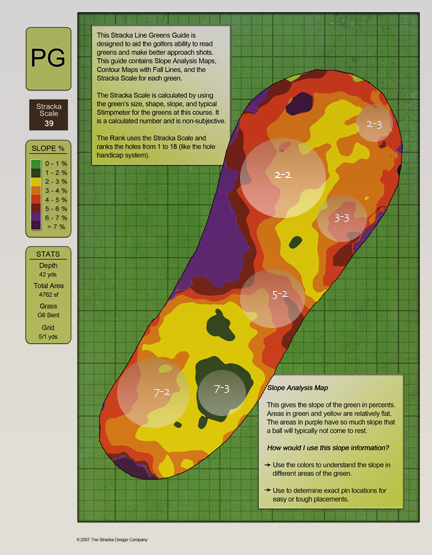
Below is a contour map of a fairly typical green (top of the two maps), with a "slope" area map of the same green (the lower map of the two). A "flat" area is a region where the contour lines next to each other remain parallel, and really this means that 3-4 contours lines stay parallel. Once these lines start to become NOT STRAIGHT anymore, the area is no longer "flat". So flat areas are areas where 3-4 adjacent contour lines are parallel LINE SEGMENTS without curving. And then there is another consideration: whether the slope percentage stays the same over the "flat" area. If the slope changes, that is the same as curling a sheet of paper: it's flat left-right, but rolling up concave or away convex in the up-down or near-far direction. This aspect is mapped in the bottom of the two maps below.
So truly "planar" areas are 1. parallel contour lines, and 2. same slope percentage. BOTH maps below have to be consulted -- upper map for parallel, lower map for same slope.
EQUAL-ELEVATION CONTOUR MAP: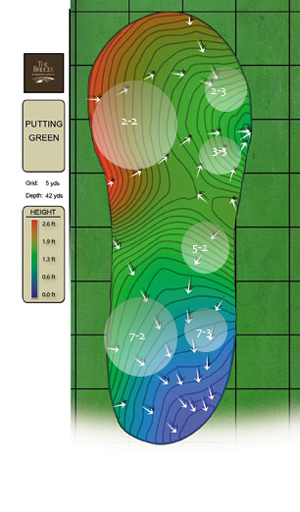 EQUAL-SLOPE AREAS MAP: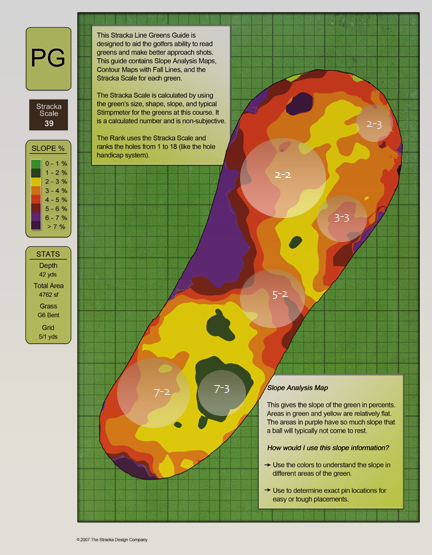
Below, the areas that are "flat enough" to consider "planar" for purposes of reading putts with hole locations on those areas are few and far between. If the blocks of the top map are numbered vertically and horizontally top to bottom and left to right as in real road maps, there is one reasonably large "flat area" at 2-2 in the top third's middle section, a tiny area at 2-3 at the top far right edge of the green, a very small "flat" area at 3-3 in the top lobe, a flatish TIER at 5-1 to 5-2 in the middle that is too steep to serve as a pinnable hole location and so is irrelevant in aimpoint charts, and another sizeable "flat" area at 7-2 in the front lower left of the green, and a small flat area at 7-3 in the front right of the green.
The grids are 5 yards x 5 yards, so the CIRCLED AREAS in total have these sizes: 2-2 is about 15' x 15'; 2-3 is 6' x 6', 3-3 is 6' x 6', 5-2 may be 7' x 7', 7-2 is about 10' x 10', and 7-3 is 7' x 7'.
Checking BOTH maps for these areas shows that what at first appears flat from the contours is actually changing slope, so that the really flat area is further restricted to only one slope color inside the circled area. Consulting the bottom map for CIRCLED ONE-COLOR AREAS:
For 2-2, the lighter orange is about 10' x 10'.
For 2-3, the one-color area is 6' x 6'.
For 3-3, it's 6' x 6'.
The 5-2 area is just too steep but in any event its flat one-color area is not very large.
The 7-2 area is curved into convexity except for a central area about 5' x 5'.
The 7-3 is about 7' x 7'.
That's a total of one area 5' x 5', two 6' x 6', one 7' x 7', and one 10' x 10'. As circles, these are areas of diameter 2.5', 3', 3.5', and 5' -- not very large, and none remaining "flat" for more than two steps away from the hole.
Even with that, speaking as a greenskeeper who set pins at four courses, the chances that the pin location will be centered within one of these four flat areas is exceedingly slim. What is REAL is that the top lobe in the left map is a large half-bowl shape draining off to the right at 4 o'clock off the front-to-back line of the green and the bottom lobe is another half-bowl draining off to the bottom right at about 5 o'clock. While it's a fairly simple green, it's not really one that offers many flat areas or flat areas that extend out very far before the surface contour and slope changes from that at the hole.
USGA pin location guidelines want pins to be located basically where there is at least a 4' x 4' flat area if not a 6' x 6' area, so 2-3' out from the hole in any direction does not change slope or flatness. Greens always have plenty of these areas, but they are about the minimal size for flat areas.
The pins on this green are highly likely to be located on areas with very minimal flatness at the hole on a general "inside of bowl" contour, with the bottom of the bowl being tipped to "pour" the water off the green a specific direction. Yes, the bowl is very shallow, but it's still a bowl. Aimpoint charts don't work to give targets on the inside of a bowl.
This means that aimpoint charts based upon the assumption that greens are "planar" or else the aimpoints aren't valid are not really useful much past about 5-8' out from a hole, and almost never are valid for 10' to 20' out. If I had to guess the percentage of real hole locations for which the aimpoint charts are actually correct for 10' putts, I would guess the percentage of real 10-foot putts and real pin locations are not "flat" or "planar" for purposes of the charts except in perhaps 20% of the putts, and that for 80% of real 10-footers, the charts are incorrect. (Aimpoint has obviously found this fact out, but claim they can handle it by telling you something extra other than what the charts say, in an advanced session for more money. Uh, okay boys.)
2. The friction in the grass can be estimated reliably without direct measurement by calculating how much friction is at work stopping the ball at Stimpmeter distance X given the ball's off-ramp initial velocity off the bottom of the Stimpmeter [and Penner borrows a calculation about the Stimpmeter ball speed that is in error, so his calculations of green speed are skewed]:
Penner: "The speed of a green will be directly related to the deceleration of the golf ball and will, therefore, be a measure of the value of g. The speed of a green is typically measured by a device called a stimpmeter, which is basically an inclined plane with a V-groove running down its centre. Holmes [9] has shown that the initial speed of a golf ball when it leaves the end of a stimpmeter is 1.83 m/s. For what would be considered a very fast green the ball rolls, after leaving the end of the stimpmeter, a distance of approximately 12 ft (3.66 m). For what would be considered a very slow green the ball rolls a distance of only approximately 4 ft (1.22 m). Using the speed of the golf ball as it leaves the stimpmeter (as determined by Holmes), the above extreme roll distances, and the acceleration of the golf ball as given by (5), the range of values for g with golf greens can be found. The result is that for golf balls rolling on golf greens 0.065 less than g less than 0.196 (6) with an average value of 0.131."
Balls come off ramp differently depending upon whether the ramp presents "sliding" friction or "rolling" friction. A V-shaped ramp like the Stimpmeter alters the "rolling" friction from that of a ball down a flat ramp rolling on only ONE bottom point to that of a ball rolling down perched on two angled edges with TWO friction points. The physics teacher that Penner borrowed from for the Stimpmeter off-ramp speed is Brian Holmes, who mis-calculted the off-ramp speed by about 10% due to his error using only the one-point rolling friction. Holmes predicted about 6.0 feet per second ball velocity off the ramp (72 inches per second), but measured speeds are closer to 5.4 feet per second (64.8 inches per second), a difference of 11.1% (1/9th too fast). This results in OVERESTIMATING the ability of the green friction to slow and stop[ the ball at X feet away. Penner uses Holmes to calculate the co-efficient of grass friction of a Stimp 8' green as 0.131, and this is the basis for all aimpoint calculations. So that is too large by 11.1%, and the calculated coefficient of grass friction should be 0.116 instead of 0.131, even assuming that is the way to guess the friction coefficient. In engineering, engineers say the coefficient can only really be determined by direct empirical measurement. Neither Holmes, Penner, nor Sweeney has ever measured green friction, so not only is it error in the aimpoint calculation; it's a crap-shoot even if calculated correctly.
3. Green speed does not vary anywhere on the level surface:
Penner: "Experimental measurements of a golf ball rolling on a green by Hubbard and Alaways [8] have indicated that there is a dependence of the deceleration of a golf ball on its speed, with the retarding force increasing at lower speeds. However, the dependence was found to be small, i.e., a 10% variation over a 14 ft (4.3 m) putt (1 ft = 0.3048 m), and for the purposes of this paper the golf balls deceleration, and therefore the value of g, will be taken to be constant."
A 10% variation in real green speeds from the beginning of the putt to the hole is not negligible. This is especially the case when the green has grain and also varies depending upon whether the surface is exposed to and faces directly into the midday sun (southern slope) or away from the sun (northern slope) and whether the green has any invasive grasses or weeds or disease areas (pretty common really). On some Bermuda greens, the different green speed up-grain versus down-grain played with the same putt force results in one 20-foot putt stopping as much as 6 feet short and the other putt racing 6 feet past the hole. And green speed also varies with time of day, growing strongest shortly after midday, and changes with mid-day watering. This is all in addition to the fact that one green differs from another because one green is high and exposed to sun and wind and the other is low and shaded in a boggy area hidden from the wind and sun.
4. Green speed does not differ when the ball travels uphill or downhill so that green speed is always assumed to be the speed of a level green surface:
Penner: "For the more general case of a rolling golf ball on a sloped green, the value of g will be taken to be the same as is found with level greens, and the equivalent contact point on the golf ball will be taken to be along the direction of travel. These approximations will greatly simplify the analysis and would be expected to have only a secondary effect on the determined paths."
In actuality, the friction is the interface between the grass and the bottom shape of the ball compared to the center of gravity of the ball. When the ball heads uphill, the center of gravity presses MORE of the area of the bottom of the ball against the uphill grass slope, the way the prow of a boat plows into the opposing water. Downhill has less friction because the center of gravity presses the rear half of the bottom of the ball down at the downhill slope and this rear half does not have a "prow of boat" effect like the uphill putt. Indeed, the friction of a cross-hill or side-hill putt is also less than the friction across level green or uphill green.
5. No putts have balls that skid and all balls start true rolling immediately off the face of the putter:
Penner: "Both Cochran and Stobbs and Daish indicate that a putted golf ball will be in a state of pure rolling after traveling approximately 20% of the total length of the putt. However, this would, in general, depend on both the loft of the putter and on the nature of the impact as a golf ball can initially be given top spin or bottom spin depending on the relative position of the putter at impact. For the purposes of this paper the ball will be taken to be in a state of pure rolling immediately after it leaves the face of the putter. This will greatly simplify the analysis and this approximation would be expected to have only a secondary effect on the actual path of the putt."
This means the touch calculations are off up to 20% depending upon what the specific golfer's stroke produces for skid-roll pattern. Any skid-roll means the aimpoint is not correct for that golfer, and ALL golfers generate some skid. The usual range is between worst-case 45 degrees backspin to 45 degrees forward spin, and NO ONE generates 360 degrees of true roll off the face of the putter without any skid. Skidding resulting from putter design alone can alter distance (and delivery speed and capture speed) between a loss of 20% of the energy up to a loss of 35% of the energy, so this is not a negligible issue. Assuming the balls start with perfect rolling means the aimpoint calculations are all off, as the distance of roll and final entry speeds of the calculations don't match reality by up to 15% (one-seventh).
"A badly designed putter can give so much backspin that the ball loses 35% or more of its initial energy through skidding before it gets rolling. (High topspin putters can reduce this to 20% or less.)"
http://www.lindsayputters.com/topspin.htm
6. Any ball launching into the air doesn't alter the distance or the line:
Penner: "For the more general case of a rolling golf ball on a sloped green, the value of g will be taken to be the same as is found with level greens, and the equivalent contact point on the golf ball will be taken to be along the direction of travel. These approximations will greatly simplify the analysis and would be expected to have only a secondary effect on the determined paths."
"Figure 2 shows the overhead view for a golf ball launched at a speed of v and a launch angle of towards a hole that lies on the y-axis."
The Penner "model" ignores launching the ball into the air when calculating "launch speed". The basic physics starts with acceptable range of capture speed and works backwards to "launch speed" off the face of the putter along some "launch angle" on the surface plane. Penner is using the term "launch" as a special term of art in physics to indicate the "launch parameters" of the ball at impact, and this specialized jargon meaning obscures the fact that the launch equations in the "model" do not include a term for vertical motion in the z-axis or up-down off the surface plane, which lies in the x- (near-far) and y-axis (left-right).
The launching and bouncing of balls off the face of the putter vertically off the surface is the MAIN source of divergence of putts off line and less than the intended distance and break expected and used in the read, not the skid-roll issue. Typical putts with modern putter designs and usual stroke motions launch balls at least 3" and out to 8" or more sometimes. The greater the distance and force, the greater the launch. No break occurs while the ball is in the air; no grass friction slows the ball while the ball is in the air; and a ball that lands and bounces tends to bounce off line due to hitting grass stems or roots, ball marks, and dimple edges. The bottom line is that launching balls into the air "swiss cheeses" the break used to aim the putt and the bouncing typically drains the energy of the putt so these putts end up high for read and short for distance, aside from the bouncing knocking the ball off line too. In other words, failing to account for this factor renders the aimpoint charts inaccurate.
7. Golf balls do not have dimples:
Penner: "The above model ignores the fact that the surface of a golf ball is dimpled, however, as the dimpled surface would be expected to have only a minor effect on the path it seems a reasonable approximation to treat its surface as smooth."
Of course they do, and dimples affect friction with the grass, interaction with the putter face for line and distance, and interaction with the hole rim. While it's not reasonable for Penner to have to factor the effect of dimples into the equations he builds up for the "model", it is instructive to see that all of the "assumptions" are really simplifications that IGNORE admittedly relevant factors in the HOPE that so ignoring the factor will not seriously undermine the "model"'s capacity for faithfully APPROXIMATING empirical experience to some reasonably satisfactory degree.
8. The capture speed of a ball depends upon the length of its path across the circular column of the hole and upon the interacting geometry of ball and rim or back wall of the hole, and calculations borrowed from another physics paper (Brian Holmes) reliably approximate reality, and only approximate adjustments are made with respect to tilted rims located on uphill or downhill slopes:
Penner: "In the case where the probability of a player making a putt is small, the scatter in the launch speed and launch angles in the putts of the given player will be much larger than the range in the launch conditions required to make the putt. The probability of the player making a putt will in these cases then be approximately proportional to the areas of the required launch conditions as given in the launch-speed launch-angle space. Pelz [10] found that professional golfers make approximately 50% of putts from a distance of 6 ft. Using this value to scale the areas of required launch conditions, as given in launch-speed launch-angle space, allows for the probability of making putts for other distances and other conditions to be determined. The result for a level green is shown in Fig. 11 with the probability of making a putt shown for hole distances ranging from 6 to 30 ft. Also shown is the range of success of professional golfers, as given by Pelz, in making putts at these same distances. As is seen, the general dependence of the probability of making a putt on hole distance, as predicted by the putting model, agrees well with the results of professional golfers."
That's okay as an approximation IN GENERAL, but real golf holes are 1) not cut straight into the earth all the time (off perhaps 20% of the holes), 2) and damaged during play by golfers' rough handling in retrieving balls and removing and replacing the flagstick. While the tilt of the hole's rim doesn't have a very large effect on ball delivery or capture speed, the downhill slope past the hole resulting in unacceptable rolls past the hole matters quite a bit in changing the golfer's motion towards the hole for stroke timing, size, tempo, rhythm and the like. Downhill slope plus steepness and downhill slope plus slick or fast green speed REALLY alters what capture speed will work out in total for getting the ball ONLY as far as the hole and not too far past the hole.
Oddly, Penner calculates hills as 5 DEGREES, which exceeds the slope for any pinnable position even when the green speed is exceptionally SLOW. Even as slow as Stimp 7', the maximum slope golfers will face for a hole location is between 3.5 and 4 DEGREES of slope, which corresponds to about 6-7 PERCENT GRADE. His modeling of uphill-downhill putts on 5 DEGREE contour/slope is then pretty far out on the fringe of relevance.
9. All captures speeds are assumed to be equally good, except that the maximum number of sinks occur when the touch delivery / capture speed is near the lowest end of the capture speed range:
Penner: "As is indicated in both these figures, the greatest range in acceptable launch angles corresponds to approximately the minimum value of acceptable launch speeds. In the case of putts on average speed greens, such as is given in Fig 14b, this also corresponds to putts near the maximum allowed launch angle."
This ignores the real problem of avoiding three-putts by going too far past the hole, which is what sets the upper limit on delivery speed in actual golf. The vast majority of golfers need help setting the upper limit of their delivery speed -- not setting the delivery speed nearest the low end of the physics possibilities. So aimpoint chooses the fundamental parameter that underlies all calculations of all aim targets in a backwards manner at war with real golf.
The reality is that delivery / capture speeds that race past the hole more than 2-3 feet are beyond the maximum acceptable velocity, and keeping the delivery speed within this maximum takes priority over achieving a delivery speed nearest the low end of the total acceptable range. Penner does not discuss a maximum range that does not send the ball too far past the hole, but in fact this speed is the upper limit and the golfer is perfectly happy with anything between the least acceptable speed and this. In other words, the acceptable delivery speed is not singular or even tightly constrained, but is a nice comfortable zone of speeds that result in the ball that misses stopping just past the front lip of the hole or stopping 2-3 feet past the back of the hole, where a comeback putt presents little threat of turning into a miss and a three-jack.
In neuroscience, if the golfer guards against the too-far speed while perceiving the spatial situation and in forming his intentionality about the outcome, he is basically rendered SAFE in terms of the too-far speed. Anything less than that down to a speed that still gets to the front lip is sort of gravy. The main deal is to sort out NOT going too far past the hole. The brain is designed by DNA trained by evolution to protect the human and itself against harm, pain, injury and death during movement. The rule of movement in the brain is safety first, then maybe success second. With this brain, ruling out too far past is the key to getting success, defined as at least as far as the front edge of the hole and safely within the safety zone but never too far past and beyond the safety zone.
The brain regards "safe success" as any putt for which the ball ends up "not any short" and "not too far past the hole as to create a problem in the comeback putt". This means that any ball ending up in this "safe house" is regarded by the brain as "children safe in the home loved equally". There is no sense for the brain discriminating in favor of one child who arrived safe inside only 1" past the hole and against another child who arrived safe inside but who stopped 21" past the hole, when a 21" comeback is never a problem. So the brain does not try to have a touch skill that delivers all balls within a nice, tight go-by distance other than "inside the home safely", as this sort of nit-picking perfectionism doesn't make any putt "safer" or really increase the rate of "success" significantly or avoid "unsafe" in putts going too far past the hole and incurring extra strokes significantly less likely. Why bother?
Aimpoint approaches the issue backwards, regarding the situation solely in terms of sinks. The brain balances sinking one putts with avoiding three putts. In a typical round of golf at the Tour level, a player reaches 12 greens in regulation and takes 29 putts. Of those 12 first putts for birdie, the golfer typically sinks no more than 3 putts inside 10 feet and the 9 rest are two putts from outside 10 feet. All 9 second putts are from inside 10 feet, without a serious danger of three-putting. Of the 6 missed GIRs, the pro chips and 1-putts from inside 8 feet 4 times and two putts for bogey usually from 10 feet and out 2 times. Total 21 putts on GIRs and 8 putts on missed GIRs. Only 7 putts are one putts and all are inside 10 feet; there are 11 putts from outside 10 feet and all are two putts.
The accuracy demanded and available for line control inside 10 feet is no more than +/- 1 degree off line left or right and the putt still will probably sink if the speed is mild. But by the same token, not may putts inside 5 feet actually have break outside the hole, and line accuracy demand is not over +/- 2 degrees left or right. That's a double benefit greenlighting putts in this range without a big risk of changing one putt into three: greater allowable error in line plus using the hole's backstop. In contrast, putts out to 20 feet have +/- 0.5 degree as the maximum error in line and the distance control is more of a threat of being seriously off. This all means that the putts that require care are much more numerous at the long range than putts in the short range requiring similar accuracy for line and distance. In the typical case, about 11 putts are pretty dicey from outside 10 feet whereas putts in the 5-10 foot range number usually only 3 to 5 of the total. STOPPING long putts skillfully no longer past the hole than 2-3 feet is more important by a factor of 3 or 4 times than delivering putts ONLY 6-12" past the hole in order to match some read.
In so many words, the objective in putting is not one putting the first attempt nearly as often as the objective is to try to sink a longish putt without running long past the hole and making a safe two-putt turn into a dreaded three-putt. Clean up putts are more about smooth rhythm and hitting the intended line than they are about perfecting one specific delivery speed.
10. All putts feature square, solidly centered, and moving online impacts of the putter head thru the ball:
Penner: "For the more general case of a rolling golf ball on a sloped green, the value of g will be taken to be the same as is found with level greens, and the equivalent contact point on the golf ball will be taken to be along the direction of travel. These approximations will greatly simplify the analysis and would be expected to have only a secondary effect on the determined paths."
"In the case where the probability of a player making a putt is small, the scatter in the launch speed and launch angles in the putts of the given player will be much larger than the range in the launch conditions required to make the putt. The probability of the player making a putt will in these cases then be approximately proportional to the areas of the required launch conditions as given in the launch-speed launch-angle space. Pelz [10] found that professional golfers make approximately 50% of putts from a distance of 6 ft. Using this value to scale the areas of required launch conditions, as given in launch-speed launch-angle space, allows for the probability of making putts for other distances and other conditions to be determined. The result for a level green is shown in Fig. 11 with the probability of making a putt shown for hole distances ranging from 6 to 30 ft. Also shown is the range of success of professional golfers, as given by Pelz, in making putts at these same distances. As is seen, the general dependence of the probability of making a putt on hole distance, as predicted by the putting model, agrees well with the results of professional golfers."
The above two passages indicate that Penner assumes golfers do not always execute putts according to the optimal or even acceptable launch parameters for speed and line. However, once the delivery speed and accepatble entry lines are set, the success or failure of the putt assumes the golfer will execute the correct line and distance (that is, a putt that enters the hole centercut with optimal delivery pace). The calculations of the model ASSUME all putts are started solidly on line. Given the aimpoint, the golfer actually will have some room to perform sloppily and still have the ball captured by the hole, but the aimpoint system has such fine-grained precision that it suggests otherwise.
Obviously golfers don't really hit all putts on the exact sweetspot with perfectly square faces moving thru the center of the ball directly down the intended line. Pros have an impact profile on the sweetspot that is about 0.5" wide left-right and half that up-down. Amateurs have an impact profile about twice that large. Any one putt falls somewhere within this profile 95% of the time, but even that does not tell how often the face of the putter makes impact while SQUARE to the intended start line or whether the sweetspot trajectory thru impact travel straight down the intended line. Not all that often, I would say, having observed amateurs and pros hitting putts with cut-stroke and arcing paths and with open faces slicing putts off to the outside.
What difference does this make? The unwarranted assumption would appear to help make the aimpoint system less subject to criticism, but in fact the implied precision required to do what the aimpoint approach commands is ill-advised. Golfers are far more successful in putting generally by NOT being overly precise on the aim and line. Ben Crenshaw, for example, does not use any line when he visualizes the read and the putt path: instead, he sees a ribbon along the green that is about as wide as his putter head from heel to toe, or as wide as the hole itself. Brad Faxon sees the swipe of a paint brush across the surface. Geoff Ogilvy reported in Golf Digest that he never uses targets or lines when reading putts. And in general the phenomenon of getting "line bound" at the expense of touch is well known among golfers.
11. Calculations of the full range of possible ball trajectories passing the hole will include only a given percentage of successful capture trajectories depending upon the golfer's skill and the difficulty of the putt, so that comparing this capture probability figure to existing putting statistics will serve as a good judge of whether the "model" has a "good fit" with reality.
Penner: "In the case where the probability of a player making a putt is small, the scatter in the launch speed and launch angles in the putts of the given player will be much larger than the range in the launch conditions required to make the putt. The probability of the player making a putt will in these cases then be approximately proportional to the areas of the required launch conditions as given in the launch-speed launch-angle space. Pelz [10] found that professional golfers make approximately 50% of putts from a distance of 6 ft. Using this value to scale the areas of required launch conditions, as given in launch-speed launch-angle space, allows for the probability of making putts for other distances and other conditions to be determined. The result for a level green is shown in Fig. 11 with the probability of making a putt shown for hole distances ranging from 6 to 30 ft. Also shown is the range of success of professional golfers, as given by Pelz, in making putts at these same distances. As is seen, the general dependence of the probability of making a putt on hole distance, as predicted by the putting model, agrees well with the results of professional golfers."
As noted, this coefficient of friction is not calculated accurately, but even so, the comparison of the "model" predicitions / calculated results and the pro empirical data is comparing apples and oranges. Pro stats reflect putting on Stimp 11' greens, not Stimp 8' (0.131 friction) greens. A Stimp 11' green in Penner's erroneous calculations is about HALF 0.131, so that is a VERY BIG DIFFERENCE. If pro stats generated on Stimp 8' greens are compared to the Penner "model" predicitions, the pros would be VERY MUCH MORE SUCCESSFUL than the "model", so the "fit" between "model" and real data is not really as "good" as it is claimed to be by Penner, and is likely not a good fit at all.
CUMULATIVE EFFECT UNDERCUTTING THE AIMPOINT MODEL
Summarizing the above "assumptions", Penner uniformly notes that each factor has a real role in reflecting reality but the "model" cannot handle the complication, so the factors are all ASSUMED to be safe to IGNORE. That's just the nature of the whole enterprise of building a "model" -- there's an "art" to it in the choices, and there's also a degree of veracity that is set as the standard for when ignoring a factor is NOT allowed and more serious effort has to be expended in the structuring of the "model". The trouble comes in two main forms: the CUMULATIVE effect of multiple simplifications is likely to be more undermining of the "model"'s efficacy than supposed without deliberate analysis to this issue, and here there is none; and the persistent ignoring of admittedly pertinent factors tends to create an insurmountable BIAS that the end product has not suffered grievously from the slashing and cutting off of whole body parts in pursuit of a stub of a "model" that can handle calculations without great effort. That's basically what we have here.
III. LACK OF TEACHING ABOUT PERCEPTIONS OF SLOPE, GREEN SPEED, DISTANCE, AND BALL SPEED RENDERS CALCULATIONS PROBLEMATIC IN APPLICATION.
Aimpoint lacks know-how about how touch works in the human brain-body or on real greens with real golfers, and hence cannot and does not teach touch. Instead, the sessions attempt to get golfers temporarily successful stopping balls within about 10" of the hole with two strings separated that far apart and golfers standing off at various ranges away trying to stop balls inside the two strings. That's NOT teaching "know-how" that travels from putt to putt, course to course, or hole to hole over the weeks and years. Neither can aimpoint teach how to perceive the basic factors reqired to turn to the correct page in the chart book and look up the correct row and column of numbers to find the correct aimpoint. This requires teaching golfers to perceive green speed as a Stimp measurement number (not really possible or normal); to perceive Slope as a percentage or degree (nothing taught except use an instrument of some kind to map the greens and get used to what the instrument reveals); to perceive fall line orientation straight uphill and downhill thru the hole (aimpoint teaches one technique that I taught David Orr, who then taught it to Mark Sweeney, and apart from that, aimpoint cannot teach perceiving the fall line orientation) -- so what use is the chart booklet if golfers can't look up the appropriate calculation (which, by the way, is incorrect)?
Studies by the USGA have proved that even pro players with years of experience cannot discriminate a slow green from a fast green unless the difference between the two green speeds is at least 1/2 a foot on the Stimp. That is, pros cannot tell which of two greens is the fast one and which the slow one when one green is Stimp 9.5' and the other green is Stimp 9.75'. Interestingly, the USGA made no attempt to determine whether pros can accurately rate the Stimp measurement of any one green with any degree of precision. Probably, pros are not better than guessing green speed within 1' of the actual value. Personal experience over the years and observation of others convinces me that the vast majority of pros aren't all that astute at calling out the number of a green's speed based solely upon visual examination and perhaps a bit of walking on the green. Getting that skill takes more attention and practice than offered merely by long familiarity / experience alone.
IV. GOLFERS DON'T AIM ACCURATELY, SO WHY GIVE THEM A TARGET THEY DON'T AIM AT?
Over 90% of all golfers including pros do not aim inside the hole from 10 feet away, and even at 6 feet away, probably 60-70% aim outside the hole, are not aware of this, and lack skill to aim correctly and accurately. Aimpoint gives these golfers a target, and perhaps during the session the aiming gets finessed okay, but once the golfer leaves, he has no ability to aim the putter and the body and the stroke motion in a manner that succeeds in using the aimpoint calculation at all. So why bother without also teaching how to aim accurately? Aimpoint does not know how to teach this, and at best suggests that a different putter made by David Edel might somehow reduce the misaiming to a tolerable level at least for a while. Sad, really.
V. GOLFERS DON'T STROKE THE BALL WHERE THE PUTTER FACE AIMS, SO WHY AIM THEIR PUTTER AT A TARGET IF THEY DON'T START THE PUTT OFF STRAIGHT?
Because golfers don't ever aim correctly, they are at the mercy of a variable stroke to figure out some way to get the ball to end up where they hope it should end up. Typically, golfers mis-aim to the outside and this teaches them at a non-conscious level that only a pull stroke can possibly work. The pull varies with the distance, so even the pull is not a steady action. But golfers typically do not know they mis-aim and also do not know their strokes don't go where the putter face aims -- 90% of them are in this boat. Hence, what sense does it make to give a golfer a target to aim at, since even if he gets aimed at the target accurately, he won't stroke the ball at the target unless he overcomes his usual pull stroke? Lacking experience as putting teachers with real knowledge, aimpoint folks don't seem to know this is a problem, so you get a situation where the blind are leading the blind in the session and later, after the session, the aimpoint isn't useful to the pull-stroke golfer. (This is the same reason that aiming a line on the ball correctly "looks left" to golfers with a pull stroke as their habitual pattern. A line on the ball "looks" right ONLY to a golfer who putts the ball the same direction the putter face aims at address, which comprises perhaps 3-5% of all golfers on the planet at most. This is just another instance of NON-instructors, unfamiliar with real skills and real golfers putting, assuming that they have a good bead on things with a few math and physics calculations.
VI. PLAYING GOLF BY CHARTS AND NUMBERS IS NOT REALLY GOLF, AS GOLF IS THE HUMAN CHALLENGED BY THE ENVIRONMENT TO PERCEIVE AND MOVE EFFECTIVELY.
The USGA equipment czar approved aimpoint charts as not in violation of the Rules in March 2008, but in November 2008 the USGA and R&A main bodies entered into a Joint Statement on Electronic Artificial Devices such as iPod apps and laser range finders that unequivocally reaffirmed the general rule that ONLY DISTANCE is allowable information that can be included in booklets and in range finders, and that ELEVATION and CONTOUR information ("slope", "gradient" etc.) cannot be used to assist golfers in planning or executing a stroke, as that undercuts skills and tradition. Aimpoint thinks they are legal because the equipment czar issued a ruling that was not correct according to the Rules he applied, and is definitely not correct in light of the Joint Statement, and has simply not been officially withdrawn or corrected. Golfers who bet that use of aimpoint charts will be approved for use in competition such as the US Open or the British Open or any other stipulated round when the governing bodies convene to refine and clarify the Rules of Golf in their 2012 session are, in my view, a little over-optimistic that their skill-debasing ways will be overlooked and allowed to continue. The basic desire to use a chart like these is very anti-golf for skill and tradition, regardless of what the current occupants of Golf House might opine. I vote for golf, not folks unhappy that they lack skill and want merely a lower score by cheating.
VII. AIMPOINT'S CHARTING HAS BEEN DONE BEFORE AND BETTER BY TEMPLETON IN VECTOR PUTTING, AND AIMPOINT AND PENNER WERE IGNORANT OF TEMPLETON.
Colonel H.A. Templeton actually road-tested his charts and used a more realistic delivery speed for the main touch in his calculations (in his 1984 book, Vector Putting: The Art and Science of Reading Greens and Computing Break, long out-of-print and almost entirely unread by golfers). His charts have less break than aimpoint breaks. Templeton's 9.5' Stimp 2% slope from 10 feet sidehill has 7" break. Aimpoint's 10' Stimp 2% slope 10-foot sidehill putt has 9" break. This pattern is replicated throughout all the charts for all the slopes and green speeds and distances.
VIII. THERE IS A BETTER, MORE NATURAL WAY, TO USE THE BRAIN TO PERCEIVE THE READ WITHOUT CHARTS THAT IS MORE ACCURATE AND RELIABLE THAN AIMPOINT.
The REAL way the brain uses perceptions and movements based upon perceptions is NOT by using numbers generated by abstract general formulae out of physics texts. The brain uses FACTS without converting the facts into or out of numbers and measurements and calculations. The brain is a Picasso perceiving the world and then responding, and Picasso does not paint by numbers.
One better way is to imagine a straight line from ball to hole and then predict what exactly would happen if the golfer putted straight along this line with his personal good delivery speed, accepting whatever the slope and green speed and contour shape that is present, and then "seeing accurately" exactly how far below the hole such a putt would pass the hole with nice stopping speed, and then aim exactly that same distance to the high side of the hole and repeat the same touch in a straight stroke at this high-side target. Another way is to generate SPECIFIC knowledge by learning how to perceive green speed and slope and then find a typical slope (say 3%) that one is likely to encounter many times in a round on the specific course and then step off sidehill to 10 feet and putt dead straight at the hole with good delivery pace and observe and mark exactly how low this PARADIGM 10-footer breaks. In fact, putts on this slope and green speed form anywhere on a 10-foot circle around the hole use this one same aimpoint with only very minor adjustments for uphill putts and downhill putts. On the course, all the same putts with the same slope and green speed will break the same from sidehill and 10 feet, and then the golfer can adjust for fine-tuned complications. The adjustments are: steeper slope breaks more, so that one-third more slope breaks about one-third more; faster green speed breaks more, and as a rule of thumb each 1' increase in Stimp speed requires about 20% more break; and greater distance breaks more, and as a rule of thumb each 2.5' (one military step) increase in distance adds about 25% more break.
Here is another "ballpark" system for estimating the break / aimpoint above the hole on the fall line in inches, after which the golfer has to pay attention to the complex reality and fine tune the read. For any given slope grade, the golfer counts the number of steps the ball sits out from the hole and applies the following formulae to get a good "ballpark" sense of the real break or aim in inches above the center of the cup along the fall line:
1% slope: Steps - 1 (e.g., 4 steps away, aim 4-1 = 3" up fall line)
2% slope: (Steps x 2) - 1 (e.g., 4 steps away, aim 4x2 - 1 = 7" up fall line)
3% slope: (Steps x 2.5) (e.g., 4 steps away, aim 4x2.5 = 10" up fall line)
These approximations apply pretty well on Stimp 9.5' green speed between 7.5' to 20' out. For each additional slope increase, the break grows by about one third (about 33%) (e.g., break of 10" at 3% becomes 13" on 4% slope; and then on 5% slope this becomes 17").
To perceive the slope percentage, orient to the fall line straight uphill-downhill thru the cup, walk three paces plus 10 more inches straight downhill, or walk three 35" putter lengths downhill, and compare the spot 100" below the cup to the elevation at the cup. An elevation difference onto the toe of the shoe located at the downhill spot is 2" and a 2% slope. A difference onto the tops of the laces of the shoes is 3" and a 3% slope. A difference onto the ankle bone is 4" and a 4% slope.
Do the aimpoint charts work despite all these flaws? Not really. There is no quantification of the actual touch, aim, and stroke straightness or the arrival speed of balls to CHECK whether the results in a training session or by one golfer attempting to apply the charts in perceiving slope and green speed and distance and delivery speed actually involves using the charts correctly or getting the expected results or simply getting a happy result in a sloppy way. Golfers who think the charts are giving good results and teaching good green reading skills are simply reacting to getting something to drink after crawling in from the desert wasteland after years baking in the sun of skill-lessness. Well, perhaps the drink is not really wholesome.
How about the television computerized line? First, that line cannot be generated by a human or even by a computer unless 1. the green surface is surveyed with precise laserometry in tens of thousands of small data points, and then 2. fed into a computer until its memory banks are ready to burst wide open, and 3. then the high-powered computer number crunches all the surface data points and the physics formulae to generate a point-to-point fine-scaled curve from ball to hole across the contour that represents the computer's read, not the golfer's. This limits the tv usage to about three greens maximum per course, since the computer will not hold more data; the greens must be lasered days in advance; the computer calculations have to be short-cutted to reduce the time the calculations and plotting takes to fit within the time from "ball lands on green" to "golfer strokes putt", since without this short-cutting there is not enough time to use the tv system at all. At the end of the day, the curve drawn on the green for tv is not the golfer's read, but the computer's read. The golfer's putt may not match the tv curve, but this does not indicate that the golfer misread the putt or failed to execute the putt he read. And in any event, this system is completely useless to real golfers -- hence the chart limited to "planar" surfaces and 20 feet out.
Here's how Penner ends his "model" building -- claiming comparison of Stimp 8' calculations with Stimp 11' pro stats works out fine but then doubting any of this matters to real golfers:
Penner: "The model of the path of rolling golf balls on sloped greens that has been presented has provided reasonable results. However, it must be made clear that the model can only approximate the actual behavior of a real putt. This is not only due to the approximations made in the treatment of the contact force and the initial motion of the golf ball but also because the grass surface will have small but numerous imperfections that will result in deviations in the golf ball’s path."
"The dynamics and the resulting paths of the golf balls that have been presented provide a reasonable model for the motion of a golf ball on sloped greens. To further improve the model would require an investigation on the position of the contact area for a rolling ball on a sloped surface and the resulting contact forces and moments. The resulting required launch conditions that were determined from this model, along with Holmes model, allowed for the determination of the dependence of the probability of making putts on the putt distance. The result agreed well with the actual performance of professional golfers."
"The model presented in this paper could be applied, in general, to the topology of any green and it would be interesting to consider the variety of possibilities. Whether the results presented here would help a golfer improve their putting is debatable and, unfortunately, this author has not noticed any improvement in his game."
As it happens, Mark Sweeney has said that Penner's physics accurately represents what happens in real putts as if the calculations of the aimpoints are "calculated facts," unassailable in the same way that 153 yards is not arguable and is simply the measured FACT. He sold the charts on this basis to the equipment czar at the USGA, who also thinks the calculations are no different from saying the measurement of the distance is 174.5 feet. But obviously, the "model" calculations are way off being mere measurements or infallible, unassailable statements of FACTS. Sweeney does not appear to recognize the difference between a "model" of cobbled-together formulae simplified for convenience and physics that accurately and veridically portrays reality with quantitative and numerical preciseness.
In essence, aimpoint is a "suggested read" -- or even merely an "opinion" -- and not a very helpful one at that. Aimpoint is similar to your caddy reading putts for you without first watching to see how you putt. And in this case, the caddy has no great track record as a reader of putts and has a few issues in his vision, his basic familiarity with greens and the skills in play, and his capacity to make sense of what he's looking at. Since it's science, with numbers and physics and formulae and a professor and all that, it must be right, huh? Golfers, though, should not be misled about this.
To summarize the MAIN points, the unreal touch skews all the targets too high, the calculations are based on a very dubious "model" with lots of simplifications that move the model away from reality, the whole is worthless without perception skills required to look up the numbers in the charts, the whole is cheating and not real golf, the comparison with pros is apples and oranges, it has all been done better by Templeton, the brain doesn't work that way, and there are easier ways to do the same thing better.
Other than that, aimpoint is the greatest thing since bounce on a sand wedge.
Instead of getting entangled in all these issues and trying to salvage something of value from the mess, golfers would be better advised to learn how to perceive slope, fall lines, green speed, ball delivery speed, elevation differences, and typical putting paradigms and patterns, and then knowing how to put all this together on real greens facing specific putts by paying attention to the space with the golfer's personal sense of delivery speed. Read with YOUR speed to see YOUR break for THIS putt, and then build the aim for start line and execute the putt with the touch that brought you to the dance.
Applying science appropriately to a sport skill like putting requires quite a bit more than mere familiarity shuffling formulae about. In general, if someone claims that a certain science has applied answers for golf, the first question has to be, "What makes you think you know about golf?" In the case of putting in particular, it would be unusual in the extreme for someone to understand what is involved in putting skills without years of focused attention, observation and study. It's not something amenable to "cut-and-paste" expertise.
Cheers!
Geoff Mangum
Putting Coach and Theorist
PuttingZone.com
Subscribe to: Posts RSS (XML): feeds.feedburner.com/puttingzone Subscribe to: Posts RSS (Atom): puttingzone.blogspot.com/feeds/posts/default
22 September 2011, 4:00 pm - Brain Science and Putting
Brain Science and Putting: What IS the Non-conscious?
In golf strokes, the non-conscious body-brain is oriented to the objective world-as-it-is, and not concerned with the subjective state of the conscious mind for "feel" of the body.
"Feel" is the worst term bandied about without clear definition in golf. Golf psychologists who use this term certainly should know better, if they have been keeping up with the incredibly rich and important new brain science spawned since 1990, but of course they have not read any of this new science at all, as is pretty evident to anyone who has.
What is "feel", and why is it poison for golfers?
"Feel" is a subjective registering in the conscious mind of a state of the body for position or movement, used to allow the mind to "judge" whether the "feel" comports with expectations and memories of what the golfer "thinks" is the correct and appropriate body action for the immediate stroke.
What's poison about that?
What is absolutely bad about "feel" is:
first, what gets elevated to the conscious mind is not especially accurate and real, but is an assemblage of ad hoc sort-of's about the body that may or may not be accurate reporting of the body state;
second, the conscious mind is not an impartial judge of "feel" but is tainted by habits and expectations and also false or partially false memories;
third, the implicit notion that unless the conscious mind "approves" the current "feel" as correct and appropriate for the stroke, then the golfer is unlikely to execute the shot well, is a formula for de-emphasizing the world-as-it-is in favor of the body-as-it-might-be-if-that-matters, which promotes error in performance; and
finally, routing the movement thru the conscious mind prevents or at least obstructs and interferes with reliance upon the body processes at the non-conscious level of the brain-as-organ/not-awareness and the body-as-organ-operated-by-the-brain-as-organ.
So what is superior to "feel" -- what is the better way to play golf? Non-consciously, with the body.
But isn't that what golf psychs teach -- to play golf non-consciously? Yes, that's what they "say", but "feel" is NOT playing by non-conscious processes -- "feel" is only "feel" when it is in the conscious awareness. Evidently, golf psychs don't really know the difference between the mind and the non-mind.
Golf is a game played in the six inches between the ears? Well, sort of. Golf is 100% physical and mental in assessing what to do and getting prepared for the stroke, then it's 100% physical and 0% mental in executing the stroke. How's that?
I guess you'd have to have been keeping up with brain science to realize how this is all VERY DIFFERENT from how golf psychologists talk about the mind and the non-conscious. The non-conscious is FAR, FAR MORE than simply shutting off the mind, Bob.
In modern neuroscience, "consciousness" means "subjective awareness", and non-consciousness means "brain and body processes of which we have no subjective awareness".
In a nutshell, the BODY and it's processes (especially for movement) comprise the non-conscious processes of the brain as organ operating the body, and those processes account for about 90% or more of ALL brain processes. And the "conscious" experiences in the MIND don't seem to have much purpose, at least for human movements such as those in golf. But then that knowledge is pretty new, compared to the pop psychology of the 1970s and 1980s that infuses all "golf psychology" today, which is uniformly ignorant of the new brain science.
The better way is to play golf "non-consciously" with the body, not with the mind, and this means, frankly, that reliance upon "feel" is not only ill-advised, but counter productive by blocking off use of better ways of getting it done.
This brings us to the odd crux of the matter: the body is not concerned with "subjective" states and instead is "all about the external world". "Huh, come again?" the golf psychs mutter incredulously.
Your non-conscious brain and your body -- when it comes to moving in the world -- basically could care less what your mind thinks about things.
Contrary to what golf psychs and most motor sports experts believe (as evident by their writings and teachings), the body is not unintelligent compared to the mind, as in the old attitude that the body is the dumb brute and mind is the cultivated human part of ourselves. This notion is utterly pervasive in western society.
Golf psychs certainly believe that playing non-consciously is little more than turning off and not using all the usual stuff that accounts for intelligence, such as analysis and language and avoiding error with check lists. That's the problem: modern brain science says that the non-conscious brain-body processes ARE intelligent in ways that the mind has no clue about. Turning off the mind is not at all what is needed to play golf with the non-conscious brain-body informed by current science. The golfer needs to KNOW about the body's movement intelligence and know also how to operate these processes to take advantage of the body's knowledge for movement.
So let's get serious and stop pretending it is unnecessary to incorporate the NEW brain science in golf. Teaching wrong stuff is just bad teaching. Teaching out-dated wrong stuff is bad and LAZY.
In what sense is the body in its non-conscious processes intelligent and educated?
The way the world and objects in the world including the body operate together in motion is called "physics". The BODY knows more specific and accurate physics about the world and body movement in the world than the MIND by a factor of 50 to 100 times. That's because the ONLY physics the MIND knows is the physics the mind assumes or the physics that a high school teacher implanted to replace misconceptions about how the physics of the world works. That is also because the world trains the BODY according to how the physics of world-body operates, and does not train the MIND at all. In fact, the MIND is completely ignorant that the world is training the BODY so that the BODY "knows" and "accurately uses" the real physics in movement planning and execution. The MIND believes and claims that the only the MIND could comprehend such a sophisticated science as physics and that the brutish BODY couldn't possibly hold a candle to what the MIND knows. This is the problem.
Ask any high school physics teacher what he faces when a new crop of bright-eyed students occupy the chairs in his or her classroom at the start of the academic period: all high school teachers know the students, be they ever so intelligent, are invariably besotted with firmly held but mistaken beliefs about the physics of the world. Among teachers, this is called "the usual collection of beliefs of naive physics". That's why the teacher has a job, and always will.
For example, Aristotle around 500 BC contemplated which mass will drop faster from the same height and reach the ground sooner: a bowling ball weighing 20 pounds or a golf ball weighing 45 grams (a little less that 2 ounces or 1/8th of one pound, 160 times less than a bowling ball). his answer, supported by sophisticated reasoning as usual, was that the bowling ball gets to the ground sooner. He didn't actually perform any experiment to check this, as Greek thinkers didn't do such menial things as experiments.
And for the ensuing 2,100 years ALL humans who inhabited the earth SWORE that the more massive object will always outrace the less massive object to the earth when released from the same height at the same time. Until ONE PERSON actually checked it, and found the claim and the belief to be wrong.
Galileo in about 1600 AD checked, and he was the first person who said, no, ANY two objects always fall side by side when dropped simultaneously from the same height, regardless of even the largest differences in mass of the objects. All masses always fall at the same rate of accelerated motion, side by side, no matter what!
And then for the following 400 more years to today, all the humans STILL get this wrong unless they take a physics class and hear the gospel, and remember it when asked the question. Otherwise, since Aristotle, every human on the planet, without specific education to correct this error, has a firmly held and completely incorrect belief that can be invalidated instantly by simply checking OR by observing what actually happens all the time on the planet.
This is the nature of the the MIND's stupidity about the real world and it's physics.
A similar misconception in the MIND is that two arms held out to the sides away from the thighs, with one being held a short distance and small angle off the thigh and the other being held a large distance and angle off the other thigh, when dropped down to the thighs by relaxing, reach the thighs in different times -- the closer one hitting the thigh first, followed by the farther-off arm and hand striking the thigh later. Wrong, and not only wrong, but always and forever happens a different way, but the MIND for some reason doesn't ever see the real answer.
As to these two fundamental examples of important physics for movement on earth (free fall of all objects and pendular motion of arms and legs and sticks and metronome rods pivoting on a point), the BODY knows the accurate physics and always gets this correct, and the MIND firmly believes an obviously incorrect if not to say stupid notion of real physics.
Okay, just how educated is the BODY? Very, and very specifically.
An example is how the world trains the body to ONE TEMPO. A tempo is how long a stick takes to swing from top to top in pendular motion. The world's physics for this is set once and for all time by the size of the rock we live on, which has been the same for about 4 or 5 billion years and isn't likely to change this week. The earth swings ANY stick in ONLY one timing or tempo, and the timing depends solely upon the length of the stick, not the weight or mass of the stick (remember free fall, where mass is irrelevant?) That applies to the human arm of the adult as well, since the arm has finished growing longer and has been the same length now for years.
When a human moves about, the arm separates from the body by turning or by voluntarily swinging it away from the side, against the force of gravity, and then the earth swings the arm back down to the side according to the laws of earth's gravity. The timing of ALL these motions down are always and forever ONE TEMPO -- short or long swings all get returned in exactly the same timing every single time when the earth swings the arm down. Roughly speaking, every human BODY gets about 857 doses or trainings of the earth's tempo for the arms every single waking day since adulthood.
What is that timing or tempo? It simply depends upon the length of the human's arm. For most people, the arm is about 3 feet long from shoulder to fingertips. How long does the earth's physics take to swing a stick that long from top to top? A smidgen less than one second or 1,000 milleseconds, perhaps around 980 milleseconds. That's because a second (1,000 milleseconds) is the time required to swing a "meter stick" from top to top, and a meter stick is slightly longer (39.37") and slower than a human arm at 36", but not by much. Yes, each individual has a somewhat "unique" timing because each arm has a unique length, but that's dicing the matter too finely, and the reality is that the different lengths of adult human arms aren't all that different, and the overlap is very prominent among a random group of people.
The MIND is utterly unaware of this on-going, ceaseless, "mind-numbingly the same" BODY training that the world carries on. And golf psychs and motor sports experts are also completely unfamiliar with (ignorant of) this training relationship between the BODY and the WORLD.
How things fall from any given height is also trained into the body, and likewise how much force is required to SEND a given mass up away from the earth thru its gravity is also constantly trained. There is one and only one force that sends a golf ball to a height of 16 feet, ever, for every human who wants to send a golf ball that high.
This brings us to the OBJECTIVE nature of the NON-CONSCIOUS brain and body processes.
The essential purpose of the BRAIN is to record the WORLD and it's invariable physics so that the unchanging BODY can use this knowledge to make safe and successful motions, and avoid pain and injury as the top priority and achieve success as the secondary priority. The BRAIN is midway between the WORLD and the BODY.
That's the odd thing. The WORLD is what it is, regardless of what you or anyone might think. And, as it happens, the same is true about your BODY, since you won't be sprouting an extra arm in the next few days or hours. So the BRAIN is recording the physics of this WORLD as they objectively operate in terms of moving the only BODY it knows. For the BODY motion to comply with the objective requirements of the WORLD, then, the BRAIN in moving the BODY has to meet the objective requirements of the WORLD. Otherwise, the movement fails or at worst incurs pain and injury.
This all means that the BRAIN in movement of the BODY is not at all concerned about internal states of MIND. Of course, MIND can completely ruin a movement, but MIND actually is irrelevant otherwise to the BRAIN and BODY for safe and successful movement.
Okay, you say, this is way too theoretical. No, it's not. It's ACTUAL.
But how do you use it? Touch or pace control in putting is an excellent example of how this new brain science applies to golf.
First, the BRAIN cannot change space or mass, and can only influence the TIMING of movement of BODY parts. The BRAIN times movement. Period. Given a mass, such as the hand, or the arm and hand plus a putter, the timing defines the force. There is no calculating the force in the BRAIN -- there is only timing the mass in relation to the requirements of the WORLD. And timing is OBJECTIVE -- you either play the music in compliance with the conductor's tempo, or you get kicked out of the orchestra as a poor musician.
Second, the intentionality of a movement to a space and the definition of the space's perception in terms of what matters for the movement is what determines the force required for a given movement. In order to fly a ball 150 yards from tee to par-three, the force required is X ergs for all comers, Sally or Tom. You either deliver the goods required or you're short or long of the target. The MIND is not part of this except when the self-reflective human starts asking what's going on. What's going on is making a good stroke so the ball goes correctly to the space. That's pretty much it for the MIND, and that only comes up if you feel a need to be reflective. But it need not and should not come up at all, unless perhaps you suck at doing what is required when you play golf, or just don't like the challenge. Then perhaps the MIND has a role to keep you on task with your perceiving and your intentionality.
For force control in putting, the BRAIN uses the perceptions of the WORLD as it is with the clear intentionality to LIMIT the force first and foremost to insure safety in the motion by avoiding and ruling out "overshoot" or spastic movement that poses a substantial risk of pain or injury. But the BRAIN does not limit the force unreasonably so that success is thereby sacrificed: the limit is only imposed when the force reaches 100% of what the WORLD requires.
Specifically, the force of a putting stroke starts with tempo and then the velocity of impact at the bottom of the swing is simply a matter of the SIZE of the backstroke, as the size determines how much downward acceleration the stroke undergoes to peak at a specific velocity at the bottom of the stroke. That's what the BODY knows specifically. The BODY knows for the given main tempo the WORLD daily installs in the BODY what exact size stroke goes with what exact velocity. The "knowing" of this is not knowing in the same way a student answers a test in a class, but in terms of using the knowledge reliably and consistently. The BODY for this specific tempo very intimately knows exactly how an entire spectrum of backstrokes correspond to velocity of impact, and when a specific putter mass is used familiarly, the BRAIN/BODY then also knows every backstroke size in terms of the force of impact, since force is mass combined with velocity.
Now, to simplify: the BRAIN pays attention to the WORLD as it is and this sets the SIZE of the backstroke using the main tempo to 100% of what the WORLD requires, using the BODY that is essentially unchanging as is what it is. With the size of the backstroke set, and the tempo in place, a backstroke uses one dose of tempo to reach the full size of the backstroke and then expends this energy by repeating another dose of tempo from top of backstroke to top of thru-stroke. Anything else will be short or long.
Eh, that means the BODY processes of setting the backstroke and getting the touch correct are COMPLETELY OBJECTIVE. Here's the "check list" of things that the golfer either does or does not do, in a yes/no or black/white sense:
1. Did the golfer formulate the intentionality with seriousness and commitment to move accurately all the way to and not too far past the hole? Yes or no.
2. Did the golfer pay attention to and take into account whatever matters for the WORLD's force requirement, such as distance, green speed, and elevation change uphill or downhill from ball to hole? Yes or no.
3. Did the golfer then respect and allow the toss-back impulse used to send the arms and hands and putter into a backstroke swings that achieves the only correct size (safe and sufficient) for the WORLD's requirement for force in this putt? Yes or no.
4. Did the golfer's backstroke persist for one full dose of the chosen tempo? Yes or no.
5.Did the golfer's thru-stroke match the backstroke timing with another dose of tempo? Yes or no.
None of this is subjective or at all dependent upon anything subjective or even conscious, with the possible exception of sticking to the task and keeping the perceptions going after useful and relevant perceptions.
But when it comes to the actual stroke motion, assuming the intentionality and perceptions have accurately set the size of the backstroke that will take place, nothing is subjective and everything is completely "do it right or mess up." Respect the impulse without knowing or having any awareness in advance (or even needing a practice stroke or any memory of what to expect, and certainly no judgement of the size as the stroke unfolds). Comply with the WORLD's tempo in the backstroke. Allow the WORLD to handle the thru-stroke, since that will always comply with the WORLD's tempo. Basically, touch is simply pay attention to the WORLD's space for the putt with movement intentionality and then start the backstroke with good tempo and whatever impulse that the non-conscious BODY has set by prior tempo-force training from the WORLD.
You can work math problems while you putt so long as you stay on movement task and comply with the tempo, without any effect at all on the safety of success of the touch.
So teaching that golf should be played non-consciously by turning off the mind is half-assed teaching that leaves out the positive information about HOW to employ the non-conscious processes. Turning off the mind is not really necessary OR sufficient to use the non-conscious processes effectively. That requires some real knowledge about how those processes are structured and operated.
From touch in putting to all human movement, it's a new century, folks. Catch up and stay up, and if you're a golf psych too lazy to incorporate the new knowledge about the BRAIN and the BODY, I would suggest you shut up about the MIND and the Non-conscious.
Cheers!
Geoff MangumPutting Coach and TheoristPuttingZone.com -- golf's most advanced and comprehensive putting instruction.Subscribe to: Posts RSS (XML): feeds.feedburner.com/puttingzone Subscribe to: Posts RSS (Atom): puttingzone.blogspot.com/feeds/posts/default
13 September 2011, 3:13 am - Ballesteros RitmosSeveriano Ballesteros Sota and "Ritmos"
Bobby Jones in the 1930s wrote that "Timing is the most important skill in golf, and yet no one teaches it." Seve Ballesteros was a great putter, one of the best, and he simply used "ritmos" as his "technique", but he wasn't the greatest explainer of how that might be an accurate and consistent way to putt.
No one in golf history has ever taught how "touch" works. It's timing. Here's how it works:
THE BRAIN, THE WORLD, THE BODY
The human brain "times" the body motion to comport with the objective requirements of the world. In order to do that consistently and accurately, the brain uses "tempo" and "rhythm".
"Tempo" is the conductor waving his arms in the air to indicate the quickness or slowness with which the orchestra should play the sheet music. A metronome is set to one particular tempo by adjusting the length of the rod and bob. One length, one tempo.
"Rhythm" on the other hand is what the drummer does when he plays all quarter notes on the sheet so that all notes of the same sort are "equal duration", whatever the "tempo". Four quarter notes are always played "bang bang bang bang" or "pop pop pop pop", whether the playing is short and quick or slow and leisurely.
But the brain does not use just "any old" tempo and rhythm. There is a "wheelhouse" tempo in each body and also a "wheelhouse" rhythm, and neither of these has anything to do with the personality and preference of the golfer. The world uses the golfer's body to INSTALL the tempo and the rhythmic pattern in the brain, and the brain is designed in evolution expressly for the purpose of accepting and recording what the world does TO the body, over what the body does to the world.
And these timing aspects are very similar from golfer to golfer, insofar as each adult body is pretty much similar in size and proportionality and mass distribution. Ask any clothing manufacturer what are the most numerous sizes sold for shirts and pants. Certain sizes are FAR more numerous than other "outlier" sizes -- it's just the demographics and anthropometrics of our species.
THE WORLD TRAINS THE BRAIN, THE BRAIN LEARNS THE WORLD FOR SAFETY AND SUCCESS
The LENGTH or SIZE that swings with only one second tempo is a meter stick, 100 cm or 39.37 inches in length. The adult human arm is not far off this length. Consequently, when the EARTH BALL moves the arms, adults typically experience a tempo that is close to a 1-second tempo in the natural swinging of the arms. The adult human leg is also not far off this meter-stick length. And not surprisingly, adults typically experience a gait tempo of nearly one second per stride when walking in a casual manner.
Studies show that the speed of walking depends upon the stride length (which depends generally on stature or height), BUT that given a specific height and stride length and speed, the step FREQUENCY tends to be about the same for adults, regardless of preferred speed or stature. The expression "Speed / Squareroot(Gravity acceleration x Height)" is pretty constant for a wide variety of adult sizes and speeds. (R. Alexander, Stride length and speed for adults, children, and fossil hominids, Am. J. Phys. Anthrop. 63(1) (Jan. 1984): 23-27.) The usual step frequency correlates with the pendular action of the limbs and centers on 2 steps per second, for a gait frequency of 1 Hz. (J. Bertram, Constrained optimization in human walking: cost minimization and gait plasticity, J. Exper. Biol. 208 (2005): 979-991.) The rule for pedestrian crosswalks is that people walk at about 3.5 feet/second and the crosswalk lights are set to a "slow" walker at 3.0 feet/second (e.g., 10 seconds to cross a 30-foot wide crosswalk). (J. LaPlante and T. Kaeser, A history of pedestrian signal walking speed assumptions, 3rd Urban Street Symposium, Seattle WA (June 24-27, 2007).) When height is factored out ("normalized"), the usual walking pace for adults centers on 1 Hz.
Male sleeve lengths range (age 40, US population) from 34" (5th percentile) to 38.5" (95th percentile), with the actual "reach" from shoulder to wrist ranging from about 27" to 32". Therefore, since the EARTH BALL swings a 39.37" meter stick in precisely 1 second, the same EARTH BALL "naturally" swings the adult male arm is a little less than 1 second. (NASA, Man-Systems Integration Standards, vol. 1 sec. 3, Anthropometry and Biomechanics, Fig. 3.3.1.3-1 (12 of 12) Anthropomteric Dimensional Data for American Male (dimensions 67 and 772).) This natural "tempo" is served up to the recording brain hundreds of times each waking day by the casual swinging of the arm, regardless of the size of the arm swing.
Both the legs and the arms in daily experience get TIMED by the EARTH BALL physics and trained relentlessly to something very close to 1 Hz timing by casual reactions. In the neuroscience of the European Space Agency, Alain Berthoz in 1999 demonstrated that the human brain has deeply embedded inside it this "gravity" timing for falling objects. The rate of falling is effectively "hardwired" in the brain by the brain's recording the physics of the EARTH BALL. (A. Berthoz, The Brain's Sense of Movement (Harvard Univ. Press, 2000).) The same sort of recording process occurs for pendular motion with the legs and arms. The brain in effect is "hardwired" to know the tempo of the arms and legs in a "wheelhouse" tempo that was installed by the repeating experience of the world.
Why fight it? It's the tempo that never changes and doesn't require learning or practicing.
So how does this work in putting for so-called "touch"?
PERCEPTION LIMITS ACTION, ACTION SHAPES PERCEPTION
Basically, the awareness of the safe and acceptable limits of the space for motion use the tempo to "size" the backstroke, which in itself sets the power or force level of the stroke.
If you're careful not to blow the putt long past the hole, the brain instinctively and effortlessly sets the backstroke size without any need to run the problem thru the thinking mind, and also without troubling the mind for permission to use a specific backstroke. Indeed, the MIND doesn't know much about it, compared to the mute body and brain, which have been "hardwired" to get the motion just right merely from paying attention to the space for the careful motion that does not go too long.
Careful? Yes, "touch" is a direct result of being attentive and careful. That's because the brain cannot afford to allow spastic over-shooting of the limbs in space, as this is very dangerous and may cause injury and pain to the body (and brain) by colliding violently with objects in space. The brain always moves carefully "to" and not usually "thru" objects in space. The spastic person swats the water glass off the table when reaching for it, or reaches for a door knob and fails because he broke his thumb against the door knob. Failure WITH pain and injury is always much more important to avoid than success is important to attain, or failure short is important to avoid. Safety first, or there will be NO motion. A brain that evolved according to any other rule would not survive in evolution.
Carefulness "sizes" the backstroke? Yes, a tempo is the same regardless of the size of the swing of the particular stick. Short swings and long swings of the same stick, according to the EARTH BALL tempo and physics, all take exactly the one same time, every time. The adult arm, for example, held away from the side and then dropped to strike the thigh, takes about 1/2 second regardless of how many inches away from the thigh the arm and hand are suspended before dropping down at the thigh. So why would the backstroke gain a size limit?
What changes when the arm and hand are held closer or farther from the thigh before dropping is the velocity of the hand at impact against the thigh. A short backstroke strikes the thigh with low velocity, and always the same velocity if started from the same distance. A long backstroke strikes the thigh faster (and harder), and always with the same velocity (and force) so long as started into the drop from the same distance off the thigh. Hence, backstroke SIZE combines with tempo to cause one and only one velocity of impact and force or impact. Size = Force. This size = This force (only and always), provided the tempo is stable. The EARTH BALL tempo is extremely stable.
To wrap it up, "touch" then uses everyday "wheelhouse" tempo and attention and carefulness about not going long in the space with the motion to size the backstroke and hence limit the force for safety and for success. Both.
SEVE AND RITMOS: BOTH LINE AND DISTANCE FROM TIMING
Now, we come to Seve and "ritmos" or rhythm. The golfer is the drummer and pays heed to the EARTH BALL conductor's tempo. That means that the backstroke is ONE-HALF of the rhythm, and a rhythm is a proportionality between the back and the thru.
Because the timing of the stroke is just a single pattern, the first half of the tempo's total time is the backstroke. The backstroke is half of the rhythmic swing. This means that the brain "sets" the backstroke size using half the tempo and half the rhythm. Once set, the golfer has to "complete the deal" by sticking to the timing in the thru-stroke. The backstroke loads the correct force, but the timing of the thru-stroke spends or uses the force. Unless the thru-stroke timing matches "whatever timing the backstroke used according to one half of the tempo", the putt runs short (a slower thru-stroke than the backstroke) or long (a quicker thru-stroke than the backstroke).
The rhythm is always right when you pay attention and are careful not to blow past the target. If the rhythm were not safe and successful, your brain is unsuitable for survival. And yet, here you are, so what other proof do you require to believe that the brian's got your back and keeps you safe against over-shoot when you "trust" the usual tempo and rhythm?
With careful intentionality in space and the usual tempo, the rhythm is NEVER short or long, and the backstroke will NEVER be allowed to get too powerful a size. The limit on the backstroke size guards against getting 105% force at impact, but the stopping of the backstroke by the instinctive brain (not the mind) does not happen earlier than very close to 100%. Otherwise, the golfer would be dead from being short all the time when he tries to place food in his mouth. Short is never good, but too long is downright dangerous!
So much for "ritmos", right? Wrong. In addition to force and distance control for "touch", the rhythm of the careful golfer with the usual tempo is ALSO what CAUSES straight strokes. Rhythm is a "what-is-where-when" deal. Te essential key to striking the ball exactly where the putter face aims at address is to KNOW when the putter face re-occupies the address location in the forward swing. That is like wanting to KNOW WHEN will the pendulum re-occupy the position in the swing when the rod is perpendicular to the floor and the pendulum bob is closest to the floor at the bottom of the swing. That's easy: each half second once the pendulum at the top of its stroke starts down. Every time.
In putting, the golfer rolling balls straight where aimed with good touch needs to do nothing if he has good rhythm except start the stroke back into the usual tempo with a confident full-bodied swing. The brain and body limit how far back the putter will swing the same way a ceiling limits how far a ball gets tossed to "touch" the ceiling. The space and the intentionality to go "to" and not "thru" the space is what limits the backstroke size and force. A diffident backstroke won't work, as that won't fully load the force at the 100% level. And any mistake in the rhythm so that the forward stroke timing doesn't mirror the backstroke loading timing will cause long or short results. Load and go.
TEACHING HOW THE NATURAL BODY ALREADY HAS GREAT TOUCH
So how do you teach "touch"? First, the golfer witnesses a demonstration of the setting of the limit to the backstroke size and force, by being careful not to go too long past the target. Then the golfer tests this personally -- jumps up and down on that plank to see if he can crack it, or not. Once the limiting of the backstroke is accepted as a literal, physical, daily, non-conscious property of the body and brain as hardwired by experience of the planet, the MIND begins to relent in its desire to control the force of the putt and relinquishes control to the music of the golfer moving with the tempo of the world. The golfer is the drummer with rhythm, and only needs to follow the conductor's tempo. The world itself and the body jointly comprise the "wheelhouse" conductor with the always-the-same tempo.
About 25 years ago, a friend of mine (Steve Rey) was practicing putting on the European PGA Tour with various training aids scattered about and Seve Ballesteros walked up and commented: "Steve, you don't need any of that stuff for excellent putting. You only need ritmos." Instant improvement in results, from that day to this.
ANYONE who has a modicum of experience on golf greens already has embedded in their brains and body a deep and detailed physics knowledge of great touch. All that is required is attentiveness to the space and reliance upon the usual tempo and rhythm of the world. Intend a good result for distance, pay attention, and join the music of the world -- a backstroke results from the body's know-how, and if the rhythm is right, the distance is right. It's normal, not special at all.
Thanks, Seve.
Cheers!
Geoff Mangum
Putting Coach and Theorist
PuttingZone.com
Golf's most advanced and comprehensive putting instruction, combining the best of golf lore with modern physics, anatomy, and the neuroscience of perception and movement processes on the green for optimal and instinctive performance of the four skills of putting: reading, aiming, stroking, and controlling distance and pace.Subscribe to: Posts RSS (XML): feeds.feedburner.com/puttingzone Subscribe to: Posts RSS (Atom): puttingzone.blogspot.com/feeds/posts/default
10 May 2011, 2:52 pm - PuttingZone Video Released
PuttingZone Video with Steve Elkington Released
The PuttingZone's premiere video is now OUT! Entitled "The Reality of Putting -- Geoff Mangum with Steve Elkington", is an hour-long presentation of the main teachings developed over the past 20 years in the PuttingZone for brain-based instinctive putting skills of reading, aiming, stroking, and controlling distance and speed. Combining the best of golf lore from a comprehensive 100-year survey with modern physics, anatomy, biomechanics, motor learning science, measurement and training technologies, PLUS the NEW neuroscience of brain-body processes for perception and movement in the relevant tasks of putting skills, the PuttingZone program is far and away the ONLY complete and integrated system for putting skills ever developed.
Filmed at the historic Champions Golf Club owned and operated by Masters legend Jackie Burke Jr., the video is offered as an immediate download from the independent website TheRealityofPutting.com. The purchase price of $35 (payable online) gives access to the video in either a 668 MB Quick-Time .mp4 file or a larger 1.3 GB Windows Media Player .wmv file, along with an introductory PDF that gives a 10-page rundown of the skills content and reproduces the video figures and photos.
Don't miss out on the most advanced and effective putting instruction available. Recent successes by players trained in the PuttingZone techniques include the British Amateur, the US Amateur (and 3 of the 4 semifinalists), a sweep of all top three positions in the World Amateur Ranking, both number-1 ranked Division I male and female players, the Western Open, Porters Cup, North and South, and others. This is different.
Download your copy of the best putting instruction in the history of golf and take your game to the next level. Visit TheRealityofPutting.com for details and ordering.
And it makes a great gift for the holidays if you know a friend who could use the help!
Cheers!
The PuttingZone Team and Geoff Mangum
Putting Coach and TheoristSubscribe to: Posts RSS (XML): feeds.feedburner.com/puttingzone Subscribe to: Posts RSS (Atom): puttingzone.blogspot.com/feeds/posts/default
3 December 2010, 8:29 pm - PuttingZone Live WebinarPuttingZone Live Webinar -- Your Invitation
Hi Friends,
I'm launching an online educational training curriculum for putting instruction that is in the beta testing phase, so if you're interested in attending a live online seminar of PuttingZone teachings at no charge / free, just send me email at [email protected] with "PZBLOG" in the subject line. The first seminar will be tomorrow, Saturday, 20 November 2010 and another on Sunday (exact times to be announced in the invitation).
These webinars are part of a complete curriculum for training all four putting skills and more -- planned as a series of nine independent courses:
• Putting -- The Untaught Skills
• The Science and Technique of Putting Touch
• The Science and Technique of the Putting Stroke
• The Science and Lore of Reading Putts
• The Science and Lore of Aiming in Putting
• The Science of Putter Design, Selection and Fitting
• Putting Psychology and Mental Management
• Teaching and Learning Science for Putting
• Putting Technology for Training and Teaching
The free beta session is Putting -- The Untaught Skills.
The curriculum is designed based upon the most advanced educational curriculum approaches available today, Bloom's "taxonomy of educational objectives" implemented with "Understanding by Design" (UbD) protocols for transforming "coverage" knowledge into deep comprehension / understanding of how the knowledge of skills ("know-how") applies in myriad on-course situations with intelligent flexibility. This is supplemented with top educational-psychology learning theory such as "experiential" learning and "information / cognitive load theory" in the defining of the learning objective, the structuring of teaching protocols, and the assessment of learner progress.


The current webinar technology takes advantage of the GoToWebinar.com platform supplemented with live streaming video and standard digital authoring programs (Adobe Creative Suite 5, Microsoft Office, Mac iWorks, QuickTime video, etc.). This platform offers email registration, reminders, and follow-up, live audio, realtime Q&A from the audience, pre-session handouts, polling and testing, desktop sharing, PowerPoint and Keynote presentations, session recording and archiving, and more.
And of course the "meat" of the courses is the best in the history of golf, informed by the most extensive and intense study of putting ever undertaken, covering everything written in books, articles, chapters, and even websites on putting lore and instruction since the 1880s, as well as the complete host of videos and DVD and ebooks available, as further informed by a direct long-term study of putting by amateurs and professional players throughout history and more.
Conventional golf instruction for putting since the 1800s has been hopelessly stuck on the stroke, plus a bit of where to stand when reading a putt and nothing worthwhile about aiming or touch at all. The PuttingZone is the ONLY instruction in the history of the game that systematically addresses and INTEGRATES all four skills for putting. And the PuttingZone is the ONLY golf instruction that applies modern neuroscience to the perceptual and movement processes of the brain and body in putting skills on the green.
If you'd like to experience this program during beta testing, please email me at [email protected] today to receive the "invitation" with directions and password for joining the session. The first beta session will be tomorrow, Saturday, 20 November 2010.
Cheers!
Geoff Mangum
Putting InstructorSubscribe to: Posts RSS (XML): feeds.feedburner.com/puttingzone Subscribe to: Posts RSS (Atom): puttingzone.blogspot.com/feeds/posts/default
19 November 2010, 5:14 pm - Geoff Mangum Explains the StrokeHere is a 45-minute interview by GothamGolfBlog.com's Ralph Perez with Geoff Mangum, discussing "the stroke" in putting and explaining why stroke technique is not that important for great putting.
Geoff Mangum on "The Stroke" from Ralph Perez on Vimeo.
Cheers!
The PuttingZone.com -- golf's most advanced and comprehensive putting instruction.Subscribe to: Posts RSS (XML): feeds.feedburner.com/puttingzone Subscribe to: Posts RSS (Atom): puttingzone.blogspot.com/feeds/posts/default
11 November 2010, 2:25 pm - Golf Digest on PuttingI was recently asked to evaluate the content of the October 2010 issue of Golf Digest's "ultimate guide" to putting in a 30-page section. Ok, no sweat.
The October 2010 issue of Golf Digest (volume 62, issue 10) has the cover article "Why You Can't Putt: 30 Pages: The Ultimate Guide to Make You Great on the Greens." The specific pages are 64-95. There are FOUR skills for putting, and Golf Digest (GD) simply doesn't get it.
The 30 pages of GD come in separate "gobbled-together" contributions from various people, all of which make it appear that Dave Stockton Jr. is the guru behind the whole 30 pages. So let's just look for real substance and offer an assessment of value to anyone wanting to learn something about HOW TO PUTT WELL.
Page 64 - picture
Page 65 - Steve Rushin, "Your putter goes ice cold, or -- the horror! -- it could be you." A pointless rumination from a bad golfer, lamenting that he can't read, aim or control the distance of his putts. ZERO SUBSTANCE.
Page 66 - Peter Morrice "The Answers Start Here: With our blockbuster package, get ready to make some putts." An introduction to the substance. ZERO SUBSTANCE.
Page 67 - picture
Page 68 - Mike Stachura, "Why Your Putter Hates You: If you haven't been fit right, you're asking for trouble." SUBSTANCE: 80% of golfers are using putters that are not fit for them. Getting a better fit for the putter will improve distance and line control. The balance of the article offers 1-2 sentence on aspects of fitting:
LENGTH: 35" is too long for most golfers and results in "too much space between your body and elbows at address and your arms won't hang naturally." DUH. BETTER NOT SAY THIS TOO LOUDLY, AS IT IMPLIES THE MAJOR ADVERTISERS OF GD MAKE CRAPPY PUTTERS.
ALIGNMENT FEATURES: Use laser and trial-and-error until some alignment mark pattern helps you the most of those tried. The ever-present "black box" approach to a mystery -- at least David Edel is trying to put some numbers to sorts of golfers and match up patterns, and HEY GOLF DIGEST, it's way more than just the alignment marks -- it's also putter head overall shape, colors, hosels, loft visibility and other physical features of the putter. More broadly, golfers don't even aim their putters -- they aim their stroke action. And in any event, if you want to know something about the visual processes of looking at alignment marks on a putter, you should probably start with visual neuroscience, not optometry, as optometrists are universally unfamiliar with the way the brain USES visual input for movement and are restricted in knowledge (and the laws of 50 states) to the refractive properties of the eyeball for purposes of prescribing lens specifications. In visual neuroscience, there are TWO separate visual pathways inside the brain, one for IDENTIFICATION of objects and shapes (which is the system optometrists relate to) and the one for ACTION or MOVEMENT IN SPACE (which has very little to do with visual acuity and a lot to do with the person's patterns of movement). NOTHING OF VALUE HERE.
LOFT: "You need more loft on your putter -- at least 4 degrees -- if you play on slower greens or start your stroke with a forward press, which immediately delofts the putterface. You can get away with less loft on faster greens or if you contact the ball on the upstroke." Confusing and illogical. The first question is HOW DOES A PUTTERFACE ROLL A BALL? The second question is WHAT'S THE BEST STROKE DYNAMIC (ball position and stroke movement) TO ROLL A BALL? The third question is WHAT DIFFERENCE DOES THE GREEN SURFACE DICTATE FOR LOFT? GD doesn't know what the questions are, so that's a pretty poor indicator that the reader should trust their recommendations. WORSE THAN SIMPLY NOT HELPFUL -- LEAVES GOLFERS MORE CONFUSED THAN BEFORE READING IT.
HEAD SHAPE: If you make off-center putts, a bigger head with heel-toe weighting might help. If not, you might like a blade putter. Pretty stupid. Head shape is also about aiming, but the unnoticed aspect is how the SOLE of the putter relates the golfer's body to the surface. WAKE UP GD AND GET SERIOUS, please.
LIE ANGLE: If the putter sole is not level, you will not hit the sweetspot and leave putts short and a toe-up posture misses left. BETTER NOT TELL PHIL MICKELSON. OF COURSE THE PUTTER SOLE SHOULD SIT FLAT -- THE ISSUE IS: WHAT LIE ANGLE OF THE FLATLY SOLED PUTTER WORKS BEST WITH GOLFER JOE? GD is WAY OFF, and SAYS NOTHING ABOUT LIE.
WEIGHT: "Generally, a lighter putter -- under 340 grams -- works better on slower greens (because you need to swing the putter head more), and a heavier putter provides stability on the shorter strokes and on faster greens." CONFUSED. Heavier provides better stability on ALL GREENS, right? Right. So GD's comment is just confused and confusing. As to slower greens, why would a golfer really want a larger and more violent stroke? The problem here is GD has NO IDEA HOW DISTANCE CONTROL WORKS with either a heavy putter or a light putter. The SIZE of the stroke gets bigger and impact velocity faster with a lighter putter mass, but the SEND gets greater with a heavier mass. Matching the putter mass to the green ends up being a question of what SIZE stroke does your tempo produce given the putter mass and the green speed for any distance. Going lighter while keeping the tempo the same makes the SIZE bigger and the STABILITY less. Going heavier makes the SIZE more compact and the STABILITY greater. Going TOO HEAVY adds jerkiness in the motion. The overall approach is, first, what green speeds does the golfer usually play, and second, what's a comfortable SIZE range for the most commonly faced putts in the 5-20' range. This ALWAYS trends away from lightness in the direction of heaviness without getting too near "TOO HEAVY" a putter or "TOO COMPACT" a stroke. CONFUSING AND VALUELESS SPIN ON THIS ASPECT OF PUTTER DESIGN.
Page 69 -- advertisement
Page 70 -- Guy Yocum, "How to Train Your Brain: New Research: Good thinking might beat out a good stroke." The article presents a description of the research of Debbie Crews with her EEG mapping of brains when putting. (The article confuses MRI and EEG, so that's a pretty bad start, as the two brain imaging processes are as unalike as using a Cray Supercomputer and counting on the fingers). Using brain images from the 12 scalp electrodes of an EEG cap, sampling 267 scalp voltage measurements in 3 seconds each putt and then using six software packages to process the voltage measurements and generate a composite image of colors on the scalp supposedly representing levels of brain activation down inside the brain itself, Crews tries to "balance" the hemispheres and colors. "Each [scalp] location represents a different facet of thought, emotion or physical activity, with the left side of the brain controlling logical, analytical thinking, and the right side in charge of the more creative, intuitive components. ... The idea, Crews says, is to synchronize the measures so the colors in the images are predominately of one type and flow together smoothly. This allows golfers to putt with a blend of confidence and concentration." Neuroscience's dean of split-brain studies Michael Gazzaniga writes frequently and plainly about the sad stupidity of this New-Age misinterpretation of his work that divides the brain up into two sides and says this aspect (e.g., logic) is over here, and this aspect (e.g., space awareness, intuition) is over on the OTHER side, but I guess what he says about it is irrelevant for golf.
Page 71 -- picture
Page 72 -- A confusing jumble of notions of feel, emotion, mechanics, thinking, arousal, intentionality, focus, fear, and the typical clap-trap of people not dealing with the science crowds the discussion. With red being highly elevated activation and dark blue being low levels of activation, brain [scalp] images are presented and the commentary that goes with the images makes no sense and is very inconsistent. Crews says golfers should be either highly aroused and emotional / nervous / anxious [red] or calmly meditative [blue], not in between; that their color pattern should be symmetrical and smooth and "balanced" left and right. But the image of "Thinking mechanics" is the most red and uniformly balanced left-right of the four images but this is said to be very bad and all left brain. The picture / image and the explanations aren't on the same wave length at all. The second image shows the next-most red mostly imbalanced to the left, and this is interpreted as "Thinking missed putt", with anxiety. The third image is very unbalanced with visual area red, left parietal / feel area blue, and right frontal / thinking area blue. This is supposed to be the pro pattern "Focused on the target". The fourth image shows uniform blue everywhere except some red in the visual area, less than the third image. This image is not identified as a pro, but as a golfer "consumed by feel". So which is it? Balanced? That's "Thinking mechanics" or "Focused on feel". Aroused and nervous? That's "Thinking mechanics" or "Thinking missed putt". Calm and meditative? That "Focused on target" or "Focused on feel". Notice the subtle hint in the labeling: Two are labelled "thinking" and two are labelled "focused". But that's not what the explanation of the data says. "If some of the areas show red, we like to see the high arousal in all areas." ALL four of the images show red -- the two "meditative" or "focus" images show red in the visual cortex area. Is she actually trying to say that the red she means is red somewhere outside the visual area? According to Crews, nervousness is better than calm because a calm mind is unnatural. "Crews points out that a quiet, meditative state can be as beneficial as nervousness, but calm is more difficult to attain because it's not a natural reaction to stress."
Well, aroused is red, but red is "bad" in the images / data.
"The player who involves the mechanical side of the brain too much is in trouble. You should pay a great deal of attention to aim, alignment and factors like that at the beginning, and then shut down the mechanical side of your brain. At that point, you want to be target-oriented and allow your imagery, feel and emotion to take over." This seems to suggest that WHILE AIMING AND SETTING UP the golfer's brain should look RED "Thinking mechanics", but then once ready to execute the stroke the golfer's brain should turn this off and replace it with the "Focused on target" blue brain. Right! Good advice, Debbie. "I'd say it's not what you think that matters, but how you think." Meaning what?
The problem here is that Crews does not study or read what neuroscience says about HOW these scalp colors get generated. She is flipping and flopping all over the lot trying to figure it out herself by trial and error experimentation INSTEAD OF READING THE SCIENCE. That's colossally uninspired! That's similar to a crazy person on the steps of the Computer Science building at MIT stopping people on the way inside telling them she is on the verge of figuring out computer architecture and logic, so the ability of humans to calculate putting motions and program putting computers is "just around the corner". "Read a book" on the subject is probably a better approach to the brain than purporting to use a bathing-cap of wires on the scalp to sort it all out from the beginning with "original empirical research". No wonder her advice is confusing and not coherently connected to her research.
SUBSTANCE: New-Age style neuroscience about left hemisphere versus right hemisphere on the one hand but then about "balancing" the hemispheres despite this but also about preferring being nervous over being calm but ultimately do both just not at the same time. VALUE: Not much better than Bob Rotella telling you that you should think like a pro or Dave Pelz telling you you should putt like a robot. Crews says worry the aim, then focus on target. Ok, how, exactly?
Page 73 -- advertisement
Pages 74-77 -- Dave Stockton, "4 Things You Should Do, But Don't." Those are: 1. Lead [guide the stroke] with your left [hand]; 2. Think roll, not hit [for distance control]; 3. Use your fingers [not your palms] to "feel" the stroke; and 4. Spot the putt. BIG PICTURE ASSESSMENT: Nothing here at all about reading, or aiming, and the tidbit about TOUCH is only "roll the ball instead of hitting the ball". Good grief! Why bother decomposing these four little pieces of STROKE stuff? The ONLY interesting contribution here is the use of the left hand to guide the stroke STRAIGHT DOWN THE LINE, as taught to Dave Stockton [Jr.] by his father Dave Stockton Sr. decades ago in the 1960s and 1970s, as recounted in Dave's book from the late 1980s Putt To Win, with Al Barkow. That's not half bad, but it's not well explained either in terms of what's good about it and why it's better than the inside-square-inside arc stroke or what it has to do if anything with a stroke path that goes straight-back / straight-thru. What else ya got?
SUBSTANCE: OK, a tidbit for stroke. VALUE: worth a paragraph or two, not 4 full pages.
Page 78 -- picture
Page 79 -- Tom Chiarella, "I'm Cursed: Among many cop-outs, here's one jinx I can't shake." Complete nonsense headed nowhere, getting there late. SUBSTANCE: NONE. VALUE: WASTE.
Page 80 -- picture
Pages 81-82 -- David Owen, "The New Way to Read Greens: The day I learned to find the Zero Line". A humorist describes a session some time ago with Brian Mogg and Mark Sweeney on how to read greens. Owen basically says he learned from Sweeney that no one knows how they read break and instead should learn to read the green surface. Owen learned a bit about some topographical features of green surfaces and then was explained about the Zero Line and "a system to identify what [Sweeney] calls the Zero Line, a (usually curving) series of connected points from which putts should be aimed at the hole." Got that -- aim the putter face along a curved series of line segments each of which aims a different direction, with only the last segment actually aiming into the hole. QUESTION: What's the system and how does a golfer do it? ANSWER IN THE ARTICLE: NOTHING SAID ONE WAY OR THE OTHER, AS IF IT WEREN'T IMPORTANT ENOUGH TO MENTION, EVEN THOUGH IT'S THE MAIN THING WE NEED TO READ ABOUT. Good grief. (And besides, it's nothing NEW about this -- HA Templeton wrote a 200-page book on this very subject with lots of charts in the 1980s and Mark Sweeney had never heard of this before I gave him a copy. Templeton doesn't agree with Sweeney's calculations' by the way.)
So now what? Use a chart, stupid. Great. The chart is supposed to give objective measurement of where to aim, as in the example: Stimp 9 green sloped 2% from the 2 o'clock position in relation to a 6-12 straight uphill-downhill line thru the cup from 15 feet away = aim at a spot 14 inches up the straight uphill-downhill line above the cup. Ok, now what? Putt with what pace? How? Back up a bit, also -- How do you perceive the green speed? How do you perceive the slope percentage? What happened to all the little line segments fro ball to hole? How do you perceive the 6-12 line? What are the assumptions about the surface and the delivery speed of the ball that go along with the "objective" numbers in the chart? Owen sums it up: "I'm not sure I'll ever take the time to master Sweeney's system. In fact I'm sure I won't. But I've already found his core ideas to be extremely helpful, especially in determining the overall direction of the break. (It's gravity, stupid!)" Geesh, fellas, ya think?
SUBSTANCE: Promise the moon and deliver merely a Keebler Cookie about "gravity" without explaining what the golfer should do or how. VALUE: Eh, still leaves the golfer at the starting block wondering what to do and how to do it.
Page 83 -- advertisement
Pages 84-85 -- Mike Shannon, "How to Roll Every Putt on Line." Says 65% of golfers "literally can't see in straight lines" and so cannot use the reading procedure of "aiming straight at the high point of the break". In addition, these 65% of golfers "have no system for handling breaking putts." WOW, where do you start? Here are 3 silly questions: 1. Why "can't" the 65% of golfers do what 35% of the golfers CAN do? 2. How DO the 35% of golfers accurately see how to aim at a spot? 3. If this were known, could you TEACH the 65% to do likewise? Mike Shannon answers these simple common-sense questions as follows: 1. Don't know, haven't wondered. 2. Don't know, haven't wondered. 3. Don't know, haven't wondered. Goodness gracious sakes alive -- is this what passes for golf instruction? Sadly, yes, GD certainly thinks so.
OK, so what about "rolling the putt on line" as promised by the title of the article? There is ABSOLUTELY NOTHING IN THE ARTICLE ABOUT THAT. Nothing. Nothing at all. Anywhere. Good grief! What the article is about is what Shannon recommends that the sad 65% who can't see a straight line and who have no method for reading putts ought to try: See how the ball will CURVE into the hole and then "react to the target" to "find the line". "Curved-line players need to trust that they can find the line by reacting to the target, without the distraction of drawing lines or spots." Say again, please, and this time with real feeling: REACT TO THE TARGET, you dunderbutt. OK, got that. Don't "track the eyes along the arc of the putt." That's not helpful, he says.
Basically nothing here about the surface, the slope, physics, aim points, delivery speed, or anything usually considered important to planning or executing breaking putts except seeing the angle the ball will be entering the hole and then "react" to that to find the start line then "trust it and let it go" even if your eyes say otherwise.
SUBSTANCE: NOTHING ABOUT ROLLING ON LINE, and instead SOMETHING WEIRD AND WEAK about SOMETHING SPECIAL TO TRY IF YOU CAN'T DO WHAT OTHERS CAN. VALUE: Misleading and confusing and blocks golfers from learning real skill or even attempting to understand HOW they do what works and offers nothing to the other 35% than "keep doing what you're doing, whatever that is, but in any event don't do what I recommend for the other 65% -- that's just for them."
Page 86 -- "Player Poll: The Best on Tour Today -- and Ever." PGA Tour: Tiger Woods: 2 keys: light grip pressure and same PACE back and thru. He used to have grip pressure of 5 on a scale of 1 to 10, according to him. The PACE is the rhythm that I teach. LPGA: Cristie Kerr: likes to practice. Champions Tour: Loren Roberts: good eyesight and a self-crafted method. College Men: special putter from Japan. College Women: practice realistic situations, pick a line, aim at a spot, roll ball over spot without second-guessing. Not different from what I teach.
SUBSTANCE: two tidbits, one from Tiger never really covered or discussed except by me, and one from Jennifer Song (College Women). VALUE: The best of the whole 30 pages in 2 sentences without much attention or explanation by GD.
Page 87 -- picture
Pages 88-89 -- picture
Pages 90-93 Matthew Rudy, "Why Women Putt Worse than Men: Experts debate the stats, the empirical evidence, and the future." Says women lack the skills of men on the green mostly because they don't practice enough or start early enough. Many of the interviewed "experts" said that unless the player starts spending lots of time putting before age 8-10, they aren't ever going to rank along with top pros at ages 20-30. Period. No exceptions.
SUBSTANCE: Next to none for how to putt, male or female, except practice a lot and start early. VALUE: WASTE OF TIME.
Page 94 -- picture
Page 95 -- Dan Jenkins, "How to Get Your Ball to Listen: Bully it, threaten it, demand mediocrity." Humorist Jenkins runs on. SUBSTANCE: ZIP. VALUE: WASTE.
CONCLUSION
To summarize the GD ULTIMATE GUIDE to putting for its substance and value on the four skills of putting:
READING GREENS / PUTTS: a confused article about the fall line and aiming at a target that doesn't tell anyone how to do anything to find either; a completely inconsistent second article that says 65% of golfers can't aim at a target and shouldn't try.
AIMING PUTTERS: a "mention" that putter fitting might help.
STROKE: an article by Dave Stockton telling us what he said in his book a quarter century ago, which is do the drill his dad taught him for leading the left hand straight down the line, and a few odd bits about keeping it low but slightly rising thru impact while delofting the putter and NOT hitting up on the ball -- got that? Also an article that say be nervous about reading and aiming, and then "turn the mechanical side of the brain off" and make a confident stroke with emotion.
TOUCH: a tiny tidbit from Stockton to the effect that "rolling" the ball instead of "hitting" it gives better distance. Oddly, the data-geek that tested this idea at TaylorMade responded to Dave Stockton's statement in a YouTube to the effect that his stroke technique "really made the ball roll out" for distance as follows: "Not really." But in a broader sense, Stockton has NOTHING for how golfers should control distance and pace, and there is NOTHING AT ALL elsewhere in the 30-page GD "Ultimate Guide" to putting. But, heck, distance control is the most important skill of the four, so why waste time on something like that?
You're kidding, right?
Cheers!
book
Geoff Mangum
Putting Coach and Theorist
The best putting instruction in golf history is now available for purchaseas an ebook download: Optimal Putting: Brain Science, Instincts, and the Four Skills of Putting (2008, 282-pages)
Geoff Mangum's
PuttingZone
PuttingZone Clinics
Flatstick Forum
PuttingZone Channel on YouTube
PuttingZone Picasweb Image Gallery
Golf's most advanced and comprehensive putting instruction -- you're either in the PuttingZone, or not.
Over 3.4 million visits -- 200,000 monthly from 50+ countries -- and growing strong.
Subscribe to: Posts RSS (XML): feeds.feedburner.com/puttingzone Subscribe to: Posts RSS (Atom): puttingzone.blogspot.com/feeds/posts/default
10 September 2010, 4:16 pm - British Open Putting
British Open Putting
Putting at St Andrews is always key to performance, as the giant greens and fierce winds render the usual stats of driving accuracy and greens in regulation much less determinative of outcome than normal, leaving the slower greens of St Andrews to test long-lag distance control.
"Touch" in golf is the ability to handle the green conditions in order to control the distance of putts with accuracy and consistency. So who has good touch?
The quickest measure of player skill for touch at St Andrews is simply to count the 3-putts and 4-putts. Tiger Woods logged five 3-jacks. What does that mean? The field of 77 players who finished had an average of 4.6 3-putts (or worse), so Tiger is a little worse than average.
Players with 0-2 3-putts include:
Oosthuizen (2)Donald (1)Lehman (1)Schwartzel (2)Canizares (2)Stricker (1)Taniguchi (0)Johnson Z. (2)
Players with 7 or more 3-putts include:
Karlsson (7)Immelman (9)McDowell (9+1)Siem (7)Mahan (11)Hanson (10)Fisher (7)Clarke (7)Van Pelt (9)Villegas (7)Coltart (8)
A more complicated ranking for putting skill orders the players first by fewest total putts, second by fewest 3- or 4-putts, third by most 0- or 1-putts, and fourth by fewest bogeys or worse:
Player
Total Putts 3-putts or 4-putts 1-putts or0-putts Bogeys or worse 1. Canizares 120 2 26 12 2. Barnes
4 28 10+3 3. Stricker 121 1 24 8+3 4. Oosthuizen
2 25 6 5. Stenson
3 20+3 6 6. O'Hair
3 26 10+2 7. Donald 122 1 23 10 8. Rock
3 21+2 11 9. Westwood
4 24+1 6 10. Schwartzel 124 2 20+1 7+2 11. Goosen
3 23 5+1 12. Calcavecchia
3 21+1 12+3 13. Kuchar
4 24 12 14. Jimenez
5 25 13+2 15. Clarke
7 25+1 13+1 16. Taniguchi 125 0 19 7+3 17. Lehman
1 20 8 18. Fowler
3 20+1 7+2 19. Johnson D.
3 22 6+3 20. Day
3 22 10+3 21. Miyase
3 22 14 22. Garrido
4 21+1 7+2 23. Jeong
5 22+1 13 24. Kaymer
6 25 11 25. Siem
7 24+1 8+3 26. Gallacher 126 4 22 9+2 27. Scotland
4 22 10+2 28. Lowry
5 21+1 8+2 29. Woods
5 21+1 10+2 30. Mickelson
5+1 25 9+3 31. Johnson Z. 127 2 19 15+1 32. Dredge
3 20 6+3 33. Moriarty
4 21 10 34. Na
4 21 11+2 35. Ishikawa
4 21 11+1 36. Andersson Hed
4 19+1 15+3 37. Watney
5 20+1 9 38. Scott
5 20+1 14+1 39. Casey 128 3 19 4+2 40. Overton
4 20 8 41. Daly
4 20 10+2 42. Chia
4+1 22 12+2 43. Garcia
5 19+1 12 44. Kjeldsen
5 17+2 13+1 45. Holmes
6 20+1 9+1 46. Coltart
8 22+1 16+2 47. Marino 129 4 19 6+3 48. Cink
4 17+1 10 49. Yang
4 19 10+4 50. Slocum
4 17+1 9+2 51. Kahn
4 17+1 11 52. Singh
4 17+1 12 53. Verplank
5 20 11+2 54. Glover
5 20 17 55. Aiken
6 21 15+1 56. McIlroy 130 3+1 19 8+2 57. Johnson R.
5+1 21 13+2 58. Karlsson
7 21 8+1 59. Villegas
7 19+1 10+1 60. Tiley 131 2+1 17 11+2 61. Allenby
4 17 5 62. Senden
4 17 8+3 63. Montgomerie
4 17 7+4 64. Pernice
5 18 8+3 65. Kim
5 18 10+2 66. Poulter
6 17+1 10+2 67. Quiros 132 4 16 11 68. McDowell
9+1 23 13+2 69. Molinari 133 6 17 10 70. Leishman
6 17 12+1 71. Immelman
9 20 14 72. Hanson
10 21 14 73. Dyson 134 5 15 11 74. Van Pelt
9 19 13 75. Mahan
11 21 11+2 76. Senior 136 6 14 14 77. Fisher 138 7 13 11+1
Of the top-10 finishers, the following were also top-10 in putting according to the above ranking:
OosthuizenStensonO'HairRockWestwood
Rory McIroy had the worst putting of a top-10 finisher with 130 putts, 3 3-putts, and 1 4-putt. Steve Stricker had superb putting (121 total putts, 1 3-putt) but scored the poorest of the top-10 putters. Mark Calcavecchia also scored poorly with good putting (124 total putts, 3 3-putts). Hunter Mahan had the most 3-putts at 11. Six players had one 4-putt each, including Phil Mickelson.
Cheers!
Geoff MangumPutting Coach and Theorist
The best putting instruction book in golf history is now available for purchaseas an ebook download: Optimal Putting: Brain Science, Instincts, and the Four Skills of Putting (2008, 282-pages)
Geoff Mangum'sPuttingZonePuttingZone ClinicsFlatstick ForumPuttingZone Channel on YouTubePuttingZone Picasweb Image Gallery
Golf's most advanced and comprehensive putting instruction -- you're either in the PuttingZone, or not.
Over 3.4 million visits -- 200,000 monthly from 50+ countries -- and growing strong.Subscribe to: Posts RSS (XML): feeds.feedburner.com/puttingzone Subscribe to: Posts RSS (Atom): puttingzone.blogspot.com/feeds/posts/default
20 July 2010, 2:06 am - More Episodes? Get the App