- 36 minutes 38 secondsThe Law in Education – Student Speech and Advocacy – IDRA Classnotes Podcast 261
Classnotes Podcast (September 30, 2026). Students have long used their voices to influence schools, public policy and democracy. IDRA and SEAT discuss student protests and advocacy, constitutional free speech protections, Tinker v. Des Moines and the challenges young people face when speaking out.
Key Takeaways
- Students retain constitutional free speech rights in public schools. Under Tinker v. Des Moines, schools generally cannot restrict student expression unless it causes a material and substantial disruption.
- Student advocacy takes many forms, from testimony to public protest. SEAT helps students advocate before school boards, state and federal policymakers, and university leaders, including through a symbolic funeral protesting restrictions on academic freedom.
- Schools should not favor one viewpoint over another. Applying rules differently based on the message students express can raise concerns about viewpoint discrimination.
- Student speech is part of civic participation. Protecting young people’s ability to express ideas and engage with issues supports their development as civic participants and their role in democracy.
Resource from the Intercultural Development Research Association (IDRA), a nonprofit advancing education equity.
 Student activism has long shaped U.S. democracy, from the Civil Rights Movement to today’s advocacy around education, racial justice and free expression. Yet many students now describe a growing fear of speaking out, raising important questions about whether constitutional protections for student advocacy remain meaningful in practice.
In this episode, IDRA summer law clerk Ámbar Caldwell is joined by Ayaan Moledina of Students Engaged in Advancing Texas (SEAT) and IDRA Chief Legal Analyst Paige Duggins-Clay, J.D., to explore the changing landscape of student speech. They discuss the role of youth activism in shaping public policy, the constitutional principles established in Tinker v. Des Moines, the dangers of viewpoint discrimination, and how current federal and state policies are influencing student advocacy in K-12 schools.
The conversation also examines how students are experiencing today’s political climate, including concerns about disciplinary consequences, self-censorship and the broader implications for civic engagement. Ultimately, the episode asks whether schools continue to serve as places where young people learn to participate in democracy, or whether fear of retaliation is creating a broader “descent in dissent.”
Whether you are an educator, policymaker, student or advocate, this episode offers an important discussion about free expression, constitutional rights and the future of student voice in U.S. schools.
Show length: 36:38 min.
Watch Podcast Video
Prev 1 of 1 Next Prev 1 of 1 NextQuotes
“We are pulling up our seat, we are pulling up our chair, and we are going to have that representation, whether we are asked to or not.”
– Ayaan Moledina
“It’s scary, but we’re doing it because we know we have to, and because we know that if we don’t do it, nobody’s going to be able to represent our voice.”
– Ayaan Moledina
“Students need to learn and express themselves freely in these environments. So, I think these are important things for students to know, how the law protects them when they’re doing that and when they’re experimenting with that, and they’re becoming the leaders of our country and our world.”
– Ámbar Caldwell
“This is actually really, really important for young people’s development, for them to exercise civic engagement, and ultimately democracy.”
– Paige Duggins-Clay, J.D.
Resources
Tinker v. Des Moines: Students’ Freedom of Speech – This educational resource from the U.S. Courts provides an overview of the landmark Supreme Court decision that established students do not “shed their constitutional rights to freedom of speech or expression at the schoolhouse gate.” It includes the facts of the case, the Court’s reasoning, and the decision’s lasting impact on student speech rights.
Tinker v. Des Moines Educational ResourceStudents Engaged in Advancing Texas (SEAT) – a youth-led organization that empowers Texas students to advocate for equitable public education through organizing, leadership development, and civic engagement. Learn more about the organization and its ongoing advocacy efforts.
First Amendment and Student Speech – American Bar Association – The American Bar Association provides an overview of student free speech rights, including key Supreme Court decisions and how courts balance students’ constitutional rights with schools’ educational responsibilities.
Texas Senate Bill 12 (89th Texas Legislature) – Read the full text of Texas Senate Bill 12, which addresses parental rights, extracurricular activities, and restrictions related to diversity, equity, and inclusion in Texas public schools. The legislation is referenced in this episode’s discussion of the current K-12 policy landscape.
Listen to every episode!
To ensure you don’t miss a single episode of IDRA Classnotes, subscribe to the podcast in iTunes and Spotify, or sign up to receive an e-mail alert as soon as a new show is published.
FAQs
What free speech rights do students have in public schools?
Students retain First Amendment rights at school. Under the U.S. Supreme Court’s Tinker v. Des Moines decision, schools generally may not suppress student expression unless it causes a material and substantial disruption to the educational environment.
How are students at SEAT advocating for change?
Students Engaged in Advancing Texas (SEAT) supports young people advocating at school boards, the Texas State Board of Education, the Texas Legislature and the U.S. Capitol. SEAT also has used public protest, including a symbolic funeral for academic freedom that brought students, faculty and other participants together to call attention to restrictions on speech and academic freedom.
What is viewpoint discrimination in schools?
Viewpoint discrimination occurs when government restricts speech because it disagrees with the viewpoint being expressed. In schools, concerns can arise when officials treat similar forms of student expression differently based on their messages.
Can schools place limits on student speech?
Yes. The Supreme Court has recognized circumstances in which schools have greater authority to regulate speech, including certain school-sponsored expression, lewd speech and messages involving illegal drug use. But political expression that does not substantially disrupt school is afforded stronger protection.
Why are student speech rights important to democracy?
Paige Duggins-Clay, J.D., explains that the significance of Tinker extends beyond the immediate First Amendment question. Giving young people opportunities to exercise their rights supports their development, civic engagement and participation in democracy.
The post The Law in Education – Student Speech and Advocacy – IDRA Classnotes Podcast 261 appeared first on IDRA.
30 September 2026, 4:29 am - Classnotes Podcast Episode List
Award-winning podcast exploring strategies to better serve every student in our diverse classrooms.
To ensure you don’t miss a single episode of IDRA Classnotes, sign up to receive an e-mail alert as soon as a new show is published.
Classnotes is IDRA’s free award-winning podcast series for people who care about public education. It explores issues facing U.S. education today and strategies to better serve every student. Subscribe for free through iTunes, Spotify, Amazon Music, etc. And if you like our show, please leave a short review for us in iTunes!
Classnotes Podcast Awards and Recognitions

Direct links:



The post Classnotes Podcast Episode List appeared first on IDRA.
29 September 2026, 5:00 am - 31 minutes 9 secondsThe Law in Education – When School Discipline and Due Process Collide – IDRA Classnotes Podcast Episode 260
Classnotes Podcast (September 4, 2026). School discipline can change a student’s future. Reporter Erin Einhorn and IDRA attorney Makiah Lyons discuss student due process rights, disparities in state protections and what families face when students are suspended or expelled.
Key Takeaways
- Students have due process rights when schools suspend or expel them, but protections and procedures vary widely by state and school district.
- Goss v. Lopez established a minimum federal standard requiring notice and an opportunity to be heard before students are deprived of their education.
- Even short suspensions can have lasting academic and personal consequences for students.
- Families may struggle to exercise their rights because disciplinary decisions happen quickly, legal help can be difficult to obtain and appeal processes may be limited.
- School discipline can have serious consequences even when students are wrongly accused, act in self-defense or make mistakes.
Resource from the Intercultural Development Research Association (IDRA), a nonprofit advancing education equity.
 Across the country, students are punished by their schools, often for minor behaviors or even by mistake. With due process rights varying from state to state, families find themselves stuck as they try to secure education justice for their children.
The U.S. Supreme Court’s 1975 ruling in Goss v. Lopez found that the Fourteenth Amendment requires schools to provide students a fair process, even for temporary removals. Schools cannot suspend students for longer than 10 days without notice and some sort of hearing process. But this is the minimum standard.
In this episode, IDRA Staff Attorney Makiah Lyons, J.D., speaks with Erin Einhorn, an award-winning investigative reporter whose book, Dismissed: The Children We’ve Lost to School Punishment and the Urgent Need for Change, is due out in the spring of 2027. Erin describes what she learned in her interviews with 60 families in 28 states starting with a 10-year-old boy who got in trouble at school.
Show length: 31:09 min.
Watch Podcast Video
Prev 1 of 1 Next Prev 1 of 1 NextQuotes
“Suspensions do not make schools safer. They do not make learning easier. In fact, they erode relationships in schools. They make schools less safe. They make schools less effective.”
– Erin Einhorn
“One of the great injustices is that some kids just have more rights than others… Depending on what state you live in, what district you live in, what school you go to.”
– Erin Einhorn
“We found that state laws outlining student rights were, shockingly, incredibly different from state to state, even where we might not really expect it.”
– Makiah Lyons, J.D.
Resources
Subscribe to Erin Einhorn’s Substack and find out when her book, Dismissed: The Hidden Costs and Cruel Legacy of School Punishment (spring 2027)
In states with few legal protections, students say they’ve been unfairly punished at school, by Erin Einhorn, NBC News, August 22, 2023
Restorative Practices Can Prevent and Heal Bias-based Harm, by Paige Duggins-Clay, J.D., IDRA Newsletter, August 2024
IDRA School Discipline – Online Technical Assistance Toolkit
Listen to every episode!
To ensure you don’t miss a single episode of IDRA Classnotes, sign up to receive an e-mail alert as soon as a new show is published and subscribe to the podcast in iTunes, Spotify or Amazon Music.
FAQs
What due process rights do students have in school discipline cases?
Under Goss v. Lopez, students have a constitutional right to basic due process when a public school deprives them of their education through suspension. At minimum, students must receive notice of the allegations and an opportunity to be heard. States can provide additional protections.
What did Goss v. Lopez establish about school suspensions?
The 1975 U.S. Supreme Court decision established that public school students have an important interest in their education that is protected by the Fourteenth Amendment. Schools must provide basic due process when suspending students, although the federal requirements provide only a minimum standard.
Do student discipline rights vary by state?
Yes. IDRA’s research discussed in the episode found significant differences among states in such areas as written notice, how much notice families receive before a hearing and requirements related to impartial hearing officers.
Can a student be suspended or expelled even if they did not do what they were accused of doing?
Mistakes can occur. Erin Einhorn describes several families she interviewed whose children were punished despite evidence that they were innocent, as well as students disciplined for accidents, self-defense or other circumstances that were more complicated than the original allegation.
Why can it be difficult for families to challenge school discipline decisions?
Discipline proceedings can move quickly, families may not understand their rights, and obtaining legal assistance can be difficult or expensive. Even when an appeal ultimately succeeds, a student may already have missed substantial instructional time.
The post The Law in Education – When School Discipline and Due Process Collide – IDRA Classnotes Podcast Episode 260 appeared first on IDRA.
4 September 2026, 10:03 pm - 21 minutes 2 secondsFrom STEM Externship to Community Impact – IDRA Classnotes Podcast Episode 259
Classnotes Podcast (August 5, 2026). Stephanie Garcia, Ph.D., talks with educators Angel Watkins and Taylor Ray about how a STEM externship evolved into a community-centered classroom project. They discuss career-connected learning, project-based STEM instruction, industry partnerships, and helping students solve authentic community challenges.
Key Takeaways
-
-
- A summer STEM externship inspired two teachers to create an authentic, community-centered learning experience for their students.
- Students applied engineering, math and design skills to reimagine abandoned spaces in San Antonio and present solutions to community leaders.
- Career-connected learning helps students connect classroom concepts with real careers, real challenges and opportunities in their own communities.
- Teacher externships and industry partnerships can spark lasting classroom innovation and strengthen STEM education.
Resource from the Intercultural Development Research Association (IDRA), a nonprofit advancing education equity.
-
 Students light up when teachers are able to integrate real-world application. IDRA’s work in STEM education helps students and teachers translate real-world application to local STEM careers. IDRA’s summer externship program connects educators with local employers to bring real-world STEM learning into the classroom.
This summer, 10 teachers explored engineering, cybersecurity, manufacturing and more. And industry professionals helped the teachers connect classroom learning to real-world STEM careers by sharing their expertise and day-to-day work. Teachers take those experiences back to their classrooms, helping students connect academic concepts to real careers, real challenges, and real opportunities in their communities.
In this episode, Stephanie Garcia, Ph.D., is joined by two incredible educators, Angelena Watkins and Taylor Ray, who transformed one summer externship experience into a powerful project-based learning experience for their students.
Last summer, one of our guests spent 30 hours working alongside professionals at a local architecture firm. What followed was a collaborative effort between these two teachers that challenged students to reimagine abandoned spaces in San Antonio and design solutions that could strengthen their communities. The project culminated in student presentations, community showcases, and even student pitches before the school district board. It is truly one of the most impactful examples of externship-to-classroom learning we have seen.
Dr. Stephanie Garcia is IDRA’s STEM education specialist and directs the IDRA VisionCoders and DSEC programs. Both at JSTEM Academy in Judson ISD in San Antonio, Taylor Ray teaches seventh-grade math, and Angel Watkins teaches seventh-grade principles of applied engineering.
Show length: 21:02 min.
Watch Podcast Video
Prev 1 of 1 Next Prev 1 of 1 NextQuotes
“Students become architects, designers, problem solvers, communicators and civic leaders. This is exactly what career-connected learning looks like.”
– Stephanie Garcia, Ph.D.
“Being able to bring the knowledge I gained from the externship into my classroom is something so invaluable that I think more teachers need to experience.”
– Taylor Ray
“Hearing the architects describe their work validated everything I’d been teaching my students for the last six months.”
– Angel Watkins
Resources
Infographic: 8 Elements of PBL Lessons
IDRA Student Engagement – Online Technical Assistance Toolkit
Webinar: First Steps in Project-Based Learning – answers some of the most common questions about planning, implementation and best practices for project-based learning.
Webinar: PBL at Home & Across the Curriculum – focuses on how through hands-on experiences, students can explore, create, engage and connect what they are learning to the real world.
Listen to every episode!
To ensure you don’t miss a single episode of IDRA Classnotes, sign up to receive an e-mail alert as soon as a new show is published and subscribe to the podcast in iTunes, Spotify or Amazon Music.
FAQs
What is this podcast episode about?
This episode follows how a STEM teacher externship evolved into a community-centered project-based learning experience. Teachers Angel Watkins and Taylor Ray share how they helped students apply STEM skills to redesign abandoned spaces, including a school, near San Antonio.
How can teacher externships improve classroom learning?
Teacher externships give educators firsthand experience in STEM workplaces, helping them design lessons and projects that connect academic concepts with real careers and community challenges.
What is career-connected learning?
Career-connected learning links classroom instruction with authentic workplace experiences and community problem-solving so students can see how their learning applies beyond school.
Who should listen to this episode?
This episode is valuable for STEM educators, school leaders, career and technical education teachers, instructional coaches, and community and industry partners interested in career-connected learning.
In this episode
- How a STEM externship became a classroom project
- Connecting STEM careers with project-based learning
- Helping students solve authentic community challenges
- Building partnerships between schools and local employers
- Lessons educators can adapt in their own classrooms
The post From STEM Externship to Community Impact – IDRA Classnotes Podcast Episode 259 appeared first on IDRA.
5 August 2026, 9:35 pm -
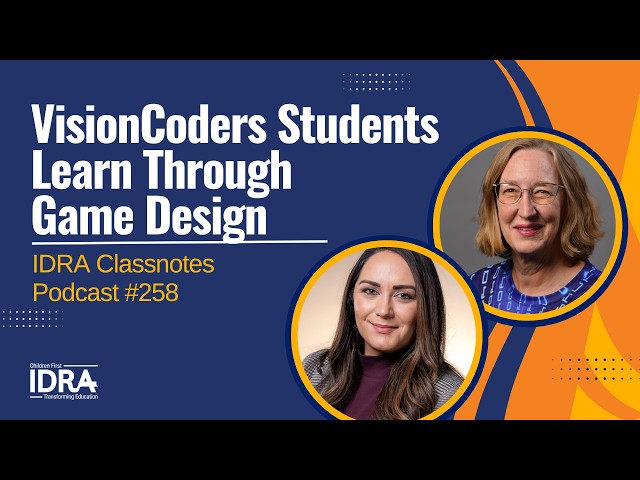
- 14 minutes 30 secondsVisionCoders Students Learn Through Game Design – IDRA Classnotes Podcast Episode 258
Classnotes Podcast (July 21, 2026). How can game design help students become confident problem-solvers and future software developers? In this episode, Stephanie Garcia, Ph.D., and Carol Luckhardt Redfield, Ph.D., discuss how the IDRA VisionCoders program combines computer science, creativity and cross-age mentoring to prepare students for success in school and beyond.
Key Takeaways
-
-
- VisionCoders teaches computer science through game design, giving students authentic opportunities to create technology rather than simply use it.
- Students build computational thinking, creativity, communication and problem-solving skills through an iterative design process.
- Cross-age mentoring motivates middle school students to create educational games that meet the needs and interests of younger learners.
- Making mistakes, testing ideas and improving designs helps students develop confidence and resilience.
- The skills students gain through VisionCoders prepare them for future learning, careers and leadership in technology and beyond.
Resource from the Intercultural Development Research Association (IDRA), a nonprofit advancing education equity.
-
 Today’s fastest-growing careers are tech-driven, and two-thirds of all new STEM jobs are in computing. But in many regions, fewer than 1% of adults work in computer-related fields. The IDRA VisionCoders program is helping build the next generation of software developers.
In this podcast episode, Stephanie Garcia, Ph.D., welcomes Carol Luckhardt Redfield, Ph.D., professor of computer science at St. Mary’s University in San Antonio. Dr. Redfield partnered with IDRA for the past five years to co-develop the VisionCoders curriculum.
VisionCoders is a middle school computer science and leadership course where students design educational games for elementary school students. This asset-based college readiness program serves students who are in at-risk situations. Nearly 80% of VisionCoders students report greater confidence in technology and career pathways; 70% now see tech as key to their futures.
Game design is about more than coding. It helps students become creative problem-solvers, collaborators and confident learners. Dr. Garcia and Dr. Redfield discuss how the IDRA’s VisionCoders program uses game design and cross-age mentoring to build computational thinking, strengthen student engagement, and prepare young people with skills that matter in school, future careers and beyond.
Dr. Stephanie Garcia is IDRA’s STEM education specialist and directs the IDRA VisionCoders and DSEC programs.
Show length: 14:30 min.
Watch Podcast Video
Prev 1 of 1 Next Prev 1 of 1 NextQuotes
“When students are given opportunities to create, design, and solve problems through technology, they’re not just learning computer science. They’re discovering their own potential as innovators, as leaders.”
– Stephanie Garcia, Ph.D.
“Wherever AI goes, we’re still going to need to be able to understand how coding works.”
– Carol Redfield, Ph.D.
“The skills that they’re learning through this program will prepare them for any career path.”
– Stephanie Garcia, Ph.D.
“VisionCoders helped me believe in myself. I’ve realized that I can do hard things as long as I don’t give up. It’s inspired me to keep exploring technology, and I’m even thinking about a career in coding now.”
– VisionCoders student, Danna Rico Granados
Resources
 IDRA VisionCoders, program webpage
VisionCoders: Many Levels of Game-Based Learning, by Redfield, C., Garcia, S., Bojorquez, H., & Puente, A. (2026). In Proceedings of Society for Information Technology & Teacher Education International Conference (pp. 3188-3193). Philadelphia: Association for the Advancement of Computing in Education (AACE).
Curriculum Poster: VisionCoders – Many Levels of Game-Based Learning, by Redfield, C., Garcia, S., Bojorquez, H., & Puente, A.
How video game coding is helping middle schoolers on San Antonio’s South Side, by Xochilt Garcia, San Antonio Report, May 25, 2026
Listen to every episode!
To ensure you don’t miss a single episode of IDRA Classnotes, sign up to receive an e-mail alert as soon as a new show is published and subscribe to the podcast in iTunes, Spotify or Amazon Music.
The post VisionCoders Students Learn Through Game Design – IDRA Classnotes Podcast Episode 258 appeared first on IDRA.
21 July 2026, 4:34 pm -
- 17 minutes 43 secondsSTEM Environments where Girls Thrive – IDRA Classnotes Podcast Episode 257
Classnotes Podcast (July 1, 2026). Research shows that girls’ confidence in STEM subjects often begins to decline during elementary school. In this episode, Stephanie Garcia and Lea Rosenauer discuss how mentorship, representation, family engagement and supportive learning environments help girls develop STEM identities and pursue STEM pathways. Drawing on research and practical experience, they explore strategies that schools, families and community organizations can use to help girls thrive.
Key Takeaways
- Girls’ confidence in STEM often begins to decline during elementary school, even when their abilities remain strong.
- Mentorship and positive female role models help girls develop a stronger STEM identity.
- Supportive environments that normalize mistakes and encourage persistence help girls build confidence.
- Girls are more likely to engage in STEM when they see connections between STEM, problem-solving and helping others.
- Families, schools and community organizations all play important roles in supporting girls’ STEM pathways.
Resource from the Intercultural Development Research Association (IDRA), a nonprofit advancing education equity.
 By about fifth grade, girls’ confidence in STEM subjects starts to fall. As a result, girls are less likely to take higher-level math courses in high school or choose STEM fields in college. But something can be done about it.
In this second recent podcast episode about encouraging girls in STEM courses and fields, Stephanie Garcia, Ph.D., welcomes guest Lea Rosenauer, M.A., President & CEO, Girls Inc. of San Antonio. They discuss key strategies like mentorship, putting positive female role models in girls’ lives and intentionally talking about women who are in STEM fields.
Like IDRA, Girls Inc., starts with the premise that all girls have strengths. Lea describes Girls Inc.’s programming in the out-of-school time space where making mistakes is celebrated.
A recent report by the National Girls Collaborative Project shows that 86% of girls want to be in helping professions. As Lea and Stephanie discuss, when classroom and out-of-school programs make connections between STEM and service along with problem solving, girls see their place in these fields. In addition, family-centered programming helps parents support their daughters as they explore STEM pathways.
Girls belong in STEM. The question is whether we’re building systems that really reflect that truth.
Dr. Stephanie Garcia is IDRA’s STEM education specialist and directs the IDRA VisionCoders and DSEC programs.
Watch Podcast Video
Prev 1 of 1 Next Prev 1 of 1 NextQuotes
“Girls, as early as age 9, don’t believe that they are brilliant enough to have their dream job.”
Lea Rosenauer
“Talent may be universal. Girls have talent and skills. But access and opportunity are not.”
Lea Rosenauer
“Confidence isn’t a personality trait. It’s built through experience, belonging and affirmation.”
Stephanie Garcia, Ph.D.
“The question is not whether girls belong in STEM. They do. The question is whether we’re building systems that really reflect that truth.”
Stephanie Garcia, Ph.D.
“When girls see women who look like them in STEM, that abstract becomes attainable”
Stephanie Garcia, Ph.D.
Resources
Changing the State of Girls in STEM Through Access, Culture and Confidence, by Stephanie Garcia, Ph.D.
The State of Women & Girls in STEM Report, by National Girls Collaborative Project
STEM Equity – Online Technical Assistance Toolkit, IDRA
Student Engagement – Online Technical Assistance Toolkit, IDRA
Building an Ecosystem for Latina Prosperity. Latinitas Conversando podcast featuring Stephanie Garcia, Gabriela Kane Guardia, Johanna Moya Fábregas & Jaime Puente. South by Southwest Edu
STEM Ecosystems Foster Community Engagement for a Strong Future – Partner with a STEM Learning Ecosystem Near You!, August 31, 2022
Meaningful Strategies for Making STEM Accessible, October 30, 2020
Five Best Practices that Add Women to the Equation – Preparing K-12 Girls for Mathematics, May 29, 2019
Listen to every episode!
To ensure you don’t miss a single episode of IDRA Classnotes, sign up to receive an e-mail alert as soon as a new show is published and subscribe to the podcast in iTunes, Spotify or Amazon Music.
The post STEM Environments where Girls Thrive – IDRA Classnotes Podcast Episode 257 appeared first on IDRA.
1 July 2026, 4:42 pm - 50 minutes 54 secondsSeeds We Planted – A Family Legacy of Brown v. Board of Ed. – IDRA Classnotes Podcast Episode 255
Classnotes Podcast (May 15, 2026). Three generations of women educators share how Brown v. Board of Education shaped their lives. Hear personal stories of school desegregation, sacrifice and opportunity, and how one family’s legacy continues to influence education today.
Key takeaways
- Brown v. Board of Education reshaped educational opportunities across generations of the Russaw family.
- School desegregation was a gradual, complex process with personal risks and sacrifices.
- Black educators and communities built strong schools despite inequities and limited resources.
- Access to education often depended on systems and circumstances, not ability.
- Family legacy and lived experiences help explain today’s education landscape.
Resource from the Intercultural Development Research Association (IDRA), a nonprofit advancing education equity.
 In this special Mother’s Day episode of the IDRA Classnotes Podcast, three generations of the Russaw family share how the legacy of Brown v. Board of Education lives on in their own lives.
IDRA staff attorney Makiah Lyons, J.D., is joined by her mother, award-winning educator and former principal Jocelyn Mills, and her grandmother, lifelong educator Janet Russaw. Together, they reflect on growing up during school desegregation in Jefferson County, Tenn., and the choices, sacrifices and courage that shaped their family’s path in education.
Through personal stories, they explore what desegregation looked like beyond the headlines – from stepping onto a bus to integrate schools to navigating loss, opportunity and community change. Their conversation highlights how one generation’s barriers became the next generation’s opportunities.
This episode honors the “seeds” planted by Black families and educators – and the lasting impact of those efforts on today’s students and schools.
Show length: 50:54 min.
Send comments to [email protected]
Sign up to receive free e-mail notices when new episodes are available.
Watch Podcast Video
Prev 1 of 1 Next Prev 1 of 1 NextQuotes
“We got their old textbooks, we got their old typewriters… when they got new stuff, we got their old stuff.”
Janet Russaw
“It’s very interesting to have this conversation, especially for me, because you realize where you were standing in your place in history. Because… from where I came through, I literally was in the middle of all of that transition.”
Jocelyn Mills
“I feel like every student deserves a chance to learn. The expectations for our kids, and especially our boys, was very, very low. I felt like that needed to change.”
Janet Russaw
Resources
Brown v Board of Education – The Law in Education, by Makiah Lyons, J.D., & Paige Duggins-Clay, J.D.
Jefferson County, Tennessee, Black in Appalachia
Black History Month Features, IDRA
Listen to every episode!
To ensure you don’t miss a single episode of IDRA Classnotes, sign up to receive an e-mail alert as soon as a new show is published and subscribe to the podcast in iTunes, Spotify or Amazon Music.
The post Seeds We Planted – A Family Legacy of Brown v. Board of Ed. – IDRA Classnotes Podcast Episode 255 appeared first on IDRA.
15 May 2026, 3:17 pm - 15 minutes 51 secondsEnding Corporal Punishment Starts With Community – IDRA Classnotes Podcast Episode #256
Classnotes Podcast (April 30, 2026). Corporal punishment is still used in U.S. schools, with harmful and disproportionate impacts on Black students, students with disabilities and children in the South. This episode explores how schools can move toward discipline rooted in dignity, relationships and student well-being.
Key takeaways
- Corporal punishment remains legal in 20 states and affects tens of thousands of students.
- Black students and students with disabilities are disproportionately subjected to physical punishment.
- Fear-based discipline harms student trust, learning, attendance and long-term well-being.
- Restorative practices and relationship-building support accountability while preserving dignity.
- Families and communities are essential to shaping fair, culturally responsive discipline systems.
Resource from the Intercultural Development Research Association (IDRA), a nonprofit advancing education equity.
 Corporal punishment in schools remains legal in 20 states, disproportionately harming Black students, students with disabilities, and children across the U.S. South. In this episode, IDRA’s Morgan Craven, J.D., and Aurelio Montemayor, M.Ed., examine why physical punishment persists in schools, the lasting harms it causes and what communities can do instead.
Through a conversation on restorative practices, family engagement and culturally-sustaining discipline, they explore how schools can move away from fear-based punishment and toward learning environments rooted in dignity, accountability and student well-being.
Morgan Craven, J.D., is IDRA’s National Director of Policy, Advocacy and Community Engagement. Aurelio Montemayor, M.Ed., is IDRA’s Family Engagement Coordinator.
Note: The audio version of this podcast episode is not out yet. But we released the video version on April 30, which is the International Day to End Corporal Punishment.
Show length: 15:51 min.
Send comments to [email protected]
Sign up to receive free e-mail notices when new episodes are available.
Watch Podcast Video
Prev 1 of 1 Next Prev 1 of 1 NextQuotes
“If we rely on fear, we’re really destabilizing school environments rather than investing in what we know works to keep kids safe.”
Morgan Craven, J.D.
“Corporal punishment sometimes may produce a moment of silence, but it doesn’t produce understanding. It doesn’t produce responsibility or trust and too often it leaves lasting harm, especially for students who are already carrying the weight of inequity.”
Aurelio Montemayor, M.Ed.
“What we want to do is have systems in place that encourage strong relationships where people understand what’s going on with the young people in the school. They are connected to them. They know their families. And they have those strong relationships. Positive, strong relationships are the root of learning.”
Morgan Craven, J.D.
Resources
End Corporal Punishment in Schools, IDRA webpage
Hitting Hurts – The Case for Ending Corporal Punishment in Texas, IDRA Issue Brief, by Morgan Craven, J.D., and Joanna D. Sánchez, Ph.D., April 2023, updated 2024 (available in English and Spanish)
Restorative Practices Can Prevent and Heal Bias-based Harm, by Paige Duggins-Clay, J.D., IDRA Newsletter, August 2024
IDRA Family Leadership in Education Model, IDRA webpage
IDRA School Discipline – Online Technical Assistance Toolkit
Listen to every episode!
To ensure you don’t miss a single episode of IDRA Classnotes, sign up to receive an e-mail alert as soon as a new show is published and subscribe to the podcast in iTunes, Spotify or Amazon Music.
The post Ending Corporal Punishment Starts With Community – IDRA Classnotes Podcast Episode #256 appeared first on IDRA.
30 April 2026, 3:53 pm - 16 minutes 35 secondsWhat Shapes STEM Pathways for Girls – IDRA Classnotes Podcast Episode 254
Classnotes Podcast (April 28, 2026). Dr. Lizdelia Piñon and Dr. Stephanie Garcia examine why women and girls remain underrepresented in STEM, highlighting how access, culture and policy shape pathways. They also share practical solutions to expand opportunities and strengthen STEM ecosystems.
Key takeaways
- Women and girls remain underrepresented in STEM, not due to ability but systemic barriers.
- Access, culture and confidence shape STEM participation and persistence for girls.
- Anti-diversity, equity and inclusion policies are reducing programs that support STEM pathways.
- Mentorship, hands-on learning and cross-sector partnerships strengthen STEM opportunities.
- Effective STEM ecosystems offer multiple entry points for students to explore and re-engage.
Resource from the Intercultural Development Research Association (IDRA), a nonprofit advancing education equity.
 Why are women and girls still underrepresented in STEM? In this episode, Lizdelia Piñón, Ed.D., talks with Stephanie Garcia, Ph.D., about what the latest data reveal, including in a new report by the National Girls Collaborative Project.
Drawing from recent research and her own experience as a Latina STEM educator, Dr. Garcia explains why the issue is not about ability but about systems. Dr. Piñon and Dr. Garcia discuss how access, culture and confidence shape who participates and persists in STEM, and how recent anti-diversity, equity and inclusion policies are dismantling critical support programs.
The conversation moves beyond the problem to practical solutions: mentorship, hands-on learning and cross-sector partnerships that create real pathways for students. Together, they reimagine what a strong STEM ecosystem can look like – one with multiple entry points where all students can see themselves and succeed.
Dr. Stephanie Garcia is IDRA’s STEM education specialist and directs the IDRA VisionCoders and DSEC programs. Dr. Lizdelia Piñon is an IDRA education associate and a bilingual special education expert.
Show length: 16:35 min.
Send comments to [email protected]
ign up to receive free e-mail notices when new episodes are available.
Watch Podcast Video
Prev 1 of 1 Next Prev 1 of 1 NextQuotes
“Talent is evenly distributed, but opportunity isn’t.”
Sameeha Rizvi
“I don’t see it as a leaky pipeline. That’s a deficit way of looking at it… A really healthy ecosystem looks like a river, or a highway system, with multiple entry and exit points, where students – no matter their age or grade – can jump in, explore and come back to it again later. There’s not a one-size-fits-all approach with STEM education.”
Chloe Latham Sikes, Ph.D.
“All of the anti-diversity, equity, inclusion laws and policies… have dismantled and defunded, high-quality programming. Those support systems are critical to STEM persistence for women and girls, and it’s under attack. It’s just a significant, massive loss of potential talent, ideas and perspectives.”
Alex De Jesus
Resources
Changing the State of Girls in STEM Through Access, Culture and Confidence, by Stephanie Garcia, Ph.D.
The State of Women & Girls in STEM Report, by National Girls Collaborative Project
STEM Equity – Online Technical Assistance Toolkit, IDRA
Student Engagement – Online Technical Assistance Toolkit, IDRA
Building an Ecosystem for Latina Prosperity. Latinitas Conversando podcast featuring Stephanie Garcia, Gabriela Kane Guardia, Johanna Moya Fábregas & Jaime Puente. South by Southwest Edu
STEM Ecosystems Foster Community Engagement for a Strong Future – Partner with a STEM Learning Ecosystem Near You!, August 31, 2022
Meaningful Strategies for Making STEM Accessible, October 30, 2020
Five Best Practices that Add Women to the Equation – Preparing K-12 Girls for Mathematics, May 29, 2019
Listen to every episode!
To ensure you don’t miss a single episode of IDRA Classnotes, sign up to receive an e-mail alert as soon as a new show is published and subscribe to the podcast in iTunes, Spotify or Amazon Music.
The post What Shapes STEM Pathways for Girls – IDRA Classnotes Podcast Episode 254 appeared first on IDRA.
29 April 2026, 2:18 pm - 43 minutes 13 secondsStudent Voices After DEI – The Law in Education – IDRA Classnotes Podcast Episode 253
Classnotes Podcast (April 24, 2026) – Students, advocates and researchers examine how Texas Senate Bill 17 and related policy changes are affecting college access, campus climate and student support systems. The episode highlights student experiences, emerging research and efforts to sustain opportunity.
Key takeaways
- Texas SB 17 and related policies are reshaping college access and campus supports.
- Students report loss of services, safe spaces and culturally relevant resources.
- Policy changes are influencing college choices, including undermatching and reduced options.
- Faculty, staff and students face uncertainty, self-censorship and shifting campus climates.
- Students and communities are organizing to sustain support systems and protect opportunity.
Resource from the Intercultural Development Research Association (IDRA), a nonprofit advancing education equity.
 As diversity, equity, and inclusion policies in education face political backlash, Texas has become ground zero for some of the most sweeping changes. Following the U.S. Supreme Court’s decision to end race-conscious college admissions in Students for Fair Admissions v. Harvard, Texas enacted Senate Bill 17, which bans diversity, equity and inclusion offices and programs at public colleges and universities. These moves, alongside additional state and federal actions, are already reshaping the educational landscape and putting college access further out of reach for many Texas students.
In this episode, IDRA education law intern Adiba Chowdhury and IDRA Deputy Director of Policy, Chloe Latham Sikes, Ph.D., are joined by Alexander De Jesus and Sameeha Rizvi, who both members of the Texas Students for DEI Coalition. They dissect the nature of recent legislative changes and their impact on Texas students. As a bonus, Dr. Sikes shares recent findings from IDRA’s ongoing study on the impact on SB 17, and Adiba shares testimony from college advisors who participated in the study.
Show length: 43:13 min.
Send comments to [email protected]
Sign up to receive free e-mail notices when new episodes are available.
Watch Podcast Video
Prev 1 of 1 Next Prev 1 of 1 NextQuotes
“DEI didn’t appear out of nowhere. It’s because students had the guts… demand that fair access.”
Sameeha Rizvi
“We’ve heard high school students, advisors and parents say they’re worried about how their student can actually academically succeed in college if they don’t feel they even belong.”
Chloe Latham Sikes, Ph.D.
“What chilling effect is coming next? Where is the university going to silence me?”
Alex De Jesus
“It’s going to be exhausting, but this is a long-term movement. It’s not a moment. We have to keep on fighting. It didn’t start here. It doesn’t end here.”
Sameeha Rizvi
Resources
Texas Students for DEI website
Texas Students For DEI Mutual Aid Fund for Undocumented Students
IDRA infographic – Understanding Texas’s Diversity Equity and Inclusion Ban at Public Universities
Info on IDRA’s study – College Access Study on the Impact of Diversity, Equity and Inclusion Restrictions
Practical tools schools can use now to help students transition to college – IDRA’s Community-Based College Access – Online Technical Assistance Toolkit
Final research report – Staying on Course When Schools Steer Clear: A Community-Based Study on the Impacts of Texas’ Diversity Policy Change on High School Students and Tools to Expand their College Pathways, by Chloe Latham Sikes, Ph.D.
Research brief – Beyond the Bans – How Legal and Policy Changes Limiting Diversity, Equity and Inclusion Practices Compromise Student Opportunity, by Chloe Latham Sikes, Ph.D., and Adiba Chowdhury
IDRA preliminary report – A Community-Based Study on the Impact of Texas’ SB 17 on Marginalized College-Going Students, by Chloe Latham Sikes, Ph.D.
Listen to every episode!
To ensure you don’t miss a single episode of IDRA Classnotes, sign up to receive an e-mail alert as soon as a new show is published and subscribe to the podcast in iTunes, Spotify or Amazon Music.
The post Student Voices After DEI – The Law in Education – IDRA Classnotes Podcast Episode 253 appeared first on IDRA.
24 April 2026, 3:52 pm - 21 minutes 16 secondsThe Work Ahead and the Hope That Fuels It – IDRA Classnotes Podcast Episode 252
 Classnotes Podcast (October 22, 2025). In the final episode of the series, IDRA Education Policy Fellows share what gives them hope and what comes next. After nine months of intense legislative advocacy, relationship building, and personal growth, they offer advice to others entering this work and reflect on how the fellowship changed their trajectories. Their stories are a powerful reminder that advocacy isn’t a moment, it’s a movement.
Mikayla Arciaga, M.A.Ed., Georgia Advocacy Director & Education Policy Fellows Coordinator, led the conversation with fellows: Vivek Datla, MPA, IDRA Education Policy Fellow – Regional, DeAndrea Byrd, IDRA Education Policy Fellow – Georgia, Isabelle Philip, IDRA Education Policy Fellow – Policy Communications, and Kaci Wright, M.Ed., IDRA Education Policy Fellow – Texas.
The IDRA groundbreaking Education Policy Fellows Program is changing the landscape of state education advocacy by training advocates with a commitment to and experience with communities of color to influence state laws and lead a powerful network of impacted communities. The 2024-25 cycle of this program is being generously supported by the Trellis Foundation, The William and Flora Hewlett Foundation, and the Kresge Foundation.
Show length: 21:16 min
Send comments to [email protected]
Watch Podcast Video
Prev 1 of 1 Next Prev 1 of 1 NextResources
IDRA 2024-25 Fellows – Bios and writings. Plus profiles brochure
IDRA Education Policy Fellows Program
Policy Whiplash in Georgia – The 2025 Session Delivered Education Gains, Losses and Looming Threats, with Terrence Wilson, J.D., Mikayla Arciaga, M.A.Ed., Isabelle Philip & Makiah Lyons, J.D., IDRA Newsletter, June-July 2025
Legislature Dances the Texas Three-Step: Defund, Demonize, Privatize Public Education, with Vivek Datla, MPA, IDRA Newsletter, June-July 2025
Student Voices on Public Policy, video feature by Trellis Foundation, May 2025
IDRA Education Policy Fellow Feature, video feature by Trellis Foundation, August 2025
Post-fellowship evaluation report of the program’s first cycle
Listen to every episode!
To ensure you don’t miss a single episode of IDRA Classnotes, sign up to receive an e-mail alert as soon as a new show is published and subscribe to the podcast in iTunes, Spotify or Amazon Music.
The post The Work Ahead and the Hope That Fuels It – IDRA Classnotes Podcast Episode 252 appeared first on IDRA.
22 October 2025, 2:27 pm - More Episodes? Get the App