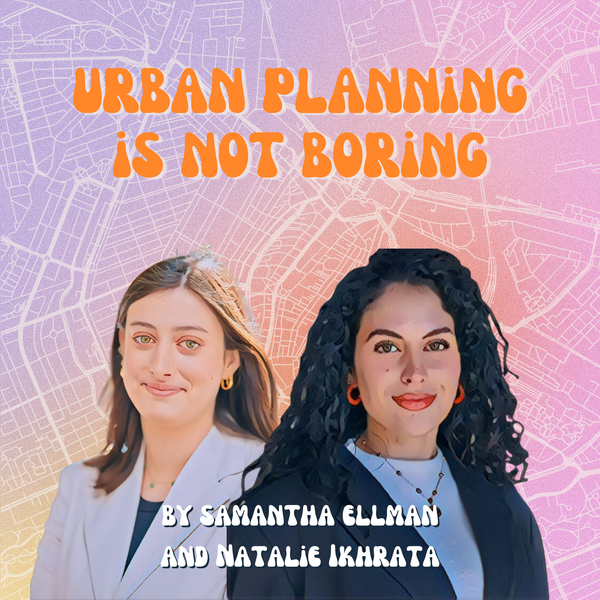
Urban Planning is Not Boring
Samantha Ellman and Natalie Ikhrata
Passionate about climate change mitigation, finding equitable solutions to the housing crisis, and more, Sam Ellman and Natalie Ikhrata dive into various topics related to the field of urban planning that are anything but boring! This podcast aims to break down complex urban planning concepts and present them in an accessible and engaging way for listeners of all backgrounds. Whether you are a seasoned urban planner or simply interested in learning more about how cities are designed and built, "Urban Planning is Not Boring" is the perfect podcast for you.
- 44 minutes 44 secondsConversations from Riverside: A Live Episode from the APA California State Conference
Welcome back to Urban Planning is Not Boring! We had the privilege of interviewing three incredible planners from the City and County of San Bernardino, plus a special appearance from the APA California President, live from the APA 2024 California State Conference in Riverside! In this episode, we dive into their unique roles in local government, what brought them to the conference, and what they’re most excited about in the world of urban planning. We also explore the latest planning trends shaping the Inland Empire and get their top advice for first-time APA conference attendees. Whether you're new to the field or a seasoned planner, this episode is packed with insights you won’t want to miss!
Special Guests include:
- Andrea Ouse, Director of Community Development at City of West Sacramento and President, APA California Chapter
- Kassie Vickers, San Bernardino County Economic Development
- George Velarde, Associate Planner at City of San Bernardino
- Angelyn Mendoza, Assistant Planner at City of San Bernardino
7 October 2024, 8:00 am - 54 minutes 7 secondsDesigning Exclusion: Hostile Architecture with Jonathan Pacheco Bell
In this episode of Urban Planning is Not Boring, we sit down with Senior Embedded Planner at 4Leaf Inc., Jonathan Pacheco Bell, to discuss hostile architecture. Jonathan recently appeared on the Decoder Ring and KJZZ NPR Phoenix podcasts where he discussed the inequities in public spaces caused by hostile architecture. He defines hostile architecture as "elements of the built environment that are designed to deter human behaviors and make targeted populations feel uncomfortable in public space." Together, we explore how hostile architecture impacts the built enviornment and public spaces, with a particular focus on how it marginalizes vulnerable communities. We discuss the ethics, impact, and alternatives to designing more inclusive public spaces. Tune in for an eye-opening conversation about the built environment and the oftentimes overlooked strategies shaping our public spaces.
About Jonathan Pacheco Bell
Jonathan Pacheco Bell is a Senior Embedded Planner at 4LEAF, Inc., Lecturer in Urban & Regional Planning at Cal Poly Pomona, and Vice President/Public Information Officer of the nonprofit Florence-Firestone Community Organization in South Central Los Angeles.
A practicing urban planner with over 20 years of experience spanning the public, private, and nonprofit sectors, Jonathan has expertise in community engagement, participatory design, inclusive public space, long-range plans, zoning enforcement ordinance development, planning studies, and project management.
During his tenure as a County planner in South Central LA’s Florence-Firestone community, Jonathan created Embedded Planning. This praxis situates the work of planners on the street-level, not behind a desk, to increase equity and participation for historically marginalized populations harmed by inequitable planning. What began in South Central is now an international movement of Embedded Planners with feet on the street. Jonathan has guest lectured widely on Embedded Planning praxis. His speaking engagements include Columbia University, UCLA, Ohio State, University of Utah, Pratt Institute, Stanford Engineering, Woodbury University, and East LA College Architecture; state and national APA Conferences in California, Iowa, and Louisiana; and public forums such as AARP Livable Communities, City Parks Alliance, and the SF Urban Film Fest.Jonathan has been a leader in the American Planning Association for over a decade. He’s a member of the Latinos and Planning Division and is published in APA’s practitioner magazine, Planning. He previously served as APA Los Angeles Social Media Director and was the Southern California representative on the APA National Social Equity Task Force. This year, Jonathan proudly received the Planning Advocate Award of Excellence from APA Los Angeles and the Planning Pioneer Award of Excellence from APA Inland Empire.
Born and raised in LA’s Latino/a Eastside, Jonathan serves as a mentor to First Gen students and emerging planners. A product of the California public school system from kindergarten to graduate school, he holds an M.A. in Urban Planning from UCLA Luskin School of Public Affairs, and additional degrees in library and information science, political science, and architecture. Connect at c1typlann3r.blog.
24 September 2024, 8:00 am - 50 minutes 50 secondsNavigating Early Careers: Insights from APA
In this episode of Urban Planning is Not Boring, Sam and Nat are joined by three representatives from various APA California chapters who share their experiences as young and emerging planners and discuss opportunities at the upcoming APA California Conference:
- Tony Lopez, APA Inland Empire
- Kyle Wilson, APA Orange County
- Brittany Montano, APA Los Angeles
Join us as we dive into the world of young and emerging planners with a focus on the American Planning Association (APA) and its support for early-career professionals. We explore how APA helps shape the future of urban planning by fostering leadership, providing mentorship, and building networks for young professionals. Join us as we hear from members of the Young and Emerging Planners group, who share their experiences, challenges, and the resources that have helped them navigate the early stages of their careers. Whether you’re a student, a new planner, or someone looking to support the next generation of urbanists, this episode offers valuable insights on how APA is empowering the future of planning.
APA California Conference
Free Student Day: Saturday, September 28th from 8 AM - 11 PM
Student Day Sessions:
- Urban Planning is Not Boring (UPINB) Unplugged: Insights for Professional Growth
- Your Dream Job May Not Exist (Yet!) – The Long and Winding Road for Planning Careers
- Cultivating Your internship for a Successful Planning Career
- What Students Want/What Employers Need (CPF)
- Dude, Where’s my Job? Finding your Way in the Planning Profession
Other Student / YEP Activities:
- Buddy Program (Mentorship)
- Headshots
- Career Day - Resume/Interview Workshops (Sunday 9/29)
- Saturday Night Mixer
- Tactical Urbanism Workshop
- UPINB Meet and Greet (Saturday, September 28th @ 8 AM) and Live Episode
How to Participate:
- Register for the Conference: apacalifornia.org/conference/2024-conferences
- Students will earn a $100 stipend for volunteering (min. 4 hours) at the conference. Sign up with our interest form and we will connect with you. Please be sure to register for the conference as well.
9 September 2024, 8:00 am - 26 minutes 26 secondsWE ARE SO BACK!
After a few months off, we're excited to say that Urban Planning is Not Boring is back! In this episode, we're catching up on what we've been up to during the break and sharing some personal updates. Don't worry—your favorite urban planning content is just around the corner. Stay tuned for more deep dives into the world of urban planning in upcoming episodes!
Coming Soon!
We will be hosting a session at the APA California 2024 Conference in Riverside California! If you'll be there, come say hi!
- “Urban Planning is Not Boring” Unplugged: Insights for Professional Growth"
- September 28, 2024, 10:15 AM-11:15
- Embarking on a journey in the field of urban planning can be daunting for new and emerging planners. Join Sam and Nat, hosts of "Urban Planning is Not Boring" and recent USC Master of Urban Planning alums, for a Q&A session focused on mentoring, leadership, networking, and more!
27 August 2024, 8:00 am - 26 minutes 32 secondsReimagining Downtowns in a Post-Pandemic World
Welcome back to "Urban Planning is Not Boring"!
We'll examine the historical context of downtown "ghost towns" and how this phenomenon is not entirely new but rather a cyclical pattern in urban development. From white flight to suburban sprawl, we'll trace the trajectory of downtowns over the last few decades, from decline to revival and now to uncertainty.
The COVID-19 pandemic accelerated existing trends and brought about unprecedented challenges. With remote work becoming the norm and downtown office spaces sitting empty, downtowns are grappling with an existential crisis. Yet, amidst the uncertainty, there lies an opportunity for reimagining and revitalizing our urban cores.
We'll discuss the findings of the Brookings research project and delve into strategies proposed by urban planners and local jurisdictions for reinvigorating downtowns. From inclusive workforce development to placemaking initiatives, we'll explore innovative approaches to breathe new life into our city centers.
Join us as we rethink the future of downtowns and navigate the path forward in reshaping urban cores post-COVID.
Sources:
To recover from COVID-19, downtowns must adapt
Breaking the ‘urban doom loop’: The future of downtowns is shared prosperity
5 March 2024, 9:00 am - 38 minutes 34 secondsVMT 101: Understanding the Basics of Vehicle Miles Traveled
Welcome back to Urban Planning is Not Boring! In this episode, we dive into an acronym many of you are likely familiar with, VMT. We start by breaking down the concept of VMT - vehicle miles traveled - which essentially measures the total distance traveled by vehicles, typically on a daily basis. To illustrate, imagine driving 20 miles to work, 5 miles to the gym, and 15 miles back home from the gym. That totals to 40 vehicle miles traveled for the day. But why does VMT matter?
We explore the legislative context surrounding VMT, particularly in California where initiatives like SB 743 have revolutionized the way transportation impacts are evaluated for new development projects. Instead of solely focusing on traffic flow and congestion reduction (Level of Service (LOS)), the emphasis has shifted towards reducing VMT to combat issues like greenhouse gas emissions.
But it's not just about legislation; reducing VMT brings a multitude of co-benefits, from mitigating air pollution and water pollution to promoting active lifestyles and improving mental health. We examine various approaches to address VMT, including Transportation Demand Management (TDM) strategies, transit subsidies, bike and pedestrian infrastructure improvements, and thoughtful land use decisions.
Ultimately, everything seems to converge on the principles of walkability and accessibility, with the vision of creating vibrant, sustainable communities where driving less is not only feasible but also desirable. Join us as we explore the multifaceted world of VMT and its implications for the future of transportation and urban development.
12 February 2024, 9:00 am - 44 minutes 20 secondsBeyond Home and Work: Exploring the Importance of Third Places
Welcome back to Urban Planning Is Not Boring! In today's episode, we delve into the concept of third places – those vital social hubs that bridge the gap between our homes (first places) and workplaces (second places). Join us as we uncover why third places are essential to fostering vibrant, connected communities.
American sociologist Ray Oldenburg introduced the notion of third places as crucial to democracy and social cohesion in this 1989 book "The Great Good Place".
Despite the allure of digital connectivity, research indicates that physical third places offer unique benefits. From promoting informal social interaction to strengthening productivity, these spaces play a pivotal role in shaping our collective well-being.
However, several impacts to the accessibility and allure of third places, including urban sprawl, technological advancements, and the COVID-19 pandemic, have created a decline in traditional third places. We examine what defines a third place – its atmosphere, accessibility, and sense of community – and discuss strategies urban planners can implement to revitalize these vital spaces.
From reimagining public spaces to fostering mixed-use developments, city planning efforts are adapting to prioritize the creation of third places. If you've been on TikTok or Reels lately, you've probably seen the rise of third places into mainstream media, thanks to creators like @signedbritt. The discussion on third places gives a name to the phenomenon that many people have experienced, such as after graduating college and realizing how walkable and accessible many amenities are on a college campus.
Join us as we navigate the past, present, and future of third places, and discover why these social sanctuaries are key to fostering social connections.
Sources:
- Protecting the “Third Place:” The Pandemic’s Impact on Commercial Corridors and How to Support Them
- Third places, true citizen spaces
- Do Yourself a Favor and Go Find a ‘Third Place’
- “Third places” as community builders
31 January 2024, 9:00 am - 42 minutes 47 secondsSpotlight on APA Inland Empire
Welcome back to Urban Planning is Not Boring! In this episode, Nat and Sam sit down with representatives from the American Planning Association (APA) Inland Empire Section to dive into the excitement surrounding the upcoming APA California Conference in Riverside from September 28th through October 1st.
- Discover the purpose and vision behind APA and its Inland Empire Section, explore the initiatives of the Diversity Division, and learn how the Young and Emerging Planners Group is shaping the future of urban planning.
- Join us as we unravel the details of the APA California Conference - the theme, dates, and location - and explore how this year's conference aligns with the pressing challenges and opportunities faced by planners today.
- Delve into the urban planning trends and history of the Inland Empire, and gain insights into the strategies employed to encourage diverse participation in the call for abstracts. Our guests share how inclusivity is prioritized in the selection process.
- Get a sneak peek into the conference atmosphere, as we discuss memorable sessions from previous conferences and how APA Inland Empire fosters collaboration and networking opportunities for attendees, speakers, and exhibitors.
We'll also be spreading the word about the call for sessions and registration, so if you're passionate about planning or have a story to share, this episode is for you!
Mark your calendars, stay informed, and be part of this vibrant planning community. Tune in to discover what's in store at the APA California Conference and learn the best ways to stay updated on APA IE and California events.
Episode Information
APA California 2024 Conference
APA California 2024 Call for Proposals
About Emily Elliot - Emily is a planning consultant based in Redlands, California and focuses her work within the Inland Empire. With a background in both the public and private sectors, she currently leads the newly minted Community Planning practice for MNS Engineers. A first-generation college graduate, she earned an associate degree from Palomar Community College, a bachelor’s degree in Geography from San Diego State University, and a Master of Urban and Regional Planning from CalPoly Pomona which she followed with AICP certification. Emily volunteers her time to the American Planning Association as Director of the Inland Empire Section and co-chair of the 2024 state conference host committee, and as a Community and Route Steward for Bikepacking Roots, a non-profit that supports and advances bikepacking, the growth of a diverse bikepacking community, and access to and the conservation of public lands.
About Ebony J. McGee Andersen - Ebony J. McGee Andersen is the founder and Director of ejma Planning + Development, Inc.; a boutique planning firm specializing in commercial and industrial project management. She is an experienced Urban and Regional Planner with a background in natural resource development, including oil and gas and surface mining entitlement, CEQA and regulatory compliance. Ebony has a bachelor’s degree in political science and African/African American Studies from the University of California, Davis and a Masters Degree in Urban and Regional Planning from California State Polytechnic University, Pomona.
About Tony Lopez - Tony is an embedded urban planner based in Southern California where he is a product of the California Community College and Public University systems. He earned an associate degree in behavioral science from Mount San Antonio College and a bachelor’s degree in urban and Regional Planning from Cal Poly Pomona. Looking to gain a global lens, Tony sought out his master’s degree in the Netherlands where he studied strategic planning and policy in the Urban Management and Development program at Erasmus University. Today, he currently works as an environmental planner with AECOM on strategic sustainable projects in San Diego, Los Angeles, and Orange County. He is also a volunteer with the American Planning Association, where his efforts focus on providing students and early-career planners with resources and network opportunities, specifically in the Inland Empire region. This past year, he has organized resume/interview workshops, social network events, and planning symposiums with universities and community colleges. He will be chairing the emerging planners and student day subcommittee at the 2024 State Conference.
16 January 2024, 9:00 am - 1 hour 6 minutesTransit-Oriented Development (TOD) East to West with Four Degrees to the Streets
Happy New Year! Welcome back to Urban Planning is Not Boring! We are back from our break with a very exciting episode! In this joint episode, the Four Degrees to the Streets and Urban Planning is Not Boring podcasts come together to discuss Transit-Oriented Development (TOD). Hosts Nimo, Jas, Sam, and Nat use their expertise and experience living in TODs as a backdrop to give a coast-to-coast perspective on this complex subject. Press play to hear:
- TOD defined as a mixed-use community that encourages people to live near transit services and decrease their dependence on driving and its key components and history
- Examples of TOD programs including BART (Bay Area Rapid Transit), NJ Transit, the City of Chicago's ETOD (equitable transit-oriented development) plan, and the Federal Transit Administration TOD Pilot Program
- Considerations for the future of TOD
Learn more about Four Degrees to the Streets, a podcast designed to empower anyone curious about places and spaces and tune in every other Tuesday. Follow Four Degrees to the Streets on X and Instagram @the4degreespod, or send them an email to connect!
Resources
Histories of Transit-Oriented Development: Perspectives on the Development of the TOD Concept
ETOD | Equitable Transit-Oriented Development
Pennrose Gives Back to Veterans Through Housing
Dover officials open new 70-unit affordable family and veterans housing in downtown
FTA FY 2023 Competitive Funding Opportunity: Pilot Program for Transit-Oriented Development
2 January 2024, 9:00 am - 27 minutes 12 secondsChallenges and Controversies: The Homelessness Crisis and Supreme Court Appeal
Welcome back to Urban Planning is Not Boring! In this episode, we delve into the bipartisan alliance formed to address a growing crisis: homelessness. Inspired by a recent New York Times article titled "In Rare Alliance, Democrats and Republicans Seek Legal Power to Clear Homeless Camps," we explore the pressing issue of homelessness in the United States and the legal complexities surrounding the removal of homeless encampments from public spaces.
Join us as we discuss the legal challenge presented by the 2018 "Boise decision," and the motivations behind politicians from diverse backgrounds urging the Supreme Court to reevaluate the ruling. We'll also hear perspectives from homeless rights advocates who emphasize the importance of comprehensive solutions to address homelessness. The outcome of this legal challenge could have significant implications for how the nation tackles this ongoing issue.
23 October 2023, 2:00 pm - 36 minutes 34 secondsA Brief Introduction to Affordable Housing
Welcome back to "Urban Planning is Not Boring." In this special episode, we're revisiting an essential topic that we recently covered in our class for Abundant Housing LA: "Introduction to Affordable Housing." Affordable housing is a pressing issue in cities worldwide, and it's crucial to understand the fundamentals of this complex and multifaceted subject. Whether you're an urban planning enthusiast, a housing advocate, or someone seeking to make sense of the challenges and solutions in your community, this episode is for you.
Join us as we dive into the core concepts of affordable housing, unpacking the key terminology, policies, and strategies that underpin this critical field. We'll provide a concise overview of the various approaches to affordability, from subsidized housing to inclusionary zoning, and explore the impacts of the housing crisis on communities and individuals.
Whether you're new to the subject or looking to expand your knowledge, AHLA's "Below Market Housing Blueprint" course is your gateway to a critical conversation about housing affordability, accessibility, and the path to creating more inclusive and equitable cities. Our goal is to demystify affordable housing, making it accessible and understandable for everyone. We'll address common misconceptions, share real-world examples, and discuss the importance of equitable housing solutions.
Enroll today in Abundant Housing LA's Below Market Blueprint Course.
"Our new 6-week course covers affordable housing's journey through LA County's processes like housing elements and CEQA. Kicking off the course are hosts of the Urban Planning is Not Boring podcast to give you a primer on affordable housing and its nuances!"
This course is a $450 value! Use the coupon code RENT75 to pay only $112.50! Enroll anytime! Live sessions are recorded and accessible for a year!
If cost is a barrier, email [email protected] for a scholarship!10 October 2023, 9:00 am - More Episodes? Get the App