- 8 minutes 52 secondsFrom Asimov to Planetary Intelligence: Rebooting Seldon Crisis
After a long pause, Seldon Crisis is back—with a new name, a broader focus, and a new home. What began as a Foundation-focused story + dramatization + commentary show is rebooting as Seldon Crisis: Beyond Foundation, exploring the near- and long-term futures of life, intelligence, and civilization—especially as today’s headlines start to echo Asimov’s themes of collapse and recovery.
In This Episode
- Why I started Seldon Crisis five years ago
- What changed—and why the show paused
- Why Foundation feels newly relevant in the era of:
- AI acceleration
- climate and planetary crisis
- inequality and political dysfunction
- systemic and existential risk
- The new show identity and direction
- The move to Substack and what it enables
What’s New
- New title: Seldon Crisis: Beyond Foundation
- New description: An exploration of the range of possibilities for life and intelligence in the near and distant future.
- New platform/home: Substack via seldoncrisis.net
- Better organization: episodes categorized as:
- Story (narrative episodes)
- Conversations (guest interviews)
- Reflections (solo essays & commentary)
- Some topics may be written-only when visuals matter.
Upcoming Topics
A planned episode inspired by three major thinkers:- Sara Imari Walker — Assembly Theory (with Lee Cronin) and new ideas about the origin of life
- David Grinspoon — Earth in Human Hands and intentional planetary stewardship; co-author (with Walker) on planetary intelligence
- Benjamin Bratton — speculative theory on planetary computation and large-scale systems thinking
Also coming: more guest conversations, including returning and new guests.
Release Schedule Note
- Posts will typically appear on Substack first, then be recorded and released as podcast episodes.
- As of recording, this post and two more are already up at seldoncrisis.net, with audio versions coming soon.
Credits
- Theme music: Tom Barnes (updated theme featured after the close)
Thank you to everyone who listened in the past—and to everyone returning now. I’m excited to keep going in a format that can last.
Next episode: Assembling Gaia26 January 2026, 1:10 am - 1 hour 2 minutesBeing Bayta with Amanda Kreitler
In this episode of Seldon Crisis,host Joel McKinnon is joined by voice actor Amanda Kreitler, the talent behind Bayta Darell and several other key characters in the Foundation podcast series. Together, they reflect on Amanda’s experience voicing Bayta, her introduction to Isaac Asimov’s work, and her approach to portraying such an intelligent, dynamic, and brave character. They also discuss the challenges and nuances of voice acting multiple roles and the lasting impact of Bayta Darell as a pioneering female character in Asimov’s universe.
Highlights:
- Introduction of Amanda Kreitler:
Amanda is celebrated for her role as Bayta Darell, Asimov's first major female character, introduced in The Mule episodes. Joel explains how Amanda came to join the project and highlights her versatility, noting her performances as Bayta, Lady Callia, Poli, the Fifth Speaker, and more. - Asimov’s Female Characters:
Discussion about Asimov’s struggle to write compelling female characters early in his career, contrasting the cold and analytical Susan Calvin with the warm, empathetic Bayta Darell. Joel and Amanda explore how Bayta’s compassion and bravery set her apart. - Amanda’s Preparation:
Amanda shares how she approached the role of Bayta Darell, channeling traits like intelligence, determination, and a touch of naïveté. She drew inspiration from Katherine Hepburn for Bayta's confident and quick-witted demeanor. - Voice Acting Challenges:
Amanda recounts her process of creating distinct voices for multiple characters in a single episode, such as the scene where Bayta interacts with her coworkers, each with a unique personality. She also talks about balancing emotional depth with vocal performance. - Reflecting on the Mule’s Storyline:
Joel and Amanda revisit pivotal scenes, including Bayta’s fateful choice to shoot Ebling Mis to save the galaxy. They explore the emotional and moral weight of Bayta’s decision and how it underscores her heroism. - Bayta’s Legacy:
Joel reflects on Bayta’s impact as Asimov’s first significant female character, emphasizing her compassion and empathy as the qualities that ultimately thwart the Mule’s plans. - Behind-the-Scenes Fun:
Insights into working on Seldon Crisis, including Amanda’s experiences collaborating with her husband, Zac, who voiced the menacing Lord Stettin, and the dynamic of voicing multiple characters. - Amanda’s Current Projects:
Amanda updates listeners on her work as the Game Master for Severed Fate, a horror-themed tabletop role-playing podcast. She discusses the challenges of voicing entire worlds of characters and her love for the horror genre.
Notable Quotes:
- On Bayta’s Strength:
“Her natural inclination to see Magnifico as a friend in need rather than an object of ridicule led the Mule to avoid controlling her… Bayta’s compassion and bravery are what made her a true heroine.” – Joel McKinnon - On Portraying Bayta:
“I pulled a bit of Katherine Hepburn—quick speaking, intelligent, and confident, even when in over her head.” – Amanda Kreitler
What’s Next for Seldon Crisis:
Joel teases the return of story episodes after a long hiatus, promising new chapters of Asimov’s Foundation series, with Amanda reprising her role in future episodes.Listen to Seldon Crisis:
Available on your favorite podcast platforms. Stay tuned for more story episodes and guest conversations.24 January 2025, 9:09 pm - Introduction of Amanda Kreitler:
- 1 hour 35 minutesBeyond Asimov's Humanism with Jamie Woodhouse
Ethicist Jamie Woodhouse has some challenging questions for humanity: should we care about the suffering of all sentient beings, or just the ones who run the show at the moment? What about when we're no longer running the show? Why should a superintelligent and possibly sentient machine intelligence care about us? Might there be other practical reasons to widen our circle of compassion beyond humans?
Active Transcript by Fanfare (read/listen).
Introduction: Revisiting Asimov’s Humanism
Joel reflects on Asimov's humanist philosophy, rooted in evidence, reason, and concern for humanity's progress. However, this anthropocentric focus leads to an important question: can humanism evolve to include all sentient beings?
The Core of SentientismJamie Woodhouse introduces Sentientism as a naturalistic worldview advocating evidence, reason, and compassion for all sentient beings. He discusses how this broader ethical scope addresses humanism's anthropocentric blind spots and extends moral consideration to non-human animals and even potential artificial intelligences.
The Role of Sentientism in Modern CrisesThe conversation highlights the intersection of Sentientism with critical global challenges like:
- Climate Change: The role of animal agriculture in exacerbating climate issues and the potential for Sentientism to influence more sustainable practices.
- AI Ethics: Speculating on the alignment of artificial intelligence with ethical frameworks, including the intriguing notion that future superintelligences might force humans to adopt more compassionate practices.
Sentientism in Action
Jamie explores practical applications, from rethinking agricultural systems to extending compassion beyond humanity. He suggests rewriting the Universal Declaration of Human Rights to encompass "Sentient Rights" as a bold step forward.
Science Fiction and Ethical FrontiersThe discussion pivots to the portrayal of sentience in science fiction. From Asimov’s Gaia to Kim Stanley Robinson’s Aurora and Iain M. Banks’ Culture series, sci-fi offers fertile ground for exploring ethical questions about sentient beings, human or otherwise.
Key Quotes:- Jamie Woodhouse on Sentientism:
"Sentientism says, in a line, we should commit to evidence, reason, and compassion for all sentient beings." - On AI and Ethics:
Joel McKinnon: "Maybe someday advanced AI will tell us, ‘We won’t kill you, but you can’t eat meat anymore.’"
Jamie Woodhouse: "That’s an interesting thought. It flips the script—an intelligence with a broader ethical framework imposing limits on us for the benefit of others." - Expanding Morality:
"The reason I might care about you isn’t because we share DNA but because you have the capacity to suffer and flourish. That’s what truly matters."
Referenced Works and Further Reading:
- Humanism and Asimov:
- Sentientism Resources:
- Ethics and AI:
- Global Biomass of Animals
- Advocacy for Climate and Sentient Beings:
15 December 2024, 6:21 pm - 1 hour 46 minutesA Meeting at Stars End with Jon Blumenfeld
Jon Blumenfeld - the voice of Homir Munn in our story episodes - is one of the three hosts of Stars End, a podcast obsessively focused on the works of Isaac Asimov, particularly Foundation. They have covered the core trilogy, the prequels, and the four books in the robot series, as well as extensive coverage of the Apple TV series. Join us as we talk about the exciting second season of the show, Asimov's robots, AI, and other topics.
Transcript: Web (Read/Listen) | PDF | MS Word
Guest: Jon Blumenfeld
Host: Joel McKinnonIntroduction and Background
- Discussion about the growth and reception of the Stars End Podcast.
- Mention of the Hari Awards hosted by Stars End Podcast.
Challenges of Podcast Editing
- Joel and Jon discuss the intricacies of editing, including noise reduction and the removal of filler words.
- Both agree that editing helps in maintaining the quality of the podcast.
Foundation Series: Book vs. TV Show
- Debate on the tension between book purists and TV show enthusiasts.
- Discussion on how the TV show has diverged from the books but still maintains entertainment value.
Character Deep Dive: Demerzel
- Analysis of Demerzel's character in the Foundation series.
- Discussion on the theme of personhood and how Demerzel navigates her programmed life.
Moments of Levity
- Joel and Jon share their favorite moments of humor in the Foundation series.
Environmental Themes and Social Relevance
- Joel expresses his initial hopes that the Foundation series could spark an environmental conscience.
- Both agree that while the show is entertaining, some of the deeper themes may have been sidelined for spectacle.
Podcasting Tips and Tricks
- Jon shares his editing process and how he uses Audacity.
- Joel talks about the different approaches he takes for story episodes versus conversational episodes.
Closing Remarks
- Mention of possible future collaborations and episodes.
- Final thoughts on the Foundation series and its impact.
Stars End Podcast (website)
The Second Annual Hari Awards Ballot (questionnaire)13 October 2023, 5:30 pm - 1 hour 29 minutesThe Golden Age of Science Fiction with Cora Buhlert
Cora Buhlert is a Hugo award winning indy Sci Fi writer and an expert on the Golden Age of Science Fiction, from the 1930s to the 50s, the period when Asimov fell in love with Sci Fi and became one of its greatest writers at a young age. Cora shares some of her favorite reflections on the period and comments on the new Apple TV adaptation of Foundation.
Transcript: Web (Read/Listen) | PDF | MS Word
Host: Joel McKinnon
Guest: Cora BuhlertIntroduction
In this episode, we dive deep into the Golden Age of Science Fiction with Cora Buhlert, an indie science fiction writer, Hugo Award winner, and an expert on Asimov's Foundation series.
Cora Buhlert
- Website: Cora Buhlert's Official Website
- Hugo Award: Hugo Awards Official Site
- Recent Works:
- Essay on Foundation: Asimov's Foundation and Philosophy: Psychohistory and Its Discontents
Wikipedia: Golden Age of Science Fiction
Other Authors and Works Mentioned- Leigh Brackett: Wikipedia, The Long Tomorrow
- C.L. Moore: Wikipedia, Jirel of Joiry
- Edgar Rice Burroughs: Barsoom Series
- E.E. Smith: Lensman Series
Podcasts and Blogs19 August 2023, 12:31 am - 10 minutes 18 secondsWho is Hari Seldon?
Who is Hari Seldon really? Is the Apple TV+ Foundation TV series character (or characters) in line with the one Asimov created 80 years ago? What bearing does his project to create a science capable of predicting and managing the future have on us today? Can a human creation become self aware and interact with its creator in totally unforeseen ways? Let's take a look at a few of these questions.
Transcript: Web (Read/Listen) | PDF | MS Word
20 July 2023, 7:25 pm - 53 minutes 48 secondsAsimov and Reason
Space based solar energy generation was originally imagined in 1941 by none other than Isaac Asimov, in the robot story Reason. This episode features a reading of the classic story and commentary about how relevant it is for our times and our preoccupation with the looming threat of artificial general intelligence.
Transcript: Web (Read/Listen) | PDF | MS Word
Reason (Wikipedia)31 May 2023, 10:50 pm - 31 minutes 16 secondsAI and Humanity, a conversation with GPT-4
Everyone is talking about AI these days, or talking to it. This episode features just such a conversation between myself and the latest version of the popular Large Language Model or LLM known as GPT-4, on the topic of what makes human beings irreplaceable. I ask it to question its assumptions about its own limitations and how it can potentially guide we problematic humans to a better future.
Transcript: Web (Read/Listen) | PDF | MS Word
Fanfare (makers of Active Transcripts featured on Seldon Crisis)
3 May 2023, 4:00 pm - 24 minutes 37 secondsAurora and Hope
I bask in the afterglow of the KSR episode and indulge in a special treat; a reading from Robinson's 2015 novel Aurora. I follow that up with some thoughts on the utopia - dystopia divide and introduce the ideas of some notable utopians I've run into lately.
Transcript: Web (Read/Listen) | PDF | MS Word
David Grinspoon: Earth in Human Hands: Long Now Foundation (YouTube)
Johanna Hoffman: Speculative Futures: Long Now Foundation (YouTube)
Johanna Hoffman: Speculative Futures of Cities: (Sean Carroll's Mindscape podcast)Rebecca Solnit: Why Climate Despair is a Luxury (New Statesman)
Matt Oja: Let's Imagine the Coastside Skyway (Half Moon Bay Review)
Want to help me make these shows? Please consider becoming a patron!
15 March 2023, 1:45 am - 1 hour 49 minutesFuture Visions with Kim Stanley Robinson
An illuminating conversation with one of our greatest living science-fiction writers on topics as diverse as AI, climate change, interstellar travel, new forms of finance needed to avert catastrophe, memorable characters and plot lines in his novels, the debate between settling Mars now vs fixing Earth first, utopia and dystopia, and his love of ultralight backpacking.
Transcript: Web (Read/Listen) | PDF | MS Word
Kim Stanley Robinson at the Long Now Foundation (YouTube)
- Origins of the Red Mars Trilogy — The Interval, 02016
- Climate Futures: Beyond 02022
- Learning From Le Guin
- How Climate Will Evolve Government and Society
- Ursula Le Guin: Call it Greatness
- Science Fiction is the Realism of our time
- Speculative Science Non-fiction
The 2015 Paris Agreement
- What is the Paris Agreement (Website)
- Original Text (27pg PDF)
KSR - Paying Ourselves to Decarbonize (NOEMA)
Special drawing rights (Wikipedia)
A safe operating space for humanity (Nature - Johan Rockström, et al )
Want to help me make these shows? Please consider becoming a patron!
28 February 2023, 10:21 pm - 46 minutes 59 secondsMapping the Galaxy with Kevin Jardine
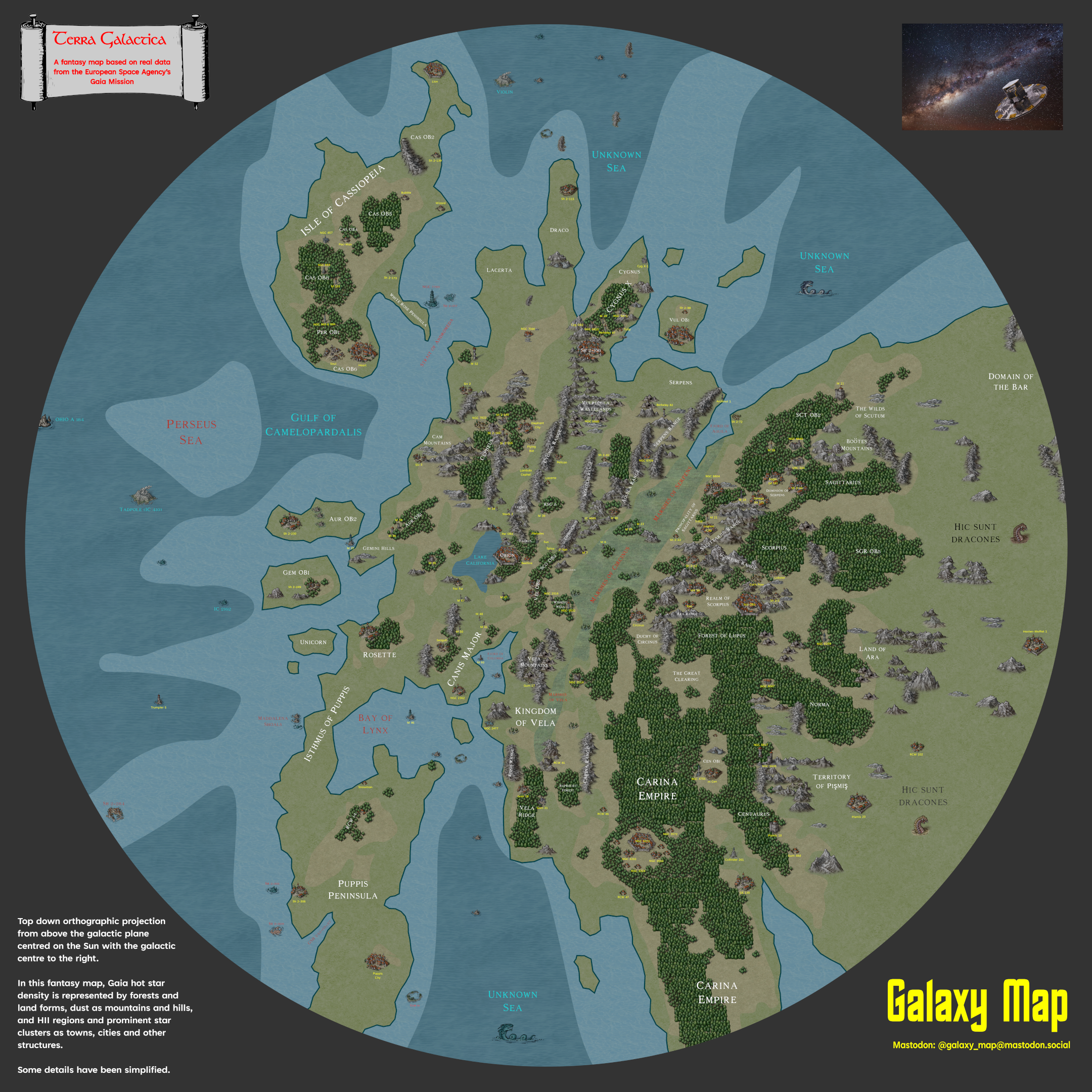
What does our Milky Way really look like? Kevin Jardine is a cartographer working to answer that question by building galactic maps from ESA's Gaia space telescope data. Here he explains a little bit about his process and some of the amazing places he's found and mapped.
Transcript: Web (Read/Listen) | PDF | MS Word
Kevin Jardine's Galaxy Maps:
- Galaxy Map poster
- Gaia DR3 Hot Star Density Map (zoomable)
- Fantasy Map poster
- High Resolution Fantasy Map (zoomable)
- The 10 parsec sample in the Gaia era (our solar neighborhood)
European Space Agency Gaia website
Want to help me make these shows? Please consider becoming a patron!
31 December 2022, 7:57 pm - More Episodes? Get the App