- 33 minutes 51 secondsPodcast episode 65: Micaela Verlato on the Humboldts and American languages
In this interview, we talk to Micaela Verlato about how the work of Wilhelm and Alexander von Humboldt on Native American languages contributed to the development of comparative linguistics.
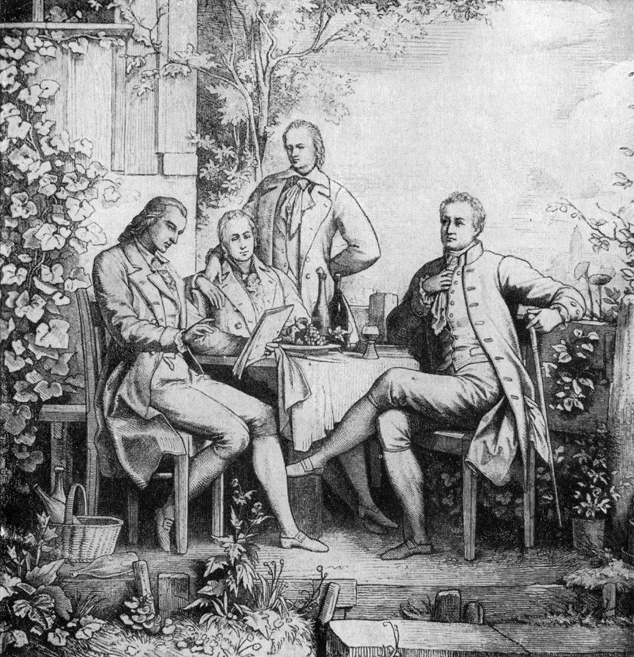 Schiller, Wilhelm and Alexander von Humboldt, and Goethe in Jena (Wikimedia Commons)
Download | Spotify | Apple Podcasts | YouTube
References for Episode 65
Adelung, Johann Christoph and Johann Severin Vater (1806–1817) Mithridates oder allgemeine Sprachenkunde mit dem Vaterunser als Sprachprobe, 6 vols, Berlin: Vossische Buchhandlung.
Andresen, Julie Tetel (1990) Linguistics in America 1769-1924, London/New York: Routledge.
Boas, Franz (1911) “Introduction,” in Franz Boas (ed.) Handbook of American Indian Languages, Part 1, pp. 1–83. Bureau of American Ethnology, Bulletin 40, Washington.
Bunzl, Matti (1996) “Franz Boas and the Humboldtian Tradition: From Volksgeist and Nationalcharakter to an Anthropological Concept of Culture,” in George W. Stocking, Jr. (ed.) Volksgeist as Method and Ethic: Essays on Boasian Ethnography and the German Anthropological Tradition, pp. 17–78, Madison: University of Wisconsin Press.
Drechsel, Emanuel J. (2024) Wilhelm von Humboldt and Early American Linguistics: Resources and Inspirations, Cambridge: Cambridge University Press.
Duponceau, Peter Stephen (1819) “Report of the Corresponding Secretary to the Committee, of his Progress in the Investigation of the General Character and Forms of the Languages of the American Indians”, APS 1819: xvii-xlvi.
––––– (1827) “The Translator’s Preface,” in David Zeisberger, Grammar of the Language of the Lenni Lenape or Delaware Indians, Philadelphia: James Kay, Jun. Reprint New York: AMS Press 1978.
––––– (1838) Mémoire sur le système grammatical des langues de quelques nations indiennes de l’Amérique du Nord, Paris : Pihan de la Forest.
Fortescue, Michael, Marianne Mithun and Nicholas Evans (2017) The Oxford Handbook of Polysynthesis, Oxford: Oxford University Press.
Haas, Mary (1969) “Grammar or Lexicon? The American Indian Side of the Question from Duponceau to Powell,” International Journal of American Linguistics 35/3: 239-55. Reprint: “The Problem of Classifying American Indian Languages: From Duponceau to Powell,” in Haas (1978), pp. 130–163.
––––– (1978) Language, Culture, and History: Essays, ed. by Anwar S. Dil, Stanford: Stanford University Press.
Humboldt, Alexander von (1808) “Ueber Amerikanische Sprachen: Aus einem Briefe des Herrn Kammerherrn Alexander von Humboldt,” in F. J. Bertuch and J. S. Vater (eds.), Allgemeines Archiv für Ethnographie und Linguistik, vol. 1, pp. 363–6, Weimar: im Verlage des Landes-Industrie-Comptoirs.
––––– (1810) Vues des Cordillères, et monumens des peuples indigènes de L’Amérique, Paris : F. Schoell.
––––– (1814–1825) Voyage de Humboldt et Bonpland. Première Partie. Relation historique, vol. 1, Paris: G. Dufour (1814); vol. 2, Paris: N. Maze (1819); vol. 3, Paris: J. Smith et Gide Fils (1825). Reprint ed. by Hanno Beck, Stuttgart: Brockhaus 1970.
––––– (1993) Briefe aus Amerika: 1799-1804, ed. by Ulrike Moheit, Berlin: Akademie Verlag.
Humboldt, Wilhelm von (1836–1839) Über die Kawi-Sprache auf der Insel Java, nebst einer Einleitung über die Verschiedenheit des menschlichen Sprachbaues und ihren Einfluß auf die geistige Entwickelung des Menschengeschlechts, 3 vols. Berlin: F. Dümmler.
––––– (1903–1936) Gesammelte Schriften (= GS), ed. by Albert Leitzmann, 17 vols. Berlin: Behr (cited as GS, followed by volume and page numbers).
––––– (1988) On Language: The Diversity of Human Language-Structure and its Influence on the Mental Development of Mankind, tr. by Peter Heath, Cambridge: Cambridge University Press.
––––– (1994–2022) Schriften zur Sprachwissenschaft (= SSW), established by Kurt Mueller-Vollmer, ed. by Tilman Borsche, Bernhard Hurch, Jürgen Trabant and Gordon Whittaker, 11 vols., Paderborn: Schöningh.
––––– (1994) Mexikanische Grammatik, ed. by Manfred Ringmacher (= SSW III/2), Paderborn: Schöningh.
––––– (1997) Essays on Language, ed. by T. Harden and D. Farrelly, Frankfurt a. M.: Peter Lang.
––––– (2009) Mittelamerikanische Grammatiken, ed. by Manfred Ringmacher and Ute Tintemann (= SSW III/4), Paderborn: Schöningh.
––––– (2010) Schriften zur Anthropologie der Basken, ed. by Bernhard Hurch (= SSW II/1), Paderborn: Schöningh.
––––– (2011) Südamerikanische Grammatiken, ed. by Manfred Ringmacher and Ute Tintemann (= SSW III/5), Paderborn: Schöningh.
––––– (2012) Baskische Wortstudien und Grammatik, ed. by Bernhard Hurch (= SSW II/2), Paderborn: Schöningh.
––––– (2013) Nordamerikanische Grammatiken, ed. by Micaela Verlato (=SSW III/6), Paderborn: Schöningh.
––––– (2016) Einleitende und vergleichende amerikanische Arbeiten, ed. by Manfred Ringmacher in collaboration with Ute Tintemann (= SSW III/1), Paderborn: Schöningh.
––––– (2017a) Von den Sprachen Amerikas zum allgemeinen Typus der Sprache, ed. by Bettina Lindorfer and Jürgen Trabant (= SSW IV/1), Paderborn: Schöningh.
––––– (2017b) Südsee- und Südostasiatische Sprachen: Vorarbeiten zu “Über die Kawi-Sprache auf der Insel Java”, ed. by Ulrike Folie, Volker Heeschen and Frank Zimmer (= SSW VI/1), Paderborn: Schöningh.
––––– (2022) Schriften zur Geschichte und Frühgeschichte der Basken und des Baskischen, ed. by Bernhard Hurch (= SSW II/3), Paderborn: Brill Schöningh.
––––– (2023) Online-Edition der Sprachwissenschaftlichen Korrespondenz, Berlin, Version von 15.03.2023, URL: https://wvh-briefe.bbaw.de
Iturrioz Leza, José Luis (2001) “Inkorporation,” in Martin Haspelmath, Ekkehard König, Wulf Oesterreicher, Wolfgang Raible (eds.) Language Typology and Language Universals. An International Handbook (= HSK 20.1), pp. 714–25, Berlin/New York: W. de Gruyter.
Jefferson, Thomas (1955) [1787] Notes on the State of Virginia, ed. by William Peden, Chapel Hill: University of North Carolina Press.
Joseph, John E. (1999) “A Matter of Consequenz: Humboldt, Race and the Genius of the Chinese Language,” Historiographia Linguistica XXVI/1-2: 89–148.
––––– (2017) “The Reception of Wilhelm von Humboldt’s Linguistic Writings in the Anglosphere, 1820 to the Present,” Forum for Modern Language Studies 53/1: 7–20.
Mueller-Vollmer (1976), “Wilhelm von Humboldt und der Anfang der amerikanischen Srachwissenschaft: Die Briefe an John Pickering,” in Klaus Hammacher (ed.) Universalismus und Wissenschaft im Werk und Wirken der Brüder Humboldt, pp. 259–334, Frankfurt a.M.: Klostermann.
––––– (1990) “Eine Einleitung zuviel. Zur Hermeneutik und Kritik der Editionen von Humboldts Einleitung in die Kawi-Sprache,” in Kodikas/Code. Ars Semeiotica 13/1–2: 3–19.
––––– (1993) Wilhelm von Humboldts Sprachwissenschaft: Ein kommentiertes Verzeichnis des sprachwissenschaftlichen Nachlasses, Paderborn: Schöningh.
Mueller-Vollmer, Kurt and Markus Messling (2023), “Wilhelm von Humboldt,” in Eduard N. Zalta and Uri Nodelman (eds.) The Stanford Encyclopedia of Philosophy (Winter 2023 Edition), URL = https://plato.stanford.edu/archives/win2023/entries/wilhelm-humboldt/. (last access: 24 November 2025)
Ringmacher, Manfred (2001) “Die Klassifizierung der Sprachen in der Mitte des neunzehnten Jahrhunderts” in Sylvain Auroux, E. F. K. Koerner, Hans-Josef Niederehe, Kees Versteegh (eds.) History of the Language Sciences: An International Handbook on the Evolution of the Study of Language from the Beginning to the Present, vol. 2, pp. 1427–36, Berlin/New York: W. de Gruyter.
––––– (2016) “Wilhelm von Humboldt und die amerikanischen Sprachen,” in Humboldt (2016), pp. 1–20.
Schlegel, Friedrich (1808) Ueber die Sprache und Weisheit der Indier: Ein Beitrag zur Begründung der Alterthumskunde, Heidelberg: Mohr und Zimmer.
Solleveld, Floris (2023) “‘Primitive structures’, Polysynthesis, and Peter Stephen du Ponceau” in James McElvenny (ed.), The Limits of Structuralism: Forgotten Sources in the History of Modern Linguistics, pp. 11–50, Oxford: Oxford University Press.
Vater, Johann Severin (1808) “Proben Amerikanischer Sprachen mit Uebersichten ihres Baues in den beigefügten grammatischen Bemerkungen,” in F. J. Bertuch and J. S. Vater (eds.), Allgemeines Archiv für Ethnographie und Linguistik 1: 341–4.
––––– (1810) Untersuchungen über Amerika’s Bevölkerung aus dem alten Kontinente, Leipzig: Vogel.
Verlato, Micaela (2013) “Wilhelm von Humboldt und die Erforschung der nordamerikanischen Sprachen” in Humboldt (2013), pp. 1–116.
––––– (2015) “The Challenge of Polysynthesis: Wilhelm von Humboldt and Early Comparative Americanist Linguistics” in Language & History 58/2: 82–94.
––––– (2020) “Linguistic Description and Language Philosophy in Wilhelm von Humboldt’s North American Grammars” in Émilie Aussant and Jean-Michel Fortis (eds.) History of Linguistics 2017 : Selected Papers from the 14th International Conference on the History of the Language Sciences (ICHOLS 14), Paris 28 August – 1 September, pp. 21–33, Amsterdam/Philadelphia: Benjamins.
14 October 2026, 2:00 pm - 19 minutes 21 secondsPodcast episode 64: Martin Konvička on the Dutch Signific Movement
In this interview, we talk to Martin Konvička about the Dutch Signific Movement, which adapted the ideas of Lady Welby in the early 20th century.
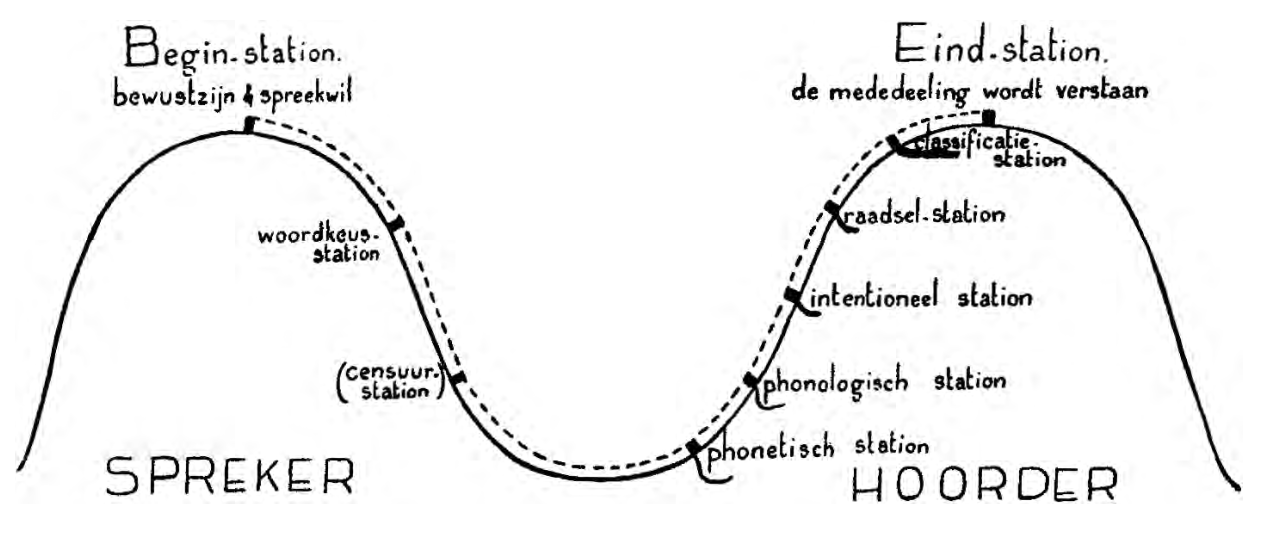 Spreker en hoorder (van Ginneken 1936, 100)
Download | Spotify | Apple Podcasts | YouTube
References for Episode 64
Primary sources
Brouwer, Luitzen E. J. 1916. “Review of J.I. de Haan – Rechtskundige significa en hare toepassing op de begrippen “aansprakelijk verantwoordelijk, toerekeningsvatbaar”. Groot Nederland 14: 333–336.
Brouwer, Luitzen E. J. 1946. Synopsis of the signific movement in the Netherlands. Prospects of the signific movement. Synthese 5: 201–208.
Brouwer, Luitzen E. J., Frederik van Eeden, Jac. van Ginneken S.J. & Gerrit Mannoury. 1939. Signifische Dialogen. Utrecht: Erven Bijleveld.
Ginneken, Jac. van.1935. Wat is taal? Onze Taaltuin 3: 265–275.
Ginneken, Jac. van. 1936. Het woord. Onze Taaltuin 4/5: 97–109.
Haan, Jacob Israël de. 1912. Nieuwe rechtstaalphilosophie. Rechtsgeleerd Magazijn 31: 480–522.
Haan, Jacob Israël de. 1916a. Wezen en taak der rechtskundige significa. De Gids 80: 281–300.
Haan, Jacob Israël de. 1916b. Rechtskundige significa en hare toepassing op de begrippen:‘aansprakelijk, verantwoordelijk, toerekeningsvatbaar. Amsterdam: W. Versluys.
Eeden, Frederik van. 1975 [1897]. Redekonstige grondslag van verstandhouding. Utrecht: Het Spectrum.
Mannoury, Gerrit. 1934a. Die signifischen Grundlagen der Mathematik. Erkenntnis 4: 288–309.
Mannoury, Gerrit. 1934b. Die signifischen Grundlagen der Mathematik: II. Anwendung der signifischen methode auf die Mathematik. Erkenntnis 4: 317–345.
Mannoury, Gerrit. 1938. Enige opmerkingen over taalgradatie. Synthese. Maandblad voor het Geestesleven van onze Tijd 3: 372–375.
Mannoury, Gerrit. 1947. Handboek der analytische signifika. Deel I. Geschiedenis der begripskritiek. Bussum: F.G. Kroonder.
Mannoury, Gerrit. 1948. Handboek der analytische signifika. Deel II. Hoofdbegrippen en methoden der signifika. Ontogenese en fylogenese van het verstandhoudingsapparaat. Bussum: F.G. Kroonder.
Mannoury, Gerrit. 1949. Signifika. Een inleiding. De Haag: N.K. Servire.
Vuysje, David. 1953. Significs: Its tendency, methodology, and applications. Proceedings of the American Academy of Arts and Sciences 80: 223–270.
Welby, Victoria. 1883. Links and Clues. London: Macmillan.
Welby, Victoria. 1896a. Sense, meaning and interpretation (I). Mind 5: 24–37.
Welby, Victoria. 1896b. Sense, meaning and interpretation (II). Mind 5: 186–202.
Welby, Victoria. 1903. What is Meaning? London: Macmillan.
Welby, Victoria. 1911. Significs and Language. London: Macmillan.
Secondary sources
Elffers, Els. 2023. Jacques van Ginneken and Significs. Historiographia Linguistica 50: 227–267.
Foolen, Ad. 1997. Language and emotions: the case of Jac. van Ginneken’s Principes de linguistique psychologique. In Bernard Caron (ed.) Proceedings 16th International Congress of Linguists. Oxford: Pergamon.
Hardwick, Charles S. 1977. Semiotic and Significs: The correspondence between Charles S. Peirce and Victoria Lady Welby. Bloomington, IN: Indiana University Press.
Kirkels, Mireille. 2019. Gerrit Mannoury (1867–1956). Een relativistisch denker. Ph.D. dissertation. Rotterdam: Erasmus University.
Nieuwstad, Jacques van. 1978. De Nederlandse significa: Een documentatie. Kennis en methode 4: 341–362.
Noordegraaf, Jan. 1980 Jac. van Ginneken en de signifische beweging. Was ik er ooit eerder? Een bundel opstellen aangeboden aan Dr. H.A. Wage ed. by S. A. J. Van Faassen. ‘s-Gravenhage: BZZTôH. 41–61.
Petrilli, Susan P. 2009. Signifying and understanding: Reading the works of Victoria Welby and the Signific movement. Berlin: De Gruyter Mouton.
Petrilli, Susan P. 2015. Victoria Lady Welby and the Science of Signs: Significs, semiotics, philosophy of language. New Brunswick: Transaction.
Schmitz, H. Walter & James McElvenny. 2022. Victoria Lady Welby. In James McElvenny (ed.) Interviews in the history of linguistics: Volume I. Berlin: Language Science Press. 67–74.
Schmitz, H. Walter. 1984. Searle ist in Mode, Mannoury nicht: Sprech‑ und Hörakt im niederländischen Signifik‑Kreis. Zeitschrift für Semiotik 6: 445–463.
Schmitz, H. Walter. 1985. Significs and language. The articulate form of our expressive and interpretative resources. With an introduction by H. W. Schmitz. Amsterdam: John Benjamins.
Schmitz, H. Walter. 1990. De Hollandse significa: een reconstructie van de geschiedenis van 1892 tot 1926. Assen: Van Gorcum.
Schmitz, H. Walter. 1992. What moved the signific movement? Concerning the history of significs in the Netherlands. Kodikas/Code 15: 79–90.
Schmitz, H. Walter. 1993. The semantic foundations and implications of signific language gradations. Histoire Épistémologie Langage 15: 53–79.
31 August 2026, 2:00 pm - 43 minutes 16 secondsPodcast episode 63: Kristine Palmieri on comparativism
In this interview, we talk to Kristine Palmieri about comparativism in Germany of the early 19th century.

Download | Spotify | Apple Podcasts | YouTube
Image credit: Museum für Asiatische Kunst, Berlin
References for Episode 63
Primary Sources (selected)
Bopp, Franz. Ausführliches Lehrgebäude der Sanskrita-Sprache. Berlin: Druckerei der Königl. Academie der Wissenschaften, 1827.
Bopp, Franz. Vergleichende Grammatik des Sanskrit, Zend, Griechischen, Lateinischen, Litthauischen, Gothischen und Deutschen. Vol. 1. Berlin: Druckerei der Königl. Academie der Wissenschaften, 1833.
Creuzer, Friedrich. Symbolik und Mythologie der alten Völker. Besonders der Griechen. 4 vols. Leipzig und Darmstadt: Carl Wilhelm Leske, 1810–1812.
Hermann, Gottfried. De Mythologia Graecorum antiquissima Dissertatio. Leipzig: Littris Staritzii, 1817.
Hermann, Gottfried. Briefe über Homer und Hesiodus vorzüglich über die Theogonie. Heidelberg: August Oswald’s Universitäts-Buchhandlung, 1818.
Jones, William. “The Third Anniversary Discourse, Delivered 2 February 1786: ‘On the
Hindus.’” In The Works of Sir William Jones. Vol. 1. Edited by Anna Maria Jones, 19–34. London: Robinson, 1799. Available online here: https://gretil.sub.uni-goettingen.de/gretil_elib/Jon786__Jones_3rdAnniversaryDiscourse1799.pdf
Leibniz, Gottfried Wilhelm. “Sprachwissenschaft: De Originibus Gentium (1700).” In Schriften und Briefe zur Geschichte. Edited by Malte-Ludolf Babin and Gerd van den Heuvel, 354–390. Hannover: Hahn, 2004.
Schlegel, August Wilhelm. Indische Bibliothek. 3 Vols. Bonn: Eduard Weber, 1823–1830.
Schlegel, Friedrich. Ueber die Sprache und Weisheit der Indier. Ein Beitrag zur Begründung der Alterthumskunde. Heidelberg: Mohr und Zimmer, 1808.
Schleicher, August. Die Darwinsche Theorie und die Sprachwissenschaft. Weimar: Hermann Böhlau, 1861.
Whitney, William Dwight. “Strictures on the Views of August Schleicher Respecting the Nature of Language and Kindred Subjects.” Transactions of the American Philological Association 2 (1871): 34–64.
Selected Secondary Sources
Blok, Josine H. “Quests for a Scientific Mythology: F. Creuzer and K. O. Müller on History and Myth.” History and Theory 33, no. 4 (1994): 26–52.
Dunkelgrün, Theodor. The Multiplicity of Scripture: The Making of the Antwerp Polyglot Bible. Toronto: Pontifical Institute of Mediaeval Studies, Canada, 2024.
Figueira, Dorothy M. “Karoline Von Günderrode’s Sanskrit Epitaph.” Comparative Literature Studies 26, no. 4 (1989): 291–303.
Fornaro, Sotera. “Friedrich Creuzer (1771-1858) à l’Académie des Inscriptions et Belles-Lettres.” Flaubert et l’histoire des religions 4 (2010). DOI: 10.4000/flaubert.1212.
Fornaro, Sotera. “Storia della religione antica tra XVIII e XIX secolo, tra Germania e Francia.” In Historiographie de l’antiquité et transferts culturels. Edited by Chryssanthi Avlami, Jaime Alvar, and Mirella Romero Recio, 255–263. Leiden: Brill, 2010.
Koerner, E. F. K. “Pilot and Pirate Disciplines in the Development of Linguistic Science.” Folia Linguistica Historica 1, no. 1 (1980): 213–224.
Koerner, E. F. K. “Models in Linguistic Historiography.” Forum Linguisticum 6, no. 3 (1982): 189–201.
Koerner, E. F. K. “Friedrich Schlegel and the Emergence of Historical-Comparative Grammar.” Lingua e Stile: Rivista di Storia della Lingua Italiana 22, no. 3 (1987): 341–365.
- NOTE: Revised or updated versions of all pieces can be found in: Koerner, E. F. K. Practicing Linguistic Historiography: Selected Essays. Amsterdam: John Benjamins Pub. Co., 1989.
Lindner, Thomas. Indogermanische Bibliothek. Band IV/1: Komposition. Heidelberg: Winter, 2015.
Marchand, Suzanne. Down from Olympus: Archaeology and Philhellenism in Germany, 1750–1970. Princeton: Princeton University Press, 1996.
Marchand, Suzanne. German Orientalism in the Age of Empire: Religion, Race, and Scholarship. Cambridge. Cambridge University Press, 2009.
McElvenny, James. “August Schleicher and Materialism in 19th-Century Linguistics.” Historiographia Linguistica 45, nos. 1–2 (2018): 133–152.
McGetchin, Douglas T. Indology, Indomania, and Orientalism: ancient India’s rebirth in modern Germany. Madison: Fairleigh Dickinson Univ. Press, 2009.
Muller, Jean-Claude. “Early stages of language comparison from Sassetti to Sir William Jones.” Kratylos 31 (1986): 1–31.
Palmieri, Kristine. “Philology as a Way of Knowing: Classical Philology in the Reformed German Universities, 1730–1830.” PhD Diss., University of Chicago, 2022. DOI: 10.6082/uchicago.3968. (please contact the author if you want to see the diss. while it is still under embargo).
Palmieri, Kristine. “Berlin as a Philological Site.” In Philological Practices: A Comparative Historical Lexicon. Edited by Glenn W. Most and Martin Kern. Princeton: Princeton University Press, forthcoming.
Paulin, Roger. The Life of August Wilhelm Schlegel: Cosmopolitan of Art and Poetry. Cambridge: Open Book Publishers, 2016.
Pfeiffer, Rudolf. History of Classical Scholarship. 2 vols. Oxford: Clarendon Press, 1968-1976.
Phillips, Denise. “Francis Bacon and the Germans: Stories from when ‘science’ meant ‘Wissenschaft’.” History of Science 53, no. 4 (2015): 378–394.
Rocher, Rosanne. “Nathaniel Brassey Halhed, Sir William Jones, and Comparative Indo-European Linguistics.” In Recherches de Linguistique. Hommages à Maurice Leroy, 173–189. Brussels: Éditions de l’Université de Bruxelles, 1980.
Rocher, Rosanne. “The Knowledge of Sanskrit in Europe until 1800.” In History of the Language Sciences. An international handbook on the evolution of the study of language from the beginnings to the present. Vol. II. Edited by Sylvain Auroux, E. F. K. Koerner, Hans-Josef Niederehe, and Kees Versteegh, 1156–1163. Berlin: De Gruyter, 2001.
Sandys, John Edwin. History of Classical Scholarship.3 vols. Cambridge: Cambridge University Press, 1903–1908.
Schwab, Raymond. Oriental renaissance: Europe’s rediscovery of India and the East, 1680-1880. New York: Columbia University Press, 1984.
Timpanaro, Sebastiano. “Friedrich Schlegel and the Development of Comparative Linguistics in the 19th Century.” In Über die Sprache und Weisheit der Indier. Edited by E. F. Koerner, XI–LVII. Amsterdam: John Benjamins, 1977.
Trautman, Thomas. “The Lives of Sir William Jones.” In Sir William Jones, 1746 –1794: A Commemoration. Edited by Alexander Murray, 91–122. Oxford: Oxford University Press, 1998.
Van Hal, Toon. “On ‘the Scythian Theory’: Reconstructing the Outlines of Johannes Elichmann’s (1601/1602–1639) Planned Archaeologia Harmonica.” Language & History 53, no. 2 (2010): 70–80.
Van Hal, Toon. “Protestant Pioneers in Sanskrit Studies in the Early 18th Century: An overlooked chapter in South Indian missionary linguistics.” Historiographia Linguistica 43, nos 1–2 (2016): 99–144.
Van Hal, Toon. “Sprachen, die Geschichte schreiben. Zu Leibniz’ sprachhistorischem Forschungsprogramm und dessen Nachwirkung.” In Einheit der Vernunft und Vielfalt der Sprachen – Beiträge zu Leibnizens Sprachforschung und Zeichentheorie. Edited by Wenchao Li, 177–206. Stuttgart: Steiner, 2014.
Wilamowitz-Moellendorff, Ulrich von. Geschichte der Philologie. Leipzig: B. G. Teubner, 1921.
Williamson, George S. The Longing for Myth in Germany: Religion and Aesthetic Culture from Romanticism to Nietzsche. Chicago: Chicago University Press 2004.
14 August 2026, 2:00 pm - 41 minutes 49 secondsPodcast episode 62: Peter Austin
In this interview, we talk to Peter Austin about his career in field linguistics and the history of language documentation in Australia, in particular how the role of Indigenous community members has changed over the past 50 years.
 Preparing Diyari language materials, Port Augusta, May 2024 (Reggie Warren, Peter Austin, Michelle Warren, late Rene Warren)
Download | Spotify | Apple Podcasts | YouTube
References for Episode 62
Austin, Peter K. 2025. Adding value to legacy linguistic fieldnotes: an Australian case study. Submitted to SOAS Working Papers in Linguistics.
Dobrin, Lise , Peter K. Austin and David Nathan. 2009. Dying to be counted: the commodification of endangered languages in documentary linguistics. Language Documentation and Description 6, 37-52.
Dobrin, Lise and Saul Schwartz. 2022. The social lives of linguistic legacy materials. Language Documentation and Description 21, 1-36.
Peter Austin’s website: https://peterkaustin.com/projects/
31 July 2026, 2:00 pm - 43 minutes 57 secondsPodcast episode 61: Adam Schembri on sign language linguistics
In this interview, we talk to Adam Schembri about the nature of sign languages, how they have been studied in the past, and how they are studied today.
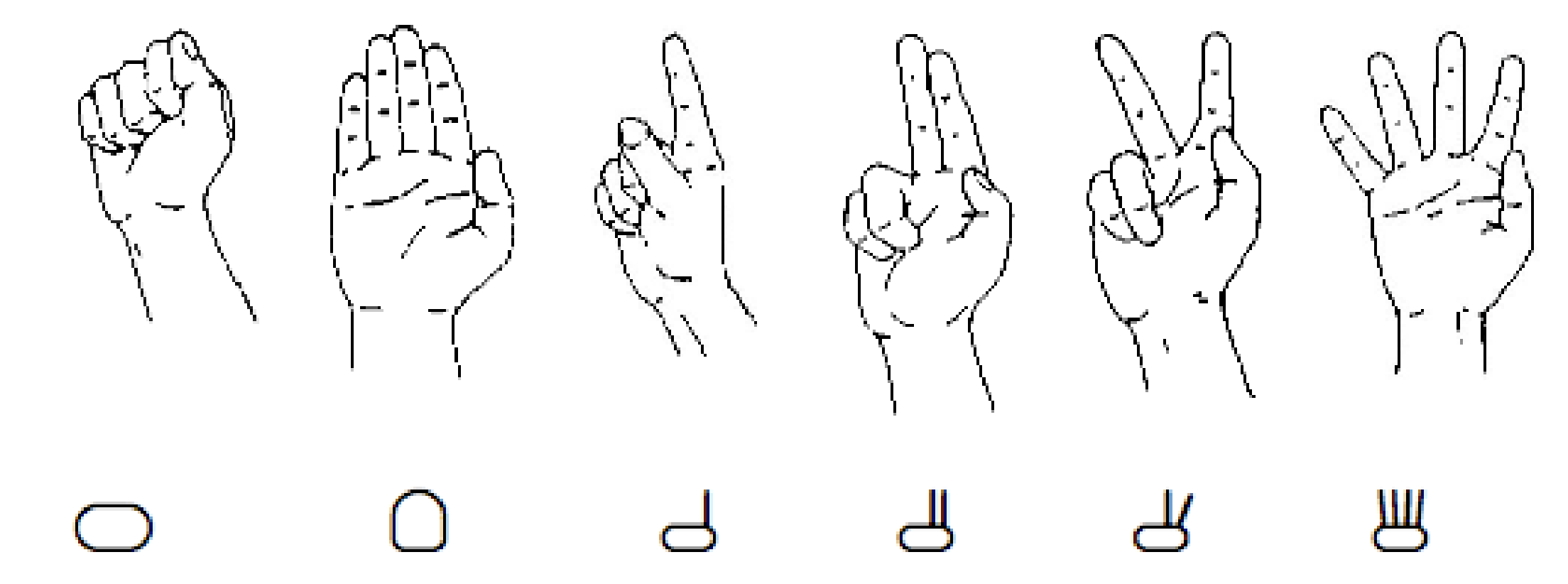 Image: HamNoSys base hand shapes, from “HamNoSys – Representing Sign Language Data in Language
Resources and Language Processing Contexts” by Thomas HankeDownload | Spotify | Apple Podcasts | YouTube
References for Episode 61
Baker, A., van den Bogarde, B., Pfau, R., & Schermer, T. (2016). The Linguistisc of Sign Languages: An introduction. Amsterdam: Benjamins.
Hill, J.C., Lillo-Martin, D.C. & Wood, S.K. (2025). Sign Languages: Structures and Contexts. London: Routledge.
Johnston, T. & Schembri, A. (2007) Australian Sign Language (Auslan): An introduction to sign language linguistics. Cambridge: Cambridge University Press.
Kendon, A. (1988) Sign Languages of Aboriginal Australia: Cultural, Semiotic and Communicative Perspectives. Cambridge: Cambridge University Press.
Klima, E.S., Bellugi, U. (1979) The signs of language. Cambridge, Mass.: Harvard University Press.
Schembri, A., Fenlon, J., Cormier, K, Johnston, T. (2026) Sign Language Linguistics: Exploring BSL and ASL. Cambridge: Cambridge University Press.
Stokoe, W. C. (1960) Sign Language Structure: An Outline of the Visual Communication System of the American Deaf. Studies in Linguistics, Occasional Papers, Vol. 8, Buffalo, NY: University of Buffalo.
Wilkinson, E. & Morford, J.P (2024). Understanding Signed Languages. London: Routledge.
Adam Schembri’s website: https://sites.google.com/view/adamcschembri/home
Transcript by Luca Dinu
JMc: Hi, I’m James McElvenny, and you’re listening to the History and Philosophy of the Language Sciences Podcast, online at hiphilangsci.net. [00:09] There you can find links and references to all the literature we discuss. [00:12] Today we’re in Birmingham, England, talking to Adam Schembri, who’s Professor of Linguistics at the University of Birmingham. [00:19] Adam is, among other things, an expert on sign language linguistics. [00:24] He’s co-author, along with Trevor Johnston, of the 2007 book Australian Sign Language: An Introduction to Sign Language Linguistics, which can claim to be the standard work on Auslan, and co-author of Sign Language Linguistics, which is coming out in June 2026 with Cambridge University Press. [00:45]
AS: They’ve just told us it’s coming out in July. [00:47]
JMc: Oh, it’s coming out in July, OK. [00:49] So in this interview, Adam’s going to tell us about how sign languages fit into the broader theoretical landscape of linguistics. [00:57] So to get us started, can you tell us what sign languages are, what are their defining characteristics, and why do we consider them a kind of language? [01:06] I mean, etymologically, our word ‘language’ is derived from a word meaning ‘tongue’, which suggests to me that we think of speech, sounds that we make with our mouths and that we hear with our ears, as being the essential characteristic of language. But obviously modality is not the key thing if sign languages are also languages, so what’s going on there? [01:27]
AS: Yeah, I mean, I think for a long time, if you look at the history of linguistics, sign languages were certainly dismissed. [01:33] So, you know, some of the big names in early 20th century linguistics, Bloomfield and other people, they didn’t consider sign languages to be languages. [01:42] Actually, though, if we go back a bit further in time in the 19th century, there are psychologists and others who did recognize sign languages as languages. [01:51] In particular, there are a couple of books written by scholars who worked on topics related to educating Deaf children who recognized sign languages as languages. [02:00] I mean, I think what I find really interesting is, I think sign languages are, you know, used by a tiny minority of the world’s population, and yet the implications for linguistics are enormous because they have really, I think, very subtly reshaped the whole focus of the field. [02:21] So I think there’s a lot more interest today in spoken language as multimodal systems, as speech and gesture packaging, and I think that’s probably come about because of the influence of sign languages. [02:34] But modern sign language linguistics, we generally consider an American researcher, William Stokoe, to be the key figure in the history of modern sign language linguistics. [02:48] There was earlier work by a Dutch researcher called Tervoort, which anticipated the work of Stokoe’s, but it was really Stokoe that was most influential because he took kind of a standard structuralist linguistic perspective and applied it to American Sign Language. [03:04] It must be said, he was working at Gallaudet College, which is a tertiary institution in the United States, rather unique in being a university or college that was established for Deaf people specifically. [03:18] So he was working there, and ironically, he was working there with Deaf and hearing academics, all of whom dismissed his interest in American Sign Language. [03:26] They thought this was just a kind of slang, broken English kind of way of speaking, so very similar to the attitudes that existed to African American Vernacular English at the time. [03:36] They kind of just thought of it as a broken form of English, but he learned to sign using what we would call signed English, so sign-supported English, so he would speak in English and he would support his spoken English with key signs. Right? [03:50] That was what he was told to do as a method of instruction, but often the Deaf students wouldn’t understand him, and he would see them translating for each other in class, and he’d go, “What’s going on there?” Like, “They’re communicating more effectively with each other than I am with them.” Right? [04:04] “I want to understand what they’re doing.” [04:06] And so he published a work which basically applied the minimal pair analysis to American Sign Language and showed that American Sign Language, the signs of American Sign Language were composed of smaller parts, right? [04:20] Sublexical elements. [04:22] He called them by fancy Latin names that we don’t want to use today, but generally in the field, they were known, they’re now known as handshape, location and movement, and he saw that the signs that the Deaf students were using at Gallaudet College were all combinations and recombinations of a set of handshapes, movements and locations. [04:44] And so by applying that analysis, he was able to demonstrate that signs weren’t, American Sign Language signs weren’t just holistic, imagistic symbols, but were created from sublexical components in the same way that spoken language words are. [05:02]
JMc: So is the key thing duality of patterning. [05:04]
AS: So it was the duality of patterning, yes. [05:06] I mean, it’s a bit more complicated than that, because we’ve realized actually the duality of patterning thing is a bit problematic for sign languages. [05:13] Many of these sublexical elements actually are meaningful as well, but that came later, and Stokoe actually revised his thinking on this much later. [05:23] But initially he was able to demonstrate in a 1960 publication, which didn’t have a huge impact at the time… [05:30] I think, kind of what really happened a bit later was two other researchers, Edward Klima, who was a linguist in San Diego and his partner, Ursula Bellugi, who was a psycholinguist, neuroscientist, they got really interested in this topic from about the late ’60s because they were interested in, if children have some kind of innate tendency to learn languages, what happens in the case of sign languages? [06:00] So they were really interested in this, and they set up a lab and some of the first sign language researchers, both Deaf and hearing, were trained in that lab and learned their craft there, and they published a book called The Signs of Language in 1979. [06:15] So like nearly 20 years after Stokoe, but this, it was the ’70s where sign language linguistics really took off in the United States, and then it began to spread to other parts of the world, including to Europe, and like the first international sign language research conference was, was in, I think in Stockholm in 1979, and so then it gradually spread from there. [06:34] And meanwhile, you know, there were these researchers like Adam Kendon and others, David McNeill, doing studies on co-speech gesture, and I think the two areas started to come together in the 1990s when people started to think about, “Okay, so how much are gestures like signs and how much are, how much signing can be equated with gestures?” [06:55] And I think both of the fields have fed off each other, but in linguistics, there’s still a lot of focus… [07:00] Like if you look at typology, for example, there’s still a huge focus only on spoken languages, right? [07:06] That’s partly our fault as sign language researchers. [07:09] We’re not very good at communicating with spoken language researchers or indeed at publishing things that are accessible to spoken language researchers. [07:16] It’s a two-way thing, right? [07:17] So sign, spoken language linguists, some part, you often don’t pay enough attention to the work that we’re doing or see implications in our work for their understanding of spoken languages either. [07:29] It’s clear it’s a language because it has both the structure of language and the use and the function of language, so it’s used in all the same ways. [07:39] Sign languages are used in all the same ways that spoken languages are. [07:42] You have sign language poetry, you have sign language… you can pun in a sign language. [07:47] You know, I mean, there’s so many ways that they are the same, right? [07:52] But the key difference is the visual modality, and there’s a lot of iconicity in spoken languages, but there’s a lot more, obviously, I will stand by this — even though there are people in my very department who have explored this issue, like Marcus Perlman and Bodo Winter, who are in my department here at Birmingham and have explored the iconicity of spoken languages and revealed that there’s a lot more iconicity in spoken languages than people realise — but I would still maintain iconicity is a much stronger driving factor in sign languages. [08:23]
JMc: So just on the structural level, so you mentioned that typologists, linguistic typologists are generally only interested in spoken languages. [08:31]
AS: Yeah, that’s often because the data is more easily accessible to them, to be honest. [08:35]
JMc: But are there direct equivalents between the sort of formal properties of spoken languages and the formal properties of sign languages? [08:42]
AS: Yeah, I mean, you can talk about sublexical structure, you can talk about a phonology of sign languages. [08:48] We’ve pretty much accepted that term, even though, as you point out, ‘language’ is based on the word for tongue, ‘phonology’ based on the word for sound. [08:55] We’ve been talking about the phonology of sign languages for the last 40 years, right? 40 or 50 years. [09:01]
JMc: What does that mean? [09:02]
AS: It means research into how the sublexical components of signs work: the hand shapes, the locations, the movements. [09:11] We now think of signs as being composed of five sublexical features: hand shape, hand orientation, location and movement. [09:20] So signs can contrast in all of those features, and there’s an additional fifth factor, which is called non-manual features, which involve things like facial expressions, or mouth gestures, or mouthing of English words, for example, which often co-occurs with signing. [09:35] All of these things can have meaningful, have a contrastive role to play in sign languages as well. [09:39]
JMc: Yeah, and you can parametrize them in the same way that you can parametrize like places of articulation. [09:44]
AS: That’s right. Right. [09:45] So it’s very similar. [09:46] It really is actually a lot more similar than you think, because if you think about it, speech is based on gestures of the oral tract, right? [09:53] So you have a place of articulation that’s equivalent to a location for a sign. [09:57] You have a manner of articulation that’s equivalent to the movement of the hand. [10:01] You have articulators. Are they the lips? Are they the tongue? And that’s equivalent to the handshapes, right? [10:06] So it’s a lot more similar when you think about speech as based on physical gestures. [10:12] Of course, we listen to the result of those gestures, but we also look at each other’s articulators and we use mouthing, you know, to assist our comprehension in face-to-face communication. [10:26]
JMc: Well, I guess it can also override auditory signals, like the McGurk effect, is it called? [10:30]
AS: Exactly. So we know that both things are really, really important. [10:33] There is actually studies showing that hearing signers like myself use more co-speech gesture, and in fact, our signing interferes with our co-speech gesture. [10:44] So we’ll often do a co-speech sign when we’re speaking. [10:48] Even to non-signing hearing people, that still happens. [10:52] Really interesting stuff about, we know now that bilinguals are actively suppressing one of their languages while using the other, because we know that with bimodal bilinguals like me, people who have a spoken language and a sign language, we don’t have to suppress the sign language as much, so it tends to come out. [11:11] Of course, you can’t do that if you’re a spoken language bilingual. [11:14] You can’t really simultaneously articulate words of two languages, but we know from bimodal bilinguals that actually you’re busy suppressing your other language while you’re speaking the one that you’re using at the time. [11:27] Anyway, so there’s also a morphology, so we can talk about, you know, derivational and inflectional processes in sign languages. [11:35] Obviously there’s a syntax, because you’ve got a vocabulary and there are ways to combine those elements to create a clause. [11:41]
JMc: So can we just talk about the morphology? How does that work? [11:45]
AS: Well, okay. So you get examples in sign languages of what many linguists would consider inflection, involve, for example, modifying verb signs to indicate subject and object arguments. [11:58] So there’s a subset of verb signs, which are called, they’re known by various names: agreement verbs, indicating verbs, directional verbs. [12:06] It depends on your theoretical framework, which what you call them. [12:09] I call them indicating verbs because they literally point to locations associated with the subject and the object argument. [12:16] Now, you’re sitting in front of me, James. So I can take the sign for ‘ask’, for example, and I can start the sign close to you and move it towards my chest, and that would mean in BSL, ‘You ask me’, and I do the reverse, you know, from me towards you, and that means ‘I ask you’, right? [12:36] And if there are two third-person arguments, neither you nor me, you know, I might set them up on the right and the left, and I would associate. [12:43] So I might say, you know, Mary on the right and John on the left, and so I’d fingerspell that name, point to the right, fingerspell John, point to the left, and then I can move the sign ASK from Mary to John, and that would mean ‘Mary asked John,’ right? [12:59] So this is considered… That’s why they’re sometimes called agreement verbs. [13:02] It’s considered a kind of person agreement marking. [13:05] It’s certainly… I don’t know whether you want to call it agreement. [13:08] Not all of us agree on whether it should be called agreement, but certainly it is flagging arguments, because it’s telling you who the subject and object arguments of the verb are. [13:18]
JMc: But is there a formal distinction in how the signs are produced between what you’re calling morphology and what you might call syntax, or is it those signs correspond to what is called verbal agreement in a spoken language, and so that’s why you consider it morphology? [13:33]
AS: Yes. Well, it becomes more syntactic if you have the arguments actually realized and to create the clause. [13:39] So obviously when you’ve got a clause with just a verb, you know, not much syntax going on because there’s just a single element, right? [13:46] But you can specify the arguments, or you can put in noun phrases that refer to the arguments and then get, you know, a fuller kind of clause with, with argument structure. [13:56] There’s a lot of research showing that, well, British Sign Language and Auslan are strongly pro-drop languages. [14:03] So there’s a lot, you know, in a narrative, for example, we’ve done studies of narratives, and you’ll find a majority of clauses are verb-only, but if you do have a transitive verb and you have two arguments, it tends to be SVO, right? [14:18] We suspect this is the influence of the surrounding spoken language, but you do find in sign languages that, like spoken languages, the word orders tend to be predominantly SOV or SVO, but you can get more flexibility in the argument structure. [14:33] So you can get, you know, other types of combinations, but sometimes they might be signalled in some way. [14:39] So for example, if you want to topicalize the object and move it to the front and have something like OSV, you might mark the object, because it’s not in an expected word order, with a brow raise, for example, or there might be a slight pause after the object. [14:53] So there are ways of signalling that you have topicalized that element. [14:57] So these are examples of the syntax of sign languages. OK. [15:01]
JMc: OK, and I guess that’s sort of equivalent to intonation in spoken language. [15:04]
AS: Yes. OK. Yeah. Very similar to the intonation patterns of spoken language. Yeah. [15:07]
JMc: OK. And when you talk about things like word order, you’re talking about the temporal order in which the arguments are realized. [15:12]
AS: Yes. Yes. Yes. Yes.
JMc: OK, because the spatial dimension is also important. [15:15]
AS: The spatial dimension is also, but it’s also segmental, right? [15:18] It’s also sequential in the sense that I start in one location, I move to another. [15:22] So even within the internal, like the sign-internal structure, there’s some sequentiality, but then you get co-occurring facial expressions and that’s a bit like intonation, and so that’s where you get more kind of simultaneity of structure. [15:36] So I could, you know, I could produce, “you ask me”, so I direct the sign, “you ask”, you know, ASK from your location towards mine, and if I do it with a brow raise, that might be a yes-no question, like, “Did you ask me something?” [15:52] Or if I did it with a brow furrow, it might be saying, “You asked me… what, exactly?” [15:57] You know, so there are ways of signalling those kinds of things. [16:01] Or I could shake my head, right? And that would be a negation. [16:04] So I could simultaneously shake the head while I produce that single verb sign, and that would negate it saying, “You didn’t ask me,” or “You don’t ask me something.” [16:13] So head shake being used for negation is a very common feature of sign languages, but there are also manual negators, so signs that are negators as well, and it’s much more common to use a combination of the manual negator and the non-manual, the head shake. [16:29] We found, we’ve just published a paper actually on negation in British Sign Language based on spontaneous data. [16:36]
JMc: So in terms of the sociolinguistic dimension of sign languages then, I mean, you mentioned that there’s poetry and that you can pun and you can do all of the things in sign languages, you can do all of the things that you can do in spoken languages, but in a large-scale spoken language, like English, for example, or German or Chinese, there are lots of different registers that are in different domains and no single person will command all of those registers. [17:02] And even, but a single person might use different ones in different circumstances, like if they’re giving a formal speech or just talking to friends. [17:11] And all of this is exhibited in sign languages as well? [17:12]
AS: That’s exactly the same. So like, you know, if I give a talk on linguistics in BSL, I will use linguistics terminology, so there’s signs for syntax, morphology, phonology. [17:22] These are not generally known to most signers, although a lot of signers do know. [17:27] This is the amazing thing is, because books like our book on Auslan have had a big impact on, you know, because they’re the only book, unfortunately, that’s the only book on the linguistics of the language, and lots of Auslan students in Australia read that book, right? [17:41] So they get a grounding in linguistics. [17:44] So linguistics has actually had a huge impact on teaching sign languages because a lot of the work that we’ve done as linguists feeds directly into sign language curricula, right? [17:54] And so a lot of the terms, so a lot of Auslan students in Australia will know, you know, words like ‘morphology’ and ‘syntax’ and ‘phonology’ and things like that, [18:04] and they’ll know the signs as well, but generally, of course, most members of the Deaf community don’t know those signs. [18:10] So yes, you do get register differentiation in sign languages as well, but obviously it depends on the size of the community and how much opportunity there has been for Deaf people to move into different domains. [18:23] So for example, in Australia, prior to the Disability Discrimination Act in the 1990s, signing Deaf people had a lot of difficulty accessing university education. [18:33] So there weren’t many, there wasn’t a very big professional class of Deaf people in Australia, but after the Disability Discrimination Act was passed, there was a huge backlog of Deaf people accessing universities in Australia in the 1990s. and now suddenly you’ve got a much more, you’ve got a larger professional class of middle-class people who’ve studied law, who’ve studied science, who’ve studied all kinds of things at university. [18:58] And so the vocab in Auslan for these things has expanded quite a lot. [19:03] But the other way that register differences are shown in Auslan is the use of fingerspelling. [19:08] So besides the sign language vocabulary, there is a system of fingerspelling where you have 26 combinations of your two hands to represent the 26 letters of the Roman alphabet, and fluent fingerspellers can very rapidly fingerspell quite long English words. [19:24] And so there’s a lot of incorporation of English technical vocabulary where there are lexical gaps in the language. [19:30] So in the past, there was a lot of reliance on the fingerspelling element, but because more Deaf people have gone to university and become, you know, professionals in law and science and other areas, sign language vocabulary has grown to meet that kind of demand. [19:44] But there’s still language planning involved. [19:46] So here in the UK, for example, there’s been a whole series of workshops by Deaf scientists and Deaf linguists to create vocabulary for the STEM subjects. [19:57] So a few years ago, where there was a group of people who got together and agreed on signs for the different planets, for example. [20:03] There hadn’t previously been standardized signs for the planets in BSL. [20:09] There’s an extensive online STEM vocabulary where standardized signs for a range of STEM concepts have been proposed. [20:17]
JMc: And those are sort of pure signs that draw on those? [20:19]
AS: Yeah, they draw on the visual elements, so things like, you know, the rings of Saturn are represented in the sign for Saturn and the great storm on Jupiter’s surface represented in the sign for Jupiter and things like that, so visual elements of the planets incorporated into the signs. [20:34] So yeah, they’re very visual, but they’re kind of standard ways. [20:38] So people now, for example, in Deaf schools, if they’re teaching that subject, they’ll go and consult the glossary so that they use the same signs that have been recommended as signs, but there’s still a lot of diversity in the community, right? [20:51] So people are going to come up with their own signs for things often as well, and often if you have an interpreter and a Deaf student studying a new area at the university, they will agree on a set of signs to use in that specific domain, and they may not be used by the wider community. [21:08] So you do get this register differentiation, but it’s a bit different from in English because English, of course, has a long history of being used in all of these domains by large numbers of people, right? [21:19] When you get a much smaller community with less access to all of these areas of life and study, then there’s been some catching up to do, but there’s nothing in the language that limits what can be talked about. [21:34] But it may be that there aren’t standard ways of talking about some very specific concepts that we have in English. [21:40]
JMc: And is there literature in the sense of, like, is there a Shakespeare of Auslan or of BSL? [21:45]
AS: No, there isn’t really an equivalent, but there are… because, of course, sign languages aren’t written languages, so you’re getting more of a kind of video literature now, like people, for example… [21:58] So, you know, sign language poetry began to be documented like in the ’80s and the ’90s with VHS recordings, but now, you know, there’s a lot more of that material online, so there are several sign language poets quite active in creating sign language poetry. [22:14] There are sign-language-specific visual forms. [22:17] So there’s something called Visual Vernacular, which is a Deaf theatre form in which people use signs and gestures that are as visual as possible in order to produce theatrical events that can be accessible to both Deaf and hearing audiences. [22:35] So that’s why it’s called the Visual Vernacular. [22:37] It’s supposed to reach out to people who don’t sign. [22:39] But that’s something that’s been created by theatres of Deaf people borrowing elements from mime and other things. [22:45] So there’s not really a Shakespeare equivalent, but there are certainly like poet laureates in the British Deaf community. [22:52] In fact, there is actually an award every year by the British Deaf Association to a poet laureate. [22:57]
JMc: Literature doesn’t necessarily depend on writing because like there’s also, you know, oral traditions. [23:02]
AS: Yes, yes. [23:03]
JMc: Sometimes with putative authors, you know, like Homeric epics. [23:06]
AS: Yes. No, we don’t really… there’s not really… [23:08] But there is a tradition of like Deaf jokes and Deaf stories that are passed down. [23:12] There are lots of really amazing Deaf jokes, some of them quite shocking for hearing people. [laughs] [23:20]
JMc: Because they… [23:21]
AS: because they involve mocking hearing people. [laughs] [23:25] There’s quite a famous joke about, you know, there’s an American and a Russian and a Deaf man on a train. [23:30] Right? And the American buys this big bottle of Coke and starts drinking it, but he only drinks a little bit of it, and then he throws out the Coke out the window. Right? [23:40] And the other people say, “What are you doing? You’re throwing the Coke away.” And he says, “Oh, there’s plenty of Coke in my country.” [23:44] And then the Russian starts drinking vodka, same thing, sips a bottle of vodka, throws the bottle away. “What are you doing?” [23:50] “Oh, there’s plenty of vodka in my country.” [23:52] So the Deaf man looks at the Russian and looks at the hearing, grabs them, throws them out the window, says, “Plenty of hearing people in my country.” [23:58] [laughs] [24:00] So those kinds of jokes, you know, so there’s lots of that kind of humour, and also Deaf storytelling. [24:07] You know, Deaf people love to tell stories about, specifically about their growing up experiences. [24:14] So many Deaf people grow up with hearing parents, and in the past, hearing parents who were encouraged not to sign by medical professionals who incorrectly believed it would interfere with the spoken language and literacy development of their Deaf children. [24:29] Right? We now know that actually Deaf children who acquire sign language from birth go on to develop really the best spoken language and literacy skills in the spoken language of the surrounding community, whereas often Deaf adults whose parents were hearing, who were encouraged not to sign, unfortunately, many Deaf adults in the adult Deaf community have varying degrees of what’s called language deprivation because they didn’t get exposed to an accessible language during the, you know, the sensitive critical period in the early stages of their life, and this can sometimes, you know, create challenges for their education because they don’t acquire their first language within that window, and it really is difficult then to acquire a second language. [25:15] English is a second language, and English literacy, and so it puts them at a real educational disadvantage for their entire life, and so it’s a very, very serious thing, and you only get this phenomenon of language deprivation in Deaf people because hearing children inevitably get exposed… [25:32] You know, I mean, there’s a few famous cases in linguistics like Genie, etc., but they’re extraordinarily rare. [25:38] You know, most hearing children can’t avoid acquiring one or more spoken languages from birth, but only with Deaf children do you get this phenomenon. [25:48] And mostly it reflects bad… It reflects misinformation, right, during most of the 20th century where medical professionals, speech pathologists, audiologists, educators of Deaf children really wrongly believed that sign languages were not bona fide languages and couldn’t provide a linguistic foundation for Deaf children to acquire the spoken language of their surrounding community. [26:12] And we now know that, tragically, that that was just a hugely incorrect view. [26:17]
JMc: Do you know why attitudes change like that? [26:20] Or do you have any speculations about it? [26:23] Because you mentioned that in the 19th century, there was work on sign languages, but it seems to have, there seems to have been a dip. [26:29]
AS: Yes.
AS: So in 18… It’s quite famous. [26:32] This is another famous part of Deaf folklore. [26:35] Everyone talks about the 1880 Milan Congress. [26:40] So there was the Congress of Educators of the Deaf, right? [26:44] So there was an international association for education of Deaf children and it would have a congress, and in 1880, there was a congress in Milan in which primarily the hearing majority of educators at this congress declared that spoken language should be the language of instruction in schools for Deaf children and that the focus should be on spoken language, right? [27:08] We suspect this was actually because many of the Deaf children that were entered Deaf schools in the 19th century tended to be children who had acquired deafness at some point in their childhood, right? [27:21] So they already had a foundation in spoken language before they became deaf, right? [27:25] And the children who were born deaf were a minority in that population. [27:30] So they weren’t really as well understood as perhaps the larger number of Deaf people, Deaf children who had acquired deafness during their childhood and therefore had some speech, right? [27:40] So we think it was probably this kind of alongside a kind of very Darwinian notion that sign languages were somehow lesser than and that spoken languages represented, you know, some kind of peak human achievement. [27:55] So yeah, so sign languages were banned from the education of the Deaf. [28:01] Now, this affected different countries differently. [28:04] So, here in the UK, it affected a lot of schools pretty much from the 19th century and into the 20th century. [28:09] In Australia, the effect was less dramatic, and in some other parts of the world, it was less dramatic. [28:16] So sign language continued to be used in schools for Deaf children intothe 20th century, but we still had a period in Australia of what’s called oralism, where there was an exclusive focus on spoken language as a language of instruction and a focus on using hearing aids and whatever available technology there was to assist Deaf kids’ listening skills and lip reading skills, but this didn’t work for many, many Deaf kids. [28:41] And even today with cochlear implants, which have proven so successful for many Deaf children and given them near-normal experiences of spoken language acquisition, even many of these children, you can’t always predict when you implant a child whether the cochlear implant will work for that child or not. [28:59] Even with today’s technology, lots of those kids actually who use cochlear implants, some of them will come to the signing Deaf community later in life because they find that they’re actually more comfortable with using sign languages. [29:10] So the recommendation from linguists and from many people in the Deaf community today is even with successful cochlear implantation or hearing aid use, give the child access to sign language alongside access to a spoken language from as early an age as possible because the sign language is the only fully accessible language for that Deaf child and can form a really rock-solid foundation for their acquisition of other languages in the future. [29:40]
JMc: We can accept that sign languages are full-featured languages on a par with any spoken language, but why is it that hearing people by default will learn a spoken language and use it and not a sign language? [29:54]
AS: That’s a very interesting question. [29:56] We do know that in fact lots of Indigenous communities, including Australia, have alternate sign languages which they use in certain circumstances. [30:05] So the most well-known cases are, of course… [30:08] I mean, apart from the Cistercian monks in Europe, OK, so, of course, there were monks in Europe that had vows of silence that used sign languages in those situations. [30:16] Similarly in Australia, you know, there are periods of spoken language taboo. [30:20] So in certain groups of Indigenous Australians, you know, there are long periods in which particularly women, the female relatives of a deceased person, experience a period of speech taboo in which they’re not allowed to speak, and they use sign language in those circumstances. [30:37] But similarly, a lot of those sign languages are also used in other contexts like during hunting in order to not disturb the prey. [30:45] Also, there’s been a lot of studies showing multimodal narrative practices in which Indigenous people will speak while retelling a story but throw in a few signs as well, as well as doing sand drawing, you know, while they’re, you know, seated on the ground and telling a story. [31:03] So quite multimodal experiences using speech, sign, sometimes music, sometimes drawing. [31:09] And in the North American case is Plains Indian Sign Language, where different tribes of Native Americans would get together and use sign language, use Plains Indian Sign Language as a lingua franca, so to communicate across the different spoken languages. [31:23] So we do know that there are actually a lot of communities that are bimodal in this sense, bimodal bilingual, they use a sign language as well as a spoken language. [31:32] But yeah, it’s really interesting question why hearing communities tend to be predominantly spoken language ones. [31:39] I mean, there are possible reasons. [31:42] The use of spoken language when there is no light, OK, or maybe also using a spoken language enables you to use your hands for something else at the same time as you’re using, as you’re speaking, you know, when you’re giving instructions on a manual task in a sign language, you have to alternate between signing the instructions and then doing the task, right? [32:02] So it might be something as trivial as that, that mean that hearing people prefer spoken languages. [32:09] But I think the key thing to remember is yes, speech is the primary means of communicating, but that doesn’t mean that they, you know, hearing people in face-to-face communication, don’t also use their bodies and their hands. [32:21] They do that a lot, right? [32:23] But it just turns out that in terms of the message, the spoken language gesture package, most of the information is in the speech, right? [32:32] But there’s still a lot of information that’s represented gesturally that isn’t always encoded in the speech, right? [32:40] So it is important to remember that spoken languages, even though they are the primary means of communication for the majority of hearing communities, they are multimodal as well, so I think we forget that at our peril. [32:53]
JMc: And how did you get into sign languages? [32:55]
AS: My first partner had Deaf parents. [32:57] So my first partner, when I was at university, he’s what’s called in the Deaf community a CODA, Child of Deaf Adults, right? [33:06] And so a CODA is usually a hearing child who grows up with Deaf parents. [33:11] And so a CODA will often acquire their sign language as their first language, their heritage language of the home, and they will acquire a spoken language some other way, right? [33:22] So yeah, my first partner had Deaf parents, and so his first language was Auslan. [33:27] He was a very fluent signer, and I was with him for a long time before I got the courage to go to sign language class, because he’d always say, “Go to class,” right? “Go to class, and then you can talk to my Deaf friends,” right? You know. [33:38] And so eventually I got up the courage to go to sign language class, and then once I started to reach a certain level of fluency, he started to sign back to me, and then it just grew from there, because he had a… we had a whole community that were just waiting to talk to me, like all of his friends, some of his family. [33:55] Yeah, I was very lucky, because I got so much support from the Deaf community, because I was already kind of on the outskirts of the Deaf community already through my relationship with my partner. [34:07] And then we broke up, but we stayed friends, and then I decided to study to become a sign language interpreter, and then I met my next partner in that sign language class, and we were partners for 20 years. [34:21] And he and I became sign language interpreters in Australia, and so we, again, the relationship with the Deaf community then just continued, because I had a partner who could sign as well. [34:30] And so we would often socialize with Deaf people, and actually, when you do have a sign language as a hearing person, you find so many opportunities to use it. [34:39] It’s incredibly useful. [34:42] You want to be in a nightclub, you’re the only people having a conversation right across the dance floor and getting your partner to get the next round of drinks, exactly what you want, because you can sign it to them. Right? [34:53] And everyone else is shouting over the music, but you’re having a great conversation with all of your friends. [35:02] But yeah, it’s incredibly useful. [35:04] So I can see why, for example, in Indigenous communities in Australia, where storytelling becomes multimodal, you can see why that happens, right? [35:13] Because it opens up a whole new potential for communication in another channel that can co-occur with the spoken channel, so once you have it, why wouldn’t you do it? [35:23]
JMc: And what is it like being a non-native signer, so effectively being an outsider to the community, but being an expert on the linguistics of it, on the science of it? [35:33]
AS: Yes. I’ve seen a real change during my career. [35:38] So I started my Ph.D in 1995. [35:41] I went to the first international sign linguistics conference, which was in Montreal in 1996. [35:46] I went to that conference, and the field then was predominantly hearing people. [35:51] It was really dominated by hearing people who were very interested in, for example, applying linguistic theories to sign languages. [35:59] So it seemed like sign languages were the ultimate test case for the use of universal grammar and things like that, so there was a lot of theoretical linguistics and a lot of hearing people, and a lot of hearing people who didn’t sign very well, right? [36:13] And who would often work with Deaf research assistants, and their communication might not be very effective with that person, and then, you know, the Deaf research assistant or the Deaf consultant would do a lot of the work recruiting participants for their experiments or their studies or what have you. [36:30] But obviously, that was a profoundly kind of colonial setup, and of course, as more and more Deaf people have gotten Ph.Ds in linguistics and moved into roles in academia, there’s been a lot of challenging of this, and I’ve seen how the field of sign language linguistics has shifted and become more inclusive. [36:49] So in 1996, there was no expectation… [36:53] I had a poster. I didn’t have an onstage presentation, but most of the hearing people, and pretty much all of the hearing people who did an onstage presentation at that conference spoke in English, right? [37:04] It was actually in Montreal, so… but everyone presented in English. [37:08] I don’t remember anyone presenting in French, but people all presented in a spoken language, right? [37:12] Basically in English. [37:14] These days, if you go to an international sign linguistics conference, there’s much more of an expectation that a hearing person like me will present in a sign language, right? [37:24] And usually a sign language conference, so for example, the most recent one, the major conference, the major international conference in our field is called TISLR, Theoretical Issues in Sign Language Research, right? [37:35] So the last TISLR was in Addis Ababa in Ethiopia. [37:39] The official conference languages were Ethiopian Sign Language, American Sign Language, which is a sign language of wider communication, and something called International Sign, which is a kind of contact sign language that’s developed spontaneously through mixing of Deaf people. [37:55] And so these were the official sign languages. [37:57] You could present in one of those sign languages or in English. [38:01] I simultaneously presented with a hearing colleague. [38:04] She spoke in English, and I signed the talk, right? [38:07] So that’s just become the norm, that there’s an expectation that hearing people like me, not only that we should learn to sign fluently so we can communicate directly with people in the Deaf community and with our Deaf colleagues, but also that we present at these conferences in a sign language so there’s no need for, to go via an interpreter, right? [38:27] There’s also an expectation that senior hearing scholars like myself provide opportunities for Deaf people. [38:34] In the U.K., we recently had Nick Palfreyman, who is now Professor of Sociolinguistics at the University of Lancashire. [38:42] He just gave his inaugural professorial lecture actually last week. [38:46] He also gave his talk in International Sign so that it could be recorded and be accessible to people from all over the world. [38:51] So he’s the second signing Deaf professor in sociolinguistics. [38:56] The first was Annelies Kusters, who’s at Heriot-Watt University. [39:00] There’s still a long way to go. I mean, we still need many more Deaf people in the field. [39:03] We still need more Deaf researchers, you know, we still need that, but the field has changed a lot in the last, you know, if I’m thinking about compared to 30 years ago in 1996. [39:13] We have come a long way, but we still have challenges to make sure that we include more Deaf people in sign language linguistics, and also the kinds of research that they can do is amazing. [39:24] I mean, the research that both Nick and Annalies have done is groundbreaking stuff. [39:29] I mean, you know, because being from within the community and having a Deaf perspective and having Deaf lived experience, it leads to all sorts of very different questions. [39:39] I think there’s still a role for people like myself, people from outside the community, because we’re interested in different things in some cases, but sometimes we’re interested in the same things. [39:47] And I think, yeah, I think there’s still a role for both, but I think there is an expectation, and it’s a very fair expectation, that people like me should provide opportunities and support Deaf scholars. [39:59]
JMc: Perhaps just one last question, which was, so there’s writing, which has a sort of symbiotic relationship with spoken language. [40:07] Writing is in a sense of representation of spoken language, although it’s also its own thing. [40:12] Like it has its own affordances and its own modality. [40:16] Is there some sort of equivalent for sign languages? [40:19] I mean, you mentioned before that you can video sign language performances to sort of create a permanent record of them, but you can also record speech, right? [40:29] That’s not what writing is. Is there some sort of equivalent? [40:33]
AS: I mean, in some places there is something called sign writing, which was developed as… it was actually adapted from Labanotation, which is a notation system for notating dance. [40:46]
JMc: OK. [40:48]
AS: So it was adapted by someone called Valerie Sutton to sign languages, [40:53] and she created the Sutton SignWriting system. [40:56] This is used in some schools in some parts of the world as a way to create literacy in a sign language. [41:05] So there are different symbols for the handshapes, locations, movements, etc., facial expressions used in the system, but it hasn’t really caught on very widely in schools for Deaf children around the world because most Deaf kids, most Deaf communities are really, really focused on accessing the written form of the spoken language of their community, the majority spoken language of the community. [41:33] So most of them, you know, most educational approaches focus on developing literacy in the spoken, the national spoken language of their country, so like, schools in the UK generally don’t do any kind of SignWriting, so, you know, they go straight to acquiring literacy in English. [41:53] There are notation systems for representing sign languages. [41:58] So one system that I was trained in was called the Hamburg Notation System, which was created by the University of Hamburg. [42:06] So it’s called HamNoSys, and this is a very iconic system that there are sets of symbols for handshakes, locations, movements, and I was trained to use this in the early ’90s when I started doing sign language research for my Ph.D, and in fact, I’ve got it in my Ph.D dissertation. [42:22] But the interesting thing is that the technology kind of overtook us, so once we got digital video and it became cheaper and easier to store on computers, we then moved straight to ELAN, right? [42:33] So ELAN being, you know, the video annotation system that was originally devised for co-speech gesture and sign languages, and that’s become the standard way now to record and to document sign languages. [42:50] So, yeah, there are sign language writing systems, but they’ve never really taken off. [42:55] There aren’t, for example, any, to my knowledge, any Deaf communities where a majority of people have literacy in a sign writing system. [43:03] They’ll have literacy within, you know, the national language of their particular country, right? [43:08] But also interesting in terms of the symbiosis between spoken languages and sign languages. [43:13] So there’s, even though sign languages are distinct in terms of their vocabulary and grammar, they exist in constant contact with the surrounding written spoken language, right? [43:24] So in the case of Auslan and British Sign Language, what you get is the incorporation of English words via fingerspelling, but also mouthing, which is the silent articulation of a word while producing a sign. [43:38] So you get a lot of the use of mouthing and the fingerspelling, and it’s interesting because it’s a bit like, it’s not the spoken language that’s being represented in the sign language fingerspelling system — it’s a signed representation of the written word. [43:51]
JMc: Well, thanks very much for answering those questions. [43:55]
AS: No, no problem. Thank you for coming to Birmingham.
14 July 2026, 2:00 pm - 24 minutes 48 secondsPodcast episode 60: Penny Lee
In this interview, we talk to Penny Lee about her research into Whorf and linguistic relativity.
Download | Spotify | Apple Podcasts | YouTube
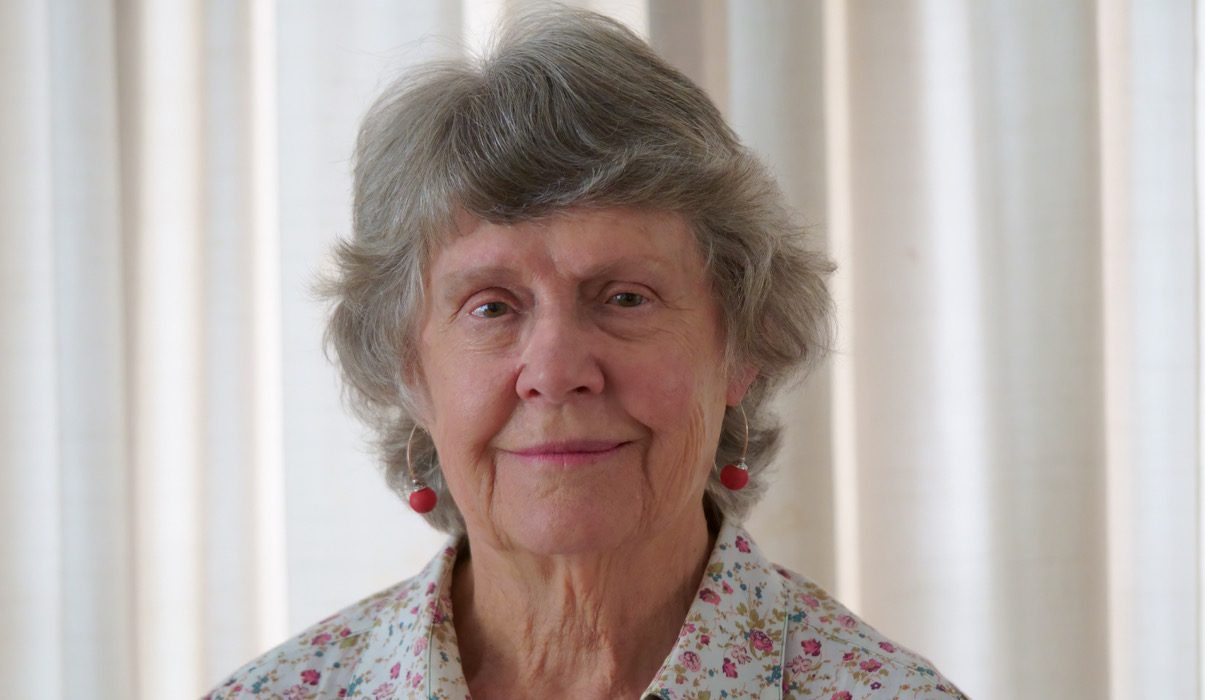
Photo by Mike Clarke.
Note: On reviewing the recording, Penny Lee noticed a slip of the tongue in her reference to a new Afterword in the 2012 edition of Whorf’s Language, Thought and Reality. This edition, in fact, features a new Foreword by Stephen C. Levinson.
References for Episode 60
Alford, Danny K. (Moonhawk). 1981. ‘Is Whorf’s relativity Einstein’s relativity?’. Proceedings of the Berkeley Linguistics Society 7.13-26.
Bohm, David. 1980. Wholeness and the Implicate Order. London: Routledge & Kegan Paul.
Capra, Fritjof. 1975. The Tao of Physics: An Exploration of the Parallels between Modern Physics and Eastern Mysticism, Bungay, Suffolk: Fontana/Collins.
Carroll, John B. 1953. The Study of Language: A Survey of Linguistics and Related Disciplines in America. Cambridge. Harvard University Press.
Carroll, John B. and Casagrande, Joseph B. 1958. ”The function of language classifications in behavior”. In E. E. Macoby et al. (eds), Readings in Social Psychology. New York: Hold, Rinehart and Winston, 18-31.
Chase, Stuart. 1938. The Tyranny of Words. New York: Harcourt, Brace and Co.
Evans, Nicholas. 2010. Dying Words: Endangered Languages and What They Have To Tell Us. Wiley-Blackwell.
Harrison, K. David. 2007. When Languages Die: The Extinction of the World’s Languages and the Erosion of Human Knowledge. Oxford: Oxford University Press.Hoijer, Harry. (Ed.) 1954. Language in Culture: Conference on the interrelations of language and other aspects of culture. Chicago: Univ. of Chicago Press.
Leavitt, John. 2011. Linguistic Relativities: Language Diversity and Modern Thought. Cambridge: Cambridge University Press.
Lee, Penny. 1996. The Whorf Theory Complex: A Critical Reconstruction. Studies in the History of the Language Sciences. Amsterdam/Philadelphia: John Benjamins Publishing Company.
Lee, Penny. When is ‘Linguistic Relativity’ Whorf’s Linguistic Relativity? In Pütz, Martin & Marjolijn Verspoor (eds) Explorations in Linguistic Relativity. Amsterdam Studies in the History of the Language Sciences, Series IV Current Issues in Linguistic Theory Vol. 199. John Benjamins: Amsterdam & Philadelphia. (45-68).
Lucy, John A. 1992a. Language Diversity and Thought: A Reformulation of the Linguistic Relativity Hypothesis. Cambridge: Cambridge University Press.
Lucy, John A. 1992b. Language Diversity and Thought: A reformulation of the linguistic relativity hypothesis. (Studies in the social and cultural foundations of language 12). Cambridge: Cambridge Univ. Press.
Lucy, John A and Gaskins Suzanne. 2001. Grammatical Categories and the Development of Classification Preferences: A Comparative Approach. In: Bowerman, Melissa and Levinson Stephen. (Eds.) Language Acquisition and Conceptual Development. Language Culture and Cognition. Cambridge University Press (257-283).
Sapir, Edward. 1921. Language: An Introduction to the Study of Speech. Harcourt Brace and World: New York.
Sapir, Edward. 1949 Selected Writings of Edward Sapir in Language, Culture and Personality. (Ed.) by David G. Mandelbaum. Berkeley: University of California.
Slobin, Dan. 1996. ‘From “Thought and Language” to “Thinking for Speaking”. In Gumperz, John and Levinson, Stephen C. Rethinking Linguistic Relativity. Cambridge: Cambridge University Press (70-96).
Whorf, Benjamin Lee. 1936. ’The Punctual and Segmentative Aspects of Verbs in Hopi’. Reprinted in Language, Thought and Reality. (65-71).
Whorf, Benjamin Lee. 1979. Benjamin Lee Whorf Papers. Manuscripts and Archives, Yale Univ. Library.
Whorf, Benjamin Lee. 2012 [2nd Edition]. Language, Thought, and Reality: Selected writings of Benjamin Lee Whorf. Ed. by John B. Carroll, Stephen C. Levinson and Penny Lee. Cambridge Ma.: MIT Press. [LTR]
30 April 2026, 2:00 pm - 36 minutes 43 secondsPodcast episode 59: Anna Wierzbicka
In this interview, we talk to Anna Wierzbicka about her life and research into semantics.
Download | Spotify | Apple Podcasts | YouTube
References for Episode 59
Apresjan, Juri. 2000. Systematic Lexicography, trans. by Kevin Windle. Oxford: Oxford University Press
Bromhead, Helen. 2009. Reign of Truth and Faith: Epistemic Expressions in 16th and 17th Century English. Berlin: De Gruyter.
Bromhead, Helen. 2018. Landscape and Culture – Cross-linguistic Perspectives. Amsterdam: Benjamins.
Goddard, Cliff (Ed.) 2018a. Minimal English for a Global World: Improved Communication Using Fewer Words. Cham: Palgrave Macmillan.
Goddard, Cliff, and Anna Wierzbicka. 2025. ‘Anchoring Anthropological Categories in Simple, Translatable Words: The Case of “Art” and “Religion”’. Current Anthropology 66(6). DOI: https://doi.org/10.1086/739001
Levisen, Carsten. 2024. Postcolonial Semantics: Meaning and Metalanguage in a Multipolar World. Berlin: De Gruyter. DOI: https://doi.org/10.1515/9783111337432
Mel’cuk, Igor. 2012. Semantics: From Meaning to Text. Amsterdam: Benjamins
Wierzbicka, Anna. 1996. Semantics: Primes and Universals. Oxford: Oxford University Press.
Wierzbicka, Anna. 2001. What did Jesus mean? Explaining the Sermon on the Mount and the Parables in Simple and Universal Human Concepts. Oxford: Oxford University Press.
Wierzbicka, Anna. 2014. Imprisoned in English: The Hazards of English as a Default Language. Oxford: Oxford University Press.
Wierzbicka, Anna. 2020. ‘Seven essential messages for the time of the coronavirus’. Russian Journal of Linguistics 24(2): 253–258.
Wierzbicka, Anna. 2020. ‘Essential messages for our time’. Language on the Move. https://languageonthemove.com/essential-messages-for-our-time/
Wierzbicka, Anna. 2025. The Nicene Creed in Minimal English: Why Christianity Needs Universal Human Concepts. Cham: Palgrave Macmillan
14 April 2026, 2:00 pm - 34 minutes 21 secondsPodcast episode 58: Ryan Nefdt on linguistic relativity and AI
In this interview, we talk to Ryan Nefdt about the light latest work in “artificial intelligence” can cast on questions of linguistic relativity.

Download | Spotify | Apple Podcasts | YouTube
Image: Cover of Linguistic Relativity by Pelletier and Nefdt (Oxford University Press)
References for Episode 58
Bickerton, D. (2014). More than nature needs: Language, mind, and evolution. Harvard University Press.
Boroditsky, L., Schmidt, L., & Phillips, W. (2003). Sex, syntax, and semantics. In D. Gentner & S. Goldin-Meadow (Eds.), Language in mind: Advances in the study of language and thought (pp. 61–79). MIT Press.
Chemla, E., & Nefdt, R. M. (2024). No such thing as a general learner: Language models and their dual optimization. https://ling.auf.net/lingbuzz/008355
Dennett, D. C. (1996). Kinds of minds: Towards an understanding of consciousness. Basic Books.
Haspelmath, M. (2010). Comparative concepts and descriptive categories in crosslinguistic studies. Language, 86(3), 663–687. http://dx.doi.org/10.1353/lan.2010.0021
Huh, M., Cheung, B., Wang, T., & Isola, P. (2024). The platonic representation hypothesis. arXiv. https://doi.org/10.48550/arXiv.2405.07987
Kallini, J., Papadimitriou, I., Futrell, R., Mahowald, K., & Potts, C. (2024). Mission: Impossible language models. In Proceedings of the 62nd Annual Meeting of the Association for Computational Linguistics (Volume 1: Long Papers) (pp. 14691–14714). Association for Computational Linguistics. https://doi.org/10.18653/v1/2024.acl-long.787
Mitchell, J., & Bowers, J. (2020). Priorless recurrent networks learn curiously. In Proceedings of the 28th International Conference on Computational Linguistics (pp. 5147–5158). International Committee on Computational Linguistics.
Moro, A., Greco, M., & Cappa, S. F. (2023). Large languages, impossible languages and human brains. Cortex, 167, 82–85.
Nefdt, R. (2023). Language, science, and structure: A journey into philosophy of linguistics. Oxford University Press.
Nefdt, R. (2024). The philosophy of theoretical linguistics. Cambridge University Press.
Pelletier, F. J., & Nefdt, R. (2025). Linguistic relativity: An essential guide to past debates and future prospects. Oxford University Press.
Pullum, G. K. (1989). The great Eskimo vocabulary hoax. Natural Language & Linguistic Theory, 6, 579–588. (Reprinted in The great Eskimo vocabulary hoax and other irreverent essays on the study of language, 1991, University of Chicago Press.)
Reines, M., & Prinz, J. (2009). Reviving Whorf: The return of linguistic relativity. Philosophy Compass, 4, 1022–1032.
31 March 2026, 2:00 pm - 22 minutes 32 secondsPodcast episode 57: Brigitte Nerlich
In this interview, we talk to Brigitte Nerlich about her career in the history of linguistics and the public understanding of science
Download | Spotify | Apple Podcasts | YouTube
Image from Brigitte Nerlich
References for Episode 57
Bréal, M. (1897). Essai de Sémantique: Science des significations. Paris: Hachette.
Gardiner, A. H. (1932). The Theory of Speech and Language. Oxford: Oxford University Press.
Harris, R. (1980). The Language-Makers. London: Duckworth.
Harris, R. (1981). The Language Myth. London: Duckworth.
Harris, R. (1990). Language, Saussure and Wittgenstein: How to play games with words. London: Psychology Press.
Lakoff, G. and Johnson, M. (1980). Metaphors we Live By. Chicago: Chicago University Press.
Nerlich, B. (1983). Le même et l’autre. Le problème de l’identité en linguistique chez Saussure et Wittgenstein. Cahiers Ferdinand de Saussure 37, 13-34.
Nerlich, B. (1986). La linguistique de Philipp Wegener. Une théorie du dialogue. DRLAV. Revue de Linguistique 34-35, 301-315.
Nerlich, B. (1986). La pragmatique: Tradition ou révolution dans l’histoire de la linguistique française?. Frankfurt/Bern/New York: Verlag Peter Lang.Nerlich, B. (1990). Change in Language: Whitney, Bréal and Wegener. London: Routledge.
Nerlich, B. (1992). Semantic Theories in Europe, 1830-1930. From etymology to contextuality. Amsterdam/Philadelphia: John Benjamins.
Nerlich, B. (1998). La métaphore et le métonymie: Aux sources rhétoriques des théories sémantiques modernes. Sémiotiques 14, 143-170.
Nerlich, B. and Clarke, D. D. (1996). Language, Action, and Context: The early history of pragmatics in Europe and America, 1780-1930. Amsterdam/Philadelphia: John Benjamins.
Nerlich, B., & Clarke, D. D. (2001). Mind, meaning and metaphor: The philosophy and psychology of metaphor in 19th-century Germany. History of the Human Sciences, 14(2), 39-61.
Nerlich, B. and Clarke, D. D. (2007). Cognitive linguistics and the history of linguistics. In: The Oxford Handbook of Cognitive Linguistics, edited by D. Geeraerts and H. Cuyckens. Oxford: Oxford University Press.
Searle, J. (1969). Speech Acts: An Essay in the Philosophy of Language. Cambridge: Cambridge University Press.
Wegener, P. (1885). Untersuchungen über die Grundfragen des Sprachlebens. Halle: Niemeyer.
Wunderli, P. (1981). Saussure-Studien: Exegetische und wissenschaftsgeschichtliche Untersuchungen zum Werk von F. de Saussure. Tübingen: Günter Narr.
14 March 2026, 2:00 pm - 33 minutes 36 secondsPodcast episode 56: Nick Enfield on linguistic signs and concepts
In this interview, we talk to Nick Enfield about his research into the connections between linguistic signs and concepts.

Download | Spotify | Apple Podcasts | YouTube
Image from Nick Enfield’s website
References for Episode 56
Dunbar, R. I. M. (2004). “Gossip in Evolutionary Perspective”, Review of General Psychology, 8(2): 100-110. https://journals.sagepub.com/doi/full/10.1037/1089-2680.8.2.100
Enfield, Nick J. (2022), “Linguistic concepts are self-generating choice architectures”, Phil. Trans. R. Soc. B 378: 20210352. https://doi.org/10.1098/rstb.2021.0352
Enfield, N. J. (2026). “The enchronic envelope”, Psychological Review, 133(2): 296–314. https://doi.org/10.1037/rev0000553
Kockelman, Paul. (2005). “The semiotic stance”, Semiotica, vol. 2005(157): 233-304. https://doi.org/10.1515/semi.2005.2005.157.1-4.233
Langacker, Ronald W. (1987), Foundations of Cognitive Grammar, 2 vols. Stanford: Stanford University Press.
Makkreel, Rudolf (2021), “Wilhelm Dilthey”, The Stanford Encyclopedia of Philosophy (Spring 2021 Edition), Edward N. Zalta (ed.), https://plato.stanford.edu/archives/spr2021/entries/dilthey/
Ogden, Charles Kay, and Ivor Armstrong Richards (1956 [1923]), The Meaning of Meaning, London: Kegan Paul.
Tomasello, Michael. 2008. Origins of Human Communication. Cambridge, Mass.: MIT Press. https://doi.org/10.7551/mitpress/7551.001.0001
28 February 2026, 2:00 pm - 36 minutes 1 secondPodcast episode 55: Janette Friedrich
In this interview, we talk to Janette Friedrich about her research and career.
Download | Spotify | Apple Podcasts | YouTube
References for Episode 55
Bühler, Karl ([1934] 2009). Théorie du langage. La fonction représentationnelle du langage, préface de Jacques Bouveresse, présentation de Janette Friedrich, traduction par Didier Samain. Marseille: Agone.
Friedrich, Janette (1993). Der Gehalt der Sprachform. Paradigmen von Bachtin bis Vygotskij. Berlin : Akademie-Verlag,
Friedrich, Janette (2010). Lev Vygotski : médiation, apprentissage et développement. Une lecture philosophique et épistémologique, 2e édition. Carnets des sciences de l’éducation, FPSE, Université de Genève. (brasilianische Übersetzung : Lev Vigotski : Mediação, aprendizagem e desenvolvimento. Uma leitura filosófica e epistemológica. Campinas SP Brasil : Mercado Letras, 2012)
Friedrich, J. (Hrsg.) (2018). Karl Bühlers Krise der Psychologie. Positionen, Bezüge und Kontroversen im Wien der 1920er/30er Jahre. Wien [u.a.]: Springer
Friedrich, J. (Hrsg.) (2022). Karl Bühler und das Wiener Psychologische Institut. Dokumente und Fundstücke, Bühleriana, Bd. 1. Lausanne: sdvig. https://karlbuehler.org/pub-216558
Friedrich, Janette & Cesalli, Laurent (éds.) (2014). Anton Marty & Karl Bühler – Between Mind and Language – Zwischen Denken und Sprache – Entre pensée et langage. Basel: Schwabe Verlag
Vygotskij, Lev S. ([1934] 2002). Denken und Sprechen. Psychologische Untersuchungen. Weinheim, Basel: Beltz.
Transcript
JMc: Hi, I’m James McElvenny, and you’re listening to the History and Philosophy of the Language Sciences podcast, online at hiphilangsci.net. [00:29] There you can find links and references to all the literature we discuss. [00:33] Today we’re talking to Janette Friedrich, who has a fascinating international career in philosophy and the history of the human sciences, above all psychology and linguistics, [00:43] and as with a few of our recent interviews, we’re going to do this discussion in German. [00:48] Janette, willkommen im Podcast. [00:50] Kannst du uns erzählen, womit es alles angefangen hat? [00:53] Du bist also in der Nähe von Potsdam aufgewachsen und du hast dann in Russland Philosophie studiert. [01:01]
JF: Ja. Ja, danke James für die Einladung zu diesem Podcast. [01:06] Ja, ja, eigentlich ist es eine lange Geschichte. [01:09] Ich bin in Potsdam geboren und habe, bin dann aber in Ostberlin aufgewachsen und habe Philosophie studiert. [01:16] Damit hat es eigentlich angefangen. [01:18] Ich habe Philosophie studiert von 1979 bis 1984 in der ehemaligen Sowjetunion in Rostow am Don. [01:29] Warum Philosophie? [01:30] Ich wusste nicht so genau, was ich eigentlich studieren wollte. [01:34] Ich habe mich immer interessiert für Literatur, Theater. [01:38] Wir haben an der Schule auch Theater gespielt. [01:40] Dann hatte ich meine Jahresarbeit geschrieben zu Bertolt Brecht. [01:43] Der hatte damals Lehrstücke geschrieben. [01:46] Ja, und da merkte ich, dass ich Spaß habe am Argumentieren und am Denken. [01:52] Man könnte fast sagen am reinen Denken. [01:54] Ja, und da hatte ich dazu noch Freunde, die Philosophie studiert hatten, auch in der Sowjetunion. [02:01] Und da habe ich mir gesagt, warum nicht Philosophie? [02:05]
JMc: Aber wie hast du deinen Studienplatz in Russland ergattert oder in der Sowjetunion? [02:08]
JF: Ja, das ist eine interessante Geschichte, weil ich wollte nicht nur Philosophie studieren… [02:15] Ich wollte, dass… der zweite Wunsch bei mir. [02:17] Ich wollte nicht in der DDR studieren, sondern ich wollte raus. [02:20] Ich wollte woanders hin. [02:21] Die DDR war klein, die kannte man. [02:24] Und ja, da habe ich gesagt, das ist ein Abenteuer. [02:26] Warum nicht in die Sowjetunion? [02:29] Und in der DDR war ja alles sehr zentralisiert gewesen. [02:33] Das heißt, jede Erweiterte Oberschule, EOS, das, was man Gymnasium nennt hier, hatte sowas wie eine Studienplatzliste. [02:44] Und auf dieser Studienplatzliste standen bestimmte Fachrichtungen, die man sich auswählen konnte und wofür man sich bewerben konnte. [02:52] Ja, aber in meiner Schule gab es leider nur Medizin, Zahnmedizin und Erdöl. [02:58] Aber da mein Kriterium ja war, ich möchte unbedingt raus, habe ich mir gesagt, OK, dann bewirbst du dich für Erdöl. [03:04] Also habe ich mich für Erdöl beworben und bin dann eingeladen worden in Halle an der Saale zum Aufnahmegespräch und da saß dann eine etwas verdutzte Aufnahmekommission und sagte zu mir, na ja, Erdöl, das ist Aserbaidschan, das ist Baku, [03:20] da schicken wir nicht so gerne junge Frauen hin. [03:22] Außerdem müssen sie schweißen lernen, wollen sie nicht was anderes studieren. [03:27] Na ja, und so bin ich dann Philosophin geworden. [03:30] Ich habe gesagt, ja, dann nehme ich gerne die Fachrichtung Philosophie. [03:34]
JMc: OK. [03:35]
JF: Ja, und dann ging es fünf Jahre zum Studium in die Sowjetunion [03:40] und wir dachten natürlich, es geht nach Moskau oder nach Petersburg, [03:45] damals hieß es noch Leningrad. [03:48] Aber da war auch alles zentralisiert organisiert [03:52] und wir wurden also alle zentral verteilt nach Rostow am Don. [03:56] Ich musste dann erst mal auf der Landkarte nachschauen, wo sich diese Stadt eigentlich befindet. [04:01] Das ist eine Ein-Millionen-Stadt, vielleicht jetzt sogar schon mehr. [04:05] Also damals war es eine Ein-Millionen-Stadt. [04:07] Sie befindet sich südlich von Moskau, 1000 Kilometer und heißt eigentlich [04:12] das Tor zum Kaukasus, weil es immer über Rostow geht, [04:15] wenn man entweder ans Schwarze Meer, nach Sotschi oder in den Kaukasus will. [04:19] Ja, und das war eine sehr bunte Stadt, [04:23] weil viele unserer Studienkollegen kamen aus dem Kaukasus [04:26] und Rostow hatte einen großen armenischen Stadtteil gehabt, [04:32] also viel mit verschiedenen Kulturen und Völkern zu tun gehabt. [04:38] Ja, und dann habe ich dort Philosophie studiert [04:41] und das erwies sich dann im Nachhinein als interessanter, [04:45] als wenn ich nach Moskau gekommen wäre oder nach Leningrad. [04:49] Warum? Aber das haben wir auch später gemerkt, [04:52] weil ein Teil, ein kleiner Teil unserer Lehrer dort [04:57] eigentlich nach Rostow geschickt wurde, um dort zu arbeiten, [05:01] weil sie nicht so ganz auf der offiziellen Marxismus-Leninismus-Linie lag [05:05] und eigentlich so etwas wie einen kritischen Marxismus, [05:09] einen kritischen Materialismus vertreten haben. [05:12] Deshalb wurde es dort dann interessant für uns. [05:15] Man fragt sich immer, was wurde dort eigentlich gelehrt [05:20] in der Sowjetunion, wenn man Philosophie studiert. [05:23] Wir haben beziehungsweise die Geschichte der Philosophie gehabt, [05:26] gute Spezialisten in der Geschichte der deutschen Philosophie. [05:30] Dann hatten wir Wissenschaftsphilosophie, Geschichtsphilosophie. [05:34] Natürlich hat die Geschichte der Philosophie in den 20er Jahren aufgehört, [05:38] weil das alles, was danach kam, als bürgerliche Philosophie zählte [05:42] und das wurde nicht gelehrt. [05:44] Was aber interessant war, war dieser schon genannte kritische Marxismus oder kritische Materialismus. [05:53] Ein Teil unserer Lehrer waren Schüler von Ewald Wassiljewitsch Iljenkow. [06:00] Den Namen hat man vielleicht manchmal schon gehört. [06:03] Das war, wie gesagt, ein sowjetrussischer Philosoph, [06:07] der sozusagen versucht hat, einen intelligenten Marxismus zu entwickeln [06:13] aufbauend auf einer Spinoza- und Hegel-Lektüre. [06:16] Das war, was er dann so eine kritische Marx-Lektüre nannte. [06:21] Ja, es gibt sogar Übersetzungen von Iljenkow ins Deutsche. [06:29] Schon 1979 hat man seine Dialektik des Abstrakten und Konkreten im Kapital von Karl Marx übersetzt. [06:36] Ja, und 1994 ist ein kleiner Sammelband, Dialektik des Ideellen, herausgekommen von Iljenkow. [06:43] Und diese Dialektik des Ideellen, das ist interessant, [06:47] weil dort beginnt dann eigentlich mein Interesse, [06:50] was mich eigentlich mein ganzes Leben lang nicht mehr losgelassen hat. [06:54] Der Iljenkow hatte so eine ähnliche Idee, wie man sie auch bei Popper findet, [06:59] von der dritten Welt, die Existenz einer dritten Welt. [07:03] Also eine Welt der objektiven geistigen Inhalte, [07:07] die sozusagen losgelöst vom Individuum sind. [07:10] Also soweit das Individuum etwas schafft, [07:13] wird es zu Ideen, die dann sozusagen unabhängig von ihm existieren [07:18] und dann auch unterschiedlich interpretiert, [07:20] unterschiedliche Lebensformen annehmen. [07:23] Ja, das war sozusagen hinter der Idee des Ideellen von Iljenkow. [07:26] Und das Interessante war, er hatte diese damals in Zagorsk [auch Sagorsk geschrieben, russische Grussstadt 70 km nordöstlich von Moskau, seit 1991 trägt sie den Namen Sergijew Possad] [07:32] auch experimentell versucht nachzuweisen. [07:35] Er hat also mit Psychologen zusammengearbeitet, [07:38] mit Alexander Meschtscherjakow, [07:43] der damals ein Experiment mit taubstummen Kindern durchgeführt hat [07:47] und sie sozusagen in die Kultur angeeignet hat [07:52] und sozusagen dazu die Idee des Ideellen von Iljenkow benutzt hat. [07:57] Dieses Thema fand ich furchtbar interessant. [08:01] Da merkt man schon diesen Schnittpunkt zwischen einem Philosophen [08:04] und einem Psychologen, also zwischen verschiedenen Disziplinen. [08:08] Und damals in Rostow haben wir neben Iljenkow [08:12] noch andere Autoren gelesen, [08:14] die man eigentlich im Westeuropa kaum kannte, [08:17] die ich aber sehr spannend fand. [08:19] Und diese Autoren kamen dann nicht wie Iljenkow, [08:22] also aus dem 60er, 70er Jahren, [08:25] sondern die kamen aus dem 20er, 30er Jahren. [08:27] Zum Beispiel, das war eine meiner Entdeckungen, [08:34] die wir damals dort gelesen haben, [08:36] einen georgischen Philosophen, [08:37] der Konstantin Romanowitsch Megrelidze hieß. [08:40] Und der hatte so etwas gesucht [08:42] wie eine phänomenologische Soziologie der Ideen. [08:46] Wieder auch diese Idee, [08:48] es gibt bestimmte ideelle Gebilde, [08:50] die kann man soziologisch analysieren. [08:52] Ja, und Konstantin Romanowitsch Megrelidze [08:54] hatte zum Beispiel bei Husserl ein Jahr studiert, [08:55] war in Berlin bei den Gestaltpsychologen, [08:59] also war beeinflusst von der westeuropäischen Tradition, [09:03] hat aber dann, wie so oft, auch in dieser sowjetrussischen Tradition etwas Eigenes entwickelt. [09:08] Also das fand ich immer ganz spannend. [09:10] Ja, und ich bin damals auch bekannt geworden in Rostow mit Wygotski, [09:16] der war auch einer der Hauptautoren, [09:18] die wir gelesen haben. [09:19] Ja, ich erzähle das ausführlich, [09:22] weil in Rostow mit diesen Autoren wurde dann endlich auch mein Dissertationsthema geboren. [09:28] Und das, was mich immer interessiert hat, [09:32] ist dieser Zusammenhang zwischen Philosophie, Psychologie und auch Sprachwissenschaften. [09:38] Weil Megrelidze war zwar auch ausgebildeter Philosoph, [09:42] aber er hatte bei der Gestaltpsychologie [09:44] etwas studiert [09:46] und hatte dann zwei Jahre [09:48] bei Nikolai Marr in Leningrad gearbeitet und natürlich auch zur Sprachtheorie gearbeitet. [09:55] Also genau wieder dieses Zusammenkommen von philosophischen Ideen und einzelwissenschaftlichen Theorien und Experimenten. [10:05]
JMc: Ja, OK. [10:07] Ja, aber deine Dissertation hast du dann in Berlin geschrieben, oder? [10:10] Du hast also 1991 in Berlin promoviert. [10:13]
JF: Genau, ich bin da zurück und ich hatte dann, [10:16] 1986 oder 1987, [10:19] hatte ich dann eine Aspirantur bekommen. [10:23] Aspirantur, das hieß in der DDR ein Stipendium, ein Doktorandenstipendium, würde man heute sagen, also [10:31] sozusagen ein Stipendium, um in drei Jahren meine Doktorarbeit zu schreiben. [10:34] Ich hatte wirklich nichts anderes zu tun als die Doktorarbeit zu schreiben und dazu bin ich sozusagen nach Leipzig geschickt worden, von Berlin, [10:43] weil in der Zwischenzeit hatte ich an der Hochschule für Ökonomie in Berlin angefangen zu arbeiten. [10:49] Die hatten mich nach Leipzig geschickt und haben gesagt, komm mit einem Doktortitel wieder, [10:55] was natürlich gut war, weil das heißt, es war kein Thema vorgegeben. [11:00] Ich habe mein Thema selber ausgesucht [11:02] und ich hatte das Glück, dass Leipzig das auch akzeptiert hatte. [11:06] Ich wurde betreut von einem Philosophen, [11:08] der spezialisiert war in der Philosophie der Industrie. [11:11] Das heißt, er hatte keine Ahnung von meinem Thema, was mich nicht sehr beunruhigt hat, [11:17] weil ich wusste ja, wozu ich arbeiten will. [11:20] Und ich habe dann meine Doktorarbeit geschrieben, dort in Leipzig. [11:26] Wie gesagt zu… [11:31] Die Doktorarbeit hatte vier Kapitel, kann man sagen. [11:34] Ein Kapitel zu Megrelidze, eins zu Wygotski. [11:37] Und nach der Doktorarbeit habe ich dann das nächste Kapitel noch dazu geschrieben zum Bachtin-Kreis, [11:43] weil ich fand es ganz wichtig war, dass man die Ideen von Bachtin und seine Sprach- und Zeichenauffassung auch mit reinnimmt. [11:50] Das waren also sozusagen die drei Kapitel meiner Doktorarbeit. [11:56] Aber es gab ein erstes Kapitel und das war mir ganz wichtig, weil dieses erste Kapitel hatte ich der Theorie von Iljenkow und Alexander Leontjew gewidmet, [12:07] der ja auch ein Psychologe war und ein Tätigkeitstheoretiker. [12:12] Und warum habe ich dieses Kapitel geschrieben? [12:15] Das war ein wichtiges Objektiv meiner Doktorarbeit. [12:20] Ich konnte nämlich damals in der DDR die Schriften der Kritischen Psychologie lesen. [12:24] Die gab es in den Bibliotheken in Berlin. [12:28] Und die Kritische Psychologie um Klaus Holzkamp [12:32] hatte sich ganz stark mit der Tätigkeitstheorie Leontjews beschäftigt und diesen Tätigkeitsansatz als Hauptquelle reingebracht, auch mit in ihre Psychologie. [12:44] Und ich fand, dass bei Leontjew ein ganz wichtiger Aspekt immer fehlte, [12:48] nämlich der Zeichen- und Sprachbegriff, und sozusagen die Bedeutung der Sprache [12:56] in der Denkentwicklung und in der Bewusstseinsentwicklung. [12:59] Und genau diese Ideen konnte ich mit den Denkern aus den 20er, 30er Jahren hineinbringen. [13:07] Das heißt, das erste Kapitel war so etwas wie ein Abgrenzungskapitel sozusagen. [13:12] Ja, das kann man so sehen, aber man kann es auch noch anders sehen und dadurch natürlich auch das Interesse an den Sprachtheorien, weil ich das damit hereingebracht hatte. [13:23]
JMc: Ja, OK. [13:24]
JF: Ja. Ja, die Doktorarbeit, [13:27] das ist vielleicht noch interessant, die erschien 1993, ich habe sie 1991 verteidigt an der Humboldt-Universität. [13:36] Ich habe sie verteidigt vor einer Kommission, [13:41] die dann von Hans-Peter Krüger geleitet wurde. [13:44] Hans-Peter Krüger war ein Philosoph, der an der Akademie der Wissenschaften der DDR gearbeitet hatte. [13:50] Hans-Peter Krüger war Habermas-Spezialist. [13:54] Wenn man die Theorie des kommunikativen Handelns von Habermas liest, dann findet man auch Verweise auf Wygotski, [14:01] kurz in den Fußnoten, wie zum Beispiel auch auf Bühler, also auch ein Interesse an dieser Art von Theorie. [14:09] Ja, die hatte ich sozusagen vor einer gemischten Kommission verteidigt. [14:16] Herr [Peter] Keiler von der Kritischen Psychologie war auch an der Kommission gewesen. [14:19] Es gab also eine sehr interessante Diskussion dazu. [14:24] Die Dissertation ist erschienen 1993 im Akademie-Verlag unter dem Titel [14:31] Der Gehalt der Sprachform. Paradigmen von Bachtin bis Vygotskij. [14:37] Vielleicht zu diesem Buch vielleicht noch ein Wort. [14:44] In bestimmten Sinne ist das Buch ins Leere gelaufen. [14:49] Kann man vielleicht so sagen. [14:51] Ich hatte ja einen Adressaten unter vielen, die kritische Psychologie. [14:56] Die war aber nach dem Mauerfall mit etwas anderen Dingen beschäftigt. [14:59] Mit sich selbst und ihrem eigenen Platz, glaube ich, wahrscheinlich in der Psychologielandschaft [15:07] Und ich selber war auch nicht mehr da. [15:09] Ich hatte nämlich 1991 Deutschland verlassen und bin nach Frankreich gegangen. [15:14]
JMc: OK, ich hätte ein paar Fragen dazu, und zwar… also apropos Mauerfall. [15:19]
JF: Ja. [15:20]
JMc: Wie war das denn damals als frisch Promovierte oder als Doktorandin zur Wendezeit? [15:28]
JF: Ja, als Doktorandin war es eigentlich nicht so schwierig gewesen für mich, [15:38] aber das hat etwas zu tun gehabt mit dem Thema, einfach ne. [15:42] Das heißt, das war ein Thema gewesen, [15:43] das ich mir selbst gewählt hatte. [15:46] Es ging um die Geschichte, [15:47] um die Geschichte der sowjetrussischen Psychologie und Sprachtheorie an irgendeiner Stelle und zu etwas, [15:54] wozu noch nicht geschrieben worden war. [15:56] Das heißt, es war also auch nicht ideologisch motiviert in dem Sinne, [16:01] sodass ich gesagt hätte, oh, ich schreibe zu etwas. [16:03] Das ist jetzt total passé. Das braucht man nicht. [16:08] Ich wusste einfach, deshalb auch der Dialog mit der Kritischen Psychologie, dass ich etwas geschrieben habe für eine Diskussion. [16:15] Nicht nur für eine Diskussion, die in der DDR oder in den osteuropäischen Ländern lief, [16:19] sondern für eine Diskussion, die auch in Westeuropa lief, weil die Franzosen hatten ja zum Beispiel auch begonnen, Wygotski zu übersetzen. [16:28] Es gab natürlich eine englischsprachige Rezeption von Wygotski. [16:32] Der Bachtin-Kreis wurde auch stark rezipiert von [Renate] Lachmann damals in Westdeutschland. [16:38] Natürlich habe ich die Doktorarbeit nicht geschrieben mit dem Glaube, dass wir in diese Diskussion mit einsteigen können, weil wir saßen ja hinter der Mauer. [16:49] Aber verunsichert in Bezug auf das Thema war ich eigentlich nicht. [16:53] Ich habe die Doktorarbeit dann einfach in Ruhe weitergeschrieben. [16:58] Sie war dann fertig im Herbst 1990. Genau? [17:05] Genau, im Herbst 1990 habe ich sie im Januar 1991 verteidigt. [17:10] Und ich hatte dann irgendwie das Glück, dass sie dann fertig war und dann auch vor einer gemischten Jury verteidigt wurde. [17:17] In dem Sinne auf dem Arbeitsgebiet war es eigentlich nicht sehr beunruhigend oder auch nicht zweifelhaft. [17:28] Die Arbeit ist dann sozusagen, ja, in die breitere Diskussion eingestiegen. [17:34]
JMc: Ja. [17:35]
JF: Wie man das privat erlebt hat oder sozial, [17:37] das sind natürlich andere Fragen. [17:39] Aber, ja, zu der Doktorarbeit selber, eigentlich hat sich damit das Tor aufgemacht [17:45] und ich hatte damit sehr viel mehr Gesprächspartner als davor, [17:49] weil ich hatte die Doktorarbeit ja doch ganz allein in meinem Kämmerchen geschrieben, [17:53] ohne Doktorvater und auch kaum mehr mit Kontakten in die Sowjetunion, [17:58] weil das ja doch 3.000 Kilometer waren und sobald man aus der Sowjetunion weg war, wurden die Kontakte auch immer weniger. [18:09]
JMc: OK. Ja. Und wie bist du denn nach Frankreich gekommen? [18:13] Das hast du auch kurz erwähnt. [18:16]
JF: Ja, ich weiß es nicht mehr genau. Ich wurde – ich glaube, es war genau zum Jahreswechsel 1991 – an der Hochschule für Ökonomie entlassen und habe dann angefangen, Forschungsstipendienanträge zu schreiben. [18:33] Ich war ein bisschen enttäuscht von der Entlassung und habe mir dann auch gesagt, der Erste, der mir Geld gibt, zu dem gehe ich. [18:41] Ja, und das waren die Franzosen, die mir ein Jahresstipendium gegeben haben, ein Forschungsstipendium von der französischen Regierung. [18:50] Das war noch so ein Programm, das beim Auslaufen war. [18:54] Das war ein Forschungsstipendium für Stipendiaten aus den osteuropäischen Ländern. [18:58] Und ich fiel noch irgendwie da drunter, weil das ja gerade erst passiert war, [19:03] der Mauerfall. [19:06] Und ich hatte Glück, weil nämlich Hans-Peter Krüger, der damals die Kommission leitete, Pierre Bourdieu kannte. [19:17] Und Pierre Bourdieu hat dann einen kurzen Brief geschrieben und erklärte sich bereit, mich für dieses eine Jahr, wenn ich das Stipendium bekomme, in seine Forschungsgruppe aufzunehmen. [19:27] Und ich habe das Stipendium bekommen und bin dann für ein Jahr an die École des Hautes Études en Sciences Sociales in die Forschungsgruppe von Pierre Bourdieu gekommen, [19:36] wurde dort von einem Kollegen von ihm, von [Louis] Pinto betreut und habe dann ein Jahr dort an der École des Hautes Études Französisch gelernt, weil ich konnte kaum Französisch, [19:51] als ich nach Paris gegangen bin. [19:54] Ja, und hatte gleichzeitig mich nicht nur bei der französischen Regierung für dieses Stipendium beworben, [20:01] sondern auch bei der Alexander von Humboldt-Stiftung für ein Feodor Lynen-Stipendium. [20:06] Das war eigentlich der gleiche Weg. [20:09] Ich wollte auch raus. Ich wollte raus. [20:11] Ich wollte woanders hin. Und die Feodor Lynen-Stipendien, das ist ein Stipendienprogramm, was genau dieses Ziel hat, [20:19] zu einem ehemaligen Humboldtianer zu gehen, [20:24] also zu einem ausländischen Forscher, der nach Deutschland eingeladen war und der sozusagen mit dieser Einladung auch die Verpflichtung auf sich genommen hat, wenn er wieder zurückgeht, [20:33] dann auch junge Nachwuchswissenschaftler bei sich aufzunehmen, wenn sie ein Feodor Lynen-Stipendium bekommen. [20:39] Und dieser Humboldtianer, das war Jean-Marc Ferry, ein Philosoph, er war bei Habermas gewesen, [20:50] in Frankfurt am Main mit einem Humboldt-Stipendium, hat die Theorie des kommunikativen Handelns von Habermas ins Französische übersetzt und war und ist immer noch der Habermas-Spezialist in Frankreich. [21:01] Und Jean-Marc Ferry war natürlich an meinen Fragestellungen nur am Rande interessiert, aber ein wunderbarer Gesprächspartner, und einfach interessiert auch jemand, [21:15] mit dem er auf Deutsch diskutieren kann, [21:17] über Philosophie bei sich aufzunehmen. [21:19] Und er hat sich bereit erklärt, mich aufzunehmen. [21:21] Also dieser Stipendiumantrag lief gleichzeitig und ich habe es auch bekommen. [21:26] Und das heißt, ich habe dann ein Jahr erst bei Bourdieu in der Forschungsgruppe zugehört. [21:34] Gearbeitet, würde ich in Anführungsstrichen lassen, [21:37] ich habe mich eingelebt, ich habe an den Vorlesungen teilgenommen. [21:41] Ich hatte das damalige Glück, dass natürlich Derrida, Lyotard, all diese Leute in Paris gelehrt haben, Vorlesungen gehalten haben. [21:51] Ich bin in Seminare gegangen, ich bin in Vorlesungen gegangen und habe mich einfach in dieses kulturelle Klima hineingewöhnt. [21:59] Und die Humboldt-S, mit Hilfe der Humboldt-Stiftung konnte ich dann diesen Forschungsaufenthalt auf zweieinhalb Jahre verlängern und habe es dann genutzt, um Französisch zu lernen, richtig zu lernen [22:14] und durch erste wirkliche Kontakte mit Spezialisten in meinem Fachgebiet… [22:19]
JMc: Ja.
JF: …sozusagen herzustellen. [22:21]
JMc: Ja. Ich bin total beeindruckt, es fallen so viele große Namen, die ich nur als historische Figuren kenne und du hast die persönlich gekannt. [lacht] [22:31]
JF: Ja, persönlich, das heißt ich habe natürlich drinnen gesessen und gesehen und gehört. [22:36] Ja. [22:37]
JMc: Irgendwie live.
JF: Ja, natürlich. [22:41] Das habe ich auch gesagt, eine Zeit, die wunderbar war. [22:44]
JMc: Ja, OK. Also dann nach deiner Pariser Zeit warst du dann so 30 Jahre in gutbürgerlichem Genf, oder? [lacht] [22:55] Wie hast du das verkraftet? Von der DDR in die Schweiz. [23:00]
JF: Ja, das ist auch wieder eine eigene Geschichte und hat auch viel mit Zufällen zu tun. [23:05] Wie man merkt, in meiner Karriere spielen auch Zufälle eine Rolle. [23:09] Als ich in Paris war, wollte ich unbedingt nach Genf. [23:15] Mal für vier Wochen und habe das auch bei der Humboldt-Stiftung beantragt. [23:19] Sie haben mir dann nochmal für vier Wochen ein kleines Stipendium für Genf gegeben. [23:23] Ich wollte nämlich ans Jean Piaget Archiv nach Genf, weil es gibt ja eine Geschichte zwischen Wygotski und Piaget und die geht um das Verständnis von Sprache und Denken. [23:37] Wygotski hat ja in seinem letzten Buch, das er 1934 kurz vor dem Tode beendet hat und das dann Posthum erschienen ist, [23:45] Sprache und Denken, hat er ja Piaget sozusagen benutzt, [23:51] besonders seine Idee der egozentrischen Sprache beim Kind [23:54] und hat die aber uminterpretiert und eine etwas andere Lesart dieses Phänomens vorgeschlagen und damit auch Piaget kritisiert [24:03] und Piaget hat ja darauf später reagiert und einen Kommentar dazu geschrieben und sich mit Wygotskis Lesart auseinandergesetzt. [24:11] Ja und ich wollte schauen, ob es einfach in den Piaget Archiven noch irgendwelche Dokumente gibt und da merkt man, [24:17] dass auch in meiner Karriere haben Archive und Nachlässe immer eine Rolle gespielt. [24:22] Ich hatte das bisher noch nicht erwähnt gehabt, aber ich war damals auch für zwei Wochen in Tbilissi gewesen und hab dann im Nachlass von Megrelidze gearbeitet. [24:31] Das heißt, mir hat es immer sehr, sehr viel Spaß gemacht. [24:34] Ich finde es immer ganz, ganz wichtig, auch sozusagen die Manuskripte, diese Objekte in der Hand zu haben, Denkwege nachzuvollziehen, zu rekonstruieren. [24:44] Das habe ich bei Megrelidze gemacht, weil es damals ja nur sein eines Buch gab, aber Manuskripte trotzdem noch da waren. [24:53] Das habe ich bei Wygotski versucht. [24:55] Das hatte damals leider nicht geklappt, weil ich damals keine Dollars hatte, weil damals wurde danach gefragt, um in die Archive zu kommen. [25:05] Aber das hat dann eben bei Jean Piaget natürlich geklappt, weil ja das Archiv öffentlich war und da hatte ich dann noch das Glück, dass ich Bärbel Inhelder kennengelernt habe. [25:15] Bärbel Inhelder war seine wichtigste Mitarbeiterin von Jean Piaget und sie lebte damals noch, als ich nach Genf gegangen bin, für diese vier Wochen. [25:26] Das Jean-Piaget-Archiv war ein wichtiger Ort der kulturellen und sozialen Zusammenkunft. [25:31] Er hatte noch Mitarbeiter, es gab wortwöchentliche Diskussionen. [25:35] Also ich habe dort auch wieder etwas erlebt, was man jetzt eigentlich nicht mehr erlebt, weil jetzt ist es nur noch ein Archiv, wo man reingeht und liest, während damals ein ganzes wissenschaftliches Leben noch stattfand. [25:46] Ja, da war ich vier Wochen und da hatte ich mich angemeldet bei einem Professor Jean-Paul Bronckart. [25:53] Man sagte mir, der kann für dich interessant sein. [25:56] Schau mal, Jean-Paul Bronckart war Psycholinguist, hat in Belgien studiert, dann bei Piaget gearbeitet und sich dann sozusagen für Wygotski interessiert und ist von Piagets Theorie zu Wygotski gegangen. [26:12] Er hatte damals ganz stark Wygotski rezipiert und diskutiert. [26:16] Natürlich nur das, was übersetzt war, entweder ins Englische oder ins Französische. [26:20] Die französischen Übersetzungen begannen gerade. [26:23] Ja, und da bin ich hin und wir haben eine Stunde diskutiert und dann bin ich wieder zurück nach Paris [26:27] und dann hat er mich sechs Monate später kurz vor meinem Stipendiumabschluss angerufen und mir eine Stelle als Assistentin bei ihm in Genf angeboten. [26:37] Naja, und da habe ich mir gesagt, na gut, bevor du nach Deutschland zurückgehst, [26:42] dann nimmst du den Weg über Genf und gehst erstmal nach Genf, bevor du dann wieder in Richtung Norden zurückfährst. [26:49] Habe ich dann nie gemacht. [26:51] Ich bin in Genf geblieben und habe mir dort, ja warum? [26:57] Habe mir dort mein eigenes Forschungsumfeld aufgebaut. [27:01] Das ist ja interessant, weil du fragtest, wie bleibt man im bürgerlichen Genf hängen? [27:09] Das habe ich mich auch immer gefragt, aber wahrscheinlich aus zwei Gründen. [27:15] Der erste Grund war ein ganz pragmatischer. [27:19] Man sieht ja an meinem Karriereweg, dass ich überhaupt kein Netzwerk in Deutschland hatte. [27:24] Das heißt, auch kaum Kontakte, weil ich bin ja gleich weggegangen nach der Wende. [27:30] Das heißt, ich wusste gar nicht wohin, zurück nach Deutschland. [27:33] Ich hätte mich bewerben können. [27:34] Ja, und der zweite Grund war, dass ich natürlich dann, das waren ja schon drei Jahre, vier Jahre, die ich dann im französischsprachigen Raum war, angefangen habe, dort Kontakte zu schmieden. [27:46] Einer der wichtigsten Kontakte, den habe ich damals dann schon in Paris begonnen. [27:54] Das war über die Person von Claudine Normand. [27:59] Das war eine Sprachwissenschaftlerin, Historikerin der Sprachwissenschaften, Spezialistin von Benveniste und Saussure, Mitarbeiterin an einem der wunderbarsten Laboratoires, finde ich, die existieren, am CNRS [28:14] gibt es ein Laboratoire zur Geschichte der Sprachtheorien. [28:19] Ich sage, ein wunderbares Laboratoire, weil dort nur Geschichte gemacht wird. [28:25] Und zwar nicht nur von ein oder zwei Leuten, sondern von zehn, zwanzig mit Doktoranden, dreißig Leuten. [28:33] Geschichte zu den Sprachtheorien nicht nur Europas und auch nicht nur zur Sprachentwicklung in Europa, sondern weltweit. [28:41] Ja, und Geschichte hat mich immer interessiert und über Claudine Normand bin ich dann reingekommen, erst mal in ihre Forschungsgruppe. [28:50] Sie hat mich dann eingeladen zu ihren Freitagssitzungen zu ihr nach Hause nach Nanterre. [28:56] Dort habe ich dann Jean-Louis Chiss und Christian Puech kennengelernt, die Clique, die zu Saussure, zum Strukturalismus gearbeitet hat. [29:04] Und damit habe ich natürlich, sind Türen aufgegangen zur Zusammenarbeit. [29:11] Und nach Genf zu gehen, bedeutete natürlich auch, diese Türen weiterhin offen zu halten und diese Zusammenarbeit weitermachen zu können. [29:21] Und das war eigentlich auch der Grund, warum ich in Genf geblieben bin. [29:24] Dazu kommt natürlich auch dieses gute Zentralisierte in Frankreich, es gibt TGVs, zweieinhalb Stunden bist du in Paris von Genf. [29:32] Und damit konnte ich einfach weiter zusammenarbeiten mit meinen Kollegen aus der Geschichte der Sprachwissenschaften. [29:39] Ich sage, ein wunderbares Laboratoire, weil auch junge Leute, die heute Psychologie, Sprachwissenschaften oder Erziehungswissenschaften studieren, werden es wissen, es wird ja kaum noch Geschichte gelehrt [29:53] in unseren Disziplinen, in unseren Fachgebieten, die wenigen Lehrstühle, die es früher gab, wurden dann umgewandelt und Geschichte ist oft nur noch fakultativ. [30:04] Für mich ist aber Geschichte dieser Disziplinen furchtbar wichtig. [30:08] Warum? [30:10]
JMc: Das war eigentlich meine nächste Frage. [30:14] Du hast die Frage selbst gestellt. [30:16]
JF: Ja, weil für mich ist Geschichte eigentlich immer Problemgeschichte. [30:22] Das heißt, es gibt bestimmte Probleme, mit denen wir uns, theoretische Probleme, die natürlich auch empirische sind, mit denen wir uns beschäftigen und die einfach nicht gelöst sind. [30:35] Und die sozusagen in jedem Jahrhundert auch anders begrifflich formuliert wurden, anders gestellt wurden, eine andere Form hatten und die sich durchziehen. [30:45] Das heißt, für mich ist Wissenschaft in dem Sinne nichts Kumulatives. [30:50] Das heißt, ich kann dir jetzt nicht die letzten Sprachtheorien geben, die aktuellen und sagen, damit haben sich alle unsere Fragen erledigt. [30:59] Nein, schauen wir uns zum Beispiel die Frage an, was ist der Unterschied zwischen Menschen und Tieren? [31:05] Da kommt oft die Antwort, ja, die Menschen haben die Sprache, die Tiere haben nicht die Sprache. [31:10] Oder die Menschen haben so etwas wie geteilte Aufmerksamkeit oder geteilte Intention, sowas findet man nicht bei den Tieren. [31:18] OK, sind diese Antworten richtig, haben wir damit die letzte Antwort gefunden? [31:24] Nein, das ist eine mögliche Antwort. [31:27] Dass es nicht die letzte sein wird, das zeigt sich, weil wir immer wieder neue Theorien entwickeln. [31:31] Und diese neuen Theorien sind ja auch nicht so neu. [31:35] Man kann ja nicht alles wieder neu denken. [31:37] Sie beziehen sich ja auch auf ältere Theorien. [31:40] Das heißt, diese Fragen bleiben einfach stehen. [31:42] Nur werden diese Theorien, also diese Antworten auf bestimmte Fragen, [31:48] die wir uns in unseren Disziplinen stellen, begrifflich auch immer anders formuliert. [31:53] Und in dieser anderen Begrifflichkeit ist die Antwort dann auch anders. [31:59] Aber dass es nur eine andere Antwort ist, in einer bestimmten Begrifflichkeit, das muss man sehen lernen. [32:06] Und um das sehen zu lernen, muss man Geschichte machen. [32:09] Weil sonst versteht man das nicht. [32:11] Sonst ist man nur in unserer Begrifflichkeit drinne, mit der man bestimmte Sachen erfasst, aber andere nicht. [32:17] Und man versteht gar nicht die Begrifflichkeit anderer Autoren. [32:21] Also dieses immer andere Denken in einer anderen Begrifflichkeit, um gleiche Probleme, das lernt man in der Geschichte. [32:28] Und damit lernt man auch relativieren. [32:31] Und man merkt, dass man das, was man jetzt als theoretischen Vorschlag macht oder als Interpretation eines empirischen Experiments nur etwas Relatives eigentlich ist, [32:42] dass man sozusagen immer explizieren muss als das, was in etwas Begrifflichem verankert ist. [32:52] Das heißt, Geschichte zu machen, lernt auch zu argumentieren und zu explizieren. [32:59] Und dieses nicht explizieren, was oft in der Wissenschaft drin ist, das kann man nicht machen, wenn man Geschichte macht. [33:07]
JMc: Ja. [33:08] Das freut mich total, dass du die Frage so beantwortet hast, weil das ist genau meine Antwort auf diese Frage. [33:13] Aber die meisten, also meine anderen Gesprächspartner im Podcast sind meistens, sind überwiegend Linguisten, [33:21] die die Geschichte der Sprachwissenschaft machen und die sagen immer, wenn wir die Geschichte machen, [33:25] können wir den Fortschritt des Faches sehen oder den Fortschritt der Wissenschaft nachzeichnen. [33:31] Ja. [33:32]
JF: Eine Sache könnte ich noch sagen, die mich noch interessiert, weil man merkt ja, ja nicht zwei Sachen, die noch interessant sind, [33:41] man merkt ja auch bis heute, bis heute beschäftige ich mich immer mit Autoren, die zu Beginn des 20. Jahrhunderts gearbeitet haben, also ein Jahrhundert vorher, vor unserer heutigen Zeit. [33:55] Und ich bin dabeigeblieben und man fragt mich ja oft, [33:59] warum interessieren mich so die 1920er, 1930er Jahre, [34:04] also eigentlich die Zwischenkriegszeit. [34:06] Das war schon so für die sowjetrussischen Autoren, das ist auch für die anderen Autoren. [34:10] Ich habe mich ja seit Beginn des 2000er Jahre sehr stark für Karl Bühler interessiert. [34:16] Das ist glaube ich noch ein wichtiger Aspekt der Karriere. [34:18] Ich bin eigentlich von Wygotski dann zu Karl Bühler gegangen, und zwar deshalb, weil ich bestimmte Fragen und Probleme [34:25] mit Wygotski nicht mehr formulieren konnte [34:27] und ich fand, man kann das gut mit Karl Bühler machen. [34:30] Und Karl Bühler ist einfach ein Prototyp dieser Autoren des Beginns des 20. Jahrhunderts. [34:35] Er ist auch, er ist jemand, der Philosoph ist, Psychologe, [34:42] aber gleichzeitig eine Sprachtheorie geschrieben hat und auch an einem pädagogischen Institut mitgearbeitet hat. [34:49] Das heißt, er ist ein Psychologe, [34:51] der als Philosoph auch ausgebildet war, auch Philosophie gelehrt hat. [34:55] Also er war immer, heute würde man dazu sagen, interdisziplinär, aber ich finde das Wort nicht so toll, weil die Interdisziplinarität, die wir heute machen, ist eigentlich nicht die, [35:06] die am Anfang des 20. Jahrhunderts war, weil wo die Psychologen eben auch noch die philosophischen Theorien kannten, wo alle eigentlich eine gleiche Sprache gesprochen haben und noch miteinander kommuniziert haben. [35:21] Also diese Mischung verschiedener Disziplinen, [35:25] also ich mache dann die Sprachtheorie aber als Psychologe, [35:29] interessiere mich für die Sprachwissenschaften, [35:31] aber als Psychologe, bin aber gleichzeitig philosophisch ausgebildet. [35:35] Das hat mich immer interessiert, sozusagen, diese Art zwischen Disziplinen zu sein. [35:41] Ich habe natürlich auch gemerkt, dass das zwischen Disziplinen zu sein, [35:47] heißt auch zwischen den Stühlen zu sitzen. [35:49] Besonders dann ab den 80er, 90er Jahren, weil wir ja eigentlich so etwas gar nicht mehr fördern, [35:57] weil wir uns bloß unsere Lehrstühle angucken, die sind bei uns sehr stark spezialisiert. [36:02] Und das heißt, das habe ich natürlich mein Leben lang auch gemerkt, [36:05] ich habe immer zwischen den Stühlen gesessen [36:07] und man konnte mich nie wirklich zuordnen, [36:10] weil ich habe als Philosoph zu Psychologen gearbeitet und war aber kein Psychologe und war auch kein Philosoph für die Philosophen. [36:19] Das ist also vielleicht eine Besonderheit. [36:21]
JMc: Vielen Dank.
JF: Bitte schön. [36:23]
14 February 2026, 2:00 pm - More Episodes? Get the App
