- 38 minutes 21 secondsAlchemical History And Beautiful Architecture: Prague With Lisa M Lilly
What draws a mystery writer from Chicago to the cobblestone streets and alchemical history of Prague? How can a city’s mystical atmosphere inspire a novel, and what happens when grief follows you to one of Europe’s most beautiful destinations?
Lisa M. Lilly shares how Prague captured her imagination, weaving the city’s gothic romance and ancient legends into her latest detective novel. From the astronomical clock that’s been marking time since 1410 to the legendary golem still said to rest in a synagogue, discover how this enchanting city became both a setting for fiction and a place of personal reflection.
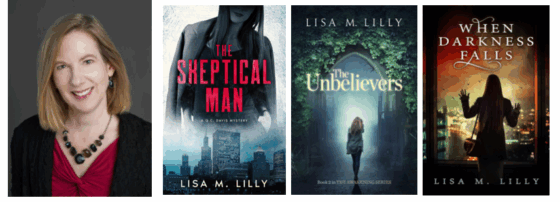
Lisa M. Lilly writes detective novels and supernatural thrillers, and also the author of Writing as a Second Career: Books for Writers. Her latest book, The Skeptical Man, features Prague in the Czech Republic
- How Prague’s architecture and eerie beauty immediately captivated a Chicago-based writer
- The city’s rich alchemical history and the famous golem legend, from medieval mysticism to modern AI parallels
- Navigating grief while traveling after losing a close friend
- Rooftop dining experiences and local Czech specialties, from monastery beer gardens to traditional duck restaurants
- Books about Prague including Wolf on a String, Prague the Mystical City, and more
You can find Lisa at LisaLilly.com
You can also take a day trip from Prague to Kutna Hora where you can find Sedlec Ossuary, or The Bone Church, which inspired my thriller, Crypt of Bone.
Transcript of the interview
Jo: Hello Travelers. I’m Jo Frances Penn, and today I’m here with Lisa M. Lilly. Hi Lisa.
Lisa: Hi. It’s so good to see you, and thank you for having me on the podcast. I’m really excited.
Jo: Oh yeah, it’s going to be fun today. Just a little introduction. Lisa writes detective novels and supernatural thrillers, and also the author of Writing as a Second Career: Books for Writers. Her latest book, The Skeptical Man, features Prague in the Czech Republic, which we are talking about today.
So Lisa, you are in America.
Why were you drawn to visit Prague and research the city for this book?
Lisa: It happened the other way around in a way. Two years ago, I went to Prague by way of Krakow because that was the main city we were going to. My travel companion and I went because my grandparents were originally from that area, came to the United States in the early 1920s or so. And I had never been. And so my friend Steve said, “Well, I’ve always wanted to see Prague, but let’s wrap that in too.” And I more or less just said, “Okay, yeah, that sounds good.”
And from the second I saw the city, we took a train there from Paris, because we also went to Paris. I just saw the architecture and we came into Old Town. And I thought, “Oh, I’m going to want to come back here. This is a beautiful city.”
And as we walked around, I was very intrigued by the history of alchemy in Prague and we did not get to the Alchemist Museum. That was on my list to go to next time. But I started thinking about it. All these story ideas – I’m very motivated by place and I had not even been sure I was going to write another book in the series right then. I was thinking of taking a break and all these story ideas started coming to mind and the more places we saw, the more I’d think, “Oh, this would be a great scene. This would be a great place to set something.”
I think Prague is so beautiful and kind of eerie in some places that it just evokes so many ideas.
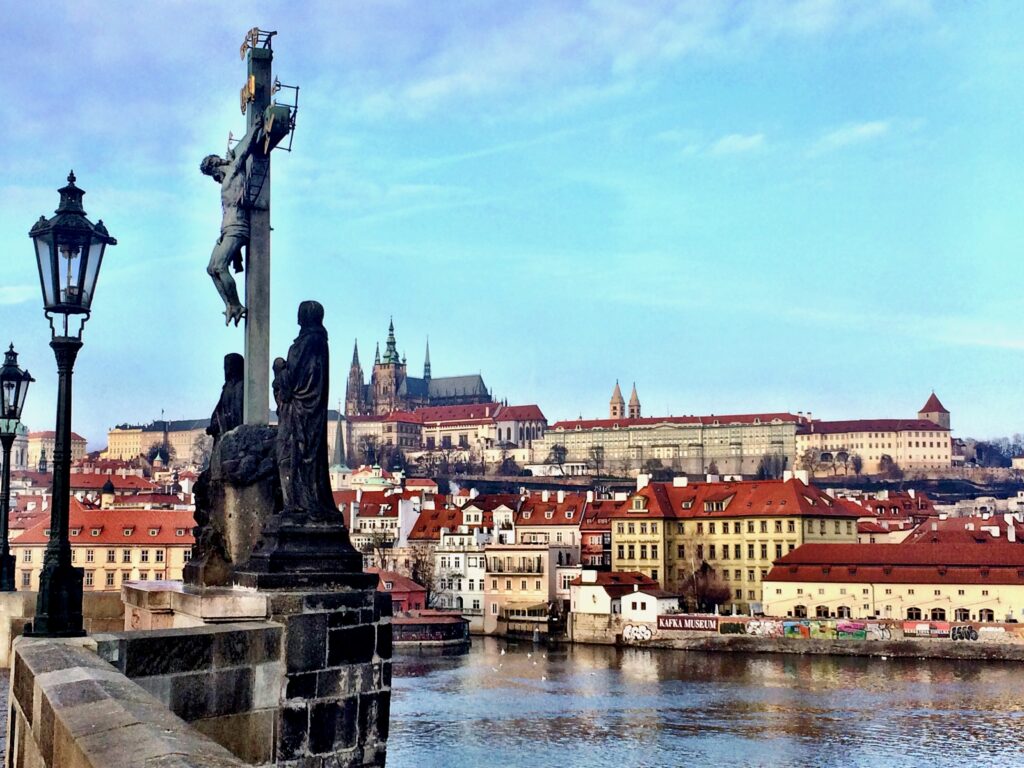 St Charles Bridge and Prague Castle Photo by JFPenn
Jo: Yeah, I think it’s interesting. Well, first of all, you said Krakow and you got the train from Paris. I mean, obviously Krakow’s closer. You could have got the train.
Lisa: Well, we went Paris to Prague, Prague to Krakow.
Jo: Oh, okay. Yeah, because it’s really – for people who might not know, you know, the Czech Republic is really right in the center of Europe, well connected with Germany, Austria, Poland, Slovakia. So, and the trains. And this always surprises me in America, because I’ve been over to the US a lot and the trains are terrible. Whereas in Europe, you could just get everywhere by train, right? So I love that you arrived by train as an American.
Lisa: Well, it turned out for us, it wasn’t the best way to go because we had worked with this travel agent who specialized in trains because we thought, “Oh, trains would be great. We’d always heard this about Europe.” And it was in terms of connectivity, but she didn’t think to tell us we were doing this almost four-week trip, so we had tons of bags. We each had two big rolling bags, two smaller bags. And we were picturing – I know you’ve taken the Amtrak where you get the compartments and you could stow your bags above and check your bags.
So we’re lugging all these bags and there’s nowhere to put them because —
Jo: We all have backpacks!
Lisa: Yeah, exactly. And people are just looking at us like, “What? What are you doing?” And there’s not a porter and we didn’t… so I would say to people, yeah, be prepared. I enjoyed the trip, and I talked to some people from Prague to Krakow. One of my favorite parts of the trip was talking to people in the compartment who were telling me – who were Polish and were telling me about all these traditions, and I’m asking them questions. It was wonderful. But yeah, don’t take eight bags. And don’t… yeah, do it if you’ve got like one bag and a backpack and know your stops.
We got off on the wrong stop. We didn’t know there were two Dresden stops. So we’re out and we’re like, “Why can we not find this connection? We need to get to Prague.” But people were so helpful. I can’t tell you how many people offered to help me with a bag or like block the train door when they were going to close it on us because very serious in Germany about the train times or help me find… I just went up to someone and said, “I don’t know how to get the train to Prague” and they just happened to speak English and were taking that train and said, “Okay, follow, follow us.” Very patient. Very nice people. Just wonderful.
Jo: Oh yeah. Well it sounds like you had an adventure in getting there.
Lisa: It was. We flew the next time.
Jo: Yeah. Okay, so let’s come back. So you said the moment you kind of saw the city and the architecture was all amazing.
What were some of the highlights, like your favorite parts of the city?
Lisa: Yeah. I loved, you know, this is very touristy, but I love the Charles Bridge because there’s just so much going on there. We walked through during the day and at night there are singers, we saw dancers. We saw a couple dressed up as a bride and groom doing a whole song and dance thing together, vendors. And of course I thought, “What a great place for a chase scene, a foot chase scene,” which ended up in my book. So I loved that.
I loved the Old Town Square, the whole Old Town neighborhood. I really enjoyed… We went to see the – I’m sure you’ve seen it – the astronomical clock, which plays I think every half hour. And you can see all these figures coming out. And I think it’s the…
Jo: I just wrote this down. It’s the from 1410, the world’s oldest working astronomical clock.
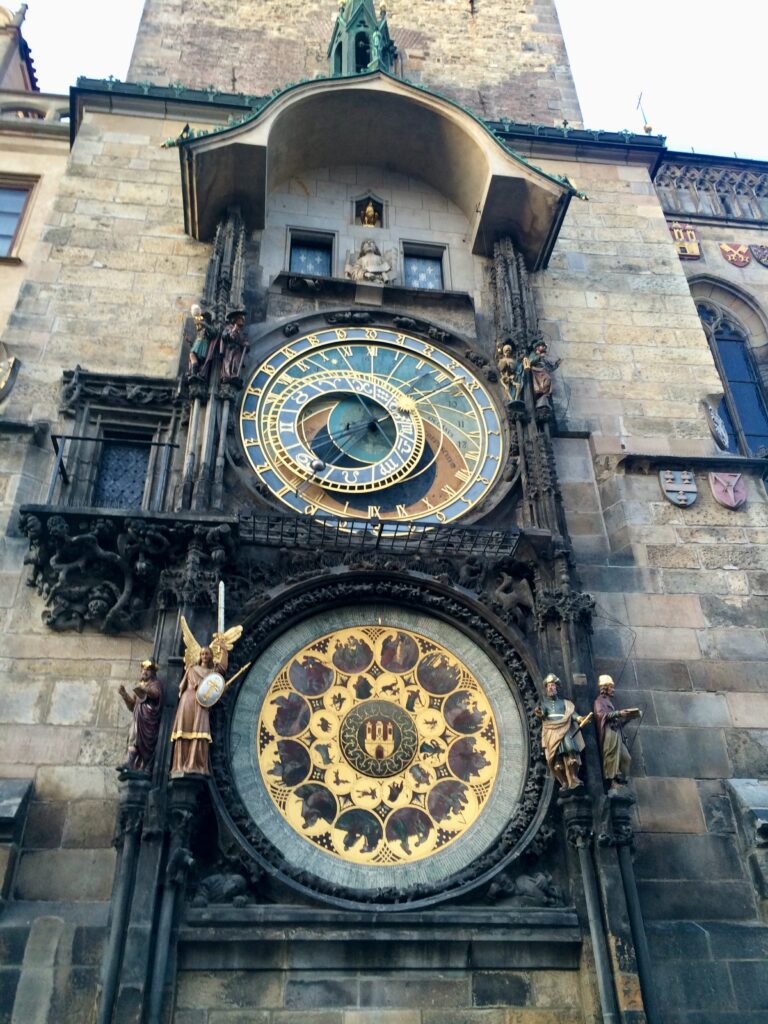
Lisa: Yeah. It’s… and you see people just standing there watching, which is how we found it. We had trouble finding it because we came to the square in a direction where the way the buildings were and the churches, you couldn’t actually see it and finally saw all these people in this narrow area that’s along the side.
That’s something else I love too, though, just the streets and how you could wander and you’d end up behind the buildings and come out another place. In Chicago where I live, we’re on a grid, so almost everything is square blocks, which is great for navigating but not as intriguing for walking around. So I love the cobblestone streets. I love the Prague Castle. I went there a number of times and we don’t have castles here either, so it’s very… that’s like a proper castle.
Jo: Oh yeah. We should say, if you stand on St. Charles Bridge and look out, it sort of dominates the skyline there, doesn’t it?
Lisa: It is what you think of as a castle and beautiful to see at night. And that reminds me just the river itself, the Vltava River. I found so peaceful. I spent a lot of time sitting by the river and reading and just watching it sparkle. And in any weather, just, I think it might be the prettiest river I’ve seen. The water seems so clear and it’s very tranquil. It’s also very shallow. I found out, so perhaps that’s why it looks so pretty. I don’t know. But the boat tours can’t go very far because they run into the bottom of the river. They just can’t keep going.
Jo: You went this year as well, did you?
Lisa: Yes. I went two years ago and went back this year and did a number of boat trips on it.
Jo: I was there in 2015, so a decade ago. I don’t remember the river being low, but then I was there in the winter. And also this summer has been one of the driest.
Lisa: Yes, I didn’t think about that. They were telling us as the river was low, and they did show us the different times that had flooded. We took one with a small boat where they could go into, I don’t know the right word, but the sort of offshoots of the river and would show us where the flooding had been and where the river level was at different points and that. Yeah, I didn’t think about that. It was very low when we went.
Jo: And you’ve been both in the summer, both times?
Lisa: Both in the summer in mid-May through mid-June. Just beautiful weather both times. We did a lot of rooftop dining, which you could see the whole city, and you could see the Prague Castle. And it’s particularly beautiful at night when the sun sets and it outlines the castle.
Jo: Yeah, it’s very kind of gothic romance. But I was there in the winter, so we went for New Year and you don’t sit by the river reading in the winter. It is freezing. It’s proper furry hoods and boots kind of weather. But also you can eat outside, but there’s lots of heaters and things, so it’s very well set up for winter. Like a lot of people go at winter for the Christmas markets and that kind of thing.
Lisa: Oh, I bet the Christmas market is… is it very big? Is it really something to see?
Jo: Yeah, it’s something. Well that, yeah, it’s the square and all the little places, but again, quite touristy. But Prague’s also well known for its beer and general nightlife.
Lisa: Oh yes. It’s funny, the other amazing thing was the monastery. I loved, you go upstairs and you see the cabinets of curiosity where the emperor had collected all these things that seemed very amazing and exotic from foreign lands. And then you see the notes and it’s like a fossil of some kind of fish that we know today. This is not a big deal, but people… they couldn’t travel the way you could now, and I love that.
And they all these books that you can’t go into the area. But I loved seeing all the books and they kept saying to us, “Oh, you have to go. The monks make this wonderful beer, and you have to go to the beer garden.” I can’t tell you how many people told us that, and neither Steve nor I like beer. So we kept being like, “Well that sounds, that sounds wonderful.” And yeah, so many signs for beer. So apparently, if you like it, good place to try a lot of beer.
Jo: It is. It’s definitely a beer capital of the world. So I mean, I guess one of the areas of the city is the Jewish quarter. I don’t know if you had a look around there.
What about the Jewish Quarter?
Lisa: We did get… the time that we went, there had been some incidents, they were limiting a lot of access, so we were only able to drive in and look at the main synagogue from the outside and we could see the gates to the cemetery. I would have really liked to go in. And our guide mostly was telling us about how much it has changed.
But she told us some of the history. You probably know the story of the golem of Prague. She told us that story.
There’s a number of versions. So the one that she told us was at the time the Emperor Rudolf II. This was like, I want to say 1500s. I hope I’ve got that right. He was very into alchemy and magic, and at the same time there was so much anti-Jewish sentiment trying to either drive the Jews out of Prague, or sometimes kill Jewish people, and yet he and the rabbi had something of a relationship.
But the rabbi created the golem which was made of clay and brought it to life to help protect the people in the neighborhood. And the version, the story she told us was it could only act based on instruction. So by itself it just would stand there. And he gave it instructions, but it came the Sabbath and he forgot to tell it to stop.
And it went on a rampage killing rampage, and he finally had to stop it at the end of the day and like not kill it, but deactivated it, I guess we’d say. And they say it’s still in the synagogue. That it’s still there.
And the funny thing, I had heard the story from a friend who was writing a book that included it, that talked about it as the first robot. The idea of it only acts on instructions, and now our guide said it’s sort of like AI. It only does what you tell it to, but you have to be careful how you instruct it and what you tell it to do.
Jo: That’s so interesting. I actually like that because the story goes that it’s sort of partly to do with Kabbalah, Jewish mysticism. And you put, he put letters, the rabbi put letters onto the golem. And that’s the thing that brought it to life and so it’s words that actually brought it to life, that this text is on it, this holy text.
And so I kind of like that with the AI stuff because it’s words that are activating it. But, well, I went a decade ago and went into the cemetery, and I think it’s really interesting because it’s an area that’s obviously been affected by war, and Hitler didn’t destroy that area to keep it as “a museum for an extinct race.” That’s why it was preserved. And I mean, that in itself is just awful in many ways.
And yet that cemetery there because it, as you say, it was a ghetto and the people were hemmed in, they, that goes sort of 10 deep and there’s so many gravestones in there and people put stones on in remembrance.
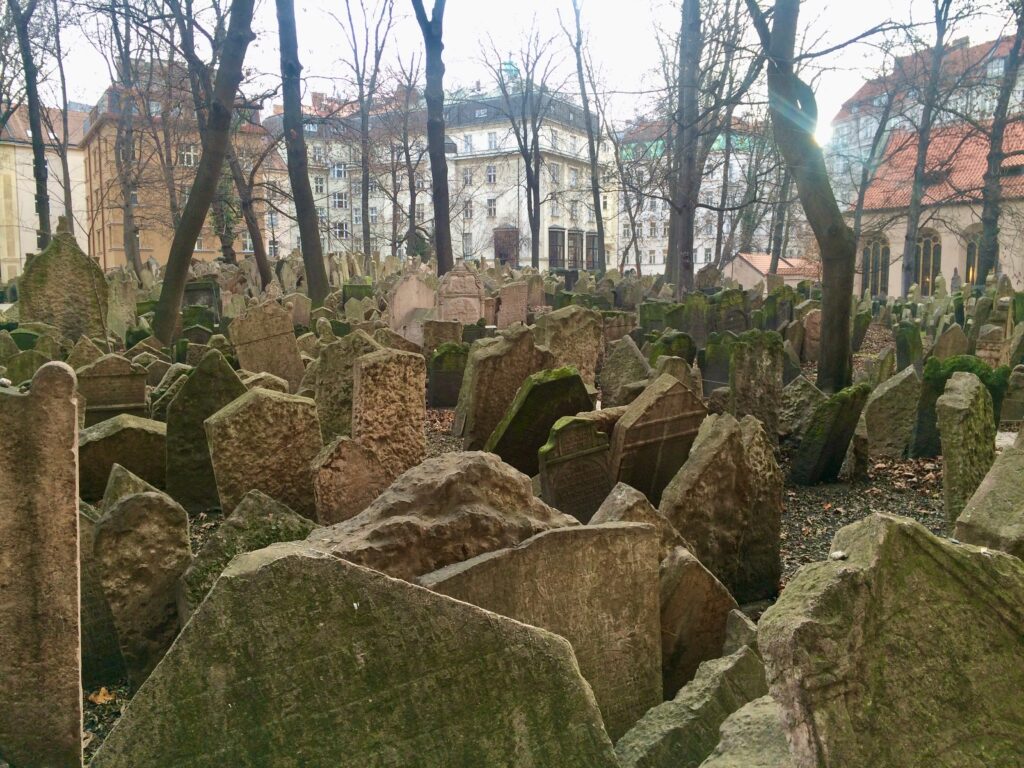 Jewish Cemetery Prague Photo by JFPenn
And so if people listening, if at some point we’re at another point in history where you can visit that cemetery, it’s an incredibly moving place. And quite different because it’s very, I guess dark. And then the Spanish synagogue, which you said you were on the outside, but the inside of the Spanish synagogue also sometimes called the Golden Synagogue because it’s just incredibly decorated and beautiful.
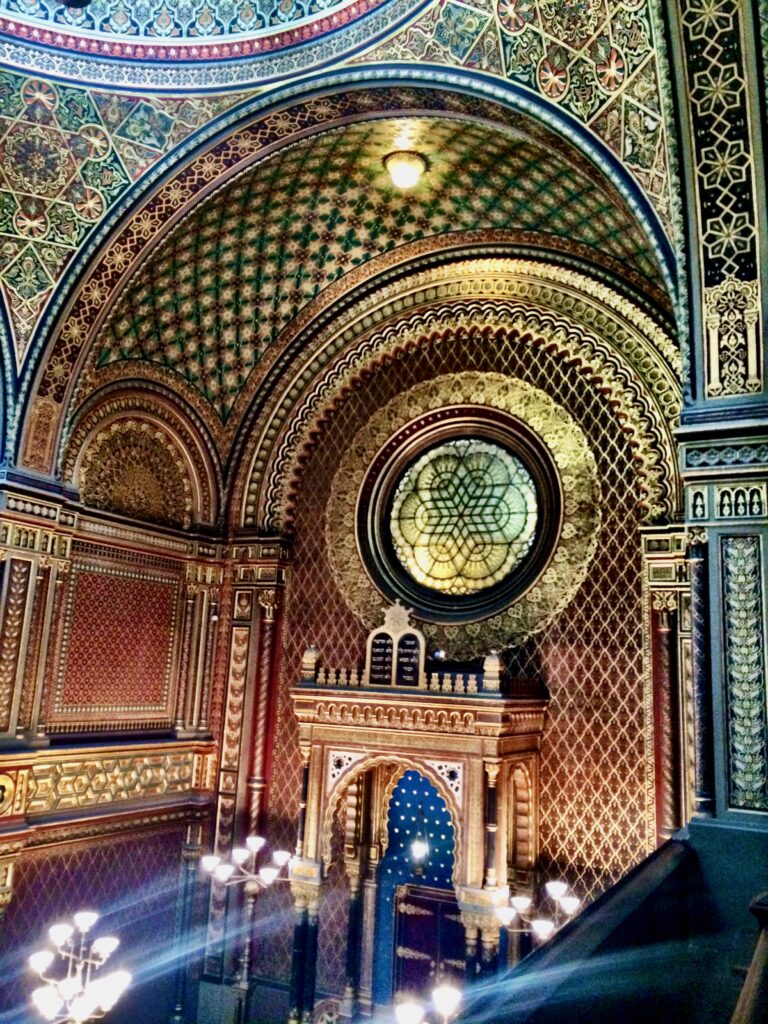 Spanish Synagogue Prague Photo by JFPenn
So yeah, I mean that Jewish quarter is fantastic. But yeah, the time in history that we are recording this, it’s a difficult time again. Which in itself is so…
Lisa: Heartbreaking and devastating that so long later and the same things are still happening. She was telling us she would get invited to events there and had to have someone come out and vouch for her and show her ID and let her in because there’s so concerned, understandably, about terrorists coming into the synagogue.
We did get to go to two other cemeteries, I’m going to say it wrong, but Vinohrady and Vyšehrad cemeteries and that was, well, I know you’ll understand this. One of the highlights of the trip for me in the sense of the beauty and seeing these gravestones, we don’t do too many of the above the ground gravestones in the US anymore. It’s all flat. But seeing like family names and this history of the family, and I was struck by so many people put their professions on the headstone, which is another thing that we don’t do here.
Or at least I haven’t seen it much. And it really got me thinking about… I mean feeling connected in a way to, we see these stories of people so long after they’re gone. And the names, I grew up in a neighborhood, lots of immigrants, lots of Polish immigrants, lots of Bohemian immigrants, and so many of the names were, I’m like, “Oh, that’s the name, last name of this friend of mine in grade school.”
And many of them were names I knew. Now were they related to the people I knew, maybe, probably not, maybe distantly, but it gave me that sense of great connection with history and with here we are across an ocean. And that sense of being part of the human family and especially in a time when everyone feels so divided it felt very peaceful and very connected and not as sad as I thought you would think, “Oh, this is sad. You’re looking at all these people who are gone.” But somehow it felt like having a place in that history.
Jo: Yeah. That’s interesting. And yeah, I obviously, I find graveyards wonderful places to think about how short life is, and so we better make the most of it — memento mori.
But you did mention in our emails that a friend of yours died while you were traveling and so you were also facing grief on your visit and thinking about her.
How do you think travel almost helps with grief?
Lisa: For me, it was in a way the perspective of feeling that larger connected sense and that life. The finiteness of life having, of course, we all know that. But I was getting this news about my friend who we had expected she had had a surgery that there was an expected recovery. And I’d seen her a number of times before I left and was sending her photos. She loved travel photos. She always was like, “Send me more, send me more.”
And then they found other problems and she was gone very quickly just in a couple weeks. And some of that news I was getting while we were in the cemetery that the type of news where you look and say, “This is not good. Like this is probably, I’m not going to see her again.” And it was really sad because I could not then be there at the time and couldn’t be there for the wake and be there with the family.
And at the same time, I would think, “Well, I know Julie. She loved travel. She loved hearing about travel, like she wouldn’t want me to spend this time, all of it, just feeling sad.” Of course, I felt sad and was grieving, but it was a reminder that and this is the only time I have, and this is the time to enjoy this or experience it, like don’t miss the experience I’m in because I’m also grieving and feeling sad that trying to maintain both at the same time.
One of your podcasts helped me because I was feeling very sad and then I was feeling not guilty, but almost like, “Well, but I’m here. Like I’m missing it. And I shouldn’t be dwelling on this, but how can I not?” And I listened. I think it was your first one when you restarted the podcast and your guest said something about the difference between vacation and travel and that travel is not always fun.
And it is not always, you don’t always have a great time, like you look forward and think, “Oh, everything’s going to be fantastic.” And it’s not, it’s sometimes challenging, and I think she was talking about other things, but she said, “There is that value.
“You still have the value. Even if it is challenging, you are experiencing something and when you come back, you’ll have experienced this journey.”
And it doesn’t all have to be so much fun and wonderful that it is still a valuable trip and not just. Helped me. It put it in perspective that I am still having this experience and I want to be present in it, even though I’m also having these feelings and this sadness and loss.
Jo: No, I love that. I think that’s really great and something for us all to keep remembering as well. And perhaps even a city like Prague and many in Krakow is another great example, of cities that have suffered in many ways. Obviously we have war in Europe at the moment and so it’s not everything is wonderful all the time anyway.
Lisa: Right, exactly. I kept telling myself that, I’m like, “Well, if I was home, I would likewise, I would be feeling sad and, yeah, life is not wonderful all the time.” Yeah, there are many wonderful things in it. And that that also, my friend who passed, she was really great at focusing on the wonderful things in life.
We had a tradition every year of going to this steak dinner after volunteering at our law school. And for weeks before, she’d say, “Oh my God, I can’t wait to that dinner. Like, they have such great food. Let’s get this as an appetizer, and oh, so-and-so will be there and tell us stories.” And then a month after, she’d say, “Wasn’t that a great time? Like, didn’t we have, remember this thing.” And so I thought about that a lot too. Like she had lots of ups and downs, but she chose to think and remember and anticipate, and I thought “That’s what I need to do. Like think about, oh, these were the great parts of the trip. This is what I really enjoyed.”
Jo: I think that’s really interesting and almost you are honoring her by enjoying the time that you had there and yet, I wonder how many, as I was talking to someone recently who was like, “Oh, I really just want to go to this particular place.” And I’m like —
“Well, why don’t you make a plan to do it because we’re not getting any younger, and you don’t know when something might happen like it did to your friend, or you don’t know when just things change.”
And so I’m like, “Well, you just make a plan, and you save up the money. You book a ticket. We’re very lucky to live in a world where you are going to be able to get to most of the places that people want to get to.”
So do you think sometimes we find it easier to honor other people than honoring ourselves? Like giving ourselves that kind of grace?
Lisa: Yeah. I do, I feel like it’s almost giving, it’s like this person outside of you giving you that permission or that reminder. And especially for me, I’m someone who tends toward anxiety, which is all about thinking about what could go wrong.
And I often deal with it by thinking of friends who think very differently than I do. And I think so now I will think, “Well, how would Julie approach this?” Or I have other friends who will think, “How would this person think about this?” And it helps because. You know, and why can’t I just tell myself to do it? I don’t know.
But it works better when I think of that other person. And maybe it is what you said, it’s like someone else giving you permission and saying, “Hey, it’s okay. Like you can let go of. Oh my God, I’ve got to be sure. I know I’m prepared for everything that might go wrong or everything that might happen,” which is, you know, when travel, I always have a lot of anxiety going up to travel because I’m like, “Did I do this? Did I get that?” And then I’ll say, “You cannot prepare for everything. That’s part of it.”
Jo: Something else, most people are lovely and they will want to help you. Like wherever you are in the world generally, people are just nice and they want to help you.
Lisa: Yeah, I really have found that. I mean, of course here and there, you meet someone who’s not, which is also true at home. But yeah, for most people, for all that, people will say to me, “Well, do they like tourists there?” I’m like, “I don’t, I mean, people seem very nice. They seem glad that we’re there, and if they don’t like us, they’re hiding it really well.”
Jo: I mean, it’s a tourist destination, right? It’s a tourist industry.
Lisa: Yeah. It’s part of what they do. I actually found in Prague particularly, people are, yes, very friendly and seem very, either they’re really, they seem actually really happy at their jobs. So maybe working conditions are better there. And it also might be that they do appreciate this is part of the way, this is especially the Old Town area, it’s a lot of it is tourists and so it’s how people are making their living.
Jo: For sure. Well, just, I guess coming back on the city in terms of the literary side of things, there’s obviously the Franz Kafka Museum is one of the top places. Any thoughts on the literary side?
Lisa: Yeah, you see Kafka everywhere. Everywhere. And I have to confess, we did not go to the museum. Not that I dislike Kafka, but he’s not my first choice for reading. But yeah, there is so much. I read a book before I went this time in between the two trips that a guide that I work with both times recommended and it’s called Wolf on a String. So I wrote down the author and, let me look here. Benjamin Black and it is set in that time at the Emperor Rudolf II. And it is about this kind of amateur alchemist or someone who pretends to be an alchemist, but it has so much history and a lot of it is in the Prague Castle.
So I was very excited to go there and my guide was pointing out, “Oh, this is where the small, they called them houses, but it was basically a room that was bordered on the outside and this is where they stayed. And this is what was called the Golden Row or the Golden Alley. And here’s why.”
And that was really exciting. She took me to, took us to a place called The Alchemist, which borders on a courtyard where a very famous alchemist. Last name was Kelly. Lived in a tower and served the king. So everywhere. If you read anything about Prague odds are you’re going to be able to go there and find that place and still find traces of it.
The place we went had alchemy symbols all over the wall, so you could go and trace that. And I love that so much of history is still there. When a historical novel you would read, you can go and visit. This is, again, probably not as much of a novelty to people who live in Europe. But here there’s so many things are just. It’s old if a building’s a hundred years old, and there I’m seeing these things from the 1300s.
Jo: Yeah. And many of them very well preserved as well. I think, you know, there are a lot of them there. But it’s funny, I mean, like you say, Chicago, I remember the first time I went to Chicago, gosh, in the nineties, and I just, I love the skyscrapers and you can go on architecture tour of modern architecture.
It’s just a very different view, isn’t it? You can see beauty of a different kind. Whereas I feel, you know, here we feel like —
We live in a museum here in Europe.
Lisa: Yes. That’s how it feels when I visit. So I kind of feel better that you say that too. Oh, because always think do, do people look at us and be like, “What? When, why are you so enthralled with this?”
Jo: I find it beautiful, you know, I live in Bath where we’ve got like 2000 year old Roman baths down the road, so.
Lisa: Yeah. And that point about beauty, I think that is what I love traveling, is I, yeah. One of the reasons I love Chicago is I love the architecture. I love the buildings. I love that we have a river, and I’ll take boat tours, architectural boat tours, and just see what else I learn. There’s always more buildings going up, but I go somewhere like Prague and it’s a very different architecture. It’s in some ways. There’s more continuity because much of it is still standing and more is built, but it’s built along the same lines and you have the cobblestone streets and it’s a totally different kind of beauty.
But both places, I look around and think, “Oh, I’m so lucky to be here. I’m so lucky to see this.” Paris, same thing. I feel like so many cities have beautiful architecture. And I have to say in the US, that is not necessarily true. Most cities I go to having grown up where I did, I look around and I’m like, “Wait, what? This is the city. Where are the, where are the amazing buildings?”
Jo: That’s true. That’s true. But just coming back, so earlier you said you weren’t so much into the beer, but —
What food and drink you did enjoy since you said you were eating outside?
Lisa: Yeah. My travel partner and I, we tend to plan trips around where we’re going to eat. We will make these restaurant reservations. So we went to, it’s called Miru. It is only open two months of the year on the rooftop of the Four Seasons Hotel. And last time we were there, we missed it. And this time we were able to go, and it is, they have maybe four or five tables only, and it’s one of these tasting menus. So each course is very small and very beautiful, and they have a drink paired with each, so wine at one point, sake, which I admit I could only have a sip of. And I was like, “Okay, that’s all for that.”
But it’s at night. So you have the beautiful view of the castle and each dish is, you know, it might be salmon, but it’s salmon with a little bit of caviar and some tuna foam and something else. All very elaborate and fancy so that if you just want an experience for a night, it’s wonderful.
This is also touristy, but there is a steak house there that is some of the best steak I ever had. It’s called George Prime, and ironically, the steak is from the Midwest in the United States. But it’s, it was, it’s something about the way they make it. I don’t know. Excellent. And we did two other rooftop restaurants.
One is called Coda on the roof of the Aria Hotel and everything is music themed. The food is very good. Like I had a farm raised chicken that was wonderful. But it’s also just to be up there outside. And if you get a plate, every plate has a different drawing of a different musician on it. And the menu is music themed, so a little bit touristy, but but it is that’s good. Very fun.
And then one, really good local place. Krčma U Fleku, I think, is it? It’s known for its duck. So if you Google duck and Prague and mostly locals there, like we heard mostly Czech being spoken, if you like duck, wonderful duck and wonderful atmosphere. It reminded me, again, as a kid, I went to a number of, if there was a party, it would be in a banquet and often in a Bohemian banquet hall.
And I walked in and I’m like, “Oh, these are the furnishings that I grew up with. This is like being at my aunts and uncle’s houses only stepped up fancy and really, really good food there.” So if you like Bohemian food or Polish food or Czech, that’s a great place to go. I think duck is definitely…
Jo: Duck is the thing for that region.
Lisa: Yeah, really good.
Jo: Yeah, that’s great. That’s fantastic. So this is the Books and Travel show.
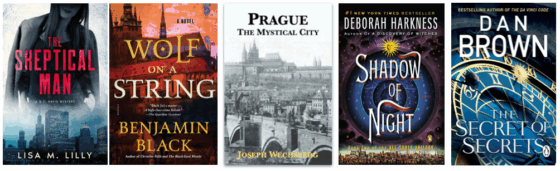
You mentioned Wolf on a String. Are there other books that you would recommend that are about or set in Prague or the area?
Jo: Yeah, for research, so between the trips, when I decided to set something in Prague, I got a book called Prague, the Mystical City. It was written in 1970. It goes through 1983. I forget the publication date, but it covers the city 1907 to 1983 and I, it’s at least 10 years old, but it really gives you that feel of Prague. It talks a lot about the history of alchemy and magic and how alchemy worked into science, how much the alchemists were the basis of so many scientific and chemistry advances later.
And it really gives you that feel for Prague if you want to read nonfiction. Interestingly, AI hallucinated for me, other books by the same author, and I was like, “Oh my God, that is a great book.” And I went hunting and hunting and I even asked like a librarian at the local university and she’s like, “Yeah, I think it made this up.”
But that’s how I found this one. I was like, “Okay.” And the other book I just happened to read, I don’t know if you read the All Souls Trilogy. It started with A Discovery of Witches, so the third…
Jo: Deborah Harkness.
Lisa: Right. Deborah Harkness. And this book, they go back, I don’t think this is too much of a spoiler. I’m not going to tell any plot things, but they go back in time and they’re in Prague in the same time period. Somehow I kept running into this same time period with the Emperor Rudolf. And there is a golem in it and it is, she meets a number of these historical figures. So if you are interested in like supernatural books, I would read the first two first, but it was very neat and I just happened to read it maybe six months before coming back to Prague. So I love that one as well.
And of course, Wolf on a String, I will say Wolf on a String. It has a mystery. So I like that. It is a bit bleak, a little bit bleak for me. So I persisted because I wanted to read about the city. And it is an interesting story. But, if you want something more uplifting, maybe, maybe not, maybe not that, maybe not. But if you’re good with a lot of darkness, then go with it.
Jo: And we should say as we record this is not out yet, but The Secret of Secrets by Dan Brown is supposedly set opens in Prague. So we shall, I shall be reading that when it comes out.
Lisa: I am so excited about that. You had mentioned that in the email and somehow I didn’t know that until you said it. And yeah, I cannot wait to get that. I love his books anyway. And now to read it in Prague, that will be wonderful.
Jo: And so your book, The Skeptical Man also has some scenes set there. But tell us a bit more about that. Because it’s also across the US as well, isn’t it?
Lisa: Yes, most of it is in the US. I had never, this is the seventh book in my mystery series. I had never taken the characters outside of the United States and I was going to take a bit of a break because the sixth book was kind of a big thing that a mystery was solved that had been running. And taking this trip in the back of my mind, I always had this idea about a magician as the victim, as the murder victim.
A magician who also debunks psychics a little bit like there was a real magician who did that. The Amazing Randi and I used a little bit of his life as a model. So when I went to Prague, I thought, “Oh, how interesting it would be if some of the people that are suspects are somehow connected to like a psychic.”
I didn’t decide was it going to be a genuine psychic or someone who was a little bit of a little bit of a little scammy. And something about being in Prague, I started thinking, “Oh, what what if there was a whole network that was based here and that played into this magician’s death.” He had crossed paths with these people and it. It really inspired me. So in the story, the detective QC Davis is asked to try to solve this murder by a friend.
She’s a lawyer, she’s a friend who’s a judge, and it’s her husband who has been killed. And they wonder like, is it someone he does this debunking of psychics? Is it somebody that he exposed that came after him, or of course there are other suspects as well in other parts of his life. And the Prague part, I just had such fun with, oh, the character’s going to get out of Chicago mostly she’s in Chicago, she’s going to get out and go somewhere else. And how would that be for her as not a world traveler? She has a friend who does a lot of world travel, so you know, it’s her taking her along and being like, “Hey, this’ll be fine. We’ll do this.”
Jo: Oh, cool. Oh, well I’m glad you got to weave it in. Where can people find you and your books online?
Lisa: You can find my fiction and nonfiction and my podcast, which is about Buffy the Vampire Slayer and story, at lisalilly.com
Jo: Fantastic. Thanks so much for your time, Lisa. That was great.
Lisa: Thank you. It was great to be on with you.
The post Alchemical History And Beautiful Architecture: Prague With Lisa M Lilly appeared first on Books And Travel.
20 November 2025, 7:30 am - 59 minutes 48 secondsBlood, Wine, And Sacrifice: Folk Horror Inspired By England’s Biodynamic Vineyards With J.F. Penn And Natalie MacLean
What would you sacrifice for the perfect vintage? Can ancient pagan rituals and biodynamic winemaking create something truly extraordinary—or terrifying?
In this conversation from the Unreserved Wine Talk podcast with Natalie Maclean, award-winning author J.F. Penn discusses the inspiration for her folk horror novel Blood Vintage, set in the vineyards of Somerset, England.
We explore the dark side of viticulture, from poisonous plants and blood sacrifices to the hard realities of small-scale winemaking and the mysterious practices of biodynamic agriculture.
Watch a short video on the English vineyards behind Blood Vintage, with my photos from Woodchester Valley and Limeburn Hill (4 minutes):
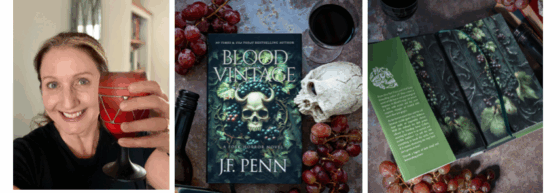
J.F. Penn is the award-winning, New York Times and USA Today bestselling author of thrillers, dark fantasy, crime, horror, short stories, and travel memoir. Jo lives in Bath, England and enjoys a nice G&T.
- New Zealand wine memories. Pinot Noir tours in South Otago, including Mount Difficulty and Peregrine Vineyard, paired with wild venison and legendary Bluff oysters
- The birth of Blood Vintage. How a tour of Woodchester Valley vineyard, frost candles, and a note in the ancient Domesday Book sparked a dark story
- English wine’s climate change renaissance. How warming temperatures are making England’s sparkling wines competitive with Champagne.
- Inside biodynamic winemaking, inspired by a visit to Limeburn Hill Vineyard, Chew Magna, Somerset. From burying cow horns to dynamisation rituals and creating a self-contained ecosystem
- The dangers and romance of viticulture, and for more on this, check out the interview with Caro Feely, The Taste of Place.
- Folk horror and the ‘terroir’ of terror. Exploring the question at the heart of the book: What would you sacrifice to create (or taste) the perfect vintage?
You can find Blood Vintage on all platforms in all formats now.
This discussion was first broadcast across two episodes on Unreserved Wine Talk with Natalie Maclean in Oct 2024 [Blending biodynamics and suspense; Wine and folklore]. You can also watch the full interview on video.
Transcript of the interview
Natalie: Jo (J.F.) Penn is an award-winning New York Times and USA Today bestselling author of horror, thrillers, dark fantasy, crime, and travel memoir, as well as short stories. She’s also an award-winning podcaster. Her podcast is amazing, by the way—The Creative Penn. I listen to it every week, and you should too, if you have any interest in books or reading.
She has a Master’s in Theology from the University of Oxford, and her latest novel is called Blood Vintage. It’s a folk horror story set in an English vineyard. I just finished reading it and it’s wonderful, Jo.
You are joining us now from your home in Bath, which is nestled in the beautiful countryside of Somerset, England, about a hundred miles west of London. Welcome, Jo. I’m so glad you’re here with us.
Jo: Oh, I’m so excited, Natalie. An excuse to drink wine with a friend!
New Zealand Wine Experiences
Natalie: Before we dive into your book, tell us about the Pinot Noir tours and festivals in the South Otago region that you attended while you were living in New Zealand.
Jo: I lived in New Zealand for six years, from 2000 to 2006. It was one of those mid-twenties “go backpacking, fall in love, stay, get married, get divorced, get remarried” stories. You understand?
Natalie: Oh wow, you were busy!
Jo: Yes, exactly. But I did a Pinot Noir tour in South Otago, and it is quite a famous region for the Pinot Noir grape. I wanted to tell you about two particular vineyards. One is called Mount Difficulty, which is a wonderful name in that region because the mountains—the Remarkables—are really high and it’s a pretty hardcore walking region, skiing region in the winter. And the other one is called Peregrine Vineyard.
It’s a beautiful region for the nature, but Peregrine have created this incredible architecture. The roof of the winery is shaped like the wings of a peregrine falcon, and I particularly remember that tour. For people who don’t know, it’s out of Queenstown in the very southeast of New Zealand. So it’s really far south. Gets very cold in the winter, but highly recommended.
And you are the best at pairing, but I was going to pair it with New Zealand wild venison, which is something you get a lot of around there. Have you tasted the New Zealand Pinots?
Natalie: Oh, I love them. New Zealand is better known for Sauvignon Blanc, but I think the Pinot Noirs are even more spectacular. They’ve got this nervy, edgy acidity that I love. It’s almost like the wine vibrates in your glass, and it’s so food-friendly because acidity is to wine what salt is to food. It brings forward flavor. Gorgeous wines, absolutely.
Jo: Since you mentioned the Sauvignon Blanc, I also wanted to recommend a very specific New Zealand oyster as a pairing with that, which is the Bluff oyster. And I think you like oysters, right?
Natalie: I write about them, yeah. It’s the one thing I can’t get past—it’s a texture thing. But anyway.
Jo: Okay, for people who love oysters who are listening, I love oysters. I’ve eaten oysters all over the world, and the Bluff oyster in New Zealand has a very short winter season, but it is incredible to me. It is the best, and I have a vivid memory of drinking a Sauvignon Blanc with a Bluff oyster—maybe a whole dozen oysters—on Lake Wakatipu in the winter sun. So I highly recommend that pairing as well, and it’s very hard to get them anywhere else in the world.
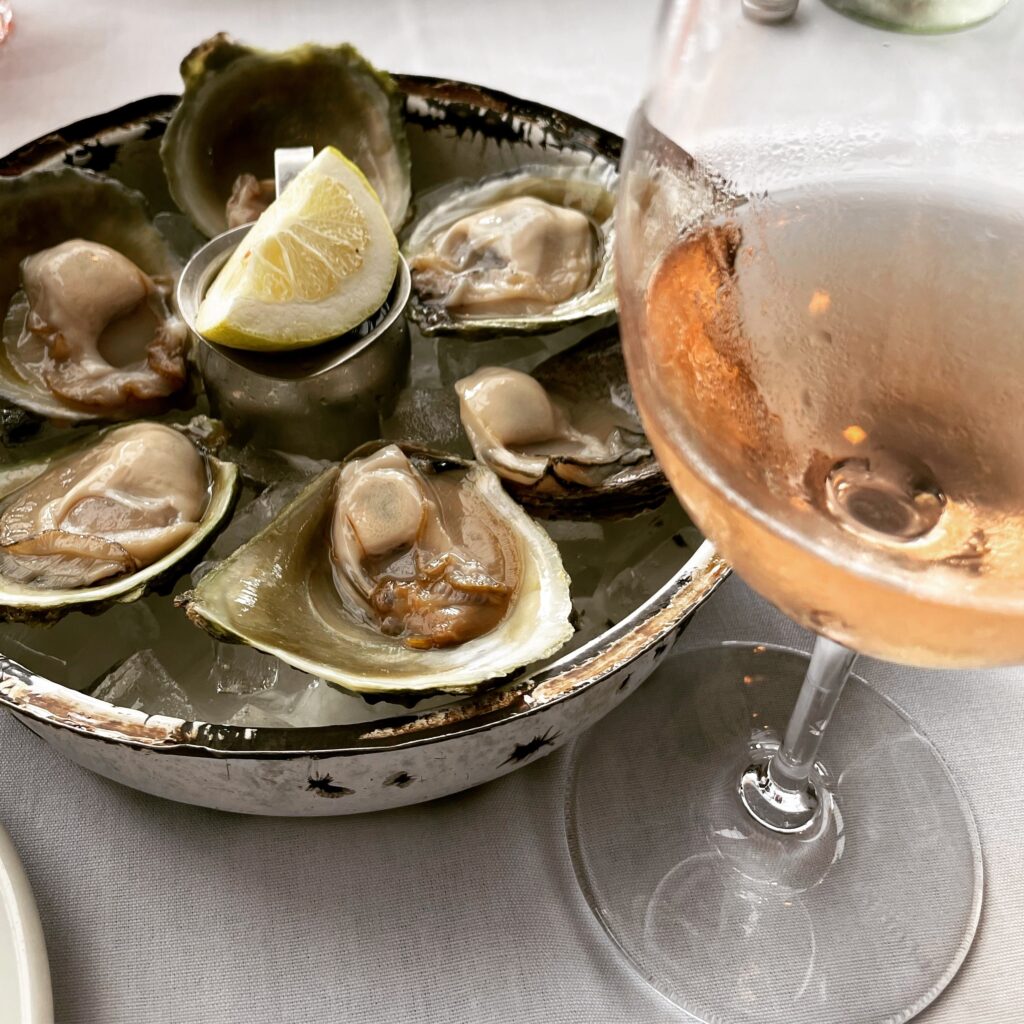 Bluff oysters New Zealand Photo by JFPenn
Natalie: Oh wow. I’ll have to make a note of that. My husband likes oysters, so we’ll do that. I love that. Great evocative image there that carries through with your book.
Introducing Blood Vintage
Natalie: So let’s set the stage for your book, Blood Vintage. You did a serious amount of research into biodynamic winemaking and winemaking generally. Before we talk about that, maybe share the overview of the book story with us, please.
Jo: This is the back of the book. Blood Vintage is a special edition, so I shall read it for you:
The perfect vintage requires the darkest sacrifice.
In the rolling hills of Somerset, England, an ancient evil ripens alongside the grapes of Standing Stones Cellars. Rebecca Langford never expected her architectural career to lead to the secluded rural village of Windbridge Hollow. But after a violent clash with eco-activists, she flees the chaos of London, desperate for a new start.
She seeks refuge at Standing Stone Cellars, a vineyard renowned for its award-winning wines and mysterious history, nestled in the shadow of ancient oaks and standing stones that have watched over the land for millennia.
But this vineyard is no sanctuary. From the primal fires of Beltane to the chilling shadow of Samhain, Rebecca finds herself ensnared in an ancient cycle of sacrifice and rebirth. The disappearance of her fellow workers, amidst evidence of blood rites, forces her to confront a horrifying truth: Standing Stone’s exceptional vintage is nourished by more than just sunlight and soil.
As the veil between worlds grows thin, Rebecca must make an impossible choice: embrace the dark legacy of the vineyard and secure her place amongst its guardians, or risk becoming the next offering to the insatiable horned god that demands his due.
Blood Vintage is an atmospheric descent into folk horror where the line between sacred and profane blurs with each sip of wine. Lose yourself in a world where pagan ritual and modern ambitions collide, and discover the terrible price of belonging in a place where the very earth demands blood.”
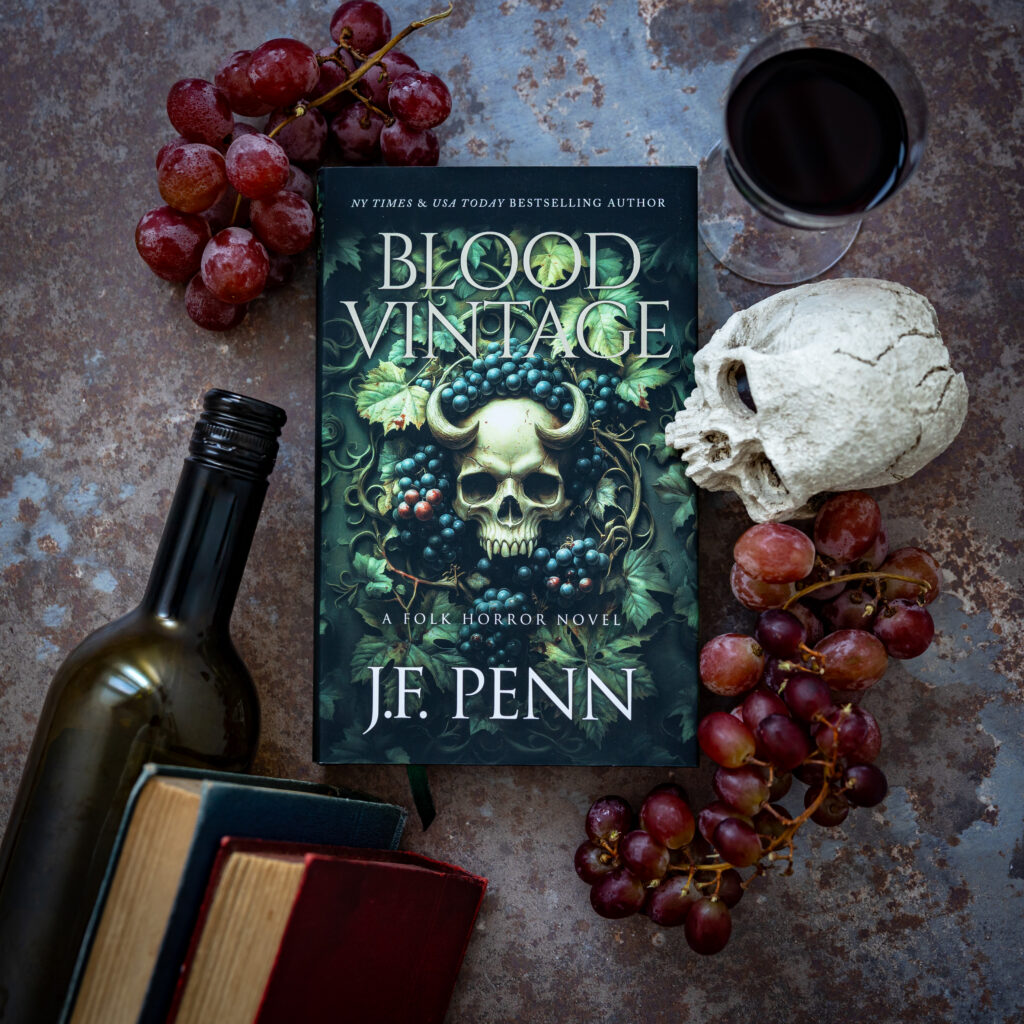
Natalie: Ooh, I love that. That is such a great description that really captures it—so atmospheric, so dark and brooding, and yet, bonus for us who love wine, wine is running right through it, woven into it.
Wine Pairings for the Book
Natalie: Before we dive into that, I’m itching to get there. You selected a wine to pair with your book, as have I. So let’s hear about yours first. What is it?
Jo: Yes, the blood vintage itself would be the Samhain wine from Limeburn Hill Vineyard. We’re going to come back to that, but that’s really hard to get. So I’ve gone with the Pinot Rosé from Woodchester Valley, which is where the original idea came from. I love a rosé, and we’ll obviously talk about where this has come from. I have my glass ready. This has been chilled. Woodchester Valley, Pinot Rosé—and I read about it, it’s 100% Pinot Précoce, the early Pinot Noir.
Natalie: Oh, lovely. I love a rosé. I’ve chosen a more brooding, darker wine for you and your book. This is from Italy because we just don’t get many English wines here in Canada. But this one, the label has a woman and her hair is in flames because fire is a metaphor, but also the sun. Stars are all around her.
It comes from the Donna Fugata winery in Italy, which means “fugitive woman” or “woman on the run,” which I think Rebecca is a little bit—from her architectural career and she’s escaping out to the countryside with the vineyards. Anyway, lots of metaphors, but I love the labels on this.
So let’s have a sip to get going here. Cheers!
Jo: Oh, you have a goblet there!
Natalie: Yes, my special glass. I bought this 20 years ago. I was in Prague with a friend of mine. It was winter, and I saw these glasses. I drank a lot more red wine at the time, and I was like, this is perfect, I love these. And this is one of those times where, you know, I’m backpacking—do I really want to take glass anywhere? But we had such a lovely trip, and these memories of drinking together are important. So that’s the story of the glass. I know it’s not perfect for rosé, we’re not going to get technical here.
Natalie: But for those who want to know, an ideal glass is clear and has a big enough bowl so that you can swirl it. But I love the goblet. Very atmospheric, very apt. Very blood vintage!
Jo: Very gothic. That’s lovely.
Natalie: Okay, tell us what drew you to this story in the first place. Where were you? Oh wait, I haven’t had a sip yet. Okay, yes.
Jo: Oh, it’s really tasty. It’s very strawberry. You are much better at these tasting notes than I am, but I can definitely taste strawberries.
Natalie: Strawberries, absolutely. That is the essence of a good, fresh rosé. It makes your mouth water. It’s like fresh berries, sunshine, and the opposite of the mood of your book. Although your book is not a downer, it’s just very gripping and thrilling.
The Origin Story at Woodchester Valley
Natalie: So tell us more about where this idea came to you.
Jo: Yes, Woodchester Valley is a small vineyard. Most of the vineyards in England are smaller, although they’re getting bought up as many of these things do. But this is a small one, and the Cotswolds is in the southwest of England. It’s an area of outstanding natural beauty, which is a distinction of certain areas, and you would absolutely recognize it. It’s the kind of chocolate-box England with the green rolling hills—lots of green because it does rain—but also sunnier. There are lots of stone buildings, cows wandering around. It’s pastoral, but also enough hills.
 Woodchester Valley Vineyard, Stroud, England. July 2024 Photo by JFPenn
I went to Woodchester Valley with my dad and my stepmom. My husband drove, so my dad and my stepmom and I drank, and we went to the vineyard. It was July, so the grapes were tiny little green bits—they weren’t full yet. Excuse my language, which is not perfect.
Natalie: That’s okay. You’re a fiction writer, not a wine writer. So that’s all good.
Jo: I describe it better in writing than in spoken words. But anyway, we went there for a wine tasting. And one of the first things they said was this area of vines was south-facing and it was beautiful. And they told us about the frost candles—the bougies, I think they’re called—where in the winter, they get these beeswax candles that are very good for the environment. They put them in amongst the vines to stop the frost and to stop them killing the bud break, I think it’s called.
And I was like, oh my goodness. In my mind I could see the frost candles and I had some story going off in my brain. So that was one little thing.
And then we walked past the crushing equipment and the bottling thing where they do the pétillant naturel, I think it is, and they turn the bottles. And I was like, oh, that could explode.
Jo: And then they told us about this ancient part of the vineyard that they own where we couldn’t visit. And I was like, ooh, I’ve got to know about that.
And it turns out—this is owned by a female vineyard owner, Fiona—she found a mention of this area in the Domesday Book. If you don’t know, it’s an 11th-century document that was essentially a tax record so they could tax people on land. And there’s a vineyard in this area from the 11th century. And so I was like, oh my goodness. And then of course, the Romans brought vines to this area. So in my mind I was like, there has to be some ancient ritual in this place. That’s where it came from.
Natalie: Oh, that’s marvelous. And you were already painting a picture with all those visuals and the mystery, the history, everything.
The Rise of English Wines
Natalie: So say a little bit more before we continue about the rise of English wines. Of course, climate change means a lot of marginal wine-growing regions are getting warmer and therefore it’s easier to ripen grapes. As I said, we rarely get them here in Canada yet. Hopefully we will in the future. But how large is the industry? What’s going on?
Jo: Yeah, what’s going on? Basically, as you mentioned, climate change. They told us this in the Woodchester tour—that the climate here now in the south of England is the same as the Champagne-growing region in France. So it’s English sparkling wines that are winning the awards, and in fact, in blind tastings, they’re often beating out some of those French sparklings.
And what’s also interesting is French vineyards are buying up land and vineyards here in England because as climate change happens, they’re looking for new vineyards.
But I did look up the numbers. It’s 8 to 10 million bottles out of the UK and around 800 tiny vineyards. And I looked up Canada, so you are 60 to 70 million bottles. So we are like a sixth of the Canadian output, but obviously you’ve got a much, much bigger country.
Natalie: We do, yes.
Jo: But compared to New Zealand, obviously New Zealand is a tiny country and has a huge wine industry, and it’s a lot bigger than both Canada and England. So I’m hoping that over time, one of the benefits of climate change might mean more English wine. But now if you go to English pubs, wine bars, you can buy English wine, it’s in the supermarkets. So I hope that you can get some over there.
Natalie: That’d be great. And I’ve heard they’re even planting vineyards in Scotland these days.
Jo: Yes, there’s one, a biodynamic vineyard in Wales as well, near where I am.
Jo: But just to come back to the Romans, because I think this is really interesting for people and why the spirit of the land is so important here—the Romans brought vines here between 43 AD and 400 AD, 1,600-2,000 years ago. And in fact, where I live in Bath, it used to be called Aquae Sulis. We have a 2,000-year-old Roman bath in the center of my city. So the land where I stand and where these vines are and where the book is set have this ancient history that’s now coming back to life.
Natalie: Yeah. All the ancient relics being discovered and buried in some of these vineyards and so on.
The Performance of The Bacchae
Natalie: So back to your story at Woodchester Valley. They mentioned you couldn’t go in that part of the vineyard, which of course immediately sparked curiosity and probably the desire to go in that vineyard. You said it also reminded you of a performance of The Bacchae. Tell us about that. What’s the connection?
Jo: Yeah, so that night—and of course my dad and me and my stepmom, we drank a few of the wines, we tasted in a proper way and no spitting—that night I remembered, it’s funny how these memories come back to you. I remembered a performance of The Bacchae, which is an ancient Greek tragedy, again, many thousands of years old. And in it, Bacchus—Greek god of wine and fertility and all these kind of wonderful things—and in it, the worshipers of Bacchus in a ritual, they go mad essentially, and they rip apart a man instead of a deer.
And this kind of gave me another thought about these sort of pagan rituals that go on around wine. And again, in our Western society, we have Christianity and Judaism, both of which use wine in religious ritual. So using wine in religious ritual as a sacrament is normal for most people. But in terms of taking it further into where you are on a different plane of consciousness, I just thought this was super interesting.
Also, the fertility stuff and the vines and wild nature. I love wild nature. I think it’s fascinating. You’ve been in these vineyards all over the place, and it’s the wild sections that I find really interesting because they might be all manicured in places, and then there’s these kind of bits that are fascinating. And it’s a perfect symbol.
Natalie: For the balance in life between restraint and thinking, and the wildness, the fierceness of nature and the body—the mind versus the body. All the metaphors are working for you in this one. That’s fantastic. And where were you watching that play? It was back when you were a high school student, right?
Jo: Yes. And I think that’s why it’s funny when these memories emerge, and there’s a kind of human brain thing, isn’t it? You think about something and it sparks something else. Yeah, I studied Greek, ancient Greek and Latin and classical civilization when I was 14 to 16. And then I went on and did theology, and reading ancient Greek was very useful.
But we went to see this performance at an actual replica of a Roman amphitheater, and it was performed in ancient Greek. And I still remember it very vividly. It was at another school, and it’s one of those occasions where you think if I was watching it now, I’d be very cynical and I’d be like, that’s a bit crap, like school kids doing a performance. But in my mind and in my memory, it was so powerful to see what happened in this ceremony. And so it really stuck in my mind.
The Dangers of Winemaking
Jo: And I have another podcast called Books and Travel, and I interviewed a vintner, Caro from Chateau Feely in France, and she was telling me about all the different ways that you can get injured and die in a vineyard. And that kind of came into my head as well, that all these things mush together when you are a writer and they pop out at different times and one thing sparks another.
Natalie: And wine itself is all about the smell, and smell is tied to memory. It’s going to touch off like a spark point, bringing you right back to a place or a time. It’s very powerful.
Okay, you just said she was talking about all the ways to die, so wine lovers also have grim imaginations, especially if we’ve got a bad bottle or something. But tell us about all the ways you discussed with Carly about the ways you could die in a vineyard, so we know what to watch out for on our next trip to a winery.
Jo: I think she was talking about how people—it was the idea of blood. You can get cut on quite a lot of these equipment, pruning things. And the machines that go through the vineyard, if you use them, and the shot—the glass. Even the glass and shattering of glass, the bottles. Sparkling wine can explode in the cellar. And in fact, that was one of my rewrites—the exploding of the wine that gets turned in the riddling rack, I think it’s called, isn’t it?
Natalie: Yeah, it is.
Jo: Which is cool. And then in those wine barrel rooms, one of those could slip, and some of those are super heavy barrels. You could definitely get crushed under one.
Natalie: And people have been known to fall into vats and not drown, but actually asphyxiate because it’s all CO2, and it’s quite deadly to be around a winery. I never thought about it that way, but you’re right. And the bottles, they can explode because they’re under pressure. The bubbles create the pressure. It’s 90 pounds per square inch—the equal of city bus tires—and it’s going under a second fermentation, adding more and more pressure under that glass. So if that’s not solid, you get exploding bottles for sure.
Jo: Yeah. And it’s very interesting because obviously I’m an author and I sit at my desk and I don’t have much that can kill me in my day job. But I just love researching all this. And I think one of the things that really came home to me in doing this research and going to vineyards was it’s such hard work. It’s seriously hard work. There’s this romance about, “Oh, when I get rich I’ll just have a vineyard or whatever.” And it’s so much work. And then also so much investment in all the equipment and all the things you need. And I think that really impressed upon me how difficult it was, but also how tired these people must be during the harvest time and all that. And yes, be careful out there in your vineyard.
Natalie: Absolutely. And we share a personal trainer, so this is just bringing to mind the hard physical work of a vineyard. I always thought you could design a workout program around wine, so you’d have abs of stainless steel.
Jo: I’ve got a bit of a workout here on my arm. That’s biceps, right?
Natalie: Thanks, Dan!
Discovering Limeburn Hill Biodynamic Vineyard
Natalie: But so you live an hour’s drive away from one of England’s few biodynamic vineyards. Tell us about that.
Jo: So this is really special. Limeburn Hill Vineyard, biodynamic, and it is certified. And I know you’ve had someone on the show to talk about biodynamics quite recently. In fact, I was listening to that earlier.
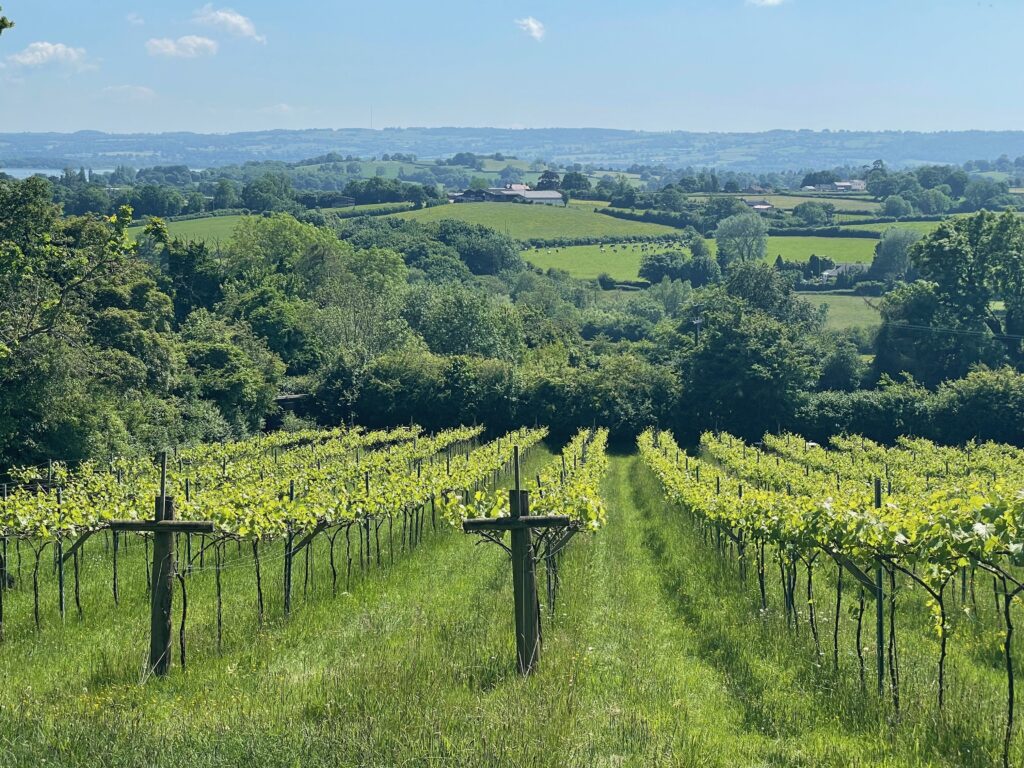 Limeburn Hill Biodynamic Vineyard June 2024 Photo by JFPenn
But essentially this is in the Chew Magna area near me. It’s again limestone. The Romans were working in that area. So again, very ancient land. It has 3,000 vines, hand-planted. It’s run by a couple, Robin Snowden and Georgina Harvey, and I went and spent a day there. I did a course on biodynamic wine growing, and it was full of wine people. And then I was like, “I’m writing a novel.” And Robin was very patient with me, especially when I said, “Oh, where do you bury the bones?” He was like, “Okay, I’ll show you.”
The Wines Named After Celtic Festivals
Jo: But I think what’s—first of all, their wines are pétillant naturel, I think that’s it. It’s a lightly fizzy wine, fermented in the bottle. And their wines, they have three wines named after those festivals: Beltane, Lammas, and Samhain. So these are Celtic festivals. And so I saw, and one’s a white, one’s an orange rosé, and one is the red—the Samhain, the winter wine, which I think is Pinot Noir.
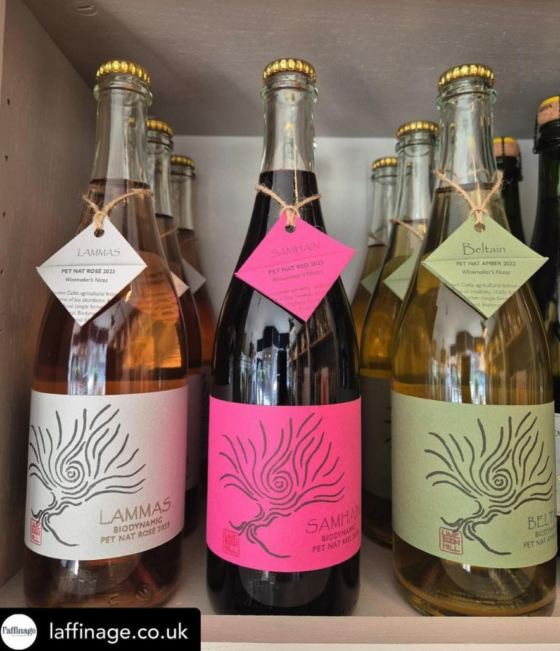 Limeburn Hill vineyard wines Photo from Instagram @laffinage.co.uk
And so I went there and I saw these wines and that gave me ideas. But then also they explained what biodynamics is and the Rudolf Steiner method of really just the holistic view of the vineyard as a contained ecosystem. And they were taking this very seriously.
So they had wild bees because it’s all the natural yeast in the area. There’s no extra stuff they do. They have these little sheep that run around eating things—lamb mowers. Wildflowers. And I was just super impressed by, again, how much work this is, but also the ecosystem of the land. It was beautiful. It was so beautiful, a wonderful day. And again, the sort of romantic idea, but he demonstrated the biodynamization, they call it, which is a stirring thing where they stir for a minute in one direction and then the other direction. And he had the books out with all the sun and the moon and the planting and the energies that go into it. And this was all just fascinating to me.
That is Limeburn Hill Vineyard, and they do tours and courses and things. Again, their wine is very hard to get. It’s served at a lot of independent restaurants, cafés, and things like that. But they’re fascinating.
And I should say there was no sacrifice.
Natalie: Yeah, I was going to say—
Jo: No blood sacrifice, no “You can’t go into that part of the vineyard, that’s where our former tasting-room staff members are buried.”
Natalie: Right!
Jo: But they did honor the land. They had an area which was a kind of sacred area, a sacred grove. And obviously there is the place where they bury the horns, and there are some preparations with skulls and things. So there’s just some weird stuff going on in biodynamics. But fascinating.
Understanding Biodynamic Preparations
Natalie: Yeah, absolutely. So just say a little bit more, if you remember it from your course—they bury the bull’s horns and the skulls and put things in them?
Jo: Yes. So I do remember, Preparation 500 is the cow horn. So each of these preparations are made from animal parts—stomachs, bladders, intestines, skulls. And then you fill them with manure or certain plants like yarrow, chamomile, different things. And that should be growing on your land as well. So it’s all a contained ecosystem.
And then you basically bury the horns in the winter, or the skulls you put in a wet place, like under some running water. And then after a certain amount of time, it gives you some stuff like compost, and then you put that in the dynamization and you turn it into a tea, and then you spray it on either the roots or the leaves or whatever you need.
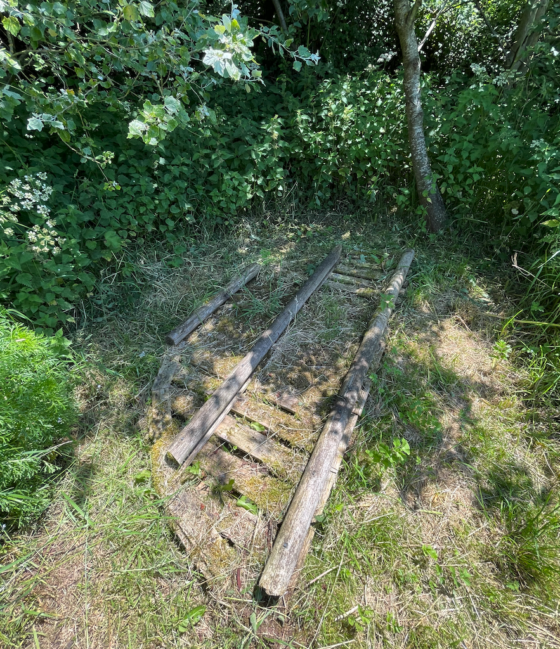 Biodynamic preparation area, Limeburn Hill vineyard, June 2024
They also use quartz. And if anyone listening is like, “Oh, she’s butchering this,” what’s so fascinating is you might think, oh, that is just weird, strange stuff. But when you think about the vineyard as an ecosystem and the real terroir, the sense of place that they’re trying to put into every single drop of the wine, why would you bring in something from the outside? And then the natural way of making these sprays and these treatments.
And Robin was saying very much that you go out and you get to know the vine, and you look at it and you’re like, okay, this needs some more moisture, or this needs some more whatever. And then you use the preparation that will go with what the land needs. And it can take a long time to get the land back up to what it should be.
In fact, he said there were no worms in the soil when they started.
Natalie: Wow, so it’s dead, the vineyard—
Jo: The microbial life was just dead.
Natalie: Yeah.
Jo: Exactly. And it took them several years, although I think he said it was quicker than expected, until the earth is just chock-full of worms. It’s like the vines had to go to rehab and get off their drugs—their fungicides and pesticides.
Natalie: Had to detox. Yes, that’s the thing.
Jo: And they planted that vineyard, so I guess they got the vines and put them there. But I just thought that was fascinating because the idea of the land itself is what I’m so fascinated with—how we feed the land to make the land then feed us. And this is something that just really interests me.
Tasting Biodynamic Wines
Natalie: Absolutely. And for whatever you believe with the astrological signs and some of the aspects of biodynamics, I think it can’t be faulted overall because it means that those who engage in those practices really have to pay attention, as you say, to the land. They really have to look at each vine almost individually and say, what does this need? And the more closely you pay attention to vines and winemaking, the better your wine will be, as opposed to mass harvests and mass spraying. Some vineyards that are not even organic, which is a step down from biodynamics, are sprayed 25 times or more over the course of just one vintage. I’m all for biodynamics.
Jo: I did want to ask you on this because I did taste—I did some tasting, I was driving, so I did spit—and it was very unusual. It was a very unusual wine. And of course every single bottle is different, not just every vintage is different. And given you are a better taster than me, how would you describe the difference between a biodynamic-tasting wine and the wine I’ve got here, the Woodchester, which is not?
Natalie: So you have regular wines, and then you have organic, you have biodynamic. Everything that organic wines are, biodynamic must be, plus there’s not going to be as many sulfites—preservatives—in organic or biodynamic as regular wines. But I think we exaggerate just how sensitive we might be. It’s only about 5% of the population that are really sensitive to sulfites, and a glass of orange juice on average has more sulfites than a whole bottle of wine.
So one major difference will be the sulfite content. But apart from that, I think in a blind tasting, I’m not sure that I could say that’s a biodynamic and that’s not—unless I was comparing a really mass-commercial wine that’s made like breakfast cereal. But then they’re going to be at two very different price points, and you’d have to control for all the factors. You’d have to have the same grape, the same region, and compare this vineyard wine biodynamic to that one that is not. But I doubt that I could really differentiate them, other than I would hope the biodynamic—they can be funky and a little weird.
Jo: Yes, funky is a great word.
Natalie: Sometimes. And then you start to veer into another category that’s not defined at all, at least legally—natural and raw wines, which are not the same, just like all stallions are horses, but not all horses are stallions. I can pick out sometimes more obviously what is a natural wine because it will have no, zero preservatives, and sometimes they can get quite funky.
Jo: Yeah. I do remember it being interesting or funky, like you say. I think you have to be very open to new things to try. It’s not, “Oh, here’s my favorite rosé,” or “Here’s my bottle of Prosecco on a Saturday night” or whatever. That’s not that kind of wine.
Recommended Reading on Biodynamics
Jo: But I did also want to mention a book called Voodoo Vintners by Katherine Cole, which is about Oregon’s biodynamic vineyards. And I used that heavily in my research, and again, fascinating. And the Demeter USA is the certification board. It’s incredible how high the standard is. There’s a lot of places using biodynamics, but they’re not certified because it’s such a high standard. I just encourage people, because again, I’m not a taster like you, a super taster, but to try these different wines. It is very interesting and supports the vineyard, which again, it is very hard to have a business as a small vineyard.
Natalie: I think it is. They’re generally small family farms, and there’s no economy of scale. There’s a few big conglomerates in each country. But the other thing is that they say on average, organic viticulture costs you 15% more, and then biodynamic another 15% on top of that because you can’t resort to pesticides, fungicides, and insecticides. Yeah, it is definitely worth seeking them out.
Wine Tourism Opportunities
Jo: Also, I was going to say on this, both these vineyards—so Limeburn Hill does courses, they do weekends, they do hen dos and stuff like that, but Woodchester has accommodation as well, so you can stay there actually in the vineyard. And so I think that’s really nice, and I enjoy that. I can spend more money in a vineyard by doing activities. So I think that’s actually something to consider. It’s not just—you don’t have to just go and do a tasting. You can actually do tours or stay places. So yeah, I enjoy that.
Natalie: Absolutely. Wine travel is just burgeoning because, as you say, you can taste the wine, but often there’ll be a restaurant attached to the winery or restaurants locally that’ll do wine and food pairings for you. There’s all sorts of things to do from spas to ballooning to biking to things for the kids—not the wine, but—
Jo: No, start your kids’ tolerance early.
Natalie: I did not mean that seriously!
What Surprised You Most in Your Research?
Natalie: Okay, so that’s really interesting. So what was the most surprising thing that you learned about biodynamics or winemaking or wine itself while you were writing the book?
Jo: Again, I think I’ll come back to how hard people are working. And how badly wrong it can go. I think when I wrote the scene about the frost in the vineyard, I really understood as I was researching that this can destroy a huge proportion of a crop. That there are things that can go horribly wrong that can just destroy the whole thing.
And I know that can happen with other farmers, but often other farmers have other crops going on, and these vineyards, they really only have the one. And so it was incredible to me how on a knife edge and how you have to look after them. Or it might be a swarm of insects, or it might be something—a flood. There’s so many things.
So yeah, that was interesting to me. And also, again, how much variability. I think as someone who enjoys wine but has perhaps just taken it for granted—I can just go and get a bottle of rosé or whatever—and then you see the variability between the areas. So again, these vineyards are about an hour and a half apart in a car. So in the big scheme of things, they’re not that far away, but they’re really very different. So again, that idea of terroir really came home to me.
But I certainly am taking viticulture a lot more seriously now than I did before. And I hope in the book, it’s not a book for viticulture people, it’s the setting. But I do care very much about my research.
Natalie: No, you do it so well. But you are right. People have that dreamy vision of owning a vineyard, but really it’s fancied-up farming. It’s hard work, calloused hands and sunburnt and all the rest of it. It’s not just what is portrayed on wine labels and wine advertising. It really is grassroots hard work.
The Social Aspect of Wine
Jo: Yeah. The passion of it is incredible, but also it makes you think a lot more about what wine is. And I know you talk about this, that there’s a lot of myths and there’s a lot of bad stuff that goes on and a lot of amazing stuff. But at the end of the day, it’s like having a glass of wine with a friend or as part of a group or your family. My family are drinkers, so wine plays a big part. And in fact, Woodchester is just down the road, so we do get wine from there. And that’s what it’s about. It’s about the times we have with wine for most of us whose job it isn’t. But I think that’s what it comes down to really.
Natalie: Absolutely. It’s the drink of conversation. It’s meant to be consumed slowly. It’s why we don’t serve wine in shooter glasses and just knock it back. Although sometimes maybe you feel in the mood for that, but really it is about communion and joining people together over conversation.
Exploring the Concept of Terroir
Natalie: You’ve mentioned terroir a few times, and in the version that I had, I counted 17 mentions. So what does terroir mean to you? You’ve said sense of place—maybe you can expand on that.
Jo: It’s a unique sense of place based on the geography, but also what’s under the earth. So I learned a lot about the limestone that this area is on and how that affects the soil. I didn’t know anything about soil before this. The weather—so the rain, what happens with the sun, what direction the slopes are on. You don’t buy a piece of land without considering where you are planting the grapes and what you feed the soil, obviously.
And I loved it—Limeburn, they just let the wildflowers grow. And by the third season of wildflowers, they had some ridiculous number, like 40 different types of wildflowers growing in amongst the vines that these little sheep were going around and eating and then pooing, and that was the whole thing.
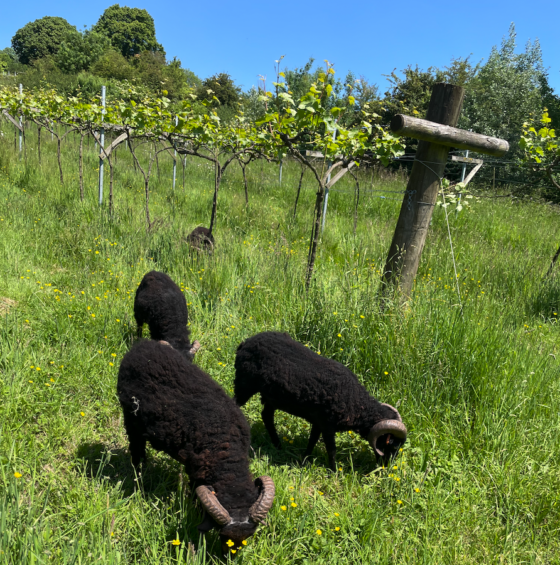 Ouesson sheep at Limeburn Hill vineyard, June 2024
And you say in your book, Wine Witch on Fire—your wonderful memoir—that terroir is like a writer’s voice. And I love that as a metaphor because it’s distinctive, it’s personal. If you know a writer and you get to know their voice, then it’s, yeah, this book, Blood Vintage, it’s a J.F. Penn book. And if you like it, you’ll like my other books because that’s my voice. And terroir, it’s just fascinating to me. And super tasters like yourself can tell where a wine is from and maybe even what fields and what particular types of grapes, and that’s just incredible.
Terroir and Terror
Jo: But also terroir sounds a bit like terror. And I did look this up. They are not from the same etymology. It’s terra as in earth for terroir, and for terror, it’s from terrere, which is “frightened.” But they sound pretty similar.
Natalie: Yes. And you’ve been able to weave them in so nicely together in the book. I always thought that because we talk about sometimes in the wine world, “terroirists,” which always sounds like “terrorists.” What are these people doing, making deadly Cabernet or whatever? There’s no real hard and fast definition, but they often are deep into the land and they make tiny bits of wine or amounts of wine. Sometimes we call them “garagistes,” which started in France because they have their winemaking facilities in their garage because their amounts were so small. So it’s more sort of a wine warrior status—I am really a purist when it comes to terroir. Nothing should interfere with it. There should be no intervention, although you have to get the grapes to ferment, so there has to be a little bit done.
Jo: That’s quite funny because I did say to Robin at Limeburn Hill, “So where do you get all your cow horns? Because I don’t see any cows.” And he did say, “We do have to order those from the biodynamic store.” But everything else, they had the patches of yarrow growing and chamomile and all the different herbs and all the different plants were all growing there. And so they tried very much to keep everything within the ecosystem. And then even they do make a spirit from the grapes, the final press or something like that, the skins. So they use everything they can. It’s a real commitment to this thing.
The Sensual Nature of Wine Writing
Natalie: It absolutely is. Again, I’ve said this a few times, but your writing is so sensual. You could easily be a wine writer, and beyond the whole string of grapes and descriptors, it’s very evocative. How did you really dig down to get all of that? Or is it just part of your toolkit? You’re such a sensual, visual writer.
Jo: I do take a lot of photos, so I have a lot of photos from those vineyards. But I also do a lot of visual research online. And also I mine sites like yours for words to describe stuff, because I have not been in a vineyard at dawn when the frost comes. And I do feel like that scene, I spent a lot of time on that scene because I was like, this is so important.
And also I do think there is a magic, and Rebecca, the main character, has just arrived from London where she doesn’t even see the stars because of the lights of the big city. And she’s there, it’s the middle of the night, they’ve rung a bell like “We have to save the buds.” So they’re putting out these candles and she’s looking up and there’s the stars. And I was like, I have to capture this. And so I spent a lot of time—there’s a lot of images online of vineyards with frost candles, and they did show me some at Limeburn Hill.
And so I think for me it’s very much about research and then it’s about point of view and taking it further. But at the end of the day, it is fiction. And of course some people were like, “It is not romantic at all to put out the frost candles because everyone’s crazy and it has to be done quickly and it’s scary.” And I do romanticize it. But I do think the sensuality is, as you say, the sensory detail of the writing in a vineyard in particular is so important because people like yourself as well—you’re taste people, you’re smell people, you’re sight people. And so that’s, I guess, what I’m trying to write.
Natalie: Absolutely, and you did.
And back to those candles, some other wineries use windmills, but just raising the temperature even one to two degrees can save vines when it’s that marginal and the frost has come. So it is very much like that. But the windmill wouldn’t have been as evocative.
Jo: No, that’s true. Yeah, that’s mechanical and machine-like.
Natalie: But yeah, the bougies, I can imagine the smoke and everything else. It reminds me of that movie, A Walk in the Clouds with Keanu Reeves. I’m probably mucking that up as well, but they were talking about the vineyard catching on fire.
Jo: I do have some fire in the book!
Natalie: Yes, you do. Absolutely. Fire’s a good metaphor too in the book.
Inspiration from Drops of God
Natalie: And another inspiration was the television show Drops of God, which is based on a book of the same name. Is that a show or a book that you would suggest we read as wine lovers?
Jo: Oh, you have to watch it. Maybe if you are a wine person it’s not as good, but as a non-wine person, I was like, it was amazing. So basically also, it’s French-Japanese, so it’s partly in French, partly in Japanese.
And essentially this wine critic—someone like yourself who’s been writing about wine for a long time—has a huge wine cellar and has collected wine their whole life. And it’s very prestigious and it’s worth millions, this wine cellar. And there are two people, so there’s his daughter and then his student, his kind of apprentice. And they have to do a competition.
So there are five bottles and they’re allowed one taste, and then they can come back a week later and have one more taste, and then they write the name of the wine, the year, the vintage, all that. And then whoever wins three out of five wins the whole collection.
But each week they’re flying around the world, looking at all the vineyards, trying to work out—they’re tasting the soil, they’re examining all the crops to try and work out what the hell this wine is. And of course, they’re all really obscure, and then they have to get the year as well. So it’s a fascinating sort of wine mystery.
But at its heart it’s also about family and about culture shock and about just those things that wine can smooth over. So the Japanese and the French vineyards is really interesting. So yeah, Drops of God. It is fantastic. Absolutely recommend it.
Natalie: I haven’t seen it yet, so I’ll have to put that on my playlist. It’s beautiful as well.
Jo: It’s Apple TV, so it is beautiful.
Natalie: Excellent. Oh yeah, they’re always shot beautifully.
Understanding Folk Horror
Natalie: And another inspiration, of course, is folklore itself, because I wasn’t familiar with folk horror. Maybe you can tell us a bit more of the folklore aspects of the book.
Jo: Yeah, so folklore is more the traditional beliefs and rituals and little superstitious things that happen around a certain area. So again, it’s all terroir-based and it’s rooted in the community. It’s rooted in the physical location.
So for example, here in the Southwest and in fact in England, we have May Day bank holiday, which is the 1st of May, which is a Beltane fertility festival. And children dance around maypoles with ribbons. And maypoles are just these very large phallic symbols, let’s say, where beautiful young ladies are meant to dance around them with ribbons—obviously fertility symbols. There’s a lot of bonfires. People jump over bonfires.
And then we have Morris dancing, which is a sort of folk dancing where people dress up. And I put this dark Morris dancing troupe into my book where they wear crow feathers and black hats, and they wear slashed black makeup. And sometimes they’re hitting—they hit sticks together. Sometimes blackthorn logs, which have spiritual meanings, or sometimes Brussels sprouts.
Natalie: The vegetable?
Jo: Yes, the vegetable! They hit together sticks full of Brussels sprouts and they fall around. It’s very weird to do with the vegetable. Yes, it’s very odd. And every single Morris dancing area has different rituals and different things.
Ancient Symbols in Modern Britain
Jo: We also have the Green Man, which is a face of, again, a fertility god covered in vine leaves or other leaves, oak leaves. And it’s in a lot of our cathedrals, so thousand-year-old medieval cathedrals have the Green Man in Christian places—the fertility symbols.
And then the horned god, the Wild Hunt, because we have a lot of stag hunting back in the olden times here. So I think it’s really interesting.
But I was looking up where you live in Ottawa, right? So one of your folklore stories is about the Wendigo, the spirit of cannibalism. Did you know about that?
Natalie: No! My God, I hope my neighbors aren’t practicing that, but it’s interesting.
Jo: Yeah, it’s very interesting. The Wendigo from the First Nations people—it often comes from the older indigenous peoples. There’s also the Loup-garou, the French-Canadian werewolf, which is also in your area.
So if people are interested, these stories, they’re so ancient and they emerge in modern culture. So even that Limeburn Hill names their wines after pagan festivals that are still celebrated by neo-pagans or just reflected. Samhain is the 31st of October, it’s Halloween, so the veil is thin. It’s the time for winter to come in. The dead are honored. This happens in every culture. It’s just they’re called different things. But yeah, folklore is fascinating. And because it’s so specific to place, again, I wanted to bring that in and again, the terroir.
Natalie: Yeah, absolutely. And of course you live in Bath, which is where Mary Shelley wrote Frankenstein, so your city has a horror pedigree. So what is folk horror? Because I think yours was the first horror book I read, and I think of slasher movies like Friday the 13th, very gory. But what is folk horror?
Defining Folk Horror
Jo: Oh, I’m thrilled that you read it because a lot of people say, “I don’t read horror, so I’m not going to read that.” It’s like people saying, “I don’t like Chardonnay, so I’m not going to drink that wine.”
Natalie: Open your minds, people!
Jo: Not all Chardonnays are alike.
Natalie: Yes!
Jo: But yeah. Yes. But it’s the idea of folk horror. So again, we mentioned folklore, and then horror is so wide, it’s a very wide genre. So I’m more of a supernatural horror type of person. It’s a lot more about suspense and slow burn kind of feeling. You are in this really quite eerie situation. And is that a blood sacrifice, or is that something normal in this area? That kind of thing. It’s this feeling out of place. It’s an outsider coming into an isolated community feeling, “I don’t know if this is right or not”—the pagan festivals, the wine, all of that.
But to me, the horror that I also bring to it, and this is an interesting question: Is it worth giving a human life? So is it worth sacrificing a human life to the land? The human life is so short and this land lives so much longer than us and produces something so wonderful. So the blood vintage is so wonderful. Is it worth the sacrifice to make art? Basically.
And this comes up across human history—is it worth sacrifice to make art? And this is what I come back to in horror. And perhaps the real horror is sometimes we might say yes.
Natalie: If it’s Domaine de la Romanée-Conti, the famous Pinot Noir from Burgundy, I’ll kill anybody to get it!
So I love that. But we also as artists, writers, whatever, give up a lot of our lives to create what we do. We’re perhaps not out there as much as other people and so on. So there is a little small death, sacrifice going on with if you want to create anything decent. But yeah, no, that’s a great question. I’ll be thinking about that over the weekend: Is it worth it?
The Heart of the Story
Jo: Well, I think that to me, the real horror and the question at the heart of the book is: What will she choose? Because you’re basically offered being part of this community. She doesn’t have a community, she doesn’t have a family, and she’s offered a part of this wonderful vineyard with these amazing things going on. And a lot of it is amazing, right? It is just wonderful. And then it’s what will I give to be part of this? And what will I give to make this wine? Or what will I give to drink this wine?
Like you said, sometimes this feeling—this isn’t wine, but I went to see the Queen’s diamonds in Buckingham Palace years ago, and I never—I’ve got a little diamond on my ring, but I never understood why people did what they did for diamonds, never understood it. And then I went to Buckingham Palace and I stood in front of one of her collections of diamonds and I was like, “Oh my goodness, I want that. I would do anything to have that diamond.” And I just felt that need. I want that.
And I tried to put that in the book, the sort of addiction. I know it’s a very difficult topic in the wine world, but what will we do for that one more taste?
Natalie: Absolutely. Absolutely. People chase all their lives after certain tastes, and it’s why they get suckered into buying fake bottles for hundreds of thousands of dollars. They’ll do anything because they actually just want that, especially the first taste—to recall your first evocative taste. Yeah, absolutely.
Jo: Yeah. I think it’s very strong. And I also didn’t really understand the collectors. Drops of God is very good on why people collect wine and why they appreciate that. But it’s also, again, we came back to earlier, why do you drink wine with a friend or whatever? And perhaps it’s the experience that we are looking for rather than that taste. It might be taste, again, for people like yourself who are super tasters, but for me it’s, I want that experience again. And of course you never can capture it again.
Natalie: That’s what makes us fools till the end. We keep chasing after it.
Jo: Oh, it’s just one more glass, one more taste away.
Natalie: I’m still enjoying this wine, by the way.
Jo: Excellent, excellent. I can’t even tell the level on that goblet. Very discreet.
Poisonous Plants in the Vineyard
Natalie: You also mentioned several poisonous plants at the Standing Stone Cellars property, including hemlock, henbane, monkshood, and nightshade. And one character says that the land needs them to feed the soils and grow the vines, and that the monkshood alkaloids seep deep into the soil, creating the slight bitterness that adds to the complexity. Nightshade contributes a deep, almost smoky note to the red. I love that idea. Did you make that up, or is that based on viticultural science?
Jo: The fact that you have to ask me is awesome because you know all this stuff. As far as I know, I made it up because I needed some poisonous plants for another particular occasion in the book.
And so I thought, but I think—as I said about the wildflowers at Limeburn Hill and the yarrow, the patches of yarrow and all the things they had growing to be part of it—why wouldn’t you do that in some way? And those herbs like hemlock and henbane, they’re used in small amounts. Poisons are used in small amounts to bring people, again, to a different level of consciousness. I guess you could say that about alcohol as well. In smaller doses it’s effective, and in larger doses it can be difficult. But that’s where I got the idea from. If you’re going to plant yarrow, why wouldn’t you plant henbane or nightshade?
So I don’t know. Have you heard of people using the darker plants?
Natalie: I have not. The most popular one is over in Australia. They have eucalyptus plants, which have a very strong oil, and you can taste the eucalyptus, the minty green, kind of in a pleasant way in some of their Cabernets or Shiraz. But I haven’t heard of the poisonous plants. So that would definitely take a darker turn of mind, I think.
Jo: I loved it. But I think the idea of the flowers and things growing is that some of the whatever’s in the nutrients go into the soil, right? And then the vines pick things up from the soil. So it wouldn’t necessarily be the poison in the wine, but I can’t see why that wouldn’t be a technically possible thing. So maybe there’s a listener who would love to tell us.
Natalie: Absolutely, absolutely. And that’s why they have the cover crops and all that. You want to encourage—the more diversity of plants you have, the more rich and diverse your soil will be microbially, and the more different insects and species. There’s a winery in Quebec that has like a hundred thousand different plants and insects and bees because they planted so much as an experiment, and they have this sort of wild nature all around it. It all definitely contributes for sure.
Architecture and Vineyard Design
Jo: Yeah. Actually Rebecca, the character in the book, I have her as an architect, and one of the reasons was because I wanted to redesign the vineyard to bring in more of this stuff. So we see these vertical walls, vertical plantings, and I thought that would be awesome on the side of a winery where you could, in the tasting room or something, there’d be actually crops up the side and change the water courses. And so I was really interested in how the plans for the vineyard would work. And of course in the book I have a labyrinth planting, which I think is very unlikely, but I thought that was quite cool.
Natalie: Yeah, no, there is a winery that has a labyrinth. But also I’m just working on a piece right now on wine and architecture, and the Antinori Winery in Tuscany, Italy has something like—it’s 11 hectares, I get acres and hectares mixed up—but the vines are growing on the roof and sides, the Sangiovese, so it looks like it’s wrapped in this green cloak and the winery’s rising up out of the land itself. So it’s really cool.
Jo: That is wonderful. I love architecture. I’ve got architects in so many of my books. I think in another life I would’ve been an architect.
Natalie: Yes, you have so many passions. That’s what makes you a great writer. You pursue them.
And I was impressed with just how much you dove into the winemaking and even in our exchanges leading up to this, beyond the book itself. So that’s what keeps you going.
The Most Difficult Part of Writing
Natalie: What was the most difficult part of writing this book?
Jo: I did love the research, but it got really difficult. And in fact, the biggest change I had to make was the description of the grapes at the different times of year. I had to even change when the book started. I had it originally starting in February, and my beta reader said, “You can’t have frost candles before bud break. That doesn’t make sense.” So I had to change that.
But it was really interesting and difficult to try and do all of that research and get it right. But also with biodynamics, I was having to try and work out, what kind of moon do you need on what kind of fruit day? And what day of the month would this be? And then what would the grapes look like? And then what?
So there was a whole year I had to map out—the viticulture year, the pagan year, the biodynamic year. There was a lot of trying to get things right. And again, I have to apologize in advance. I’m bound to have got something wrong, but I really did try.
Natalie: That’s okay. That’s hard. Between that and the whole architecture thing, you’re ready to open your own winery.
Jo: Oh, when I’m rich, I’ll just open one.
Natalie: Oh, that’s right. Sit back on your beautiful veranda in your white flowy dress and your Chardonnay.
Jo: Absolutely!
Final Questions
Natalie: Alright. Wow, time just flew here, Jo. Let me round up with a few last questions. If you could share a bottle of wine with any person in the world, who would that be and which bottle would you open with them?
A Meeting with Carl Jung
Jo: I am very much inspired by the Swiss psychologist Carl Jung. So I studied psychology of religion, and his work has inspired my fiction. So Stone of Fire and Crypt of Bone have a lot of Jung in them. But also my nonfiction book, Writing the Shadow, which is about tapping into the shadow, the dark side. And there’s a heck of a lot of shadow in the wine industry. You and I will have to—
Natalie: Oh yes, we’ll get into it. Yep.
Jo: We’ll talk about that. But yes, so Carl Jung—obviously now dead—but he wrote about wine as a metaphor for transformation of base into gold. That was one of his many things.
Natalie: I did know that.
Jo: The repressed self. Okay. Yeah, the repressed self. A lot about mythology, a lot about folklore. But I was like, what do you drink with Carl Jung? So I actually had a look. Where I would want to do it is he has a tower. He did a lot of stone carving, again architecture, at his tower in Bollingen on Lake Zurich. So I looked for some wine in that region, and there’s a wine called Chasselas. Maybe, you know, is that right?
Natalie: I wouldn’t dare correct your pronunciation after all we’ve been through, even for wine terms. Yes, Chasselas. But it is the Swiss grape. I think it’s a bright white.
Jo: Yes. So it’s a white wine. And I would put that with a cheese platter, maybe raclette, which is the melted cheese that you have in that region. And I would ask him, because I’m turning 50 next year and I feel like I would like to ask him about the challenges of midlife. He had a bit of a breakdown and he wrote this thing called The Red Book, and I’ve got a copy. It’s this huge oversized book. And he did paintings and he just wrote journals and he was just deep in midlife crisis.
And so I love that. I think it’s really interesting. We think of him in academia, but he was just very—I want to use the word sensual, and I don’t mean sexual—he was just deeply in life. So yeah, Carl Jung. There you go. Could have a session while you’re at it.
Natalie: That sounds great. I love that.
And as we wrap up, is there anything that we haven’t covered that you’d like to mention?
Encouraging Wine Exploration
Jo: I think I would encourage people—I’ve listened to a few of your episodes and people are so good at describing wine. And as someone who is just a normal wine person, I think I’d really encourage people to try different kinds of wine without being scared of it. And I feel like sometimes when normal people like me listen to wonderful writers like yourself about wines, we feel maybe a bit stupid in a way. “Oh, I can’t try that,” or “I can’t taste that.”
But what I’ve discovered, I think, by visiting these smaller vineyards is just try some stuff that’s a bit out of your comfort zone. And it might be super, super interesting, like the orange wine. I’d never tried these sort of volcanic orange wines. And even if you can’t describe them very well, it doesn’t matter.
I think supporting the vineyards, supporting the viticulture industry is just as important as supporting the authors and the artists and the writers out there. And it’s a difficult time for everyone, and hopefully we can all support each other. But yeah, I absolutely loved writing this book. I love delving into the wine industry, and I appreciate all of you a lot more.
Natalie: Great. And my advice would be parallel to yours: Try something outside your reading genre, like folk horror. I was pleasantly surprised. It was like the funky Chardonnay I had never tried before. It was great. I loved it. It expanded my horizons.
Where can people best get in touch with you, Jo?
Jo: Yes, so jfpenn.com/bloodvintage is the book. Since you’re listening to a podcast, if you want to write, The Creative Penn podcast—Penn with a double N. And Instagram at jfpennauthor. You can find lots of photos that also go with the book, including those vineyards, which I hope people will check out.
Natalie: That sounds like a lot of fun. Great, Jo, this has been fantastic. I loved it. I can’t believe how fast the time went, but thank you. Next time it has to be over a glass of wine in person. Maybe in the part of the vineyard where we’re not allowed to go because it just rebels that way.
Jo: Thanks so much for having me, Natalie. That was great.
Natalie: All right. I raised my glass to you. Cheers!
Jo: Cheers!
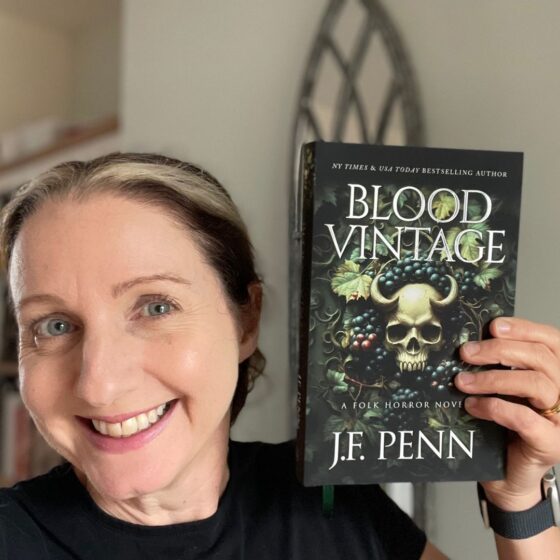 J.F. Penn with Blood Vintage
The post Blood, Wine, And Sacrifice: Folk Horror Inspired By England’s Biodynamic Vineyards With J.F. Penn And Natalie MacLean appeared first on Books And Travel.
28 October 2025, 9:00 am - 32 minutes 25 secondsMexico’s Day Of The Dead With Luisa Navarro
Why is Mexico’s Day of the Dead such a beautiful way to remember our loved ones who have died? What are the elements that go into the altar? How can tourists respectfully experience the tradition?
In this fascinating conversation, Luisa Navarro, founder of Mexico in My Pocket and author of Mexico’s Day of the Dead: A Celebration of Life through Stories and Photos, shares her personal journey from rejecting her Mexican heritage to celebrating it, while revealing the true beauty and meaning behind one of Mexico’s most misunderstood traditions.
Luisa Navarro is the founder and CEO of Mexico in My Pocket, and the author of Mexico’s Day of the Dead: A Celebration of Life through Stories and Photos.
- Luisa’s childhood struggle with being Mexican American and how she transformed from rejecting her culture to becoming its passionate advocate
- The true meaning behind Día de los Muertos, its indigenous Aztec origins, and how it differs completely from Halloween
- The significance of ofrendas (altars), including sugar skulls, pan de muerto, marigolds, and photographs of deceased loved ones
- How different days honor different types of deaths
- Traditional foods like pan de muerto, café de olla, and how families share meals with both the living and the dead
- How to respectfully experience Day of the Dead celebrations in Mexico while avoiding appropriation and understanding the difference between authentic traditions and commercialized parades
You can find Luisa at MexicoInMyPocket.com and Mexico’s Day of the Dead book here.
Transcript of the interview
Jo: Hello, travelers. I’m Jo Frances Penn, and today I’m here with Luisa Navarro. Hi Luisa.
Luisa: Hi. It’s so wonderful to be here with you today.
Jo: Great to meet you. Now, just a quick introduction. Luisa is the founder and CEO of Mexico in My Pocket, and the author of Mexico’s Day of the Dead: A Celebration of Life through Stories and Photos, which is fantastic.
So first up, just tell us a bit more about you and your Mexican heritage and how you bring that into your life and your business in Brooklyn.
Luisa: Yes, of course. So I was actually born in Dallas, Texas. I am Mexican American. My mom is from Tila, which is Northern Mexico, and my dad is from Michoacán, which is more central and it’s actually where Día de los Muertos is very much celebrated.
Growing up in Dallas, I struggled originally with my identity a lot being Mexican American —
because what happened was I went to school and I only spoke Spanish because Spanish was my first language. My mom insisted that all four of her kids learn Spanish first before going to school. And then when we were in school, we all struggled to make friends because we only spoke Spanish.
The teachers would criticize my mom, but my mom insisted that we would be perfectly fine and that we would learn English eventually, and she was right. And so eventually I became bilingual. And during that time, at a very young age, I discovered young kids were saying horrible things about Mexicans and I didn’t know how to handle that. I realized, wait, I think I’m Mexican.
And so long story short, I didn’t want to be Mexican at a very young age. I was about four or five years old. I have these memories very vividly. And so I came home to my mom in Dallas and I said, I’m no longer Luisa, I’m now Hannah. I think I said Hana, my mom always says I pronounced it very interestingly, but I was like, I’m Hana. And I will not respond if you don’t call me Hana. Yeah, I mean, it’s very sad.
But luckily, luckily, luckily, thank God my mom and my grandmothers all came to my rescue and they were like, no, these kids are wrong, and here’s why, and here’s why being Mexican is incredible. And so luckily for me, I did a 180. I very much embraced my culture. I became a journalist.
And during that journey as a journalist, I noticed that these negative types of stories continued to happen. But instead of getting upset with people, I never really blamed the kids who said these things because I realized they were being taught this by their parents. As you get older, you realize this is being learned.
And so when I became a journalist, I realized that the media was always covering us in a very negative light. And being American is amazing because we have mainstream media here. We have the power to tell stories, but unfortunately I have seen as a Mexican American, a lot of those stories that are told about Mexico in the US are negative.
I wanted to do something positive. So as a journalist, I started a side project called Mexico in My Pocket and it was a blog. And on that blog I would share very positive stories about Mexico and our culture, and —
I slowly started to learn more about my heritage and I became very passionate about it.
And I started that blog in 2015. So it’s been 10 years now.
So basically my journalism career brought me to New York City. I went to Columbia Journalism School and then eventually I got out of the news and I started my own company called Mexico in My Pocket, where we sell beautiful handcrafted items from all over Mexico. And I have the privilege of telling the story of how these products are made, and the stories of our culture.
Jo: I think that’s wonderful. It’s really interesting to hear about how that felt for you as a child. But of course, you’ve chosen one really interesting topic, Day of the Dead, which in itself many people struggle with negative stereotypes around Day of the Dead. So let’s just start with sort of basics.
What is Day of the Dead? When is it? And why did you choose this topic?
Because you could have chosen lots of different ones.
Luisa: I could have chosen so many different topics. And the irony is that when I was little, I also very much struggled with the fear of death. And I actually don’t think I really loved Day of the Dead as a child because my mom would decorate with skeletons during that time of year. And I feared it and I was like, this is terrifying. I don’t want to talk about death. My biggest fear was my parents dying.
But the reason that I decided to write a book about Day of the Dead, and for those of you who don’t know what Day of the Dead is, is once a year. It’s a Mexican tradition, it’s rooted in Mexico.
Once a year we come together and we honor our loved ones who have died.
And I think it’s the most incredible holiday. I think that everyone around the world should take time to once a year, honor their loved ones who have died.
You know, we celebrate our moms once a year. We celebrate our dads once a year. We celebrate love. Once a year, we should be celebrating our loved ones who have died. And I think that Mexico is the true emblem and symbol and example for us to honor the dead once a year. And they’ve set an incredible example for us not to fear death, but to take control of it the most that we can and to celebrate our loved ones who have died and not forget them.
And so the reason I wrote this book, there’s a lot of reasons, but one of the reasons was just like the reason I started my blog. I felt like —
I did not see an accurate or beautiful representation of what Day of the Dead is, and I felt like I wanted something to preserve these traditions so that I could pass it down to the future generations, including my son.
Because I worried that being Mexican American, I am the first generation to live here, but I’m so proud to be Mexican and I never want to lose sight of that. And I want my son to also know about his heritage, his ancestry, his traditions. And so I wrote this book for the future generations so that they could learn and always celebrate these traditions, no matter how far removed they are from their origin, from their ancestry’s origin country.
Another reason I wrote the book was —
There is a lot of confusion and misunderstanding when it comes to Day of the Dead.
So I have a gift shop in Carroll Gardens in Brooklyn, and people would come into our store and they would see the altar that I build in the store. And they would ask us if we were celebrating the devil. And I was like, okay. We need a book because I want to clarify just how beautiful Day of the Dead is.
And I think the name Day of the Dead, I think anything associated with death can be very off-putting because I think just like me as a child fearing death. I think a lot of people fear death and I think they don’t want to talk about it. And so that inspired me to write this book and to shed light on how I think Mexico is doing an incredible job at basically honoring our loved ones who have died.
And if you’ve experienced death, I think you can relate to this, that it is very painful, not just because the person died, but you feel like you’re not allowed to talk about them anymore. And Day of the Dead is a time where you can come together once a year and talk about your loved ones who have died without having to worry about anyone judging you. And I think it’s so beautiful.
Jo: You mentioned your son there and I noticed in the book, which is a beautiful book, both the words and obviously the images, it is really beautiful and colorful. And there are children in the book, and this is another thing that I think some people get hung up on, like we should only talk about death if we’re adults or whatever. But Mexican tradition seems to bring in the children a lot more. Perhaps you could comment on that, like how is it so natural that everyone in the family is included?
Luisa: I mean, everyone in the family is included because on Day of the Dead, we’re honoring our family members. And so it’s also a wonderful opportunity to educate your children on their ancestors and on their loved ones who have died.
And quite frankly, one of the things that was most moving to me when I traveled to Oaxaca that I didn’t know about was an altar that honored babies. And so there’s room for everyone, like death affects everyone. It affects all ages. It affects different scenarios as we know.
You know, I saw an altar where a woman was 35 years old. I’m 35 now. And she lost her baby and she died as well in giving birth. And so they honored her and her child on this altar, and I think that’s so beautiful because her story was not forgotten in spite of such a tragic situation. And I think that Mexico does a really beautiful job of that.
Jo: So let’s come to the altar that you mentioned.
What goes on the altar? What types of things might people put on the altar and what is the aim of it?
Luisa: Yeah, so that’s actually another reason I wrote the book. So the altar has so many elements. I don’t even think we have time to get into every single one because quite frankly, I wrote a whole chapter on it and I even had questions about how to build a traditional altar because there’s so much tradition and history that is involved in it.
We place the sugar skulls with people’s names to honor the sweetness of life, but also to honor and remember the specific person who died. We use pan de muerto, which is a specific type of Day of the Dead bread that only happens, that is only made once a year and it is made with anise and orange peels and orange blossom water. It also honors the sweetness of life, but then they decorate it with crossbones on top to honor the dead.
So what I would say is that from all of these elements, it’s really coming together and honoring and celebrating and really showing that Mexicans don’t fear death, but they respect it and they choose to accept it. I think they choose to accept it.
But one of the most important things that goes on an altar are the photographs of our loved ones, of our ancestors.
And so that’s why I believe we include everyone. We include our children, and we show them and we teach them, and we tell them about their great grandparents and we tell them about their grandparents. It’s a wonderful time of year to finally share your family stories, and so that’s why I think everyone around the world should be celebrating Day of the Dead. Or doing it in their own way. Once a year, having a dinner at home and talking about their loved ones who have died. I don’t think we should not talk about this. And that’s why I love being Mexican. I’m Mexican, and I’m American, but being Mexican is incredible because of Día de los Muertos.
Jo: I have some follow up questions there. So the first thing is the skull. You mentioned the sugar skulls. I wanted to show you and the people on the video. So this is the one I keep here with the butterflies, but they obviously, it’s not to be put on an altar, but it’s kind of, I like to keep it there and I bought it in the US.
 My sugar skull puchased in Austin Texas
Luisa: You can put that on an altar actually. Yeah. You can put that on an altar. It’s beautiful. It’s hand painted. It’s clay. Yeah. That’s stunning. I love that.
Jo: Yeah, so I kind of have it in my own way, not as part of your tradition, but as part of my own sort of eclectic tradition. But so tell us more about the skulls and the skeletons. Because you mentioned, and the point is that they are, the sugar skulls are more colorful, aren’t they? Because people think black and white and kind of that depressing thing.
Tell us about the colorful sugar skulls
Luisa: Yeah. It’s funny that you mentioned that. So I talk about this in the book. I talk about the colors of Day of the Dead actually. And that’s exactly why we chose the turquoise and the orange color. The orange, obviously is representative of the marigolds, which we use marigolds because of the scent and the color, because we believe that the scent and the color attracts the spirits to visit us once a year. So we place them on the altar and we sprinkle petals of them to lead the dead back to us, the spirits back to us to visit us once a year.
But you mentioned the skulls and the skulls. What people might not realize is that it’s thanks to indigenous traditions and thanks to the indigenous people that Day of the Dead exists in Mexico. So the origins of Day of the Dead stem from the God of Death known as Mictlantecuhtli. And yes, that is a mouthful, but it’s important that we know his name, that we celebrate him, and that we honor the roots of this indigenous tradition.
It was only blended until the Spanish arrived, thanks to Catholicism. But, I want to highlight him specifically because he was the god of death and he was depicted with a skeletal face. And so you were interested in why skeletons and I actually in my own research was very interested in why on earth Mexicans are obsessed with skeletons. It’s all thanks to him.
So the Aztecs, once a year in the summer actually would celebrate him in his festival. And they would make tamales and they would burn copal. And some of these traditions we can see in modern day Día de los Muertos celebrations. These traditions didn’t evolve until the Spanish arrived, and they imposed Catholic religion on the indigenous people and eventually, there was a syncretism that happened, a natural syncretism.
And the tradition moved from the summer because the Aztecs refused to get rid of their honoring of the god of death. And they would secretly kind of continue. And eventually it was moved to All Souls Day and All Saints Day. And so that’s the modern day celebration that we know today, and that’s why altars have crosses and Virgen de Guadalupe. And there’s a blending of indigenous traditions with Catholicism. So yeah, that’s why we have the skeleton. It’s thanks to that god and it’s thanks to the Aztecs and the indigenous traditions.
Jo: Yeah. And I think, I mean obviously in many traditions there’s portrayals of death, but it’s never so colorful.
And I think that’s what’s so lovely about the skeletons and the face painting and the beautiful pictures you have in the book. But also just to come back on the Day of the Dead, I was really interested. I didn’t know. And in your book you list, it’s not just one day.
There’s actually different days for different types of people who died.
Luisa: Yeah, that’s correct. So, traditionally it starts on the evening of October 31st. It’s not Halloween, it has nothing to do with Halloween. And then it’s November 1st when the kids arrive, and then November 2nd when the adults arrive. But the thing is that people don’t realize is that all over Mexico, there are different traditions. So in some parts they believe that it depends on where you are in Mexico and how they celebrate. But that’s like pretty much the basics, right?
But yes, there are other days, I do have it in the book actually. So October 27th is the day to remember pets. October 28th is for the tragic deaths, including those who died from violence or suicide. And then October 29th is for the drowning. And the one I really like is October 30th, because it’s a day for those who have been forgotten or who don’t have a family member to remember them.
But yes, there are different days to honor different people. People really like the day to remember their pets, which is October 27th. Which I love too. And like that’s the thing is like, I just feel like I’m just so proud to be Mexican and I’m so proud of these traditions and I really just want to shed light on them and shed light on the beauty of them and quell some of that misunderstanding that we’re celebrating the devil because that has nothing to do with that at all.
In fact, I think more people, if they learned about Day of the Dead, they’d be inspired to host a dinner themselves and to maybe talk about their loved ones who have died and put their pictures up and maybe make their favorite meals. In my opinion, it is the most beautiful holiday in the entire world. So I’m very, very proud of it.
Jo: Again, coming back to the altar, so you mentioned the pan de muerto. So do you eat that?
Do people actually eat pan de muerto or is that an offering food?
Luisa: We do eat it. So there’s two things there. So one, you’re right when we put it on the altar. Actually this is a great question. So there’s two schools of thought here. You can buy it in the bakery. So think of it like a sweet treat that’s once a year, kind of like, I’m sure you know this, but in the United States once a year, pumpkin spice is huge, right? So it’s like everyone wants their pumpkin spice. The difference is, is that this is rooted in tradition.
So once a year in Mexico, the bakeries make and you can go and buy it, and it’s the most delicious thing in the world. And the one thing that most people don’t realize is there’s actually tons of different types of pan de muerto, and in my book, I do cover the different types because we visited different villages and how they make it.
And there’s a beautiful pan de muerto that almost looks like embroidery. And it’s actually all made of flour. They’re like these flour, they’re actual flowers like floral. It looks like embroidery. And that type of bread is from Oaxaca. But it’s a sweet treat that you can eat once a year and we do put it on the altar.
When I put it on my altar, I do not eat it after. But it, if you put it on the altar, it is meant for the dead. And so what a lot of people say, depending on where you travel in Mexico, but they say they put it on the altar and then after the dead have already had their chance, like let’s say they come November 1st or November 2nd and they’ve gotten their chance to eat the bread, then they will eat it and enjoy it.
But what some people say who have eaten it and enjoyed it is they say that it’s lost its taste. Because the dead already had it. So I personally do not eat the bread if I put it on the altar. But some people do, some people do eat the bread after and enjoy it with their family during the celebrations, but it’s not until after the dead have arrived. So yeah.
Jo: They’ve got to have their bit first.
Luisa: Yeah. It’s all fascinating, right? And it’s like, I love, that’s the thing is it’s nuanced. It’s very nuanced.
Jo: Yeah, and everyone has their own thing, but you’ve got some other recipes in the book I think as well.
What are the other food and drinks that are associated with that time?
Luisa: Yeah, we do. I’m very, very happy because we asked people to collaborate because something my dad has always emphasized is that I’m very privileged as a Mexican American to be able to travel between Mexico and the United States, and I can’t agree more. And so, recognizing that there will be people who will never have the chance or the opportunity to travel to Mexico to celebrate these holidays, I wanted to make sure that we included recipes in the book so that people could celebrate no matter where they live.
So we have a recipe for sugar skulls in the book. We have a recipe, well, it’s a tutorial, a DIY tutorial to make papel picado, which are these gorgeous Mexican tissue paper flags, tissue paper garlands that we use to celebrate and honor the fragility of death. And they’re really gorgeous. I’m sure you’ve seen them. If you go to a Mexican restaurant, you’ve seen them. But we also use them during Day of the Dead to honor our loved ones. And they all have little motifs. So you’ll often, for Day of the Dead, you’ll see them decorated with skulls and skeletons.
And then we have something called pan de muerto negro, and this is a specific type of pan de muerto, but it’s black sugar made from burnt corn husks, so corn husks, which we use to wrap our tamales in. And this recipe is beautiful because it represents the ashes of the dead.
I found that it doesn’t taste that different from the traditional sugar one. I thought it would taste different for me. It didn’t taste different. But it is really fun and it is really beautiful. So it’s got a black color with the crossbones and traditional. But yeah, we had Fany Gerson who I absolutely adore. She is the owner of La Newyorkina here in New York City and she provided that recipe for us.
Jo: That’s great. And then what about drinking? Is there any alcohol involved or is it a non-drinking event or is there special drinks that people have?
Luisa: So the rule of thumb there, or when alcohol is involved, like it would be, let’s say my great-grandfather loved a specific type of beer, right? So I would put that on the altar for him so that when he arrives he can have that specific alcohol that he loved in life. But yes, you can, for example, if you’re having a dinner. Of course you can have a drink, you can have, I mean, Mexico is the land of tequila, mezcal, and we also have other delicious drinks like café de olla, which is a cinnamon type coffee that is made in a pot. That’s why it’s called café de olla. It’s so delicious.
So yeah, basically you would drink the beverages that your loved ones really enjoyed. It could even be a Mexican Coca-Cola. I mean, I love Coca-Cola. I love specifically Mexican Coca-Cola. It’s made with a different type of sugar. And yeah, so those would be the beverages.
Jo: And then I wanted to circle back to the religion element. Because the majority of Mexican people are at least nominally Catholic. And so when people come to the altar, are there prayers, Catholic prayers that you would say for the dead, or is the Catholicism kind of completely different?
Do you pray at the altar or is it more of a memorial?
Luisa: I would say it’s more of a memorial.
That isn’t to say that you can’t pray at the altar. You can obviously pray, but yeah, it is a blending of Catholic and indigenous traditions because Mexico was colonized by the Spanish. They brought Catholicism and so you will find crosses. In fact, the top of the altar, traditionally if it’s a seven tier altar, should have a saint at the top.
So I typically put La Virgen de Guadalupe, which every Mexican person will know. She is basically the patron saint of all of Mexico. She’s the Virgin Mary of Mexico. And my grandmother revered her, so I always put La Virgen de Guadalupe at the top of my altar. So yeah, you will definitely see a blending of Catholicism with these traditions for sure.
Jo: And if you go to church over that period, do they have a special service?
Luisa: Yes, of course, because since it’s celebrated on All Saints Day and All Souls Day, so if you went to All Saints Day and All Souls Day, you would, yes, you would go to church for that. I haven’t seen Day of the Dead altars in the Catholic Church. But you will see them outside, like all over Mexico.
Jo: So you’ve mentioned a couple of places, you mentioned Oaxaca and some other places. But if people want to visit, so I mean, I’m really interested as a tourist. Are there places that tourists can go to? You know, not in a weird way, but people who are interested in the cultural elements, who want to come and have a look.
Are there places where tourists can visit for Day of the Dead?
Luisa: Yeah, a hundred percent. There’s definitely ways to do it. One of the things there, there’s lots of ways to do it. I would say one of the best ways is to go to Mexico City, because it is a large city and there’s celebrations all over.
If you wanted to go to the cemeteries, I would recommend making a personal connection with someone before you go. Not just like visiting without having some type of connection or some type of invitation.
Whenever I go, it’s because I’ve made some type of connection and have been invited. And to be honest, like I went because I was documenting it for the book, but I don’t necessarily just go to go like I wanted to learn more.
I will say be mindful if you visit the cemeteries that you are a tourist, sadly, some people will take advantage and get drunk and act inappropriate. One of the things that I learned is that the face paint that it, they’re dressed as La Catrina, and that’s a whole other topic, but it’s the sugar skull face paint that you see. It’s not appropriate to go to the cemeteries with that. So it’s something to be mindful of as a tourist that those are separate traditions.
So if you’re going to the cemetery to be very mindful that you’re in a cemetery, you will see music. It depends on the cemetery. That’s the other thing. And it depends on the location. So for example, in Michoacán, when I visited Michoacán, I found that it was a lot more quiet. It wasn’t somber, but the families were gathered and they might have been drinking a beer, but they were gathered more as like, I wouldn’t say it was this rambunctious party.
Now there’s other cemeteries where I have heard and I chose not to go. But I have heard that there are concerts happening, like full blown concerts. So yeah, I mean, it does depend, but at the end of the day, I think you need to be mindful that you are a tourist and to do your research and talk to people before you decide to go. Just like if you go into someone’s home, right? You’re going to be respectful.
If you go into someone’s home, like if someone asks you to take your shoes off when you go into someone’s home, you respect that and you honor that, and you’re visiting, right? So it’s the same when you go for Day of the Dead, is just have these conversations, be mindful, ask what’s appropriate, and trust your gut. You know, I think you’ll know too if you’re like something feels like you’re being, you know, you’re trespassing or that type of thing.
Jo: Yeah. And are there processions and you know more, you see that in the movies and stuff? Does that happen too?
Luisa: It does. And I have to say that so originally the only, it has become very commercialized, I have to say.
The only reason the parade happens in Mexico City now is because of the James Bond movie. That’s not like a centuries old tradition.
So people think that that’s like some centuries old tradition. That’s not true.
It’s actually Day of the Dead has become extremely popular because of movies like Coco as we know. And so now there are parades, but you know what, like those are for the tourists and I think it’s great. If you want to go and celebrate and see, a lot of Mexican artisans participate in those parades, which makes me really happy.
So you get to see like their actual craft and artwork, and I think it’s a wonderful way to go and celebrate if you’d like, and do the face paint. Like in that scenario, the face paint is totally fine, just know what you’re wearing. And I talk about that in the book, but there’s a whole section on who La Catrina is. And why that originated. But that is what the face paint is. I think the problem with the face paint is that people don’t know what they’re wearing, so they don’t know the history of her.
Jo: And I wonder if those processions and like the Bond movie is part of, you know, you’ve started by saying, somebody said, are you celebrating the devil? And I wonder if there’s a confusion with the Carnival / Mardi Gras / voodoo, sort of the skeleton from Voodoo who comes out the ground, and then there’s processions and things. Do you think that may have got mixed up in people’s heads?
Luisa: I think yeah, of course. I think there is a confusion between Halloween and Day of the Dead, but —
Day of the Dead is not Halloween at all and it’s not voodoo at all.
And I think that because of the skeleton imagery that it can get mixed up and confused if people don’t read about the origins.
And that’s one thing I will say, people ask me all the time if they can celebrate Day of the Dead, and I mean, death is universal. It affects all of us. Of course, you can celebrate Day of the Dead, but it’s just like know exactly what you are celebrating and know about the history and research and read about Mictlantecuhtli and the God of death and the Aztec traditions, and how that skeleton imagery evolved into our modern day traditions. So it’s about educating yourself at the end of the day.
And look, I’m Mexican American, but I also had to educate myself on these traditions and learn about them.
Jo: So this is the Books and Travel podcast, so do you have any other books that you would recommend about Day of the Dead or Mexico in general?

Luisa: Of course. So my favorite book that I read throughout this process, I read lots of books and articles and information, but my specific favorite one was called The Skeleton at the Feast. And I feel like they really got into the history of Day of the Dead. And so I recommend that book if you want to check it out and learn more about the history of Day of the Dead.
Jo: Brilliant. And just show us your book one more time on the video because it’s so beautiful. It’s just fantastic. So where can people find the book and everything you do online?
Luisa: Yeah, of course. So the book is available wherever all books are sold. So you can find it at Amazon, you can find it at Barnes and Noble Target, bookshop.org, which supports independent bookstores, people from my community love shopping there. And you can find me at mexicoinmypocket.com at Mexico in My Pocket, all over social media.
Jo: Brilliant. Thanks so much for your time, Luisa. That was great.
This transcript has been edited for clarity and readability while maintaining the authentic conversation between Jo Penn and Luisa Navarro about Mexico’s Day of the Dead traditions.
The post Mexico’s Day Of The Dead With Luisa Navarro appeared first on Books And Travel.
16 October 2025, 7:30 am - 48 minutes 26 secondsEgypt Beyond the Pyramids And Glimpsing The Future In History With Sean McLachlan
What’s it really like to be an archaeologist in the Middle East? How can modern travelers experience Egypt beyond the pyramids and tourist traps? What will survive from our digital age when future archaeologists dig through our ruins, and how does studying ancient civilizations change the way you see the world today?
Canadian ex-archaeologist and award-winning author Sean McLachlan shares insights from 25 years of full-time writing and decades of travel through Egypt, Morocco, and the Middle East.
Sean McLachlan is a Canadian ex-archaeologist and the multi-award-winning author of history, travel, and fiction. His books include The Masked Man of Cairo Historical Detective series, the Moroccan Mysteries, and post-apocalyptic sci-fi series, Toxic World.
- Sean’s previous archaeology career in the Middle East and Eastern Europe, including dangerous moments
- The reality of archaeological fieldwork vs. Hollywood portrayals, from Roman bath games to 3000-year-old fingerprints
- His Masked Man of Cairo detective series set in 1919 Egypt during the independence movement
- Hidden gems in Egypt beyond ancient sites: Islamic Cairo, desert oases, Coptic monasteries, and the new museums
- Practical travel advice for Egypt and the Middle East, including cultural sensitivity and safety tips
- His post-apocalyptic fiction and thoughts on what will survive from our civilization for future archaeologists
You can find Sean at SeanMcLachlan.net and his books here on Amazon.
Transcript of the interview
Jo: Hello Travelers. I’m Joanna Penn, and today I’m here with Sean McLachlan. Hi Sean.
Sean: Hey, Joanna.
Jo: It’s great to have you on the show. Just a little introduction. Sean is a Canadian ex-archaeologist and the multi-award-winning author of history, travel, and fiction. His books include The Masked Man of Cairo Historical Detective series, the Moroccan Mysteries, and post-apocalyptic sci-fi series, Toxic World.
Wow, lots there. Sean, you were just telling me how long you’ve been a full-time author?
Sean: It’s my 25th anniversary this year as a matter of fact.
Jo: That is just incredible. But before we get into that, tell us about your previous career in archaeology, because obviously I’m fascinated with it. Lots of people are.
What is the reality of the archaeologist’s job? Are you really like Indiana Jones?!
Sean: Well, not quite Indiana Jones. I worked for about 10 years in the Middle East and Eastern Europe, got a master’s degree. And it’s an amazing job actually. There’s a lot of meticulous excavation and fieldwork, surveying, a lot of lab work, and it is a lot of fun.
I ended up shifting out of it because I didn’t like the academic side of it too much – the fighting for office space and funding and the petty backstabbing that you see in so many university departments. I really liked the fun stuff, which was the actual fieldwork.
And as far as being Indiana Jones, well I never got shot at when I was in the field. I did get shot at by accident once when I was hiking in Arizona, but that’s a different story. And the only real danger was once there was a Palestinian Viper on the site when we were working in Tel Gezer in Israel, Which is this really nasty snake that the venom can kill you in 20 minutes. But we were working near a kibbutz and one of the kibbutz members had a tractor and ran it over. So that was the end of that problem.
Jo: But just sort of coming back on, you said you didn’t like the academic side but you did enjoy the dig work and the lab work. So in my head, I know what dig work looks like from the movies, obviously. What did you do in the labs and —
What time period were you working on?
Sean: Well, I worked in several different time periods. The biggest site I worked at was Tel Gezer, which was an old archaeological site in Israel. And a tell is basically an artificial mound where people will build a settlement usually on high ground. And then people will build on those foundations and people will build. And after several thousand years, you end up with an artificial hill, which is all just archaeological deposits and you get this a lot throughout the Middle East and they’re called Tell, which is Arabic for Hill.
And we were digging through that. And the main thing we were doing in those field seasons was we were working through an Egyptian governor’s palace when the Egyptians conquered the Levant. And so we found some nice hieroglyphics and all that. And also the city gate, which was commissioned by King Solomon. It’s actually mentioned in the Old Testament.
So we’re working on that. And that was actually the second time I got in danger in archaeology, both at the same site because we had these things to either side of the gate called casemate walls, where you had an inner wall and an outer wall, and then a storage room in the center.
And so we were digging down through the deposits to find all the stuff that was inside and somebody was working on the other side of the wall, and I’m about eight feet down. And this guy had found a big rock and he thought it was just a deposit. It was too big to move, so he was slamming at it with a sledgehammer, but what he didn’t realize, it was part of the wall.
So I’m eight feet down with this not very stable wall above me of these giant stones, and suddenly it starts going boom, boom.
Jo: Buried alive!
Sean: Fastest I ever moved! I teleported out of that pit. I was just, one moment I’m in there and the other moment I’m about 10 feet away screaming my head off.
Jo: And one of the tells I’ve been to is Megiddo, which is the biblical Armageddon.
Sean: Megiddo is amazing.
Jo: What got me into writing the types of things that we both write is The Source by James Michener, which of course is based on that.
Sean: Well, I never worked at Megiddo. Michener’s book was amazing though. I read that in university and it was well worth reading. I actually read it in Bulgaria when I was on another excavation, and this was an interesting site because —
One of the exciting things about archaeology is you never know what you’re going to find —
and this site was on really high hill at this sharp turn of the Struma River, which runs through Bulgaria, down to Thessaloniki on the Greek coast.
We’d seen some Roman deposits come out of there. So we thought we were going to get a Roman village or a villa on top of this high ground. So we start digging down and the first thing we come to is ash. And we keep digging. We get more and more ash and we’re getting all like black hands and everything is poofing up everywhere and we’re sneezing black. It’s terrible.
And we went through about eight feet of this stuff and we asked around, and we found out that that had been a beacon from the Balkan Wars from 1912, because they were worried the Turks were going to come up the river valley and attack. And so this was to signal. So we got through that and then we found the Roman site.
But it wasn’t a villa, it was several graves. So we excavated those and we looked down further to see if we’d find more graves. And in the end, actually, we found a very well preserved Bronze Age village. So we went through a good 3000 years of habitation from 1912 all the way back to 1500 BC.
Jo: Wow.
Sean: So that was a lot of fun.
Jo: That is the romance of archaeology, right? That everybody thinks about. And then of course we both put that kind of stuff in our books now. But let’s talk about that because I wondered if you see things differently. I think when I went to Megiddo, I was kind of seeing the layers of story.
You travel a lot and you also research these different areas of history.
How do you look below the surface of what is there to find those stories underneath?
Sean: Well, one of the interesting things about archaeological sites is thinking about the people that were there.
I was at the Baths of Caracalla in Rome, these giant Roman baths, just a few weeks ago. And my favorite part, you’re going through these giant vaulted rooms. They’re still preserved 2000 years later, tile floors. Interesting little drains that are still there, like the drains are still there, so well preserved.
But on this sort of marble seat next to one of the pools, somebody had carved the board for an old Roman board game. So these people were sitting there enjoying the caldarium. It’s all steamy and warm, and they’re playing a board game while they got their feet in the pool. I love that, those little details are always the best.
And when often you see, when you pick up pieces of pottery where the potter has altered it a bit, just smooth things out, you’ll find their fingerprints or her fingerprints on there. So you got a 3000 year old fingerprint.
Jo: I guess then you’re thinking about like who they were. It was really what you were just saying about the ash. That’s really interesting to me because the ash almost has no story because something was burnt there. But what you were saying gave it historical context and it loops back.
Sean: Yeah. You’re right. And it looped back to the present day because I was there in ’93 just after the fall of communism. And the new government, which was democratic with a small D, was making it very clear to the Turkish minority that they might be better off moving back to Turkey. And so there was that whole tension.
So while that was going on in town, we’re up there seeing the remnants of the last time those two sides had a war.
Jo: Yeah, yeah. The historical perspective is so interesting. So one of the places you go a lot is to Egypt and you’ve got this Masked Man of Cairo series, and a lot of us do think, and on this show I’ve talked, we’ve talked about ancient Egypt, but you are writing about a different time period there. So tell us about that time period and what people might think differently.
Tell us more about your interest in more modern Egypt
Sean: I decided to do my series set in 1919 right after World War I. And that was when the first wave of the independence movement started in Egypt. During World War I, the British Empire basically took over. They had already had a lot of influence in Egypt, but it was still technically an Ottoman Province. But when Britain and the Ottoman Empire found themselves on opposite sides of the war, they took the mask off and named Egypt as a protectorate.
And then they brought in a lot of people for the Egyptian expeditionary force to work as laborers on the Western front, which was very hard on the people that had to go. And one of the ways they calmed down the Egyptian people was to say that they would have a seat at the table after the war to discuss independence.
Well that didn’t actually happen. So the Egyptians took the British at their word and said, well, no, we need to be in Versailles. And the British said, no. And then that kicked off the whole independence movement. So I found that to be very interesting time period to set it in.
And in a lot of my books, I explore colonialism. So I have three main characters in this series. One is Sir Augustus, who’s a World War I veteran. He’s a masked man because he’s lost half of his face. He has one of those masks that the French artists made – they would look at an old photograph of the person and make a mask that looked like their face, which sort of worked and sort of looked very disturbing. And he hates Europe, wants to live in Egypt, disapproves of colonialism, but is constantly benefiting from it.
Then I have Mustafa who is Nubian and that’s an interesting minority. They’re a very large minority in Egypt, but they’ve had to deal with a lot of racism at the hands of the Egyptians. And of course this being 1919, he experiences racism at the hands of the British too. But he’s also an archaeologist and Egyptologist. So he is very pro independence, but relies on European institutions for his career. So you got all these tricky problems.
And then we have Faisal, who’s a street kid who’s based on a lot of the street kids I’ve met in my neighborhood in Bab al-Luq in downtown Cairo, who doesn’t care about independence, he just wants his next meal.
So that’s an interesting trio and I wanted to have the historical background moving along in the background as they’re solving mysteries.
Jo: I mean you mentioned where you live in Cairo. If people want to see things in Egypt or in Cairo itself that are more from that period or from other periods that are not just ancient Egypt, like —
What are some of the places that you would recommend visiting?
Sean: Oh, it’s endless. I first went to Egypt in ’91 after I was working on a dig in Cyprus for the same reason everybody else did. I wanted to see the pyramids and the Sphinx and Karnak and all that, and I love that. But the more I kept going back, the more I discovered how much else there is.
And there’s an amazing number of beautiful mosques there, most of which foreigners are allowed in as long as you behave yourself and dress appropriately. There’s a lot of old medieval architecture. The old areas, what you call Islamic Cairo, although most of it of course is Islamic, is fascinating. You can walk around these old labyrinthine streets, and there is a thousand year old fountain and there was an 800 year old mosque and you go around.
And then there’s all the bazaars and all the smells and sights of that. As far as things specifically from the early 20th century, not so much because it was sort of this transition period. But when I’ve read accounts from that era and when I’ve wandered around the back streets of Cairo, there’s a lot that you can still recognize.
I mean, of course everyone’s got cell phones and lights and all that, but the pace of life, a lot of the clothing, a lot of the way that people still interact, the traditional crafts, they’re all still there. So that makes it very easy to research. I always tell my readers it’s inspiration made easy. I just go off to these places.
Jo: Just walking around. I mean, you mentioned the mosques there, obviously you said there are so many.
Is there one particular mosque that sticks out in your mind as particularly interesting or beautiful?
Sean: My personal favorite is the Mosque of Ibn Tulun, which is from about 800 AD, one of the oldest mosques in Cairo. And it’s based on the mosque in Samarra, in Iraq. And instead of having the stairs on the inside, it has the stairs on the outside. So you go up these winding stairs and you end up looking over this beautiful view of Cairo, and right next to it is the Gayer Anderson Museum.
It was this old house from the early 20th century that was built in the Islamic style, but it was actually owned by a western professor. And you can tour that and see his art collection, see all the interior. There’s several old stately homes that you can tour the interior.
I also went up the mosque of Samarra in Iraq, and that was terrifying because I’m acrophobic and there’s no railing for the external staircase. So you’re going up and up and up and the staircase gets narrower and narrower and narrower. And I get right up to the top and I have this photo taking a photo of my boot on the step and there’s no more space. And the same size of my boot is the bus that we came in all the way down at the bottom.
Jo: Oh. And that turns my stomach even just thinking about it.
Sean: Yeah. I have a fear of heights. But I had to go up it. I would’ve kicked myself for the rest of my life if I didn’t go up it, so I went up it.
Jo: That is interesting. I have, like, I do feel sick around heights and the last place I tried was Cologne Cathedral, and I tried to climb up the spire and about halfway up I just was like, I literally can’t, and then I had to sit on my bum and go down the stairs on my bum all the way down again. So, yeah, I don’t think I’ll try that, but that sounds interesting.
And you mentioned a museum there, and again, there’s loads of museums. And now things have changed a bit, haven’t they? Like when I was there, I guess it was like 25 years ago, the Museum of Antiquities was still the old one, like in town. And that’s now moved.
Have you been to that amazing new Antiquities museum?
Sean: Yeah, there’s actually a couple of new museums. The museum at Tahrir Square is still there, but they’ve taken a lot of the good stuff out, including King Tutankhamun. But the new Egyptian museum on the Giza Plateau right next to the pyramids is fantastic. It is huge.
I spent I think eight hours there in total, and I still didn’t get a proper look at it. I have to go back the next time I’m there. Amazing architecture. And the front hall is this series of steps with all these statues and sarcophagi. And then you get up to the museum proper where you go through the different periods as in a normal museum.
It is truly stunning. And then there’s a Museum of Egyptian Civilization, which is a smaller, sort of more bespoke museum that goes through all the periods, but also has a lot of modern stuff, including the different ethnic groups. There’s a section about the Nubian and a section about the Bedouin, Upper Egypt, Lower Egypt, the delta.
So that’s all well worth seeing too. I got to see that with some Egyptian friends. Their daughter who was nine at the time, gave me the tour, so that was interesting. It’s always fun to follow a child through a museum the way they dart around and make associations that you wouldn’t think of.
Jo: Yeah, they get bored quite quickly.
But I go quite quickly through museums and I stop when I’m like, that’s the thing I want to spend more time with. Because I imagine, I mean, it was pretty overwhelming when I was there, but I imagine now, like you said, if you spent eight hours there, that’s a lot.
Sean: I’m a museum junkie. I can do it.
Jo: Yeah, you can do it. But I mean, a lot of people come into Cairo and do the pyramids and then leave, go down the Nile, up the Nile and do other bits quite quickly.
If people are in Cairo for even a couple of days, are there things they should see?
Sean: I would highly suggest Khan el-Khalili, which is the old market, which has been around for about a thousand years, and that is well worth seeing.
And when you’re in there, it’s very packed and there’s all these stalls and some of it’s tourist kitsch, but some of it is things for Egyptians to buy, but it’s easy to get overwhelmed by all the spices and everything you’re seeing, but also look up because you’ll see all these old windows and these lovely arches and stuff. There’s people living up there too, you know, people peeking down, looking at you. So it’s well worth looking around there.
And also just relax, go to some of the cafes. The cafes are open for everybody. I’ve noticed a lot of foreigners are sort of hesitant about going to Egyptian cafes, but it’s never a problem. And I mean, Egyptian women go to cafes too, so they’re open for everybody and it’s a very relaxed cafe culture. The Egyptians are very Mediterranean that way.
So it’s well worth going to the cafes and getting a tea or a coffee and just watching the world go by. In my neighborhood in Bab al-Luq, which is down in the central part of old downtown, which has a lot of old 19th and early 20th century buildings during the big boom that they were having back then, there’s some lovely old shaded pedestrian roads where they’re just lined with cafes. It’s very relaxing.
Jo: Yeah. And I guess most people, in fact, I wouldn’t associate the word relaxing with Cairo.
I remember the traffic being particularly difficult and I guess also sometimes the heat, depending on what time of the year. Cultural stereotypes, I think make people afraid. And the media in fact, and of course there have been issues, there always are issues in every country, but people may think religious fundamentalism, there are potential issues. So what, how can you help people be more relaxed? Like how should they behave to make the most of it?
Sean: It’s easier because I’m a man, let’s just put that out there.
Women traveling with men will not have any problems at all. My wife’s been there a bunch of times, has never had a problem. Women traveling together tends to be okay. Just no mini skirts and halter tops. I mean, you’re in a Muslim country. I mean, I don’t wear shorts when I’m there. I always wear long pants, just get some light khaki pants or something. And it’s getting more accepted than it used to be, but it’s still not a good idea. And you can’t go into a mosque dressed that way.
Religious fundamentalism, the current junta of generals has done a very good job of crushing the Muslim Brotherhood, so there haven’t been any terrorist attacks for quite some time. That said, you will occasionally meet people that you don’t get a very good vibe off of. Although that happens to me all the time.
It’s sad to say, but I will not get into a taxi with an openly religious taxi driver because they always try to overcharge me.
Jo: Interesting. It’s tourist tax. You know there is a level of tourist tax that should be allowed, I think in any place. But you are more of a regular.
I mean, I guess the other thing is the street hawkers, some of whom are often children as well in some places. And that can be overwhelming. Like you feel like you should be buying something or giving money, and then as soon as you do, there are lots more. Is that still?
Sean: That is a problem. They’ve cleared them out a little bit, but see, I don’t mind the people who go around at night around the cafes trying to sell whatever it is they’re trying to sell. Because a lot of these kids, they’re not homeless, but they’re very poor. They’re probably living eight to a room. And everybody has to have a little job to supplement the income. And if it’s something I would reasonably want to buy, then I buy it. I don’t mind.
What I don’t like is the tourist hustlers who are like pushing you, like, oh, come to my shop. No, no, because then if you go to the shop, you’re doomed. They’re going to pressure you and pressure you and pressure you.
And you just have to learn to say no and mean it.
And one of the tactics that they sometimes use is if you’re refusing, you say, no, no, sorry, I’m just not interested in say, what? Are you racist? No, I’m not. No, I’m not racist. I just don’t want your plastic bust of Nefertiti.
Jo: Yeah, I think it’s especially at the tourist sites, I remember the, I think it was the Temple of Hatshepsut. And gosh, there were so many there. But there the coaches offload and I guess it’s a good spot. But be aware that that’s going to happen and just watch out for it.
Sean: And there’s no real way to avoid it.
The more you go, the more comfortable you get.
And the less they come after you, they realize, they sense it.
One thing that you do have to watch out for, and this isn’t happening in the new museum, but happens in the old Egyptian museum in Tahrir, is you’ll be taking photos or a video and some guy will come up to you, flash an ID in Arabic and say, I work for the museum. You’re not allowed to take photos, you don’t have permission. You have to give me 400 pounds. These guys are just hustlers. And what they’re flashing is not their museum ID. It’s actually their national ID.
Jo: Yeah, that’s a good one. I mean, a lot of the cathedrals in Europe, you do have to pay like an extra fee to take photos, but you do that at the front desk when you get your ticket, basically.
I would also say like, I traveled as an independent woman, but I went with a group, so I think this is easy enough, like there are millions of different groups you can join traveling in Egypt. So I guess also —
What are some other areas of Egypt that you find interesting that, again, are often overlooked in the rest of the country?
Sean: Oh, well, all of them, but that’s not a very good answer, is it?
Well, obviously Upper Egypt, Karnak, Aswan, Luxor, all that, but a lot of people go there. One of my favorite places is the Western desert and the oases in the Western desert. I have a whole book set in Bahariya, which is a very isolated oasis out in the middle of nowhere, way out past Cairo. You get on a bus and you drive and drive and drive and drive and drive.
And there’s some amazing stretches of desert out there. I went camping. Beautiful star filled nights where the sky felt like it was about 12 feet above your head. So many stars. You can’t even recognize the constellations, but amazing geography there, geology there where the wind will scour the rock into all these weird shapes. And there’s a White Desert, which is all this gypsum. And then there’s a Black Desert, which is all volcanic stuff. And so that was really, really interesting.
And there’s some archaeological sites in Bahariya as well. It’s a very different culture because they’re Bedouin who’ve settled and they settled hundreds of years ago. So they’re not Bedouin, they’re not Nile Valley folk, they’re Bahariya.
And the Faiyum is another more accessible oasis. It’s on a branch of the Nile, about three hours southwest of Cairo, and that has this lovely lake and there’s a large stretch of cultivated land there. And then you can go out in the desert, go see some old archaeological sites there and these amazing sand dunes.
And I’m actually putting them in the next book that’s coming out in August. My characters go there to solve a murder. And you can see what the locals call ‘sand whales,’ which are fossilized whales from when the whole area was an inland sea.
And what’s interesting about these whales is you might’ve heard how whales were originally land animals that became amphibious and then went into the sea. Well, these fossils are old enough that you can still see vestigial hind legs on them and their front legs turned into fins. It’s amazing.
Jo: That’s very cool. You can find archaeology everywhere.
Sean: Yes. There’s still regions I haven’t seen. There’s all these Coptic monasteries in the Red Sea area that I want to go to. I’ve been to the ones in Wadi Natrun, which is another road trip well worth doing. You can see monasteries that have been functioning since the fifth century.
Jo: The Coptics are fascinating. I still remember the first time I was in Jerusalem on the roof of the Holy Sepulchre and the Ethiopian Coptics there have a little shrine on the roof. They’re poor but close to the shrine.
Sean: That’s Jerusalem. Jerusalem’s an electric place. I love that.
Jo: Well that’s a whole other episode.
Sean: I haven’t been in years either.
Jo: No, I haven’t either. But yes, let’s just come onto an angle I wanted to tackle since you also write post-apocalyptic books. And I think this is so interesting because you are mainly historical and ex-archaeology and you think about this and I wondered —
What do you think we will leave in the historical record from our era?
Because it feels to me like we are so interested and we write about these times that are quite ancient.
And as you mentioned, even like the 1919, when you are writing like there isn’t necessarily that much from then. So what do you think about what will last?
Sean: Well, that’s a good, a lot of plastic. But other than that, that’s a good question. I mean, all this electronic data that’s gone very early, a lot of my very early writings is gone.
Jo: Disappeared.
Sean: You’re not launching this into space?!
Jo: Maybe, but no, we should. I mean, even our books, our books rot. I mean the books that last, this is what’s interesting. The books that last are usually made of, I guess there’s papyrus in Egypt, but like vellum or more organic matter, I guess.
Sean: There’s a great book called The World Without Us by Alan Weisman, I think is the author, The World Without Us. And he looks at the theory, what would happen if all humans disappeared tomorrow, how much would be around? And so he looks at a lot of older sort of modern ruins.
He goes to the Green Line in Cyprus. Back in, I think it was ’72 or ’73, the Turks invaded Cyprus because they were having a fight with the Greek national party that wanted to join with Greece, there was a division that cut right through Nicosia and a couple other cities. And so there was this green line between the Turkish North and the Greek Cypriot South.
And there’s a strip there that has just been sitting there for 50 years and he got to visit it. He had to get visas from both sides and have guards go with him and everything, but what he was surprised was how much was gone, like so much had just fallen apart.
Things that you don’t think about like tires because tires dry out. And so there were cars there that he went to a gasoline station that had a stack of tires that all that was left were the rims. Like everything else had just shredded. There was just this sort of black dust and the heap around. That sort of thing.
A lot of the buildings had simply fallen in, even though they were solidly enough made back in the sixties or the fifties or whenever they had been built, because they just been sitting around for 50 years. Because he went in the 2010s. They had all fallen apart.
Jo: Yeah. And you wonder whether the like the Burj Khalifa for example, or the Shard in London, do they end up crumbling? Because like in London and in Egypt and Cairo, there are these buildings that are a thousand years old or you are excavating things that are much, much older.
Are these things going to last or are we just not building like that anymore or making things? I think we don’t really build to last though.
Sean: I give you a good example. I’m here in Oxford University doing research right now and I’m in the Bodleian Library, lovely library. It’s 600 years old, the oldest parts and they’re still solid and I can sit in there and work and everything is fine.
My wife is at the astrophysics department in a building that was built in the mid fifties.
Jo: Oh, they’re so ugly around there, aren’t they?
Sean: Brutalism! How can you put brutalist architecture in the middle of Oxford? I know it’s criminal. And the concrete’s already beginning to decay because it’s not fully waterproof — in England!
Jo: Which is crazy. I was at Mansfield College, which is right near that science area and yeah, it’s reasonable looking and has a nice chapel, but yeah, I mean, it’s completely different in different colleges and different time periods. But I mean, Oxford itself is a sort of time capsule, isn’t it?
Sean: Oh, sure. And I love that about it. I went to high table in Christ Church once, and the person who was sponsoring me to get in, because I’m not an Oxonian, therefore I just can’t go to these things.
Jo: Well, they wouldn’t let me in there!
Sean: She took me down the side passage that led to the kitchen and there was this huge slab of an open table. And I look at that, I’m like, that looks old. And she says, this might be the oldest thing in Oxford. Because it was just, it was obviously old growth and it was obviously medieval because it was just this big slab with legs.
And the top was literally this thick and it was shiny because it was so old, but there’s all these deep carved scratches in it and everything. And this table had been serving the university for literally centuries and it will outlast the astrophysics department and it’ll outlast our books. It’s also just too heavy to move, so it’s just going to stay there.
Jo: Interesting.
When you write your post-apocalyptic books, are you thinking about this view of history or casting your mind into a future where it goes horribly wrong?
Sean: Well, what I do with Toxic World is I decided, as much as I like zombies and all that, I didn’t want to use zombies or a plague or a meteor because I felt that was kind of a cop out.
What happens in my scenario is there’s resource depletion and overpopulation, and then World War III kicks off and a lot of things crumble, and then people start building up, and then there’s more wars and the countries fragment into city states, and there’s more wars and more degradation and et cetera.
There’s some nukes go off just for chuckles and there’s a bio war, so a bunch of animals go extinct and everything just slowly decays to the point where there’s only one town left called New City. And it’s not really a city. It only has 3000 people in it. And they barely are able to keep the lights on. And there’s ravaging hordes out there and toxic wasteland.
And sad to say, I think that that’s much more of a likely scenario that might actually, if we’re not careful, that might actually be how it goes down.
Jo: Except overpopulation? I think now we are basically dying off by not having children?
Sean: Well, some sections of the world and some sections still are growing. So it’s sort of a trade off. There are predictions that the rise in population’s going to level out. Whether it does or not, we shall see.
Jo: We should see, but I do find this interesting because as you say, like, let’s go back to that pile of ash that you were excavating again, evidence of war, and going back to Tel Megiddo in Israel, same thing.
Evidence of cities razed and destroyed and the next city built on top of it, and then the next city, and on and on.
And just these levels and levels. I mean, that is history, but what you are also writing is, that’s also the future. I guess are we just stuck in these cycles?
Sean: There’ll be decline and then people will rise up.
I mean, you’re seeing certainly Europe’s, I would say Europe is definitely in decline on a number of levels. China seems to be booming. How viable that is in the long term is hard to say. I mean, they only really started this communist capitalist experiment 30 years ago. So it’s way too early to say what’s going to happen.
Some people say the United States is in decline. I’m not so sure they are. They’re certainly undergoing a fundamental change. Where that’s going to end up, I have no idea. But I wouldn’t write off the United States quite yet.
But all empires die and the American Empire will die. The Chinese empire will die. And the next one, the Canadian Empire.
Jo: When we have it. The glorious days, the Canadian Empire. When was that?
Sean: It’s coming next!
Jo: Well, it’s so funny because I agree with you obviously being British and feeling like we live past the end of empire, so the end of the British Empire was a while ago now, you know, not in our lifetime. And like you’re in Oxford. I’m in Bath.
We live in this kind of nice museum of Europe. The whole continent is like a museum.
And then you go to America and I agree with you. I think America’s still got that sort of pushing forward energy.
And then what I like doing though, as a British person is going to Portugal because I feel like their empire died before the British Empire. And so I see the future of Britain in Portugal, which let’s face, it’s got a great quality of life. And it’s got some lovely parts about it, but a lot of people don’t realize how big an empire Portugal once had.
Sean: Oh, it was vast.
Jo: Huge. And there’s a podcast called Hardcore History, and Dan Carlin, the host, has a book The End is Always Near, which is about this collapse of civilizations. I guess you talked about decline, but is there anything else, like if we think about traveling to places. Because I didn’t go to New Orleans before the big hurricane.
Sean: So I haven’t been since.
Jo: Oh, you haven’t been since, okay. So I have been since, but I remember being invited to go visit someone and I said, ‘oh no, I’ll do that another time.’ And then obviously Katrina happened and you know, all of that. But are there places where you visit and it’s like, okay —
Are there are places that we need to see because things are going to change and they might disappear?
Sean: I’m more aware of that ever since ISIS. Because when I was much younger in the mid nineties, I traveled to Syria before the Civil War and spent a couple months there. Wonderful. Had a great time. Saw Palmyra, saw a lot of that.
I also did some journalism in Iraq between, in this a peaceful period between the surge and the rise of ISIS. And there was this sort of a lull for about a year and a half, and I got in right then. And so I saw a lot of sites there. So I saw a lot of places that ISIS wiped off the map.
I also saw several Christian communities near the border of Syria that became ISIS territory. And so the people I met and the towns I saw, well, they just don’t exist anymore. So yeah, that made me very aware.
I had always been aware because I was an archaeologist, when you are working on a city and nobody knows what it was called or any of the people who lived there, it changes your perception a little bit. But when it was people I actually met and places I actually saw myself, and then they got wiped off the map, that really brought it home to me.
Everything’s fragile and there’s nasty people in the world.
Jo: Or just natural disasters. Things that happen.
My Map of Shadows and my Mapwalker series has this split world. And on the other side of the map are all the places that got pushed out of our maps because like you mentioned, Iraq for example, someone drew it on a map and there it was, all these places, those lines don’t necessarily exist and they change and that also shifts people. But it is super interesting to think what might go.
Sean: But things endure too, which is something that I’ve always found interesting. I mean, Iraq, the name is Uruk. The old city state from 3000 BC.
There is a, since you’ve lived in London, I suppose, there’s a road called Houndsditch, and they were doing some excavations there. The Museum of London. And they found that it was a ditch outside the old Roman wall, and they found a bunch of dog skeletons in it. It’s where they dumped their dead dogs. And that ditch later got paved over, turned into a road that got named Houndsditch.
You talk to people in Houndsditch, they have no idea why it’s called Houndsditch. But that name got preserved and passed through three different languages to make it to our present day.
So some things will endure, and I think that people interactions, the more I read history, people don’t change a huge amount.
I mean, culturally there’s shifts, but what we want out of life and how we interact with friends and family, I don’t think they’re vastly different. And so I think some things remain the same.
Jo: Yeah, we still want to sit on the edge of that bath and play a game.
Sean: Exactly. I can just totally see these people with their feet in the water and they’re playing a game. I love that.
Jo: That’d be me. Although I might have a book rather than play a game, but well, let’s just come back, we could talk all day actually, I think about all this kind of stuff, but I am interested just in an attitude to travel. So you obviously, you travel a lot. You’re a relaxed type of guy. You’ve got a lot of experience traveling and then people might be listening and like, well, how do I do that?
What’s your overarching tip for people who want to travel but maybe just struggle?
Sean: Slow down, see less for longer. I mean, I understand that not everyone can go off for two months a year to Cairo like I can, but find a place you like and just hang out.
I’m very lucky that I’m married to a woman that likes to travel that way. Because so many people want, it’s like, oh, they have a whole checklist of things I have to see. I need to see a dozen things. That drives me insane. Just stresses me out. I’d rather stay home and work, but slow down. Have a second coffee at a cafe in Tahrir Square or go for a walk at night or in Alexandria just sit by the seaside and look out. That sort of thing.
And try to meet people. I often travel alone, especially if I’m going to crazier places. I’m planning a trip to Algeria for probably November, and I’m going to go alone, because if you’re alone, you’re going to meet more people and that’s a lot of fun.
And you can do this as a woman in the Middle East, you’re just going to be meeting women. And what’s been fun is I’ve traveled, like with my wife, but with other women beforehand, we’d travel in the Middle East together and then she’d go off with ladies and I’d go off with the guys and we’d come back at the end of the evening and we’d have had completely different experiences. And so we’d just compare notes. So that was kind of fun.
So it’s very doable, and as a woman, solo traveler is, if you keep your head about you, it’s not going to be any more dangerous than London. Perhaps less dangerous than London. London’s maybe not the best one to compare it to, but less dangerous than St. Louis. How about we put it like that?
There’s very little street crime in Cairo. There’s just hassling in Cairo. And so I would just say go for it. Relax, spend more time, talk to the locals and just have a good time. And people tend to be fairly laid back the more you can. You more, you reach out and try to understand and try to speak the local language, that helps too.
I did a project in Harar, which is an old medieval walled city in eastern Ethiopia, and they have their own language, Harari, which is only spoken in this little walled city. And this city is not really a city. It’s about 50,000 people. And I remember the first time I managed to make a coherent sentence in Harari. Everyone just flipped out. There weren’t very many more after that, but the fact that I tried enough to actually make a sentence in Harari and don’t ask me to repeat it because it’s long since gone, being able to do that, that really helps.
People are just generally curious about one another.
And people want to meet, especially in more remote areas because they don’t get to meet very many foreigners. And we’re trained with this idea that the world’s hostile and you watch the news and everyone’s blowing each other up. But mostly people just want to relax and enjoy their life and have a good time and just like anybody else.
And you get them on that level and everything’s generally okay.
Jo: Fantastic. Right, so this is the Books and Travel podcast.
What are a few books that you recommend around the topics we’ve discussed today?
Sean: One crazy book that I just read recently is Walking The Nile by Levison Wood. Have you read that?
Jo: Oh yeah.
Sean: Total Mad Dogs and Englishman type book. This guy decides to walk the length of the Nile. And he doesn’t start at Lake Victoria. He starts in Rwanda. Good job. And that’s very well written and very interesting. It has a bit of the sort of dashing British adventurer ignoring local politics. He’s very much that. But it is well written and it is a lot of fun to read.
And I was just in the Oxfam shop near my house, and I picked up this, which is an excellent classic book on Morocco, Morocco That Was by Walter Harris. He was a correspondent for the Times around the turn of the century. So he wrote several books. And Walter Harris traveled all through Morocco in the teens, in the twenties, just my era.
And described a lot of the old kasbahs and meeting the Sultan and the old bandits that used to be around there, but also a lot of cultural mores and customs that are still around today. So that’s a lot of fun.
Jo: Fantastic. And then just tell us a bit about your books if people want to try them.
Sean: Oh, I was just at a book fair here in Oxford and sold almost all the copies of my books. But I do have, this is book five. I sold book one through four. This is for the Masked Man of Cairo series. This is the case of the Asphyxiated Alexandrian. This is where they go up to Alexandria searching for Alexander’s tomb, which of course has been long since lost.
Sir Augustus has to go because one of his old war buddies gets murdered. And so he has to go find it. I don’t have anything from the Toxic World or Moroccan mysteries because those all sold out. But I do have a copy of a standalone I did based in modern Tangier called The Last Hotel Room.
And this I wrote right after the Syrian civil War kicked off and there was always a small Syrian community in Tangier in Northern Morocco. And what the King of Morocco decided to do was allow Syrians in without a visa. So suddenly there was this huge influx, but he didn’t give them citizenship or residency, so they couldn’t go to school. The kids couldn’t go to school, the parents couldn’t work.
I mean, they weren’t getting bombed, but they were stuck in this sort of limbo and they couldn’t get to Europe. Not at that moment. They started going later. And I was watching this influx. And so I wrote a book about some of the Syrian refugee kids that I met, and a portion of the last hotel room goes to a charity there. There’s a few charities I like to support for kids in the Middle East. Because there’s a lot of need. It’s pretty rough.
Jo: Interesting. You have books about so many things.
Where can people find you and your books online?
Sean: Well, I’m at seanmclachlan.net. And I’m on all the socials at WriterSean, on Instagram, my Facebook author page. And I just started a Pinterest account, so I’m putting up things on Pinterest as well and Amazon, of course.
Jo: Well, brilliant. Thank you so much for your time, Sean.
Sean: Thank you. It’s been a lot of fun.
This transcript has been edited for clarity and readability while maintaining the authentic conversation between Jo Penn and Sean McLachlan about archaeology, Egypt, Morocco, travel, and writing.
The post Egypt Beyond the Pyramids And Glimpsing The Future In History With Sean McLachlan appeared first on Books And Travel.
25 September 2025, 7:30 am - 46 minutes 52 secondsFacing Fears And Finding Resilience In Midlife: Long-Distance Walking With Zoe Langley-Wathen
Have you ever considered a radical change to mark a new chapter in your life? What fears hold you back from taking on a huge challenge, like walking for weeks on your own? Zoe Langley-Wathen talks about conquering her fears on the 630-mile South West Coast Path, and how it led to an even bigger goal: to walk the entire coastline of Great Britain.
Zoe is the author of 630 Miles Braver: Midlifing on the South West Coast Path. She’s also a Fellow of the Royal Geographical Society, an award-winning teacher, and host of the HeadRightOut podcast.
- Why Zoe chose the South West Coast Path to mark a rite of passage into midlife
- The beautiful highlights and the brutal, challenging aspects of the 630-mile trail
- Overcoming fears of walking and wild camping solo
- Practical advice on training, managing physical pain, and preparing for a long walk
- How the experience built lasting resilience and changed her life trajectory
- Zoe’s next epic adventure with her husband: walking the 7,300-mile coastline of Great Britain
You can find Zoe at HeadRightOut.com
You can find my tips on long-distance multi-day solo walking in my book, Pilgrimage: Lessons Learned from Solo Walking Three Ancient Ways, and more pilgrimage resources here.
Transcript of the interview
Jo: Hello Travellers, I’m Jo Frances Penn, and today I’m here with Zoe Langley-Wathen. Welcome, Zoe.
Zoe: Hi Jo, thank you for having me.
Jo: It’s great to have you on the show. Zoe is the author of 630 Miles Braver: Mid-life-ing on the South West Coast Path. She’s also a Fellow of the Royal Geographical Society, an award-winning teacher, and host of the HeadRightOut podcast.
Where is the South West Coast Path, how long is it, and why did you decide to walk it for a significant birthday?
Zoe: Thank you for having me on.
The clue is in the title, 630 Miles Braver. The path is 630 miles long, or 1,014 kilometres. It starts at Minehead on the south-west tip of England and travels all the way down to the toe of Cornwall, where you’ll find Land’s End. It then continues along the coast of Cornwall, Devon, and Dorset, finishing at Poole Harbour, the second largest natural harbour in the world. For people who need to locate it geographically, Minehead is about 60 miles or an hour and three-quarters south-west of Bristol.
As for why I did it, it was to mark a rite of passage into midlife. Around 2010, I had a moment of what felt like divine intervention in a bookshop in Wells, Somerset. I walked in and there was a book on a shelf, and I swear there was a shaft of light shining on it: the South West Coast Path Handbook.
I had been searching for a path for a long time to mark this rite of passage. I’d considered Kilimanjaro or the Inca Trail to Machu Picchu, but none of them resonated. This one just clicked, because I had wanted to do it for about 15 years but never thought myself capable. I thought only gritty, athletic, strong people did the South West Coast Path, not me. I just didn’t think I was enough in any capacity.
Suddenly, it was like a lightbulb had been switched on. I grabbed the book, paid for it, and thought, ‘Right, I’m going to do this. I don’t know how, but I’ll figure it out.’ And I did sort out figure it out along the way.
Jo: You said you were ‘searching for a path for a long time,’ which is a really interesting phrase. You’d considered more iconic places, but felt a sense of calling to this one. I feel like I had that for the Camino de Santiago for a really long time.
What do you think it is in us as humans that makes us search for a path?
Zoe: That’s an interesting question. I’m not sure it’s necessarily a path that is calling us, but rather a need to make sense of our lives. Turning 40 or 50 is a pivot point in our lives where we might need to re-identify with ourselves.
For a long time, I had been ‘mum’ and ‘teacher,’ completely immersed in work. For me, it was about challenging myself to do something I didn’t think I was capable of something out of the ordinary.
I also wanted to fundraise to make it serve a purpose. But really, whether I was conscious of it or not, I was searching for another side of myself—a stronger version of me.
Jo: It seems at midlife we often want to make a change. With a long walk that takes weeks, you have to plan for a literal pivot in your life, like taking a whole summer off. Is the scale of that commitment part of the appeal? It takes, what a month, to six weeks to walk it?
Zoe: It took me 48 days to do it. I knew I was going to be scared ’cause I was scared. I was definitely fearful.
By announcing it at the school where I was working, to friends and family, and even in assemblies, I created accountability. There was no backing out.
I knew it was a challenge that felt out of reach, and I think that’s what I was looking for. Taking a week off work feels less momentous than a challenge that is going to take six or seven weeks, and doing it solo. I discovered I was carrying a lot of fears in my rucksack that I perhaps didn’t realise I had.
These paths have a way of exposing all sorts of hangups and interesting thoughts, but they also help you sort things out.
It can be problems or creative ideas; it was certainly magical for that.
Jo: You can deny your problems and escape yourself for a week, but not for six or seven weeks, and all the challenges along the way.
Let’s circle back to challenge. Let’s start with what were some of the most beautiful and memorable sections, and I guess we should say that as we record this in 2025, the film version of The Salt Path is out, which is set along the same coastal path and the book by Raynor Winn. You can certainly see some of these amazing sections.
What were some of the most beautiful and memorable sections for you?
Zoe: There are so many on the South West Coast Path, it’s really hard to choose. But I lived in Dorset for 30 years, so I have to say the Jurassic Coast, which is about 96 miles from Exmouth to Poole, is absolutely beautiful.
[I walked part of this from Lyme Regis to Seaton.]
The geology, the stunning scenery, the rollercoaster paths… they challenge you to your core, but they are absolutely, exquisitely beautiful. It’s hard to believe that nature has produced something so fabulous.
I also really connected with the ruggedness of North Devon and Cornwall, particularly around Bude in North Cornwall and Zennor, which is down towards Land’s End.
The quaintness of the cottages, the interest of the architecture, the churches… there’s a church on a beach, the Church of St. Winwaloe at Gunwalloe, also known as the Church of the Cove. That absolutely blew me away because it’s so tucked away in the most remote place. I love architecture, but I love nature as well.
One more place that blew me away was the Minack Theatre, which is near Porthcurno. It was built by a lady named Rowena Cade and her gardener, starting in the 1930s. She worked on it for about 50 years until she died in the 1980s. I should say that I don’t like heights, and climbing down the narrow, steep steps carrying a full pack scared me, but it still wowed me. It left me in awe how somebody could dedicate their whole life to something that is now such an iconic feature of the Cornish landscape. Anyone performing there is performing with the backdrop of the sea behind them.
Jo: Just to be clear, everyone, it’s on the coast at the edge of the coast, right? So you’re looking out to sea.
Obviously it’s called the Coast Path, are you within sight of the sea the entire time?
Zoe: I’d like to say yes, but no. I mean, mostly you are. Mostly, so wherever possible they try and keep the path as close to the sea as they can. But obviously for erosion reasons, that’s not always possible and safety reasons. Sometimes they have to reroute you inland.
So yeah, there are moments – well, I say moments, miles – there will be miles through woodland and estates where it takes you into kind of very leafy green areas where you do not see the sea maybe for a whole day.
But generally you do see the sea. And to be honest, if you don’t see the sea. Sometimes you are – well, generally you’re going to find things that are of great interest anyway. So whether it’s plants, whether it’s wildlife, buildings.
One of those stretches, there was another church actually, within the first couple of days, a little church called Culbone and it’s in a valley. You just wander down into the dip through the woods. Lots of little holloways and brick built bridges from the Victorian times.
But then you get down to this church and it’s a tiny church and I think it housed a leper colony many, many years ago. But it’s just very olde worlde. You would love it, Jo. The tombs and the gravestones that are covered in all the lichens and the mosses. It paints a very antiquated picture and it is beautiful. Just a nice energy there.
Jo: For people who don’t really know England, there are some stereotypes, obviously. I guess the weather would be one thing, but also perhaps people think, ‘oh, it’s all quaint,’ so what are the more stormy aspects or the bits where it’s just like, okay, this is actually wild? Because some of that coast was famous for pirates and rocks.
It’s not a gentle coastline really, is it? It can be quite violent with weather and waves.
Zoe: Very far from it. Violent, brutal, challenging. Steep steps are built generally by volunteers, so very often they might not be of a standard height, so do be prepared for some steps to be even thigh height. So it is almost like climbing up them. That’s where walking poles come in handy.
I found that having a pair of walking poles meant that I could lean on something. It takes the pressure off your knees. They say it takes up to 25% of the strain off your knees, but particularly useful when you’re going down steps like that.
A lot of cliff paths that maybe have eroded, not to the point where they’re collapsing into the sea, but say for example, steps, again, if they have eroded away, you might end up with a slope that you have to descend that in wet weather would be quite sticky and actually quite nice to get down. But in dry weather, that creates a sort of gravelly slip. So, yeah, be careful of that.
Cows – there’s a lot of people who might not like cows and you will come up against cows from time to time.
But yeah, bad weather. My goodness. I mean, I had shocking weather in Cornwall and upon High Cliff, which is the highest point of the Southwest Coast Path. And I didn’t heed the advice of locals. I would say always take the advice of locals, but I didn’t on that day and I ended up hunkering down on the top of High Cliff thinking, what the hell have I got myself into?
I just had my hood up and poles dug into the hill and just wanting to be transported, teleported off the hill. I did actually spot some locals and asked if I could walk back down with them because the wind was buffeting me at 40, at least 40, if not 50 miles an hour. It was so strong and it just didn’t feel safe to be up there at that point. So, yes, do keep an eye on the weather reports as well, and ask locals for knowledge if you’re unsure.
Jo: I think that’s really important because some of the amazing sections in lovely weather are all wonderful. And then, like you say, over six weeks, seven weeks, there’s always going to be issues with the weather. I mean, this is England.
Zoe: It can’t be helped. And actually that creates a whole new experience for you as well, and one that –
People get grumpy about the rain, but actually when you are already out in it, you just accept it and it helps you to build more resilience —
and just think, well, actually, I know it’s a cliche, but they say there’s no such thing as bad weather, only bad gear.
And so if you’re wearing the right gear, actually you can get through it. And you generally find there’s trail angels out there. There’s people who are so kind and if they see that you are a drowned rat will very often take you in and say, come on, come and have a cup of tea, dry off for a bit.
It’s quite interesting how many times that happened. Or you just go and hole up in a cafe because actually you are never that far away. It’s not like you are in such a remote place that you are never too far away from civilisation. So there are cafes, there are shops, there are people pretty much most days.
You’ll just have quite a few miles in between where you don’t see people, which is nice. I like that solitude too.
Jo: That’s a really good point, is that this is not a wilderness walk. So even though it’s a long walk, it’s certainly not away from civilisation in any way. And there are pros and cons with that. As you say, you can get a coffee or an ice cream or something, but what are there sections? Because this happened to me on the Camino, it was like, oh my goodness. The industry here is a little much like this is a bit much, and sometimes Devon, Cornwall, these places can be pretty touristy.
Any places where you’re like, grab an ice cream and move on as fast as possible because they’re a bit too touristy?
Zoe: Most of the big towns, to be honest, the big seaside towns, I felt like that. Torquay for example, I mean, Torquay in my head, I had this romantic memory of how wonderful it was because we used to holiday there when I was a child and I was really looking forward to walking through Torquay again.
But actually when I got there, it was a bit – sorry to any listeners who are from Torquay – but it just felt a bit sad and unloved and even though it was summer, and I don’t think we even grabbed an ice cream there. We just plowed on through there.
There was another place, I forget the name of it now, but probably North Cornwall and there’s a beach where people can park on the beach if they want to. And it looked really lovely coming down from the cliffs into the town. But as we walked through. I say we, because I think I was walking with somebody that day, but as we were walking through, I felt like an alien. I felt like we were being stared at because, carrying this big rucksack and I wasn’t dressed in the usual kind of flip-flops and shorts and bikini top that everybody else was wearing.
And so, yeah, that didn’t feel so welcoming. But then the majority of places, I have to say, the majority of places did. But yeah, just be prepared to move on through the bigger places and make yourself feel comfortable in the more natural landscape. That’s definitely my tip.
Jo: Coming back to some of the challenges, so you’ve mentioned fear and obviously the title of the book has braver in it, so you’re tackling some of these fears. But one of the big ones is of course going solo. So I’ve done solo walking, but I have not solo wild camped, which I know was a big challenge for you and something that you wanted to face, but it’s not necessary, so people listening, it’s not necessary to wild camp on the Southwest Coast Path. There are places you can stay or go in groups obviously, but —
In terms of some of the challenges that you faced and being a woman walking solo, tell us about that.
Zoe: So the very first fear that I had was walking on my own. And I talk about this when I go and do talks with groups because particularly guys, they don’t realize that as a woman growing up, we’ve always had somebody to walk with because you don’t let children go and walk on their own, particularly girls.
When I was a teenager, I always had friends with me. In my twenties I had a partner or a husband. Then late twenties, thirties, I had a child. So I always had somebody with me when I was walking and I felt almost ashamed to say that I had got to 40, and apart from going to the shops on my own, or maybe going round the park – I don’t even think I’d probably done that. I don’t think I had ever actively chosen to go on a walk on my own.
So in itself, that is quite a big thing for a lot of women feeling uncomfortable. I’ve spoken to women about this. They’ve said to me, I can’t do it. I feel uncomfortable. I feel naked. I feel like people will be watching me. And so that’s a real big thing that I now try and promote to try and shelve, to try and put it to one side and just gain some of that power back, to go and enjoy the outdoors on your own.
So there was that, there was obviously wild camping on my own. Camping was a little bit of an issue, but I felt okay once I was in a campsite and I was surrounded by other people, but it took me 35 days to actually pluck up the courage to wild camp on my own. And I think by then it was almost needs must. I haven’t got a choice. I was just plunked in that situation, I couldn’t go any further and I ended up pitching myself between a five bar gate and a kissing gate next to a footpath. In fact, that is the front cover of the book.
So I am just squeezed in there like a tent sandwich, but again, I think I felt comfortable because I was surrounded by a boundary. I think it was that safety of the boundary. But once I had done it, oh my goodness.
If I could just say about this experience I had that night. I felt very nervous about camping out there on my own for the first time, but I was woken in the night by that telltale tingle of needing the toilet in the middle of the night, which happens to most of us. Particularly, you know, 50 plus. But anyway, so I put it off, I thought about all the things that could happen or who might be out there and how would I feel, and I just got myself worked up into a real tizzy.
In the end, after risk assessing for what seemed like hours about what could happen, I finally unzipped the tent and I gasped. I just remember that feeling inside me of going, oh my goodness, this is the most beautiful thing I’ve ever seen.
The sky was full of so many stars. I had never seen that amount of stars. You know, when there’s no streetlights, no cars around, and it’s a clear night. And yeah, I just promised myself in that moment, I would never, ever pass up the chance to walk and wild camp solo ever again and have a wild wee in the middle of the night.
Jo: Wild weeing is a thing! I think that was the turning point for you.
Zoe: Definitely.
Jo: And then you also do write about physical pain as part of the experience. I also felt that on my pilgrimages, blisters, all of that kind of thing. But you do do a lot of walking and you’ve done a lot of walking, so —
What would be your tips for people who want to try and reduce their pain?
Zoe: I’m going to just put this out there. I still get blisters.
It doesn’t seem to matter what I do. I still get some walks where I get blisters, some walks where I don’t. So I think a lot of it is about combination. So combination of socks, having the right boots, making sure your feet fit in the boots properly. And I actually went for a fitting yesterday for new boots and they gave me some really sound advice about making sure your toes have got plenty of room, so if obviously it’s too tight, you’re going to be getting blisters.
Lessening the weight of the rucksack is a big thing because more weight on your back means more weight on your feet. But something else I didn’t realize is that less weight on your feet – so lighter boots can really help with less blisters as well.
Keeping your feet as dry as possible, so making sure you’ve always got a spare pair of socks in the top of your pack that’s easily accessible. So when you stop at lunchtime, take your socks off, let your feet air, dry them out. Foot powder if you’ve got some like Daktarin type powders. Something just to kind of keep them dry.
And I would then say also, ease into the walk. Don’t try and walk too many miles too soon, because the last walk I did, I was fine for three or four days, and then the moment I started thinking I was falling behind and I started pushing to do more miles, I cranked it up too high and started doing 18, 19, 20 miles. And then boom, the blisters came.
And that was during that first heat wave we had. I was going over Dartmoor and it was just way too hot because my feet were sweating and I was doing too many miles.
So, yeah, ease into it gently. Keep your feet as dry as possible, lessen the weight of your pack and take ibuprofen. That’s the other key tip, if you are able to take ibuprofen, make sure that you take a couple before you go to bed at night because you will get heel pain, you will get foot pain from that constant pounding, and the ibuprofen is just magic, just takes the pain away and lets you sleep.
Jo: Don’t underestimate some painkillers and maybe half a shandy or something as well before bed, but sleeping. Also some people might have in their mind like a coastal path, along a cliff, but you have mentioned the rollercoasters, like the hill climbs are some of the steepest, aren’t they? So talk a bit about that.
Should people be doing hill climb training before such a walk?
Zoe: It’s definitely worthwhile. And if you build it up gradually as well. So weight carrying in your rucksack and climbing hills or walking hills, not physically climbing, but ascending hills without that weight in your rucksack is going to make a huge difference. So I would say build up weight in your pack.
I’ve got an iron that I carry with me when I’m training. It’s for an Aga and it’s got extra plates, hot plates that are obviously cold that fit on the bottom. So if I want to add an extra kilo, I put an extra hot plate.
Jo: And then if you want to iron something, amazing?!
Zoe: Well, you know, yes. But it’s instant weight in my bag without me having to rush around, filling it with bits and bobs. But yeah, certainly make sure that you do your weight training.
Anything over a day is also going to change the dynamic. So if you could go out just for an overnighter somewhere would really help too. And other exercise. I mean, it’s not just about walking, it’s overall physical strength and stamina.
So I practice yoga every day, just 20 minutes. It’s nothing mammoth, it doesn’t take too much out of my day, but 20 minutes every day and I’m finding that really gives me the upper body strength as well as the flexibility and the stretches that I need. If I’ve been doing walks and when it means when I’m on a walk, it’s almost like that muscle memory.
My body and my head remember the stretches that I need to do to make it feel good in my thighs, in my calves, in my hip flexors. Because when we are sat down a lot, which as writers, we tend to be sat quite a bit, hip flexors and glutes tend to struggle a bit.
Jo: Muscles atrophy unless you use them. I love that.
And I think you are really right about saying you must do a multiday. Don’t go off and do a six week without doing – I did a five day, that was my first smaller walk, the Pilgrims Way and then the St. Cuthbert’s Way, which were five and six days I think, and then did the Camino.
Because like you say, when you are overnight, there are just other things that you need and that you don’t really understand unless you do an overnight. And it’s definitely scary but as you say, it’s one of the best things. And you mentioned resilience there and just the self-development. But let’s fast forward to you now because it’s what, a decade ago?
Zoe: It’s 14 years since I did the walk. And it took me four years and four months to write the book. And I would actually say that that was a whole adventure in itself.
So when you think I could have – how many times I could have walked the Southwest Coast Path? I mean, okay. I might have had sore knees, but yeah, there were definitely some real mental ups and downs in the journey of writing the book.
Jo: It’s got a lot of heart in it. I really appreciate that about it. I think it’s really honest. And just a lovely book about that, but as we said, you have done a lot more walking since then and you are actually planning what is, for some people – in fact, for me it seems quite an extreme walk. So tell us what you are planning to do. So we are recording this in mid 2025.
Tell us what your plan is for your next big walk?
Zoe: So last year Mike came to me. Mike is my husband. He came to me and he said, ‘Zoe, if we don’t go off and do this walk soon, I might never get the chance to go.’ And I gulped because we have both always wanted to walk the coastline of mainland Great Britain.
But I could have quite happily waited another couple of years because I’ve got another two books I want to write in the Miles series, which are some of the other walks that I’ve done. But so I dug my heels in. I hoped he’d forget about it, and then he came back to me again. He said, come on, we really need to start organizing this walk.
I should say here. So there’s 19 years difference between Mike and I. So I’ve just turned 54. Mike’s just turned 73, and yeah, rightly so. He’s concerned that either his body or his mind is going to let him down, and he’s not going to get the opportunity to do this wonderful thing that we’ve both always wanted to do.
So I will say I am happy with it. Now, it doesn’t mean I’m not apprehensive. I’m still nervous about certain aspects of the walk, but we are both excited and we’re both in the mode of getting the house ready so we can rent the house out. We anticipate it’s going to take two years.
Jo: Two years. Everyone’s like, what, two years?!
Zoe: Two years, yes. But 7,300 miles. Mike is on two brand new hips. He has tested them out on the Camino last year, and it worked well for him, which is good. So we are taking off.
It’s not going to be a race. It’s going to be eight to 10, 12 miles a day. It’ll be eight miles a day round Scotland, 12 miles a day round England and Wales, and eight miles a day for the Southwest Coast Path, which we’re saving until last, because that was the very first path that I walked, which is obviously what the book is about. It’s also where I met Mike.
Jo: So 7,300 miles. So if people don’t understand Great Britain, because of course we talk about England, we talk about UK, just if people aren’t from here, just explain that.
Zoe: So it’s Great Britain, mainland. It includes England, Scotland, and Wales, not Northern Ireland. So it’s England, Scotland, Wales, and we are not taking any ferries. So we will be walking, we’re starting on the western edge of Poole Harbor at the end of the Southwest Coast Path.
And instead of taking the ferry across, we’re walking around Poole Harbor, which is about 35 miles. So we anticipate that’ll take two and a half to three days. We are then heading anti-clockwise, so going east towards Brighton and then up the east coast. We’re going towards London, over Tower Bridge, back down the Thames again, and then up the east coast for the winter. So beast from the east maybe. Who knows?
Jo: And when will you hit Scotland?
Zoe: So we’re going to hit Scotland at the end of March next year, beginning of April. So there is method in our madness for doing the East coast in the winter. It’s so that we do the east coast of Scotland in the summer, where it will be less midge. And then we will be coming down the western side, the western highlands during the winter. So a bit tricky perhaps, but yeah, we shall see. Hopefully it won’t be too snowy for us.
Jo: So then, everyone’s like, but —
What on earth do you pack for two years of walking?
Is it just – do you change, you getting things sent at different times or are you going to buy different stuff along the way because you don’t want to be carrying winter stuff when it’s the summer and all that?
Zoe: So we’ll probably start off with winter gear because we take off on the 4th of October. That’s our starting date. We’re obviously walking into the latter part of the autumn and winter. We will have a bag each of spare kit for the summer stashed somewhere. We haven’t yet figured out exactly where that’s going to be. We’ve got an offer from two or three different people.
But yeah, so there will be kit at points where we can say to people, look, we really need, I don’t know, a warmer sleeping bag or, I’m too hot in these trousers. Can you send me my summer weight trousers? So they will be with somebody, they’ll post them on to us.
And we also have an arrangement with one of the shops as well. So as we run out, not run out, as we wear out of things, they will send us new kit to whatever destination we’re at at that point, we can find somewhere just slightly ahead of us on the trail. People, I’ve spoken to quite a lot of people in recent months who are saying, oh, well, we’d be quite happy to come out and meet you, or we’ll help you, or you can come and have a shower at ours.
So those are the sorts of people that I’ll be contacting ahead of time saying, actually, do you mind if we have a little package sent to you?
Jo: Because that seems huge.
How are you a different person from the woman who set off on the first walk who basically couldn’t even do much, to where you are now?
Zoe: It’s absolutely intense when I think about it now.
I mean, that was only supposed to be a one-off walk to mark my rite of passage into middle age. And it turned out to be a whole new trajectory. And I just went on walking each year, facing new challenges because I think I realized that in having a focus, in having a challenge, in being in the outdoors, particularly in my own space with my own thoughts and my own ideas to kind of mull over, I was becoming a more resilient version of me.
When I’ve been off, even when I’ve been off on a sort of 5, 6, 7 day walk – I did one just a couple of months ago – I come back and I find that that resilience has topped up. You don’t just do a walk like that and then say, yay, I’m more resilient, and that’s it. You stay more resilient for the rest of your life. It needs to be maintained and it needs topping up.
So I find that a big walk will last me two or three months. It boosts my confidence. I get imposter syndrome quite a bit. I don’t – some people don’t like to call it that, but yeah, definitely a belief in myself wavers quite a bit throughout the year, and then I go off on a walk and suddenly I feel like I can face the world.
So there’s all sorts of things that come into play there, but resilience is the biggest thing and I guess that’s why I do it, but we just love being outside as well and appreciating nature and seeing the things that you wouldn’t normally see when you’re driving.
And although I am an introvert, I still love to meet the people on these walks because if you are out walking, you’re generally meeting other people who have a similar frame of mind to you because you’re both out in the countryside walking. So we tend to meet some amazing people and some of those people are best friends now.
Jo: If people want to follow you and Mike virtually, not physically, are you sharing this along the way?
Zoe: Yeah, we will be. So we’re called One Coast Any Age – a Head Right Out Adventure. Head Write Out is my little brand, my baby that has been going since 2019. So they can go to headrightout.com and find more details there. We’re on Instagram and Facebook at Head Right Out. We’re just keeping it simple. We’re walking in aid of Dorset and Somerset Air Ambulance as well.
So there’s information on the page if people feel like they want to go and have a look at more about what they do.
Jo: Fantastic. Right. Well this is the Books and Travel podcast.
What are a few books that you recommend either about the Southwest Coast Path or long distance walking in general?
Zoe: Do you know this had to be one of the hardest things that I needed to think about because if you could see my bookcase, it’s absolutely full of adventure memoirs and walking. And so I’ve really had to kind of finely tune this.
The number one, I know it’s been said before on your podcast, but it has to be The Salt Path by Raynor Winn, because that was the book that triggered my realization that I had a story to tell. I really connected with Raynor’s story. So connected with me on so many levels.
And then my book number two, also by Raynor Winn would have to be Landlines. That’s not – this one is not about the Southwest Coast Path. This one is about walking long distances around the country. So starting from Cape Wrath and working their way down through the country. And again, it’s the beauty and the connection with these long distance paths and the humour in it as well. Have you read Landlines?
Jo: Yes.
Zoe: I found some really gentle humor in there that I really appreciated about other walkers and their view about them walking and who they were. Anyway, I won’t spoil it for anybody.
Wild by Cheryl Strayed. I know that’s also another one that you’ve had, and I was trying to think of different books. I do have some different books to recommend, but those are my top three. So, Wild by Cheryl Strayed, I definitely resonated with the rawness and the honesty in Cheryl’s book. I think I understood the healing that she experienced while walking long distances. I experienced grief when I was walking the Southwest Coast Path, and so I definitely felt that.
Ursula Martin is my number four. One Woman Walks Europe. Ursula, I should say is a friend of mine, but I have read One Woman Walks Wales, which was her first book and her second book was One Woman Walks Europe and just the intensity, the almost incomprehensible nature of walking for years from Ukraine back across the whole of Europe to Tierra del Fuego and then on up to Wales, and it happened to end up through the COVID years as well. So it’s how she navigated being told that she had to go home, lock your doors and go home and don’t, when she is actually essentially homeless because she’s transient, she’s a traveler, she’s walking, where does she go?
So that brought lots of thoughts up about how you manage as a long, long-distance walker.
And my number five, I’m actually sneaking in two here because I’m just finishing Simon Armitage. Walking Home. He’s mentioned in The Salt Path, and I realized I’d never actually read a book by Simon Armitage, which I felt really ashamed about. So I read it and I’ve been really enjoying it. I’m on the last chapter, so that’s quite funny in places. He’s walking home along the Pennine Way as this troubadour who is reciting poetry in village halls and pubs and homes and having money donated to him. But yeah, that’s a good one.
But my last book I read before that was Windswept by Annabel Abbs. Have you read this one?
Jo: I’ve got it. I’ve actually got it on my list.
Zoe: Yes, yes. I love it. I just really enjoyed the exploration and the research that she had taken the time to delve into with each of the women that she writes about. So there’s Nan Shepherd who is an author back from the thirties who wrote The Living Mountain about the Cairngorms. She talks about Daphne du Maurier and her friend Clara Vyvyan, I think, who again, they are women who of their time wouldn’t normally be going off doing long distance walks. But they show the appreciation for being out in nature and what it gives them.
Simone de Beauvoir, who was known as a staunch feminist and partner to Jean-Paul Sartre. And yet she also, there’s this side of her that not a lot of people knew about how she really connected with the outdoors, but was going out for like nine, 10 hours a day sometimes just to collect her thoughts and think out what was going on in her head. And that’s really kind of how I feel about walking.
There’s a quote I jotted down about that. De Beauvoir came up with:
“I was walking and the world seemed to open up before me, no longer enclosed or narrow.”
And it’s just like, yes, my world feels so small and our comfort zones – my comfort zone tends to shrink so much if I haven’t been doing things like this. And then when I go on a long distance walk, it just opens up before me. I just love that quote.
Jo: Brilliant. Well just remind people one more time where they can find you and your book and everything you do online.
Zoe: So it’s headrightout.com. Head Right Out on all the socials and the book is available at Amazon, but it’s also available wide so you can go into any independent bookshop – and we both do that – and ask for 630 Miles Braver. Please support the independents.
Jo: Brilliant. Well thanks so much for your time, Zoe. That was great.
Zoe: Jo, this has been an absolute pleasure. Thank you so much.
The post Facing Fears And Finding Resilience In Midlife: Long-Distance Walking With Zoe Langley-Wathen appeared first on Books And Travel.
28 August 2025, 7:30 am - 43 minutes 40 secondsWriting Partition: Merryn Glover on History, Home, and the Hill Stations Of India
How does a childhood spent in the Himalayas of Nepal and India shape a life and a love for the mountains of Scotland? How can fiction help us understand the complex, painful history of India’s Partition? I discuss all this and more with the award-winning author, Merryn Glover.
- Merryn’s nomadic “third culture kid” upbringing with missionary parents in Nepal and India
- The experience of attending an international boarding school in a North Indian hill station.
- The history of Indian Hill Stations like Mussoorie, from their origins in the British Raj to modern-day holiday destinations.
- Weaving the complex history of India’s Independence and Partition into her novel, A House Called Askival.
- The perspective of writing about India as both an insider to the international community and an outsider to the wider culture.
- How her childhood in the Himalayas influenced her love for her current home in the mountains of Scotland.
- Recommended travel books
You can find Merryn at MerrynGlover.com
Transcript of the interview
Jo: Hello Travelers. I’m Jo Frances Penn, and today I’m here with Merryn Glover, who is an award-winning author of fiction, nature writing, plays, and short stories. Welcome, Merryn.
Merryn: Hi there. Thank you for having me.
Jo: It’s great to have you on. You were born in Kathmandu and brought up in Nepal, India, and Pakistan. You have an Australian passport and call Scotland home after living there for over 30 years. Tell us more about that.
How did travel form such a backdrop to your life?
Merryn: Essentially, because my parents were working in South Asia, that’s how I came to be born and brought up there. It very much was my life.
Up until I was 18 and moved back to Australia to go to university, my father estimated that we’d probably moved 60 times. Some of those moves were backwards and forwards to the same locations or the same house, but it was very itinerant. In a lot of those locations, I didn’t necessarily have my own bedroom; it might be the curtained-off end of a living room, or I was often sharing with my big brother. It was very nomadic and it was just the life that we had. As a child, of course, you don’t think your life is unusual. It’s just the life that you have, and it’s only later on that you realize it is quite different to most people, particularly once I was back at university in Australia.
Jo: What did your parents do that you traveled so much?
Merryn: They were missionaries, in the old language, if you like, which tends to bring people out in hives.
They were working in linguistics, literacy, and Bible translation, primarily amongst one of the language groups in Nepal, but ultimately in quite a lot of locations in India and Pakistan as well. They were working a lot with local churches, local Christians, and in a lot of training, enabling them in their own literacy and linguistic work.
Jo: It’s incredible how much travel there is involved in that. When you remember being a kid, given you were moving around so much… I went to school in Malawi, in Africa for a while, and I don’t really remember it being different, as you said. How did you feel?
Did you feel different? Did you go to random schools? How was that experience?
Merryn: It was very varied. For the first seven years of my childhood, my parents spent a lot of time in a village in the hills of Nepal, and my mother homeschooled us when we were there. She was a qualified primary school teacher, so that obviously helped. She taught my brother and myself out on the veranda of the home that we lived in, in the village, for only a couple of hours every morning. After that, we were pretty free to roam and play.
When we were in places like Kathmandu, there were often small, mission-run schools that we attended, and you had quite an international mix of kids at those schools. Then when I was nine, I followed my brother to a boarding school in North India, in the mountains, and I was there till I was 18.
Interestingly, although boarding school means that you are away from your parents (and a lot of the time you are, and you’re dealing with homesickness and that sense of displacement), for some of the time, one or both of them were based where the school was, and we were day scholars.
On the other hand, being there for nine years, it became a place of continuity and consistency. It became like an extended family and a community, which I’m still incredibly close to. I’m still really close to those friends and a lot of the staff. It is this most extraordinary and very international community of people that I got to know through that school.
Jo: How interesting that you’re still close to them. And then you said you went back to Australia when you were 18. Did you just think everyone was so boring and provincial, or were you just wanting to be normal?
Merryn: We were based in Melbourne when I went back to university, and Melbourne is a very metropolitan city. For my parents’ leave, every three or four years, we would go back to Australia for anything from a few months to about 18 months when my dad was completing his PhD in Canberra.
Through the National University, there was accommodation for international students, and we were actually accommodated there. That was great for me because there were all these kids from Africa and India and so on running around in a big shared back garden. The primary school I went to in Canberra was in the area where all the embassies are, so again, it was relatively international by Australian standards.
But arriving back for university at age 18, university is a good time to make a transition because you’ve got a slightly more diverse mix of people. You’ve got mature age students and a fair international mix because that’s what Melbourne is like. You have people with varying degrees of relationship to Australia because of their own family heritage. Some of them more recently moved, some of them their families have been in Australia for generations, but they still have a strong Greek identity or whatever else it might be.
I was still probably one of the people with the weirdest accent. People thought I was American, which is partly because of the school I went to in India; there was a strong American influence in weird ways. It was an American-Indian accent mix; I don’t think any American would’ve owned it. Then some people thought I was Irish.
But at university, partly because of the course I did – drama, dance, and English – being different was quite cool at that stage. People just thought it was fascinating and wanted to find out more about it.
In contrast, friends I know who made that transition back to their parents’ country when they were 13 or 14 had a really hard time because that’s when you don’t want to be different. That’s when you really want to fit in and look and sound like everybody else. That is a really difficult time to change. So, for me, it was a good time to transition.
Jo: I’m really interested in this because my mum brought us back from Malawi when I was going into senior school, so I was about 11 or 12. As you were saying, 13 is a difficult time. For people listening who are thinking, “I want to travel with kids,” or “I want to go live somewhere else”… Looking back, I’m grateful for my time away; it was all positive in my mind.
Do you look back and think it was all amazing, or were there things that stick out in your mind as a terrible challenge? What can we do to encourage people to live somewhere else with children?
Merryn: I look back and I’m very thankful for most of it.
I think most of it was an extraordinary privilege.
Boarding school is a very mixed experience wherever you are, and that’s something that I explore in the book we’ll be talking about later, as quite a bit of it is set in a fictionalized version of the boarding school I went to. Although there were lots of things I loved about the school and I still love that community of friends that I’m very close to, just being away from your own family for that length of time when you’re still growing up is never going to be ideal.
But to encourage people, yes, it’s a wonderful thing to give children, if you can: the experience of other places and other cultures.
It’s very different now. When I was a teenager in India — I was born in 1969 — there was no internet. The only way you could keep up with fashion or music was when friends went back to America or Europe for their holidays and came back with cassette tapes or new clothes. There was a much greater gulf between my experience and that of my peers back in Australia, which in many ways, I was quite thankful for. I wasn’t brought up around television, and my life was much more about the context and the culture I was in, and the extraordinary beautiful places I lived in.
Whereas today, kids are not cut off wherever you take them. You’ve got the internet and access to their home culture, and they can speak easily to their grandparents or friends. In a sense, that’s almost a threat because it can prevent you from really embracing the place you go to if you’re too connected to home.
I sometimes feel sorry for people that travel these days because there might be this pressure to share everything on social media. Maybe we don’t give ourselves the opportunity to really soak up the place we’re in, to absorb it, enjoy it, and relate to the people you’re meeting on the ground, rather than being so constantly connected to everybody back home.
There are real pros and cons now. But I would definitely say to families that it’s a really rich experience. I’ve been interested in listening to this podcast in particular, where you’ve talked to people about the ‘third culture kid’ experience and people bringing up their own children in other cultures. There is now a huge amount of resource to help families navigate that in ways that support their young people.
In the world today, more than ever, we need to listen to and learn from one another. The best way we can do that is to get to know people who might otherwise seem different.
Once we have proximity and closeness to people—and often that means physical closeness, actually meeting somebody and chatting over a chai—we realize our shared humanity is much more powerful than anything that divides us.
Jo: Absolutely. And being in someone else’s country, when it’s not yours, means you have to be respectful and think about what’s important in that culture. I think that helps you appreciate that culture differently.
Merryn: Yes, I think that’s a really important attitude for people to embrace.
We should be careful not to treat other people’s countries like our playground—that because we’ve paid for a flight and a visa, we’re somehow entitled to use it like a theme park. It is their home, their country, their culture. It can’t be reduced to a few stereotypes and cliches.
There will be complexity, and it’s really important to learn how to be a good guest.
Don’t always try to beat people down to the cheapest price, and don’t necessarily wear things that might be appropriate in our own context.
Just do a little bit of homework to find out what is acceptable and courteous in that context, and it will really pay dividends in terms of people being glad to welcome you and looking after you well.
Jo: Let’s get into the book. Your novel, A House Called Askival, is set in an Indian Hill station.
Tell us about what a Hill Station is, and about Mussoorie?
Merryn: Yes, sure. I’d probably say, A House Called Askival.
Askival is actually the highest mountain on the Scottish Hebridean island of Rùm. It’s a Viking word; there’s Askival, Hallival and Haskeval, which sounds like something out of Lord of the Rings, but they are the names of mountains on the island of Rùm. You might wonder why there is a house called Askival in a story set in a North Indian Hill station, and that is partly because of the nature of what hill stations are.
They are towns, generally up in the mountains, that were set up pretty much during the time of the British Raj by the British to provide an escape from the heat and disease of the plains in the summer.
They were summer resorts they would go to, particularly the Memsahibs and the children. They were also locations for military cantonments and convalescent hospitals. A lot of boarding schools were gradually established there. There was an idea that if young girls were brought up in the heat of the tropics, it would negatively affect their development.
There had been a time when children were sent back to England or Scotland for schooling from a very young age, and we know Rudyard Kipling was absolutely miserable being sent back to England. But gradually, they thought if the boarding schools were up in the cool of the hills, this would not negatively affect these ‘delicate flowers’. So a lot of boarding schools were established up in the hills.
The most famous hill station people might know is Shimla in India. That is because the Viceroy would move his entire government from Delhi up to Shimla for the summer months because it was so hot to function in Delhi.
Because of that, Shimla was a place where people had to behave because it was official and the government was there. Whereas the Hill Station that my book is set in, Mussoorie, which is where I went to school, was the party town. It developed a reputation for being a bit loose because the Viceroy wasn’t there.
People didn’t have to behave, and they didn’t. There were lots of fancy hotels and balls and ice rinks and malls and bandstands. It was very much ‘the season’, like we hear about the season in London. In these hill stations, they would have their summer season. People would be promenading up and down the mall, and it was the place to be seen.
Jo: We should clarify, when you said ‘the mall’, did you mean a street that people would walk along or a shopping complex? Because Americans might be thinking of massive shopping complexes!
Merryn: No, it’s the street that people would walk along. It’s an English term, I guess, like The Mall that goes down to the Queen’s house, to the palace.
Jo: I’ve seen on TV that the hill stations are very green. Were there tea plantations at some of them as well?
Merryn: Some of them definitely. Darjeeling is another quite famous hill station and it had tea plantations. A lot of the ones further south in India had tea plantations as well. Mussoorie didn’t; they were very forested. They were often very well known for hunting, so that was another big pursuit in the days of the Raj, because of these forests.
Mussoorie, where I lived and my book is set, recently featured on an episode of Race Across the World. So if anybody wants to see it, you can catch it there. Mussoorie was called ‘Queen of the Hills’ because it was beautiful. It’s actually two sister hill stations, Mussoorie and Landour. Landour was originally named after a Welsh place, Llanddowror. It was a military cantonment and it still has quite tight protections around planning permission and cutting down trees, so it’s still very wooded and beautiful and not overbuilt, which is quite a mercy.
The reason the house in my novel is called Askival is because of this tradition in the hill stations. As these colonial bungalows were built by the Raj, they would name them nostalgically after home. The first and oldest house in Mussoorie is called Mullingar, named after a place in Ireland because it was built by Captain Frederick Young, an Irish military man.
The school that I went to was called Woodstock, not named after the rock festival in the US, but after a novel by Sir Walter Scott. In fact, there are several houses in Mussoorie named after Sir Walter Scott novels. This is what people did. Once the Americans started to build their places, there would be American names for their houses as well. So in my novel, the house Askival was built by a Scottish Army captain from the island of Rùm in the days of the Raj. His house is right at the top of the ridge, so he names it after the highest mountain on his island home, following that same pattern.
Jo: The book spans 70 years of history through three generations. British people in general may know about Indian history, but it’s complicated. There are elements of the British Raj, which you’ve mentioned, and the religious and cultural conflicts that have happened since.
How did you weave those elements of Indian history into your story, and how do they affect the sense of place?
Merryn: It’s very much the context of my novel. It spans 70 years, pretty much from India’s independence and partition from Pakistan to a contemporary timeframe, but with throwbacks to the freedom movement in India.
There are characters in the novel who have links and relationships with different aspects of that freedom movement. Although the central family in the novel is American, the father, James, his best friend is a South Indian Christian, Paul Verghese, and Paul’s parents worked closely with Mahatma Gandhi in the freedom movement. It was often by using characters and their stories that I was able to weave in elements of the actual history.
One thing that really interested me is that Mahatma Gandhi used to hold these prayer meetings all around India, trying not just to move the nation towards independence, but also to hold it together.
He was utterly heartbroken that partition happened. He was very pluralist and universalist in the way he tried to hold everyone together. I found out that he held one of his prayer meetings in Mussoorie. A Sikh man I knew, who went to my school many years before, had been at that prayer meeting. It was lovely to be able to hear his memories of it, and that prayer meeting is now in my novel, attended by my characters.
The story goes into the buildup towards independence. This hill station, Mussoorie, is in many ways on the fringes of what happened. But some of the troubles that were going on, mainly in the Punjab and through to Delhi, and of course in parts of the new Pakistan, spilled over into locations like Mussoorie. You had refugees, people rendered homeless who needed safe places to stay.
In the story, my American family’s cook is Muslim and needs to leave because it has become unsafe. The Muslims in the bazaar of Mussoorie—a lot of the merchants were Muslim—were coming under attack and felt the need to leave for Pakistan. The cook is in the process of trying to leave, and the family are helping him when a tragedy strikes, which is a major trigger for the action of the novel.
I was really interested to speak to people who had been in Mussoorie at the time and to realize that although it was geographically removed, it was affected by the troubles.
Some of the missionaries from Mussoorie traveled down into the refugee camps on the plains to support the medical work happening there, working with Indian colleagues. It was really interesting to be able to read people’s letters and diaries and hear their memories. When I was working on the novel, it was a while ago, and there were still quite a few people who had firsthand memories of that time. Of course, there are fewer and fewer people now with those firsthand memories. It was a process of doing that historical research and then working out how that could be woven into the lives of my characters.
Jo: For people listening —
You’ve mentioned independence and partition. Could you briefly explain them?
Merryn: Sure. Prior to British colonization, there was no single country called India.
There were multiple different regions and rulers of the Indian subcontinent. At the time the East India Company arrived in the early 1600s, the Mughal Empire was dominant, although within that there were some small, independent Hindu princely kingdoms.
Gradually, over the time of the British, the Mughal Empire declined. In 1858, control of the whole region was taken over by the British government. That was the beginning of what we now call the British Raj.
What triggered the British government taking over control was what has been called the Indian Mutiny or the First War of Independence, which was a rising up of the Indian soldiers, the sepoys, against their British overlords. So you had these ongoing pushes for independence from the British.
By the time they finally managed to secure that in 1947, there were a lot of difficulties within the populations in terms of securing sufficient rights and freedoms for the different ethnic and religious communities. There was particular concern amongst many Muslims that, as a numeric minority, their needs and interests would not be protected by the Hindu majority in a free India. That was the push of the Muslim League to have their own separate country, and that was the cause of Partition.
At the time, you had India as the central country, and then the Islamic state of Pakistan, which was West Pakistan and East Pakistan (which subsequently became Bangladesh).
Partition caused a mass migration. I think it is still considered the biggest mass migration in recorded history, with probably 14 million people attempting to get to the other side.
There was no law that they had to do that; there was no legal requirement that Muslims had to live in Pakistan and that Sikhs and Hindus had to live in India.
But there had been so much conflict and a sense that now we have this country of our own, the land should belong to the people of this religion. It caused an enormous outbreak of violence, with probably 2 million people killed. It was this incredible tearing apart of these countries, which in many ways has remained unresolved.
Jo: Even a few weeks ago they were threatening nuclear war with each other again.
Merryn: Yes, and the actual dividing line in Kashmir has never been really agreed, and Kashmir continues to be a place of ongoing tension.
The reality is that more Muslims stayed in India than ever moved to Pakistan. There is still a large Muslim minority within India. India remains a very diverse country in terms of ethnic and religious groups, but it currently has a strongly Hindu government with a strongly Hindu nationalist agenda, which continues to exacerbate some of those tensions.
Those religious and ethnic tensions were always a part of the Indian story, but they were undoubtedly exacerbated and probably exploited by the British in order to undermine a united freedom movement. It’s a lot of those themes that I’m interested to explore in the novel.
Jo: I heard someone describe India as being more like Europe, in that all these different ethnic groups, languages, and peoples who fought each other for generations are all supposedly grouped under one country name.
And the other thing about partition, as you said, was this time of upheaval; we often think of refugees going in one direction, but this was people going in opposite directions at the same time. Coming to the obvious fact that you are not Indian or Pakistani —
How does being an outsider—which I think gives a different perspective—affect your point of view?
Merryn: That’s a really interesting question. I suppose to some degree, I am not an outsider to a lot of the material because the core family in the book is a missionary family within India. That whole subculture is central to the story, and I’m exploring a lot of those themes.
Having been part of that international community, where some of my closest friends and roommates came from all these different backgrounds, in some senses I’m writing from an insider experience. But I recognize that I am obviously not of the ethnicity or the religion of many of the characters within the novel.
It does give me a different perspective. There’s no such thing as a neutral perspective, so I own that. I own the fact that I come from my own worldview and understanding, while seeking very much to listen to and learn from all the different perspectives I set out in the story.
I’m also clear that I’m not attempting to represent an entire people group or religion. These are characters, each with their distinctives. It’s a whole set of enmeshed stories. A book about Partition written by somebody born and brought up in India who is Indian by ethnicity will be a very different perspective. But I guess what is unique about the perspective I’ve brought is that it is a story grown out of a very international mix of people, a subculture within India.
Another section is set in 1984 when Indira Gandhi was assassinated by her Sikh bodyguards. That’s another thread in the Partition story, in a way, because there was a strong movement for an independent Sikh state called Khalistan in what is now Punjab.
The Sikh thread is important in terms of those tensions. After Indira Gandhi’s assassination, there was a big backlash of rioting and violence against the Sikh community, which many people understood as a reopening of the wounds from 1947. That experience in 1984 happened when I was back in Australia, but all my school friends were there, in Delhi, when it all broke out.
There are scenes in the novel that happened on a bus stopped by mobs, and that actually happened to my school friends. What that does is it takes a group of kids who are just being kids—they’re not looking at each other in those different categories—and suddenly the significance of those categories, and what it means to have a turban on your head, becomes a matter of life and death.
So my perspective, the particular angle I bring, is from within this very mixed international community trying to come to terms with these bigger tensions. The questions are around:
Can we live together in peace even though we are so different? How do we reconcile from wounds of the past?
I think sometimes these small microcosms, these small international communities that emerge, can help answer some of those questions.
Jo: Coming full circle, you now live in Scotland and have written other books. I believe you have written a novel, A Stone in the Sky, set in the Cairngorms mountains, and also The Hidden Fires, which is non-fiction about the same mountains.
How does this mountain life now echo back to your childhood? And is Scotland now home?
Merryn: Yes, the main thing my three published books have in common is mountains.
I love mountains, which makes sense having been born in the Himalayas and gone to school there, living at altitude for most of my growing-up years. One of the things I explore in The Hidden Fires, the non-fiction book, is a response to a book called The Living Mountain by Nan Shepherd, an Aberdeenshire author. Her book is about the Cairngorms and her love for them, and I was invited to write a response.
In my book, I acknowledge that when I first came to Scotland and people took me hillwalking, I had a major superiority complex. I was like, “You call these mountains?” because I’d been to the Himalayas, the highest and most iconic mountain range in the world.
For me, learning to get to know the Cairngorms was a slow-burn love story of coming to see how extraordinary, beautiful, and precious they are. In actual fact, at one time they were as high as the Himalayas, but they are so old that they have been worn down over time.
All that’s left is this granite core, and in all those nooks and crannies, there is an extraordinary richness of beauty. 25% of the UK’s endangered species live in the Cairngorms National Park, which is where I live. It’s a really precious, threatened, and beautiful environment. I’ve loved discovering them.
The Cairngorms are often described as ‘a slice of the Arctic in the UK’ because when you’re up there, the conditions, wildlife, and flora and fauna are like the Arctic tundra. In the winter, you can get winds of 100-plus miles an hour whipping over them, and people die.
People don’t realize that it is an extremely dangerous environment in the winter. You can get incredible whiteouts and there are real steep cliffs and drops. It’s one of the world’s high-class climbing places because of its challenging winter and summer climbing conditions. I’m not a climber, I should say. I’m just a happy hill walker.
For me, it was this discovery that actually this is an extraordinary mountain range. It is very different to the Himalayas, but very beautiful. I love being in mountains. I love that sense of height and perspective that they give you, the sense of beauty and wonder. You can have both the sense of being small in this vastness, but also the sense of how special it is to receive that, to be present to it, to be alive to it. That is something that has gone with me everywhere I’ve been.
Jo: I love that feeling of insignificance. I get it in historical places, like in Gothic cathedrals. I feel it anywhere where you realize that your life is really tiny, and it helps put everything into perspective.
You feel grateful for that moment. Against these mountains, as you say, which are so old, we just can’t appreciate the span of time or space as little humans. Some people don’t like that feeling, but it feels like that is something that you recognize as well.
Merryn: For me, it is both a feeling of being quite small in the vastness of it all, but that doesn’t mean your life doesn’t matter.
It’s that extraordinary paradox: although the universe is vast and time is vast and we are just a blink of an eye in it, each and every one of us is precious. I remember somebody once talking about how when a newborn baby is born, we often talk about it as a miracle. This person said, “And when did you stop being a miracle?” You never did.
I think it was Einstein who said you either treat the world like nothing is a miracle or everything is a miracle, and I’m in the second camp.
The sense that actually everything, including each and every person, is extraordinary, special, and a one-off. Each moment we get to be here is a one-off. Particularly in mountain spaces or, as you say, cathedrals—and those Gothic cathedrals are often designed to give you a sense of the outdoors, ironically. The sense of height, the heavens, vast trees, skies, and stars—in a strange way, you’re inside, but they’re lifting you out. I find it’s the bringing together of the vastness and the preciousness of the fact that you exist, that you’re here, and that you do matter.
Jo: Fantastic. This is the Books and Travel podcast, so apart from your own books —
What are a few books you recommend that resonate with what we’ve talked about today?
Merryn: Yes, obviously, I’m a great lover of India books and things about the subcontinent.
The most famous one that also covers that history of independence and partition is Salman Rushdie’s Midnight’s Children. I actually read it when I had Hepatitis E in Kathmandu, which was a very strange state of mind to be in, but I just think it’s extraordinary.
There’s a novel about partition by the Indian author Khushwant Singh called Train to Pakistan, which is very much that insider perspective.
Kiran Desai’s book, The Inheritance of Loss, won the Booker Prize. Her mother, Anita Desai, is another extraordinary writer. That’s set in Darjeeling, so it’s another hill station story.
William Dalrymple has written lots of brilliant books about India. City of Djinns is his book about Delhi, also The Age of Kali, and then a whole series about the Mughal Empire and the East India Company. He’s one of the most eminent historians on India.
And if you want to know more about the Cairngorms, then Nan Shepherd’s book, The Living Mountain, has sometimes been hailed as the greatest work of nature writing in the UK. It’s very short, only 30,000 words, but you can return to it time and again and find something new. It is a small masterpiece.
Jo: Brilliant.
Where can people find you and your books online?
Merryn: My website is www.merrynglover.com. You can find me there. I’m on various bits of social media, but they’re not my favourite places to be. On my website, you can always find a way to email me, and I do always reply. I love hearing from people.
Jo: Brilliant. Well, thanks so much for your time, Merryn. That was great.
Merryn: Thank you, Joanna. Great to chat.
The post Writing Partition: Merryn Glover on History, Home, and the Hill Stations Of India appeared first on Books And Travel.
14 August 2025, 7:30 am - 33 minutes 27 secondsBritish Pilgrimage: On This Holy Island With Oliver Smith
What makes a place sacred, and can you find spiritual transformation without traveling thousands of miles? Why do ordinary English villages and Scottish islands continue to draw seekers from around the world? Award-winning travel writer Oliver Smith talks about British pilgrimage sites from Lindisfarne to Iona, and Walsingham to Glastonbury, and how these ancient places still draw even secular pilgrims today.
Oliver Smith is a multi award-winning travel writer and author of The Atlas of Abandoned Places, and On This Holy Island: A Modern Pilgrimage Across Britain.
- The double lives of pilgrimage places, and how ordinary locations can offer transcendent experiences
- Lindisfarne’s tidal causeway
- The tension between commercial tourism and genuine spiritual seeking at sacred sites
- Iona’s remote Scottish island setting and the challenging journey required to reach it
- Walsingham’s remarkable history from medieval powerhouse to modern multicultural pilgrimage destination
- Why Glastonbury might be Britain’s best pilgrimage
- The philosophy of traveling deeper not further, and finding extraordinary meaning in familiar places
You can find Oli at OliverSmithTravel.com
You can find more Pilgrimage Resources here, as well as my book, Pilgrimage: Lessons Learned from Solo Walking Three Ancient Ways.
Transcript of the interview
Jo: Hello Travelers. I’m Jo Frances Penn, and today I’m here with Oliver Smith. Hi Oli.
Oli: Hello, how are you doing?
Jo: Oh, it’s great to have you on the show. Just a little introduction. Oli is a multi award-winning travel writer and author of The Atlas of Abandoned Places, and On This Holy Island: A Modern Pilgrimage Across Britain, which we are talking about today. It’s a fantastic book.
Now, Oli, I wanted to get straight into it. So you say in the book, although you’ve traveled all over the world, you say quote from the book,
“What interested me now were those places that promised a kind of travel beyond what could be charted on an ink or pixel map.”
So I wondered if you could start with that, because you’ve been to all these tick list travel places. What about those that are these soulful journeys?
Oli: I guess what really interests me is that a lot of these places that feature in the book, they sort of live double lives, you know?
If I pick one at random, or one near where you are in the country. If we think about Glastonbury for example, it’s fascinating because people go there with such huge expectation. For some people it’s a place that unlocks other worlds to them. The tor might be a portal to some world of the fairies or some world of Arthurian legend, or it might be something to do with Joseph of Arimathea. Jesus Christ walking in Somerset and that old legend, you know, so much is invested in it.
Yet at the same time, Glastonbury is a place where if you go to the high street, there’s a Boots. There is a pub selling the usual repertoire of lagers and warm beers and Nobby’s Nuts behind the bar, you know, these places. I think all of them, to some degree in the book, they are ordinary, mundane places that people live in and people pass by every day.
But then they offer, they promise a kind of an extra level, which is detectable to some people and isn’t to others. So it is that kind of duality. I think what really interested me when I was writing this book.
Jo: Yeah, and I guess, well it’s almost a bigger question because when you look at your career as a travel writer and you mentioned their expectation, which I think is a fantastic word for so much of travel, you could pick any of the tick list places in the world and say, well, you know, that would be amazing. And then perhaps it’s not.
I always think of Venice because I went to Venice one winter and it flooded and it stank and it was meant to be amazing, but it wasn’t. So I did really just wonder like —
Why write a pilgrimage book when you have traveled so many wonderful places?
Oli: I think one thing that can be said about all the places I’ve visited in this book is that there are places where you learn an awful lot about humanity and the human condition.
People often gravitate to pilgrimage places at these kind of weightless moments of their lives when they’re sort of on a hinge. Perhaps they’ve lost someone who is dear to them. Perhaps they’ve been made redundant. Perhaps they’re looking for direction, they’re going through a rite of passage.
But they are often people who are quick to tell you their story. They’re quick to open their heart. And I found myself getting in such deep and involving and fascinating conversations with people.
I think my pilgrimage book is possibly a little bit different to a lot of the other ones that are out there. It’s not really about me. I’m more of a kind of witness perhaps. I wouldn’t go as far as to say that these places didn’t have some magic that I felt on some level. But I think it is primarily about looking at these 12 places, sort of different characters as well as being character places – they are rich in characters themselves.
So yeah, I think you will have the best conversations if you go to wherever it might be. Walsingham on a pilgrimage day, or Stonehenge solstice or whatever it might be.
Jo: Well one of the places that you went is Lindisfarne and I love that you slept in the rescue box. Now I’ve walked across the sands. It was one of the highlights of the St. Cuthbert’s Way. I had just a wonderful time.
Tell us about the crossing to Lindisfarne
Oli: I think what makes Lindisfarne really interesting is its geography. That tidal element to Lindisfarne is something that’s not entirely unique, because you also get it at St. Michael’s Mount. You also get it at a couple of Holy Islands in the Severn Estuary, I think as well. But on that scale, the idea of taking a walk of three miles across a path that twice a day is completely submerged, is quite a wonderful thing.
And I wrote in the book that I think that path has many lessons. The idea that you only have a finite amount of time. The idea that you need to make the best of that time, that’s something that’s instructive for life on a much bigger level.
But I think probably what’s more interesting is the element of vulnerability there. You know, the idea that you are walking across the sea and the sea will be coming back for you very shortly, and you run the risk every time you step onto that path.
And it’s fascinating how there’s this sort of perpetual drumbeat through the summer of stories of people getting stuck on the causeway. It can be someone who often has got some quite flashy car and they think they can go straight through it. And then they go in the drink sort of halfway across. It’s also quite often people who are from countries where there aren’t tides. So people from central Europe, even the Mediterranean, you know, people sort of drive halfway across the causeway and they think it’s a car parking space, and they go for a little wander and they come back and the sea’s risen again. And suddenly their car is steering wheel deep in water.
But there’s so much biblical symbology in that, you know, the idea of the floods, the idea of the seas parting for Moses. I think all of that kind of echoes very slightly around the Lindisfarne Causeway, both the tarmac road and the Pilgrims Way. I think all those things are important.
I mean, I guess the other thing to say is the start of it all, Saint Aidan chose Lindisfarne because of this tidal rhythm. Because there’s these hours where the island is closed off from the world and the monks there would be in their solitude. They would be praying. And then there are those hours where the door opens in a way and they can go out into the world. They can spread the word. So it’s not an accident that the monastery is situated there.
I think the one thing that is absolutely extraordinary about Lindisfarne that just doesn’t get spoken about enough is that almost every weekend or every other weekend in summer. Maybe that’s a bit too much. Maybe every other weekend or once a month, something like that, a car will go under in the causeway and these people will be in the car. The water will be going up, they’ll be calling the RNLI, they’ll probably be in a panic. RNLI will turn up in their lifeboat and then they’ll fish them out and they’ll go back to the sea houses and their car will be absolutely kaput.
And there’s even a cottage industry. There’s a little garage by the causeway that seems to – I mean, it seemed to me that their business was essentially going out there, picking up the car and dragging it back.
But in living memory, there’s no record of anyone ever having drowned. You see how fast that water moves and you see how dangerous it can be. And you can see how clueless people are. And there were a few people who did sort of weigh it over in their minds and say to me, well, there is, that is almost miraculous. The fact that nobody has ever come a cropper there in living memory, or even, I think even longer than that. I think there was sort of a muttering of something happened a hundred years ago. But it’s quite extraordinary how that’s the case.
Jo: So I gotta come back to the box. Because we can picture this in our mind. So just explain what the walk looks like and what is the box and the poles and everything.
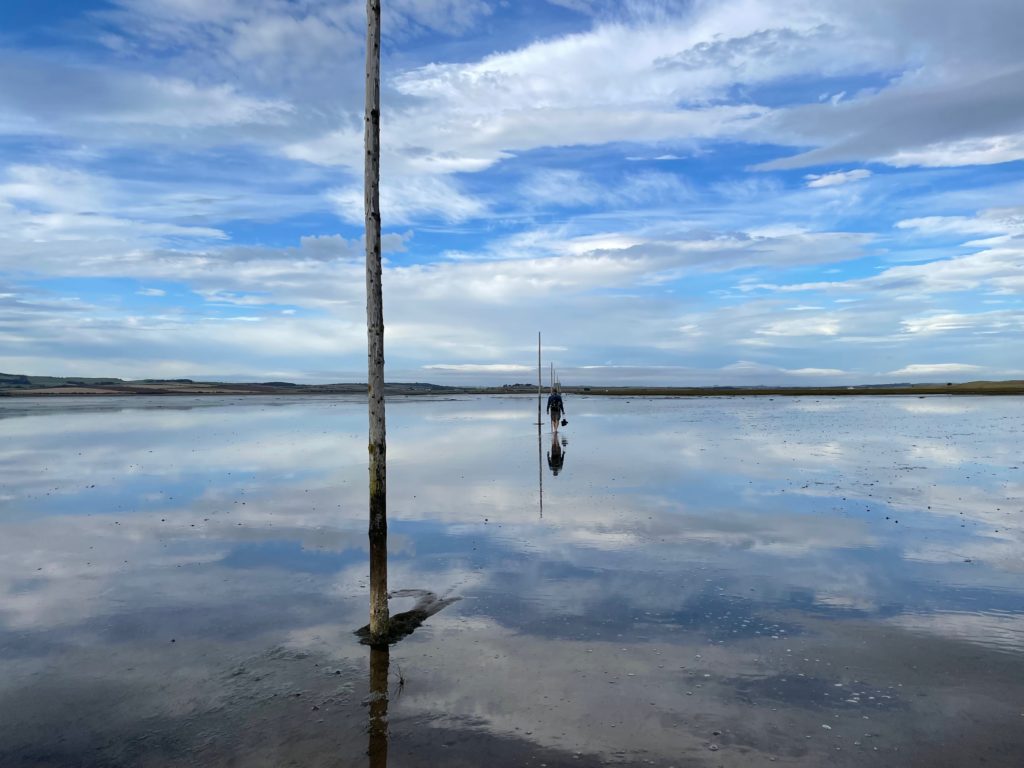 Walker on the sands crossing away from Lindisfarne Photo by JFPenn
Oli: Sure, sure. Sorry, I got carried away there. So you go across the causeway and say you’re going out at low tide, it sort of looks almost like a little bit of a desert. And then you’ve got the two routes, the Pilgrims Way, which is the walking path, which sort of goes in a straight line, and then the metal causeway, which is for cars.
And on both of them you find these shelters. On the Pilgrims Way, it almost looks a bit like a tree house without a tree as it were. This sort of rickety, kind of slightly precarious platform on stilts that’s designed that, if you get caught by the tide, you can rush up there and you can wait it out.
But on the metal causeway where the cars are, I think just by the deepest point, but just by the point where people tend to get stuck, they’ve essentially put what looks like what looks like a garden shed on stilts. And that hovers by quite a deep channel. So it is this really weird thing that looks like someone’s sort of taken their garden shed from B&Q or from Homebase or wherever, and they’ve propped it on four concrete legs and stuck it sort of up in the sky. Almost like the umpire at Wimbledon or something. Do you know what I mean?
And if you go in there, you actually realize it’s a bit more sturdy than that. It’s actually built bespoke by the council, by Northumberland council, I think it was. And it’s quite cozy in there, but I went up there because I thought the most interesting thing about Lindisfarne for me was that betweenness, that sort of being halfway between being an island. Not an island, being a tidal island. And that kind of act of the water, severing it, cutting it off, and then retreating and it’s like this umbilical cord that kind of gets cut and then reattaches every – so, I mean, reattaches, it’s not particularly good metaphor, you know what I mean?
But yeah, I sat out there for however long it was, eight hours or something. I was really careful to make sure no one spotted me so they didn’t try and rescue me. But when you are up there, it is quite a kind of, you know, you’re at this gateway to a holy island. And Lindisfarne in high peak season is so crazy busy. But if you’re there, you know, in the middle. Kind of in the causeway on the gatehouse as it were. It’s just total silence, total peace, beautiful views and just seals kind of swimming up and down the channel. And you maybe there more than in the village. You get a sense of what it might’ve been for Cuthbert, for Aidan, for those saints who are so important to the story of Lindisfarne.
Jo: When I walked over, I heard this sound and I was like, what is that sound? And it was the seals singing, which apparently happens sometimes. And then of course it’s a bird sanctuary as well. So it is incredibly beautiful.
But you mentioned earlier about the duality of these places, and you did mention there that the village is really busy, and this is one of the interesting things about pilgrimage in general. There is an industry and I guess there always was, you know, Chaucer’s Canterbury Tales. Obviously there’s always been an industry and I found that really hard, walking into the village with my wet boots and everything and my backpack and I was like, this is, and everyone looks at you weird because they’ve come off a coach.
How was that, with many of the places you visited, the industry versus the spirituality side?
Oli: I think you’ve hit the nail on the head there. Because you said it was always there. I think it was always there. The commercial side of life is almost impossible to escape in pilgrimage locations.
I mean, one example I often talk about is if you go to the square that marks the finishing line of the Camino and you see these people gathering there. And they’re often in extremely heightened states and some of them are almost euphoric. And it’s this extremely kind of beautiful, poignant moment.
And then there’s the cathedral, which is obviously extraordinary itself, but then parked between the pilgrims and the cathedral. There’s often one of those little sightseeing road trains. Do you know the one that’s sort of like halfway between a bus and a train and there’s someone on a loudspeaker and maybe it plays a little song and it might even have a smiley face on the front of it, but that’s standing between the pilgrims and the cathedral and is just evidence for me of just how people will spy a buck in places where people spiritually gravitate. And that’s always been the way I think.
I think it also applies to lots of things. It applies to souvenirs, trinkets, pilgrims’ badges, whatever it might be, rosary beads, these, I think these are the original gift shops in a way. You know, when pilgrims go somewhere and they want something to take the magic of that destination back with them.
But it also applies in terms of the commercial side of things. I think it is to do with, I mean, you said the Canterbury Tales, like, I think pilgrimage for many people is about boozing and about going out. And if you hear about those stories of Shikoku Japan, where pilgrimage for many people is just sort of a pretext to go out there and just live the high life and kind of see the world a bit and have some fun. That’s one strand of it. I’m not saying that’s definitive for many people. It is a really lofty endeavor. And for a lot of people, I think these two things kind of mingle, sometimes comfortably, sometimes not so comfortably.
But yeah, I think the commercial side of things, bathos, these things will always be there, I think.
These places they promise escape and transcendence on one level, but then on another level, totally fail to deliver that. And I think it’s worth being honest about that.
Jo: I think so too. And again, it comes back to what you said about expectation. And in fact, the only place I sort of found that solitude and nature was on the St. Cuthbert’s Way because it’s so remote, in terms of the walk, whereas then arriving at Lindisfarne.
But I wanted to ask you about somewhere else, which is Iona, because I haven’t been, and part of me is kind of scared because of these expectations. So you say in the book
“More than anywhere I traveled for this book, Iona seemed a place that prompted wild infatuations. Dreams drifted northward to settle on this little Scottish island.”
So tell us about Iona.
Oli: I think here again, it’s to do with geography. I mean, I think the fact is for most people in Great Britain, Iona will almost certainly be a long way away from where you live unless you happen to live on the island of Mull or Oban or wherever it might be. It’s somewhere that through our modern eyes is at one removed from the rest of the world.
You know, it’s an island off an island off an island. If you count Great Britain as well. It’s at the edge of, it’s the edge of the Ross of Mull. It’s also kind of quite, it has a different feel to the Isle of Mull, which it neighbors and which is the route there. It’s geologically different. It looks kind of different.
And the way it’s regarded by many people is, you know, this is one of the first Christian outposts in Great Britain, happening around the same time as Canterbury emerges and that it’s at the wild edge of the world. You know, that this kind of little perch on the cusp of the Atlantic, which is kind of untrue in terms of history. Because Iona was actually very well connected. It was close to Ireland in those times. The way of getting around was not by land, but by sea. And it was on a kind of fairly established network of sea roads.
But I mean, yeah, that doesn’t stop the fact that it’s sort of seen as a sort of wilderness pilgrimage in many ways to, and there is no way getting there is easy. You will have to get a ferry or you have to get to Oban for a start, which could be umpteen train connections through riding the West Highland line through beautiful glens, a ferry to Mull, another wild road across Mull, which is kind of only just very slightly wider than your car, possibly narrower. And then you get to a ferry, another ferry port. Then you get a lot. So by the time you got there, whether you like it or not, you’ve made a kind of pilgrimage of one sort.
So I think that those are some of the reasons why, I mean of, and of course it’s hugely historically significant. It’s where Saint Columba, one of those early Christian saints of the British Isles established his monastery, in whatever it was, the seventh century I think it was. It’s at the very beginning of the story. It has the same elements as many pilgrimage sites across Britain, which is they were destroyed by reformations of one kind or another. And so that, you know, the ruins are often part of it.
And some people might find that kind of disappointing. Perhaps people from a Roman Catholic background might go there and see things being smashed to rubble, but I think perhaps in England we’re a bit more conditioned to find some kind of poetry in that, when we think of Tintern Abbey or Glastonbury Abbey or great monasteries like Rievaulx and Fountains and places like that.
They almost have their own kind of majesty in decay. And there’s an element of that I think about Iona. When you get there and you just sort of see these kind of slightly weathered. Pieced back together, Christian crosses. There is certainly some, yeah, there’s something stirring about all those things, I think.
Jo: And I guess one of the other things about it is where it is, physically as you said, so for people listening who don’t know the geography sort of very northwest. Realistically, you’ve got a lot of weather arriving, so, and you, I think you were there for a week, right?
How was the weather? How was that wildness around it?
Oli: Yeah, I mean it’s one of those places that you go and you can go and stand on a west facing cliff and you’ll have the kind of entire Atlantic blowing up down your face and you sort of almost get this kind of facelift from quite how intense it is. And that’s hugely stimulating.
And some people in the community there, of community with a big C that religious community in Iona Abbey today, someone said that’s almost like an image of God, this kind of sea, which is all powerful, which is vast and unknowable and it has that kind of element of the divine, of the almighty about it, I’d say. That’s certainly part of it.
And then the origin story of Iona, of St. Columba coming from Ireland. Sailing in this tiny little coracle across these insanely wild seas. These are kind of real, Channel Five trawler program seas where they’re just flinging around boats and it’s all rags of white surf. It’s not something we’re used to if you live near the English Channel or the North Sea or even the Irish Sea, they’re not quite on the same scale. I think all those things are part of Iona’s appeal, you know? I mean, it is a hugely historically significant place. There’s no two ways about it.
Jo: I like that kind of, we can’t control the weather and we can’t control God, and we’re sort of trying to find that in that place.
I also want to ask you about Walsingham because there was a point in history when it was a super, super famous place.
And I would bet that many people listening, probably most people listening to this, have never heard of Walsingham. So you say it’s unique in Britain in being a tiny village, shouldering the weight of its holy past. Tell us about that.
Oli: Yeah, I mean it’s a little village in Norfolk, which is sort of, I mean it’d be wrong to say Norfolk is remote in the context of England, but it’s a little bit more out the way. It’s kind of this bit of part of this bit of land that sticks out into the sea that incorporates a few, a couple of other counties as well. And it’s kind of a bit of a holiday heartland as well. Some lovely beaches there. And has a lot of very, very pretty kind of villages with flint, these kind of flint on the facade that makes all the houses kind of quite sparkly and lovely in a way.
But it’s fascinating that sort of in the midst of this kind of quite quintessentially English, slightly Miss Marple-esque landscape. There’s a lovely little village, which at the dawn of the, well, no, actually, was it 1061 something? There was an apparition of the Virgin Mary before a Saxon noblewoman. That’s a long time before other sites of other more famous sites of Marian apparitions, like Lourdes, like Fatima, like Medjugorje in Bosnia. This is a good several centuries before all of those.
And yeah, the fact is that this tiny little village was one of the kind of major pilgrimage sites of Christendom. It was ranked alongside Canterbury, and kind of only a few pegs below Rome, Santiago, it was mentioned in the same breath as Jerusalem by some people that, you know, people would go to this little village, that there would be royal pilgrimages there, kings would be going there.
And then suddenly, the English reformation happens. And this little place experiences the same fate as all the pilgrimage destinations in England at that time. These monasteries are all taken apart, smashed to bits. The icons, the shrines, are destroyed. Suddenly this sort of sleepy village goes back to being sleepy again for another 400 years or so.
And it was only at the dawn of the 20th century, where the local vicar, Alfred Hope Patten. He decided to kind of resurrect it in a small way. And so when you go to Walsingham today, it’s a place that kind of, you know. Its sanctity is originally medieval. Originally about a thousand years ago there was this Marian apparition, but then you go there and everything looks like something from the start of the 20th century.
The church sort of looks almost a bit like a kind of early BBC building or something. And the shrine is conspicuously quite new and shiny and is only, you know, only less than a hundred years old. And that this place has sort of had this sort of second life after its sort of renaissance at the start of the 20th century.
I mean, the counterpoint now is that obviously with the decline of church going that fewer and fewer people are going there. I mean, in the 1930s, there were special trains laid on from London, taking people there. Right through the 20th century, coach loads of people would go from their home parish on pilgrimage there. And now those numbers are dwindling. COVID dealt a big blow to the place. And now it’s just sort of quietly kind of ticking along.
The really fascinating thing for me about Walsingham is how it is, you know, almost, I mean, like you said, a lot of English people will not have heard of this place. And even people in Norfolk will probably not have heard of this place.
But if you go there, you will find like large numbers of Latin American people who happen to be working in London, you’ll find huge numbers of Tamil people, from Birmingham or from the Midlands, even from London, who, I mean, the biggest pilgrimage to this place now is the Tamil pilgrimage. Where these fields fill up with cars and this place that’s in the middle of Norfolk. It’s in the middle of kind of Brexit land and a large majority of people, they’re kind of white, Anglo-Saxon people. And then suddenly there’s this very highly diverse and really quite wonderful little village in the middle of it all. I think that’s something quite lovely.
Jo: And I wonder, because you said it looks quite modern and you also mentioned there the decline in church going, but actually there is a renaissance in pilgrimage. And people do like visiting. I mean, I’m not a Christian and I’ve done several pilgrimages and I feel an attraction to the ruins and the great cathedrals and these things.
I haven’t been to Walsingham, I’m not attracted to it because maybe it’s too modern. Do you think that’s maybe one of the reasons it hasn’t come back like some of the other places?
Oli: Yeah, hugely. I think that’s really interesting. How some pilgrimage places will speak to people of kind of less certain faith and others don’t.
I mean, someone asked me the other day for a piece they were writing what I consider to be Britain’s foremost pilgrimage destination now. The classic answer would’ve been Canterbury. Or indeed, Walsingham would’ve been a candidate for a lot of British history. And then, you know, Lindisfarne is also important, but I think even though it’s kind of second tier in the kind of more historical stakes, I think Glastonbury is the biggest pilgrimage destination now in Britain. Just because it means so many different things to different people. It is of importance to Anglican and Catholic communities. But it also brings in neopagan new age people. It brings in people who are looking for some kind of nebulous idea of nationhood as well. Those Arthurian legends that somehow this place has a kind of seed of an origin story about Britain embedded within it.
But also, I mean, I think there’s a logistical argument that the biggest gathering in Britain, the Glastonbury festival, which happens just a few miles down the road and a few days ago. I mean, that’s a pilgrimage for many people. If you look deep. If you kind of look a little bit more closely, you can see that those, some of those things, things like the pyramid stage, that was kind of an energy center. And there are pilgrimage elements to the Glastonbury Festival today.
So, I mean, yeah, I mean, Walsingham, it doesn’t have that ancient kind of draw of Iona, it doesn’t have the wilderness feel of Lindisfarne. It’s not got an enormous cathedral at the end of it, like Canterbury. And accordingly, while pilgrimage is in renaissance in many ways, it’s being left behind to some extent. I think, relative to those other places.
Jo: So I wanted to also ask you, so you have almost a call to action at the end of the book about “finding Jerusalem in our own backyard to travel deeper, not further to break through the crust of the familiar to find the fantastical.” So I think this is really important and you do mention changes in attitude to travel perhaps with climate change and things being a bit different now. So how can we do that though?
How can we travel deeper, not further and see things differently?
Oli: That’s a very good question. I think the way I saw things differently in this book is sort of being in the right place at the right time.
If I kind of give an example of that, I mean, every time I, well, not every time. Because sometimes you take the M4, but a lot of times when you go on holiday to Devon and Cornwall, you drive down the A303 and there’s that horrible sort of choke point near Amesbury and traffic’s crawling really slowly and it’s really annoying. And you look out the window and you’re like, oh, there’s Stonehenge. And you’re like, oh, hi Stonehenge. Then you sort of push on down the road and then you don’t think about it again.
Or you might go there on a school trip or something like that. We might kind of go with your family and walk past the barrier. And you’re like, oh, this is very interesting. I think that had been my attitude to Stonehenge until I started reading about its modern history as a place of gathering at Solstice about the free festivals and visited there on one Summer Solstice event.
And you see that its history for many people is not abstract. That it is a kind of, it is not a heap of old stones. It’s a temple for many people. And the historical sources suggest that people can to a large extent make it what they want it to be. And they do. And the lack of a dogma, the lack of a creed about that place means that you are free to kind of complete the picture yourself.
And I didn’t know, I mean, maybe was a bit too young to know about the free festivals of the seventies. The Battle of the Beanfield where Stonehenge was sort of closed off to the outside world because of the parties that were going on there. And I didn’t realize that it was kind of reinvented, rediscovered as a shrine about 40, 50 years ago and now it’s just sort of ticking along, but you can still get a sense of those people for whom it was a kind of, it was a sort of. They were holy stones.
And that had never crossed my mind until I’d been to some solstice. That I’d read the sources around it. And I think, yeah, that’s part of it. Just learning more, speaking to more people. Waiting until the tourist tour buses have thinned, and when the sun started going down, perhaps, or whatever it might be. Those are often the moments when you start to see a little bit more clearly the magic that some of these places possess and were chosen for in the first instance.
Jo: Fantastic. Well, this is the Books and Travel podcast.
What are some of the books you recommend about pilgrimage or British travel?
Oli: Okay. Yeah, probably if I was to pick one book about British travel of the last 10 years that kind of opened my eyes a bit more widely. It’s probably not particularly original answer, but probably the The Book of Trespass. I think that’s just a fantastic book that, you know, so much of kind of landscape writing and nature writing is so polite and so deferential and just something that turns that on its head. I really like it. I think it was really fantastic and so much fun. It was a really great book. So I really enjoyed that.
In terms of pilgrimage writing, I really, I’ve not quite finished it yet, but I really enjoyed Holy Places: How Pilgrimage Changed the World by Kathryn Hurlock, I think I like it because it’s very kind of clear-eyed and sees through an awful lot of the kind of cloud of mystery around these places to just sort through historical facts. That’s a really fun one.
British kind of landscape books. I mean, I would say probably my, those kind, you know, I think probably every writer has a few kind of holy texts of their own. And probably, again, it’s not hugely original, but for me it’s As I Walked Out One Midsummer Morning, which obviously only has like a few pages of England before it starts hightailing over to Spain. But that kind of landscape around the Slad Valley and I guess not very far from you. Really.
Jo: We should say that’s Laurie Lee if people don’t know.
Oli: Yes, of course. That’s another really, that kind of is writing about a place where, you know. It kind of almost jumps out the page at you really, and you feel that you’re there in some ways. I really love that kind of classic British travel writing that came out of the kind of seventies and eighties, those are maybe not quite as fashionable now, the kind of Bruce Chatwin and Patrick Leigh Fermor and all that stuff, but that’s what really kind of inspired me when I was young. And I know that there, there’s a lot of those kind of books are kind of quite flawed in many ways and a lot of stuff is made up.
Jo: Oh, we are all flawed.
Oli: We are all flawed. But yeah, those guys get away with it because they could do it so brilliantly and make it feel so real. But yeah, those books are all hugely important to me. I think you can often tell quite how important a book is by how well thumbed it is. But for me, I’m just looking up on my shelf now and I think the most battered book up there is Wind, Sand and Stars by Saint-Exupéry. That’s like another really kind of sacred text for me. Sorry, I rattled on.
Jo: Oh no. We love books. That’s why we’re here.
Where can people find you and your books online?
Oli: My website is oliversmithtravel.com. And my social media handles are OliSmithTravel on Instagram and Twitter.
Jo: Brilliant. Well thanks so much for your time, Oli. That was great.
Oli: Thank you. Thanks for having me. Thanks for reading the book.
The post British Pilgrimage: On This Holy Island With Oliver Smith appeared first on Books And Travel.
7 August 2025, 7:30 am - 37 minutes 57 secondsTouching History: The Ancient Craft Of Stonemasonry With Andrew Ziminski
What is it like to work on ancient English churches, cathedrals and stone monuments? How does stone, a symbol of permanence, change over centuries? In this interview, I explore the craft of stonemasonry with church conservator Andrew Ziminski.
Andrew Ziminski is a stonemason and church conservator with decades of experience working on some of the greatest cathedrals and churches in Britain. He’s also the author of The Stonemason: A History of Building Britain and Church Going: A Stone Mason’s Guide to the Churches of the British Isles.
- The ancient craft of stonemasonry and how the tools have remained unchanged for millennia
- How stone is damaged over time by settlement, weather, and even the metal used to build with
- The defining features of Gothic architecture, a movement focused on light and colour, not darkness
- Why the “Green Man” carvings in churches are Christian symbols of resurrection, not pagan figures
- How ancient churches can feel imbued with the atmosphere of centuries of human experience
You can find Andrew at MinervaConservation.com.
You can find my articles and photos of Gothic Cathedrals here.
Transcript of the interview
Jo: Hello Travelers. I’m Jo Frances Penn, and today I’m here with Andrew Ziminski. Hi Andy.
Andy: Hello, Jo.
Jo: Yes, absolutely. So just a little introduction. Andrew is a stonemason and church conservator with decades of experience working on some of the greatest cathedrals and churches in Britain. He’s also the author of The Stonemason: A History of Building Britain and Church Going: A Stone Mason’s Guide to the Churches of the British Isles. I’m a fan and I have the books right here if you are watching the video. I love them. So thank you so much for coming on today, Andy, I want to get straight into it because —
Part of why I love churches and cathedrals is this sense of timelessness, of being small against the backdrop of history.
How does it feel for you when you are working on these ancient buildings, doing this ancient craft?
Andy: Well, in theory, I should be getting bored of it, I mean, I’ve been doing it so long, but anything but. My interest seems to grow with every project that we work on. We pretty much only work on ancient churches, medieval bridges, and the odd castle every now and again.
There’s always something new to discover, be it a particularly local school of carvers or a type of medieval graffiti that I see carved into the piers of a particular church. There are so many regional variations in the British Isles, in terms of architecture and materials and the approach of the people who built these places, that I’m always sniffing them out. And as I understand more, it makes me want to understand even more, if that doesn’t sound too crazy. I think the day I’ll stop nosing around these places will be my last one on the planet.
Jo: Well hopefully not falling off some spire.
Didn’t you work on Salisbury Spire?
Andy: Yeah, I started my training at Salisbury. I went to a local stonemasonry college because our part of England, the Southwest, is renowned for its building stones. There used to be a very excellent stonemasonry college at Weymouth on the coast in Dorset. From there I went up to the top of the tower, not the spire, but the tower, which is the square section that supports the octagonal base of the spire which is 404 feet tall and the tallest medieval structure in Europe that’s still in its original condition. It’s pretty amazing.
Jo: It is. Salisbury is amazing. And you mentioned ancient churches, so some people listening might be in places where they don’t have such ancient architecture as we have.
What timeframe are you talking about when you say ancient churches?
Andy: The oldest church I’ve worked on is in Bradford-on-Avon in Wiltshire, again in the Southwest. That was built around the year 1000, and anything from then onwards really.
I tend to switch off with Victorian churches because I’m not really that interested in them. Victorian churches in the UK are generally Victorian interpretations of earlier medieval forms, and I think I might as well just study the medieval form and not the Victorian fakes. Even though their craftwork is excellent. Very often in the churches that we work on, we’re very close to the city of Bath, as you know, it is absolutely groaning with Roman ruins.
It’s not unusual to see Roman material that the Anglo-Saxons reused in their walls or as part of their altars. I’ve done lots of work in the Roman baths in Bath, so I’d say the earliest structure I’ve worked on is the West Kennet Long Barrow, which was built about 3000 BC and has its own postcode. So I’ve worked on a building that’s 5000 years old, and that was quite incredible.
Jo: It is incredible. And just again, coming back to this ancient craft, because the stonemasonry is also ancient. Obviously the people who built these things were stonemasons.
How did you decide to get into this, because most people don’t go into stonemasonry?
It’s not a growing profession. It’s so fascinating that you chose this direction.
Andy: Well, a number of factors came into play. My father came here as a refugee during the war. The only options for him as a job were going down the coal mine or working as a stonemason in a granite quarry. We used to go to Scotland and I liked the permanency of the things he made. He was Polish and he’d say, “Son, this will last for a million years,” and they probably will, because they’re built of granite.
So I quite liked the permanency of that from a young age. And I’ve always had a deep interest in history. I thought, how can I draw together the worlds of craft and history? Going down the path I knew a little about from my father seemed like a good way. And 35 – 40 years on, I haven’t looked back.
Jo: I do find it fascinating. I went and did a weekend of stone carving and so I did actually use some of the tools and boy, my body hurt!
What about the physicality of what you do? This is hard material. Is it very physical or is a lot of what you do now with chemicals or how does the job work?
Andy: I’m a conservator first and foremost, and what that means is that my aim is to keep as much of the original as possible. It’s like dentistry, I guess. If there’s a cavity, and the stone around the cavity or the rot is okay, I will fill it using a lime mortar, which is a very ancient technique that the Romans used.
You can’t lift a quarter-of-a-ton-sized piece of stone, you’ve got to use kit. Many people are surprised when I’m on site and my colleagues, half of them are women. Very often I find that women make better stonemasons than some of my more gung-ho male colleagues who just want to bust their backs and destroy their bodies by lifting things they shouldn’t lift.
The tools that we use are unchanged since Roman times or even ancient Egyptian times. The head of my dummy is made of nylon, but the ancient Egyptians used mallets made of palm trees turned on a lathe. So, the materials might be different, but the tools, the form of the tools, the approach, and the mindset are exactly the same.
The way I would approach cutting a block of stone is not in any way different to someone who was cutting a limestone block for the Great Pyramid, or in the Roman Baths in Bath, or in the Colosseum, or at Notre Dame. This is a sort of brilliant handing on of the baton over the generations that goes unnoticed, and I like that about craft skills.
Jo: Are young people coming into it? Is there another generation? Because I feel like that kind of craftsmanship –
Are we losing this kind of craftsmanship or is it still here?
Andy: No, there’s stonemasons in every hedge round here because it’s a stony area. The local stonemasonry college in Bath is really good. There’s no shortage of youngsters coming through at all.
It’s different in other parts of the country where there isn’t such a strong tradition. But certainly around here in Southwest Britain, Southern Britain, and in London, there are lots of stonemasons. But there are other crafts that are suffering from a demise in interest, mainly because people don’t know that these jobs exist, and I think that’s a big problem.
I spent all last week at the Chalke Valley History Festival, educating young people that it’s possible to earn a living that’s good for your soul, good for your body, and good for society by undertaking a traditional craft, be that a stonemason, an oak carpenter, or a stone slater. All church roofs need stone slaters, and that’s an area where there is a real shortage. If you want to become a millionaire in years, become a church stone slater.
Jo: But then, you love the stone now, I guess.
Andy: Yeah, I mean, ’cause our business is tiny, there’s just eight of us and we just go from job to job. We’ve had to become generalists so we can carve pretty much anything. We could rebuild any vault we could repair a hole in a wall and plaster it up. We’ve got a broad range of skills, but we’re not specific and in the craft of ow masonry. There are lots of different areas you can be, you can focus on being a letter cutter, for example, and just do headstones or memorials or you could be a sculptor, of some sort.
Or you could be what they call a Banker Mason. You’re just in a workshop making components to be fitted into a church or a fixer mason. But we sort of have to do all of that. So we’re a bit slower than the people who choose to specifically focus on one of those types of tasks.
Jo: I’m also interested because when I was attracted to this whole area and Gothic cathedrals, it was this sense of things lasting. We think of stone as something that doesn’t change, and it’s used as a metaphor for unchanging and unyielding, and yet your very job is fixing stone.
What changes and damages stone over time? What are you fixing?
Andy: Settlement within the structure is very often a problem. When these buildings were put up, say a Norman church or cathedral in the th century, because they hadn’t quite got the engineering right, they would tend to settle around the central tower. So you get lots of cracks and settlements in the arches. A Norman arch adjacent to a tower, which is semi-circular like a Roman arch, will very often have settled and there’ll be some deflection in the arch, and it’s details like that that always need maintaining.
Different stones erode in different ways in different parts of the country. They’ve historically been subject to acid rain, and in limestones, that causes a particular problem externally, but the core of the stone will very often be in good condition. So that will be repaired, as I mentioned earlier, with lime mortars, or we’ll just do some dentistry and cut out the rot, replacing it with a new piece of stone.
Some stones in this part of the world are very good and some are rubbish. The Anglo-Saxon Church at Bradford-on-Avon has been there since the year and there’s no new stone in it at all. It’s because the Anglo-Saxons had the pick of the quarry. They knew where the best stone was. This is something I’ve noticed: very often Anglo-Saxon churches will be of bigger blocks than their later additions and be of a better quality of stone.
They’re still there and hanging around. So as I say, they had the pick of the stone and it’s gonna be larger and of better quality. Very often Victorian stonework is a bit rubbish and the way that the Victorians chose to build.
If we’re looking at a reproduction Gothic Victorian church, the Victorians wouldn’t have built in the gothic style from an engineering perspective. You have some squared off stones on the inside and the outside, and it would all be tied together in a rubble core so the whole building was, the walls were all unified, but with the Victorians, they would clad a rubble core with stonework and use cast iron cramps to reach into the core of the building and the cast iron corrodes ’cause it’s type of iron and that causes all sorts of problems. So Victorian church generally aren’t that well built.
Jo: I did visit the Salisbury Stonemason’s yard and they talked about that. And how, the metal, basically, like you said about dentistry, you think that that discoloration and the kind of almost rotting, but you mentioned the stone in Bradford-on-Avon.
What is quality when it comes to stone?
Andy: I think what might’ve helped Bradford is it is in a pretty rural area, whereas Bath is an urban area. It’s a very similar type of stone in Bath, but a slightly less durable stone was selected because the Anglo-Saxons and the Normans had the pick of what was available.
What tends to happen in Bath is that the coal that was extracted from the Somerset coal fields was a very high sulfur coal, and everyone was burning that in their grates. Consequently, all the buildings were covered in a sort of sulfation blackened crust, and that weakens the outside of the stone.
With the Saxon Church of Bradford-on-Avon, I think a simplicity in materials has also helped it. The masons who turned up to build this wonderful little building literally extracted the stone from the quarry face that’s still there behind them. They put up this stone structure with stone blocks, but they didn’t use a cement mortar or a lime mortar; they just used clay from the local riverbed to glue the stones together. When we opened up one of the corners where there was a bit of movement, you could just smell the river from a thousand years ago. It was just incredible. So we just knocked it up in a bucket and put it back in.
But I’ve noticed that like on the bridges around Bradford on Avon, there’s two medieval bridges and we’ve worked on both of them extensively, and they were constructed in the same way. So when they were sinking the piers, the central sections that the arches spring from, they would sink them down into the riverbed and of course the river bed’s clay, and there’s just tons of clay coming up, so they would just use that to glue together the stones. So all these incredible 13th century bridges and the adjacent tithe barn. It’s astonishing, isn’t it?
Jo: It’s beautiful.
Andy: It’s just old stone and clay, you know, simplicity and it’ll be there for another thousand years, won’t it?
Jo: I want to come back to Gothic because you mentioned the Gothic, and I love a Gothic cathedral. For people who might not know, many of my listeners are also book people and Gothic literature is dark and quite different, whereas gothic architecture is more about light and airiness and height.
Could you talk about what are the hallmarks of Gothic and some of the places that you’ve worked on?
Andy: I think giving that form of literature the name Gothic is a bit of a misnomer.
The Gothic [architectural] movement is all about light and color. Norman churches are these tall, dark churches that had tiny windows and thick walls. The Gothic movement was all about getting the light, which was the actual essence of God itself, into the church. So they wanted to flood the altar and the church itself with light. Consequently, you get much bigger pointed windows, and windows with a branch network within them to hold the glass, that’s called tracery.
Medieval churches would’ve been highly colored, they would’ve been lit by candles. It would’ve been an incredibly sensory experience to visit one of these places.
So I really don’t get the whole gothic movement at all, really. It’s just completely wrong.
Jo: Yeah, it is a little weird, and I feel that people get gothic architecture wrong because they think of The Hunchback of Notre Dame, for example, and the darkness and all that. But again, that’s not Notre Dame inside and the architectural thing.
Where have you worked on in terms of Gothic Cathedrals?
Andy: I trained at Salisbury Cathedral and spent a few enjoyable years there learning the ropes. I’ve worked at Wells Cathedral in Somerset.
Jo: Maybe you could just tell people about the scissor arches at Wells, because that’s a very special kind of architecture, isn’t it?
Andy: Yes. What tended to happen with Norman churches is they borrowed Roman architectural forms and tried to make them taller. As they got taller and the Gothic system was introduced, there was a desire for Gothic buildings that were built on a Norman core to go even taller. At Wells, they started to build a central tower.
So you look down the main part of the body of the church, that’s called the nave, and you’ve got wings coming off the arms of the cross, if you like. They’re called transcepts and the most sacred part, as I’m sure your listeners know, is at the east end, and that’s where all the chapels are and the altars and all that.
As it went up and they put a lead spire on the top, it just started to sink back down. This deflection I was talking about earlier on the side. The side arches adjacent to the tower, which we quite often have to repair, all started to split and come apart. The thing was about to collapse.
The master mason at that time, a chap called William Joy, came up with this very practical solution of introducing these scissor arches. They’re called scissor arches because they look like a pair of open scissors placed one on top of the other with the loop in the central section. That loop, where you would put your fingers, takes all the strain from all the surrounding stresses.
 Scissor arch behind altar, Wells Cathedral Photo by JFPenn
Jo: It’s beautiful. I mean, you said there it was architecturally functional, but it’s beautiful.
Andy: Oh, it’s completely mad. And Wells is so great because of the carving inside.
It’s got this Great West Front, which is the greatest West Front in Britain, and it’s full of incredible carving that’s survived since the 1220s-1240s.
 Wells Cathedral west front Photo by JFPenn
The actual carving inside is just as astonishing. It’s a tour de force of the medieval sculptor’s art, this form of leaf called stiff leaf. It’s a composite form, not a real leaf.
You can date any church on the basis of the stiff leaf. The stuff at Wells is the best in the country by a mile.
Did you see the toothache? It’s kind of all these sort of strange cartoonlike carvings of people with toothache holding their mouth open like this.
Jo: There is a lot of comedy in some of these churches that you think, how did they get away with that? I did a carving of a Green Man.
 JFPenn’s Green Man with petunias
Could you explain why we have things like a Green Man in a Christian place?
Andy: Funny enough, I have been carving a Green Man all this week at the Chalke history festival. The Green Man seems a pretty uncompromisingly pagan figure, but Gothic stone carving is full of foliate forms. Doesn’t matter where you go in the country, as long as the stone is carvable between 1220s and Reformation, sticking a face in these foliate forms seems a rational thing to do. Stonemasons would just carve and carve and carve.
These faces are not the faces of saints or pagan figures. It just indicates the abundance of nature, but it’s about rebirth, regeneration, and most importantly, resurrection. So, these characters are uncompromisingly Christian in my view. I don’t think they’re a hangover from the pre-Christian days because you don’t see an Anglo-Saxon or Norman Green Man. It just appears with all this wonderfully vital carving that you see in places like Wells.
They’re a really good form in ceiling bosses. Where you have a stone roof vault, to lock all the stones together at the top, you need a really massive, circular feature called a roof boss. Decorating that with a green man is a very obvious thing to do. You’ve got to decorate it with something, and there are only so many lives of the saints you can portray, so the Green Man is very, very common.
Jo: I did also want to ask you, because in Churchgoing, talking about the more spiritual element, you said,
“Atmosphere should have its own entry in this book, it’s usually been as tangible a presence as anything else.”
What kinds of those experiences have you had and why do non-religious people love these places and feel something in these places?
Andy: It’s such a personal thing, isn’t it?
I go into a church at six in the morning in the middle of winter. It’ll be cold and frosty, and the heating won’t be on, but the sun will be coming up and will radiate through the east window. These first glimpses of the day will light up the motes that are floating around in the church, and you can’t not be moved by these places.
I refer to the walls of a church as like an old-fashioned night storage heater that slowly releases the births, the deaths, the coming together, the tragedy, the pathos of life that’s taken place since these places first went up seven or eight hundred years ago. I don’t have a particular faith, but I know there’s something else going on.
Jo: It’s interesting you say “like the storage heater,” and I feel too that when there is emotion in a place, it sort of becomes imbued with it and you can perhaps sense some of that emotion.
What’s interesting is some places you go and you really do feel something, and other churches, you know, there’s this idea of dead churches. There are some that clearly had worship in them but do feel dead. And other ones you go in and you are like, “Oh yeah,” like Wells just has such a feeling in it. Then you go in somewhere else, like St. Paul’s Cathedral in London, and I don’t feel anything there.
Why do you think we feel things in some places and not others?
Andy: I’m completely with you about St. Paul’s. It’s weird, isn’t it?
I worked there for a while and it was very interesting. The guy who was teaching me was the master carver there, and he’d been there since he was a boy. His education was rebuilding Christopher Wren’s City of London churches after the Second World War. He would send me off every lunchtime to go and look at a different church, and I found more of that vibe going on in the churches really than the cathedral.
That said, you’ve got to pay to get into Westminster Abbey, which I find so appalling. But Westminster Abbey, talking about atmosphere, it’s in the middle of busy London and it’s just the most atmospheric of all. It’s not a cathedral, it’s a Royal Peculiar, which means it’s the church of the Monarch. I’ve shivered a few times in there over the years when I’ve managed to blag my way in for nothing through the gift shop.
Jo: How interesting. I mean, that really has a lot of famous burials, and I’ve got some photos there of these skeletons. There’s some really good sculpture there. But it is interesting, and you are not religious, you’re not a Christian?
Andy: I am a bit, but not really.
Jo: It’s interesting how we feel that in stone.
So, we are almost out of time. Apart from your own books —
What are a few books you might recommend that feature stonemasonry or architecture?
Andy: Everyone on the planet has to read A Month in the Country by J.L. Carr. It’s a novella about two First World War veterans, one working as an archaeologist and the other is a wall painting restorer, working together in a church. It’s the most wonderful short read that really fills in a lot of spaces if you’re trying to understand what our medieval churches are about.
To understand old churches now, they’re a machine of sacredness that was designed before the Reformation. There’s a really brilliant book by a chap called Eamon Duffy, and it’s called The Stripping of the Altars. It’s very entertaining, and every page is a winner.
I also recommend Country Church Monuments. And King of Dust by Alex Woodcock is a lovely book. It’s very specific to Cornwall, but it’s thoroughly recommended if you want to understand the weirdness of the area.
And this one, Old Parish Life: A Guide for the Curious. It’s just wonderful. This chap has been spending his whole life raiding old parish accounts. Tell me when to stop and I’ll read you a random thing. It’ll be worth it.
Jo: Go … stop!
Andy: Burial before the reformation. In 1556, there was a payment to Phelps, the tinker for the mending of the corpse bell of 12 shillings.
Jo: That’s awesome, I love a corpse bell!
Where can people find you and your books online?
Andy: My Church Going book is selling really well and it’s available in all good bookshops, I imagine. I guess you can get anything from anywhere, can’t you?
Jo: Brilliant. Well, thank you so much for your time, Andy. That was great.
Andy: Thanks, Jo.
The post Touching History: The Ancient Craft Of Stonemasonry With Andrew Ziminski appeared first on Books And Travel.
24 July 2025, 7:30 am - 37 minutes 41 secondsFearless Roots: Travel, Grief, And Resilience With Becky Doughty
What does it mean to come from everywhere and nowhere at the same time? How can travel shape our sense of self, and how do we find our way home when faced with unexpected grief abroad?
In this episode, I talk with author Becky Doughty about her traveling childhood as a missionary kid, a life-changing trip to Tuscany that resonated with grief, and how traveling alone helped her become more resilient.
Becky writes heartfelt and wholesome, contemporary commercial fiction and Christian fiction, including the Autumn Lake and the Tuscan Romance series.
- Growing up as a missionary kid in West Papua
- Being adopted, from “nowhere, anywhere, and everywhere.”
- How a dream trip to Tuscany turned into a journey of grief after the sudden death of her father.
- Turning a traumatic travel memory into a heartfelt romance
- Overcoming the fear of traveling and why embracing the moment is more important than worrying about what might go wrong.
- Becky’s solo backpacking trip to run the Dublin marathon and how it stripped away everything except her own inner strength.
You can find Becky at BeckyDoughty.com
Jo: Hello Travelers. I’m Jo Frances Penn, and today I’m here with Becky Doughty. Hi Becky.
Becky: Hi Jo. How are you?
Jo: I’m good. It’s great to have you on the show. For a little introduction, Becky writes heartfelt and wholesome, contemporary commercial fiction and Christian fiction, including the Autumn Lake and the Tuscan Romance series. We have lots to talk about today, but as a starter —
How did travel play a part in your childhood?
Becky: Well, I always say I’m a missionary kid in recovery because travel made me fearless. Being a kid that traveled all around the world, I never really had a place that was home base. Even though we didn’t live in a lot of different countries, we did primarily live in Indonesia. My dad was an airplane mechanic and pilot, and he oversaw most of the hangar operations at our base camp in what is now West Papua.
For me, travel was just a way of life. We traveled back and forth to the States, which was home, and I traveled to school. I was a boarding student in high school and we traveled all on our own, with no parents. It was two days of travel, and we had to get to the right place during our stopover. Travel was just a part of life and it made me a fearless, “I’m just going to do whatever I want to do” kind of person. But the flip side is that it also leaves you feeling a little bit, not unrooted, but wondering where to put your roots down.
Especially since we were always told that America was home, in particular where our grandparents lived. But it never felt like home because we were always only visiting. That’s a big part of why I write stories about people finding their place. I’ve always written stories and escaped into other people’s lives for that reason.
Jo: It’s fascinating that you were told where home is whilst living elsewhere. Because you are living there, in West Papua or PNG as it was, with a very different culture, climate, and religions. I worked in mining for a while, so I know that sort of ‘Wild West’ idea of what was going on in PNG, and of course, there were wars and everything. So that’s very different.
To be told, “Your home is in America, you belong in America,” must have been very strange. What age were you? What were your formative years?
Becky: My parents went to the mission field with three kids under three. My older brother and I are adopted, not biologically related, and then the next two siblings came along naturally. My sister and I are only eight months apart. So when they went to the mission field, my brother was around three, I was one, and my sister was younger. I lived away until my senior year of high school.
We came back periodically. At the beginning, it was every four years. Then, as they realized how isolating that was for some people, it changed. I think now furloughs are closer to every two years.
Jo: And of course, no internet. International phoning was really hard. A very different world.
Becky: Completely different.
We had to travel to phone home to our grandparents. Once a year, we would travel into the capital, Jayapura, and make a very short call at the embassy. Our main mode of communication was cassette tapes. We would record and send them, and it could take four to six weeks, or even two months, to arrive. Our grandparents would record these long cassette tapes with Grandpa reading stories and singing songs, saying things like, “Here’s a song that reminds me of Becky.” We had these wonderful treasures because communication was so difficult.
Jo: Do you still have them?
Becky: I don’t have them anymore. My mom has a few things from back then, but those are some of the memories that we just lost. One of the issues we had was that we often had to pack up and leave everything behind. You get used to taking only what you can put in your suitcase, and with the idea that we were just going ‘home’ to see the grandparents, a lot of stuff that we should have kept wasn’t. My mom has kept all of her prayer letters and has compiled them in a book, so that’s cool because we get to see the journey through those letters.
When we came back to Indonesia, we would often pack a crate and have it shipped by sea. By the time it arrived, it would often have holes cut in the side and things taken from it. So even when we sent stuff ahead, things were often missing. We never knew quite what we would get at the other end. We started shipping things in 55-gallon drums that you could seal, which were harder to break into, but you can cut the lock on one of those. It was always a free-for-all; you never knew what was going to meet you.
Jo: A far cry from Amazon next-day delivery!
I want to come back to something you mentioned. You were adopted, and I was reading on your website that you say —
“I am adopted. It’s pretty cool. I come from nowhere, anywhere and everywhere.”
This fascinated me, because I don’t think I’ve ever read a description of being adopted in terms of sense of place before. That really caught my eye. Why did you choose those words to describe it that way?
Becky: That’s a really good question. I’ve had to really think about this and how to answer it succinctly.
One of the things I struggled with growing up was a sense of belonging. It’s not because my parents were problematic; they were wonderful parents. I am a success story as far as winning the lottery with parents through adoption. But I still always felt that there’s something of me out there somewhere. If I could find my people and my place, I would know where I came from, and that would give me a better sense of where I’m going.
Because I have such a deep connection to the people in my life—my adopted family, my husband of 37 years, our grown kids and five grandkids—I have a very stable life in terms of people. But because of the travel and never really having that sense of place, I always thought it would be cool to find out that I’m from some random place and get there and find a bunch of people who look and act just like me.
According to my birth records, I have both Japanese and Spanish in me, which you’d never know. But wouldn’t it be cool to go to Japan and find where I started from? So a sense of place is almost more important to me because I already have a sense of people.
Ironically, there’s a funny twist. We’ve been living in California for most of our marriage, but we moved to Indiana, which is in the middle of the Midwest. We ended up living on the exact same street, just four houses up from where my husband grew up. For my husband, Kevin, coming back to his street has been like coming home. There’s a little bit of me that gets to live vicariously through him regarding where home is. But I think I’ll always be searching for where home is.
I am a believer, and that is actually one of the few things that has kept me grounded.
The reason I came back for my senior year of high school was because I got kicked out of school. I really struggled with authority, especially not being able to question it. It was a very conservative boarding school for missionary kids. If you questioned anything, you were the troublemaker. That really played a lot into my feelings of “Why am I here? I don’t fit here.” I was told, “This is how Christians act and behave,” but that’s not the way I believe.
That set me as an adult in this direction of searching. I walked away from my faith for a long time in my thirties, and then at the end of that journey, I realized that’s the only thing I can really depend on because people are just people. This goes back to that idea of place. The older I get, the more I feel like maybe I’ll just keep traveling while I’m here and wait for that feeling of home for Heaven.
Jo: That’s really interesting. I have heard many people of faith say they will go home to God or Jesus. Let’s stick with different places because you have your Tuscan romance, ‘All The Way to Heaven’.
Everyone loves Tuscany. Tell us about the trip that inspired the book. Since a sense of place is so important to you, what places from that time still stick in your mind?
Becky: A friend of mine and I had “Go to Tuscany” on our bucket list because we were massive fans of ‘Under the Tuscan Sun’.
Ironically, it was the movie that we loved so much. I always read books first, but this was one that I didn’t, because I didn’t know it was based on a book until after watching the movie. My husband, bless his heart, hates flying, but I grew up on little tiny puddle jumpers and never thought of flying as something to be afraid of. So, he stayed home with the kids.
We wanted to go to a few places that were a little less chaotic, especially since we were going in October, during the harvest and tourist season. We started our trip in Lucca, which is a medieval walled city.
It was a perfect introduction to Tuscany because it felt like what you see in the movies without being super touristy. One of the coolest things about Lucca was the walls that circle the city, which have a walking and bike trail on top. You could rent a bike for the day and go all the way around the city, pulling off for gelato, stopping at the little merchant market, or popping into the square. It was a fully immersive, self-guided tour of this wonderful little town.
The first morning we were there, we woke up to the sounds of a woman singing Puccini under our window. And Lucca is actually the birthplace of Giacomo Puccini. It just felt like it was straight out of a movie.
Then we went to Siena and were a couple of months late for the Palio, the crazy horse races. But we discovered that there are little neighbourhood competitions that go on year-round. At one point, around 10 or 11 at night, we heard a group of people coming up the street singing at the top of their lungs. We went running down from our fifth-floor balcony—stairs only—and joined the back of the group and walked with them down to the Piazza del Campo. There was another group coming from the other end, and they were launching good-natured taunts at each other. We just got to sit there and experience it and have celebratory drinks with everyone. It just felt like we were part of this much bigger picture.
Our goal was to go from Tuscany down to the Amalfi coast and then back up to Rome to go home. We headed down to Sorrento, settled in, and the next day we went to Naples, saw the museum and the secret room. We went back to Sorrento and took a day trip to Capri, which was beautiful. The next day we were supposed to go to Positano and Amalfi, but I got a call from home that my dad had had a stroke.
I got to speak to him, and he said, “Don’t come home. I’m going to be okay.” But everything had changed. When he had a second stroke, we knew we had to go home.
We headed back to Rome the next morning and were able to get a plane that afternoon to Paris. We had a six or seven-hour layover, so we overnighted in the airport.
I got a call in Paris asking if it would be okay with me if they took him off life support because he was otherwise gone.
Because of my belief in Heaven, I was comforted by the fact that I will see him again. I didn’t need him to wait for me; he was already gone.
Needless to say, I got home and Italy got shelved. Everything that happened there was put on hold, and it was full-on into processing grief, taking care of my mom, and gathering family. It was just pretty brutal.
Jo: That’s fascinating, because some people never go anywhere because they’re afraid of something happening while they’re gone.
And then there’s your experience, where one of the worst things did happen while you were away, and you dealt with it. But now, whenever you think back to that trip, that grief is the overwhelming memory. So, I’m interested —
How did you write a romance about an area that resonates with that grief? And do you have any thoughts for people who are afraid to travel because of that kind of fear?
Becky: Ironically, my friend is quite a bit older than I am, and her father was in ill health. We had talked about what would happen if we got the call about her dad. She had said, “I’ve said my goodbyes to him, we won’t come home.” We never imagined it would be my dad; he was only 67.
When I came home, everything got put away. I rarely even spoke about Italy to anyone.
Then, seven years later, almost to the day—two days shy of the seventh anniversary of Dad’s death—I was woken up hearing that same woman singing Puccini outside my window. I lay there for a minute thinking, “Where am I?” I could hear her voice just echoing, even after I woke up. I thought, maybe this is Dad saying, “Let’s go revisit this place that had these wonderful memories for you that turned sour because of me.” Of course, I projected all of that into it, but that’s how it felt.
So I pulled stuff out and started going through it.
It was so hard for me to see the good in it while also remembering how every little moment felt once I learned what had happened with Dad. I finally said, “I need to look through this stuff and pull out these memories as though they’re somebody else’s,” to give myself that distance. I created a character who was completely different from me, a different person who went to all these places and sort of told me about them. It was a very natural progression; my creative mind put this together. It became her story, and I decided to write it. It wasn’t a conscious decision to conquer anything; there’s a lot of guilt when you’re away.
There’s always that regret. But I think living with regret is one of the worst things we can do in life. It keeps us trapped where we are rather than moving forward. Bringing this book to life was a way to honor the trip and the memory, but it’s also a way to honor my dad. At the back of the book, I have an author’s note that tells a brief version of this story.
Sometimes we have to let time pass, but other times, I think we have to face things.
I’m a bit of a warrior, so I want to face the demons and the hard things. But even if we face them, we have to give ourselves grace and space, a place where we can withdraw if we need to. The book is not at all about someone losing a father. It is a romance about a girl who plans a trip to surprise the guy she’s dating, finds out he’s already married, and ends up going by herself. To me, that’s another element of facing your demons—facing them alone.
Jo: I never get the audio guide in museums. I don’t want to be told what to pay attention to. I want to be the one drawn to something first.
Becky: Bad things happen no matter where we are. If we’re going to have regrets, I would rather regret missing being at the right place for a bad thing than regret not experiencing good things.
Jo: Ninety-five percent of all the traveling I’ve done has had a positive net effect. Bad things have happened, but they have not taken away from the overall importance of the travel.
Becky: Yes, absolutely. In the year 2000, during what I call my “running years,” I decided I wanted to run one marathon in my life. And if I was going to run a marathon, I wanted to make it a good one. So I ran the Dublin marathon.
There were monumental weather issues—flooding all over England, Scotland, and Ireland. I flew into London and backpacked up through Leicester. A friend and I then drove up through the Yorkshire Dales, stayed with friends of hers, and then went into the Lake District. We were at Derwentwater, and the lakes were overflowing the docks. It was crazy. Then I crossed over from Cairnryan to Northern Ireland and stayed in Belfast. Had I known anything about what was going on in Belfast in the year 2000, oh my gosh. At the youth hostel I stayed at, the windows were shot out and boarded up. They said they weren’t replacing them until it was over because they were tired of replacing them. Waking up at 11 o’clock with gunshots outside was just crazy.
Jo: We should say it’s not like that anymore. The Troubles have passed!
Becky: Oh my gosh, no, it’s wonderful now.
Leaving Scotland, I was back by myself, backpacking down to Dublin, staying in youth hostels. I ran the marathon, and it was raining the whole time. My sister, who lived in Sweden, had planned to come over but had to have surgery. I ran this epic race by myself. The start and finish line was a mile from the youth hostel. I walked there, crossed the finish line, walked back, and just cried for an hour in the showers. It was a complete release of endorphins with no one to share it with.
It was one of the most traumatic experiences of my life. It was like having everything stripped away.
I ended up leaving a day early and heading down to Wicklow and Glendalough, just hanging out at St. Kevin’s monastery and its ruins, walking and processing all by myself.
Then I had to go down to Rosslare to take the ferry back across to Wales. The storms had kicked up again, and I got the last ferry across. I got into Pembroke, made it to Swansea, and found the train tracks had been flooded out. They were shutting everything down, and I had to be back at Heathrow the next day. I just thought, “I’m not going to make it. I just want to go home to my people.”
It was utter chaos. By the time I made it home, it really was a stripping down of everything—all my plans, all my expectations. Everything that I thought would happen, happened, but in a different version. I realized I have no control. The only thing I can control is the people I love and what’s inside of me—what I give to the world, what I put out there. To me, that’s what self-control is. It’s not putting limitations on myself; it’s me determining what I put out there.
When we go on these trips, I can either be afraid that something bad will happen, or I can embrace the moment that I’m in. You just never know. You don’t know what you’re missing out on if you don’t go.
Jo: Well we are almost out of time, but this is the Books and Travel show.
What are a few books that you love and recommend?
Becky: Of course, Frances Mayes’ ‘Under the Tuscan Sun‘. I think everybody should read that. It’s actually a memoir and very different from the movie.
We talked a little bit about grief, and one of the authors I really love is Caitlin Doughty. She’s written several books on death, and ‘Smoke Gets in Your Eyes’ is another take on it. To me, understanding and embracing death is a good way to process grief.
We also talked about the idea of home. My husband and I have always made a home by planting a garden; it’s the first thing we do wherever we end up. I also have a morbid fascination with poisonous plants, but this is a beautiful book called ‘The Complete Language of Flowers’. The art in it is just wonderful. A lot of my books are a little ‘gardeny’ anyway. I’m a hobby herbalist, so I have a lot of herbal and home remedy books, and my garden is also my medicine chest. And of course, then my books.
Jo: Yes, absolutely.
Where can people find you and your books online?
Becky: I am an author and an audiobook narrator. You can find my books at beckydoughty.com. I narrate most of my own books, but I also narrate for many others—I have over 200 audiobooks out there. You can find my books and audiobooks on Amazon, Audible, and Apple. Just look up my name, Becky Doughty.
Jo: Brilliant. Well thanks so much for your time, Becky. That was great.
Becky: Thank you, Jo.
The post Fearless Roots: Travel, Grief, And Resilience With Becky Doughty appeared first on Books And Travel.
10 July 2025, 7:30 am - 37 minutes 57 secondsTraveling By Cruise Ship With Wendy Neugent
Have you ever wondered what it’s really like to live and work on a cruise ship? Is it all glamour and exotic locations, or is there a hidden, more challenging side to life at sea?
How do you cope with being away from family for months at a time, and what strange events unfold on these floating cities? In this episode, former cruise ship entertainer Wendy Nugent talks about her journeys and how they inspired her mystery novels.
If you like episodes about the sea/books, check out episode 1 where I talk about my tallship journey from Fiji to Vanuatu, Sailing around the world with Tom Dymond; Tallship sailing in Galveston, Texas, and Sailing the Pacific with Nadine Slavinski.
Wendy spent a decade as part of an award-winning magic act performing on cruise ships all over the world. She traveled from Alaska to Venezuela, Bermuda to Tahiti, and many exotic ports of call in between. Now, Wendy uses her insider knowledge of cruise ship life to write entertaining cozy mystery books set on cruise ships.
- Wendy’s journey from a theater graduate to performing on ships around the globe
- The highs and lows of life at sea, from incredible shore excursions to the challenges of being away from family
- The strict social hierarchy and unique culture on board, with crew members from many different nations
- The weird and wonderful things that happen on cruises—from ship fires to rescuing refugees—that inspire her mystery novels
- Practical tips for potential cruisers on choosing the right itinerary and ship size for their travel style
- How to make a tiny, temporary cabin feel like home, especially when your cabin mate is a performing parrot
- Recommended books
You can find Wendy at WendyNeugent.com.
Transcript of the interview
Jo: Hello, travelers. I’m Jo Frances Penn, and today I’m here with Wendy Neugent. Hi Wendy.
Wendy: Hi Jo. It’s so nice to get to talk to you.
Jo: I’m excited about this. Just a little introduction. Wendy spent a decade as part of an award-winning magic act performing on cruise ships all over the world. She traveled from Alaska to Venezuela, Bermuda to Tahiti, and many exotic ports of call in between. Now, Wendy uses her insider knowledge of cruise ship life to write entertaining cozy mystery books set on cruise ships. I think you’ve got one there as well, haven’t you? One of your books.
Wendy: Yeah, Murder Takes a Bow.
Jo: Fantastic. So this is going to be really interesting. To start off, just tell us —
How did you come to work on cruise ships in the first place? Why did you want to be part of that kind of life?
Wendy: I have a degree in theater, so I had a background in entertaining, but I was actually working at Colonial Williamsburg as a costumed tour guide straight out of college. I had moved there from upstate New York and was excited to be someplace a little warmer. I met someone who was working on cruise ships and they ended up hooking me up with a job working as a youth counselor. So that was my first contract. It was just three and four-day cruises, really quick. It was on the former Disney ship, the Premier Cruises. I ended up working my way up to being part of a review show where I had a section where I would hold up big dance cards and dance around on stage and do silly things like that. 9
And then over the years, I worked into having this magic act with my then-partner and traveled the world. It was a really fun way when I was young and in my twenties and early thirties to get paid pretty well to live on ships and travel the world. So I have no regrets about it. It was a great experience and I really enjoyed it. I don’t know if I’d want to do it now at this point in my life, but when you’re young and you don’t have any commitments, it’s a really fun way to get to see the world.
Jo: And why did you stop working on cruise ships?
Wendy: I stopped because I was five months pregnant!
Jo: I was going to say, there must be a family in there!
Wendy: Yeah. So that last contract was pretty rough because I was dealing with morning sickness and performing and getting bigger and everything. My last contract ended when I was five months pregnant. And I was definitely done at that point. You get burnt out from all of the travel and constantly being on the go and in a different port every day. It’s a lot. So 10 years was good and I really enjoyed it, but I was definitely ready to leave when I was done.
Jo: Yeah. Well, but it’s interesting because of course you’ve written this series of books set on cruise ships, so there’s definitely this thing in you that is still kind of holding onto that life. So let’s first start with —
What are some of the most amazing things, the highlights that you can remember, that you were like, yes, this is the best job in the world?
Wendy: Oh, definitely. I mean, I hiked to a waterfall in Venezuela with all of the entertainers on board. It was epic. You got done with this out in the middle of Venezuela and you’re thinking, what life am I living? This is incredible.
And when I was in Tahiti, Jean-Michel Cousteau was there and he was leading tours in Fatu Hiva, which is one of the Marquesan islands. I mean, you’re thinking, how is this even possible that I’m getting to do this?
Tahiti was definitely a high point and I was incredibly lucky because I was on the Paul Gauguin, which is a very small cruise line. And a beautiful ship. Very, very high-end cruises, where they had a lot of educational talks and things like that going on.
I lucked out because I was only there for a few weeks, but over that time, the run that I was on, they were going up and they did a special run up into the Marquesas, which are really remote islands that you wouldn’t get to. It would be very difficult if you weren’t on a ship to be able to go to all of these different islands and get to see these places. So Hiva Oa and Fatu Hiva and all these places that are amazing. And because you’re part of a ship, they’re bringing on dance groups and cultural events and things like that. So it was an incredible experience.
Jo: Those things just sound amazing. You did mention a small cruise boat and I’m really interested in this. I have never been on a cruise. I have been on a tall ship, as a passenger on a tour ship, but not like a cruise cruise.
When you say a small cruise ship, what sizes are we talking here?
Wendy: I think that this had about 300 passengers. I’ve been on cruise ships that had 1,500 passengers up to 3,000. So, when we would do a performance, we might have 1,200 or 1,500 people in the audience at a time. So there are some pretty large ships. The smaller ships are pretty unique and there are not very many of them, and they tend to be more expensive because they’re going into very unique ports and things like that. But when I got to do those, they were always my favorite for sure.
Jo: And then again, you said the high points there sounded like they were on the shore leave instead of on the boat. So were there any moments when you were out on the ships that you were like, this is amazing? Or did you just never have the time to kind of stand at the bow doing the Titanic thing?
Wendy: No, I definitely did that. Because I was on ships during that time period when Titanic was a thing.
It was really fun and —
I think the most fun part of working on a cruise ship is that everybody’s there together.
So I was really lucky because I was working as an entertainer, and when you’re doing that, you just do your shows. I didn’t have to do any crew duties. I was on the passenger manifest. So it’s a pretty good life compared to the crew. You have a decent cabin, you have your own private cabin, you’re not stacked in bunk beds like the crew might be.
Because it’s a very, almost a military kind of background of the way that ships work. There’s very much a hierarchy. You have your crew members that live down in the below decks and they’re having to wear uniforms all the time.
They’re very restricted in what they can do during the day, and they work a lot of hours. And then, above crew, you have staff members. The staff members are more the ones that are running the games and, when I was working as a youth counselor, I was on staff. So you have more privileges, but you’re still like a uniform-wearing person that lives in a crew area. And then when you’re an entertainer, and I guess the officers, you know, the officers rule everyone, passengers and crew.
As an entertainer, there aren’t very many of you on board. Even if you have a cast, it will usually be a few people that are singers and dancers that perform. And then there’ll be a few entertainers like I was, where you have your own act and you’re traveling ship to ship to ship, doing your performance. And when you’re doing that, you generally are on as a passenger, you’re on that passenger manifest. So other than performing, I got to read all the time. I got to sit out on the deck in Alaska and watch the eagles fly by and watch the sea otters drift past the ship. So it was a pretty good gig for the time.
But the best part of that is that you meet people from all over the world —
— and you have friends. Because you’re away from your family, you’re away from all your friends and you’re only there maybe for two months or six months. So you bond really quickly because you don’t have anybody else and you’re there for Christmas and you’re there for your birthday.
You get kind of relationships that you might not ever have in day-to-day life working just a normal job. So that’s the most fun. Like my favorite memories are sitting out on the back deck and you’re getting to hang out with the comedians and all of these really funny, entertaining people that are super interesting. And generally the people that work on cruise ships tend to be kind of unique because it’s not a normal thing to do, so they tend to be really fun and funny. The people are what make it so much fun.
Jo: It’s kind of crazy. I mean, you are a writer now and I’m obviously a writer and —
I’m an introvert, and the thought of all those people is way too much!
Now, as a writer, you do spend time alone, so are you an extrovert or how did you deal with all that?
Wendy: No, I’m definitely an introvert and that was the most challenging part because if I left my cabin after I’d had my show, everyone recognized me and it would get exhausting. You would get the same jokes over and over again. Because I was doing a magic show, I had people come up and literally a man lift my shirt up to see why I got cut in half. I mean, the boundary crossing was kind of crazy. So it would get exhausting.
The good thing is you would do a contract and then you’d go home for a few months and you could rest.
The other thing is that when you were on the ship, you had your cabin, you could kind of find little places, or you would come out in the evenings when everybody else was doing something else. Or when you get into port, you would go off. Because you didn’t need to do the touristy things after the first week. You could go find a little place where no one was and kind of build your own little private world within that. And I always looked forward to if my show was at the end of the cruise, because then I would have just kind of quiet the whole time. Because it did wear me out. It definitely did.
Jo: Yeah, it’s very interesting. Well, let’s talk about some of the challenges. I mean, I guess there, you said you had a decent cabin, so that implies that some of them were pretty bad.
What are some of the biggest challenges of the cruise life?
Wendy: Well, it’s definitely the fact that you are away from everybody and you can be away from your family for every holiday. My grandma passed away a couple of years ago and I got all of her pictures and I’m going through organizing all of her pictures and I’m like all these family events and I’m not in any of them because I wasn’t there for anything.
So that’s kind of challenging that you’re missing out on when someone had a baby or Christmas and people’s birthdays and you just miss all that kind of stuff. So that makes it difficult. My husband’s always laughing at me because if something happened in the nineties, I’m like, I didn’t watch the TV show. I didn’t see that. I’m like, yeah, it’s like all brand new to me because I just missed like a decade.
Back then, I didn’t have a cell phone. I didn’t have any internet. Like if I had to send an email, I would find like an internet cafe someplace and go send an email.But it was very, like, I used payphones and quarters to be able to call people or a card. So you didn’t have the same kind of ease that you would have now where you could just FaceTime your family and be a part of things. So that was definitely difficult. And that was part of me, because I’m close to my family and so I had a hard time with that part.
But at the same time, I’m glad I did it when I was young. In Alaska, I got to go up through Perseverance Trail and I also saw people that were on ships that were finally able to afford to go on these incredible cruises and they weren’t able to do those things because their knees were bothering them or they were on oxygen or something. So I just tried to always be grateful that I was able to do this while I was young and healthy and see the world. b
Jo: Yeah. But then I guess a lot of people listening are not going to work as entertainers on the cruise ship!
I mentioned the introvert thing, but I also have this sense of it being really constrained. Where I would, if, say it’s really bad weather and you’re stuck in your cabin, whether or not you are feeling sick or whatever.
The thought of not being able to get off and just walk away is something that brings up — not fear, exactly, but a sort of concern.
I don’t necessarily want to do that. So what would you say to people who have those feelings around cruise ships?
Wendy: So, my husband kind of was like that when we met. He was like, oh boy, I bet I’m going to get stuck on a cruise someday, aren’t I? And he did.
We went, I took a group of my readers in January and he came along and we had a great time. We had a balcony cabin, which I think helped because we could sit outside and just watch Cuba go by and things like that. And it was fun. And he had a better time than he expected. I don’t know if it would be like his number one way of traveling again, but he did enjoy it.
And I think that there are certain itineraries that would just be very difficult to do if you were just trying to, like Alaska for example. There are all these little tiny islands on the inside passage. It is possible to book ferries and maneuver your way up through there. But it’s just, it’s definitely more challenging to do something like that.
Tahiti, the same thing. You’ve got all of these little islands and so you know, it’s an eight-hour flight from the west coast. I’m on the East coast, so it was like a 30-hour flight for me to get there. You could figure out ways to go to all of those different islands, but it would be expensive. It would be exhausting to try to navigate all of the travel arrangements and things like that.
So it’s just, certain destinations I think make sense. Some people just love to cruise. Two of my best friends, like that’s their way they travel. If they go someplace, they go on a cruise. And that’s great.
But if you just love it, like going to the Caribbean or going to the Mediterranean is super fun because just like the experience of being on the ship is part of it for those people. They want to go to Bingo, they want to go on the biggest ship that has some kind of a water slide and things like that.
But you can also find some really interesting itineraries that would maybe go someplace that, like if you wanted to travel in Asia, that is an interesting place to go, but it can be very difficult to maneuver your visas and not being able to read the signs and things. And so you could kind of get a taste of it by going on a cruise. They go all over the place. It’s not just like the big beach destination. So it depends.
I think like a Canada-New England cruise, that was spectacular. And I got to go to, started in Boston and it went up into Bar Harbor, Maine. And I got to go to Prince Edward Island and see the Anne of Green Gables house. And I went to Quebec City and I went to Montreal and that was really cool.
And while you could do that, you can’t drive to all those places, so you’d have to do driving and ferries and cross borders, and it just makes it super simple.
You unpack, once you wake up in the morning, you get off the ship in whatever destination you’re in, and then you move on to the next place.
Jo: Hmm. Well I was thinking about that because I did this tall ship journey from Fiji to Vanuatu and as you said, Fiji is islands, Vanuatu is lots of islands. And so we were stopping at different islands. But it’s funny because I don’t think of that as a cruise. I was on watch, you know, I was still a passenger, but I was on watch duty and there were only, it must have been 20 people maybe.
What would be the difference between passage on a tall ship and a cruise? Is there a point at which a journey on a ship becomes a cruise?
Wendy: So I know there are like river cruises and things that are small. My parents are actually going on a cruise in July up, they’re doing a New England cruise and it’s just got a couple hundred passengers.
But I think that that’s kind of the difference. When you start to have a hundred, 200 people, it’s going to be more considered a cruise. And I think one of the benefits would be if you have seasick issues, a larger ship. They just don’t move around the same way. Like you may feel the movement, but it’s not going to knock you around quite the same way as a smaller one. The smaller the ship is, the more you’re going to start to feel. And I think the modern, especially the modern ships, they’ve got all sorts of things to try to keep people so it almost feels like you’re just in a hotel walking down the hallway.
So I’ve been on some small ones where you walk down the hallway and you like hit, you know, as you were going down, because you were just getting rocked back and forth. On, especially like the Bermuda crossing, crossing the Atlantic to Bermuda. That one I would wake up in the morning and my back would hurt, and my neck would hurt from like holding onto the bed all night because it was bouncing us around. So that wasn’t my favorite run. But it was kind of fun because once we got to Bermuda, we’d be there for three or four days, which usually you’d be there for a few hours to a port. So, yeah, because you could just really enjoy the port.
Jo: Yeah, so I think you are right about thinking about the itinerary, perhaps before, I guess the itinerary and a budget before picking a boat or something because then you can really think about that aspect of it.
I think I would do a smaller one. Like we did some walking in Norway and of course Norway is the same, just lots and lots of fjords and so I did actually look into that. Well, you’ve encouraged me, but I did want to ask you, because of course you write these cruise ship mysteries, so you must have also been inspired by some weird and unusual things. So, I mean, you mentioned that the sort of military hierarchy that must come into it somehow, but —
What are some of the other things you’ve woven into your fiction that is unusual about cruising?
Wendy: So, I was on a cruise ship that, they were parking the boat at the dock and they didn’t do a very good job and they rammed into the dock and it hit so hard that it literally crushed the side of the boat. Like you could have put a Volkswagen bus in the dent on the side of the boat.
I was onboard a shipboard fire on a Cunard ship once. I was in Montreal on that Canada-New England cruise I was telling you about and we had a wave of flu that came through the ship and they ended up quarantining us and we were quarantined for a week. It made national news. So yeah, there’s definitely some interesting things that have happened.
And when you’re on, I was on probably eight or 10 different cruise lines over the years. So there’s always going to be something that happens. I was there during when the Cuban refugee crisis was happening on one ship and we picked up Cuban refugees that were trapped. They were floating on just like this raft that you’re not quite sure how it’s holding them up. And they didn’t have any water and they didn’t have any food.
And everybody’s at like a sail away party and they’re all dancing and music and then you look down and you see that kind of human tragedy and waited with them until the Coast Guard came and picked them up. So, there are some incredible things that have happened.
When I was in Tahiti, I had an accident on stage and I fell and got a concussion. And that makes its way into one of the stories where the sleuth has a concussion and then, how is she going to navigate being on board and having this, because while you have a doctor on the ship, it’s not the same as what it would happen if you were having that here where they would rush you to the emergency room and do all sorts of tests. So it’s definitely a different experience.
I’ve seen people get airlifted off with a helicopter that they had some kind of a medical event. So those kinds of things that you see happen and you’re, you know, that’s definitely the start of a story right there. When I was back on ships, I had the idea for the series, but publishing was different back then and I was off on a ship. I didn’t even have access to anything to even know how, you know what to do or anything.
So I waited until my kids were a little older and then the world had changed and the way publishing had worked had changed, and it was much more attainable to be able to get the information on how to do all that.
Jo: Well, the one show I do watch is Dr. Odyssey on Disney. Have you seen that show?
Wendy: No, I haven’t. I actually took my TV out to put my bookshelf up.
Jo: Well, so I don’t normally watch cruise ship stuff, but you mentioned the doctor there, and it’s about the medical team. I like medical dramas. And this is kind of medical dramas on a cruise ship. And so, but it’s so funny because of course, bigger drama than concussion. Like someone needs some kind of surgery in a storm and things like this.
Wendy: Well, and a lot of people that go on cruises are older and so you’re more apt to have medical issues or they’re doing something that younger people wouldn’t do at home, like they’re on a jet ski or something and they end up hurting themselves and they’ve got to come back to the ship and they’ve got a broken leg or a broken arm or something. So it happens.
They’ve got a pretty incredible setup. And you know, Olivia, my character, she ends up down there all the time because she’s always petted something she shouldn’t pet or doing something she shouldn’t do and ends up in some kind of a jam where she needs her doctor to help her.
Jo: Yeah. Well, one of my many obsessions is this idea of home. And I wondered, like you mentioned there are all these contracts and then you’re moving from boat to boat. So you would arrive on a new cruise ship and you are like, okay, I am here for, let’s say, you said two to six months.
How do you make your cabin into somewhere that you can bear to live for that amount of time? How do you make a little sense of home in that place?
Wendy: So one of the things that I was really lucky because I had a magic show is that I ended up getting pets that could come with me.
So I was really unique compared to other people. So Olivia, in my book, she has a parrot that is part of her show and he is based on a parrot that I had that would do the act with me. So having him with me, that just made traveling… Now it made the travel much more difficult having to get permits to get in and out of countries, have to have a vet that you have inspect before you leave, and then a vet that inspects when you come back, that has to come to the ship before you can get the bird off the ship. Half the time they wouldn’t even know what type of bird it was and you’re paying them $500 to come to the ship on a Sunday morning.
But always having a pet, because I’m an animal lover. I have a cat, Abraham Lincoln, that is my buddy. So, you know, for me not having a pet was difficult. So those first couple of contracts before I did that, having him, that made a world of difference and being able to travel with him made it much more like home.
But it’s still, you’ve got your little cramped cabin. I mean, because every cabin is small. Unless you’re going on in a suite, you’re not. And that’s not if you work on a ship, you’re not going to have that. So, you take some of the things that make it feel like home for you, but you can’t have candles. You can’t cook in your room. There are many things that would make it easier. So you spend a lot of time meeting at the buffet and it just kind of is what it is. But that was the hard part for me. Now the good part is you get done with a six-month contract and I would have two or three months where I wouldn’t work and I would just be able to be home. So bigger doses.
Jo: Are there animals on cruise ships?
You think of the ship’s cat, for example. Are there animals or is it usually animal-free?
Wendy: Captain Kate, she used to work as a captain on Celebrity and she traveled with her Sphynx cat who recently passed away. 146 But it’s pretty unusual if it’s not. Usually it’s an entertainer if there’s an animal on board. You can bring a service animal on board if you have a service dog. And they have like a grass area for them to be able to go potty and things like that. But that’s really, it’s very unusual to be able to have an animal and if no entertainers have one, there wouldn’t be any onboard.
Jo: Ah, okay. No, that is really interesting. I guess people get to see animals and birds when they’re traveling.
Wendy: When I would go to St. Thomas, there were parrots that I would visit there. I went to see monkeys. I had like everywhere I went, that was kind of my favorite thing to do. Like go to Mexico, I knew that if I went to Xel-Há I could go see the monkeys. So I’d spend the day visiting my monkeys.
Jo: Well and I guess like you mentioned, the itinerary, some of those, like the Galapagos for example, people go on it to see the creatures and things, and I guess there’s scuba diving. I guess I’ve been on some bigger scuba diving liveaboards where there are more people and stuff like that.
Wendy: Really, the Paul Gauguin in Tahiti, you could literally go snorkeling or scuba diving right off the back of the ship. The back of the ship came down like a garage door kind of thing and it could turn into a dock and you could go right off the ship.
And then, yeah, you’d be there and there’d be incredible fish and dolphins swimming right by you. I remember being out in Alaska and standing watching as we were pulling into Juneau and this huge whale just breached. And you think how huge those ships are. I mean, they’re like a floating hotel. You have 3,000 people, but then there’s 1,500 crew to keep that whole thing running. And the whale breaches and the entire ship just rocks from the whale.
Jo: That’s so cool.
Wendy: It is very cool.
Jo: I’ve definitely learned this from our chat is that, decide what you want to see and do and then find a cruise that matches that. 159 Because I mean, my husband knows someone who likes heavy metal music, and there’s a tour, like a cruise ship that is for metalheads, and I’m like, I can’t think of anything worse really than a cruise ship full of like heavy metal music all the time.
Wendy: I was on, I worked on a cruise once where they had a nudist cruise charter ship. And they’re like, you have the option if you would like. And we’re like, no, thank you.
Jo: Well actually, that’s what this Dr. Odyssey does too, on the show. Every week is a different theme.
So like, they might have gambling week and that kind of thing, and there are people listening like, why don’t you know about this? I’m like, it’s just something I haven’t done.
But the other thing that’s interesting to me is you mentioned that it’s like this floating city and there’s crew. You’ve said at one point, in your pitch to me, with crew members from 60-plus nations. When you think about that, all these different cultures, obviously people, different religions, there’s, and there’s political stuff going on that presumably makes people kind of hate each other in some way, and then they have to do this kind of service culture. Right?
How does the culture of the cruise ship work when people come from so many different places?
Or is it just like it is cruise ship culture where you don’t do all the other stuff?
Wendy: I definitely think that that is part of it, is that when you’re on the ship, there are just expectations that you are going to be kind to everyone. 166 You’re going to be in service to everyone, whether they’re crew, staff.
That’s, you want to make everybody’s experience pleasant because you are living in this tiny little place together.
But there are like, a lot of times the officers, they will all be like all Greek or all Turkish or all British. And so I think that some of that is because the cultures are very different. A lot of the officers have military backgrounds and they’re very strict, very regimented in the way things are. 171 It’s not always, you know, not everyone that comes up has been in the military, but it is pretty common, especially for the navigation officers and the ones, that’s how they’ve learned how to drive these huge ships and things like that.
But like you would be on one ship and it would just literally be everybody there would be Greek and then you’d go on a different ship and all the officers would be Turkish and they don’t necessarily go back and forth.
But it was, I mean, for me, I loved it. I made friends with, there was a girl that worked in the casino that was from the Ukraine, and I got to learn about what her life was like back home and why she was, what it meant to her to be able to come on the ship. The money she was able to make as a crew member, she was able to send back to her family. She was able to use that money to be able to build a better life for herself. A lot of the people, they have young children and their parents might be raising their children while they’re on a contract and their contracts can be long, they can be nine months or a year, and they may do two or three of those. But when they’re done, they’re able to buy a home or they’re able to do things in their country because the money, while it may not be like for us working as a cabin steward, it may not, you feel like, I can’t believe the hours they’re working for how much money they’re making, but for Indonesia or for a country like that, that money can go a lot further when they take it back home. So there are some definite benefits depending on where you are. For the entertainers, it’s one of the best-paying gigs that you can get without doing something like a casino in Vegas or Atlantic City or something like that.
Jo: Yeah. And as you say, if it’s like, and obviously all those officers, they have to get their experience and maybe they’ve been in the navies or whatever, but then that also helps because I guess the discipline of the crew and the staff has to be, well, this is the ship. It’s not your country. No, it’s not your religion over here or whatever. It’s like, this is our ship and we all have to play the game, I guess, for a certain period, and then you can leave.
Wendy: Right. And they’re really good about like making, like they would have in the crew mess, there would be Indonesian food and Filipino food and, so that they have some of that at least a few times a week where it would feel like home to them where they would have things that they could bring. Because the different crew members work in all the different departments. So I think everybody’s in the same boat, literally. So everybody wants to make that home for everybody else too.
So, yeah, there’s definitely culture more than like, yeah, everyone brings their own history and their own interests and things like that when they come, but I think everybody kind of comes together and then you are a Celebrity or you are a Princess, and that’s kind of your identity, that you know you’re very proud of the ship that you’re working on.
Jo: Oh, wait, wait. When you said you are a Celebrity or you are a Princess? That’s the cruise line?
Wendy: The cruise line. Sorry. Yes. The cruise line.
Jo: It’s not like I can pretend to be a princess.
Wendy: I mean, you could. That’s the other thing. If you go on a cruise, you are never going to see anybody again. So you can be whoever you want to be.
Jo: I don’t know. Don’t people love it so much? And they’re like, oh, I’ll see you this time next year.
Wendy: Definitely. I mean, the people who love cruising, they love cruising, and they’ll find the cruise line that like fits them because there are different, each cruise line will have a different clientele that kind of navigates to them with age and you know how much it costs to do that, or the types of itineraries they go to.
And so yeah, there are people who are like, they’re part of the Celebrity club. They go on just Celebrity ships and they’ve been on 27 cruises over the years, and then there are people who, you know, they’ve gone on one and they’re like, that’s just not for me. 193 It depends on what you’re interested in. Like, I’m not a gambler. You know, going into the bars and things like that wasn’t that interesting for me. So I enjoyed it. Working on it. It’s not necessarily the way I would travel all the time for vacations.
Jo: Well, maybe some people listening can leave us some comments about their favorite cruise lines. I’m certainly interested. Okay. So, this is the Books and Travel podcast. So apart from your own books obviously —

What are a few books that you would recommend around cruising and boats?
Wendy: So if you’re looking to like pick itineraries, Lonely Planet has some wonderful books that are like a Caribbean itinerary or going to Alaska that you can kind of get some information about what those ports are and it’ll help you to pick. I definitely would like to go to Ketchikan and so I want to look for one that has that because our Sitka or whatever your interest is. So for just guides, those are interesting ones. And they tend to be kind of surface level for the different ports because you’re usually only there for a day. But it can kind of give you an idea of like, I’m only going to be in Juneau for six hours. What should I do while I’m there? So they’re kind of interesting.
As far as fiction, if you’re a mystery lover like I am, Mary and Carol Higgins Clark wrote a very light, very fluffy mystery called The Santa Cruise. That’s very silly. And it’s like after Christmas and all of these Santas are on this ship. It’s goofy and silly, but if you’re just looking for something light and fun, that is a fun one.
And then what I read a lot when I was working on ships is not necessarily cruise related, but I love James Michener. He had a lot of books that like, if you want to know about the formations of the shells in French Polynesia, like he is your guy. And so I would feel like I really knew the places from his book and when I got there, I had the history of it. I had so much information from his books. I just think they’re amazing. And I had plenty of time on ships to read one of his, you know. Door stops.
Jo: Yes. Serious doorstop books. James Michener. I’m thinking, and actually, when you go on a cruise, I guess if you take a physical book, I mean, a lot of people now read on their phone or a device, a Kobo or whatever.
Wendy: I didn’t have, there were no eBooks. So yeah, the ships usually have a library. So you can usually get some books on ships. They sometimes will sell some in the gift shop. And then, for me there, I would go into port and I would just load up books and then the next week I would take them off and get the next round of books when I would hit the States and could go to a bookstore.
Jo: That’s so funny. You reminded me then, when I was backpacking as well in the late nineties and 2000, and you’d carry a book to the next place and then you’d take it to like a book swap. And basically it was whatever was there. I remember reading in Australia in the Outback, there was this only this one book about giant spiders invading a site, and I was like, I shouldn’t be reading this in Australia!
Wendy: I mean like every library everywhere. If they had a, if they had like a book exchange or a, because I couldn’t, I couldn’t get a library card because I’d only be there for a few weeks. But usually they would have like a little book sale at the front or something like that. And I would bring my books and donate and then I would buy my next stack of books.
Jo: That is awesome.
Where can people find you and your books online?
Wendy: My books are available wide. They’re available in all the major bookstores. You can get them on Amazon, Barnes & Noble, Kobo, wherever you read books. I also have a website, wendyneugentbooks.com.
If you want to come and see me there, I’ve got pictures from back when I worked on ships, and I’ve got a free travel guide for cruises. If you’re interested in getting some more information about like packing and those kinds of things, you can get that there.
Jo: Brilliant. And show us the book one more time. So down backwards. There you go. Murder Takes a Bow. Looks great. If you want a cruise ship mystery. There you go. So thanks so much for your time, Wendy. That was great.
Wendy: Oh, thanks Jo. It was really a pleasure to be here.
The post Traveling By Cruise Ship With Wendy Neugent appeared first on Books And Travel.
26 June 2025, 7:30 am - 42 minutes 33 secondsTo The End Of The Earth: Walking Spain’s Camino de Santiago With Bradley Chermside
How can a physical journey trigger profound inner change? What draws a non-religious person to undertake a Catholic pilgrimage? What happens when you encounter both the best and worst versions of yourself on the same path? Bradley Chermside, international best-selling author, entertainer, and host of the El Camino de Santiago Podcast shares his transformative journey.
You can also find my memoir, Pilgrimage, and lots of pilgrimage and Camino resources here.

Bradley Chermside is an international bestselling author, copywriter and multi-award winning singer and entertainer. He’s the host of the El Camino de Santiago Podcast, and today we’re talking about his book,The Only Way is West: A Once in a Lifetime , 500 Mile Adventure Walking Spain’s Camino de Santiago.
- Life before the Camino and why walk a pilgrimage if you’re not a Christian
- Spiritual and personal influences
- Highlights of the Camino, and the challenges along the way
- Meeting people, walking together and alone
- Balancing life after Camino — and why Bradley continues to walk the routes
- Recommended books
You can find Brad at BradleyChermside.com and also on the El Camino de Santiago Pilgrims Podcast.
I was also on Bradley’s Camino podcast talking about my own Camino experience here.
Transcript of the interview
Jo: Hello, travelers. I’m Jo Frances Penn, and today I’m here with Bradley Chermside. Hi, Brad.
Brad: Hello.
Jo: Hello. So just a little introduction. Brad is an international best-selling author, copywriter, and multi-award-winning singer and entertainer. He’s the host of the El Camino de Santiago podcast, and today we’re talking about his book, The Only Way Is West: A Once-in-a-Lifetime 500-Mile Adventure Walking Spain’s Camino de Santiago. And on the video, Brad’s just showing the book there, it is fantastic. So we’re going to jump straight into it. I wanted to pick out this quote from the book.
You talk about, “A meaningless, empty existence, exacerbated by the Monday morning blues.” Why was pilgrimage the answer?
Take us back. What was life going on in your life at that time and why was pilgrimage your answer?
Brad: Well, exactly what you just described there was a meaningless existence. I knew it had a limit on it. I knew it wasn’t a sustainable way of living.
Jo: What was it though? We’re dying to know.
Brad: I don’t really need to go into details! but it was just doing what you do as a youngster. You’re experimenting with different things, and it wasn’t really fulfilling in any way. And the work I was doing at the time wasn’t fulfilling either, even though I was making a good living out of it. And I thought, you know what? There’s got to be a drastic change here, and I’d read two books about the Camino during the time. The Camino by Shirley MacLaine, which is mad.
I was like, “Whoa, I wouldn’t mind some of these crazy things happening.” These really vivid lucid dreams and hallucinations in her dreams and stuff. And also The Pilgrimage by Paulo Coelho, which is one of my favorites.
Jo: And I read that one. That was my one. Very different books.
Brad: Oh yeah, definitely. And again, a bit woo-woo, as they say.
But I’m into woo-woo so it was definitely preaching to the converted. And I thought, you know what? And anyway, I bumped into a friend of mine in London, just by chance, a serendipitous event, and they said to me, “You should… I’ve been trying to get in contact with you. You should walk the Camino.”
And this person was never ever present on social media, literally disappeared off the earth. And I just bumped into them on the wrong train on the London Underground. So I got onto the wrong train on the London Underground and I was like, “This is a sign.”
I decided to go and walk it, and the massive change was exactly what I needed.
It was a chance to look back at the life I was leaving and realize that it was going down a dead end and that changes were needed.
Jo: So what year was this?
Brad: This would have been 2015.
Jo: Oh, okay. So as we speak now, like a decade ago. And so, how old were you approximately at the time?
Brad: 2015, so going back I would’ve been 36.
Jo: That’s really interesting. So I do think that in that mid-30s, I also at that point, I was working as a business consultant, and I was like, “What is the point?” And I wasn’t living quite the high life that it sounds like you were, but it was also a similar, “What am I doing with my life?” I think there’s probably something that starts to hit at mid-30s when that happens.
Brad: Yeah, I think it comes at different points for everybody, doesn’t it? But you just know, like, you’ve got to make a big decision. And it was very, very necessary.
Jo: So you read those two books, but you… as far as I know, you’re not a Christian, right?
Brad: No, no, I’m not, no.
Jo: So how did you go from… I mean, obviously you read those two books, but something was drawing you, and you said you’re a fan of woo-woo.
What in your background prompted you to want to go on what is essentially a Catholic pilgrimage to change your life?
Like, you could’ve gone to India and done meditation or something, but you chose this.
Brad: Yeah, it’s a very good question because I have done stuff like that. I’ve spent time with Hare Krishnas. I’ve chanted with them and stayed in a Buddhist silent retreat, which for me is a really big challenge. The silent retreat was in Hertfordshire in the UK.
And I’ve always been spiritually curious. I’ve also worked in a church, worked for a church. You know, this was part of my journey, like, where is my spiritual destination? Where’s my spiritual home? Still haven’t found it, if I’m being honest. But that is all part of the journey so I’m always open to religion, always open to spirituality. And I just knew that this was a place where it was a kind of a bastion of European spirituality.
And my brother is super spiritual. He’s older than me but he’s super spiritual and he’s been an influence definitely. He’s a Christian, actually.
Jo: Okay, so there was something there.
Brad: Yeah, yeah. And he was shoving Bibles under my nose as a kid, and I’d pick it up. It never really resonated with me personally. But always aware, always open, always, and I knew this was just a place where I’d probably meet like-minded seekers.
Jo: Yeah, and I use that word too, seekers.
Brad: Mm-hmm.
Jo: And I think that’s, I guess, what I’d say to people listening, if you’re not religious, you can still be a seeker, like a spiritual person.
Which Camino route did you walk at that time and what were the most beautiful parts, the highlights?
Brad: The Camino Francés, which is the kind of official starting point, is in France at the foot of the Pyrenees, Saint-Jean Pied de Port. And you cross the Pyrenees, then you walk all the way to Santiago de Compostela across the whole of northern Spain.
I went on to the Atlantic and finished in Finisterra, which is the supposed end of the Earth until the Americas were discovered. So I love that idea. And that’s where the Camino Francés trail, the official trail, goes from. You can jump on and off any point along that trail. There’s not like a gate that opens up and closes until you get to the end. You could just get on there and walk it. And the first day is stunning. It’s a really tough walk. It’s up and over the Pyrenees.
There’s a stop along the way in a place called Orisson. That’s a really good stopping point. I went all the way over and all the way down on the first day, 27 kilometers, but the views are incredible. It’s like you’ve walked through the gates of heaven and you’re up in the clouds and you’re above the clouds and you see the serrated mountainous skyline and the jagged peaks poking through the clouds. It’s unfathomable to the mind. You never think that such natural beauty exists.
And also, another beautiful part would be Santiago to Finisterra. That’s an official start of another Camino, which is the Camino Fisterra. You get another Compostela when you get to Finisterra as well. And me and my wife did that again last year, March 2024. It’s four days walking, three days if you really want to give it some. But wow, I mean, that is something else. Forest all the way, pine forest, walking alongside… I just got goosebumps saying it. And the energy, the energy, oh my Lord —
There’s something in the air there between Santiago and Finisterra that I guess you could call it a higher vibration, a supreme energy, a purer energy —
I don’t know what it is, but you go there and your whole soul just breathes a sigh of relief when it gets there.
Jo: Is it a lot less busy?
Because one of the issues, I guess depending on the time of year, but the main Camino routes and the Francés particularly can be very, very busy, and that last 100 kilometers is particularly busy because that is the one that a lot of people only do the last 100 kilometers. So is that separate one on to Finisterra, is it a lot emptier?
Brad: I guess it depends on what time of the year you do it, but it definitely has less people than the main Camino routes. I don’t know the official statistics. I know the two most common routes are the Camino Portuguese, which would be in second place, and the Camino Francés. So where the Camino Finisterra ranks on that, I don’t know, but there’s definitely less people. It’s a harder walk, so that’s why there’s less people as well. It’s not an easy walk by any stretch of the imagination.
Jo: Is it more mountains again?
Brad: There’s a lot of ups and downs. There’s a Spanish guy I met along the way and he described it as, “Bing bong, bing bong, bing bong.”
But it’s not just the fact that there’s lots of ups and downs, but it’s like you go really vertical up and down. I found myself doing zigzags to get down because it was so steep.
Jo: Okay, because of the knees. That’s the thing, it’s the downwards on the knees, right?
Brad: Yeah, it’s a stretch, but it’s a challenge, but beautiful and just the scent of pine forest everywhere and then you kind of get to the last day and you’re walking alongside the beach and there’s all these lovely places to stop off and eat seafood. And I don’t know what it is about Finisterra but because it’s the supposed end of the world.
Again, I’ve just got goosebumps. My hairs are standing on end here. When you get there, it’s just like, oh my God, it’s quite emotional when you get there. Me and my wife just kind of got there and we were like, “Oh my God, this is just something else.”
Jo: And your wife is Catholic, right?
Brad: She is, yeah. She’s a very, very devout Catholic girl, my wife.
Jo: Yeah. So it’s interesting that you both have a different experience of what is spiritual, but if you both find that place so important, that’s really interesting that you feel that way. But winding it back to your original Camino —
What were the hardest parts of the journey?
—when you didn’t know anything about any of this stuff and presumably hadn’t done a walk that long either because it’s like six weeks, isn’t it?
Brad: Yeah, I mean, I did it in 29 days. I was going great guns. But I’ve got experience like running marathons and triathlons and stuff like that. But I will say even though I’ve done marathons and triathlons, nothing can prepare your body for walking day in, day out those lengths of kilometers. That was definitely the hardest part, adjusting to the physical challenge.
They say that the Camino is kind of split into three different challenges or three different areas of growth, where the first is the physical and then it’s the mental. The middle part of the Camino Francés is quite tough because there’s a stretch of about 200 kilometers or so between the cities of Burgos and León, and it’s called the Meseta which is like the breadbasket of Spain. So it’s very mind-numbing terrain, there’s long stretches where there’s no cafes or bars. It’s just you and your thoughts walking alone with the hot sun beating down on you. Very, very tough mentally. Physically as well, but mentally, I’d say it’s harder.
And then you get to the last part where it’s more the spiritual awakening supposedly. That doesn’t happen for everybody and you shouldn’t ever put pressure on yourself for that to happen, you just get on walking. But there are also the mental challenges, like you alluded to, Jo, is the fanfare around the last 100 kilometers.
I’ve had some kind of hate mail about this from people saying that I wrote in my book that they’re a ‘plastic pilgrim’ because they only walked 100 kilometers. But that isn’t what I wrote. I wrote that you do encounter more plastic pilgrims along the 100 kilometer mark, because it’s where you get all clapping, all dancing, school groups, tours, people with a flag in the air being followed, singing, dancing, people that are up until 1:00 in the morning in the hostels, singing and clapping.
It’s a real challenge because you’ve walked so far, and you’re so tired, and then these people are just, they’re not walking so far, it’s just a party to them. Fair enough, but I kind of defined a plastic pilgrim as someone who didn’t really respect the ethos of the Camino and fellow pilgrims. And they happen to appear around the 100 kilometer mark. So you have to shift your perspective a little bit and not be so judgmental. And I was definitely guilty of that.
Jo: Oh, me too. I was just thinking there, I was judgmental of, at the time, of the people who weren’t carrying their own stuff.
Brad: Me too, I’m ashamed to say. Yeah.
Jo: Yeah. And now, looking back, I’m like —
“Look, there shouldn’t be any shame in however you do the Camino, and it’s your Camino your way.”
But at the time, I remember one particular point, and I was like, these older people who I’d seen at the place we were staying that morning, they’d left – I’d left really early with my pack on, all my stuff, and they just whizzed past me later in the day with just tiny day packs on. They were like, “Oh, hi again.” And by then I was like, [sigh]. And that day, I remember thinking, “Yeah, you don’t carry your own stuff.” This judgmental voice in my head. But like you said, one of the challenges is coming up against your own issues, right?
Brad: Absolutely, yeah. And I think that’s the point where I was definitely guilty of being a pilgrim snob, no doubt about that.
And I look back and I’m a little bit ashamed of myself really. But at the end of the day, everyone’s pilgrimage is different and because you’re doing so much physical exercise, there’s a lot of cortisol coursing through your veins as well. So your stress hormones are at the peak as well. So you have to forgive yourself a little bit for that. Because when you step back you’re like, “Okay, there was no need to think like that.” And you’re only souring your own experience as well, being like that.
Jo: Yeah. Again, all of this, it’s meant to be a challenge and there are different levels of the challenge.
What about some of the more emotional things?
You do at one point talk about crying and you also talked about a rumor of some spiritual ley lines among the Camino paths. So tell us more about that sort of emotional and spiritual side?
Brad: Yeah, it’s hard to define it or explain it, really. Because first of all, alluding to those ley lines, again, a bit woo-woo, but I’m reading from the Britannica website here, these are not my words. I’m not this articulate, okay? So, “Ley lines, invisible lines that, according to new age thinkers, join significant landmarks across the world. They believe them to hold sacred powers.” So, this is the theory behind it.
I can tell you from experience that they say that believers will say that there are ley lines that run across the whole of the Camino Frances, supposedly in the ground, I guess. I don’t know where they are. And they’re also say that the Milky Way runs directly above it as well. So there’s supposedly this explosion of spiritual energy. And I guess lots of people have spiritual energy blocks, and it helps to really open that up. And I guess when that happens, there’s an explosion of emotions as well.
And with lots of things going, there were different challenges mentally, professionally, emotionally in my family at the time that I was going through. So it was like, “Why am I crying?” I don’t know.
You don’t know why you’re crying, you just do. It just happens. And there’s also just the great natural beauty that’s all around you.
You’re walking through vines, like red wine vines, and mountains on the sky. Everything’s just so beautiful.
And you’re meeting people from all over the world, lovely people. And on the pilgrimage, I often think, like, you sometimes encounter the worst version of yourself. You’re also meeting people at their best version of themselves as well, because they’re open, they’re traveling, they’ve released themselves from the shackles of the nine-to-five. And so, just that great mixture, that cocktail of beautiful energy just opens up something, I think. And I guess whether the ley lines are a result of that, or whether they cause that, who knows? Who knows? But I can tell you there’s a special energy on that Camino, and there’s something beautiful going on there. And maybe the ley lines are the culprit.
Jo: Yeah, it’s interesting. I like that you said there, “Whether it’s the cause of it or because of it.” Because I also feel that when people of either faith and belief, when you worship in a particular place, this is true anywhere in the world with any religion, it’s not specifically Christian, there are places where people have worshiped over the years. That might be a pagan place. And there is energy that you can sense there if you are open to it.
And I agree, I think there’s places like that along the Camino. What’s interesting, of course, is the Cathedral of Santiago de Compostela, which is really like, a thousand years old and full of all these relics, and a very holy place for Catholics. I didn’t get that sense in there. I don’t know. What do you think about the difference between the sort of more humble senses, and the really grand places of worship?
Brad: So it’s really interesting you say that, because the word I take from that is energy. And even though I don’t consider myself a Christian, I love to go into churches, because I love the energy in the churches.
Yeah, I love the divine, spiritual, purer energy where people go there and they emit and they transmit beautiful energy. And I think that’s why it’s such a good place. And when you go to a place like the cathedral in Santiago, it’s more of a tourist site these days.
So maybe the energy’s different and people aren’t really in there to worship, are they? They’re there to take pictures.
Jo: I was, to be fair.
Brad: And understandably. It’s a stunning cathedral. There’s no doubt about it.
It’s beautiful inside and out. And that special energy, I have actually felt more in the city of Santiago, in the squares, there’s the place outside, Praza Obradoiro.
That’s my very poor attempt at Gallego there, which is the national language of Galicia, the local dialect. Or, actually it’s a language, to be honest. It’s not a dialect, it’s a language.
And in Praza Obradoiro, I love the energy there, because that’s when you see all the pilgrims turn up and finish, and they’re all so jubilant and celebrating. Again, it just gives me goosebumps, just seeing them come in, throw their backpacks to the floor and celebrate. It’s really nice to watch.
When you’ve finished your pilgrimage, it’s nice to just go and sit there and have a cold beer and just watch everybody do that. It’s really nice.
In your book, I felt that your experience was quite different to mine, because I was solo, and I’m quite a solo person, so I wouldn’t say I hung out with people at all. And I got private accommodation, so I wasn’t in hostels and all that. But your Camino did seem like pretty people-based, pretty chatty, lots of relationships.
How did people shape the route and how can others who might want to walk it meet people but also have time alone?
Brad: A great place to meet people is always the albergues, the hostels. When I’ve gone on my own, I’ve stayed in albergues, specifically because I wanted to meet people, more than anything.
And they are really economical as well.
And just a cheeky little hint, there’s this really special albergue along the way in a little village called Granon. And it’s like a donativo, they call it, so you give a donation based upon what you can afford to pay. And everyone gets together. There’s about 40 pilgrims. They get together. They all make a meal together. Then they go to worship together in the church afterwards. The albergue is an annex to the church.
So a really beautiful experience. I really recommend that as a place to meet people. But albergues are a great place to meet people along the way. Also in the cafes and bars along the way. That’s when you often encounter the quirky locals. The locals are very quirky, very helpful. Even if you don’t speak Spanish, it doesn’t matter, because they talk with their hands. They’ll still talk at you anyway, they won’t care if you talk Spanish or not. And then you’ll meet your fellow pilgrims as well. And that’s when you say, “How far have you walked today? Where are you going to? How are you feeling? You want some cream for your blisters?” All this kind of stuff. Everyone’s very helpful with each other along the way. So that’s a great place to meet people.
And how does people shape my Camino? I guess, again, it falls back to energy, doesn’t it? You meet people that have got this lovely energy and sometimes you’re tired along the way and you might bump into someone and they’ve got a really engaging, uplifting conversation.
And I found that when I got tired, I started talking to people that put an extra 10K in my boots or an extra bounce in my boots.
And I guess you’d call me an extroverted introvert. And I think that probably describes me, because I love to be with people, but then I’ll just crash and burn and I can’t be with anyone for a while. I need to go and just sit in a corner and be quiet with myself. So I think the pilgrimage, the Camino really affords you to do both, to be honest. Because you can just go and tuck yourself away in a little cafe in a plaza when you’re finished walking, and journal. That’s what I did anyway. And from that point of view, it really does have something for everyone. The solo walker, as I think you prefer to do, Jo. But I know you found it hard to find that time alone the way, that time alone.
Jo: Well, sometimes, when it was busy. But I wasn’t chatty, like you are. But you went on your own, you didn’t go with other people?
Brad: Yeah, I went alone, all alone. I went all alone. For anybody, that’s a scary thing to do, because you don’t know where you’re gonna sleep the next night. And I didn’t plan anything. I just wanted it to be… Sometimes I just slept where I felt. I slept in a church tower one night, which was something I wouldn’t repeat, to be honest.
The pigeons were very busy, that’s all I’ll say.
But yeah, there’s definitely something for everybody. And there was one time where I just remember really wanting to walk alone, and there was a French gentleman. This was on my final day, my final walk into Santiago, and I felt really bad because I know he wanted to walk with me. But he didn’t speak English, I didn’t speak French, so it was really difficult and tiring to communicate.
And in the end, I had to kind of get the message across that I wanted to walk alone. I felt really bad, but I wanted that last stretch into Santiago to be alone.
Jo: Although that last stretch also, so certainly the very end bit, is in the city, so it’s quite weird, isn’t it? You’re like… It’s kind of a strange ending, because you were out there and then you’re in this city and there’s everyone going about their normal lives.
Brad: Well, yes, a little bit of an anti-climax.
Now, when you say people shaping your way, I just remember an old fella outside, really old man outside a cafe. The Spanish, they love to smoke, and there’s a guy smoking a cigar, and he just raised his cigar to me as I walked past him, and that really, really gave me a lift. I don’t know why, it really did.
Jo: That’s nice that you remember that. Well then, let’s talk about the ending, because —
You went with a purpose to make, you said, a drastic change, a dramatic change in your life. So what did happen as a result of that first Camino?
Brad: Yeah, it’s more like what didn’t happen. To be honest with you, I changed everything.
I dropped the business I was running. I just closed it. I could’ve sold it, but I was like, “You know what? I don’t care about the money.” I just didn’t want to do it anymore, so I closed that down. Changed jobs and yeah, I decided that I was gonna move to Spain, so I moved to Spain.
My plan was never to write a book. I didn’t know I was a writer at the time. I’ve always written. I’ve always enjoyed writing, but I kept a journal and I was sending emails, because I was like, “I’m gonna get off social media.” I’ve found that social media drains my mental battery, and staying off it charges it. So, sadly as part of what we do, social media’s an integral part, and sometimes it uses you rather than you use it.
But massive changes and I ended up writing a book. After I got back, I’d just kind of put together all of my journals and my Dictaphone commentaries and I sent it to friends and family at Christmas, just as a “Yeah, this is just a…” And so many of them got back to me and said, “This is so good. You should do something with this.” And I was like, “Eh, not sure.”
But in the end I decided to do so and this little baby was born. And an alternate career was also born as well, so I’ve kind of got two careers that actually complement each other now, which is great.
Jo: Which is the writing and your entertainment?
Brad: Yeah, yeah, yeah. I’m one of those cringey entertainers, that’s me.
Jo: I love that though. It’s so interesting, because to me —
The way you talk about the Camino and being a spiritual seeker, and then an idea of you being in some nightclub doing entertainment, how do those two things go together?
Brad: It’s really interesting because I don’t really drink alcohol these days. Because I live in Spain now, the odd beer, a cold beer in a lovely cafe, that’s nice. That’s about as much as I’ll drink. And in my industry, I’m always being like, “Push drinks,” you know?
And I just have to turn them down. There was one time me and my wife did a gig a couple of weeks ago and the barmaid just came and put two shots in front of us and insisted we drink it. I was like, “Oh, do I have to? Oh.” And it just felt like poison.
So it’s strange. They’re very two contrasting lifestyles, but in actual fact, they really complement each other, because I have all day to write and then I go to work in the evening, and it’s great. I’ve found my vocation, which is an alternate vocation, which is writing.
And I love doing the entertaining as well. Really enjoy it. And I really feel like it was something I was born to do, you know? I’ve got this kind of bubbly personality. Some people might call it annoying. I don’t know.
Jo: I think it’s charming that you do both. Do you sometimes, like if you’re in a club or something, do you sometimes see young men who were like you were, and you can’t really say anything because you’re so old and mature now?
Brad: Oh, of course, yeah, of course. I look at them, I’m like, “Yeah, that’s me. That’s the annoying version of myself.” And in some ways it helps me to do the job, because I’m able to permit them, tolerate them in a way as if I was thinking, “Oh, I’m something special. I’m better than that.” At the end of the day, I’m just a PE teacher that ended up being a singer, an entertainer and a writer. And thankfully I make a living out of it, and I’m really grateful for that.
I’ve just always been the cheeky chappy, the happy-go-lucky character, and like I say, some people might find that annoying, but that’s me.
Jo: It’s also really important, because I know I’m quite a serious person. The point is —
You can enjoy doing the Camino. You can be a happy, laughing pilgrim. You don’t have to be like a serious, super spiritual, “Oh, my life is so awful,” kind of… You know, sometimes it all gets a bit too serious.
Brad: I think the Camino definitely has that element to it, and pilgrims, obviously they’re there to search, they’re there to seek, they’re there to find answers.
So when they meet a character, some of them might meet a character like me and think, “Who is this idiot?” You know, like, “Just leave me alone.” And I don’t blame them for that. I might probably think the same, to be honest. But there should be a bit more of a fun element.
Like for example, I’ve been on certain Camino forums and gone on there with the way I am, a bit jokey, and I’ve just been trolled by people. So I’m like, “I’m not going back on here.” And I haven’t since, to be honest with you. I think because I’d said about showering with your clothes. I said it’s a good way to clean your clothes. And then the people are on there saying, “You shouldn’t shower your clothes. You’re wasting water.” And I was like, “Oh, okay. I didn’t know that.”
Jo: I would agree that showering with your clothes is the best way. I mean, that’s what you do. You put them under your feet and you wash yourself and then you stamp on them because the soap of the shampoo… I mean, that seems not like wasting water to me.
Brad: Yeah, exactly. Well, maybe it uses less… You’d use the same amount of water doing it in a sink, wouldn’t you? So, I don’t know. To me, I’m killing two birds with one stone, you know?
I got trolled for that. I got trolled by someone because they said I was putting stickers all along the Camino Portuguese. As if I would… Why would I do that?
Jo: Maybe someone else did it on your behalf for your book or something.
But you’ve done more Caminos since then?
Tell us why, and also why the podcast? Like, you haven’t just let it go and moved on?
Brad: Well, I think the podcast just came… The idea came to me when I was walking the Camino Portuguese a few years later. My wife is obsessed with the Camino more than I am. She absolutely loves it. You look around our house, there’s Camino memorabilia everywhere. We’ve got shelves, we’ve got fridge magnets, we’ve got paintings. You name it, they are everywhere.
And so why I did just… I love the Camino, I love nature, I love exercise, I love physical challenge, so there’s that element to it. My wife loves it, so I’ve since walked the Camino Portuguese, the Camino Ingles, the Camino Finisterra again. So we’ve been back to the Camino a good few times since.
I think there might be another one. Can’t remember off the top of… We were gonna walk the Camino Invierno this year, but in the end, we didn’t do it, but it’s definitely on the list.
Jo: On the list.
Brad: And we’ve also walked a lovely walk in England, which people don’t know about very much, but the Leeds to Liverpool canal walk, oh my Lord, that is amazing. And it’s so easy as well, because it’s flat all along the way. It’s just a canal.
Jo: I love walking. I live near a canal, and it’s really easy because you just keep it on one side of you.
Brad: Yeah, yeah. You never get lost.
You never get lost. You just follow that body of water from Leeds to Liverpool, stunning walk. And so easy, you just literally hop off the canal, stay in some accommodation, hop straight back on it, it’s a really beautiful walk.
And why the podcast? I mean, it just came to me. I was like, okay, one, it would be a good marketing tool for the book, and I just enjoy talking about the Camino and meeting other pilgrims.
And in all honesty, I got to the point a few years ago, it was 2022, but I’m about to resurrect it, and I’d been let down by a few guests who said they were gonna come on and they didn’t. And I was thinking, “Is this a sign that I should stop it? Have I exhausted talking about practical elements of the Camino?” And I felt like I had, so I’m gonna be going on resurrecting it with yourself as one of the first interviews. Which is a real honor, so I’m really grateful for that.
Jo: It was lovely. And it’s a different conversation to this one. Like, you were interviewing me about my pilgrimage, so it was quite different. And people can find that interview over there, hopefully by the time this goes out.
Brad: Yeah, and your book is really interesting as well, because it’s not only a memoir, it’s also kind of like a bit of a self-help guide as well. And there’s also loads of practical tips for planning the Camino and training tips.
Jo: Yeah, our books are really different, don’t you think?
Brad: Yeah, yeah, yeah. Definitely, yeah.
Jo: Your book is full of characters, and that is fantastic. Whereas on mine, because it was solo, I’m the only character pretty much.
Brad: Yeah, well, my writing mentor kind of said to me… He’s always said to me, “Character squeeze, character squeeze, character squeeze, character squeeze.” And it was like, when I was thinking, “Wow, there’s so many people, I don’t even need to.” They’re dripping character. No need to squeeze them, you know? So that’s got to go in there.
And the podcast is something I’m really excited to resurrect, to be honest with you, because it’s continued to grow in its listenership and its following.
Even though I haven’t done anything for three years, I’m still getting messages regularly saying, “Oh, it was so inspirational, your podcast.” I think because for someone who’s never walked the Camino and someone that’s maybe a pilgrim looking to refine their routine, they’ve got a lot from it.
And you’re going on there listening to people who have had such a good time on the Camino, and it gives people that haven’t walked it that motivation and that incentive to do it.
Jo: Have you done a solo episode on there about the Finisterra?
Brad: Mm, I don’t think so.
Jo: Well, I’m gonna ask for one. I love the conversations, but the solo episodes I think sometimes with the host talking about that is really cool. Or maybe you could do it with your wife or something.
Because I literally, and I only said to you a few weeks ago when we recorded my interview on your show, I said, “Oh, I have no interest in walking another Camino.” Like, as far as I was concerned, it’s done. Now you’ve given me the idea to walk that Finisterra, and I’m like, “Oh, okay.” Because I always had in my mind, ’cause Paulo Coelho went there at the end, probably Shirley did as well, it is what some people do for sort of the end of the world type moment, and I didn’t do it. So that, you’ve put that in my head now.
Brad: That’s not a bad idea actually, because I know my wife would be more than happy to talk about it, and she always takes like, a thousand photos.
Jo: Yeah, I would love that. That’s the episode I want to listen to, because now I’m thinking about it. But yes, your podcast is fantastic. This is the Books and Travel Podcast.

We’ve obviously talked about our books, but what are a few more books you recommend about the Camino or pilgrimage in general?
Brad: Well, there’s four Camino books that jump out of my mind. We’ve mentioned two of them already.
And the other two, which would be Spanish Steps by Tim Moore. Very similar to mine, quite irreverent, kind of a humorous angle on it. He walked it with a donkey.
Jo: What, leading the donkey?
Brad: The donkey carried his stuff. He wanted to make it like a medieval or an ancient pilgrimage. And I felt sorry for the donkey, if I’m being honest with you.
But maybe donkeys are just like dogs, they like to do that, you know? Be by a human’s side. So, I did take pity on the donkey a lot. But it is very funny, I have to say. And the writing’s brilliant.
There’s another book called The Journey In-Between by Keith Foskett, that has some really lovely descriptive writing in there.
And talking about walking, Bill Bryson, A Walk in the Woods is very, very funny as well. I don’t know if you’ve heard of that one, but really good book.
I read it and I listened to it because I liked it that much. And my favorite book ever, which is similar to the Camino in a way, it’s called The Brazilian Adventure, and it’s by a guy called Peter Fleming, written in the 1930s. So it’s kind of written in Cholmondeley Warner style English, you know? It’s, “Rio de Janeiro is a lot like Reading, but with less people.” You know?
And you have to permit the guy politically incorrect language, because it’s the 1930s, you know? Like, you have to just put that aside and say, “Okay, probably he wouldn’t write that if he was writing that in this day and age.” There’s a few things that you would read, you go, “Oh, should be writing that.”
But fantastic writing. My God, he’s a vocab gymnast, that guy. Oh my God, the writing is incredible. So The Brazilian Adventure, and he’s trying to find… He’s going to virgin territory into Brazil, to look for a guy that he’s not sure if he exists or not still, in an area if he’s not sure if it exists or not either. So the whole thing is just a calamity the whole time, but the writing is incredible. And the adventure, you know, the beasts, the crocodiles, the snakes. All of this kind of stuff, it’s just amazing.
And through the lens of someone who’s very understated, where these days, we have to overstate everything to get attention. But, “Oh, I saw a snake and it tried to kill me. I shot the bugger.” You know, stuff like this. It’s very funny.
Jo: Oh, excellent. Oh, well, this has been fun.
Where can people find you and everything you do online?
Brad: My books are on Amazon. Just search for The Only Way Is West, and you’ll find it on there. It’s got 4.5 out of 5 stars, 1,500-plus reviews. So it’s reviewed quite well. And I’ve written another book, which is Not from Around Here, Memoirs of a Soft Southerner Up North which is about me being a Southerner living up North during the pandemic. And so just, I write funny memoirs basically. And you’ll find them all on Amazon.
Jo: And the podcast?
Brad: The podcast, you could just go onto wherever you listen to your podcasts and just type in Camino de Santiago pilgrims podcast. Camino de Santiago pilgrims podcast, and you’ll get 87 episodes of lots of Camino tips, tricks, and hacks.
Jo: Brilliant. Thanks so much for your time, Brad. That was great.
Brad: Thanks for having me. It’s been a pleasure.
The post To The End Of The Earth: Walking Spain’s Camino de Santiago With Bradley Chermside appeared first on Books And Travel.
12 June 2025, 7:30 am - More Episodes? Get the App