- 23 minutes 8 secondsLost in Translation – TeamSTEPPS
In this episode, the we welcome back guest host, Dr. Neelou Weeker, and ED nurse, Leigh Clary, to discuss the critical intersection of language barriers, patient equity, and emergency care. Through two powerful clinical scenarios, the team explores the “gold standards” of medical translation, the challenges of resource-limited community settings, and how TeamSTEPPS tools—specifically closed-loop communication and situational monitoring—can be leveraged to ensure true informed consent and patient safety.
The Gold Standard vs. Clinical Reality
Providing equitable care means ensuring every patient, regardless of language or culture, fully understands their medical team. While academic centers are often highly resourced, executing communication seamlessly remains a universal challenge.
1. Translation Tools and Hierarchy
- The Gold Standard: Video- or audio-based professional interpretation tablets allow face-to-face or direct vocal translation.
- The Secondary Backup: In-house dual-handset “blue phones” connect directly to professional phone lines when tablets experience connectivity issues.
- The Tertiary Backup: Multilingual staff members can help act as a bridge. Many institutions feature language fluencies on staff ID badges.
- Note: Staff members should only be used to establish initial rapport or identify the required dialect, not as official medical interpreters.
- The Danger of Family Interpreters: While family members bring invaluable cultural context and an understanding of the patient’s baseline, studies show they only correctly interpret medical dialogue 19% of the time.
- The Bottom Line: Always utilize the official route first. When technology fails, do your absolute best—never settle for “good enough” when better communication is possible.
2. Academic vs. Community and Rural Settings
- Emergency medicine requires extreme adaptability. In resource-limited community or rural hospitals, finding an interpreter for less commonly spoken languages can take upwards of 30 minutes.
- Physicians must sometimes physically carry translation phones from room to room while managing other patients just to maintain an open line with a rare-dialect interpreter.
Applying TeamSTEPPS to Patient Communication
We routinely use TeamSTEPPS tools to communicate with our fellow clinicians, but we must remember that the patient is the most important member of the healthcare team.
1. Closed-Loop Communication & The Teach-Back Method
To confirm true patient understanding, avoid simple “yes or no” questions, nods, or smiles. Instead, utilize the Teach-Back Method, requiring the patient to repeat the instructions or choices back to you in their own words.
- How to Phrase It (Taking Responsibility):
- “I want to make sure that I have been clear in what I’ve said to you. To help me feel reassured that I communicated everything correctly, could you tell me what you understand is going on?”
- Clinical Value: This is particularly vital for high-stakes decisions and ED discharge instructions.
- Multimodal Approach: In high-stakes moments, combine professional translation, family context, and teach-back to minimize errors.
2. Situational Monitoring
Resuscitative environments are chaotic, and the primary physician trying to run a cod or secure an airway has immense cognitive load.
- The Team Safety Net: Other team members (nurses, techs, scribes) can help monitor the situation and catch critical communication errors.
Reconciling Clinical Urgency with Informed Consent
How do you balance the immediate need to save a life with the time-consuming process of formal translation?
- The ABC Priority: First and foremost, secure Airway, Breathing, and Circulation. If a patient presents to the ED in extremis and cannot communicate, clinicians must operate under the assumption that the patient wants life-saving measures performed.
- Task Delegation: While the medical team manages the immediate ABCs, immediately task support staff (such as social workers) with finding an official interpreter, locating family members, and gathering background information.
- Next Steps: Once the ABCs are stable, the team has the time and space to pause, establish formal translation, and dive deeper into informed consent for further procedures.
Key Takeaways
- Acknowledge the Bias of Urgency: Time pressure can tempt us to bypass official translation channels. Guard against this by maintaining an equity-first mindset.
- Close the Loop with Patients: Ensure they can paraphrase their care plan or consent choices.
- Protect the Team via Shared Roles: Trust your teammates to monitor the big picture and catch subtle communication gaps during high-stress resuscitations.
Do you use TeamSTEPPS or a similar model in your ED? We’d love to hear what has been successful for your team. Hit us up on social media @empulsepodcast or connect with us on ucdavisem.com
Host:
Dr. Julia Magaña, Professor of Pediatric Emergency Medicine at UC Davis
Guest Host:
Dr. Neelou Tabatabai, Assistant Professor of Emergency Medicine at UC Davis
Guest:
Leigh Clary, RN, BSN, RN, CEN, ADCES, MICN , ED Nurse and TeamSTEPPS Project Lead at UC Davis
Resources:
TeamSTEPPS Player of the Month Program, Presentation by Leigh Clary and Jose Metica
TeamSTEPPS Pocket Guide – Agency for Healthcare Research and Quality
EM Pulse: TeamSTEPPS, September 17, 2021
***
Thank you to the UC Davis Department of Emergency Medicine for supporting this podcast and to Orlando Magaña at OM Productions for audio production services.
Disclaimer: The opinions expressed on this podcast are those of the hosts or guests and do not necessarily reflect the views of UC Davis Department of Emergency Medicine, UC Davis Health, or their parent organizations.
8 June 2026, 10:04 pm - 32 minutes 8 secondsED Sustainability: Small Changes, Big Impact
It is getting hot in California, which has us thinking about the massive carbon footprint of healthcare. The emergency department is famously resource-heavy, but can we save lives and reduce waste? Dr. David Barnes joins us to explain how going green isn’t just about being a “tree hugger”—it’s about saving money, cutting waste, and making our hospitals resilient against supply chain chaos.
Defining Healthcare Sustainability
- Balancing Safety and Footprint: Sustainability in healthcare means delivering efficient, affordable care that minimizes resource waste while remaining clinically safe and meaningful.
- The Power of Resiliency: A sustainable healthcare system is inherently a resilient one. Reducing reliance on single-use items and utilizing local renewable energy sources (like microgrids) protects hospitals from supply chain disruptions caused by geopolitical conflicts or weather-driven power grid failures.
The Three Scopes of Emissions
- Scope 1 (Direct): Emissions directly produced by hospital operations, such as idling fleet vehicles and leaking anesthetic gases.
- Scope 2 (Indirect): Purchased energy used to power and heat the facilities (e.g., local electricity and steam lines).
- Scope 3 (Supply Chain): The largest bucket, making up 60% to 80% of healthcare emissions. This includes employee commutes, medical waste incineration, manufacturing of disposable devices, and food production.
Clinical Traps: Where We Waste the Most
- Pre-packaged Kits: Studies show 75% to 80% of items inside specialized kits (like central lines) go completely unused and are thrown away.
- Over-Preparation: Opening multiple single-use items (like various ET tube sizes) or donning full trauma PPE for minor injuries creates an immediate, unnecessary trash stream.
- Pharmaceutical Waste: Standard packaging size leads to heavy drug wasting (e.g., using 5 mL from a 100 mL propofol bottle). This regulated medical waste is costly and energy-intensive to incinerate.
- The Glove Epidemic: Glove overuse skyrocketed during COVID-19 and became a habit. Most routine encounters carry no contamination risk, making glove use clinically unnecessary.
Shifting the Culture
- “Take What You Need, Leave What You Don’t”: Avoid opening supplies you may not need or bringing extra gauze or syringes into a room. Due to infection safety protocols, these often end up in the trash.
- Watch Where You Toss: Keep coffee cups and paper out of the red biohazard bins. Regulated medical waste costs six times more to process and must be incinerated, creating massive greenhouse gas emissions.
- Embrace Reprocessing & Reusables: Support partnerships with companies that safely clean and reuse devices historically labeled “single-use” (like EKG leads or waffle mattresses). Swap disposable plastic gowns for reusable cloth gowns that survive 90 washes.
- Model the Behavior: Culture change takes patience and persistence. Instead of finger-wagging or shaming colleagues, visibly adopt sustainable habits to drive grassroots practice changes.
Key Takeaways for the ED Clinician
- Speak up on bad design: Clinicians are on the front lines of waste. Advocate for local sustainability initiatives to grab the attention of hospital executives who handle major purchasing contracts.
- Normalize virtual alternatives: Protect staff well-being and slash commuting emissions by offering Zoom or Teams options for short, solitary administrative meetings.
- Keep it in perspective: Healthcare sustainability is about finding the sweet spot where clinical safety, resource utilization, and environmental impact meet.
Hosts:
Dr. Julia Magaña, Professor of Pediatric Emergency Medicine at UC Davis
Dr. Sarah Medeiros, Professor of Emergency Medicine at UC Davis
Guest:
Dr. David Barnes, Professor of Emergency Medicine, Director of ED Sustainability, and Member of the Sustainability Committee at UC Davis Health
Resources:
Green ED (Royal College of Emergency Medicine)
***
Thank you to the UC Davis Department of Emergency Medicine for supporting this podcast and to Orlando Magaña at OM Productions for audio production services.
21 May 2026, 8:56 pm - 18 minutes 43 secondsStop the Itch (Urticaria Edition)
It’s one of the most common—and most frustrating—complaints in the Emergency Department: the patient covered head-to-toe in hives, miserable, itching, and desperate for relief. In this episode of EM Pulse, we welcome back ED Clinical Pharmacist Haley Burhans to tackle the “uncomfortable” topic of urticaria. We move past the myths of one-and-done doses and explore why your standard allergy dosing might be leaving your patients itching for more.
The Power of Second-Generation Antihistamines
Haley explains why second-generation antihistamines (cetirizine, levocetirizine, fexofenadine) should be your first-line ED therapy, rather than the old school standard, diphenhydramine (Benadryl).
- Xyzal vs. Zyrtec: We break down the L-enantiomer (levocetirizine) and whether it actually beats its predecessor in preventing drowsiness.
- The “Double Dose” Pearl: For acute urticaria in the ED, 10mg of cetirizine isn’t enough. Haley recommends starting with 20mg for adults (or doubling the weight-based dose for kids) to see relief within 20–60 minutes.
- The 4x Rule: Guidelines now support up to four times the standard daily dose for refractory cases (usually split BID). We discuss the safety data behind these higher regimens and why they are tolerated so well.
The Steroid Trap and the Rebound Effect
Patients often come in requesting steroids but they are NOT the primary cure for urticaria.
- The Antihistamine Backbone: Steroids treat inflammation, but the antihistamine treats the underlying stimulus. If a patient stops their antihistamines and only takes a steroid burst, they are set up for a miserable rebound.
- Dosing Strategies: If you do use steroids, keep it to a burst or taper of 10 days or less. We discuss the utility of methylprednisolone (Medrol Dosepak) versus a simple prednisone burst/taper or a course of longer-acting dexamethasone.
Beyond the Basics: Benadryl and the MABs
- The Danger of “Dirty” Drugs: Why diphenhydramine has fallen out of favor due to its sodium channel blocking side effects, anticholinergic toxicity, and psychiatric risks.
- The Future of Itch: A look at emerging biologics like omalizumab. While these IgE-blockers shouldn’t be started in the ED, it’s important to know about them to treat patients who are taking them, or who present with rebound urticaria after recently stopping them.
Key Takeaways
- Go Big on Second Generation Antihistamines: Start with a double dose of cetirizine in the ED. It’s safe, effective, and less sedating than first-generation alternatives. Discharge patients on that double dose twice a day.
- Think Long-Term: Urticaria pathways need time to “cool down.” Advise patients to stay on the prescribed meds/doses for 1–2 months, not 1–2 days.
- Steroids are Adjuncts: Use a short burst (<10 days) for severe distress, but never as monotherapy.
- The Taper is Key: Encourage a slow taper of medications to prevent symptom recurrence.
- Managing Expectations: Most urticaria has no identifiable cause (often viral or idiopathic). Reassure the patient that while we may not find the why, we can help manage the itch.
How do you handle the “itch that won’t quit”? Do you have a favorite antihistamine cocktail? Share your experience with us on social media @empulsepodcast or at ucdavisem.com
Hosts:
Dr. Julia Magaña, Professor of Pediatric Emergency Medicine at UC Davis
Dr. Sarah Medeiros, Professor of Emergency Medicine at UC Davis
Guests:
Haley Burhans, PharmD, Emergency Medicine Clinical Pharmacist at UC Davis
Resources:
***
Thank you to the UC Davis Department of Emergency Medicine for supporting this podcast and to Orlando Magaña at OM Productions for audio production services.
5 May 2026, 9:47 pm - 35 minutes 5 secondsWhen the Ovaries Retire: Menopause in the ED
Menopause is not just “hot flashes”—it is a systemic hormonal shift that affects almost every organ system. For the emergency clinician, recognizing the symptoms of perimenopause and menopause is crucial for expanding the differential diagnosis once life-threatening conditions are ruled out. Dr. Pam Dyne joins us for a crash course on evaluating menopausal and perimenopausal patients in the ED.
The “Why”: Why Menopause Matters in the ED
- The Mimic: Menopausal symptoms can mimic emergencies, including cardiac events, neurologic issues, and acute musculoskeletal injuries.
- The “Nothing Bad” Trap: After a negative workup (e.g., for chest pain or abdominal pain), telling a patient “everything is normal” often leaves them without answers. Identifying menopause as a potential etiology provides patient-centered closure and a path to treatment.
- Empowerment: Many medical providers are insufficiently trained when it come to menopause – ED clinicians can help patients advocate for themselves.
Physiology Refresher: When the Ovaries Retire
- The Signal: Prior to menopause, the brain sends FSH/LH to the ovaries, and the ovaries answer with estrogen.
- The Shift: In menopause, the ovaries “retire.” The brain keeps shouting (higher FSH levels), but the ovaries don’t respond.
- Perimenopause: Hormones fluctuate wildly, cycles become irregular, and symptoms are often at their peak due to inconsistency.
Hormone Therapy (MHT): Debunking the Myths
A major barrier to treatment is the “mass hysteria” caused by the 2002 Women’s Health Initiative (WHI) study.
- The Correction: Modern re-analysis shows that for healthy females under 60 and within 10 years of menopause, hormone therapy is extremely safe. (There are some exceptions, including females at high risk for certain cancers)
- The Benefits: It has been shown to reduce all-cause mortality by 30% and has many potential health benefits, including lower the risk of Alzheimer’s, Parkinson’s, and osteoporotic fractures.
The Difficult Pelvic Exam: ED “Hacks”
Examining older female patients can be challenging for myriad reasons, including physical limitations and lack of proper ED pelvic exam gurneys.
- The Upside-Down Speculum: If you can’t use stirrups, keep the patient flat on the bed. Turn the speculum upside down (handle facing up) so it doesn’t hit the gurney. Tip: Push down on the handle; don’t pull up like a laryngoscope.
- Lateral Decubitus: Perform the exam with the patient on their side (top leg held up) if they cannot flex their hips.
- Comfort: Use liberal lubrication and consider topical lidocaine gel.
- The “Hidden” Problem: Always check for old/forgotten pessaries or fecal impaction in cases of pelvic pain or recurrent UTIs.
Clinical Pearls: Specific Presentations
1. Post-Menopausal Bleeding
- Rule: Cancer until proven otherwise.
- Workup: Speculum exam (confirm source) + Ultrasound (measure endometrial thickness) + Endometrial biopsy (usually outpatient).
2. Genitourinary Syndrome of Menopause (GSM)
- Symptoms: Vaginal dryness, thinning tissue, pH changes, and recurrent UTIs (≥3 culture-proven UTIs in 12 months or ≥2 in 6 months).
- ED Treatment: ED docs can and should prescribe vaginal estrogen cream. It is not absorbed systemically and is highly effective at preventing future UTIs.
3. Pelvic Organ Prolapse
- Types: Cystocele (bladder), Rectocele (rectum), or Uterine prolapse.
- Exam Tip: Symptoms are often gravity-dependent. If you don’t see the bulge while the patient is supine, ask them to bear down.
4. Musculoskeletal (MSK) Syndrome of Menopause
- Presentation: atraumatic joint pain, tendinopathies.
- Cause: Estrogen receptors are located throughout the MSK system; loss of estrogen leads to inflammation and ligamentous changes.
Key Takeaways for the ED Clinician
- Keep menopause on your differential: Don’t dismiss vague aches, mood changes, or urinary issues in women aged 45–60 as “just stress.”
- Look at the Problem: If a patient has pelvic pain or bleeding, do the exam. You might find a simple fix, like a forgotten pessary or local atrophy.
- Connect to Care: If you suspect menopause is the culprit, point them toward menopause.org to find a certified practitioner.
Hosts:
Dr. Julia Magaña, Professor of Pediatric Emergency Medicine at UC Davis
Dr. Sarah Medeiros, Professor of Emergency Medicine at UC Davis
Guest:
Dr. Pamela Dyne, Professor of Clinical Emergency Medicine and Chief Physician Wellness Officer at Olive View UCLA Medical Center
Resources:
North Americal Menopause Society (NAMS) – Menopause.org
UTIs and Estrogen: the Overlooked Link, By Ashley Winter, MD; Rachel Rubin, MD; and Howie Mell, MD, MPH. ACEP Now, February 16, 2022
American College of Obstetricians and Gynecologists (ACOG): Menopause
***
Thank you to the UC Davis Department of Emergency Medicine for supporting this podcast and to Orlando Magaña at OM Productions for audio production services.
29 April 2026, 7:02 pm - 18 minutes 52 secondsMicro Skills, Macro Impact (Part 2)
“Time can only be spent. Think of it as your most valuable currency.”
Welcome back to EM Pulse. We are continuing our deep dive with Dr. Resa Lewiss into the world of Micro Skills. If you missed it, go back and listen to Part 1 where we definite micro skills and discuss how they can help you as an early, mid or late career physician. In the second half our interview, we move beyond the career stages and into the daily habits that protect our time, our energy, and our sanity.
Protecting Your Time and Energy
The “Failure Friend” and the Board of Directors
Building on the concept from Part 1, Dr. Lewiss emphasizes that your Personal Board of Directors isn’t just for networking—it’s for survival.
- The “No-Judgment” Call: In EM, bad outcomes happen. You need a person you can call to simply be heard without needing a solution. Whether it’s a mistake or just a really rough shift, having a “failure friend” is a vital micro skill for psychological health.
Networking as an Introvert (and for Women)
Networking often feels “creepy” or superficial, but Dr. Lewiss re-frames it as connecting.
- Arrive Rested: For introverts, the best micro skill for networking is showing up with a full battery.
- Deliberate Rest: This is the practice of doing non-work activities (nature, exercise, meals with loved ones) specifically to return to work with more focus.
Meaningful Feedback: Start, Stop, Continue
Tired of vague “Good job!” feedback? Dr. Lewiss shares her own mistakes in giving feedback and offers a better way to receive it:
- The “One Thing” Rule: When someone praises your work, ask: “What is one thing that stood out?”
- The Framework: To get honest feedback from subordinates or peers, ask them: “What is one thing I should start doing, one thing I should stop doing, and one thing I should continue doing?”
Reclaiming the Calendar: Meetings and JOMO
Emergency physicians often suffer from FOMO (Fear Of Missing Out), but Dr. Lewiss argues for JOMO (Joy Of Missing Out).
- Break the “one-hour meeting” mold. Most one-hour meetings can be 30 minutes. Most 30-minute meetings can be 15 minutes. Most 15-minute meetings could be a text or a phone call. Not everything needs a meeting!
- The Power of the Pause: Before saying “yes” to a new committee or project, pause. Ask, “Can you tell me more?” Ask key questions like, what are the goals? What is the timeline? What are the deliverables?
Is Lifestyle Medicine the new frontier?
Dr. Lewiss discusses why many EM physicians are pivoting toward Lifestyle Medicine. By focusing on the “pillars” (sleep, movement, community, and food), physicians can move from treating chronic disease in the ER to preventing it in the community.
We want to hear from you! Which of these micro skills resonated with you? Have you been able to apply these to your daily life and medical practice? Connect with us on social media @empulsepodcast or on our website ucdavisem.com.
Hosts:
Dr. Julia Magaña, Professor of Pediatric Emergency Medicine at UC Davis
Dr. Sarah Medeiros, Professor of Emergency Medicine at UC Davis
Guest:
Dr. Resa E. Lewiss, Emergency Medicine and Lifestyle Medicine Physician, Adjunct Professor of Emergency Medicine at the Warren Alpert Medical School of Brown University, TEDMED speaker, educator and mentor.
Resources:
Micro Skills: Small Actions, Big Impact, by Adaira Landry, MD and Resa E. Lewiss, MD
The Visible Voices Podcast, hosted by Dr. Resa Lewiss
Lewiss on Lifestyle Medicine, column on Healio by Dr. Resa Lewiss
***
Thank you to the UC Davis Department of Emergency Medicine for supporting this podcast and to Orlando Magaña at OM Productions for audio production services.
8 April 2026, 10:36 pm - 17 minutes 40 secondsMicro Skills, Macro Impact (Part 1)
“If you read this book on a Friday, we promise you will be better at your job on Monday.”
In the high-stakes environment of the Emergency Department, we often focus on the “big saves,” but what if the secret to a thriving career lies in the tiny details? In part one of this special two-part series, we sit down with Dr. Resa Lewiss, an emergency and lifestyle medicine physician, TEDMED speaker, and co-author of the hit book Micro Skills: Small Actions, Big Impact.
We dive into why the “workplace playbook” isn’t always handed to us and how breaking down overwhelming professional goals into small, actionable behaviors can transform your trajectory.
What Exactly Are “Micro Skills”?
Dr. Lewiss defines Micro Skills as the small, actionable behaviors and steps that serve as the building blocks for achieving massive goals. Whether it’s tackling an overwhelming project or building a habit you thought was “just for other people,” almost everything can be broken down into these manageable units. For Dr. Lewiss and her co-author, Dr. Adaira Landry, these skills are the “missing playbook” they wish they’d had earlier in their careers.
Early Career: The Micro Skills of Self-Care
For those just entering the workforce—from residents to new attendings—the focus must be on sustainability.
- Become an “Award-Winning Sleeper”: Stop wearing exhaustion as a badge of honor. Dr. Lewiss highlights why sleep is a professional necessity, not a luxury.
- The Personal Board of Directors: Create a “round table” of go-to people—mentors, peers, and sponsors—who can help you navigate professional and personal hurdles.
Mid-Career: Navigating Conflict & Team Dynamics
As physicians gain competence and move into leadership, the challenges become more interpersonal.
- The “Paper Tiger” Colleague: Learn how to identify coworkers who project authority they don’t actually have by trusting your “Spidey sense”, checking organizational charts, asking established leadership.
- Inquiring Carefully: When navigating workplace tension, focus on avoiding gossip and seeking clarity from trusted supervisors.
Late Career: Modeling Culture & Professionalism
Seasoned physicians have the greatest power to shift the culture of a department.
- The Scheduled Send: Protect your team’s “deliberate rest” by scheduling emails to arrive during standard business hours.
- From Bystander to Upstander: Use your seniority to shut down unprofessional behavior with simple scripts like, “I don’t understand the joke, can you explain it to me?”
Coming Up in Part 2…
The conversation continues! In the next episode, we explore the “Power of the Pause,” why Dr. Lewiss advocates for the “Joy of Missing Out” (JOMO), and a simple three-question framework (Start, Stop, Continue) to get the meaningful feedback you actually need to grow.
We want to hear from you! Which of these micro skills resonated with you? Have you been able to apply these to your daily life and medical practice? Connect with us on social media @empulsepodcast or on our website ucdavisem.com.
Hosts:
Dr. Julia Magaña, Professor of Pediatric Emergency Medicine at UC Davis
Dr. Sarah Medeiros, Professor of Emergency Medicine at UC Davis
Guest:
Dr. Resa E. Lewiss, Emergency Medicine and Lifestyle Medicine Physician, Adjunct Professor of Emergency Medicine at the Warren Alpert Medical School of Brown University, TEDMED speaker, educator and mentor.
Resources:
Micro Skills: Small Actions, Big Impact, by Adaira Landry, MD and Resa E. Lewiss, MD
The Visible Voices Podcast, hosted by Dr. Resa Lewiss
Lewiss on Lifestyle Medicine, column on Healio by Dr. Resa Lewiss
***
Thank you to the UC Davis Department of Emergency Medicine for supporting this podcast and to Orlando Magaña at OM Productions for audio production services.
18 March 2026, 8:06 pm - 29 minutes 25 secondsDo Clinical Decision Tools Reduce Bias? DFTB Collab
This episode of EM Pulse dives into a critical intersection of clinical practice: the overlap between objective evidence-based medicine and the subjective influence of implicit bias.
In a special collaboration with Don’t Forget the Bubbles (DFTB), we are joined by experts from across the globe to discuss a landmark study on how clinical decision rules—specifically the PECARN (Pediatric Emergency Care Applied Research Network) imaging rules—impact disparities in pediatric trauma imaging.
The Variables of Bias
The team explores the concept of equitable care—providing the best possible outcome regardless of factors outside a patient’s control—and why awareness alone often isn’t enough to counteract the biases we all carry.
Standardizing Equity: The Power of the Rule
The core of this discussion centers on a prospective multicenter study titled “Perceived Race and Ethnicity on CT Use in Children with Minor Head or Abdominal Trauma.”
The Question: Do racial and ethnic disparities in CT use still exist in the “PECARN era”?
- The Twist: Why the researchers chose to look at clinician-perceived race rather than self-identification to capture what is actually happening in the provider’s mind during a shift.
- The Finding: The guests discuss the encouraging results regarding how structured clinical rules can act as “equity builders.”
A Global Perspective
Bias isn’t just a local issue. With representation from UC Davis, UCSF, Children’s National, and Athens, Greece, the panel looks at the international landscape of pediatric emergency care. We discuss:
- The barriers to implementing decision tools in different healthcare systems.
- How these rules—originally developed in the U.S.—are being validated and adapted from Australia to Europe.
Our guests share how they envision these findings changing their next shift—not by removing the “humanity” of the process, but by anchoring conversations with families in solid evidence.
Check the Show Notes: We’ve included links to the original study and the companion blog post at Don’t Forget the Bubbles, which features a deep dive into the data. You can also find the PECARN Pediatric Head Injury and Intra-abdominal Injury (IAI) rules on MDCalc to use on your next shift.
We want to hear from you! Connect with us on social media @empulsepodcast or on our website ucdavisem.com.
Hosts:
Dr. Julia Magaña, Professor of Pediatric Emergency Medicine at UC Davis
Dr. Sarah Medeiros, Professor of Emergency Medicine at UC Davis
Guests:
Dr. Nate Kuppermann, Executive Vice President and Chief Academic Officer; Director, Children’s National Research Institute; Department Chair, Pediatrics, George Washington University School of Medicine and Health Sciences
Dr. Nisa Atigapramoj, Pediatric Emergency Medicine Physician at UCSF Benioff Children’s Hospital
Dr. Spyridon Karageorgos, Pediatric Emergency Medicine Physician at Aghia Sophia Children’s’ Hospital in Athens, Greece
Resources:
DontForgetTheBubbles.com: CT Use in Children with Minor Head or Abdominal Trauma
PECARN Spotlight: Tools Validated
Excuse Me, Your Bias is Showing
****
Thank you to the UC Davis Department of Emergency Medicine for supporting this podcast and to Orlando Magaña at OM Productions for audio production services.
10 March 2026, 4:07 pm - 16 minutes 29 secondsPenicillin Allergy Delabeling
We’ve all seen it: the patient whose chart is “flagged” with a penicillin allergy, but when you dig into the history, the story doesn’t quite add up. Maybe it was a stomach ache in the 90s, or maybe they’re just carrying a “inherited” allergy from a parent.
In this episode of EM Pulse, we sit down with ED Clinical Pharmacist Haley Burhans to discuss why these labels are more than just a nuisance—they’re a clinical liability—and how a simple tool can empower you to fix them on the fly.
The Hidden Danger of the “Safe” Choice
Choosing a non-beta-lactam antibiotic because of a questionable allergy label feels like the path of least resistance, but the data tells a different story. We explore how “playing it safe” can actually lead to:
- Worse Outcomes: Why second line antibiotics often mean higher treatment failure rates.
- The “Superbug” Factor: The surprising link between penicillin allergy labels and the rise of MRSA and VRE in our communities.
- The C. diff Connection: Why alternative choices might be setting your patient up for a much more difficult recovery.
The Solution: The PEN-FAST Score
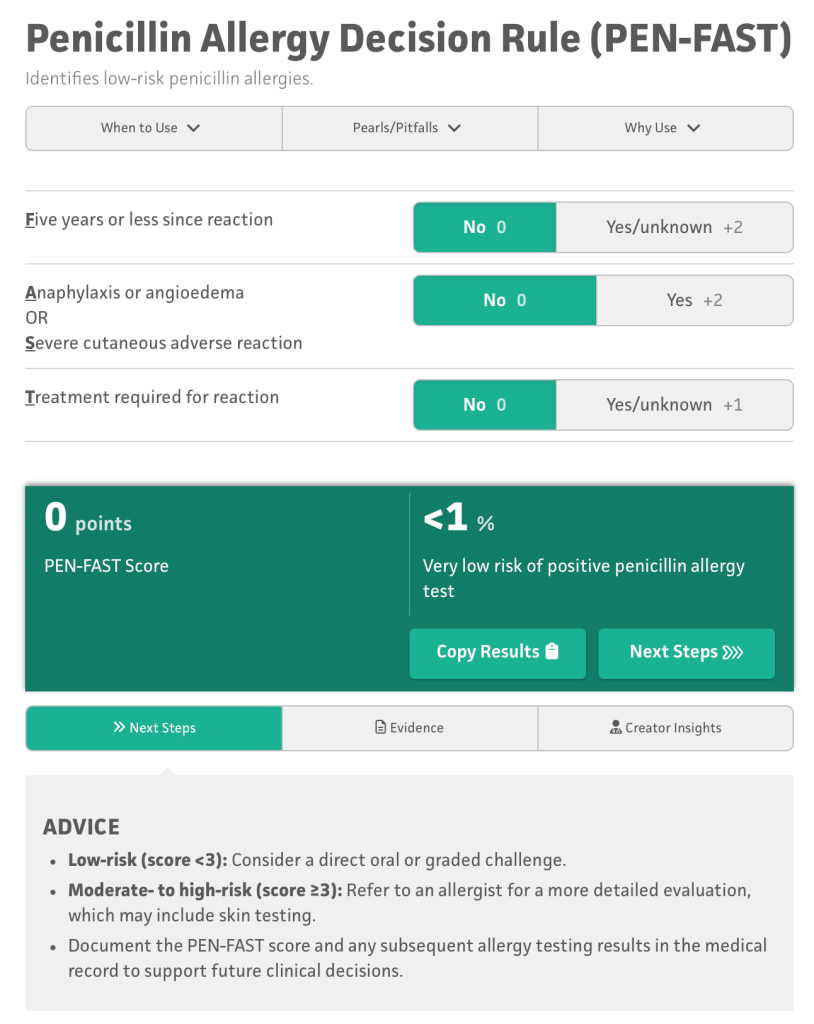
How do you move from “I think this might not be a true allergy” to “I am confident this antibiotic is safe”? Haley introduces the PEN-FAST score, a validated scoring tool designed to risk-stratify patients based on a few key historical questions.
- The Mnemonic: We break down the PEN-FAST acronym so you know exactly which three questions to ask to risk-stratify your patient in seconds.
- IgE vs. The Rest: Learn to distinguish between the “true” dangerous hypersensitivity and the delayed reactions that shouldn’t stop you from using the best drug for the job.
- The “Amoxicillin Rash”: We dive into this common pediatric “gotcha.”, why many kids end up with a lifelong allergy label after a routine ear infection, and why it often has nothing to do with the drug itself.
The Bottom Line: Patients with low PEN-FAST scores are considered low risk, making an oral challenge under observation in the ED a reasonable option. Higher scores may require shared decision-making or referral.
Why the ED is the Perfect Place for a “Challenge”
Delabeling isn’t just for the allergist’s office. We argue that the Emergency Department is actually the ideal setting to challenge these allergies.
- The “Oral Challenge”: Learn the practical steps for performing a trial dose in the department.
- Safety First: Why your environment and expertise make you uniquely qualified to handle the “what-ifs” better than anyone else.
Key Takeaways
- Question the Label: The vast majority of reported penicillin allergies are inaccurate due to patients outgrowing the allergy or misinterpreting common side effects as allergic reactions.
- History is Everything: Dig deeper than just “rash.” Ask about the timing relative to the dose, specific appearance (hives vs. flat rash), and what treatment was required (epinephrine vs. antihistamines).
- Use PEN-FAST: Utilize this tool to objectify the risk.
- Document Tolerance: Even if you don’t fully delete the allergy label, if you successfully treat the patient with another beta-lactam (like ceftriaxone), document that tolerance clearly to aid future clinicians.
- Cephalosporins are likely safe: Later-generation cephalosporins generally have very low cross-reactivity and are usually safe options even in truly allergic patients
How do you handle documented penicillin allergies? Do you use the PEN-FAST tool? Share your experience with us on social media @empulsepodcast or at ucdavisem.com
Hosts:
Dr. Julia Magaña, Professor of Pediatric Emergency Medicine at UC Davis
Dr. Sarah Medeiros, Professor of Emergency Medicine at UC Davis
Guests:
Haley Burhans, PharmD, Emergency Medicine Clinical Pharmacist at UC Davis
Resources:
Penicillin Allergy Evaluation Should Be Performed Proactively in Patients with a Penicillin Allergy Label – A Position Statement of the American Academy of Allergy, Asthma & Immunology
***
Thank you to the UC Davis Department of Emergency Medicine for supporting this podcast and to Orlando Magaña at OM Productions for audio production services.
 17 February 2026, 8:07 pm
 - 33 minutes 26 secondsTiny Hot Patients And The PECARN Febrile Infant Rule
This episode of EM Pulse dives into one of the most stressful scenarios in the ED: the febrile infant in the first month of life. Traditionally, a fever in this age group has meant an automatic “full septic workup,” including the dreaded lumbar puncture (LP).
But times are changing. We sit down with experts Dr. Nate Kuppermann and Dr. Brett Burstein to discuss a landmark JAMA study that suggests we might finally be able to safely skip the LP in many of our tiniest patients.
The Study: A Game Changer for Neonates
Our discussion centers on a massive international pooled study evaluating the PECARN Febrile Infant Rule specifically in infants aged 0–28 days. While previous guidelines were conservative due to a lack of data for this specific age bracket, this study provides the evidence we’ve been waiting for.
- The Cohort: A large pool of infants across multiple countries.
- The Findings: The PECARN rule demonstrated an exceptionally high negative predictive value for invasive bacterial infections.
- The Big Win: The rule missed zero cases of bacterial meningitis.
Defining the Danger: SBI vs. IBI
The experts break down why we are shifting our terminology and our clinical focus.
Serious Bacterial Infection (SBI)
Historically, this was a “catch-all” term including Urinary Tract Infections (UTIs), bacteremia, and meningitis. However, UTIs are generally more common, easily identified via urinalysis, and typically less life-threatening than the other two.
Invasive Bacterial Infection (IBI)
This term refers specifically to bacteremia and bacterial meningitis. These are the “high-stakes” infections the PECARN rule is designed to rule out. Dr. Kuppermann notes that we should ideally view bacteremia and meningitis as distinct entities, as the clinical implications of a missed meningitis case are far more severe.
The HSV Elephant in the Room
One of the primary reasons clinicians hesitate to skip an LP in a neonate is the fear of missing Herpes Simplex Virus (HSV) infection.
- Low Baseline Risk: While the overall risk of HSV in a febrile infant is low, the risk of “isolated” HSV (meningitis without other signs or symptoms) is even rarer.
- Screening Tools: Most infants with HSV appear clinically ill. Clinicians can also use ALT (liver function) testing as a secondary screen – transaminase elevation is a common marker for systemic HSV.
- Clinical Judgment: If the baby is well-appearing, has no maternal history of HSV, no vesicles, and no seizures, the risk of missing HSV by skipping the LP is exceptionally low.
Practical Application: Shared Decision-Making
This isn’t just about the numbers—it’s about the parents.
“Families don’t mind their babies being admitted… They do not want the lumbar puncture. It is the single most anxiety-provoking aspect of care.” — Dr. Brett Burstein
The PECARN “Low-Risk” Criteria:
(Remember, this rule applies only to infants who are not ill-appearing.)
- Urinalysis: Negative
- Absolute Neutrophil Count (ANC): ≤ 4,000/mm³
- Procalcitonin (PCT): ≤ 0.5 ng/mL
The Bottom Line: If an infant is well-appearing and meets these criteria, physicians can have a nuanced conversation with parents about the risks and benefits of forgoing the LP, while still admitting the child for observation (often without empiric antibiotics) while cultures brew.
Key Takeaways
- The “Well-Appearing” Filter: If an infant looks ill, the rule does not apply. These patients require a full workup, including an LP, regardless of lab results.
- Meticulous Physical Exam: Assess for a strong suck, normal muscle tone, brisk capillary refill, and any rashes or vesicles.
- History is Key: Always ask about maternal GBS/HSV status, pregnancy or birth complications, prematurity, sick contacts, and any changes in feeding, stooling or activity.
- Procalcitonin: PCT is the superior inflammatory marker for this rule. If your facility only offers traditional markers like CRP, the PECARN negative predictive value cannot be strictly applied. In the words of Dr. Kuppermann: “If you don’t have it, for God’s sakes, just get it!
- ALT to Screen for HSV: While not part of the official PECARN rule, our experts suggest that significantly elevated liver enzymes should raise suspicion for systemic HSV.
- Observe, Don’t Discharge: Being “low risk” does not mean the infant goes home. All infants ≤ 28 days still require admission for 24-hour observation and blood/urine cultures.
We want to hear from you! Does this change how you approach febrile neonates in the ED? How do you handle shared decision-making with parents? Connect with us on social media @empulsepodcast or on our website ucdavisem.com.
Hosts:
Dr. Julia Magaña, Professor of Pediatric Emergency Medicine at UC Davis
Dr. Sarah Medeiros, Professor of Emergency Medicine at UC Davis
Guests:
Dr. Nate Kuppermann, Executive Vice President and Chief Academic Officer; Director, Children’s National Research Institute; Department Chair, Pediatrics, George Washington University School of Medicine and Health Sciences
Dr. Brett Burstein, Clinician-Scientist and Pediatric Emergency Medicine Physician at Montreal Children’s Hospital, McGill University
Resources:
“Hot” Off the Press: Infant Fever Rule
Do I really need to LP a febrile infant with a UTI?
PECARN Infant Fever Update: 61-90 Days
****Thank you to the UC Davis Department of Emergency Medicine for supporting this podcast and to Orlando Magaña at OM Productions for audio production services.
 4 February 2026, 4:55 pm
 - 19 minutes 17 secondsMedicine on the Go: Care at Home
Reimagining Care Beyond Hospital Walls
Hospitals are a finite resource—but patient needs are not. This episode continues our multi-part series on taking medicine to where patients are—rather than making them come to us. From preventative care to pediatricians meeting families in their own environments, the series has explored how medicine is evolving beyond traditional settings. In this episode, we explore one of the most compelling—and long-overdue—ideas yet: care at home.
What Is Home-Based Medical Care?
Joined by Dr. Kelly Owen, Professor of Emergency Medicine at UC Davis and Medical Director for Express Care and Dispatch Health, the conversation dives into what home-based care really looks like—from urgent care at home to ED-to-home follow-ups and post-hospital discharge support designed to prevent readmissions.
A Patient-Centered Solution That Works
Through a powerful real-world case, the team illustrates how mobile medical units can deliver wraparound care—medications, follow-up appointments, and clinical evaluation—right in a patient’s living room, avoiding unnecessary hospital stays while improving outcomes and patient satisfaction.
Why This Model Matters Now
With emergency departments stretched thin, home-based care offers ways to:
- Reduce avoidable ED visits and hospitalizations
- Improve continuity of care after discharge
- Support vulnerable, homebound, or transportation-limited patients
- Deliver care that insurance covers and patients prefer
The model is compelling: high patient satisfaction, low ED escalation rates, and health care dollars saved—all while keeping patients at the center.
The Future of “Medicine on the Go”
As technology and remote monitoring continue to evolve, this episode makes the case that home-based care isn’t a niche experiment—it’s a scalable, sustainable future for emergency and outpatient medicine.
Tune in to hear how taking medicine to where patients are is transforming care—for the better.
Was this series helpful for you? What other topics would you like to see us cover? Let us know on social media @empulsepodcast or at ucdavisem.com
Hosts:
Dr. Julia Magaña, Professor of Pediatric Emergency Medicine at UC Davis
Dr. Sarah Medeiros, Professor of Emergency Medicine at UC Davis
Guests:
Dr. Kelly Owen, Professor of Emergency and Medical Director of Express Care and Dispatch Health at UC Davis
Resources:
‘The next frontier of emergency medicine’: House calls following emergency room
by Liam Connolly, April 30, 2024.
UC Davis Health embarks on innovative care at home journey
by Liam Connolly, July 18, 2023.
AMA’s Return on Health: Telehealth framework for practices.
***
Thank you to the UC Davis Department of Emergency Medicine for supporting this podcast and to Orlando Magaña at OM Productions for audio production services.
 21 January 2026, 4:12 am
 - 17 minutes 31 secondsPush Dose Pearls: Tamiflu vs Xofluza
We’re stepping out of our Medicine on the Go series for a rapid-response episode on something hitting all of us hard right now: **influenza**. A lively debate among our colleagues sparked this conversation—especially around a newer flu antiviral, baloxavir (Xofluza). Who’s using it? When does it make sense? How much does it cost patients? And how does it really compare to the longtime staple oseltamivir (Tamiflu)? The questions came fast, the opinions were strong, and we knew it was time to dig in. With flu season in full swing, this episode is all about practical decision-making at the bedside.
Back to Basics: How Flu Antivirals Work
To help break it all down, we welcome back our trusted ED pharmacist, Haley Burhans. We begin with a quick review of how influenza antivirals have evolved.
, approved in 1999, was the first widely used antiviral and works by blocking the neuraminidase enzyme. Over time, concerns about resistance led to the development of newer options. That brings us to baloxavir (Xofluza), approved in 2018. Xofluza works differently by stopping viral replication earlier in the virus life cycle. While both medications aim to shorten illness and reduce complications, they differ in how they work, how they are dosed, and which patients benefit most.
Who Should Get What—and When?
Next, we focus on real-world ED decision-making. Who should receive Tamiflu, and who is a good candidate for Xofluza? We review use in children, pregnant patients, hospitalized patients with severe or worsening illness, immunocompromised patients, and those at higher risk due to conditions like asthma, lung disease, diabetes, heart disease, obesity, or older age. Timing is critical. Both medications work best when started within 48 hours of symptom onset. However, oseltamivir is still recommended even after that window for patients who are hospitalized or severely ill. We also discuss when antivirals can be used for post-exposure prpphylaxis.
What Does the Evidence Say?
We then take a closer look at the data behind antiviral treatment. Both Tamiflu and Xofluza shorten the time to symptom improvement. Observational studies suggest oseltamivir may reduce hospital length of stay and in-hospital death in adults and shorten hospital stays in children. Trial data also suggest baloxavir may be more effective against influenza B. We compare dosing strategies—five days of twice-daily Tamiflu versus a single-dose Xofluza—and review side effects and pediatric considerations.
Real-World Barriers: Access and Cost
Finally, we tackle the practical issues clinicians face every day. Tamiflu is widely available and familiar to most providers. Xofluza, on the other hand, often requires prior authorization and may be harder for patients to obtain. We discuss insurance barriers, out-of-pocket costs, manufacturer coupons, and situations where Xofluza may or may not be a realistic option.
Take-Home Message
This episode is a practical, evidence-based conversation designed to help emergency clinicians make confident decisions during flu season. Whether you’re treating a high-risk patient, considering a single-dose option for uncomplicated flu, or simply trying to stay current, this discussion delivers clear, useful guidance you can use on your next shift!
What’s your go to flu treatment? What other medications would you like to learn more about? Hit us up on social media @empulsepodcast or at ucdavisem.com
Hosts:
Dr. Julia Magaña, Professor of Pediatric Emergency Medicine at UC Davis
Dr. Sarah Medeiros, Professor of Emergency Medicine at UC Davis
Guests:
Haley Burhans, PharmD, Emergency Medicine Clinical Pharmacist at UC Davis
Resources:
CDC: Influenza Antiviral Medications: Summary for Clinicians
ACEP Influenza Resources and Updates
****
Thank you to the UC Davis Department of Emergency Medicine for supporting this podcast and to Orlando Magaña at OM Productions for audio production services.
 16 January 2026, 7:50 pm
 - More Episodes? Get the App
