Pasadena Mennonite Church
Pasadena Mennonite
Here you will find the weekly sermons and talks from Pasadena Mennonite Church, an Anabaptist community in the Los Angeles area. We are committed to centering ourselves on Jesus, walking the path he leads us, and learning to be formed into a community of his peace and justice. We are all on this journey at different places and trying to help each other along the way.
- Justice & Service at PMC
PMC’s Justice and Service Commission invites us into ministry around affordable housing, indigenous rights, peacemaking amidst war and world conflicts such as in Gaza, and political advocacy in these and other areas. Justice is aspirational but also is possible, so the commission places Justice before Service in its name as a reminder to seek justice and not settle for direct service, valuable as that is. Our panel will share briefly about specific ministries.
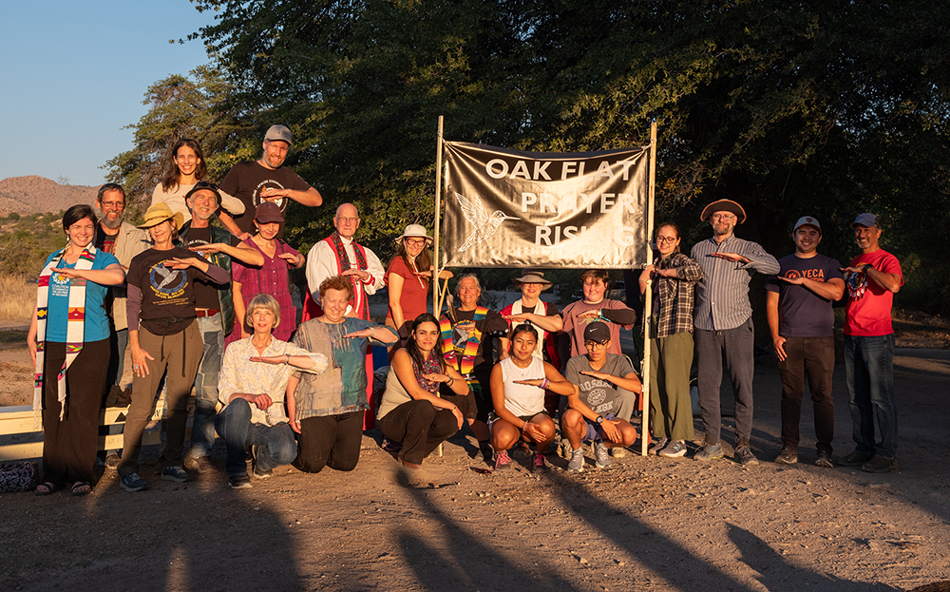 PMCers Join Coalition at Oak Flat Prayer Rising.
Below: Hear David Gist, Pastor Katerina Gea, and Bert Newton as they speak about Justice & Service Projects and PMC.
27 May 2024, 2:33 am - Drawing in the Sand
Cara Pfeiffer uses the story of the woman caught in adultery, John 8:1-11, to share the practical peacemaking steps Jesus took in that encounter to deescalate the situation and to protect a vulnerable woman.

Questions for thought:
- What everyday conflicts in your life could be deescalated with practices of pause and non-threatening body language?
- What are some practical steps you could take in your own life to have a more peaceful coexistence with difficult people in your life?
Listen to the sermon and discussion below. (Audio is a bit uneven given the set-up for group exercise.)
13 May 2024, 12:43 am - Spirituality and the Profane
Executive Conference Minister of Pasadena Southwest Mennonite Conference, Stanley Green, spoke into our Anabaptist Basics series on October 16th. His sermon on the Spirit and spirituality was entitled Spirituality and the Profane. Stanley talks about he and his wife, Ursula, being among four other couples that founded Pasadena Mennonite with retired missionary, Dorothy Smoker, 36 years ago. This was also their welcome into the Mennonite denomination, where Stanley went on to serve as Executive Director of Mennonite Mission Network, prior to which he served as pastor, conference minister and mission executive in South Africa, Jamaica and the United States.
Stanley describes his first pastorate in South Africa, where his parishioners were menial laborers on farms producing ostriches and grapes. Stanley knew that the very religious white owners of the farms would beat their workers. They were paid little, forcing them to buy on credit from the farm store half-way through the month. And at 13, children were taken out of school to work the farms.
 Photo: Josh Appel
This history created an interest for Stanley regarding the topic of spirituality. Current definitions and the history of the western church created a duality between mind and body, and other-worldliness over earthliness, as well as linear thinking. This has been manifested through sexism, climate change, and wide-spread disease that plagues our society.
It is time to bring back what has been forgotten: the body, the physical world, and those labeled as “other” back into our consciousness so that our world can heal and find restoration.
Hear more as Stanley talks about the impact of this history on discipleship, as well as born out in Jesus incarnationational ministry.
2 November 2022, 1:03 am - Jesus and Justice
On September 11th, we were honored to hear from Sarah Augustine, a Pueblo (Tewa) descendant and the author of The Land Is Not Empty: Following Jesus in Dismantling the Doctrine of Discovery (Herald Press, 2021). This is the first week in a back to basics series called Anabaptist Academy, and centers around Jesus and Justice.

We were privileged to have Sarah speak to us several years ago, and learned about and became members of Reapair Network for the Anabaptist Coalition for Dismantling the Doctrine of Discovery, commited to becoming a people that repudiates the doctrine of discovery in our words, thoughts, and actions.
Sarah talks about becoming a mediator through Lombard Mennonite
Peace Center, learning the tools for effective nonviolent resistance. Her theme on this September 11th Sunday was how violence is exponential in its growth.The Doctrine of Discovery is a legal doctrine, a paradime for creating law. It is the current legal doctrine in the United States that defines reality for indigenous peoples, dating back to colonization., mission, and economic development. It was last cited in 2005 in a majority opinion written by Ruth Bader Ginsburg, who said that this is a matter of settled law.
And it is also based upon Christian doctrine deployed by the church.
Hear more as Sarah talks about indigenous boarding schools, the role of Indian agents and pastors, missions and economic development, and the current impact of the Doctrine of Discovery — along with Jesus’ message of justice.
(Apologies that the first lines of her sermon were clipped.)
18 October 2022, 9:02 pm - Kujenga
Jason T. Smith, gifted in weaving together cultural ideas and theological metaphors, spoke to us on September 4th.
 Photo: Michal Parzuchowski
Jason states that sometimes in theology, it’s best to leave some words untranslated. Kujenga means “to build” in Swahili. In Kenya, both Swahili and English are official languages. Leslie Scott, an Englishwoman born in Kenya brought a derivative of the word kujenga to the western world: Jenga. After her family moved to Ghana, she packaged and sold the family game.
Jason goes on to talk about a Mythbuster’s Jr episode tasked with whether the whole foundation of a Jenga tower could be removed while leaving the building standing?
And then Jason turns the question back to us as the church, and refers to the building up of the body of Christ in 1 Corinthians 3:9-17. And he asks, “What is so foundational to what we are as Christians that removing it would cause what we’ve built to collapse? Living out our faith in Jesus is a group activity. Christianity is not solitary.
Hear more in the video below as Jason continues to build on the body of Christ as a Jenga metaphor, or watch below.
23 September 2022, 11:07 pm - Hearing Martha (Seek to Understand Rather than Persuade)
Mike Rewers decided to step into the pulpit after 25 years of listening due of his love of empathy — both in receiving empathy and in helping others to extend it. And we give less empathy when we’re blind to what is happening. The topic of empathy was week 6 of the 9-week Peaceful Practices we’ve been going through as a congregation. Mike, a therapist, spends his week helping others find ways to bring more peace into their lives. And our primary scripture for the day is with Martha and Mary in Luke 10:38-42, where Martha asks Jesus to send Mary to help serve. Mike extends his look Martha and Mary by adding two other glimpses of them from the book of John, giving us a fuller picture. In addition, you’ll hear him refer to the second passages Matthew 13: 10-15, with Jesus quoting Isaiah about listening without understanding, looking without perceiving, and hearts that have gone dull.
 Mary and Martha, by He Qi
We enter the passage with a rather unpeaceful Martha — and Mike empathizes with her blindness in the situation. While it can be soothing and loving to feel understood by someone, we enter this passage with Martha feeling unseen. Yet God helps us move from being blind to seeing the one needful thing — the transformative love of God that allows us to see both within ourselves and to see others.
The more we are aware of our own blindness, the more empathy we can have for others in their blindness. Both parties on different sides of a conflict think the other just doesn’t get it. But culturally, are 50% of people just stupid? And it’s always the 50% we’re not on, right? But at some point the gospel has to be about helping us to see beyond our own perspective. When we can see that we are blind, we become more able to see the other with loving and accepting eyes, which is how God sees us — and them. But we have to bump into others to become aware of ourselves. God lives in the space between us and the other, and calls us into healing.
This passage isn’t about making Martha into Mary, but about having a deeper understanding of who each of them are — actually seeing one another. In order to see our brokenness, we need to learn forgiveness, acceptance, and vulnerability. When we can become aware of our own pain, we can begin to have empathy for others. We must be able to see the other from outside of our own perspective in order to comfort them.
Hear more as Mike walks through the emotions of Martha, and her ensuing interaction with Jesus — and how this impacts their relationships going forward.
9 August 2022, 3:07 am - The Power of God in Acts
We were privileged to share a worship service this week with our host church, Conexión. Juan Pablo Plaza brought the message from this English/Spanish congregation, while Frank Scoffield Nellessen translated for non-Spanish listeners.
In speaking to two communities together, Juan Pablo referenced the wisdom of Acts and the early church. but rather than being the story of the early church, Juan Pablo notes that it is the story of what God was doing in the early church and its transformation through the Spirit, as well as the fulfillment of Old Testament promises. This changes our reading of the book.
Jesus appears to his apostles over a period of 40 days, addressing their questions. They continue to wonder whether Jesus has returned to restore the kingdom of Israel. Jesus instead speaks of power that will come upon them in the form of the Holy Spirit.
 The Pentecost, by El Greco
Juan Pablo asks us how we currently think of power in our lives. This was not a dominion over others, but the power of the Spirit of God. What was this power to be for? To interpret scripture? To discern what God is doing amongst the community? To accomplish the mission of the church?
What if instead this is a power that allows us to bypass the offenses of others, that makes it possible for us to live in peace, the power to be able to be patient and kind to others, to trust in God despite adversity, the power to able to control our desires — power that can only be given by the Spirit of God. This is a power so simple, so sweet and profound that it can really only come from God. And it invites us to accompany others.
This is also a power that leads us to differing practices in our faith communities. The coming of the Holy Spirit on Pentecost, Acts 2:4, was not simply to send the church out with a mission, but to lift up the church, and to involve it in different practices — those of sharing, of mission, of prayer, studying the scriptures — those practices that make up a community.
The essence of being a faith community, shown in Acts 2:42-47, is to know what is happening in one another’s lives — to learn the capacity to share in what others are living. And when we can do this within our church communities, it will be easier to do so outside the church as well.
How do we practice these acts of love in our own communities of faith?
Hear these words and more in the audio below.
4 August 2022, 10:11 pm - Discovery
 Photo by Vadim Bogulov, Unspash.
“What a time in the U.S. to be asked to talk about conflict resolution,” says Kathleen Klompien-Wedberg as she begins her sermon relating to our Peaceful Practices Curriculum. She notes that the past few weeks have seen the world in a time of war and aggression on multiple fronts.
Yet our passage in Matthew 18:10-22 about trying to reconcile, again and again, the the songs we sing about God’s love and seeing from one another’s point of view, the interactions with the children this morning — call us to be looking at our situation with humility, with creativity, and with discovery. We’re not doing this by ourselves.
Discovery is endless in the world of little people. Discovery is a humble posture. Juxtaposed with belief, discovery demands that we ask questions rather than give answers. Kathleen quotes French philosopher Emile August Cartier, “Nothing is more dangerous than an idea when it is the only one you have.”
And a 2018/19 study called Beyond Conflict Polarization Index found that Americans incorrectly believe that members of the other political party dehumanize, dislike and disagree with them more than twice as much as they actually do.
A posture of discovery means that we’re willing to have something shaken up in the way we see the world. She goes on to talk about an exercise from our curriculum about learning to see what’s below the surface of our own perspectives, and those of others — our stories.Hear more as Kathleen delves into Rumi’s story of men in a dark room trying to describe an elephant, about our the impact of our own stories, and about learning to see what lurks below our perspectives and of others we interact with. The images she describes are from our Peaceful Practices Curriculum, Session 3.
14 July 2022, 10:32 pm - Practicing Curiosity
“Curiosity is a tough choice for us to make as adults,” says Lisa Thornton as she began our first week of sermons related to a curriculum entitled “Peaceful Practices — A guide to healthy communication in conflict.” And though the curriculum talks about how children tend to have a natural curiosity about the world around them, Lisa finds curiosity to be an intentional posture that one must choose. And it’s not always easy or preferred.

Lisa finds that curiosity isn’t merely about inviting all opinions to the table and giving them equal value, but about looking at the others around the table regardless of their opinion, and holding each person with value. It’s about working to start interactions rooted in empathy and not immediate judgement. Every story we encounter comes with it’s own context and life experiences. Hearts and minds are never changed because of one side’s declaration of truth at the other. Hearts and minds are changed because stories of others are revealed, and the Holy Spirit is allowed to work throughout.
She says that “in organizing we have a saying that the first revolution is internal.” This means that for every person, there was an internal revolution that awakened their heart and mind to a new way of thinking. A posture of curiosity opens the door for this revolution, and creates ways for people who we once saw as other to be seen as kin.
The story we read this past July 3rd in Luke 13:10-17 has a lot to teach about this.
Hear more as Lisa unpacks the story of Jesus healing a woman bent over for 18 long years, rendering her invisible, on the Sabbath; and the responses the healing generates in the synagogue.
Note: for members of our congregation listening, we did “talk-back” this week by breaking up into groups to take on the role of the woman, the synagogue leader, and the crowd, and thinking about what their perspective might have been.
5 July 2022, 11:36 pm - Act 4
Rob Muthiah began began Pentecost Sunday by saying that we could learn from our Pentecostal siblings in terms of a sensitivity to the Holy Spirit. Pentecost Sunday celebrates the coming of the Holy Spirit in a new way following the resurrection and ascension of Jesus.
Rob reviews how the Spirit of God is present in creation, throughout the Old Testament, and in the life and ministry of Jesus. And so, Rob asks, what about today?
He goes on to use a metaphor developed by theologian and vicar Sam Wells, of performing a play that is missing an act — which we are assigned to improvise. Improv involves following the preceding acts and knowing the act to come. This is how the church discerns God’s movement today: following scripture, knowing what’s to come, filled with the Spirit, gifted by the Spirit, and guided by the presence of the Spirit.

Listen below as Rob fleshes out these ideas, following readings in John 14:15-17 and Acts 2:1-4, 12-21.
15 June 2022, 9:26 pm - More Episodes? Get the App