- 17 minutes 7 secondsDonald Trump and Peter Thiel Are Using AI To Supercharge the Surveillance State
Peter Thiel, the billionaire venture capitalist and PayPal co-founder, has a provocative theory about how the Antichrist could take over the Earth and enslave humanity.
"My speculative thesis is that if the Antichrist were to come to power it would be by talking about Armageddon all the time," Thiel told Hoover Institution interviewer Peter Robinson earlier this year.
The greatest danger we face, according to Thiel, might not be from global warming, terrorism, nuclear winter, or artificial intelligence going rogue. The real danger is that we're so afraid of these threats that we're willing to give up our freedom in the interest of "peace and safety," which is the phrase Thiel ascribed to the Antichrist, citing Thessalonians 5:3.
"It's the opposite of the picture of Baconian science from the 17th, 18th century, where the Antichrist is like some evil tech genius, evil scientist who invents this machine to take over the world," Thiel told the New York Times' Ross Douthat on a podcast. "In our world, it's far more likely to be Greta Thunberg."
"I feel like that Antichrist would maybe be using the tools that you are building," replied Douthat.
Douthat was referring to Palantir, the government contractor that Thiel co-founded in 2003 during the height of the war on terror. Today, Palantir is "in the white-hot center of the latest trend reshaping the global order," according to The Wall Street Journal, receiving more than $322 million from government contracts in the first half of 2025.
It's equipping the government with tools to sift through massive data troves to identify patterns and hunt down illegal immigrants. It's helping the Feds deploy facial recognition technology, and has created AI tools to "predict" where crimes might happen in advance.
"Like, wouldn't the Antichrist be like: Great, we're not going to have any more technological progress, but I really like what Palantir has done so far," Douthat asked Thiel. "Isn't that a concern? Wouldn't that be the irony of history, that the man publicly worrying about the Antichrist accidentally hastens his or her arrival?"
When Thiel replied that hastening the Antichrist's arrival is "obviously" not what he thinks he's doing, Douthat agreed that it was unlikely but pressed, "I'm just interested in how you get to a world willing to submit to permanent authoritarian rule."
It's a great question. While Peter Thiel is warning that the Antichrist could bring totalitarianism by exploiting our desire for "peace and safety," a company that he co-founded is building the tools with great potential for abuse by a totalitarian surveillance state, all based on our desire for "peace and safety."
Is it too late to stop this nightmare?
It's fitting that Palantir is named after the mythical stones in J.R.R. Tolkien's Lord of the Rings, which allow users to see into distant lands, eavesdrop on conversations, peer into the past, and—some claim—conjure visions of the future. Tolkien, a devout Catholic, explored the dangers of unbridled power in a way that resonates with Thiel's ideas about the Antichrist.
While the Antichrist invokes peace and safety, the corrupted wizard Saruman in Lord of the Rings implores his fellow wizard Gandalf to join forces with the dark entity Sauron, he invokes the values of "Knowledge, Rule, Order."
Trump promised peace and safety when he took the stage to accept the Republican nomination in 2016 by cracking down on crime and riots in America's big cities.
"I have a message for all of you: the crime and violence that afflicts our nation will soon come to an end. Beginning on January 20th 2017, safety will be restored."
Thiel, who was the first tech billionaire to back Trump, spoke at that convention.
Eight years later, Trump was back at the RNC once again warning of a crisis and promising to restore peace and safety.
"There's never been an invasion like this anywhere," said Trump, referring to a spike in illegal immigration.
Exploiting a national emergency, real or manufactured, is how governments typically grow their power and limit our freedoms. As the libertarian economic historian Robert Higgs chronicled in his 1987 classic, Crisis and Leviathan, the government ratcheted up its power in the 20th century by capitalizing on the Great Depression and two world wars.
More recently, the 9/11 terrorist attacks justified the war in Afghanistan, provided cover for the invasion of Iraq, and led to the expansion of the surveillance state under a new paradigm known as Total Information Awareness.
"[Total Information Awareness was] what Palantir is now. What they were literally trying to do is come up with the ability to ingest data from pretty much any source and then run that against their de facto target list," says Patrick Eddington, a former CIA analyst who studies the surveillance state at the libertarian Cato Institute. His latest book is The Triumph of Fear, a history of federal law enforcement and surveillance.
"All this stuff at the end of the day is fear-based. That's how we get a lot this surveillance mentality," says Eddington.
Total Information Awareness was an initiative started at DARPA, the research arm of the Defense Department. The stated goal was to construct a "virtual, centralized, grand database" for tracking terrorists, the same kind of database Trump wants to build to track illegal immigrants.
The government hit years of roadblocks before finally achieving this vision. Public backlash to the unnerving name led to a rebranding before Congress defunded the program in 2003.
"But a lot of these really bad surveillance-related ideas, even if they get knocked down, they're kind of like a vampire, right? You knock them down. You think you've knocked them down for good, and then one way or the other, they just seem to kind of come back," says Eddington.
Total Information Awareness lived on under the innocuous code name "basketball" and was absorbed by the NSA, which Edward Snowden would later reveal was collecting the phone records of millions of Americans and intercepting web traffic without the knowledge of the companies involved.
The same year that Congress defunded Total Information Awareness, Peter Thiel and his co-founders created Palantir.
They even met with John Poindexter, the recently fired director of Total Information Awareness, who told them they had "an interesting idea." Initially, the company struggled to attract mainstream investment, but when the CIA's venture capital arm, In-Q-Tel, put in $2 million, it signaled interest from Washington, and the company took off.
Today, Palantir is worth more than $400 billion with over half of its revenue coming from government contracts.
Thanks to advancements in artificial intelligence, the dream—or nightmare—of "total information awareness" seems closer than ever before.
ICE is now using mobile facial recognition technology to track immigrants and tie their identities to "derogatory information" compiled in one of their database. The agency also uses Clearview AI, facial recognition tech that scrapes social media, and much of the data is managed by Palantir.
Even if you support Trump's objective to deport more immigrants, you should still be concerned about this technology. Like with many surveillance tools of the past, immigrants and foreigners are fertile testing ground before it's rolled out to the wider domestic population.
People on the Republican side should really not be cheering a lot of this stuff that's going on right now, because if Democrats manage to retake the White House and both chambers of Congress, which is a very real possibility, then they could turn around and use those tools," says Eddington. "And by the way, that's exactly what my own work in this book basically shows."
The MAGA movement should understand what it's like to walk under the gaze of the Eye of Sauron. After the January 6 riot, "right-wing extremism" became a priority for America's intelligence agencies. Online censorship reached its zenith under the Biden administration, which leaned on social media companies to suppress speech that criticized COVID policies, vaccines, or questioned election integrity.
The "triumph of fear," as Eddington calls it, is what has allowed governments—particularly federal law enforcement—to expand and consolidate power throughout history, consistent with Higgs' theory of crisis and Leviathan.
Eddington has documented how, since its inception, federal law enforcement has been weaponized to go after not just criminals but political dissidents, which the FBI did with a program called COINTELPRO in the '50s and '60s.
"It started out as something designed to target the Communist Party of the United States," says Eddington, "But then of course it branched out. You know, they went after Dr. Martin Luther King, Jr. They went after the organization that he founded. We're talking about hundreds of thousands of human beings who were targeted in the course of this."
It's easy to imagine how the technology that Palantir is building to help the government keep tabs on terrorists and illegal immigrants in the interest of peace and safety could be applied more broadly. Snowden has predicted that governments will soon use AI-enhanced surveillance not merely to fight terrorism or deport immigrants but to shape behavior.
"We are all entering a new phase of history where what we considered the more enlightened collection of States globally, ones that had embraced the classically liberal ideal, are now some of those working hardest to roll it back, to bureaucratize, to influence, to nudge, to shape, to ultimately control each and every individual within their territory and beyond," said Snowden at a conference in Singapore late last year.
Thiel is also worried about AI.
"If you were to say that crypto is libertarian, then why can't we say that AI is is communist," said Thiel at the University of Oxford in 2023. "It's not completely inherent in it, but it's a certain tendency in it, and while I am pro-acceleration, I'm pro-tech, I'm even pro-AI, it is probably the one technology that I have the most misgivings about."
But Alex Karp, the CEO of Palantir, who provided the company's technology to the Ukrainian military free of charge, says the goal should be to make sure that these tools are in the hands of the good guys.
"We were asked if we were willing to supply our product for free [to Ukraine]. I was very in favor of this because our goal is to set a global standard for the world for behavior," Karp told a World Economic Forum audience in 2023. Elsewhere he's emphasized that "Western institutions and the West are a superior way to live, and we've fought for that."
Joe Lonsdale, a Palantir co-founder, defends the company's government contracts on similar grounds, saying that since AI is inevitable," it's really important that AI ends up lifting everyone up and the way it's going to do that is through Western civilizations."
He previously told Reason that the company actually was formed to protect civil liberties as it aids the government in catching terrorists.
"The whole core of Palantir was basically a civil liberties engine from the start," said Lonsdale. It [controls] what data are you allowed to see in what context."
Palantir's system makes it easier to track whether unauthorized users access private data, in effect watching the watchers.
"If you have Palantir installed at a certain part of the FBI or the CIA or anywhere else, the people running that can go back and look," says Lonsdale. "You have basically full audit logs….We don't set the policy, but we make it so it's very transparent."
Eddington thinks Palantir still bears responsibility for the capabilities it hands to the government, even though it's not setting policy.
"This kind of technology can really help to create the kind of real world, real-time dystopia that we're seeing right now," says Eddington.
Peter Thiel has warned that it's easy to go from the frying pan into the fire. Tools designed for hunting down illegal immigrants in America, or combatants in Gaza or Ukraine, can be repurposed.
"I always think that if we're going to have this frame of talking about existential risks, perhaps we should also talk about the risk of another type of a bad singularity, which I would describe as the one-world totalitarian state," Thiel told Douthat in his podcast interview.
In Lord of the Rings, the wizard Saruman starts on the side of good. Then the villainous Sauron manipulates him through the palantír stone to make the wizard believe he sees a future where Sauron's evil plan triumphs. But it's all a deception.
The wizard sees no other choice but to join forces with the dark entity. He's drawn into Sauron's circle of evil by the palantír stone, because he underestimates its power: A useful parable for understanding how versatile tools can be extremely dangerous in the wrong hands.
To protect against the totalitarian power grab that Thiel is warning us about, we need stronger political constraints on the surveillance state. The solution is also technological. As Snowden has emphasized, communication tools with built-in end-to-end encryption provide a bulwark for privacy.
"What if we could enforce human rights through new means, through math, through technologies, through something that these agencies don't control.That's the power of encryption," Snowden said at the Singapore conference.
But privacy tools need legal protection. Recently the French government arrested the creator of the encrypted social network Telegram for running an "unlicensed" encrypted service. The U.S. government is prosecuting the creator of Tornado Cash, a tool that allows cryptocurrency users to anonymize their digital cash.
This war on privacy in the name of safety needs to stop.
And maybe technologists, like the executives and engineers at Palantir, have a moral responsibility not to use their talents to design tools that a government can so easily turn against its citizens. As OpenAI CEO Sam Altman has stressed, privacy protections are more important than ever.
If you go to chat about sensitive stuff and then there's like a lawsuit or whatever, we could be required to produce that," Altman told podcaster Theo Von in July. "And I think that's very screwed up. I think we should have the same concept of privacy for your conversations with AI that we do with a therapist or whatever…. I think it's this huge issue of, like, how are we going to treat the laws around this?"
But we don't have to wait for regulators to act. Altman could make design choices to add more privacy protections to Chat GPT.
Ultimately, tech founders will do what consumers demand, which is why public opinion matters.
"Americans have been brought to their present inauspicious circumstances by, above all else, changes in the prevailing ideology," wrote Robert Higgs in Crisis and Leviathan. But "there remains a hope, however slight, that the American people may rediscover the worth of individual rights, limited government, and a free society under a true rule of law."
The federal government didn't balloon as the country lurched from crisis to crisis in the 19th century, Higgs observes. That changed in the 20th century, when Progressive intellectuals convinced the public that a strong central government was the solution to our problems, especially in times of crisis.
Now is the time to absorb a different lesson: No one person should hold the rings of power. Better they be cast into the fire.
Photo Credits: New Media CC BY-SA 2.0, Abaca Press Poitout Florian Abaca Sipa USA Newscom, Gage Skidmore, aaron shwartz sipa usa newscom, EyePress Newscom, Periodismodepaz, CC BY-SA 4.0, Sailko CC BY 3.0, Gerd Küveler
The post Donald Trump and Peter Thiel Are Using AI To Supercharge the Surveillance State appeared first on Reason.com.
25 September 2025, 3:00 pm - 12 minutes 52 secondsEisenhower Warned Us About the 'Scientific Elite'
In President Dwight D. Eisenhower's famous 1961 speech about the dangers of the military-industrial complex, he also cautioned Americans about the growing power of a "scientific, technological elite."
"The prospect of domination of the nation's scholars by federal employment project allocations and the power of money is ever present," warned Eisenhower.
The federal government had become a major financier of scientific research after World War II, and Eisenhower was worried that the spirit of open inquiry and progress would be corrupted by the priorities of the federal bureaucracy.
And he was right.
Today, many of the people protesting the Trump administration's cuts to federal funding for scientific research are part of that scientific, technological elite.
But there's a good chance that slashing federal spending will liberate science from the corrupting forces that Eisenhower warned us about.
"If you look at, particularly, 19th century Britain when science was absolutely in the private sector, we have some of the best science," says Terence Kealey, a professor of clinical biochemistry at the University of Buckingham and a critic of government science funding. "It comes from the wealth of the rich. Charles Darwin was a rich person. Even [scientists] who had no money had access to rich men's money one way or another. The rich paid for science."
Kealey points out that Britain's gross domestic product (GDP) per capita outpaced that of 19th-century France and Germany—both of which generously subsidized scientific research—indicating that the return on state subsidies in the form of economic growth was low. As America emerged as a superpower, its GDP per capita surpassed Britain's.
"So the Industrial Revolution was British, and the second Industrial Revolution, was American, and both were in the absence of the government funding of science," says Kealey.
Thomas Edison's industrial lab produced huge breakthroughs in telecommunications and electrification. Alexander Graham Bell's lab produced modern telephony and sound recording, all without government money. The Wright Brothers—who ran a bicycle shop before revolutionizing aviation—launched the first successfully manned airplane flight in December 1903, beating out more experienced competitors like Samuel Langley, secretary of the Smithsonian Institution, who had received a grant from the War Department for his research.
The notion that the government needs to accelerate scientific progress was based on America's experience during World War II, when federally funded research led to breakthroughs in rocketry, medicine, and radar. The Manhattan Project, which cost $27 billion in today's dollars, employed more than half a million people and culminated in the creation of the atomic bomb and the discovery of nuclear fission.
"Lobbyists took the Manhattan Project and said, 'Look what government funding of science can do,' and they then twisted it," says Kealey. He acknowledges that the government can accomplish discrete, "mission-based" scientific projects—like racing toward a bomb—but he argues that this is very different from the generalized state funding of "basic research" that followed.
In November 1944, President Franklin D. Roosevelt sent a letter to Vannevar Bush, director of the U.S. Office of Science and Development during the war. Roosevelt instructed Bush to come up with a plan to make federal funding of scientific research permanent.
"It has been basic United States policy that government should foster the opening of new frontiers," wrote Bush in calling for the nationalization of basic science research. "It opened the seas to clipper ships and furnished land for pioneers."
Bush's treatise eventually led to the creation of the National Science Foundation in 1950.
But it was a stunning accomplishment from America's greatest rival that would supercharge the nationalization of science. Sputnik, the world's first manmade satellite, seemed to confirm fears that the Soviets, with their centrally planned economy, might eclipse the U.S. in scientific innovation and weapons technology.
That turned out to be completely wrong. But in 1957, Americans were terrified.
After Sputnik, the Eisenhower administration tripled the budget of the National Science Foundation, which would provide federal grants to universities and labs.
If federal funding of science is counterproductive, as Kealey argues, what explains the success of Sputnik and the Manhattan Project?
Of course, government funding has led to major breakthroughs both during and after World War II, such as the synthesis and mass production of penicillin during World War II (though it was accidentally discovered in a contaminated hospital lab in 1928), cancer immunotherapy, artificial heart valves, and the gene-editing technology CRISPR.
But this has to be compared to what might have otherwise happened. Good economics takes into account not only the seen, but the unseen.
What are the unseen innovations the world misses out on when governments set the research agenda?
"If the government funds science, it actually takes the best scientists out of industry puts them in the universities, and then industry in fact suffers," says Kealey.
After Sputnik, government money pushed basic science out of the private sector. By 1964, two-thirds of all research and development was paid for by the federal government.
"If you were a tool maker in Ohio in 1964, and you wanted to invest in R&D to make better tools because you wanted the beat your competitors in Utah, you wrote a grant to the Department of Commerce," says Kealey. "That's how nationalized American science was … Eisenhower's warning is absolutely correct."
In academic science, process often takes precedence over outcomes. Researchers are incentivized to publish peer-reviewed papers that garner citations, which helps them secure prestigious academic posts and more federal grants.
"What happens under peer review under the government is that there's homogenization, and only one set of ideas is allowed to emerge," says Kealey.
The pressure to publish has created a positivity bias, where an increasing number of papers supporting a hypothesis are published, while negative findings are often buried.
One biotech company could confirm the scientific findings of only six out of 53 "landmark" cancer studies.
Swedish researchers found that up to 70 percent of positive findings in certain brain imaging studies could be false.
A team of researchers re-examined 100 psychology studies and successfully replicated only 39. "There is still more work to do to verify whether we know what we think we know," they concluded.
In an influential 2005 paper, Stanford University professor John Ioannidis flatly concluded that "most published research findings are false." He argued that the current peer review model encourages groupthink, writing that "prestigious investigators may suppress via the peer review process the appearance and dissemination of findings that refute their findings, thus condemning their field to perpetuate false dogma."
"You end up with a monolithic view, and so you crush what's so important in science, which is different ideas competing in a marketplace of ideas," says Kealey.
For decades, the federal government advised Americans to avoid saturated fat and prioritize carbohydrates based on the work of a researcher named Ancel Keys, who received substantial funding from the U.S. Public Health Service and the National Institutes of Health (NIH). Today, the debate that Keys suppressed rages on.
"Ancel Keys said, 'I have the solution, it's all to do with fats,'" says Kealey. "And very quickly, you couldn't get grants to the American Heart Association unless you subscribe to Ancel Key's theory of fat. Having captured this small little redoubt, he then moved to the [National Science Foundation], and then suddenly the whole world believed only one thing."
More recently, Stanford's Jay Bhattacharya was attacked by the public health establishment for questioning the COVID-19 lockdowns. He told Reason there's an inherent conflict between the NIH director setting public health policy and doling out grant money.
"If you have an NIH director that [sets policy and distributes money], they control the minds of so many scientists. It's an inherent conflict, and nobody's going to really speak. Nobody's going to disagree with them because that's the cash cow," says Bhattacharya, who President Donald Trump appointed head of the NIH. His agency now faces a proposed 40 percent spending cut.
But if Kealey is right, slashing science funding could, counterintuitively, accelerate medical innovation in the long run.
"If these changes can be managed in such a way that these scientists can move from the NIH into the private sector without massive disruptions to all the work and research they're doing, that will be to the benefit of America," says Kealey.
It would be similar to what happened in the early 1970s, when Congress slashed the Defense Advanced Research Projects Agency's budget in half, laying the groundwork for the rise of the computer age.
"What happens to all those scientists? Well, they all go out to Silicon Valley, because they've all been made redundant … And they invent the modern world," says Kealey.
"New frontiers of the mind are before us, and if they are pioneered with the same vision, boldness, and drive with which we have waged this war we can create a fuller and more fruitful employment and a fuller and more fruitful life," wrote Roosevelt in his letter to Bush.
But maybe Roosevelt drew the wrong conclusions from the war. "Vision, boldness, and drive" can be found amongst the dreamers and tinkerers working in private laboratories, who are often too iconoclastic to be good candidates for government research grants but whose ideas, simply, work.
"It's technology that keeps science honest," says Kealey. "If you're a scientist and you make an observation which can be tested, 'If you do this, the rocket will go that way, if you do that, the rocket will go this way,' then as a scientist you have to be honest because you'll soon be found out. But if your money comes from the government and it comes by peer review from committees, and the committees subscribe to a false paradigm, no one is going to test your paradigm."
Before government money flooded in, private research facilities like Bell Labs were centers of innovation. AT&T's research lab discovered radio astronomy in 1933 when its scientists tried to figure out why its telephone wires experienced interference the longer they stretched.
"You have a mission, you do research, and many times you make discoveries in pure science that actually are very valuable to everyone else," says Kealey.
Vannevar Bush and FDR were wrong: The private sector can push forward the scientific frontier. In fact, federal funding of R&D in America has flatlined for decades, while business investment keeps going up.
Abandoning NASA's Cold War space race monopoly, the government has outsourced rocket design to competing private companies. The world can barely keep pace with the breakthroughs announced by Silicon Valley's privately funded AI labs.
"Science in America today is actually more private than it was in 1940. People just haven't seen it. No one wants to talk about it because there are no votes in privatizing science," says Kealey. "I would like to see that process continued."
Let's heed Eisenhower's warning. The question is not whether or not America should continue conducting scientific research. It's about who is in control.
Photo credits: MARILYN HUMPHRIES, MARILYN HUMPHRIES/2025 Marilyn Humphries/Newscom; Ron Adar, M10s/ZUMAPRESS/Newscom; Brian Branch Price/ZUMAPRESS/Newscom; Jim West/UCG/Universal Images Group/Newscom; Don & Melinda Crawford/Don and Melinda Crawford/UCG/Universal Images Group/Newscom; Michael Siluk/UCG/Universal Images Group/Newscom; Gina M Randazzo/ZUMAPRESS/Newscom; Thomas Müller/dpa/picture-alliance/Newscom; Chris Kleponis - Pool via CNP/Newscom; Jim LoScalzo - Pool via CNP/ZUMAPRESS/Newscom
The post Eisenhower Warned Us About the 'Scientific Elite' appeared first on Reason.com.
19 May 2025, 3:00 pm - 15 minutes 46 secondsMilton Friedman's Warning to DOGE
"Wise words," wrote Elon Musk about this 1999 viral clip described as "Milton Friedman casually giving the blueprint for DOGE [the Department of Government Efficiency]" as he ticks off a list of federal government agencies he'd be comfortable eliminating.
Musk is right. Friedman, a Nobel Prize–winning libertarian economist, did offer a solid blueprint for creating a smaller, less intrusive government. At the peak of his fame, he seemed poised to influence an American president to finally slash the federal bureaucracy.
But those efforts ended in disappointment because they were blocked by what Friedman called the Iron Triangle of Politics.
Slashing government waste and making the federal bureaucracy more accountable are incredibly important. But President Donald Trump and Musk are hitting the same wall President Ronald Reagan did more than four decades ago.
Now more than ever, it's time to pay attention to Milton Friedman's advice for how to defeat the tyranny of the status quo.
In the 1980s, Friedman's influence reached deep into the halls of power.
"Government is not the solution to our problem. Government is the problem," said President Reagan during his first inaugural address in January 1981.
Like Trump, Reagan was preceded in the White House by a big government liberal, who expanded the size of government and whose presidency was plagued by inflation.
Reagan, who awarded Friedman the Presidential Medal of Freedom, promised to enact many of the libertarian policy ideas laid out in the 1980 bestseller co-authored with his wife Rose.
"I don't think it's an exaggeration to call Milton Friedman's Free to Choose a survival kit for you, for our nation, and for freedom," Reagan said in an introduction to the television adaptation of Friedman's book.
But for the most part, the Reagan Revolution failed to deliver on its libertarian promises.
"Reagan's free market principles…clashed with…political reality…everywhere," wrote his former budget director David Stockman in his 1986 book The Triumph of Politics: Why the Reagan Revolution Failed. "For the Reagan Revolution to add up," he wrote, all the people "lured" by politicians into milking social services "had to be cut off."
Reagan tried to keep his promises but, like most presidents, he was only partly successful.
Reagan lifted price controls on oil, cut taxes, and pushed for deregulation. But his commitment to these initiatives quickly fizzled. Federal spending exploded, and he even left trade quotas in place for the automotive industry.
The failure of the Reagan revolution inspired the Friedmans to write The Tyranny of the Status Quo, which examines the political obstacles that obstruct government cost cutting. Their insights are as relevant today as they were 41 years ago.
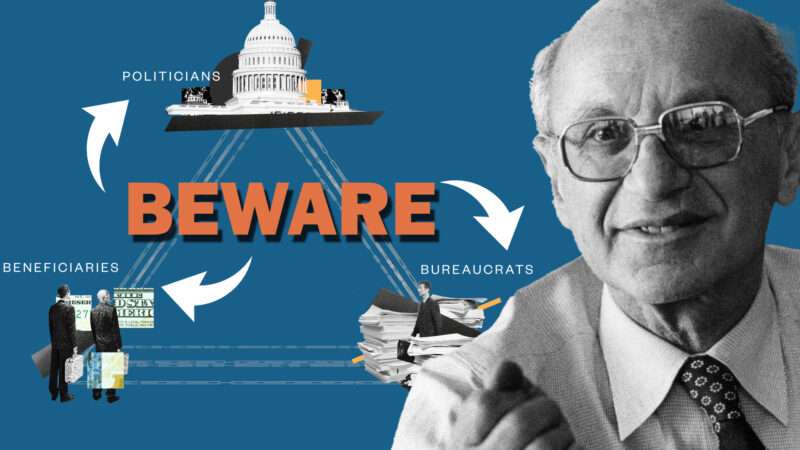
The book, which came out in 1984, pinpoints the Iron Triangle of Politics as the main obstacle to cutting government. The triangle's three points reinforce each other to uphold the status quo: the Beneficiaries, the Politicians, and the Bureaucrats.
The "beneficiaries" are interest groups and connected industries that profit off of government programs at the expense of taxpayers. Today's beneficiaries include farmers who receive federal dollars. The new budget bill backed by the Republican Party would extend the Farm Bill, which subsidizes crop purchases. As Friedman said, the people paying the bill are "dispersed." You might not have noticed your share of the $2.1 billion going to prop up corn, soybeans, wheat, and other prices when you paid your 2023 taxes, but the farmers who get that money certainly did.
The "politicians" depicted on the triangle are supposed to be responsive to their constituents but end up serving interest groups instead. But it's the bureaucrats who actually distribute the money.
They grow their power when politicians grow the size of their departments, which generates more spoils to distribute to the beneficiaries. It's a symbiotic relationship all at taxpayer expense.
Bureaucracy tends to "proceed by laws of its own," wrote Friedman, noting that in the half-century between Franklin Delano Roosevelt's New Deal and the Reagan Revolution, the U.S. population "didn't quite double but federal government employees multiplied almost fivefold."
Musk has also observed that a metastasizing bureaucracy "proceeds by laws of its own," stating in a press conference from the Oval Office that "if the people cannot vote and have their will be decided by their elected representatives…then we don't live in a democracy, we live in a bureaucracy."
And, like Friedman, he senses danger if the ballooning of the bureaucratic state isn't reversed. At another press conference, he told attendees that "the overall goal here with the DOGE team is to help address the enormous deficit….If this continues, the country will become de facto bankrupt."
DOGE's strategy is to try breaking through the Iron Triangle by the force of a thousand cuts, looking for little inefficiencies with the mindset of a software engineer. Musk has described his role as "tech support," which is fairly accurate given that the Executive Order that created DOGE actually just rebranded an Obama-era agency called the U.S. Digital Service.
It's a good start. The federal work force should be streamlined, and much of it even automated. But Musk might be repeating some mistakes of the Reagan years.
As Stockman observed, the Reagan Revolution floundered because his team only focused on "easy solutions" like ferreting out "obscure tidbits of spending that could be excised without arousing massive political resistance," which" yielded savings that amounted to rounding errors in a trillion-dollar budget."
To make real progress on cutting spending, the cost reduction must go deeper than tech support could manage on its own. Friedman knew that the path to shrinking the federal government began with abolishing federal agencies. In his viral clip, he lists the departments of Housing and Urban Development, Agriculture, Commerce, and Education as ones to put on the chopping block.
Trump has already shut down the Department of Education…kind of. His executive order directs the Education secretary to draw up plans to eliminate or shift some spending to other departments. It keeps major spending like federal student loans intact, and a total dismantling will require Congress to act.
The Trump administration has made severe cuts to the U.S. Agency for International Development (USAID), and it defunded the Consumer Financial Protection Bureau, the brainchild of Elizabeth Warren, which made access to credit and banking more difficult for low-income customers. DOGE also enticed 75,000 federal workers to resign. But many of these cost-cutting initiatives have been challenged in court. Truly eliminating federal agencies requires congressional action.
Because Trump holds only slim congressional majorities and didn't win on a platform to slash government, he won't be able to eliminate entire federal departments like Commerce or Agriculture.
But what would happen if the Trump administration had really followed the Friedman blueprint, learned from the shortcomings of the Reagan Revolution, and created a political movement capable of pressuring Congress to finally start permanently eliminating entire agencies?
Friedman says it would actually make the federal government function better by narrowly focusing on providing what state governments and the private sector can't.
"One function of government is to protect the country against foreign enemies—national defense," says Friedman. "A second function of government, and one which it performs very, very badly, is to protect the individual citizen against abuse and coercion by other citizens….I believe that the government performs that function very ineffectively because it's doing so many things that it has no business doing."
Earlier this year, Musk wielded a chainsaw gifted to him by Argentina's libertarian president, Javier Milei, who more closely followed the Friedman blueprint by targeting the beneficiaries and the bureaucracy, which he calls "La Casta."
In Argentina, it took massive poverty and triple-digit inflation to spark a real libertarian movement that now has a chance of overthrowing the tyranny of the status quo.
We don't want to wait for things to get that bad.
Musk praised Milei's approach at an event in Buenos Aires co-hosted by the libertarian Cato Institute.
"I think governments around the world should be actively deleting regulations, questioning whether departments should exist," said Musk. "Obviously President Milei seems to be doing a fantastic job on this front."
Fantastic indeed. But how can the Iron Triangle be overcome in the American system?
DOGE itself can't legally delete entire departments. DOGE's website claimed $140 billion in cuts out of its $2 trillion goal as of early April 2025.
But it hasn't provided full documentation, and various media and open source analyses have ball-parked DOGE's total savings as more in the $2 billion to $7 billion range.
Either way, DOGE isn't anywhere close to reaching its goal of cutting $2 trillion in government spending, or almost 30 percent of the $7 trillion annual budget. The Congressional Budget Office found the deficit grew 5 percent in February compared to the previous year despite DOGE's early cuts. Meanwhile, the Republican majority passed a budget projected that would add $3.4 trillion to our $28.8 trillion debt.
And we haven't even talked about Social Security and Medicare, which are the major drivers of debt, and which Trump has promised not to touch.
As Stockman came to realize, this is a bipartisan problem.
"There isn't a difference [between the parties] when it comes to the debt," he said on an episode of Reason's Just Asking Questions. "How in the world can we keep adding $1 trillion to our public debt every three months? How are we going to get away with basically enslaving the next generation of Americans with debt?"
The only way to break the Iron Triangle, Friedman suggested, is to push through deep structural reforms that are hard to overturn: a balanced budget amendment that forces Congress to spend responsibly, a line item veto allowing a president to eliminate special interest handouts without scrapping an otherwise popular law, a flat tax to eliminate special interest carve-outs, and a hard limit on how much money the government can print each year.Sounds easy, right? Of course, it isn't.
Friedman believes that to defeat the Iron Triangle, a popular politician must break free of the grip of the triangle's other two points.
A new president, with a broad popular mandate and bully pulpit, is in a unique position to push the kind of radical but necessary reforms needed to cut government. And it all must happen, says Friedman, within the first six-month "honeymoon" period.
Trump entered his second term with a bold and disruptive plan, but he's spending his political capital unwinding America's global trade and defense partnerships, not on slashing spending.
To really cut the government, Friedman says you must capture the White House with a plan to cut spending and then make it harder to spend more. Trump isn't fighting that battle. He went to war with Rep. Thomas Massie (R–Ky.) for opposing the GOP's bloated budget.
And with Trump's tariffs throwing the market into turmoil, legal challenges to his executive action piling up, and his popularity already waning, the "honeymoon" is already over.
The gargantuan task of breaking the Iron Triangle will probably be left to whoever comes next. But the Iron Triangle will remain unbroken, and the looming threat of an increasingly centralized and bloated government will persist, until a movement emerges that is dedicated to achieving enduring structural reforms.
As Friedman wisely observed, it's not only short-term results that matter but the methods and their long-term consequences.
When asked what he'd do if made dictator for a day, Friedman replied, "I don't want to be made dictator. I don't believe in dictators. I believe we want to bring about change by agreement of the citizens. If we can't persuade the public that it's desirable to do these things, we have no right to impose it on them even if we had the power to do it."
DOGE's mission to rein in our catastrophic debt and unrestrained federal government is one of the most important political battles of our time. But it's a mission that will need more than a single executive agency to ultimately succeed: It needs a mass political movement.
Photo credits: Everett Collection/Newscom, Bonnie Cash - Pool via CNP/CNP / Polaris/Newscom, Graeme Sloan/Sipa USA/Newscom, Mattie Neretin - CNP/Newscom, CNP/AdMedia/SIPA/Newscom, Mattie Neretin - CNP/Sipa USA/Newscom, CNP/AdMedia/SIPA/Newscom, Yuri Gripas - Pool via CNP/ZUMAPRESS/Newscom, © Tobias Arhelger | Dreamstime.com, Sipa USA/Newscom, Sipa USA/Newscom, Everett Collection/Newscom, Gage Skidmore (CC BY-SA 2.0), rawpixel.com / Library of Congress, © Joe Sohm | Dreamstime.com, Joe Tabb, The U.S. National Archives, Michael Evans/ZUMAPRESS/Newscom
The post Milton Friedman's Warning to DOGE appeared first on Reason.com.
8 April 2025, 3:40 pm - 7 minutes 8 secondsWhy the Internet Celebrated a Killer
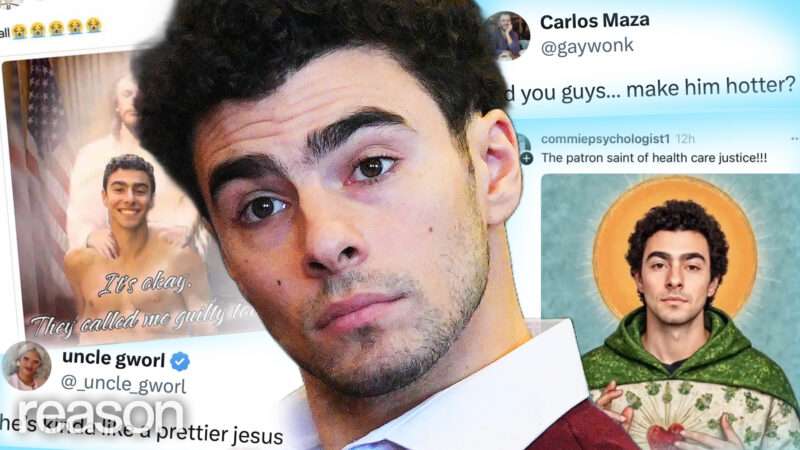
"Deny," "defend," "depose"—these three words were allegedly written on bullets found at the murder scene of United Healthcare CEO Brian Thompson. The slogan began appearing in graffiti, highway banners, and T-shirts. When the identity of the likely killer was revealed to be a man named Luigi Mangione, he developed a passionate fanbase.
"So many men and women are going nuts over how good-looking this killer is," said Jimmy Kimmel in a breezy monologue joking about his writing staff's adulation of Mangione's physique. "Free Luigi!" exclaimed comedian Bill Burr on a later episode of Kimmel's show.
How did a man who allegedly executed a married father of two at dawn on a New York City sidewalk become a hero? Those three bullets with words inscribed on them explain not just why the alleged killer did it, but why he received so much adulation. And it's not for the reasons most people think.
It seemed like the perfect American tragedy: A handsome valedictorian with a promising future suffers a back injury and a botched surgery, robbed of life's pleasures at his physical peak—no surfing, no travel, no sex. The personal became political, so the story goes, when the health insurance industry rejected Mangione's claim for treatment. "Deny, defend, depose" was likely a reference to a 15-year-old book by Jay Feinman exposing how health insurance companies don't pay routine claims.
"Frankly, these parasites simply had it coming," Mangione wrote in a manifesto.
His fans embraced him as "our shooter." The media made him a symbol of American rage towards a system that denies basic treatments with an eye toward the bottom line. Former Washington Post and New York Times reporter Taylor Lorenz defended the celebrations of Thompson's murder, writing that in a nation with "a barbaric healthcare system," where "the people at the top…rake in millions while inflicting pain, suffering, and death on millions of innocent people," "it's natural to wish" that people like Brian Thompson "suffer the same fate."
"I felt alongside so many other Americans, joy, unfortunately," Lorenz told an incredulous Piers Morgan when asked to describe her reaction to Thompson's murder, later clarifying that she felt, "maybe not joy, but certainly not empathy."
Forty-one percent of poll respondents under age 30 say the killing of Brian Thompson was acceptable. More young people polled admitted to viewing the killer favorably than unfavorably. But these poll numbers don't actually tell us very much about popular dissatisfaction with health insurance.
Most people under 30 are healthy and don't interact much with the health care industry. In fact, despite its problems, two-thirds of Americans say they are personally "satisfied" with their own insurance coverage.
Yet, the "delay, deny, and defend" inscribed on bullets do explain Mangione's popularity: Equating words with weapons is a reflection of how our culture increasingly treats language and violence as morally indistinguishable.
I first encountered claims that speech equaled violence a decade ago as I interviewed college students about microaggressions, trigger warnings, and deplatforming mobs. One student expressed the view that "political change is hard to conceive of without violence…even taking human life." Today, most students approve of shouting down viewpoints they disagree with; almost half are okay with blocking access to speeches; and a third say violence is a justified response to hateful ideas.
These notions trace back to the 1960s and a group of intellectuals who were part of the "Frankfurt School." In a 1965 essay, the German-American philosopher Herbert Marcuse, who was once branded the father of the New Left, called into question the value of free speech in a "manipulated" society, arguing that we need to "reexamine…the traditional distinction between violent and non-violent action" and recognize a difference between "revolutionary and reactionary violence, between violence practiced by the oppressed and the oppressors."
"People experience denied claims as an act of violence against them," Rep. Alexandria Ocasio-Cortez (D–N.Y.) said in a social media post addressing Thompson's murder.
If words are violence—and denying a service is violence—then actual violence is justified as retribution. To celebrate the murder of Brian Thompson, one must first dehumanize him by transforming him from a three-dimensional human into a low-resolution symbol.
But he was a real person with a family: a father of two and the son of a grain elevator operator who worked his way up the corporate ladder.
Thompson reportedly rushed $135 billion to an emergency fund for health care providers, keeping "thousands of hospitals and other healthcare providers afloat during the pandemic." Meanwhile, the federal government struggled to find the money. He was soon after promoted to CEO.
He made a lot of money in that role but didn't start out with the same "privileges" as his accused murderer: an Ivy League son of wealthy parents who spent the months leading up to the murder bumming around with friends in Hawaii. There's also no evidence that Mangione was ever a United Healthcare client. He evidently received back surgery and recommended the procedure to others on Reddit, advising on strategies to get insurers to cover it.
The truth is, neither of these men should be viewed as heroes or villains, or simplistic symbols in a memetic war. They're flawed humans who made consequential choices with varying levels of knowledge and virtue. And now Mangione, if proven guilty, will rightly face the consequences of those choices.
Fortunately, political violence is still unpopular with the majority of Americans, but it only takes a small and determined minority to wreak havoc when left unchecked. During the Black Lives Matter protests of 2020, a similar mentality that led to celebrating Thompson's murder generated support and excuses when neighborhoods were looted and bricks were tossed through store windows. Following its defeat, some members of the Democratic party, such as Rep. Seth Moulton (D–Mass.), are distancing themselves from the mob cancellation, anti-speech, deplatforming mindset because they realize that it's a losing strategy.
"We have a wing of our party that shames us, that tries to cancel people who even bring up these difficult topics and shames voters," Moulton said in an interview defending his comments about trans athletes that had provoked a backlash in his party.
Maybe it's possible to reverse the cultural drift that made the murder of Brian Thompson into something to celebrate. Combine moral zealotry with increasingly blurred lines between political speech and violence long enough, and the outcome is predictable: more violence.
Photo credits: Antony Mayfield (CC BY 2.0), SEBASTIAN KAULITZKI/SCIENCE PHOTO LIBRARY/Newscom, Mykyta Starychenko, Anthony Behar/Sipa USA/Newscom, Curtis Means/UPI/Newscom, Stefan Krusche, Tomas Del Amo, Kelpfish, Cristina Matuozzi/Sipa USA/Newscom, Steve Sanchez/Sipa USA/Newscom; Credit: Marilyn Humphries/Newscom
The post Why the Internet Celebrated a Killer appeared first on Reason.com.
24 February 2025, 8:50 pm - 15 minutes 47 secondsWhy Donald Trump Made a Deal To Free Ross Ulbricht
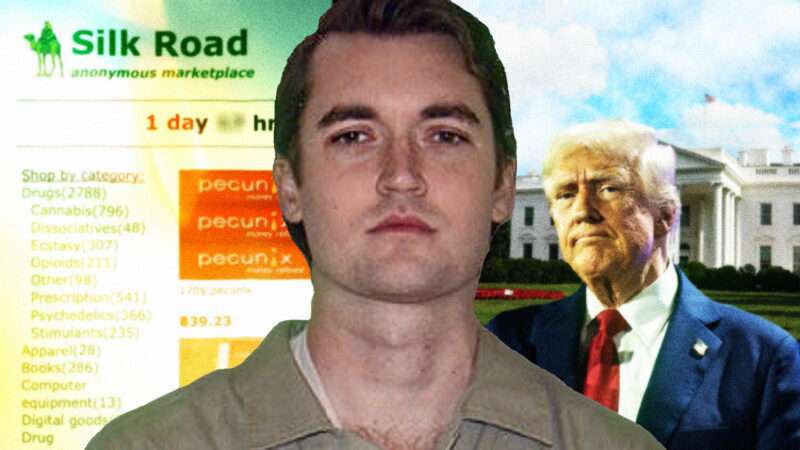
Ross Ulbricht was arrested at 29. Now, he's 40. He faces a double life sentence plus 40 years with no possibility of parole for creating the Silk Road, a dark web drug marketplace that facilitated $1.2 billion in bitcoin-denominated transactions.
"I'll spend the next few decades in this cage. Then, sometime later this century, I'll grow old and die. I'll finally leave prison, but I'll be in a body bag," he told an interviewer at a 2021 virtual blockchain conference.
But a second chance might be coming for Ulbricht, from an unlikely savior.
"If you vote for me, on day one, I will commute the sentence of Ross Ulbricht," Donald Trump told a crowd of attendees at the 2024 Libertarian National Convention.
Trump made a deal with the Libertarian Party. And now, Ulbricht might not have to spend his middle and old age behind bars. He might not have to leave in a body bag if Trump makes good on his promise.
Will he?
In the coming months, career FBI officers and Department of Justice (DOJ) attorneys may dredge up lies about Ulbricht so that Trump will change his mind. They may appeal to some of his draconian instincts. They may try to pin on Ulbricht some of the disastrous outcomes of the drug war.
But Trump should ignore the saboteurs and keep his promise to free Ulbricht. Here's why:
Ulbricht's arrest on October 1, 2013, at the Glen Park Branch of the San Francisco Public Library was like a scene from an action movie. As he was downloading an interview with Vince Gilligan, the creator of Breaking Bad, he was simultaneously administering the Silk Road in another browser window.
Undercover FBI agents staged a physical fight behind him. When he turned his head to observe the commotion, another agent snatched his laptop before he could close the cover, which would have encrypted the contents of its hard drive.
The FBI keeps a picture of the computer on display as a trophy from the hunt.
But Ulbricht was no Walter White, the frustrated high school chemistry teacher who transforms into a violent drug kingpin in Gilligan's series, driven by his lust for power and retribution. Ulbricht was an Eagle Scout, who majored in materials science and engineering at the University of Texas at Dallas on a full scholarship. He was passionate about libertarian philosophy and Austrian economics, and read Ludwig von Mises and Murray Rothbard.
He wrote on LinkedIn that he wanted to use economic theory "as a means to abolish the use of coercion and aggression amongst mankind" and create "an economic simulation to give people a first-hand experience of what it would be like to live in a world without the systemic use of force."
"I was trying to do something good," said Ulbricht in a 2021 jailhouse interview. "I was trying to help us move forward."
And he did. Ulbricht created an underground e-commerce website called the Silk Road. He was its first vendor, selling homegrown psilocybin mushrooms. The Silk Road became the eBay of drugs, with trusted sellers earning higher ratings, and the message boards filled with tips for safer drug use. It established an ethical code of conduct: No fake degrees, no child porn, no stolen goods. "Our basic rules are to treat others as you would wish to be treated and don't do anything to hurt or scam someone else."
"I was trying to help us move toward a freer and more equitable world," said Ulbricht.
At the same time, the Obama administration's justice department was pressuring banks and credit card companies to stop servicing gun shops, adult websites, and payday lenders, even though what they were doing was completely legal.
The Silk Road demonstrated that, with bitcoin, you could buy things on the internet by circumventing payment rails that the government controlled. Online trade had become virtually unstoppable.
"Back then, bitcoin made me feel like anything was possible," Ulbricht says in his jailhouse interview.
Ulbricht became a hero to libertarians. But others say he got exactly what he deserved.
"Life in prison without parole. Anybody else? Any other wise guys want to do it? That's what you'll get," gloated Bill O'Reilly on Fox News at the time of the sentencing.
For his part, Ulbricht is remorseful and regretful, telling his interviewer from the jailhouse that "we all know the road to hell is paved with good intentions, and now here I am. I'm in hell."
Does he deserve this fate? As Ulbricht became paranoid that he'd be caught, did he stray from his high-minded ideals and "break bad" like Walter White? And does that mean Trump should think twice before freeing him?
Ulbricht's friends were shocked at his arrest. They described him as "sweet-natured," "loyal," and "guileless and nonaggressive." He comes across as poetic and sensitive in his artwork and an online interview with a friend posted before his arrest, where they each muse about their first love and plans for the future.
But many who oppose freeing Ulbricht say that he was also a contract killer, pointing to uncharged allegations that he tried to hire hit men to take out digital bandits during his tenure at the Silk Road.
But when you look closer, things get murky. Here's what we know:
When building their case, prosecutors drew on chat logs from a moment of crisis at the Silk Road. The site's top administrator, Curtis Green, had just been arrested. It looks like he might have stolen about $350,000 worth of bitcoin.
"Nob," a participant on the Silk Road, was chatting with the site's top administrator, who called himself the "Dread Pirate Roberts." He told Nob, "This will be the first time I have had to call on my muscle," and asked that Green be "beat up, then forced to send the bitcoins he stole back."
Later that day, the Dread Pirate Roberts messaged Nob again: Can you change the order to execute rather than torture?
Nob sent the Dread Pirate Roberts pictures of what looked like Curtis Green being tortured and killed.
It turns out that Nob was DEA agent Carl Force, one of two investigators on the case who went to prison for embezzling bitcoin during the investigation. He had staged Green's murder as part of a sting operation.
But Ulbricht's defenders say that the Dread Pirate Roberts who was chatting with the corrupt undercover agent who set up a fake hit wasn't actually Ross Ulbricht.
After all, the name was inspired by the film The Princess Bride to describe a character inhabited over and over by different individuals through many generations.
When the Dread Pirate Roberts granted an interview to Forbes two months before Ulbricht's arrest, he insisted that he was not the site's founder.
"I didn't start the Silk Road, my predecessor did," he told the Forbes journalist, who pressed to ask if he wrote the comments in the Silk Road forums. "The most I am willing to reveal is that I am not the first administrator of Silk Road," replied the Dread Pirate Roberts.
The jury never saw this interview. Green, the man targeted for the fake hit, has said there were "multiple" people with access to the account, including himself.
Green told Ulbricht's mother that he doesn't believe Ulbricht was the one who put out the hit and claims the undercover agent, Carl Force (aka Nob), also had access to the Dread Pirate Roberts' account.
There were other hits also ordered by the Dread Pirate Roberts that didn't lead to any actual known murders.
Federal prosecutors never charged Ulbricht with attempted murder, but the federal judge who sentenced him to two life sentences plus 40 years with no possibility of parole nonetheless referenced these episodes in her decision.
She also said that Ulbricht should serve as a public example for acting as though he "was better than the laws of this country."
Well, maybe he is. The drug war is the real villain in his story. It has cost $1 trillion while fueling decades of black market crime and violence—all as U.S. overdose deaths increased.
Black markets often become violent because there are no legal mechanisms for contract enforcement, and their participants become desperate to avoid being caught, which is what happened to the Silk Road.
It's ironic that Trump, the man who openly admires China and Singapore's death penalty for drug dealers, might be the one to free the founder of the world's first major dark web drug market.
But if there's one thing Trump likes, it's a good deal.
One of his most audacious deals of the 2024 campaign was with the Libertarian Party, which never wins but sometimes covers the spread in close presidential elections.
Trump showed up at their convention and proclaimed himself something of a Libertarian himself, to which he was met with a chorus of boos.
But behind the scenes, something else was going on. Trump had struck an agreement with the Libertarian Party leadership: Don't spoil this election for me, and I'll free your boy Ross.
Libertarian National Committee chair Angela McArdle told Reason that Trump's former Director of National Intelligence Richard Grenell set up a meeting between her and the president at Mar-a-Lago during the 2024 campaign.
"Rick [Grenell] is like, 'Well, President Trump is a deal-maker,'" says McArdle. "'You ask for the world. You ask for whatever you think you can get, and it'll probably land in the middle. He likes making deals.' I was anxious to ask too much and have Ross fall by the wayside. So I really hit it home like, 'We just want you to free Ross Ulbricht. Like, it's the most important thing.' And he said, 'I love freeing people. I'll do that.'"
After the party's nominating convention, McArdle vowed that the party would only back its own candidate—Chase Oliver—in noncompetitive states favoring the Democrats. Trump won by thin margins in several swing states while the Libertarian Party finished with its lowest vote share in 16 years.
"It was sort of this like a glorious miracle, the way things unfolded with Chase [Oliver]," says McArdle. "It couldn't have been better for making sure that Donald Trump was incentivized to stick to his promises and felt like secure in it and that he wasn't going to get screwed over in this deal."
So now it's time for Trump to keep his end of the bargain.
The Silk Road began as Ulbricht's idealistic attempt to make the black market just a little safer by creating a place where people could vet buyers, avoid risky in-person transactions, find untainted drugs, and share safety information.
That it ultimately seems to have fallen prey to some of the same violent forces as has every other black market in history only shows how hard it is to fix the problems prohibition causes—whether it's violence or increasingly dangerous synthetic drugs like fentanyl, which is driving the overdose epidemic and has only grown worse since Silk Road's shutdown.
Unless, and until, the government wises up and takes a different approach to drugs, our choices are places like the Silk Road and its many imitators since, or the cartels.
While Trump has vowed to "take down the cartels, just as we took down the ISIS caliphate," history has shown that's easier said than done. America tried "decapitating" the cartels in the early 2010s, and it led to an even bloodier situation in Mexico.
The last war on the cartels created a power vacuum enabling the rise of the notorious "El Chapo." Once he was arrested, others took his place, and the cartel transformed into a more decentralized and resilient "umbrella" structure. The new leadership increased the fentanyl flow, with seizures nearly doubling between 2021 and 2023.
As long as there is a strong demand for drugs in America, it seems that there will be willing suppliers. Drug prohibition has failed, and no amount of bluster about executing dealers or going to war in Mexico is likely to change that.
But even if you disagree and think Trump can somehow finally win the drug war, it still doesn't justify keeping Ulbricht locked up through his 40s.
He has served his time and expressed remorse.
"I'm sorry to the extent that my actions led to drug abuse and addiction," he said in his 2021 jailhouse interview.
He's been a model prisoner, pursuing his master's degree in psychology, teaching and serving as a conflict mediator on the inside, and collecting over 150 signatures of support for his release from fellow inmates.
On all counts, this certainly would be a far more defensible intervention than President Joe Biden's self-serving pardoning of his son Hunter for all potential crimes covering more than a decade.
Ulbricht, a first-time offender, has suffered enough. Donald Trump made a deal, and many of Ulbricht's supporters voted for him—or at least not against him—because of that deal.
It might not be pretty, but it's politics in 21st-century America. Trump got what he wanted. Now it's time to set Ulbricht free.
*CORRECTION: This post previously included incorrect information about a plea deal offer.
The post Why Donald Trump Made a Deal To Free Ross Ulbricht appeared first on Reason.com.
17 January 2025, 3:40 pm - 8 minutes 19 secondsThree Mile Island Nearly Killed Nuclear. Now It's Coming Back.

Is a nuclear renaissance about to begin on the very site of the public relations catastrophe that practically destroyed the industry 45 years ago?
Constellation Energy recently announced a deal with Microsoft to restore a retired reactor on Pennsylvania's Three Mile Island. Microsoft has agreed to purchase energy from the plant for 20 years to power its AI data centers.
A U.S. nuclear reactor has never before been brought out of retirement.
Nuclear power was once considered the clean energy source of the future, with dozens of new plants coming online in the late '60s and early '70s.
But in March of 1979, a meltdown occurred at Three Mile Island's nuclear plant.
There were no casualties, and there was no lingering environmental damage. But the incident spooked the nation. From a publicity standpoint, the timing was disastrous—Three Mile Island occurred while The China Syndrome, a fictional account of safety cover-ups at a nuclear plant, was still in theaters, featuring Jane Fonda, Jack Lemmon, and Michael Douglas.
"After Three Mile Island, what was considered to be the best interest of the public was just reducing risk to as low as possible," says Adam Stein, director of the Nuclear Energy Innovation Program at the Breakthrough Institute. "It resulted in a huge volume of regulations that anybody that wanted to build a new reactor had to know. It made the learning curve much steeper to even attempt to innovate in the industry."
It was a public relations disaster for the nuclear industry, and the industry's expansion tapered off, concluding in a 20-year spell in which no new nuclear reactors were built in the U.S.
"My view is that these supposedly environmentalist groups formed in the 1970s that are not primarily pro-environment. They're really primarily anti-nuclear," says Eric Dawson, co-founder of Nuclear New York, a group fighting to protect the industry on the grounds that nuclear is "the most scalable, reliable, efficient, land-conserving, material-sparing, zero-emission source of energy ever created."
He says that Three Mile Island empowered the antinuclear movement.
The same year of the meltdown, about 200,000 antinuclear activists crowded into New York's Battery Park City, capping off a week-long concert featuring Pete Seeger, Jackson Browne, and Bonnie Raitt, which raised awareness and funding for the antinuclear movement.
"Stopping atomic energy is practicing patriotism," Ralph Nader told the crowd. "Stopping atomic energy is fighting cancer; stopping atomic energy is fighting inflation."
"They are a generation that was radicalized from the Vietnam War," says Dawson. "They became antiwar. They then became anti nuclear weapons, and then they conflated nuclear weapons with nuclear energy. And they made it their mission to shut down nuclear energy."
And they succeeded in that mission. Environmentalists, in effect, may have crippled the only truly viable form of clean energy.
The federal government makes permitting arduous. Many states severely restrict new plant construction and force operational ones to shut down prematurely.
A striking recent example was the shutdown of Indian Point Energy Center, New York state's largest nuclear plant. Antinuclear activists had targeted the plant. Their cause gained significant traction with the support of New York State Attorney General—and future governor—Andrew Cuomo, who believed the nuclear plant was "risky."
Of course, it is true that nuclear energy carries risk. So does every form of power generation.
"If you look at energy sources, there's nothing that's perfect. There is no utopia. basically we have a choice. Everything is compared to something else," says Dawson.
Decades of political attacks on the nuclear industry have caused the United States to rely more on burning fossil fuels, which brings another set of risks.
"[Nuclear] would eliminate the majority of pollution-related fatalities in the US, which is thousands a year, because most of those come from coal-fired power plants," says Stein.
As politicians have slowly realized that the dangers of nuclear power may have been exaggerated by activists, and the benefits of a reliable emissions-free energy source underappreciated, the regulatory landscape has slowly changed. The first new U.S. reactor built from scratch since 1974 opened in Georgia in 2022—albeit at a very high cost. The federal government issued its first ever approval for a small modular reactor in January 2023.
Constellation estimates that it will spend about $1.6 billion to bring the Three Mile Island reactor online by 2028 and will seek to renew the operating license through 2054. Pennsylvania's governor Josh Shapiro wrote a letter to federal regulators asking that the application be fast-tracked. Microsoft's VP of energy calls the deal "a major milestone" in the company's effort to "decarbonize the grid" while pursuing an AI-driven future that's going to require a lot of energy.
The Microsoft deal is the latest piece of evidence that nuclear energy—after being hampered by decades of hyper-cautious regulation—is poised for a comeback. Three Mile Island could one day become a symbol for nuclear's rebirth.
Photo Credits: RICHARD B. LEVINE/Newscom; FRANCES M. ROBERTS/Newscom; Paul Souders / DanitaDelimont.com / Danita Delimont Photography/Newscom; LAURENCE KESTERSON/KRT/Newscom; Robert J. Polett/Newscom; Dick Darrell/Toronto Star/ZUMA Press/Newscom; St Petersburg Times/ZUMAPRESS/Newscom; Library of Congress/Bernard Gotfryd; Jmnbqb, CC BY-SA 4.0 DEED, via Wikimedia Commons; Meghan McCarthy/ZUMA Press/Newscom; Erik Mcgregor/ZUMA Press/Newscom; Joe Sohm/Visions of America/Joseph Sohm/Universal Images Group/Newscom; Reginald Mathalone/ZUMAPRESS/Newscom; Bastiaan Slabbers/ZUMAPRESS/Newscom; Anthony Behar/Sipa USA/Newscom; */Kyodo/Newscom; Pacific Press/Sipa USA/Newscom; Paul Hennessy/ZUMAPRESS/Newscom; Michael Siluk/UCG/Universal Images Group/Newscom; KEVIN DIETSCH/UPI/Newscom; Reginald Mathalone/ZUMAPRESS/Newscom; ROGER L. WOLLENBERG/UPI/Newscom
Music Credits: "Bubbles Drop" by Cosmonkey via Artlist; "Paper or Plastic" by Bubblz via Artlist; "Digital Abyss" by Stephen Keech via Artlist; "Expand" by Theatre of Delays via Artlist; "Monomer" by Leroy Wild via Artlist; "Behind the City" by Ziv Moran via Artlist; "Fantasma" by Omri Smadar via Artlist
The post Three Mile Island Nearly Killed Nuclear. Now It's Coming Back. appeared first on Reason.com.
26 September 2024, 2:45 pm - 11 minutes 1 secondA New Law Is Making It Even Harder To Find Day Care in D.C.
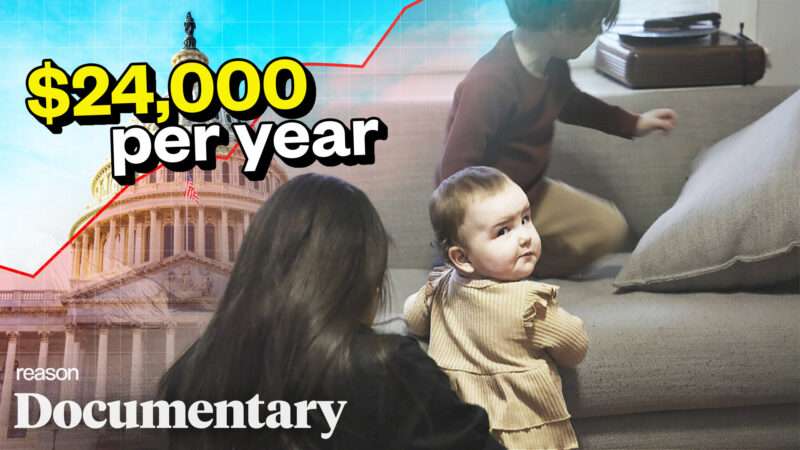
Average toddler day care costs in Washington, D.C., exceed $24,000 a year, outstripping expenses in cities like New York and San Francisco. Despite the steep prices, parents such as Megan McCune and Tom Shonosky, who live in a suburban D.C. neighborhood with their children John and Lizzy, believe day care is still worth it.
"They're doing these amazing activities with kids. John's last teacher was planning just all these really stimulating, exciting experiences," McCune says. "That's just not something that we can feasibly do and also have full-time jobs."
But day care might soon become a luxury the couple can no longer afford. In 2016, a regulation was passed mandating that day care workers obtain a college degree. The city's logic is straightforward: If D.C.'s day care staff had college degrees, they could do a better job helping disadvantaged kids climb out of poverty.
"The developmental opportunities and those early opportunities that they have really set the foundation for their potential success long term," explained local education official Elizabeth Groginsky, a proponent of the regulation. After a delay, the rule was finally implemented in December 2023.
Yet contrary to its intended benefits, this regulation could lead to job losses among day care workers, increased operating costs for day cares, and higher tuition for parents.
Ami Bawa, lead teacher and assistant director at a nursery school in northwest D.C., exemplifies the unintended consequences of the regulation. Although she has been working in the field for over 20 years, Bawa may now be forced out of her job. "Even though I have a lot of experiential learning, I don't meet what is now the current standard," she explains.
As a veteran teacher, Bawa is technically eligible to apply for a waiver to continue working, but she's been waiting for five months for a response from the city. "All of these roadblocks make it harder. We're going to lose a lot of really good teachers," Bawa says.
Proponents argue that the regulation will earn teachers more respect and higher salaries. But Bawa disagrees: "A profession like teaching specifically has to be one where you really care for and love what you're doing. What your education credential is doesn't equate to loving and being committed to the field."
The regulation "makes us feel like we're interchangeable, like anybody could do this job, when that really is not the case."In addition, the college requirement complicates the process for day cares to find qualified staff. McCune explains, "It's going to be the smaller day cares, the more affordable day cares that are going to suffer because they're not going to be able to attract talent or retain it, and they're not going to be able to put their prices to the level that they need to be to cover that talent, because people like us aren't going to be able to pay it."
In 2018, the libertarian-leaning public-interest law firm the Institute for Justice sued the D.C. government to overturn the education requirements, claiming it interferes with the right to earn a living. But the courts ruled in favor of the city on the grounds that the requirement was reasonable.
Yet the effectiveness of college requirements remains a subject of debate. As Robert Pianta, a professor of early childhood education at the University of Virginia, points out, "The evidence for a two-year degree or a four-year degree is not strong."
There are over 3,000 early childhood degree programs across the United States, and they vary significantly in terms of what they teach and focus on. "With all that variation under there, it's no surprise to anyone that the degree itself doesn't matter," Pianta says.
Many day care teachers eager to retain their jobs have enrolled part-time at institutions such as Trinity Washington University, a small college in the district. To earn the degree required to be an assistant teacher at a D.C. day care, students at Trinity can take classes like American history and music appreciation but aren't required to take courses in early education.
Councilmember Christina Henderson supports the idea that day care workers study subjects unrelated to early education, emphasizing the importance of "critical thinking and learning." In contrast, McCune remarks, "Let's just back up a little and remember that these are babies….I think the needs of children at that stage, they're pretty primal."
Nicole Page, a local preschool director, believes that "it does not only take education, it takes experience" to work at a day care. "That's what we will lose if we are not able to retain our staff, is the wealth of knowledge that they have by hands-on experience."
Her preschool is at risk of losing valuable staff, with at least 11 teachers failing to meet the new qualifications. One teacher even has a Ph.D. in family and children studies and is an adjunct professor teaching a policy and advocacy course for early childhood education at a local university, but she's no longer qualified to teach at a day care because her degree isn't in early childhood education.
"If we are not able to retain the staff that we have, we may end up having to close some of our classrooms," Page explains.
This regulation, intended to improve child care quality, may instead harm those it aims to assist. "I just think in D.C., there's a lot of bureaucracy," says Shonosky. "This is just another case where bureaucracy is going to make our lives worse."
Music Credits: "Pizzi Waltz" by Kadir Demir, via Artlist; "Against the Clock" by Rhythm Scott, via Artlist; "The Morning Lights" by Francesco DAndrea. via Artlist; "Sophisticated Nostalgia" by Nobou, via Artlist; "Deep Dive" by Ty Simon, via Artlist; "The Isle" by Rhythm Scott via Artlist; "Grey Shadow" by ANBR, via Artlist; "Currents" by Ardie Son, via Artlist;
Photo Credits: Caroline Brehman/CQ Roll Call/Newscom
The post A New Law Is Making It Even Harder To Find Day Care in D.C. appeared first on Reason.com.
14 May 2024, 2:45 pm - 9 minutes 22 secondsAcademics Use Imaginary Data in Their Research
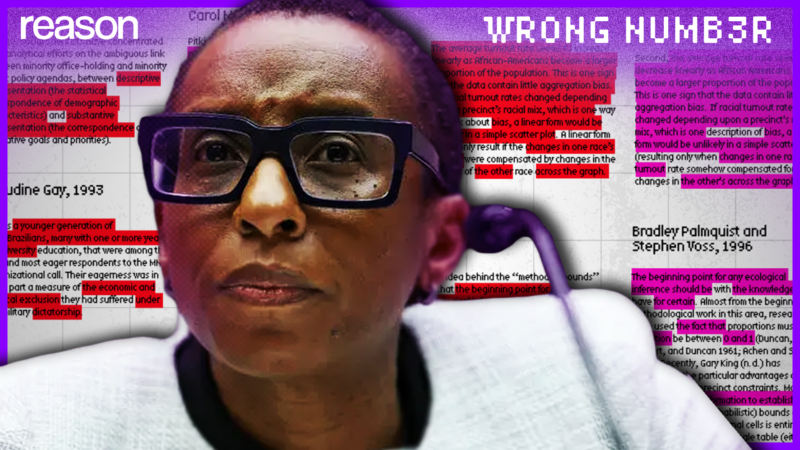
After surviving a disastrous congressional hearing, Claudine Gay was forced to resign as the president of Harvard for repeatedly copying and pasting language used by other scholars and passing it off as her own. She's hardly alone among elite academics, and plagiarism has become a roiling scandal in academia.
There's another common practice among professional researchers that should be generating even more outrage: making up data. I'm not talking about explicit fraud, which also happens way too often, but about openly inserting fictional data into a supposedly objective analysis.
Instead of doing the hard work of gathering data to test hypotheses, researchers take the easy path of generating numbers to support their preconceptions or to claim statistical significance. They cloak this practice in fancy-sounding words like "imputation," "ecological inference," "contextualization," and "synthetic control."
They're actually just making stuff up.
Claudine Gay was accused of plagiarizing sections of her Ph.D. thesis, for which she was awarded Harvard's Toppan Prize for the best dissertation in political science. She has since requested three corrections. More outrageous is that she wrote a paper on white voter participation without having any data on white voter participation.
In an article in the American Political Science Review that was based on her dissertation, Gay set out to investigate "the link between black congressional representation and political engagement," finding that "the election of blacks to Congress negatively affects white political involvement and only rarely increases political engagement among African Americans."
To arrive at that finding, you might assume that Gay had done the hard work of measuring white and black voting patterns in the districts she was studying. You would assume wrong.
Instead, Gay used regression analysis to estimate white voting patterns. She analyzed 10 districts with black representatives and observed that those with more voting-age whites had lower turnout at the polls than her model predicted. So she concludes that whites must be the ones not voting.
She committed what in statistics is known as the "ecological fallacy"—you see two things occurring in the same place and assume a causal relationship. For example, you notice a lot of people dying in hospitals, so you assume hospitals kill people. The classic example is Jim Crow laws were strictest in states that skewed black. Ecological inference leads to the false conclusion that blacks supported Jim Crow.
Gay's theory that a black congressional representative depresses white voter turnout could be true, but there are other plausible explanations for what she observed. The point is that we don't know. The way to investigate white voter turnout is to measure white voter turnout.
Gay is hardly the only culprit. Because she was the president of Harvard, it's worth making an example of her work, but it reflects broad trends in academia. Unlike the academic crime of plagiarism, students are taught and encouraged to invent data under the guise of statistical sophistication. Academia values the appearance of truth over actual truth.
You need real data to understand the world. The process of gathering real data also leads to essential insights. Researchers pick up on subtleties that often cause them to shift their hypotheses. Armchair investigators, on the other hand, build neat rows and columns that don't say anything about what's happening outside their windows.
Another technique for generating rather than collecting data is called "imputation," which was used in a paper titled "Green innovations and patents in OECD countries" by economists Almas Heshmati and Mike Shinas. The authors wanted to analyze the number of "green" patents issued by different countries in different years. But the authors only had data for some countries and some years.
"Imputation" means filling in data gaps with educated guesses. It can be defensible if you have a good basis for your guesses and they don't affect your conclusions strongly. For example, you can usually guess gender based on a person's name. But if you're studying the number of green patents, and you don't know that number, imputation isn't an appropriate tool for solving the problem.
The use of imputation allowed them to publish a paper arguing that environmentalist policies lead to innovation—which is likely the conclusions they had hoped for—and to do so with enough statistical significance to pass muster with journal editors.
A graduate student in economics working with the same data as Heshmati and Shinas recounted being "dumbstruck" after reading their paper. The student, who wants to remain anonymous for career reasons, reached out to HeshmAati to find out how he and Shinas had filled in the data gaps. The research accountability site Retraction Watch reported that they had used the Excel "autofill" function.
According to an analysis by the economist Gary Smith, altogether there were over 2,000 fictional data points amounting to 13 percent of all the data used in the paper.
The Excel autofill function is a lot of fun and genuinely handy in some situations. When you enter 1, 2, 3, it guesses 4. But it doesn't work when the data—like much of reality—have no simple or predictable pattern.
When you give Excel a list of U.S. presidents, it can't predict the next one. I did give it a try though. Why did Excel think that William Henry Harrison' would retake the White House in 1941? Harrison died in office just 31 days after his inauguration—in 1841. Most likely, autofill figured it was only fair that he be allowed to serve out his remaining years. Why did it pick 1941? That's when FDR began his third term, which apparently Excel considered to be illegitimate, so it exhumed Harrison and put him back in the White House.
In a paper published in the journal of the American Medical Association and written up by CNN and the New York Post, a team of academics claimed to show that age-adjusted death rates soared 106 percent during the pandemic among renters who had received eviction filing notices, compared to 25 percent for a control group.
The authors got 483,408 eviction filings, and asked the U.S. Census how many of the tenants had died. The answer was 0.3 percent, and that 58 percent were still alive. The status of about 42 percent was unknown—usually because the tenant had moved without filing a change of address. If the authors had assumed that all the unknowns were still alive, the COVID-era mortality increase would be 22 percent for tenants who got eviction notices versus 25 percent who didn't. This would have been a statistically insignificant finding, wouldn't have been publishable, and certainly wouldn't have gotten any press attention.
Some of the tenants that the Census couldn't find probably did die, though likely not many, since most dead people end up with death certificates—and people who are dead can't move, so you'd expect most of them to to be linked to their census addresses. But some might move or change their names and then die, or perhaps they were missing from the Census database before receiving an eviction notice.
But whatever the reality, the authors didn't have the data. The entire result of their paper—the 106 percent claimed increase in mortality for renters with eviction filings versus the 22 percent observed rate—comes from a guess about how many of the unknown tenants had died.
How did they guess? They made the wildly implausible assumption that the Census and the Social Security Administration are equally likely to lose track of a dead person and a living one. Yet the government is far more interested in when people die than when they move, especially because they don't want to keep cutting them Social Security checks. Also, dead people don't move or change their names.
Whether or not their assumption was plausible, the paper reported a guess as if it reflected objective data. That's considered acceptable in academia, but it shouldn't be.
Another paper, titled "Association Between Connecticut's Permit-to-Purchase Handgun Law and Homicides," was published in the American Journal of Public Health. It cooked up data to use as a control. The study claimed to show that a 1994 gun control law passed in Connecticut cut firearm homicides by 40 percent. But firearm homicide rates in Connecticut followed national trends, with no obvious change after the 1994 law.
Forty percent compared to what? The authors arrived at their conclusion by concocting an imaginary state to serve as the control group, combining numbers from California, Maryland, Nevada, New Hampshire, and Rhode Island. This fictional state had 40 percent more homicides than the real Connecticut.
Reality is too messy for a technique like this to tell us anything meaningful. The author's entire finding derived from the fact that Rhode Island, which comprised most of "synthetic Connecticut," experienced a temporary spate of about 20 extra murders from 1999 to 2003, a large percentage increase in such a small state. Since the temporary spike in murders wasn't the result of a change in gun control policy, it tells us little about the efficacy of Connecticut's 1994 law or the policy issue at hand.
Is it always wrong to guess about missing data? No, not under conditions of extreme uncertainty in which data collection is impossible before a decision has to be made. For example, if you're considering taking a potentially life-saving medicine that hasn't been properly studied, you make the best guess you can with the information you have. But difficult decisions that have to be made with scarce information shouldn't influence public policy and aren't worthy of publication.
Yet researchers routinely rely on these methods to generate results on matters of no great urgency, because in academia publishing matters more than truth. Which is a shame. Progress in human knowledge requires real-world observations, not clicking a mouse and dragging it to the bottom of the screen.
Photo Credits: Michael Brochstein/Sipa USA/Newscom, Walter G Arce Sr Grindstone Medi/ASP, Graeme Sloan/Sipa USA/Newscom
Music Credits: Strange Connection by Nobou, Digital Dreams by Jimmy Svensson, Nothing Can Stop Us by Nobou, Hero Is Born by idokay, Sneaky Shenanigans by Charlie Ryan
The post Academics Use Imaginary Data in Their Research appeared first on Reason.com.
7 May 2024, 2:45 pm - 8 minutes 9 secondsThe Bad Science Behind Jonathan Haidt's Call to Regulate Social Media
In his 1996 book, The Vision of the Anointed, economist Thomas Sowell sketched out a pattern that many of the "crusading movements" of the 20th century have followed. First, they identify a "great danger" to society, followed by an "urgent need" for government action "to avert impending catastrophe."
A new book by psychologist and author Jonathan Haidt, The Anxious Generation, argues that the government must regulate social media because it's causing a teen mental health crisis. Haidt is, in many ways, a model researcher because of his rigor, transparency, and openness to dissent. On this issue, however, he fits neatly into Sowell's framework.
Those best equipped to get attention from the government and the media are the most "articulate" people, Sowell observes, and they often reference opaque studies without explaining them. And Haidt is certainly articulate—his book is well-written and filled with compelling insights. But he claims far too much certainty for his views, based on research that is mostly junk. And he advocates for restrictive government policies without doing the simple tests that might support or disprove their value.
Academic studies often make use of statistical techniques that are hard for the average person to decipher, which is a shame because "most published research findings are false," as Stanford's John Ioannidis argued in a 2005 paper. Ioannidis wasn't just referencing the many scandals of fabricated data, conscious or unconscious bias, and misrepresented findings. Even top researchers at elite institutions have been guilty of statistical malpractice. Peer review is worse than useless, better at enforcing conventional wisdom and discouraging skepticism than weeding out substandard or fraudulent work. Academics face strong pressure to publish flawed research. Few have the skill and drive to produce high-quality publications at the rate required by university hiring and tenure review committees. Even the best researchers resort to doing some easy, low-quality studies. Bad studies tend to be the most newsworthy and the most policy-relevant.
Many of the papers Haidt compiled contained coding errors, inappropriate statistics, and other issues. Most downloaded some data of little relevance—either cheap to generate, like surveying your sophomore psychology students, or data collected for a different purpose—and analyzed it with an off-the-shelf statistical approach.
Haidt cites 476 studies in his book that seem to represent an overwhelming case. But two-thirds of them were published before 2010, or before the period that Haidt focuses on in the book. Only 22 of them have data on either heavy social media use or serious mental issues among adolescents, and none have data on both.
There are a few good studies cited in the book. For example, one co-authored by psychologist Jean Twenge uses a large and carefully selected sample with a high response rate. It employs exploratory data analysis rather than cookbook statistical routines.
Unfortunately for Haidt, that study undercuts his claim. The authors did find that heavy television watchers, video game players, and computer and phone users were less happy. But the similar graphs for these four ways of spending time suggest that the specific activity didn't matter. This study actually suggests that spending an excessive amount of time in front of any one type of screen is unhealthy—not that there's anything uniquely dangerous about social media.
An example of a bad study that Haidt cites in his book is one that paid $15 each to 1,787 self-selected internet respondents, aged 19 to 32, to answer 15 minutes' worth of questions online. Few were likely to have been teenage girls, and there's no reason to expect any were depressed teenage girls who used social media. In fact, I couldn't find any studies in Haidt's compendium that spent substantive time interviewing any depressed teenage girls or heavy social media users.
Another study that uses low-quality data was based on surveys of 143 University of Pennsylvania students, who participated for psychology course credit. Undergraduate psychology students at an elite university are hardly a representative sample of the population. The authors seem to have made significant coding and random assignment errors.
Haidt cites 17 studies he considers to be longitudinal that either find no effect or an effect in the opposite direction of his claim, and only four were true longitudinal studies, meaning they analyzed the same group of people at different times to see how changes at one time, like increased social media use, were associated with future changes, like more depression. One of the studies on Haidt's list contradicted his claim, finding that depression occurs before social media use, not the other way around.
Practically all of the studies Haidt cited either have major methodological errors or didn't say what he claimed. I doubt many of the senators on the Judiciary Committee or members of their staff, to whom Haidt claimed an "urgent need" for government action, read the underlying papers. The fact that Haidt cites a lot of studies just makes the problem worse. Errors cascade; they don't cancel each other out.
Even the best studies Haidt relies upon have the fatal flaw of not studying the subject. You can't establish the effect of heavy social media use on teenage girl depression unless you study heavy social media users and depressed teenage girls. None of the studies do this. Instead they study mostly adults, mostly average social media users, without serious psychological issues.
When Haidt moves on to policy, a different kind of study is called for. If you want to ban phones in schools, study kids who went to phone-free schools vs. a control group of kids who were allowed to use phones in school. Even this would only tell you average effects, but at least showing the change is positive on average is a step toward testing your hypothesis.
To be fair, Haidt does have some solid policy proposals that don't suffer from this flaw. When he argues that governments should stop criminalizing free play or that internet companies should insist on more reliable age-verification measures, which parents are requesting, he doesn't need studies.
When Haidt first presented his argument on Substack, I critiqued the studies he cited, and he responded by suggesting that I have impossibly high standards for proof and that the consensus of hundreds of researchers studying related issues is strong enough to justify policy actions. My objection is that the researchers whose work Haidt relies on didn't bother to talk to teenagers who are heavy social media users and who are in treatment for depression. Based on poor quality studies, he wants the government to dictate to parents how to raise their children, overruling the judgments of those who are intimately acquainted with the individuals involved.
Some have argued that it's obvious that social media is causing depression in teenage girls. It may be a contributing factor, but the purpose of social science research is not to confirm but to challenge our knee-jerk assumptions, because reality is so complicated. The proper scientific approach is to try to falsify your hypothesis.
If you are going to recommend new laws to regulate social media, as Haidt has, you need to consider the likelihood that your intervention isn't going to yield the effect you want.
There's a tendency among the anointed, Sowell observes, to see "little standing between intention and result." But the real world is "a system of innumerable and reciprocal interactions, all constrained within the confines of natural and human limitations." Often "individual problems cannot be solved one by one without adding to other problems elsewhere."
As any parent knows, children are complex human beings. Policies designed to control their behaviors don't often yield the results we expect. Even if we knew social media use caused depression, we wouldn't know the effect of policies that restrict social media use.
We know alcohol leads to many catastrophic problems, but that doesn't tell us how to regulate youth drinking. If we stop adolescents from using social media, we don't know what they'll do instead, and it might be more harmful.
There's no doubt that social media has significant effects, positive and negative, on the mental health of many young people. Dealing with this is one of the challenges modern parents must face.
But Sowell's anointed class of academics seem happy to impose coercive solutions on evidence that takes a one-size-fits-all approach and that they wouldn't rely upon for their own troubled teenage daughters.
Photos: Daniel Hambury/Eyevine, Mikkel Aaland/Free To Choose, E. Jason Wambsgans/TNS/Newscom, CNP/AdMedia/SIPA/Newscom, BONNIE CASH/UPI/Newscom, Richard B. Levine/Newscom, Howard Lipin/TNS/Newscom
Music: "Stream" by ANBR, "Empty Rooms" by Gal Lev, "Eclipse" by Yuriy Leontiev, "Curiosity" by Kevin Graham, "Discovery" by We Dream of Eden, and "Continent' by ANBR. Roadway by Ardie Son
The post The Bad Science Behind Jonathan Haidt's Call to Regulate Social Media appeared first on Reason.com.
2 April 2024, 2:45 pm - 26 minutes 23 secondsThe Political Sabotage of Nuclear Power

Once upon a time, America embraced nuclear power as the future of energy. Today it accounts for a mere 18 percent of the nation's electricity generation, while fossil fuels remain dominant at 60 percent. Why did nuclear fail to take off?
From 1967 to 1972, the nuclear sector experienced significant growth, and 48 new nuclear plants were built. But in March 1979, a meltdown at Pennsylvania's Three Mile Island nuclear power plant, which resulted in no casualties and no lingering environmental damage, spooked the entire nation and empowered anti-nuclear activists.
"After Three Mile Island, what was considered to be in the best interest of the public was just reducing risk to as low as possible," says Adam Stein, director of the Nuclear Energy Innovation Program at the Breakthrough Institute. "It resulted in a huge volume of regulations that anybody who wanted to build a new reactor had to know. It made the learning curve much steeper to even attempt to innovate in the industry."
After the incident, the momentum behind nuclear reactor construction tapered off and no new reactors were built for the next two decades. Nowadays, the landscape remains unchanged: The federal government makes permitting arduous, while many states impose severe restrictions on new plant construction and force operational ones to shut down prematurely.
For example, take Indian Point Energy Center, the largest nuclear plant in New York State. In 2007, anti-nuclear activists targeted the plant, which provided a quarter of downstate New York's electricity. Their cause gained significant traction with the support of New York state attorney general—and future governor—Andrew Cuomo, who believed the nuclear plant was "risky."
Cuomo promised to usher in a new era of clean energy for New Yorkers. His moves against Indian Point garnered support from fellow Green New Deal advocates, including Senator Bernie Sanders (I-Vt.) and Rep. Alexandria Ocasio-Cortez (D–N.Y.), as well as environmental groups.
The plant eventually closed in April 2021, but there was "a gulf between intentions and results," explains writer Eric Dawson, co-founder of Nuclear New York, a group fighting to protect the industry. The closure of Indian Point increased New York's carbon emissions. State utilities had to make up for the loss of energy by burning more natural gas, resulting in a 9 percent increase in energy-related CO2 emissions. At the same time, the state's energy prices also increased.
This outcome isn't unique to New York. Germany also opted to phase out nuclear power, betting on wind instead. Electricity from windmills increased, but so did the country's reliance on coal. In 2023, Germany emitted almost eight times the carbon per kilowatt-hour than neighboring France, which still gets the majority of its electricity from nuclear and less than 1 percent from coal.
According to Dawson, nuclear power is "the most scalable, reliable, efficient, land-conserving, material-sparing, zero-emission source of energy ever created." Wind and solar aren't as reliable because they depend on intermittent weather. They also require much more land than nuclear plants, which use about 1 percent of what solar farms need and 0.3 percent of what wind farms require to yield the same amount of energy.
The economics of nuclear power are undoubtedly challenging, but its advocates say that's primarily because of its thorny politics. The headache of building a new power plant is vividly exemplified by Georgia's Plant Vogtle. The first U.S. reactor built from scratch since 1974, the project turned into a nightmare scenario: It took almost 17 years from when the first permit was filed for construction to begin, it cost more than $28 billion, and it bankrupted the developer in the process.
Nuclear regulation is "based on politics and fear-mongering and a lack of understanding," explains Indian Point's vice president, Frank Spagnuolo. If they aren't shut down, he says, power plants such as Indian Point could safely continue to provide clean energy for decades.
Despite the opposition, there remains some hope for the future of nuclear energy. Companies are actively developing next-generation nuclear technologies, such as small modular reactors and molten salt-cooled reactors, to minimize the risks associated with nuclear meltdowns and explosions. And some former nuclear opponents have become advocates, acknowledging it as a vital source of clean energy. The converts include the Environmental Defense Fund, the Natural Resources Defense Council, and even Rep. Ocasio-Cortez. The Biden administration has also demonstrated support for nuclear power, with the Department of Energy projecting a tripling of nuclear energy production in America by 2050.
Anti-nuclear activists, environmentalists, and politicians have crippled the only truly viable form of clean energy. But the long nuclear power winter might finally be coming to an end in America.
Photo Credits: Louis Lanzano/Polaris/Newscom; Erik McGregor/Pacific Press/Newscom; JB NICHOLAS/Splash News/Newscom; Erik Mcgregor/ZUMA Press/Newscom; Erik Thomas/NY Post/MEGA/Newscom/DBNYC/Newscom; Pool/ABACA/Newscom; Jon G. Fuller/VWPics/Newscom; imageBROKER/J. Ehrlich/Newscom; */Kyodo/Newscom; RICHARD B. LEVINE/Newscom; FRANCES M. ROBERTS/Newscom; Bill Clark/CQ Roll Call/Newscom; MOURAD ALLILI/SIPA/Newscom; Pacific Press/Sipa USA/Newscom; Paul Hennessy/SOPA Images/Sipa/Newscom; Michael Siluk/UCG/Universal Images Group/Newscom; Joe Sohm/Visions of America/Joseph Sohm/Universal Images Group/Newscom; KEVIN DIETSCH/UPI/Newscom; ROGER L. WOLLENBERG/UPI/Newscom; Utrecht Robin/ZUMAPRESS/Newscom; Dick Darrell/Toronto Star/ZUMA Press/Newscom; St Petersburg Times/ZUMAPRESS/Newscom; Ron Adar, M10s/ZUMAPRESS/Newscom; Reginald Mathalone/ZUMAPRESS/Newscom; Hans Pennink/ZUMAPRESS/Newscom; Paul Hennessy/ZUMAPRESS/Newscom; Antti Yrjonen/ZUMA Press/Newscom; Brittany Murray/ZUMA Press/Newscom; Meghan McCarthy/ZUMA Press/Newscom; Dan Herrick/ZUMAPRESS/Newscom; Nuclear Regulatory Commission, CC BY 2.0 DEED, via Wikimedia Commons; Library of Congress/Bernard Gotfryd; Jmnbqb, CC BY-SA 4.0 DEED, via Wikimedia Commons; Truzguiladh, CC BY-SA 2.5 DEED, via Wikimedia Commons; Georgia Power; Edibobb, CC BY 3.0 DEED, via Wikimedia Commons; Michael Barera, CC BY-SA 4.0 DEED, via Wikimedia Commons; Ken Lund, CC BY-SA 2.0 DEED, via Wikimedia Commons; Z22, CC BY-SA 3.0 DEED, via Wikimedia Commons; Ron Sachs - CNP for NY Post/CNP/Polaris/Newscom
Music: "The Edge" by Theatre of Delays via Artlist; "Digital Abyss" by Stephen Keech via Artlist; "Expand" by Theatre of Delays via Artlist; "Monomer" by Leroy Wild via Artlist; "Behind the City" by Ziv Moran via Artlist; "No Decides" by Or Chausha via Artlist; "Pulse" by Theatre of Delays via Artlist; "Each and Every" by Crosstown Traffic via Artlist; "Upon Dragon Wings" by Rob Cawley via Artlist; "Silent Bloom" by SLPSTRM via Artlist; "Sad Snow" by Yehezkel Raz via Artlist; "First Try" by Neon Ridge via Artlist; "Still Need Syndrome" by Yarin Primak via Artlist; "Night Shift" by Curtis Cole via Artlist; "Elastic Clock" by Jozeque via Artlist
The post The Political Sabotage of Nuclear Power appeared first on Reason.com.
5 March 2024, 5:07 pm - 1 hour 20 minutesDavid Stockman on Why Trump Can't Fix the Debt: 'This Guy Is Part of the Swamp'
As Ronald Reagan's first budget director, former Michigan congressman David Stockman led the charge to cut the size, scope, and spending of the federal government in the early 1980s. He made enemies among Democrats by pushing hard for cuts to welfare programs—and he ultimately made enemies among his fellow Republicans by pushing equally hard to slash defense spending. His memoir of the era, The Triumph of Politics: Why the Reagan Revolution Failed, is a legendary account of how libertarian principles got sacrificed on the altar of political expediency.
Stockman's new book is Trump's War on Capitalism, and it takes a blowtorch to the former president's time in office. "When it comes to what the GOP's core mission should be…standing up for the free markets, fiscal rectitude, sound money, personal liberty, and small government at home and non-intervention abroad," he writes, "Donald Trump has overwhelmingly come down on the wrong side of the issues."
At a Reason Speakeasy event in New York City, Reason's Nick Gillespie talked with Stockman about his political journey from being a member of Students for a Democratic Society who protested the Vietnam War to being one of Reagan's main advisers to his denunciation of Donald Trump and his hope that Robert F. Kennedy Jr.'s candidacy helps throw the 2024 election into the House of Representatives.
Stockman also explains how Trump led the charge on COVID lockdowns, got rolled by Wall Street and the Federal Reserve, and why his nativist views on immigration are inimical both to freedom and economic growth.
Watch the full video here and find a condensed transcript below.
Nick Gillespie: This is The Reason Interview with Nick Gillespie. Thanks so much for coming out. Our guest tonight is David Stockman. He is a former congressman, a two-termer from Michigan, south of Grand Rapids. Probably best known in the public eye for being Ronald Reagan's first budget director who made the naive, idealistic, and absolutely wonderful mistake of believing that Ronald Reagan wanted to cut the size, scope, and spending of government across the board. He wanted to cut the welfare-warfare state, right?
David Stockman: Well, the welfare part.
Gillespie: And this is before we get into his fantastic book, a real stinging critique of Donald Trump, Trump's War on Capitalism. In preparing for this, you as budget director, you came in and you had to cut $40 billion from a $700 billion budget in 1981. To give you a sense of how quaint that is, the defense budget now is about $700 billion. I think we may be approaching that just in interest on the debt. But you were scrounging around to find $40 billion to cut. What happened?
Stockman: Well, I think the problem was Ronald Reagan believed in small government profoundly, except for the Pentagon side of the Potomac River. And he was really a hawk, a real, unreformed, unrequited Cold War hawk. The defense budget was about $140 billion when we got there. By the time he left, it was $350 billion, a massive increase on the theory that the Soviet Union was developing first-strike capability. None of that was true. That was the origination of the whole neocon view of the world. That's where all these characters originally got their start in the process. And so, by the time we got to 1988, the defense budget had eaten up and then some of all the domestic cuts, and the Republicans who were willing to stand up for domestic spending cuts and title reforms and so forth were so demoralized by seeing these massive increases year after year for the Pentagon that they basically threw in the towel, and the whole thing was kind of a wipeout.
If you want to get the numbers on it, just to kind of cap off the point, when Jimmy Carter left the White House after all those years of big spending by the Democrats, first Carter and then before him, of course, [Lyndon B. Johnson (LBJ)], and guns and butter and all the rest, the domestic non-defense budget was 15.4 percent of [gross domestic product (GDP)]. So way up, historically. When Reagan left, it was 15.3 percent. So he made a 0.1 percent difference. And that's about all we got.
Gillespie: I would recommend everybody read, The Triumph of Politics, David's memoir of his time. The subtitle is Why the Reagan Revolution Failed and—if you're interested in political economy as well as gossip—it's really one of the great memoirs.
But the book we're talking about tonight is Trump's War on Capitalism. The title says it so well there isn't even a subtitle. Why don't you start by telling us what was Trump's war on capitalism? He is a businessman. He talked about having the greatest, the biggest, the best economy ever when he was president. What's the essence of Trump's war on capitalism?
Stockman: Well, the question I think you're getting at is, why did I write it? And the answer is I had already written three books trying to expose the fact that Donald Trump isn't remotely an economic conservative; he doesn't believe in small government. I don't think he believes in free markets. And certainly he had no affinity whatsoever for sound money or fiscal rectitude. So in 2016, I wrote a book called Trumped! to warn people. In 2018, I wrote another book called Peak Trump to say I was right. In 2020, I wrote a third book called Dump Trump. Well, the fourth time would be the charm, right? And the book came out five days before the Iowa primaries. It was too late. But there is a bigger point to it, and that is: We're never going to get the kind of government, I think, that all of us believe in—the kind of society, the kind of liberty, the kind of economic prosperity, the kind of market capitalism and so forth. Unless there is an honest contest in the process of democratic governance in the United States between one party that more or less lines up as the government party, the party of state, the party of the political class, the bureaucratic class, the apparatchiks in Washington. And there's a second party that represents the hinterlands and all of the impulses that go with us, to leave us alone, to tax us less, to spend less, to intervene less, to get out of our way, to allow the private society and economy to breathe. So we really need a government party contesting with an anti-government party.
The problem is, today we have a uni-party in terms of the primary leadership in the Republican Party in Washington. When I look at [Mitch] McConnell, who's been there 55 years on the government payroll, I can't really tell any difference between him and our senator from New York, the leader on the Democratic side. And so, what I think the great danger is that the problems in the United States today in terms of our position in the world—which is a disaster in terms of our public debt but we can get into a lot of those numbers in a minute—and in terms of a rogue central bank that is totally out of control is that, if we don't address any of that, then [we will have continued rule of the uni-party], and we can't have [that]. We need to break it up. But Donald Trump, despite all of his rhetoric and all of his loud boasting about draining the swamp and being the outsider and coming in to clean up the whole thing, is just as much a statist when it comes to all the key issues. And we go through them in the book, as well as most of the mainstream politicians in Washington.
So the last thing we need is a fight in 2024 between Trump and Biden. It's pointless. It's useless. We need to have a clean break in the Republican Party, blow it up if we have to, and not allow the second party in our democracy to be Trumpified. Because if it's Trumpified, then we get more of what we had during the four years that he was there. I've got a lot of data on that, but let me just cap it here with one, and then we can go into some of the details. When Trump was sworn in, the public debt was $20 trillion already, and it had been swelling rapidly for several decades. When he left, it was close to $28 trillion. So let's just call it $8 trillion in four years. Now, someone might ask later, numbers of this magnitude are almost hard to grasp, to understand, but here's how to understand: The first $8 trillion, equivalent to the $8 trillion that Trump racked up in four years, had taken from the first day of the Republic to 2005 to approve. That is, the first 43 presidents in 216 years generated $8 trillion in public debt. Trump replicated that in four years, not only because of huge tax cuts that he didn't try to offset with spending but because of the whole disaster of the pandemic, the COVID, the lockdowns, and $6.5 trillion worth of bailout and relief and free stuff that came out of the effort to try to tell people, "Yeah, we're sending everybody home. And don't worry, we'll send you money too." So, that's the heart of the matter.
Anybody that can generate $8 trillion in four years of additional public debt, equal to the first 43 presidents—and there were some real rascals, obviously, and bad guys in that lineup, including [Franklin D. Roosevelt] and LBJ and a lot of others in between—that's the kind of number that grasps you by the collar and tells you, this guy is part of the swamp. He's not part of the solution.
Gillespie: What is wrong with running up massive debt?
Stockman: Someone asked me that in 1970 when I first went to work on Capitol Hill. I ran for Congress in 1976 against the outgoing [Gerald] Ford deficits, which were large. And the question was raised, and here we are. And it's now $34 trillion and rising and so, maybe it's no problem after all.
No, the answer is there are two ways to finance the deficit, both of them bad. The first way is the honest way: You finance it in the bond pits by borrowing out of the private savings stream. The effect of that, though, everybody understood when I was first on Capitol Hill in the '70s and into the early '80s, is that when you finance the public debt deficits the honest way, it causes crowding out. It forces up interest rates higher and higher, because whatever the given supply of savings is at the moment. Uncle Sam is the sheriff. His elbows get first call on the money. Crowding out happens. Rates go up. That's where we got the famous bond vigilantes and so forth. And that's why, actually, when we were trying to cut taxes in the early '70s, what I called the College of Cardinals—the established, seasoned Republican leaders in the House: Bob Dole, Sen. [Pete] Domenici, Howard Baker, who was the Senate leader—they said, "No, we've got to be careful here, because if we finance all of these tax cuts with red ink and borrowing, we're going to crowd out private investment. We're about to hear from our car dealers who can't finance their lot. We're going to hear from our home builders whose customers can't get mortgages," and so on. So the point is, if you finance it the honest way, you cause crowding out, you get an early reaction economically. You basically suppress productive investment and you shift society's resources to "government investment"—if you think that's a word, and I don't. I think it's an oxymoron.
The honest way of financing the deficits, which by the way, had to be done in the late '70s and early '80s because Paul Volcker was sitting in the chair at the Fed, and he was not about to monetize the debt. As a result, we had an environment in which the political reaction function, the feedback, was almost instantaneous. Run big deficits, drive up interest rates in the bond pits. Those spread to the banking sector. Those spread to the hometown car dealers and homebuilders and SNL bankers and just regular consumers. And it causes a political reaction that tends to create a constituency in the political system in Congress for reining in the deficit. That's the first way.
The second way is to issue all kinds of public paper and have the central bank buy it. And that's called monetization. And that's exactly what we've been doing ever since the late '70s or late '80s, effectively after Volcker left. And let me just give you some idea of how much has been monetized. When [Alan] Greenspan took over, and you remember, this is 1987, he was allegedly at one time a great believer in the gold standard and an Ayn Rand disciple and other things. He sort of lost his economic rigidities. He was kind of nerdy. But in any event, the balance sheet of the Fed was $200 billion, and this is 1987. So it has something like 70 years of the Fed's existence. It had taken 70 years to get to $200 billion. And I'm going to talk a lot about the balance sheet of the Fed and people say, "What does that mean? Why is that such a big deal?" The balance sheet of the Fed is simply the track record of how much cumulative money they seized out of thin air and printed, fiat credit, over time. So we had $200 billion.
To cut this story short, until they decided that inflation was out of control about a year ago and began to pull back, the balance sheet of the Fed had reached $9 trillion. Now, this is in a lifetime. I am looking out here, I can see probably quite a few people that might have been around in 1987. You went from $200 billion to that $9 trillion. That's 45 times growth in that period of time—several decades—at a point when the GDP was only increasing by 5x.
So when the money printed by the Fed goes up 45 times and the size of the economy goes up five times, you are way, way, way, out of kilter, out of skew. And it is that massive, continuous money printing which monetized all of the debt being created by a reckless Congress and White House that allowed us to continue to run these huge budget deficits year after year. But eventually it catches up with you as well.
There's this famous thing, I think it's Hemingway's book where he's asked, "How did you go bankrupt?" And the answer was, "Slowly at first, then all of a sudden." What I'm trying to get at here is the honest way to finance the deficit will cause problems very quickly. What we're doing is the slow way, but we've created massive financial bubbles. Massive misallocation of resources, tremendous amounts of speculation that should never happen in a healthy economy and wouldn't happen. And it's permitted this to go on much longer than would have been the case if we had done it the honest way. But, now we're at the point where I think the chickens are coming home to roost. Even the Fed has stopped printing money because inflation was out of control.
Gillespie: So to bring it back to Trump, Trump made a big deal about caring about the forgotten man, talking about Main Street vs. Wall Street, all of that. Your book makes the case that whatever he's saying, he's actually helping Wall Street or the financial sector far more than production sectors and service sectors of the economy. Talk a little bit about his tariffs and his immigration policy. He's trying to help small producers, saying we're going to keep China from dumping cheap products here so you can have your industry here. Why is that wrong?
Stockman: The big irony about Trump is that he was the outsider who campaigned against the status quo, the establishment, the deep state, and the political class. And that all made for good rhetoric, and it actually resonated with the public. But when you look at what his policy solutions are, they have nothing to do with draining the swamp. Trump's basic take on why all these people were left high and dry in flyover America and in the Rust Belt, and why we lost millions and millions of jobs, and why manufacturing is going to China and elsewhere is that this was all due to the work of nefarious foreigners. Foreign governments that were cheating and unfair in their trade practices. Immigrants coming across the border in hordes, who were allegedly bloating our welfare state and undermining our economy and undermining our security.
Gillespie: That's always the great thing, right? Immigrants are simultaneously coming here for welfare and then outworking us.
Stockman: Yeah. But see, the point is if you want to drain the swamp, then you better go to the swamp and change the policies. Ask what has caused all of this disorder, distrust, and failure. That would have pointed exactly to the Federal Reserve because it's been pro-inflation since the '70s. And then it made inflation official with its 2 percent target. And it was that pro-inflation policy decade after decade that priced out the world market. It's that simple.
I look at one statistic that I've got in the book that looks at the cumulative increase in unit labor costs over the decades. And that's important because remember what unit labor costs are: It's when wage cost increases—benefits and pay—[while productivity remains the same or decreases]. Because if you have wage increases and you have equal productivity gains, then the cost of production doesn't change. And a business can go on and expand and thrive without raising the prices. But if wages are increasing dramatically, more rapidly than productivity, because you have a pro-inflation policy being run by the central bank, then over time, unit labor costs get totally out of control. And here's a startling number: From 1970 when we basically flushed sound money down the drain at Camp David—in 1971, actually, [Richard] Nixon [was president]—from then until the present, unit labor costs in the United States have risen 275 percent. And as a result of that, we have priced ourselves out of the services market because all of the services have gone to India and other low-wage countries, to say nothing of the merchandise goods market that has gone to Mexico and China and so forth.
I have one little thing in the book that gives a pretty good example. IBM was the great monster, the midway at one point in terms of making the computer hardware, which is the modern economy. But between 1990 and the present, their employment in India has gone from zero to about 180,000, and their employment in the United States has been cut by more than a third. So, that's on the services side to say nothing of what happened to these massive year-in, year-out, merchandise trade deficits. Why did that happen? It all happened because of the unit labor costs increasing at these rates. It happened because you had a pro-inflation rather than a pro-deflation central bank. And ironically, it happened because Milton Friedman gave Richard Nixon—tricky Dick, as we all fondly call him—some very bad advice. He said, "OK, we're going to unlink the dollar from its base, from its link to gold. But don't worry about that, because the free market will take care of exchange rates." And what that really meant was that if we inflated too much domestically, relative to the rest of the world, our exchange rate would go down. All of a sudden, the imports would cost a lot more, our exports would be less competitive, and there would be a disciplining mechanism, a braking mechanism that would prevent huge increases in the trade deficit and the offshoring of production. And that's what Friedman told Nixon. Now, in theory, he was probably right, but in practice, he was utterly wrong, because what happened over the last five decades is all the central banks in the world have engaged in dirty floats. And so there never was a free market.
Gillespie: Could you explain what a dirty float is?
Stockman: A dirty float basically says, rather than let the market clear in terms of the exchange rate between, say, the dollar and the yen, or the dollar and the euro, or the dollar and Mexican peso, the central bank stepped in and tried to peg the exchange rate. They believe if they peg their exchange rates low, it'll help their export factories. It'll help jobs. It'll help prosperity. They can export more to the rest of the world. That's called mercantilism. And what the Fed has done after 1971 is spread a massive monetary disease in the world called mercantilist monetary policy. I've got a lot of examples in the book of why we've lost so much production and jobs to Mexico—and to say nothing of China. [This is all] basically because the Fed said it's OK to manipulate your currency. It's OK to increase your domestic money supply at huge unsustainable rates because we're doing the same thing here. And so as we flooded the world with fiat dollars, the Fed's balance sheet went—as I said, just in that short period of time—from $200 billion to $9 trillion. The rest of the world, these other central banks, but particularly the Asian ones and also the Persian Gulf, oil Petro central banks, bought in dollars hand over fist. But the secret in that whole thing is when they were buying dollars to keep their exchange rate from rising, they were basically selling their own currency to the domestic market. In other words, the Fed was exporting inflation, and the other central banks reciprocated by buying up the dollars and inflating their own money supplies.
Now, why am I going into all this? Because that meant that what Friedman said [about] the automatic adjustment mechanism of the free market in exchange rates was short-circuited. It was blocked. And so the adjustment never came, and as a result, from 1974 onward, we have not had one year of a trade surplus. And it's gotten worse and worse. And over that period of time, it was $15 trillion of cumulative trade deficits. And if you even throw in the surplus on services that we have in the world, it's still $11 trillion over the last 40 years. Is 11 trillion a big number? Well, if you put it in today's purchasing power, it's $20 trillion.
Therefore, basically, we have borrowed $20 trillion from the rest of the world to keep this whole game going. So this is how we got into the mess, on trade. And this is why Trump, as I say in the book, had it totally upside down. The problem was, he would tell you, these nefarious evildoers in the U.S. Trade Administration or in the Commerce Department or lobbyists sneaking around the banks of the Potomac that made bad trade deals and gave away the store with all of our competitors. And that's why we're in such a big mess. And that if you put a guy who really knows how to negotiate—for instance, not pay his bills, which is one of his negotiating techniques—if you put a tough guy like me in the Oval Office, I'll negotiate good trade deals. And before you know it, everything is going to be better. Well, he negotiated NAFTA, as you all remember. There was a lot of hoopla about that. Basically, if you look at it, it just got a new name. Nothing changed. And secondly, if you look at what happened to the deficit with Mexico, it doubled—
Gillespie: And is that a bad thing, though? I mean, he renegotiated NAFTA. We kind of got worse terms on some level, but we got more stuff cheaply.
Stockman: Well, yes. I think that's true. But there's a certain kind of libertarian free market and free trade that ignores the monetary side. There is this point I used to make, and I think half of it's valid and the other half isn't. The point we used to make in the '70s and '80s was, well, if other countries are stupid enough to fill their harbors with rocks and figuratively stop trade, why should we reciprocate and be as stupid as they are? Therefore, if they want to subsidize their exports like the Chinese or others, more power to them because they're basically transferring wealth to our consumers; domestic welfare is better off, and so that's fine. Well, that's half of the equation. But the other half of the equation is that when you have a net export imbalance of $20 trillion over a period of time, you have exported a huge amount of your production base to the rest of the world. And unless you can keep borrowing at higher and higher rates, that isn't sustainable as an economic matter first, but as a political matter.
And this is the point. And you may think it sounds a little flippant, but I don't think it is. I think that Milton Friedman was the godfather of Donald Trump, because Milton Friedman basically told Nixon, "Sever the link to gold"—I'm the gold standard man, I think you might have noticed that—and [that] we don't need to worry about the ancient relic or barbarous relic or whatever [John Maynard] Keynes called it, because we have a market—a free market that'll set the exchange rates right. Well, he was wrong about that. We exported massive amounts of our industrial base. We created a burned-out zone in much of the Rust Belt, the upper Midwest, Pennsylvania; New England was long gone. I was from the auto state of Michigan, and you know that was totally burned out. But where did Trump get elected in 2016? On the margin, he got elected in the Rust Belt precincts of Pennsylvania, Michigan, Wisconsin, Iowa, in all the places that got left behind because we had an unsustainable set of economics with the rest of the world. And it was caused by the central bank that Friedman was willing to let free.
Now, of course, Friedman thought that all of the central bankers, that is, the members of the Fed, would be just like him. They would be Milton Friedman clones, and they would be very punctilious about the rate at which they were expanding Fed credit, and he had all kinds of rules of thumb and so forth. But of course, that was a pipe dream. That was naive. People who would get appointed to the Fed are basically there to do the business either of Washington politicians or Wall Street speculators.
I'm not really trying to trash Milton Friedman because he's a great hero—in terms of free markets and the understanding of the rudiments of a free society, you can't beat Milton Friedman. But the problem is he had a view of central banking and a view of the Federal Reserve that I think was totally wrong and that became the fulcrum for all of these things that happened.
Gillespie: Whatever has been going on in terms of economic growth has been bad for a while, but you talk a lot about TARP—how at the end of the Bush administration and the beginning of the Obama ones, handouts to automakers were locked into place. But could you talk a little bit about how Trump did something similar with COVID? Is part of the problem that these parts of the American economy get wiped out because they're not allowed to change and adapt because they get various kinds of programs that are designed to help them make it through to the next paycheck?
Stockman: Yeah. That's kind of the problem of crony capitalism. For anybody that might be interested, I wrote a 640-page book on that whole topic that was released in 2013. But I think the issue that we need to find a way to understand is that everything goes back to central banking. And when the central bank makes it so easy to borrow money, we end up with an economy that when Greenspan left or got there, there was about $10 trillion of total debt on the economy, public and private. And that was less than 200 percent of GDP. Today it's $96 trillion. In other words, they have kept interest rates so low, they've had such deep and long-lasting financial repression that the economy has become a giant [leveraged buyout (LBO)]. And when you do an LBO—I was in the private equity business, so I know—there can be prosperity for a couple of years. But if things don't work out right, you're going to have interest payments that begin.
Gillespie: To bring it back to Trump's specific policies, he came into office saying he was not only going to stop illegal immigration, but he was going to cut legal immigration in half. What is bad about that? Why is that part of the war on capitalism?
Stockman: Essentially, it raises a whole issue of supply-side policy. And I was a supply-sider back in the 1980s with Reagan. And then I got run out of the supply side church because I didn't follow all the precepts exactly.
The issue that we have today, as to why growth has been so tepid and why living standards have sort of stagnated, why there are so many very alienated people out there in flyover America wanting to get behind Trump—the reason that this has been happening is because we've got huge deficiencies on the supply side of our economy in terms of labor and capital investment. You know, the native-born work force is actually shrinking. It peaked in 2015, and it's shrinking. And that's because, for whatever reasons, native-born women and families are not having babies. And so our labor force is shrinking, and since historically half of GDP growth has been labor—the other half is productivity—our economy is grinding to a halt because the labor supply is shrinking, unless we allow immigrants who want to work to come here and become part of the work force.
I got a number that I think is kind of startling when you hear about the flood of immigrants coming in and that we're being overrun and how America's being somehow turned upside down. If you go to 1870, we finally got out of the Civil War and all the chaos that generated. There were only 39 million people left in America—north, south, all the states after the union reunited. Over the next 40 years to the eve of World War I, we had 25 million immigrants. So, relative to the population in 1870, the immigrant population in a few decades was two-thirds of the population to begin with. Now, how many immigrants do we have today? We have legal immigrants of about a little over a million. We have a population of 335 million people. So immigration today is less than one-third of 1 percent [of the population], not 66 percent or 60 percent.
That's the first point. The second point is we have a totally broken, ridiculous, immigration policy that comes right out of the swamp in Washington, and if Trump really understood what he was saying when he said, "I'm going to drain the swamp," the first thing you would do would be to change the basis for immigration. To get here, you either have to be a family unification, which is about 400,000 out of the million, or you have to be a Ph.D. or some high-tech skilled worker to get a couple hundred thousand more slots, or, and this is the big or, you have to be a refugee or an asylee. That's the only way that unskilled workers can get into the United States today, when we desperately need unskilled and low-skilled workers, because our native work force is declining.
In the last year that the data is available, 2022, only 4,000 green cards were issued under the category of things called E3 and E6, for unskilled workers; 4,000 out of the 1,118,000 legal immigrants that got here, to say nothing of the hordes littered on the border. Now, the hordes on the border, if you look—if you can stand it—at Fox News every night, most of them are pretty strong-back to able-bodied young people, and their families are middle-aged. But it's an unskilled, low-skilled work force looking for a job and a better economic opportunity. But the policy is equivalent to trying to drive a dump truck through a pinhole.
In other words, there are millions of people at the border trying to come in. There are only 4,000 slots for unskilled workers, so all of them are at the border, being forced to pretend that they're asylees, that they're refugees. And the only way you can become a refugee is to cross the border, break the law, get arrested, and then be put into the queue that takes months and months, in fact, years of determination in a totally clogged up court system in order to get certified that you're an asylum seeker. And you have to prove, for instance, that if you come from Costa Rica, you're in endangerment of life and limb if you stay.
I bring up Costa Rica because I checked the other day, it turns out you can get a ticket from Costa Rica to Kansas City if there were some job openings there for $214 a day. So if we had a guest worker program of that kind that makes so much sense today that would allow people to go to the U.S. consulate in Costa Rica, get a guest worker permit, and be matched up with someone looking to hire people for lawn care work or warehouse work in Kansas City, they could get there for $214. No fuss, no muss. No chaos at the border. No border patrol people chasing around in the middle of the night. And we would open up that little pinhole to the economic rationality that we need to have.
In other words, [the system can be reformed simply] to make it economics-based rather than asylum-based, which is politics. If you have a guest worker program and people come here and they're making the payroll and their employer is certified month after month, year after year, after 10 years, I'd say give them citizenship and let them stay. The whole problem would be solved.
The hordes at the border are millions of people who want to be economic immigrants but are being forced to be political refugees, and they're creating a mess. And the reason I mentioned the $214 Delta ticket is that to get from Costa Rica to the Rio Grande, you have to pay the coyote $4,000 to $10,000 to get you there, when Delta would be happy to do it for $214, if we were only smart enough to have a rational, economics-based immigration system. But there you go again. Immigration control, the whole byzantine, convoluted control system is statism at its worst. It's run by the lobbyists in Washington. Google gets everybody they want. They get all the Ph.D.s, they get all the smart young techies coming out of South Korea or Taiwan or wherever else they're coming from. They take care of their needs. The Fortune 500 takes care of their needs because there are four or five categories for advanced degrees, Ph.D.s, unusual skills. They all get in 3,000 or 4,000 a year. But employers that need to have people working in fast-food joints or in lawn care businesses or in warehouses or in agriculture can't get anybody here legally. So you get the whole mess that we have today.
Gillespie: So, Trump is awful. I can't speak for this audience. I know for myself, I didn't vote for Trump. I don't expect to vote for Trump. I'm not moving to Canada and I'm not moving to Cuba if he wins or anything like that. But isn't the alternative as bad or worse? Because it's going to be Joe Biden.
Stockman: Well, if you have to suffer through another Democratic administration, might as well have a senile guy in the chair, because very little is going to get done. But that's a little facetious. I think from our point of view in the world that four years is not the end of history, and that if we don't get a nonstatist or an anti-statist party, reassemble, realign out of the mess of the uni-party that we have today, well then there really is no hope because you continue to do the same old thing over and over again, which [Albert] Einstein said is the perfect definition of insanity. So I say, what we need to do in 2024 is blow up the Republican Party. It needs to be purged. It is a gang of cultural right-wingers, neocon warmongers, and basically career politicians who use the party as a fundraiser.
Gillespie: Do you still consider yourself a Republican?
Stockman: Well, I think, no. This party needs to go.
Gillespie: In the book, you mentioned the drug war is stupid. Can you give us some explanation in 10 seconds?
Stockman: I'll give you three seconds. The drug war is really goddamn stupid. And again, this is part of the whole Trump shtick. He came down the escalator in 2015 talking about the murders and the rapists and the drug dealers coming across the border. As I lay out in my book quite clearly, if the drug part of it is a problem, deregulate drugs and let the teamsters ship the stuff in and let Philip Morris distribute. Keep it legal.
Bring it above ground. Make it legal. Take out all the premium profit that basically goes to funding the criminal organizations that are necessitated when the government decrees that a desired product shall be artificially scarce. So, that's part of all the rhetoric too. I mean, everything you hear about all the drugs coming across, that is a different issue. And we need to separate them out, the economics of immigration vs. the economics of the stupid war on drugs and the drug control laws that we have. People don't probably remember this—I don't think any of us could, we haven't been around long enough—but until 1918, you didn't have to have a passport to come to America, OK? There were no passports.
All of this immigration control really began then, and it's created its own bureaucracy and its own set of politics. So if we got back to sort of economically driven border policy, which was what we had to our great benefit until 1923 when they passed the first Immigration Act, most of this problem would go away.
This interview has been condensed and edited for style and clarity.
The post David Stockman on Why Trump Can't Fix the Debt: 'This Guy Is Part of the Swamp' appeared first on Reason.com.
31 January 2024, 4:00 pm - More Episodes? Get the App
/https://tf-cmsv2-smithsonianmag-media.s3.amazonaws.com/filer/28/09/28091e22-069f-44a4-ab78-cb18195fed80/food_guide_pyramid_1992.gif)